Adhyaya 11
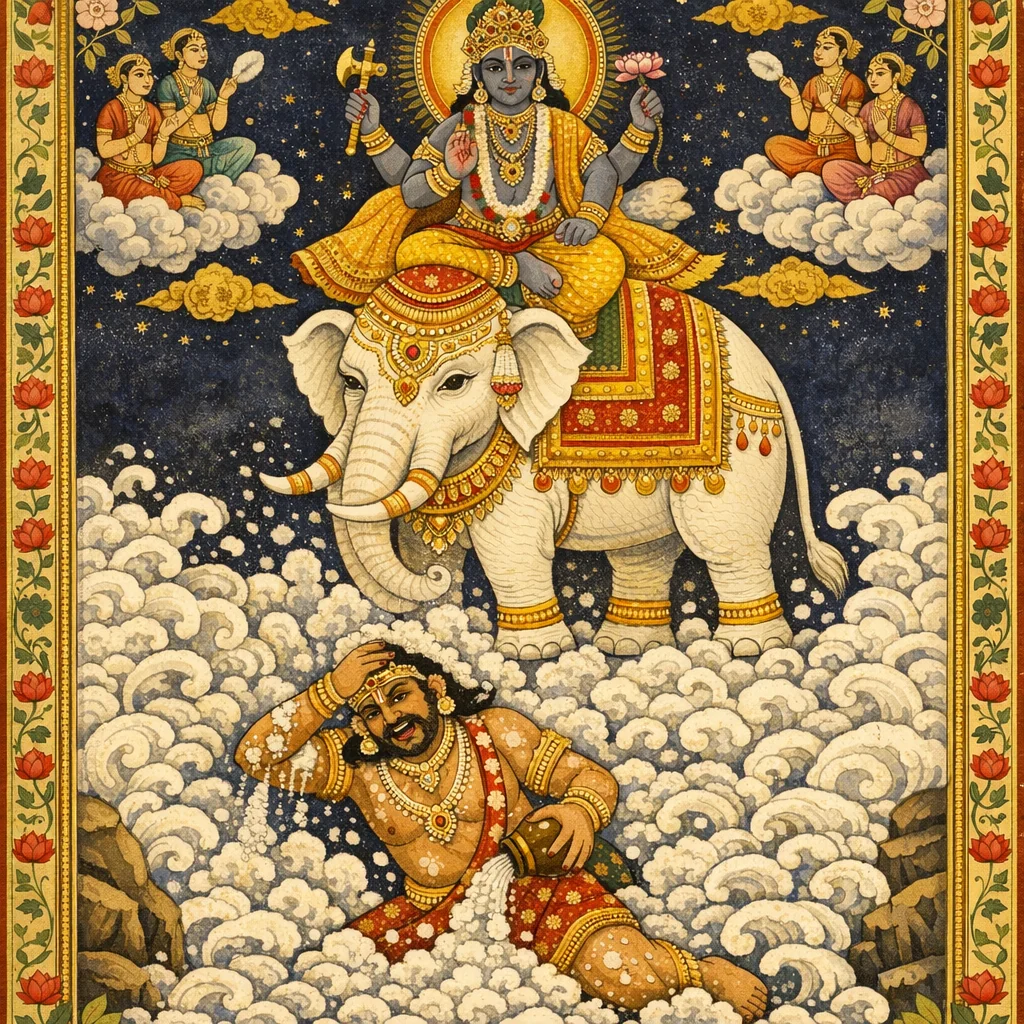
Indra Slays Namuci—The Limits of Power and the Triumph of Divine Strategy
Following the devas’ revival by Śrī Hari’s grace after the amṛta episode, the battlefield reverses: the previously defeated demigods now press the asuras. Indra, enraged, moves to kill Bali, but Bali answers with sober philosophy—victory and defeat unfold under kāla, not personal ego, and the wise neither exult nor lament. The combat escalates: Bali strikes Indra; Jambhāsura intervenes and is slain by the thunderbolt; Namuci, Bala, and Pāka attack with extraordinary archery, temporarily obscuring Indra. Indra reemerges and kills Bala and Pāka, but Namuci proves invulnerable—Indra’s vajra cannot pierce him. A celestial voice reveals Namuci’s boon: he cannot be killed by anything “dry or moist.” Indra meditates and discovers foam, neither dry nor wet, and uses it to sever Namuci’s head. The devas celebrate, then Brahmā sends Nārada to halt further slaughter; the devas desist and return to heaven, while surviving asuras rescue Bali to Aṣṭagiri, where Śukrācārya revives the fallen with the Saṁjīvanī mantra, and Bali remains steady, without lamentation—setting the stage for Bali’s later destiny under the Lord’s plan.
Shlokas
Verse 1
श्रीशुक उवाच अथो सुरा: प्रत्युपलब्धचेतस: परस्य पुंस: परयानुकम्पया । जघ्नुर्भृशं शक्रसमीरणादय- स्तांस्तान्रणे यैरभिसंहता: पुरा ॥ १ ॥
Śukadeva Gosvāmī said: Thereafter, by the supreme grace of the Supreme Personality of Godhead, Śrī Hari, all the demigods, headed by Indra and Vāyu, were brought back to life. Being enlivened, the demigods began severely beating the very same demons who had defeated them before.
Verse 2
वैरोचनाय संरब्धो भगवान्पाकशासन: । उदयच्छद् यदा वज्रं प्रजा हा हेति चुक्रुशु: ॥ २ ॥
When the most powerful Indra became angry and took his thunderbolt in hand to kill Mahārāja Bali, the demons began lamenting, “Alas, alas!”
Verse 3
वज्रपाणिस्तमाहेदं तिरस्कृत्य पुर:स्थितम् । मनस्विनं सुसम्पन्नं विचरन्तं महामृधे ॥ ३ ॥
Sober and tolerant and well equipped with paraphernalia for fighting, Bali Mahārāja moved before Indra on the great battlefield. King Indra, who always carries the thunderbolt in his hand, rebuked Bali Mahārāja as follows.
Verse 4
नटवन्मूढ मायाभिर्मायेशान् नो जिगीषसि । जित्वा बालान् निबद्धाक्षान् नटो हरति तद्धनम् ॥ ४ ॥
Indra said: O rascal, as a cheater sometimes binds the eyes of a child and takes away his possessions, you are trying to defeat us by displaying some mystic power, although you know that we are the masters of all such mystic powers.
Verse 5
आरुरुक्षन्ति मायाभिरुत्सिसृप्सन्ति ये दिवम् । तान्दस्यून्विधुनोम्यज्ञान्पूर्वस्माच्च पदादध: ॥ ५ ॥
Those fools and rascals who want to ascend to the upper planetary system by mystic power or mechanical means, or who endeavor to cross even the upper planets and achieve the spiritual world or liberation, I cause to be sent to the lowest region of the universe.
Verse 6
सोऽहं दुर्मायिनस्तेऽद्य वज्रेण शतपर्वणा । शिरो हरिष्ये मन्दात्मन्घटस्व ज्ञातिभि: सह ॥ ६ ॥
Today, with my thunderbolt, which has hundreds of sharp edges, I, the same powerful person, shall sever your head from your body. Although you can produce so much jugglery through illusion, you are endowed with a poor fund of knowledge. Now, try to exist on this battlefield with your relatives and friends.
Verse 7
श्रीबलिरुवाच सङ्ग्रामे वर्तमानानां कालचोदितकर्मणाम् । कीर्तिर्जयोऽजयो मृत्यु: सर्वेषां स्युरनुक्रमात् ॥ ७ ॥
Bali Mahārāja replied: All those present on this battlefield are certainly under the influence of eternal time, and according to their prescribed activities, they are destined to receive fame, victory, defeat and death, one after another.
Verse 8
तदिदं कालरशनं जगत् पश्यन्ति सूरय: । न हृष्यन्ति न शोचन्ति तत्र यूयमपण्डिता: ॥ ८ ॥
Seeing the movements of time, those who are cognizant of the real truth neither rejoice nor lament for different circumstances. Therefore, because you are jubilant due to your victory, you should be considered not very learned.
Verse 9
न वयं मन्यमानानामात्मानं तत्र साधनम् । गिरो व: साधुशोच्यानां गृह्णीमो मर्मताडना: ॥ ९ ॥
You demigods think that your own selves are the cause of your attaining fame and victory. Because of your ignorance, saintly persons feel sorry for you. Therefore, although your words afflict the heart, we do not accept them.
Verse 10
श्रीशुक उवाच इत्याक्षिप्य विभुं वीरो नाराचैर्वीरमर्दन: । आकर्णपूर्णैरहनदाक्षेपैराहतं पुन: ॥ १० ॥
Śukadeva Gosvāmī said: After thus rebuking Indra, King of heaven, with sharp words, Bali Mahārāja, who could subdue any other hero, drew back to his ear the arrows known as nārācas and attacked Indra with these arrows. Then he again chastised Indra with strong words.
Verse 11
एवं निराकृतो देवो वैरिणा तथ्यवादिना । नामृष्यत् तदधिक्षेपं तोत्राहत इव द्विप: ॥ ११ ॥
Since Mahārāja Bali’s rebukes were truthful, King Indra did not at all become sorry, just as an elephant beaten by its driver’s rod does not become agitated.
Verse 12
प्राहरत् कुलिशं तस्मा अमोघं परमर्दन: । सयानो न्यपतद् भूमौ छिन्नपक्ष इवाचल: ॥ १२ ॥
When Indra, the defeater of enemies, released his infallible thunderbolt scepter at Bali Mahārāja with a desire to kill him, Bali Mahārāja indeed fell to the ground with his airplane, like a mountain with its wings cut off.
Verse 13
सखायं पतितं दृष्ट्वा जम्भो बलिसख: सुहृत् । अभ्ययात् सौहृदं सख्युर्हतस्यापि समाचरन् ॥ १३ ॥
When the demon Jambhāsura saw that his friend Bali had fallen, he appeared before Indra, the enemy, just to serve Bali Mahārāja with friendly behavior.
Verse 14
स सिंहवाह आसाद्य गदामुद्यम्य रंहसा । जत्रावताडयच्छक्रं गजं च सुमहाबल: ॥ १४ ॥
The greatly powerful Jambhāsura, carried by a lion, approached Indra and forcefully struck him on the shoulder with his club. He also struck Indra’s elephant.
Verse 15
गदाप्रहारव्यथितो भृशं विह्वलितो गज: । जानुभ्यां धरणीं स्पृष्ट्वा कश्मलं परमं ययौ ॥ १५ ॥
Being beaten by Jambhāsura’s club, Indra’s elephant was confused and aggrieved. Thus it touched its knees to the ground and fell unconscious.
Verse 16
ततो रथो मातलिना हरिभिर्दशशतैर्वृत: । आनीतो द्विपमुत्सृज्य रथमारुरुहे विभु: ॥ १६ ॥
Thereafter, Mātali, Indra’s chariot driver, brought Indra’s chariot, which was drawn by one thousand horses. Indra then left his elephant and got onto the chariot.
Verse 17
तस्य तत् पूजयन् कर्म यन्तुर्दानवसत्तम: । शूलेन ज्वलता तं तु स्मयमानोऽहनन्मृधे ॥ १७ ॥
Appreciating Mātali’s service, Jambhāsura, the best of the demons, smiled. Nonetheless, he struck Mātali in the battle with a trident of blazing fire.
Verse 18
सेहे रुजं सुदुर्मर्षां सत्त्वमालम्ब्य मातलि: । इन्द्रो जम्भस्य सङ्क्रुद्धो वज्रेणापाहरच्छिर: ॥ १८ ॥
Although the pain was extremely severe, Mātali tolerated it with great patience. Indra, however, became extremely angry at Jambhāsura. He struck Jambhāsura with his thunderbolt and thus severed his head from his body.
Verse 19
जम्भं श्रुत्वा हतं तस्य ज्ञातयो नारदादृषे: । नमुचिश्च बल: पाकस्तत्रापेतुस्त्वरान्विता: ॥ १९ ॥
When Nārada Ṛṣi informed Jambhāsura’s friends and relatives that Jambhāsura had been killed, the three demons named Namuci, Bala and Pāka arrived on the battlefield in great haste.
Verse 20
वचोभि: परुषैरिन्द्रमर्दयन्तोऽस्य मर्मसु । शरैरवाकिरन् मेघा धाराभिरिव पर्वतम् ॥ २० ॥
Rebuking Indra with harsh, cruel words that were piercing to the heart, these demons showered him with arrows, just as torrents of rain wash a great mountain.
Verse 21
हरीन्दशशतान्याजौ हर्यश्वस्य बल: शरै: । तावद्भिरर्दयामास युगपल्लघुहस्तवान् ॥ २१ ॥
Quickly handling the situation on the battlefield, the demon Bala put all of Indra’s one thousand horses into tribulation by simultaneously piercing them all with an equal number of arrows.
Verse 22
शताभ्यां मातलिं पाको रथं सावयवं पृथक् । सकृत्सन्धानमोक्षेण तदद्भुतमभूद् रणे ॥ २२ ॥
Pāka, another demon, attacked both the chariot, with all its paraphernalia, and the chariot driver, Mātali, by fitting two hundred arrows to his bow and releasing them all simultaneously. This was indeed a wonderful act on the battlefield.
Verse 23
नमुचि: पञ्चदशभि: स्वर्णपुङ्खैर्महेषुभि: । आहत्य व्यनदत्सङ्ख्ये सतोय इव तोयद: ॥ २३ ॥
Then Namuci, another demon, attacked Indra and injured him with fifteen very powerful golden-feathered arrows, which roared like a cloud full of water.
Verse 24
सर्वत: शरकूटेन शक्रं सरथसारथिम् । छादयामासुरसुरा: प्रावृट्सूर्यमिवाम्बुदा: ॥ २४ ॥
Other demons covered Indra, along with his chariot and chariot driver, with incessant showers of arrows, just as clouds cover the sun in the rainy season.
Verse 25
अलक्षयन्तस्तमतीव विह्वला विचुक्रुशुर्देवगणा: सहानुगा: । अनायका: शत्रुबलेन निर्जिता वणिक्पथा भिन्ननवो यथार्णवे ॥ २५ ॥
The demigods, being severely oppressed by their enemies and being unable to see Indra on the battlefield, were very anxious. Having no captain or leader, they began lamenting like traders in a wrecked vessel in the midst of the ocean.
Verse 26
ततस्तुराषाडिषुबद्धपञ्जराद् विनिर्गत: साश्वरथध्वजाग्रणी: । बभौ दिश: खं पृथिवीं च रोचयन् स्वतेजसा सूर्य इव क्षपात्यये ॥ २६ ॥
Thereafter, Indra released himself from the cage of the network of arrows. Appearing with his chariot, flag, horses and chariot driver and thus pleasing the sky, the earth and all directions, he shone effulgently like the sun at the end of night. Indra was bright and beautiful in the vision of everyone.
Verse 27
निरीक्ष्य पृतनां देव: परैरभ्यर्दितां रणे । उदयच्छद् रिपुं हन्तुं वज्रं वज्रधरो रुषा ॥ २७ ॥
When Indra, who is known as Vajra-dhara, the carrier of the thunderbolt, saw his own soldiers so oppressed by the enemies on the battlefield, he became very angry. Thus he took up his thunderbolt to kill the enemies.
Verse 28
स तेनैवाष्टधारेण शिरसी बलपाकयो: । ज्ञातीनां पश्यतां राजञ्जहार जनयन्भयम् ॥ २८ ॥
O King Parīkṣit, King Indra used his thunderbolt to cut off the heads of both Bala and Pāka in the presence of all their relatives and followers. In this way he created a very fearful atmosphere on the battlefield.
Verse 29
नमुचिस्तद्वधं दृष्ट्वा शोकामर्षरुषान्वित: । जिघांसुरिन्द्रं नृपते चकार परमोद्यमम् ॥ २९ ॥
O King, when Namuci, another demon, saw the killing of both Bala and Pāka, he was full of grief and lamentation. Thus he angrily made a great attempt to kill Indra.
Verse 30
अश्मसारमयं शूलं घण्टावद्धेमभूषणम् । प्रगृह्याभ्यद्रवत् क्रुद्धो हतोऽसीति वितर्जयन् । प्राहिणोद् देवराजाय निनदन् मृगराडिव ॥ ३० ॥
Being angry and roaring like a lion, the demon Namuci took up a steel spear, which was bound with bells and decorated with ornaments of gold. He loudly cried, “Now you are killed!” Thus coming before Indra to kill him, Namuci released his weapon.
Verse 31
तदापतद् गगनतले महाजवंविचिच्छिदे हरिरिषुभि: सहस्रधा । तमाहनन्नृप कुलिशेन कन्धरेरुषान्वितस्त्रिदशपति: शिरो हरन् ॥ ३१ ॥
O King, when Indra, King of heaven, saw this very powerful spear falling toward the ground like a blazing meteor, he immediately cut it to pieces with his arrows. Then, being very angry, he struck Namuci’s shoulder with his thunderbolt to cut off Namuci’s head.
Verse 32
न तस्य हि त्वचमपि वज्र ऊर्जितो बिभेद य: सुरपतिनौजसेरित: । तदद्भुतं परमतिवीर्यवृत्रभित् तिरस्कृतो नमुचिशिरोधरत्वचा ॥ ३२ ॥
Although King Indra hurled his thunderbolt at Namuci with great force, it could not even pierce his skin. It is very wonderful that the famed thunderbolt that had pierced the body of Vṛtrāsura could not even slightly injure the skin of Namuci’s neck.
Verse 33
तस्मादिन्द्रोऽबिभेच्छत्रोर्वज्र: प्रतिहतो यत: । किमिदं दैवयोगेन भूतं लोकविमोहनम् ॥ ३३ ॥
When Indra saw the thunderbolt return from the enemy, he was very much afraid. He began to wonder whether this had happened because of some miraculous superior power.
Verse 34
येन मे पूर्वमद्रीणां पक्षच्छेद: प्रजात्यये । कृतो निविशतां भारै: पतत्त्रै: पततां भुवि ॥ ३४ ॥
Indra thought: Formerly, when many mountains flying in the sky with wings would fall to the ground and kill people, I cut their wings with this same thunderbolt.
Verse 35
तप:सारमयं त्वाष्ट्रं वृत्रो येन विपाटित: । अन्ये चापि बलोपेता: सर्वास्त्रैरक्षतत्वच: ॥ ३५ ॥
Vṛtrāsura was the essence of the austerities undergone by Tvaṣṭā, yet the thunderbolt killed him. Indeed, not only he but also many other stalwart heroes, whose very skin could not be injured even by all kinds of weapons, were killed by the same thunderbolt.
Verse 36
सोऽयं प्रतिहतो वज्रो मया मुक्तोऽसुरेऽल्पके । नाहं तदाददे दण्डं ब्रह्मतेजोऽप्यकारणम् ॥ ३६ ॥
But now, although the same thunderbolt has been released against a less important demon, it has been ineffectual. Therefore, although it was as good as a brahmāstra, it has now become useless like an ordinary rod. I shall therefore hold it no longer.
Verse 37
इति शक्रं विषीदन्तमाह वागशरीरिणी । नायं शुष्कैरथो नार्द्रैर्वधमर्हति दानव: ॥ ३७ ॥
Śukadeva Gosvāmī continued: While the morose Indra was lamenting in this way, an ominous, unembodied voice said from the sky, “This demon Namuci is not to be annihilated by anything dry or moist.”
Verse 38
मयास्मै यद् वरो दत्तो मृत्युर्नैवार्द्रशुष्कयो: । अतोऽन्यश्चिन्तनीयस्ते उपायो मघवन् रिपो: ॥ ३८ ॥
The voice also said, “O Indra, because I have given this demon the benediction that he will never be killed by any weapon that is dry or moist, you have to think of another way to kill him.”
Verse 39
तां दैवीं गिरमाकर्ण्य मघवान्सुसमाहित: । ध्यायन् फेनमथापश्यदुपायमुभयात्मकम् ॥ ३९ ॥
After hearing the ominous voice, Indra, with great attention, began to meditate on how to kill the demon. He then saw that foam would be the means, for it is neither moist nor dry.
Verse 40
न शुष्केण न चार्द्रेण जहार नमुचे: शिर: । तं तुष्टुवुर्मुनिगणा माल्यैश्चावाकिरन्विभुम् ॥ ४० ॥
Thus Indra, King of heaven, severed Namuci’s head with a weapon of foam, which was neither dry nor moist. Then all the sages satisfied Indra, the exalted personality, by showering flowers and garlands upon him, almost covering him.
Verse 41
गन्धर्वमुख्यौ जगतुर्विश्वावसुपरावसू । देवदुन्दुभयो नेदुर्नर्तक्यो ननृतुर्मुदा ॥ ४१ ॥
Viśvāvasu and Parāvasu, the two chiefs of the Gandharvas, sang in great happiness. The kettledrums of the demigods sounded, and the Apsarās danced in jubilation.
Verse 42
अन्येऽप्येवं प्रतिद्वन्द्वान्वाय्वग्निवरुणादय: । सूदयामासुरसुरान् मृगान्केसरिणो यथा ॥ ४२ ॥
Vāyu, Agni, Varuṇa and other demigods began killing the demons who opposed them, just as lions kill deer in a forest.
Verse 43
ब्रह्मणा प्रेषितो देवान्देवर्षिर्नारदो नृप । वारयामास विबुधान्दृष्ट्वा दानवसङ्क्षयम् ॥ ४३ ॥
O King, when Lord Brahmā saw the imminent total annihilation of the demons, he sent a message with Nārada, who went before the demigods to make them stop fighting.
Verse 44
श्रीनारद उवाच भवद्भिरमृतं प्राप्तं नारायणभुजाश्रयै: । श्रिया समेधिता: सर्व उपारमत विग्रहात् ॥ ४४ ॥
The great sage Nārada said: All of you demigods are protected by the arms of Nārāyaṇa, the Supreme Personality of Godhead, and by His grace you have gotten the nectar. By the grace of the goddess of fortune, you are glorious in every way. Therefore, please stop this fighting.
Verse 45
श्रीशुक उवाच संयम्य मन्युसंरम्भं मानयन्तो मुनेर्वच: । उपगीयमानानुचरैर्ययु: सर्वे त्रिविष्टपम् ॥ ४५ ॥
Śrī Śukadeva Gosvāmī said: Accepting the words of Nārada, the demigods gave up their anger and stopped fighting. Being praised by their followers, they returned to their heavenly planets.
Verse 46
येऽवशिष्टा रणे तस्मिन् नारदानुमतेन ते । बलिं विपन्नमादाय अस्तं गिरिमुपागमन् ॥ ४६ ॥
Following the order of Nārada Muni, whatever demons remained on the battlefield took Bali Mahārāja, who was in a precarious condition, to the hill known as Astagiri.
Verse 47
तत्राविनष्टावयवान् विद्यमानशिरोधरान् । उशना जीवयामास संजीवन्या स्वविद्यया ॥ ४७ ॥
There, on that hill, Śukrācārya brought to life all the dead demoniac soldiers who had not lost their heads, trunks and limbs. He achieved this by his own mantra, known as Saṁjīvanī.
Verse 48
बलिश्चोशनसा स्पृष्ट: प्रत्यापन्नेन्द्रियस्मृति: । पराजितोऽपि नाखिद्यल्लोकतत्त्वविचक्षण: ॥ ४८ ॥
Bali Mahārāja was very experienced in universal affairs. When he regained his senses and memory by the grace of Śukrācārya, he could understand everything that had happened. Therefore, although he had been defeated, he did not lament.
Frequently Asked Questions
Namuci was protected by a boon that he would not be killed by anything “dry or moist.” The vajra, though famed for killing Vṛtrāsura and other invulnerable beings, is still subordinate to the higher law created by boons, karma, and divine sanction. The episode teaches that raw power is constrained by providence and by the precise terms of destiny.
After an ākāśa-vāṇī disclosed the condition of Namuci’s boon, Indra meditated and realized that foam is neither dry nor moist; using foam as a weapon, he severed Namuci’s head. Symbolically, victory comes through buddhi guided by higher revelation—not merely through force—and shows that dharma can require intelligent compliance with cosmic law rather than impulsive aggression.
Bali states that all combatants are under kāla, receiving fame, victory, defeat, and death according to prescribed action (karma). Therefore, the wise do not become elated or depressed by outcomes. His critique targets Indra’s pride—assuming personal agency as the sole cause of success—presenting a Bhagavata view of humility and metaphysical realism.
Lord Brahmā, seeing the danger of total asura annihilation, sent Nārada to instruct the devas to stop. The reason is cosmic balance and dharmic restraint: even justified victory should not become uncontrolled slaughter. Nārada reminds the devas that their success came by Nārāyaṇa’s protection and Lakṣmī’s grace, not by independent might.
Śukrācārya revived dead asura soldiers who had not lost heads, trunks, or limbs by using his mantra called Saṁjīvanī. In-context, Saṁjīvanī demonstrates the asuras’ access to powerful brāhmaṇa-śakti (mantric potency) and keeps the narrative tension alive—showing that conflict persists until the Lord’s broader plan (including Bali’s later surrender to Vāmana) unfolds.