Adhyaya 3
Gajendra’s Prayers and the Appearance of Lord Hari (Gajendra-stuti and Hari-darśana)
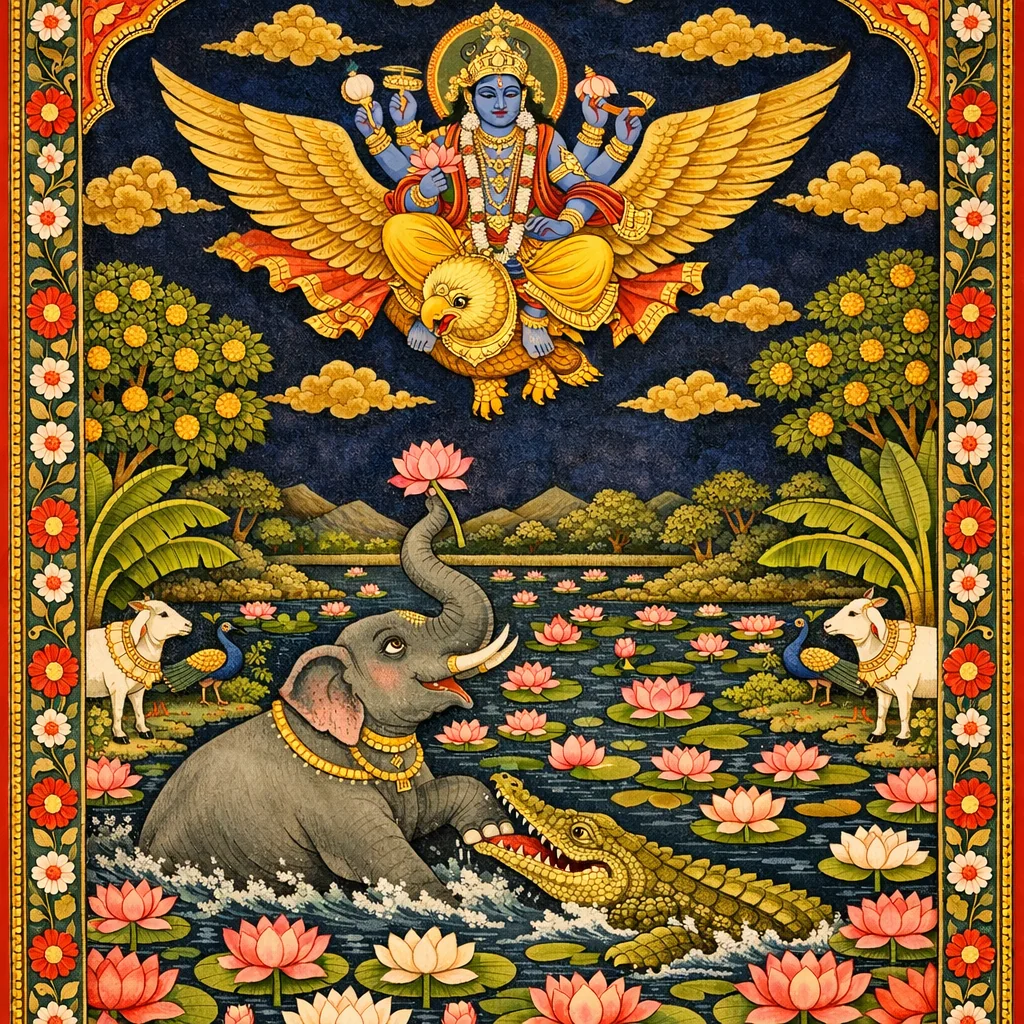
Continuing from the crisis of Gajendra’s capture, Śukadeva describes how the elephant-king, in extreme distress, gathers his mind with resolute intelligence and remembers a mantra learned in a previous birth (as Indradyumna). He offers a sustained stuti to Vāsudeva/Nārāyaṇa that begins with the Lord as the root cause and indwelling witness, then expands into apophatic and Vedāntic negation (neti neti), affirming the Lord as simultaneously the source, support, and transcendence of creation. Gajendra acknowledges the inadequacy of demigod worship for ultimate refuge and implicitly bypasses deva-invocation by addressing the Supreme without sectarian limitation. The devas therefore do not respond, but Hari—Paramātmā and Puruṣottama—manifests swiftly on Garuḍa with divine weapons. Seeing the Lord approach, Gajendra offers a lotus and direct obeisance. The Lord descends by causeless mercy, pulls both elephant and crocodile from the water, and with the Sudarśana-cakra severs the crocodile’s mouth, rescuing Gajendra. The chapter thus bridges philosophical theology (Brahman–Paramātmā–Bhagavān realization) to narrative resolution, setting up the aftermath and deeper liberation implications in the subsequent section of the episode.
Shlokas
Verse 1
श्रीबादरायणिरुवाच एवं व्यवसितो बुद्ध्या समाधाय मनो हृदि । जजाप परमं जाप्यं प्राग्जन्मन्यनुशिक्षितम् ॥ १ ॥
Śrī Śukadeva Gosvāmī continued: Thereafter, the King of the elephants, Gajendra, fixed his mind in his heart with perfect intelligence and chanted a mantra which he had learned in his previous birth as Indradyumna and which he remembered by the grace of Kṛṣṇa.
Verse 2
श्रीगजेन्द्र उवाच ॐ नमो भगवते तस्मै यत एतच्चिदात्मकम् । पुरुषायादिबीजाय परेशायाभिधीमहि ॥ २ ॥
The King of the elephants, Gajendra, said: I offer my respectful obeisances unto the Supreme Person, Vāsudeva [oṁ namo bhagavate vāsudevāya]. Because of Him this material body acts due to the presence of spirit, and He is therefore the root cause of everyone. He is worshipable for such exalted persons as Brahmā and Śiva, and He has entered the heart of every living being. Let me meditate upon Him.
Verse 3
यस्मिन्निदं यतश्चेदं येनेदं य इदं स्वयम् । योऽस्मात् परस्माच्च परस्तं प्रपद्ये स्वयम्भुवम् ॥ ३ ॥
The Supreme Godhead is the supreme platform on which everything rests, the ingredient by which everything has been produced, and the person who has created and is the only cause of this cosmic manifestation. Nonetheless, He is different from the cause and the result. I surrender unto Him, the Supreme Personality of Godhead, who is self-sufficient in everything.
Verse 4
य: स्वात्मनीदं निजमाययार्पितं क्वचिद् विभातं क्व च तत् तिरोहितम् । अविद्धदृक् साक्ष्युभयं तदीक्षते स आत्ममूलोऽवतु मां परात्पर: ॥ ४ ॥
The Supreme Personality of Godhead, by expanding His own energy, keeps this cosmic manifestation visible and again sometimes renders it invisible. He is both the supreme cause and the supreme result, the observer and the witness, in all circumstances. Thus He is transcendental to everything. May that Supreme Personality of Godhead give me protection.
Verse 5
कालेन पञ्चत्वमितेषु कृत्स्नशो लोकेषु पालेषु च सर्वहेतुषु । तमस्तदासीद् गहनं गभीरं यस्तस्य पारेऽभिविराजते विभु: ॥ ५ ॥
In due course of time, when all the causative and effective manifestations of the universe, including the planets and their directors and maintainers, are annihilated, there is a situation of dense darkness. Above this darkness, however, is the Supreme Personality of Godhead. I take shelter of His lotus feet.
Verse 6
न यस्य देवा ऋषय: पदं विदु- र्जन्तु: पुन: कोऽर्हति गन्तुमीरितुम् । यथा नटस्याकृतिभिर्विचेष्टतो दुरत्ययानुक्रमण: स मावतु ॥ ६ ॥
An artist onstage, being covered by attractive dresses and dancing with different movements, is not understood by his audience; similarly, the activities and features of the supreme artist cannot be understood even by the demigods or great sages, and certainly not by those who are unintelligent like animals. Neither the demigods and sages nor the unintelligent can understand the features of the Lord, nor can they express in words His actual position. May that Supreme Personality of Godhead give me protection.
Verse 7
दिदृक्षवो यस्य पदं सुमङ्गलं विमुक्तसङ्गा मुनय: सुसाधव: । चरन्त्यलोकव्रतमव्रणं वने भूतात्मभूता: सुहृद: स मे गति: ॥ ७ ॥
Renunciants and great sages who see all living beings equally, who are friendly to everyone and who flawlessly practice in the forest the vows of brahmacarya, vānaprastha and sannyāsa desire to see the all-auspicious lotus feet of the Supreme Personality of Godhead. May that same Supreme Personality of Godhead be my destination.
Verse 8
न विद्यते यस्य च जन्म कर्म वा न नामरूपे गुणदोष एव वा । तथापि लोकाप्ययसम्भवाय य: स्वमायया तान्यनुकालमृच्छति ॥ ८ ॥ तस्मै नम: परेशाय ब्रह्मणेऽनन्तशक्तये । अरूपायोरुरूपाय नम आश्चर्यकर्मणे ॥ ९ ॥
The Supreme Personality of Godhead has no material birth, activities, name, form, qualities or faults. To fulfill the purpose for which this material world is created and destroyed, He comes in the form of a human being like Lord Rāma or Lord Kṛṣṇa by His original internal potency. He has immense potency, and in various forms, all free from material contamination, He acts wonderfully. He is therefore the Supreme Brahman. I offer my respects to Him.
Verse 9
न विद्यते यस्य च जन्म कर्म वा न नामरूपे गुणदोष एव वा । तथापि लोकाप्ययसम्भवाय य: स्वमायया तान्यनुकालमृच्छति ॥ ८ ॥ तस्मै नम: परेशाय ब्रह्मणेऽनन्तशक्तये । अरूपायोरुरूपाय नम आश्चर्यकर्मणे ॥ ९ ॥
The Supreme Personality of Godhead has no material birth, activities, name, form, qualities or faults. To fulfill the purpose for which this material world is created and destroyed, He comes in the form of a human being like Lord Rāma or Lord Kṛṣṇa by His original internal potency. He has immense potency, and in various forms, all free from material contamination, He acts wonderfully. He is therefore the Supreme Brahman. I offer my respects to Him.
Verse 10
नम आत्मप्रदीपाय साक्षिणे परमात्मने । नमो गिरां विदूराय मनसश्चेतसामपि ॥ १० ॥
I offer my respectful obeisances unto the Supreme Personality of Godhead, the self-effulgent Supersoul, who is the witness in everyone’s heart, who enlightens the individual soul and who cannot be reached by exercises of the mind, words or consciousness.
Verse 11
सत्त्वेन प्रतिलभ्याय नैष्कर्म्येण विपश्चिता । नम: कैवल्यनाथाय निर्वाणसुखसंविदे ॥ ११ ॥
The Supreme Personality of Godhead is realized by pure devotees who act in the transcendental existence of bhakti-yoga. He is the bestower of uncontaminated happiness and is the master of the transcendental world. Therefore I offer my respect unto Him.
Verse 12
नम: शान्ताय घोराय मूढाय गुणधर्मिणे । निर्विशेषाय साम्याय नमो ज्ञानघनाय च ॥ १२ ॥
I offer my respectful obeisances to Lord Vāsudeva, who is all-pervading, to the Lord’s fierce form as Lord Nṛsiṁhadeva, to the Lord’s form as an animal [Lord Varāhadeva], to Lord Dattātreya, who preached impersonalism, to Lord Buddha, and to all the other incarnations. I offer my respectful obeisances unto the Lord, who has no material qualities but who accepts the three qualities goodness, passion and ignorance within this material world. I also offer my respectful obeisances unto the impersonal Brahman effulgence.
Verse 13
क्षेत्रज्ञाय नमस्तुभ्यं सर्वाध्यक्षाय साक्षिणे । पुरुषायात्ममूलाय मूलप्रकृतये नम: ॥ १३ ॥
I beg to offer my respectful obeisances unto You, who are the Supersoul, the superintendent of everything, and the witness of all that occurs. You are the Supreme Person, the origin of material nature and of the total material energy. You are also the owner of the material body. Therefore, You are the supreme complete. I offer my respectful obeisances unto You.
Verse 14
सर्वेन्द्रियगुणद्रष्ट्रे सर्वप्रत्ययहेतवे । असताच्छाययोक्ताय सदाभासाय ते नम: ॥ १४ ॥
My Lord, You are the observer of all the objectives of the senses. Without Your mercy, there is no possibility of solving the problem of doubts. The material world is just like a shadow resembling You. Indeed, one accepts this material world as real because it gives a glimpse of Your existence.
Verse 15
नमो नमस्तेऽखिलकारणाय निष्कारणायाद्भुतकारणाय । सर्वागमाम्नायमहार्णवाय नमोऽपवर्गाय परायणाय ॥ १५ ॥
My Lord, You are the cause of all causes, but You Yourself have no cause. Therefore You are the wonderful cause of everything. I offer my respectful obeisances unto You, who are the shelter of the Vedic knowledge contained in the śāstras like the Pañcarātras and Vedānta-sūtra, which are Your representations, and who are the source of the paramparā system. Because it is You who can give liberation, You are the only shelter for all transcendentalists. Let me offer my respectful obeisances unto You.
Verse 16
गुणारणिच्छन्नचिदुष्मपाय तत्क्षोभविस्फूर्जितमानसाय । नैष्कर्म्यभावेन विवर्जितागम- स्वयंप्रकाशाय नमस्करोमि ॥ १६ ॥
My Lord, as the fire in araṇi wood is covered, You and Your unlimited knowledge are covered by the material modes of nature. Your mind, however, is not attentive to the activities of the modes of nature. Those who are advanced in spiritual knowledge are not subject to the regulative principles directed in the Vedic literatures. Because such advanced souls are transcendental, You personally appear in their pure minds. Therefore I offer my respectful obeisances unto You.
Verse 17
मादृक्प्रपन्नपशुपाशविमोक्षणाय मुक्ताय भूरिकरुणाय नमोऽलयाय । स्वांशेन सर्वतनुभृन्मनसि प्रतीत- प्रत्यग्दृशे भगवते बृहते नमस्ते ॥ १७ ॥
Since an animal such as me has surrendered unto You, who are supremely liberated, certainly You will release me from this dangerous position. Indeed, being extremely merciful, You incessantly try to deliver me. By your partial feature as Paramātmā, You are situated in the hearts of all embodied beings. You are celebrated as direct transcendental knowledge, and You are unlimited. I offer my respectful obeisances unto You, the Supreme Personality of Godhead.
Verse 18
आत्मात्मजाप्तगृहवित्तजनेषु सक्तै- र्दुष्प्रापणाय गुणसङ्गविवर्जिताय । मुक्तात्मभि: स्वहृदये परिभाविताय ज्ञानात्मने भगवते नम ईश्वराय ॥ १८ ॥
My Lord, those who are completely freed from material contamination always meditate upon You within the cores of their hearts. You are extremely difficult to attain for those like me who are too attached to mental concoction, home, relatives, friends, money, servants and assistants. You are the Supreme Personality of Godhead, uncontaminated by the modes of nature. You are the reservoir of all enlightenment, the supreme controller. I therefore offer my respectful obeisances unto You.
Verse 19
यं धर्मकामार्थविमुक्तिकामा भजन्त इष्टां गतिमाप्नुवन्ति । किं चाशिषो रात्यपि देहमव्ययं करोतु मेऽदभ्रदयो विमोक्षणम् ॥ १९ ॥
After worshiping the Supreme Personality of Godhead, those who are interested in the four principles of religion, economic development, sense gratification and liberation obtain from Him what they desire. What then is to be said of other benedictions? Indeed, sometimes the Lord gives a spiritual body to such ambitious worshipers. May that Supreme Personality of Godhead, who is unlimitedly merciful, bestow upon me the benediction of liberation from this present danger and from the materialistic way of life.
Verse 20
एकान्तिनो यस्य न कञ्चनार्थं वाञ्छन्ति ये वै भगवत्प्रपन्ना: । अत्यद्भुतं तच्चरितं सुमङ्गलं गायन्त आनन्दसमुद्रमग्ना: ॥ २० ॥ तमक्षरं ब्रह्म परं परेश- मव्यक्तमाध्यात्मिकयोगगम्यम् । अतीन्द्रियं सूक्ष्ममिवातिदूर- मनन्तमाद्यं परिपूर्णमीडे ॥ २१ ॥
Unalloyed devotees, who have no desire other than to serve the Lord, worship Him in full surrender and always hear and chant about His activities, which are most wonderful and auspicious. Thus they always merge in an ocean of transcendental bliss. Such devotees never ask the Lord for any benediction. I, however, am in danger. Thus I pray to that Supreme Personality of Godhead, who is eternally existing, who is invisible, who is the Lord of all great personalities, such as Brahmā, and who is available only by transcendental bhakti-yoga. Being extremely subtle, He is beyond the reach of my senses and transcendental to all external realization. He is unlimited, He is the original cause, and He is completely full in everything. I offer my obeisances unto Him.
Verse 21
एकान्तिनो यस्य न कञ्चनार्थं वाञ्छन्ति ये वै भगवत्प्रपन्ना: । अत्यद्भुतं तच्चरितं सुमङ्गलं गायन्त आनन्दसमुद्रमग्ना: ॥ २० ॥ तमक्षरं ब्रह्म परं परेश- मव्यक्तमाध्यात्मिकयोगगम्यम् । अतीन्द्रियं सूक्ष्ममिवातिदूर- मनन्तमाद्यं परिपूर्णमीडे ॥ २१ ॥
Unalloyed devotees, who have no desire other than to serve the Lord, worship Him in full surrender and always hear and chant about His activities, which are most wonderful and auspicious. Thus they always merge in an ocean of transcendental bliss. Such devotees never ask the Lord for any benediction. I, however, am in danger. Thus I pray to that Supreme Personality of Godhead, who is eternally existing, who is invisible, who is the Lord of all great personalities, such as Brahmā, and who is available only by transcendental bhakti-yoga. Being extremely subtle, He is beyond the reach of my senses and transcendental to all external realization. He is unlimited, He is the original cause, and He is completely full in everything. I offer my obeisances unto Him.
Verse 22
यस्य ब्रह्मादयो देवा वेदा लोकाश्चराचरा: । नामरूपविभेदेन फल्ग्व्या च कलया कृता: ॥ २२ ॥ यथार्चिषोऽग्ने: सवितुर्गभस्तयो निर्यान्ति संयान्त्यसकृत् स्वरोचिष: । तथा यतोऽयं गुणसम्प्रवाहो बुद्धिर्मन: खानि शरीरसर्गा: ॥ २३ ॥ स वै न देवासुरमर्त्यतिर्यङ् न स्त्री न षण्ढो न पुमान् न जन्तु: । नायं गुण: कर्म न सन्न चासन् निषेधशेषो जयतादशेष: ॥ २४ ॥
The Supreme Personality of Godhead creates His minor parts and parcels, the jīva-tattva, beginning with Lord Brahmā, the demigods and the expansions of Vedic knowledge [Sāma, Ṛg, Yajur and Atharva] and including all other living entities, moving and nonmoving, with their different names and characteristics. As the sparks of a fire or the shining rays of the sun emanate from their source and merge into it again and again, the mind, the intelligence, the senses, the gross and subtle material bodies, and the continuous transformations of the different modes of nature all emanate from the Lord and again merge into Him. He is neither demigod nor demon, neither human nor bird or beast. He is not woman, man, or neuter, nor is He an animal. He is not a material quality, a fruitive activity, a manifestation or nonmanifestation. He is the last word in the discrimination of “not this, not this,” and He is unlimited. All glories to the Supreme Personality of Godhead!
Verse 23
यस्य ब्रह्मादयो देवा वेदा लोकाश्चराचरा: । नामरूपविभेदेन फल्ग्व्या च कलया कृता: ॥ २२ ॥ यथार्चिषोऽग्ने: सवितुर्गभस्तयो निर्यान्ति संयान्त्यसकृत् स्वरोचिष: । तथा यतोऽयं गुणसम्प्रवाहो बुद्धिर्मन: खानि शरीरसर्गा: ॥ २३ ॥ स वै न देवासुरमर्त्यतिर्यङ् न स्त्री न षण्ढो न पुमान् न जन्तु: । नायं गुण: कर्म न सन्न चासन् निषेधशेषो जयतादशेष: ॥ २४ ॥
The Supreme Personality of Godhead creates His minor parts and parcels, the jīva-tattva, beginning with Lord Brahmā, the demigods and the expansions of Vedic knowledge [Sāma, Ṛg, Yajur and Atharva] and including all other living entities, moving and nonmoving, with their different names and characteristics. As the sparks of a fire or the shining rays of the sun emanate from their source and merge into it again and again, the mind, the intelligence, the senses, the gross and subtle material bodies, and the continuous transformations of the different modes of nature all emanate from the Lord and again merge into Him. He is neither demigod nor demon, neither human nor bird or beast. He is not woman, man, or neuter, nor is He an animal. He is not a material quality, a fruitive activity, a manifestation or nonmanifestation. He is the last word in the discrimination of “not this, not this,” and He is unlimited. All glories to the Supreme Personality of Godhead!
Verse 24
यस्य ब्रह्मादयो देवा वेदा लोकाश्चराचरा: । नामरूपविभेदेन फल्ग्व्या च कलया कृता: ॥ २२ ॥ यथार्चिषोऽग्ने: सवितुर्गभस्तयो निर्यान्ति संयान्त्यसकृत् स्वरोचिष: । तथा यतोऽयं गुणसम्प्रवाहो बुद्धिर्मन: खानि शरीरसर्गा: ॥ २३ ॥ स वै न देवासुरमर्त्यतिर्यङ् न स्त्री न षण्ढो न पुमान् न जन्तु: । नायं गुण: कर्म न सन्न चासन् निषेधशेषो जयतादशेष: ॥ २४ ॥
The Supreme Personality of Godhead creates His minor parts and parcels, the jīva-tattva, beginning with Lord Brahmā, the demigods and the expansions of Vedic knowledge [Sāma, Ṛg, Yajur and Atharva] and including all other living entities, moving and nonmoving, with their different names and characteristics. As the sparks of a fire or the shining rays of the sun emanate from their source and merge into it again and again, the mind, the intelligence, the senses, the gross and subtle material bodies, and the continuous transformations of the different modes of nature all emanate from the Lord and again merge into Him. He is neither demigod nor demon, neither human nor bird or beast. He is not woman, man, or neuter, nor is He an animal. He is not a material quality, a fruitive activity, a manifestation or nonmanifestation. He is the last word in the discrimination of “not this, not this,” and He is unlimited. All glories to the Supreme Personality of Godhead!
Verse 25
जिजीविषे नाहमिहामुया कि- मन्तर्बहिश्चावृतयेभयोन्या । इच्छामि कालेन न यस्य विप्लव- स्तस्यात्मलोकावरणस्य मोक्षम् ॥ २५ ॥
I do not wish to live anymore after I am released from the attack of the crocodile. What is the use of an elephant’s body covered externally and internally by ignorance? I simply desire eternal liberation from the covering of ignorance. That covering is not destroyed by the influence of time.
Verse 26
सोऽहं विश्वसृजं विश्वमविश्वं विश्ववेदसम् । विश्वात्मानमजं ब्रह्म प्रणतोऽस्मि परं पदम् ॥ २६ ॥
Now, fully desiring release from material life, I offer my respectful obeisances unto that Supreme Person who is the creator of the universe, who is Himself the form of the universe and who is nonetheless transcendental to this cosmic manifestation. He is the supreme knower of everything in this world, the Supersoul of the universe. He is the unborn, supremely situated Lord. I offer my respectful obeisances unto Him.
Verse 27
योगरन्धितकर्माणो हृदि योगविभाविते । योगिनो यं प्रपश्यन्ति योगेशं तं नतोऽस्म्यहम् ॥ २७ ॥
I offer my respectful obeisances unto the Supreme, the Supersoul, the master of all mystic yoga, who is seen in the core of the heart by perfect mystics when they are completely purified and freed from the reactions of fruitive activity by practicing bhakti-yoga.
Verse 28
नमो नमस्तुभ्यमसह्यवेग- शक्तित्रयायाखिलधीगुणाय । प्रपन्नपालाय दुरन्तशक्तये कदिन्द्रियाणामनवाप्यवर्त्मने ॥ २८ ॥
My Lord, You are the controller of formidable strength in three kinds of energy. You appear as the reservoir of all sense pleasure and the protector of the surrendered souls. You possess unlimited energy, but You are unapproachable by those who are unable to control their senses. I offer my respectful obeisances unto You again and again.
Verse 29
नायं वेद स्वमात्मानं यच्छक्त्याहंधिया हतम् । तं दुरत्ययमाहात्म्यं भगवन्तमितोऽस्म्यहम् ॥ २९ ॥
I offer my respectful obeisances unto the Supreme Personality of Godhead, by whose illusory energy the jīva, who is part and parcel of God, forgets his real identity because of the bodily concept of life. I take shelter of the Supreme Personality of Godhead, whose glories are difficult to understand.
Verse 30
श्रीशुक उवाच एवं गजेन्द्रमुपवर्णितनिर्विशेषं ब्रह्मादयो विविधलिङ्गभिदाभिमाना: । नैते यदोपससृपुर्निखिलात्मकत्वात् तत्राखिलामरमयो हरिराविरासीत् ॥ ३० ॥
Śrī Śukadeva Gosvāmī continued: When the King of the elephants was describing the supreme authority, without mentioning any particular person, he did not invoke the demigods, headed by Lord Brahmā, Lord Śiva, Indra and Candra. Thus none of them approached him. However, because Lord Hari is the Supersoul, Puruṣottama, the Personality of Godhead, He appeared before Gajendra.
Verse 31
तं तद्वदार्तमुपलभ्य जगन्निवास: स्तोत्रं निशम्य दिविजै: सह संस्तुवद्भि: । छन्दोमयेन गरुडेन समुह्यमान- श्चक्रायुधोऽभ्यगमदाशु यतो गजेन्द्र: ॥ ३१ ॥
After understanding the awkward condition of Gajendra, who had offered his prayers, the Supreme Personality of Godhead, Hari, who lives everywhere, appeared with the demigods, who were offering prayers to Him. Carrying His disc and other weapons, He appeared there on the back of His carrier, Garuḍa, with great speed, according to His desire. Thus He appeared before Gajendra.
Verse 32
सोऽन्त:सरस्युरुबलेन गृहीत आर्तो दृष्ट्वा गरुत्मति हरिं ख उपात्तचक्रम् । उत्क्षिप्य साम्बुजकरं गिरमाह कृच्छ्रा- न्नारायणाखिलगुरो भगवन् नमस्ते ॥ ३२ ॥
Gajendra had been forcefully captured by the crocodile in the water and was feeling acute pain, but when he saw that Nārāyaṇa, wielding His disc, was coming in the sky on the back of Garuḍa, he immediately took a lotus flower in his trunk, and with great difficulty due to his painful condition, he uttered the following words: “O my Lord, Nārāyaṇa, master of the universe, O Supreme Personality of Godhead, I offer my respectful obeisances unto You.”
Verse 33
तं वीक्ष्य पीडितमज: सहसावतीर्य सग्राहमाशु सरस: कृपयोज्जहार । ग्राहाद् विपाटितमुखादरिणा गजेन्द्रं संपश्यतां हरिरमूमुचदुच्छ्रियाणाम् ॥ ३३ ॥
Thereafter, seeing Gajendra in such an aggrieved position, the unborn Supreme Personality of Godhead, Hari, immediately got down from the back of Garuḍa by His causeless mercy and pulled the King of the elephants, along with the crocodile, out of the water. Then, in the presence of all the demigods, who were looking on, the Lord severed the crocodile’s mouth from its body with His disc. In this way He saved Gajendra, the King of the elephants.
Frequently Asked Questions
The text emphasizes that Gajendra praised the Supreme Authority without naming a particular deva and without seeking intermediary shelter. Since devas operate within delegated jurisdiction and karma-bound cosmic roles, they were not invoked; Hari, as Paramātmā and Puruṣottama, is the universal witness and independent protector, and thus He personally responded to pure surrender directed to the Supreme.
Verse 1 frames remembrance as both prior saṁskāra (Indradyumna’s past spiritual training) and Kṛṣṇa’s grace enabling recollection under crisis. The implication is that bhakti impressions are never lost; when danger strips away false supports, the Lord can awaken dormant devotion, making remembrance itself an act of mercy and a doorway to deliverance.
It functions as direct śaraṇāgati to Vāsudeva, identifying the Supreme Person as the root cause and indwelling Lord of all beings. In the chapter’s progression, it anchors Gajendra’s movement from philosophical glorification of the Absolute to personal reliance on Bhagavān, culminating in Hari’s visible intervention.
The prayer distinguishes between material limitation and transcendental form. Bhagavān is not conditioned by prakṛti, yet He manifests by internal potency (antarāṅgā-śakti) in avatāra forms for līlā and protection. This preserves transcendence while affirming personal theism: the Lord is beyond guṇas yet can accept functional relation to them for cosmic purpose.
Gajendra states the Lord is unreachable by mind, words, or ordinary consciousness, yet is realized by pure devotees in bhakti-yoga. The narrative then validates the claim: in a condition where physical power and strategy fail, heartfelt surrender and glorification draw the Lord’s immediate presence, showing bhakti as both epistemology (how He is known) and soteriology (how one is saved).