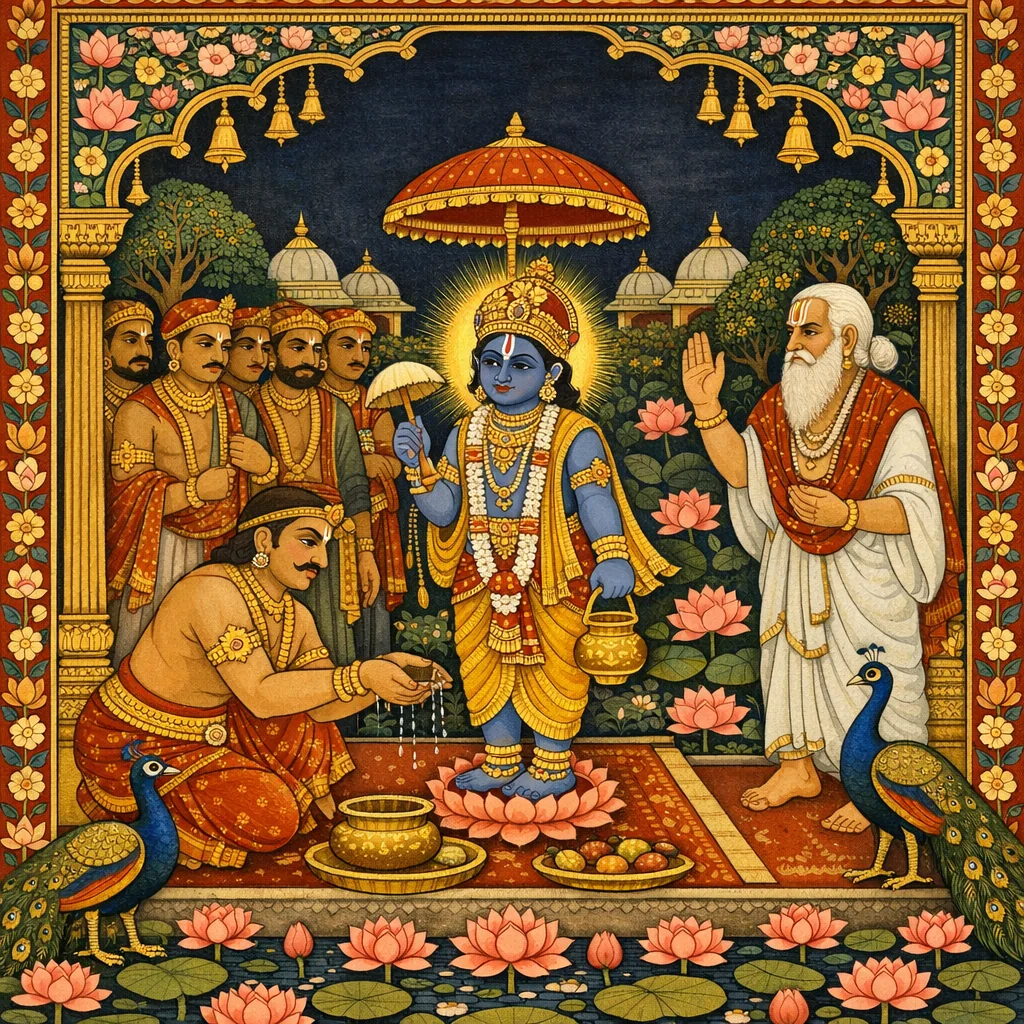
Adhyaya 19
Vāmanadeva Praises Bali; the Measure of Three Steps; Śukrācārya Warns Against the Gift
Continuing the Vāmana–Bali encounter, Vāmanadeva responds to Bali’s courteous, dharma-grounded speech by praising the Daitya dynasty’s traditional generosity and its crowning jewel—Prahlāda. The Lord recalls the line’s heroic and antagonistic figures (Hiraṇyākṣa and Hiraṇyakaśipu), using their histories to contrast uncontrolled anger and ambition with Bali’s cultivated religious etiquette. He then asks for only three paces of land, teaching that restraint and contentment (santoṣa) are the brāhmaṇa’s safeguard from karmic entanglement, while sense-driven acquisition never satisfies. Bali, seeing the request as childish, urges Him to ask for more and prepares to seal the donation with water. At this pivotal moment—bridging Bali’s vow and the imminent cosmic expansion of Trivikrama—Śukrācārya intervenes, identifying the dwarf as Viṣṇu and warning that the gift will strip Bali of kingdom, prestige, and livelihood. He argues for strategic refusal, even permitting untruth in exceptional social emergencies, thereby setting up the next chapter’s ethical clash: satya-vrata (truthful vow) versus pragmatic self-preservation under a guru’s command.
Shlokas
Verse 1
श्रीशुक उवाच इति वैरोचनेर्वाक्यं धर्मयुक्तं स सूनृतम् । निशम्य भगवान्प्रीत: प्रतिनन्द्येदमब्रवीत् ॥ १ ॥
Śukadeva Gosvāmī continued: When the Supreme Personality of Godhead, Vāmanadeva, heard Bali Mahārāja speaking in this pleasing way, He was very satisfied, for Bali Mahārāja had spoken in terms of religious principles. Thus the Lord began to praise him.
Verse 2
श्रीभगवानुवाच वचस्तवैतज्जनदेव सूनृतं कुलोचितं धर्मयुतं यशस्करम् । यस्य प्रमाणं भृगव: साम्पराये पितामह: कुलवृद्ध: प्रशान्त: ॥ २ ॥
The Supreme Personality of Godhead said: O King, you are indeed exalted because your present advisors are the brāhmaṇas who are descendants of Bhṛgu and because your instructor for your future life is your grandfather, the peaceful and venerable Prahlāda Mahārāja. Your statements are very true, and they completely agree with religious etiquette. They are in keeping with the behavior of your family, and they enhance your reputation.
Verse 3
न ह्येतस्मिन्कुले कश्चिन्नि:सत्त्व: कृपण: पुमान् । प्रत्याख्याता प्रतिश्रुत्य यो वादाता द्विजातये ॥ ३ ॥
I know that even until now, no one taking birth in your family has been poor-minded or miserly. No one has refused to give charity to brāhmaṇas, nor after promising to give charity has anyone failed to fulfill his promise.
Verse 4
न सन्ति तीर्थे युधि चार्थिनार्थिता: पराङ्मुखा ये त्वमनस्विनो नृप । युष्मत्कुले यद्यशसामलेन प्रह्लाद उद्भाति यथोडुप: खे ॥ ४ ॥
O King Bali, never in your dynasty has the low-minded king been born who upon being requested has refused charity to brāhmaṇas in holy places or a fight to kṣatriyas on a battlefield. And your dynasty is even more glorious due to the presence of Prahlāda Mahārāja, who is like the beautiful moon in the sky.
Verse 5
यतो जातो हिरण्याक्षश्चरन्नेक इमां महीम् । प्रतिवीरं दिग्विजये नाविन्दत गदायुध: ॥ ५ ॥
It was in your dynasty that Hiraṇyākṣa was born. Carrying only his own club, he wandered the globe alone, without assistance, to conquer all directions, and no hero he met could rival him.
Verse 6
यं विनिर्जित्य कृच्छ्रेण विष्णु: क्ष्मोद्धार आगतम् । आत्मानं जयिनं मेने तद्वीर्यं भूर्यनुस्मरन् ॥ ६ ॥
When delivering the earth from the Garbhodaka Sea, Lord Viṣṇu, in His incarnation as a boar, killed Hiraṇyākṣa, who had appeared before Him. The fight was severe, and the Lord killed Hiraṇyākṣa with great difficulty. Later, as the Lord thought about the uncommon prowess of Hiraṇyākṣa, He felt Himself victorious indeed.
Verse 7
निशम्य तद्वधं भ्राता हिरण्यकशिपु: पुरा । हन्तुं भ्रातृहणं क्रुद्धो जगाम निलयं हरे: ॥ ७ ॥
When Hiraṇyakaśipu heard the news of his brother’s being killed, with great anger he went to the residence of Viṣṇu, the killer of his brother, wanting to kill Lord Viṣṇu.
Verse 8
तमायान्तं समालोक्य शूलपाणिं कृतान्तवत् । चिन्तयामास कालज्ञो विष्णुर्मायाविनां वर: ॥ ८ ॥
Seeing Hiraṇyakaśipu coming forward bearing a trident in his hand like personified death, Lord Viṣṇu, the best of all mystics and the knower of the progress of time, thought as follows.
Verse 9
यतो यतोऽहं तत्रासौ मृत्यु: प्राणभृतामिव । अतोऽहमस्य हृदयं प्रवेक्ष्यामि पराग्दृश: ॥ ९ ॥
Wheresoever I go, Hiraṇyakaśipu will follow Me, as death follows all living entities. Therefore it is better for Me to enter the core of his heart, for then, because of his power to see only externally, he will not see Me.
Verse 10
एवं स निश्चित्य रिपो: शरीर- माधावतो निर्विविशेऽसुरेन्द्र । श्वासानिलान्तर्हितसूक्ष्मदेह- स्तत्प्राणरन्ध्रेण विविग्नचेता: ॥ १० ॥
Lord Vāmanadeva continued: O King of the demons, after Lord Viṣṇu made this decision, He entered the body of His enemy Hiraṇyakaśipu, who was running after Him with great force. In a subtle body inconceivable to Hiraṇyakaśipu, Lord Viṣṇu, who was in great anxiety, entered Hiraṇyakaśipu’s nostril along with his breath.
Verse 11
स तन्निकेतं परिमृश्य शून्य- मपश्यमान: कुपितो ननाद । क्ष्मां द्यां दिश: खं विवरान्समुद्रान् विष्णुं विचिन्वन् न ददर्श वीर: ॥ ११ ॥
Upon seeing that the residence of Lord Viṣṇu was vacant, Hiraṇyakaśipu began searching for Lord Viṣṇu everywhere. Angry at not seeing Him, Hiraṇyakaśipu screamed loudly and searched the entire universe, including the surface of the earth, the higher planetary systems, all directions and all the caves and oceans. But Hiraṇyakaśipu, the greatest hero, did not see Viṣṇu anywhere.
Verse 12
अपश्यन्निति होवाच मयान्विष्टमिदं जगत् । भ्रातृहा मे गतो नूनं यतो नावर्तते पुमान् ॥ १२ ॥
Unable to see Him, Hiraṇyakaśipu said, “I have searched the entire universe, but I could not find Viṣṇu, who has killed my brother. Therefore, He must certainly have gone to that place from which no one returns. [In other words, He must now be dead.]”
Verse 13
वैरानुबन्ध एतावानामृत्योरिह देहिनाम् । अज्ञानप्रभवो मन्युरहंमानोपबृंहित: ॥ १३ ॥
Hiraṇyakaśipu’s anger against Lord Viṣṇu persisted until his death. Other people in the bodily concept of life maintain anger only because of false ego and the great influence of ignorance.
Verse 14
पिता प्रह्लादपुत्रस्ते तद्विद्वान्द्विजवत्सल: । स्वमायुर्द्विजलिङ्गेभ्यो देवेभ्योऽदात् स याचित: ॥ १४ ॥
Your father, Virocana, the son of Mahārāja Prahlāda, was very affectionate toward brāhmaṇas. Although he knew very well that it was the demigods who had come to him in the dress of brāhmaṇas, at their request he delivered to them the duration of his life.
Verse 15
भवानाचरितान्धर्मानास्थितो गृहमेधिभि: । ब्राह्मणै: पूर्वजै: शूरैरन्यैश्चोद्दामकीर्तिभि: ॥ १५ ॥
You also have observed the principles followed by great personalities who are householder brāhmaṇas, by your forefathers and by great heroes who are extremely famous for their exalted activities.
Verse 16
तस्मात् त्वत्तो महीमीषद् वृणेऽहं वरदर्षभात् । पदानि त्रीणि दैत्येन्द्र सम्मितानि पदा मम ॥ १६ ॥
O King of the Daityas, from Your Majesty, who come from such a noble family and who are able to give charity munificently, I ask only three paces of land, to the measurement of My steps.
Verse 17
नान्यत् ते कामये राजन्वदान्याज्जगदीश्वरात् । नैन: प्राप्नोति वै विद्वान्यावदर्थप्रतिग्रह: ॥ १७ ॥
O King, controller of the entire universe, although you are very munificent and are able to give Me as much land as I want, I do not want anything from you that is unnecessary. If a learned brāhmaṇa takes charity from others only according to his needs, he does not become entangled in sinful activities.
Verse 18
श्रीबलिरुवाच अहो ब्राह्मणदायाद वाचस्ते वृद्धसम्मता: । त्वं बालो बालिशमति: स्वार्थं प्रत्यबुधो यथा ॥ १८ ॥
Bali Mahārāja said: O son of a brāhmaṇa, Your instructions are as good as those of learned and elderly persons. Nonetheless, You are a boy, and Your intelligence is insufficient. Thus You are not very prudent in regard to Your self-interest.
Verse 19
मां वचोभि: समाराध्य लोकानामेकमीश्वरम् । पदत्रयं वृणीते योऽबुद्धिमान् द्वीपदाशुषम् ॥ १९ ॥
I am able to give You an entire island because I am the proprietor of the three divisions of the universe. You have come to take something from me and have pleased me by Your sweet words, but You are asking only three paces of land. Therefore You are not very intelligent.
Verse 20
न पुमान् मामुपव्रज्य भूयो याचितुमर्हति । तस्माद् वृत्तिकरीं भूमिं वटो कामं प्रतीच्छ मे ॥ २० ॥
O small boy, one who approaches me to beg something should not have to ask anything more, anywhere. Therefore, if You wish, You may ask from me as much land as will suffice to maintain You according to Your needs.
Verse 21
श्रीभगवानुवाच यावन्तो विषया: प्रेष्ठास्त्रिलोक्यामजितेन्द्रियम् । न शक्नुवन्ति ते सर्वे प्रतिपूरयितुं नृप ॥ २१ ॥
The Personality of Godhead said: O my dear King, even the entirety of whatever there may be within the three worlds to satisfy one’s senses cannot satisfy a person whose senses are uncontrolled.
Verse 22
त्रिभि: क्रमैरसन्तुष्टो द्वीपेनापि न पूर्यते । नववर्षसमेतेन सप्तद्वीपवरेच्छया ॥ २२ ॥
If I were not satisfied with three paces of land, then surely I would not be satisfied even with possessing one of the seven islands, consisting of nine varṣas. Even if I possessed one island, I would hope to get others.
Verse 23
सप्तद्वीपाधिपतयो नृपा वैन्यगयादय: । अर्थै: कामैर्गता नान्तं तृष्णाया इति न: श्रुतम् ॥ २३ ॥
We have heard that although powerful kings like Mahārāja Pṛthu and Mahārāja Gaya achieved proprietorship over the seven dvīpas, they could not achieve satisfaction or find the end of their ambitions.
Verse 24
यदृच्छयोपपन्नेन सन्तुष्टो वर्तते सुखम् । नासन्तुष्टस्त्रिभिर्लोकैरजितात्मोपसादितै: ॥ २४ ॥
One should be satisfied with whatever he achieves by his previous destiny, for discontent can never bring happiness. A person who is not self-controlled will not be happy even with possessing the three worlds.
Verse 25
पुंसोऽयं संसृतेर्हेतुरसन्तोषोऽर्थकामयो: । यदृच्छयोपपन्नेन सन्तोषो मुक्तये स्मृत: ॥ २५ ॥
Material existence causes discontent in regard to fulfilling one’s lusty desires and achieving more and more money. This is the cause for the continuation of material life, which is full of repeated birth and death. But one who is satisfied by that which is obtained by destiny is fit for liberation from this material existence.
Verse 26
यदृच्छालाभतुष्टस्य तेजो विप्रस्य वर्धते । तत् प्रशाम्यत्यसन्तोषादम्भसेवाशुशुक्षणि: ॥ २६ ॥
A brāhmaṇa who is satisfied with whatever is providentially obtained is increasingly enlightened with spiritual power, but the spiritual potency of a dissatisfied brāhmaṇa decreases, as fire diminishes in potency when water is sprinkled upon it.
Verse 27
तस्मात् त्रीणि पदान्येव वृणे त्वद् वरदर्षभात् । एतावतैव सिद्धोऽहं वित्तं यावत्प्रयोजनम् ॥ २७ ॥
Therefore, O King, from you, the best of those who give charity, I ask only three paces of land. By such a gift I shall be very pleased, for the way of happiness is to be fully satisfied to receive that which is absolutely needed.
Verse 28
श्रीशुक उवाच इत्युक्त: स हसन्नाह वाञ्छात: प्रतिगृह्यताम् । वामनाय महीं दातुं जग्राह जलभाजनम् ॥ २८ ॥
Śukadeva Gosvāmī continued: When the Supreme Personality of Godhead had thus spoken to Bali Mahārāja, Bali smiled and told Him, “All right. Take whatever You like.” To confirm his promise to give Vāmanadeva the desired land, he then took up his waterpot.
Verse 29
विष्णवे क्ष्मां प्रदास्यन्तमुशना असुरेश्वरम् । जानंश्चिकीर्षितं विष्णो: शिष्यं प्राह विदां वर: ॥ २९ ॥
Understanding Lord Viṣṇu’s purpose, Śukrācārya, the best of the learned, immediately spoke as follows to his disciple, who was about to offer everything to Lord Vāmanadeva.
Verse 30
श्रीशुक्र उवाच एष वैरोचने साक्षाद् भगवान्विष्णुरव्यय: । कश्यपाददितेर्जातो देवानां कार्यसाधक: ॥ ३० ॥
Śukrācārya said: O son of Virocana, this brahmacārī in the form of a dwarf is directly the imperishable Supreme Personality of Godhead, Viṣṇu. Accepting Kaśyapa Muni as His father and Aditi as His mother, He has now appeared in order to fulfill the interests of the demigods.
Verse 31
प्रतिश्रुतं त्वयैतस्मै यदनर्थमजानता । न साधु मन्ये दैत्यानां महानुपगतोऽनय: ॥ ३१ ॥
You do not know what a dangerous position you have accepted by promising to give Him land. I do not think that this promise is good for you. It will bring great harm to the demons.
Verse 32
एष ते स्थानमैश्वर्यं श्रियं तेजो यश: श्रुतम् । दास्यत्याच्छिद्य शक्राय मायामाणवको हरि: ॥ ३२ ॥
This person falsely appearing as a brahmacārī is actually the Supreme Personality of Godhead, Hari, who has come in this form to take away all your land, wealth, beauty, power, fame and education. After taking everything from you, He will deliver it to Indra, your enemy.
Verse 33
त्रिभि: क्रमैरिमाल्लोकान्विश्वकाय: क्रमिष्यति । सर्वस्वं विष्णवे दत्त्वा मूढ वर्तिष्यसे कथम् ॥ ३३ ॥
You have promised to give Him three steps of land in charity, but when you give it He will occupy the three worlds. You are a rascal! You do not know what a great mistake you have made. After giving everything to Lord Viṣṇu, you will have no means of livelihood. How then shall you live?
Verse 34
क्रमतो गां पदैकेन द्वितीयेन दिवं विभो: । खं च कायेन महता तार्तीयस्य कुतो गति: ॥ ३४ ॥
Vāmanadeva will first occupy the three worlds with one step, then He will take His second step and occupy everything in outer space, and then He will expand His universal body to occupy everything. Where will you offer Him the third step?
Verse 35
निष्ठां ते नरके मन्ये ह्यप्रदातु: प्रतिश्रुतम् । प्रतिश्रुतस्य योऽनीश: प्रतिपादयितुं भवान् ॥ ३५ ॥
You will certainly be unable to fulfill your promise, and I think that because of this inability your eternal residence will be in hell.
Verse 36
न तद्दानं प्रशंसन्ति येन वृत्तिर्विपद्यते । दानं यज्ञस्तप: कर्म लोके वृत्तिमतो यत: ॥ ३६ ॥
Learned scholars do not praise that charity which endangers one’s own livelihood. Charity, sacrifice, austerity and fruitive activities are possible for one who is competent to earn his livelihood properly. [They are not possible for one who cannot maintain himself.]
Verse 37
धर्माय यशसेऽर्थाय कामाय स्वजनाय च । पञ्चधा विभजन्वित्तमिहामुत्र च मोदते ॥ ३७ ॥
Therefore one who is in full knowledge should divide his accumulated wealth in five parts — for religion, for reputation, for opulence, for sense gratification and for the maintenance of his family members. Such a person is happy in this world and in the next.
Verse 38
अत्रापि बह्वृचैर्गीतं शृणु मेऽसुरसत्तम । सत्यमोमिति यत् प्रोक्तं यन्नेत्याहानृतं हि तत् ॥ ३८ ॥
One might argue that since you have already promised, how can you refuse? O best of the demons, just take from me the evidence of the Bahvṛca-śruti, which says that a promise is truthful preceded by the word om and untruthful if not.
Verse 39
सत्यं पुष्पफलं विद्यादात्मवृक्षस्य गीयते । वृक्षेऽजीवति तन्न स्यादनृतं मूलमात्मन: ॥ ३९ ॥
The Vedas enjoin that the factual result of the tree of the body is the good fruits and flowers derived from it. But if the bodily tree does not exist, there is no possibility of factual fruits and flowers. Even if the body is based on untruth, there cannot be factual fruits and flowers without the help of the bodily tree.
Verse 40
तद् यथा वृक्ष उन्मूल: शुष्यत्युद्वर्ततेऽचिरात् । एवं नष्टानृत: सद्य आत्मा शुष्येन्न संशय: ॥ ४० ॥
When a tree is uprooted it immediately falls down and begins to dry up. Similarly, if one doesn’t take care of the body, which is supposed to be untruth — in other words, if the untruth is uprooted — the body undoubtedly becomes dry.
Verse 41
पराग् रिक्तमपूर्णं वा अक्षरं यत् तदोमिति । यत् किञ्चिदोमिति ब्रूयात् तेन रिच्येत वै पुमान् । भिक्षवे सर्वम्ॐ कुर्वन्नालं कामेन चात्मने ॥ ४१ ॥
The utterance of the word om signifies separation from one’s monetary assets. In other words, by uttering this word one becomes free from attachment to money because his money is taken away from him. To be without money is not very satisfactory, for in that position one cannot fulfill one’s desires. In other words, by using the word om one becomes poverty-stricken. Especially when one gives charity to a poor man or beggar, one remains unfulfilled in self-realization and in sense gratification.
Verse 42
अथैतत् पूर्णमभ्यात्मं यच्च नेत्यनृतं वच: । सर्वं नेत्यनृतं ब्रूयात् स दुष्कीर्ति: श्वसन्मृत: ॥ ४२ ॥
Therefore, the safe course is to say no. Although it is a falsehood, it protects one completely, it draws the compassion of others toward oneself, and it gives one full facility to collect money from others for oneself. Nonetheless, if one always pleads that he has nothing, he is condemned, for he is a dead body while living, or while still breathing he should be killed.
Verse 43
स्त्रीषु नर्मविवाहे च वृत्त्यर्थे प्राणसङ्कटे । गोब्राह्मणार्थे हिंसायां नानृतं स्याज्जुगुप्सितम् ॥ ४३ ॥
In flattering a woman to bring her under control, in joking, in a marriage ceremony, in earning one’s livelihood, when one’s life is in danger, in protecting cows and brahminical culture, or in protecting a person from an enemy’s hand, falsity is never condemned.
Frequently Asked Questions
On the surface it models brāhmaṇical restraint—taking only what is needed to avoid sinful entanglement. Theologically it is deliberate līlā: the Lord’s “small” request exposes the limits of material proprietorship and prepares the revelation of Trivikrama, where the Supreme measures and reclaims the cosmos while honoring the devotee’s vow.
Satisfaction is linked to self-control, not to the quantity of possessions. The text argues that uncontrolled senses remain dissatisfied even with the three worlds, while a person content with what destiny provides becomes fit for liberation and gains spiritual strength (brahma-tejas).
Śukrācārya is the Daityas’ preceptor and a master of policy and ritual learning. He recognizes Vāmana as Viṣṇu acting for the devas’ interest and warns that the promised gift will result in total dispossession, endangering Bali’s livelihood and the Daitya cause; thus he urges refusal as protective strategy.
The passage lists narrow social exceptions where falsity is traditionally not condemned (e.g., protecting life, cows, and brāhmaṇical culture). Yet the narrative context problematizes Śukrācārya’s counsel by placing it against Bali’s pledged satya and the presence of Viṣṇu; the next narrative movement tests whether expediency can override a vow made in a sacred charitable act.