Adhyaya 12
Lord Śiva Bewildered by Mohinī (Viṣṇu’s Yoga-māyā and the Limits of Ascetic Power)
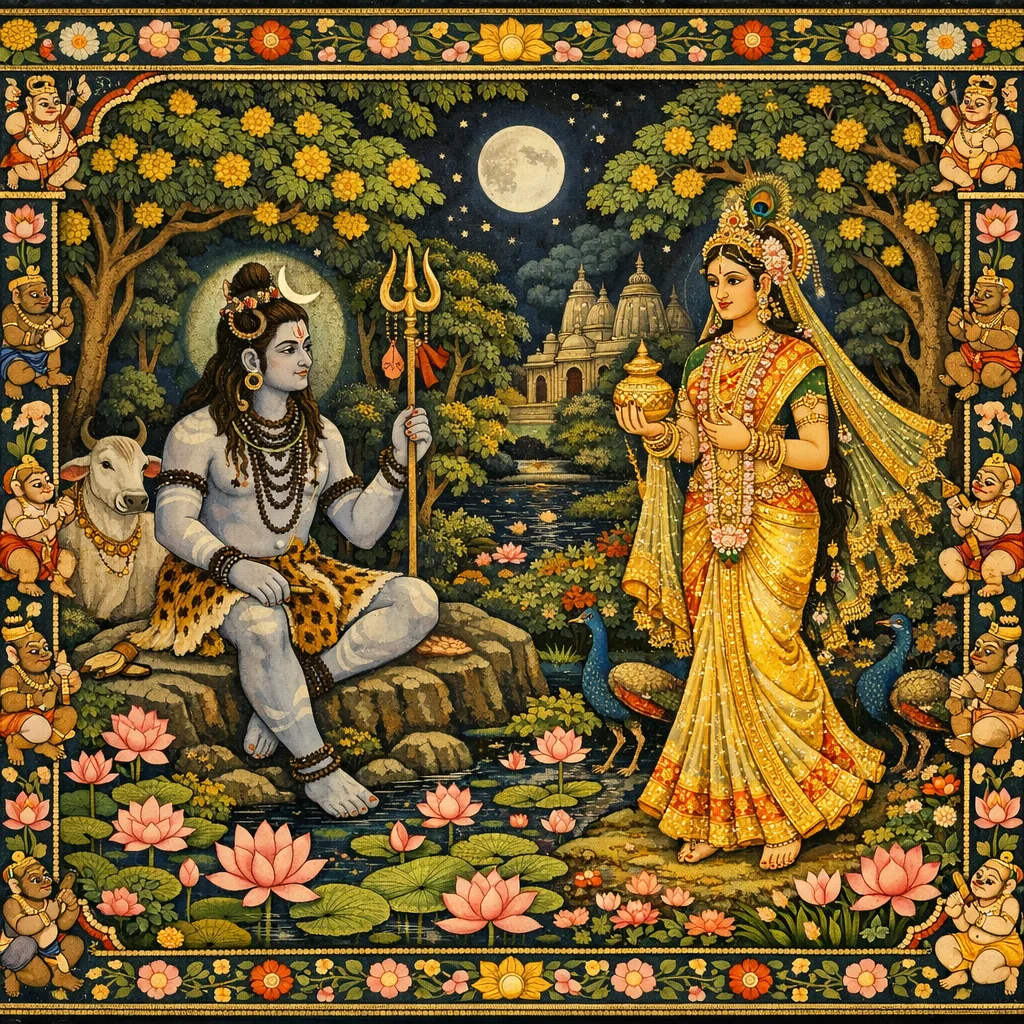
Following the devas’ successful receipt of amṛta through Viṣṇu’s Mohinī form in the aftermath of Ocean-churning events, Śukadeva continues the narrative by introducing Lord Śiva’s desire to witness that extraordinary form. Śiva, accompanied by Umā and his gaṇas, approaches Madhusūdana and offers profound theological praise: Viṣṇu as the non-material Supreme Cause, the unity of cause and effect, and the inadequacy of partial philosophical readings (Vedānta, Mīmāṁsā, Sāṅkhya, Pātañjala, Pañcarātra) without full recognition of Bhagavān. Viṣṇu agrees and manifests Mohinī in a forest, whose beauty agitates Śiva; he pursues her, becomes overcome, and discharges semen—later said to become mines of gold and silver. When the illusion ends, Śiva regains composure, recognizes Viṣṇu’s incomparable śakti, and is praised for his steadiness. Viṣṇu resumes His form; Śiva returns to Kailāsa and instructs Bhavānī on the astonishing reach of the Lord’s māyā. The chapter closes by reaffirming that hearing these līlās destroys suffering and culminates in worshipful remembrance—bridging the churning narrative to its devotional takeaway.
Shlokas
Verse 1
श्रीबादरायणिरुवाच वृषध्वजो निशम्येदं योषिद्रूपेण दानवान् । मोहयित्वा सुरगणान्हरि: सोममपाययत् ॥ १ ॥ वृषमारुह्य गिरिश: सर्वभूतगणैर्वृत: । सह देव्या ययौ द्रष्टुं यत्रास्ते मधुसूदन: ॥ २ ॥
Śukadeva Gosvāmī said: The Supreme Personality of Godhead, Hari, in the form of a woman, captivated the demons and enabled the demigods to drink the nectar. After hearing of these pastimes, Lord Śiva, who is carried by a bull, went to the place where Madhusūdana, the Lord, resides. Accompanied by his wife, Umā, and surrounded by his companions, the ghosts, Lord Śiva went there to see the Lord’s form as a woman.
Verse 2
श्रीबादरायणिरुवाच वृषध्वजो निशम्येदं योषिद्रूपेण दानवान् । मोहयित्वा सुरगणान्हरि: सोममपाययत् ॥ १ ॥ वृषमारुह्य गिरिश: सर्वभूतगणैर्वृत: । सह देव्या ययौ द्रष्टुं यत्रास्ते मधुसूदन: ॥ २ ॥
Śukadeva Gosvāmī said: The Supreme Personality of Godhead, Hari, in the form of a woman, captivated the demons and enabled the demigods to drink the nectar. After hearing of these pastimes, Lord Śiva, who is carried by a bull, went to the place where Madhusūdana, the Lord, resides. Accompanied by his wife, Umā, and surrounded by his companions, the ghosts, Lord Śiva went there to see the Lord’s form as a woman.
Verse 3
सभाजितो भगवता सादरं सोमया भव: । सूपविष्ट उवाचेदं प्रतिपूज्य स्मयन्हरिम् ॥ ३ ॥
The Supreme Personality of Godhead welcomed Lord Śiva and Umā with great respect, and after being seated comfortably, Lord Śiva duly worshiped the Lord and smilingly spoke as follows.
Verse 4
श्रीमहादेव उवाच देवदेव जगद्वयापिञ्जगदीश जगन्मय । सर्वेषामपि भावानां त्वमात्मा हेतुरीश्वर: ॥ ४ ॥
Lord Mahādeva said: O chief demigod among the demigods, O all-pervading Lord, master of the universe, by Your energy You are transformed into the creation. You are the root and efficient cause of everything. You are not material. Indeed, You are the Supersoul or supreme living force of everything. Therefore, You are Parameśvara, the supreme controller of all controllers.
Verse 5
आद्यन्तावस्य यन्मध्यमिदमन्यदहं बहि: । यतोऽव्ययस्य नैतानि तत् सत्यं ब्रह्म चिद्भवान् ॥ ५ ॥
The manifest, the unmanifest, false ego and the beginning, maintenance and annihilation of this cosmic manifestation all come from You, the Supreme Personality of Godhead. But because You are the Absolute Truth, the supreme absolute spirit soul, the Supreme Brahman, such changes as birth, death and sustenance do not exist in You.
Verse 6
तवैव चरणाम्भोजं श्रेयस्कामा निराशिष: । विसृज्योभयत: सङ्गं मुनय: समुपासते ॥ ६ ॥
Pure devotees or great saintly persons who desire to achieve the highest goal in life and who are completely free from all material desires for sense gratification engage constantly in the transcendental service of Your lotus feet.
Verse 7
त्वं ब्रह्म पूर्णममृतं विगुणं विशोक- मानन्दमात्रमविकारमनन्यदन्यत् । विश्वस्य हेतुरुदयस्थितिसंयमाना- मात्मेश्वरश्च तदपेक्षतयानपेक्ष: ॥ ७ ॥
My Lord, You are the Supreme Brahman, complete in everything. Being completely spiritual, You are eternal, free from the material modes of nature, and full of transcendental bliss. Indeed, for You there is no question of lamentation. Since You are the supreme cause, the cause of all causes, nothing can exist without You. Yet we are different from You in a relationship of cause and effect, for in one sense the cause and effect are different. You are the original cause of creation, manifestation and annihilation, and You bestow benedictions upon all living entities. Everyone depends upon You for the results of his activities, but You are always independent.
Verse 8
एकस्त्वमेव सदसद्द्वयमद्वयं च स्वर्णं कृताकृतमिवेह न वस्तुभेद: । अज्ञानतस्त्वयि जनैर्विहितो विकल्पो यस्माद् गुणव्यतिकरो निरुपाधिकस्य ॥ ८ ॥
My dear Lord, Your Lordship alone is the cause and the effect. Therefore, although You appear to be two, You are the absolute one. As there is no difference between the gold of a golden ornament and the gold in a mine, there is no difference between cause and effect; both of them are the same. Only because of ignorance do people concoct differences and dualities. You are free from material contamination, and since the entire cosmos is caused by You and cannot exist without You, it is an effect of Your transcendental qualities. Thus the conception that Brahman is true and the world false cannot be maintained.
Verse 9
त्वां ब्रह्म केचिदवयन्त्युत धर्ममेकेएके परं सदसतो: पुरुषं परेशम् । अन्येऽवयन्ति नवशक्तियुतं परं त्वांकेचिन्महापुरुषमव्ययमात्मतन्त्रम् ॥ ९ ॥
Those who are known as the impersonalist Vedāntists regard You as the impersonal Brahman. Others, known as the Mīmāṁsaka philosophers, regard You as religion. The Sāṅkhya philosophers regard You as the transcendental person who is beyond prakṛti and puruṣa and who is the controller of even the demigods. The followers of the codes of devotional service known as the Pañcarātras regard You as being endowed with nine different potencies. And the Patañjala philosophers, the followers of Patañjali Muni, regard You as the supreme independent Personality of Godhead, who has no equal or superior.
Verse 10
नाहं परायुर्ऋषयो न मरीचिमुख्याजानन्ति यद्विरचितं खलु सत्त्वसर्गा: । यन्मायया मुषितचेतस ईश दैत्य-मर्त्यादय: किमुत शश्वदभद्रवृत्ता: ॥ १० ॥
O my Lord, I, who am considered to be the best of the demigods, and Lord Brahmā and the great ṛṣis, headed by Marīci, are born of the mode of goodness. Nonetheless, we are bewildered by Your illusory energy and cannot understand what this creation is. Aside from us, what is to be said of others, like the demons and human beings, who are in the base modes of material nature [rajo-guṇa and tamo-guṇa]? How will they know You?
Verse 11
स त्वं समीहितमद: स्थितिजन्मनाशंभूतेहितं च जगतो भवबन्धमोक्षौ । वायुर्यथा विशति खं च चराचराख्यंसर्वं तदात्मकतयावगमोऽवरुन्त्से ॥ ११ ॥
My Lord, You are the supreme knowledge personified. You know everything about this creation and its beginning, maintenance and annihilation, and You know all the endeavors made by the living entities, by which they are either implicated in this material world or liberated from it. As the air enters the vast sky and also enters the bodies of all moving and nonmoving entities, You are present everywhere, and therefore You are the knower of all.
Verse 12
अवतारा मया दृष्टा रममाणस्य ते गुणै: । सोऽहं तद्द्रष्टुमिच्छामि यत् ते योषिद्वपुर्धृतम् ॥ १२ ॥
My Lord, I have seen all kinds of incarnations You have exhibited by Your transcendental qualities, and now that You have appeared as a beautiful young woman, I wish to see that form of Your Lordship.
Verse 13
येन सम्मोहिता दैत्या: पायिताश्चामृतं सुरा: । तद् दिदृक्षव आयाता: परं कौतूहलं हि न: ॥ १३ ॥
My Lord, we have come here desiring to see that form of Your Lordship which You showed to the demons to captivate them completely and in this way enable the demigods to drink nectar. I am very eager to see that form.
Verse 14
श्रीशुक उवाच एवमभ्यर्थितो विष्णुर्भगवान् शूलपाणिना । प्रहस्य भावगम्भीरं गिरिशं प्रत्यभाषत ॥ १४ ॥
Śukadeva Gosvāmī said: When Lord Viṣṇu was thus requested by Lord Śiva, who carries a trident in his hand, He smiled with gravity and replied to Lord Śiva as follows.
Verse 15
श्रीभगवानुवाच कौतूहलाय दैत्यानां योषिद्वेषो मया धृत: । पश्यता सुरकार्याणि गते पीयूषभाजने ॥ १५ ॥
The Supreme Personality of Godhead said: When the demons took away the jug of nectar, I assumed the form of a beautiful woman to bewilder them by directly cheating them and thus to act in the interest of the demigods.
Verse 16
तत्तेऽहं दर्शयिष्यामि दिदृक्षो: सुरसत्तम । कामिनां बहु मन्तव्यं सङ्कल्पप्रभवोदयम् ॥ १६ ॥
O best of the demigods, I shall now show you My form that is very much appreciated by those who are lusty. Since you want to see that form, I shall reveal it in your presence.
Verse 17
श्रीशुक उवाच इति ब्रुवाणो भगवांस्तत्रैवान्तरधीयत । सर्वतश्चारयंश्चक्षुर्भव आस्ते सहोमया ॥ १७ ॥
Śukadeva Gosvāmī continued: After speaking in this way, the Supreme Personality of Godhead, Viṣṇu, immediately disappeared, and Lord Śiva remained there with Umā, looking for Him all around with moving eyes.
Verse 18
ततो ददर्शोपवने वरस्त्रियंविचित्रपुष्पारुणपल्लवद्रुमे । विक्रीडतीं कन्दुकलीलया लसद्-दुकूलपर्यस्तनितम्बमेखलाम् ॥ १८ ॥
Thereafter, in a nice forest nearby, full of trees with reddish-pink leaves and varieties of flowers, Lord Śiva saw a beautiful woman playing with a ball. Her hips were covered with a shining sari and ornamented with a belt.
Verse 19
आवर्तनोद्वर्तनकम्पितस्तन-प्रकृष्टहारोरुभरै: पदे पदे । प्रभज्यमानामिव मध्यतश्चलत्-पदप्रवालं नयतीं ततस्तत: ॥ १९ ॥
Because the ball was falling down and bouncing up, as She played with it Her breasts trembled, and because of the weight of those breasts and Her heavy flower garlands, Her waist appeared to be all but breaking at every step, as Her two soft feet, which were reddish like coral, moved here and there.
Verse 20
दिक्षु भ्रमत्कन्दुकचापलैर्भृशंप्रोद्विग्नतारायतलोललोचनाम् । स्वकर्णविभ्राजितकुण्डलोल्लसत्-कपोलनीलालकमण्डिताननाम् ॥ २० ॥
The woman’s face was decorated by broad, beautiful, restless eyes, which moved as the ball bounced here and there from Her hand. The two brilliant earrings on Her ears decorated Her shining cheeks like bluish reflections, and the hair scattered on Her face made Her even more beautiful to see.
Verse 21
श्लथद् दुकूलं कबरीं च विच्युतांसन्नह्यतीं वामकरेण वल्गुना । विनिघ्नतीमन्यकरेण कन्दुकंविमोहयन्तीं जगदात्ममायया ॥ २१ ॥
As She played with the ball, the sari covering Her body became loose, and Her hair scattered. She tried to bind Her hair with Her beautiful left hand, and at the same time She played with the ball by striking it with Her right hand. This was so attractive that the Supreme Lord, by His internal potency, in this way captivated everyone.
Verse 22
तां वीक्ष्य देव इति कन्दुकलीलयेषद्-व्रीडास्फुटस्मितविसृष्टकटाक्षमुष्ट: । स्त्रीप्रेक्षणप्रतिसमीक्षणविह्वलात्मानात्मानमन्तिक उमां स्वगणांश्च वेद ॥ २२ ॥
While Lord Śiva observed the beautiful woman playing with the ball, She sometimes glanced at him and slightly smiled in bashfulness. As he looked at the beautiful woman and She watched him, he forgot both himself and Umā, his most beautiful wife, as well as his associates nearby.
Verse 23
तस्या: कराग्रात् स तु कन्दुको यदागतो विदूरं तमनुव्रजत्स्त्रिया: । वास: ससूत्रं लघु मारुतोऽहरद्भवस्य देवस्य किलानुपश्यत: ॥ २३ ॥
When the ball leaped from Her hand and fell at a distance, the woman began to follow it, but as Lord Śiva observed these activities, a breeze suddenly blew away the fine dress and belt that covered her.
Verse 24
एवं तां रुचिरापाङ्गीं दर्शनीयां मनोरमाम् । दृष्ट्वा तस्यां मनश्चक्रे विषज्जन्त्यां भव: किल ॥ २४ ॥
Thus Lord Śiva saw the woman, every part of whose body was beautifully formed, and the beautiful woman also looked at him. Therefore, thinking that She was attracted to him, Lord Śiva became very much attracted to Her.
Verse 25
तयापहृतविज्ञानस्तत्कृतस्मरविह्वल: । भवान्या अपि पश्यन्त्या गतह्रीस्तत्पदं ययौ ॥ २५ ॥
Lord Śiva, his good sense taken away by the woman because of lusty desires to enjoy with Her, became so mad for Her that even in the presence of Bhavānī he did not hesitate to approach Her.
Verse 26
सा तमायान्तमालोक्य विवस्त्रा व्रीडिता भृशम् । निलीयमाना वृक्षेषु हसन्ती नान्वतिष्ठत ॥ २६ ॥
The beautiful woman was already naked, and when She saw Lord Śiva coming toward Her, She became extremely bashful. Thus She kept smiling, but She hid Herself among the trees and did not stand in one place.
Verse 27
तामन्वगच्छद् भगवान् भव: प्रमुषितेन्द्रिय: । कामस्य च वशं नीत: करेणुमिव यूथप: ॥ २७ ॥
His senses being agitated, Lord Śiva, victimized by lusty desires, began to follow Her, just as a lusty elephant follows a she-elephant.
Verse 28
सोऽनुव्रज्यातिवेगेन गृहीत्वानिच्छतीं स्त्रियम् । केशबन्ध उपानीय बाहुभ्यां परिषस्वजे ॥ २८ ॥
After following Her with great speed, Lord Śiva caught Her by the braid of Her hair and dragged Her near him. Although She was unwilling, he embraced Her with his arms.
Verse 29
सोपगूढा भगवता करिणा करिणी यथा । इतस्तत: प्रसर्पन्ती विप्रकीर्णशिरोरुहा ॥ २९ ॥ आत्मानं मोचयित्वाङ्ग सुरर्षभभुजान्तरात् । प्राद्रवत्सा पृथुश्रोणी माया देवविनिर्मिता ॥ ३० ॥
Being embraced by Lord Śiva like a female elephant embraced by a male, the woman, whose hair was scattered, swirled like a snake. O King, this woman, who had large, high hips, was a woman of yoga-māyā presented by the Supreme Personality of Godhead. She released Herself somehow or other from the fond embrace of Lord Śiva’s arms and ran away.
Verse 30
सोपगूढा भगवता करिणा करिणी यथा । इतस्तत: प्रसर्पन्ती विप्रकीर्णशिरोरुहा ॥ २९ ॥ आत्मानं मोचयित्वाङ्ग सुरर्षभभुजान्तरात् । प्राद्रवत्सा पृथुश्रोणी माया देवविनिर्मिता ॥ ३० ॥
Being embraced by Lord Śiva like a female elephant embraced by a male, the woman, whose hair was scattered, swirled like a snake. O King, this woman, who had large, high hips, was a woman of yoga-māyā presented by the Supreme Personality of Godhead. She released Herself somehow or other from the fond embrace of Lord Śiva’s arms and ran away.
Verse 31
तस्यासौ पदवीं रुद्रो विष्णोरद्भुतकर्मण: । प्रत्यपद्यत कामेन वैरिणेव विनिर्जित: ॥ ३१ ॥
As if harassed by an enemy in the form of lusty desires, Lord Śiva followed the path of Lord Viṣṇu, who acts very wonderfully and who had taken the form of Mohinī.
Verse 32
तस्यानुधावतो रेतश्चस्कन्दामोघरेतस: । शुष्मिणो यूथपस्येव वासितामनुधावत: ॥ ३२ ॥
Just as a maddened bull elephant follows a female elephant who is able to conceive pregnancy, Lord Śiva followed the beautiful woman and discharged semen, even though his discharge of semen never goes in vain.
Verse 33
यत्र यत्रापतन्मह्यां रेतस्तस्य महात्मन: । तानि रूप्यस्य हेम्नश्च क्षेत्राण्यासन्महीपते ॥ ३३ ॥
O King, wheresoever on the surface of the globe fell the semen of the great personality of Lord Śiva, mines of gold and silver later appeared.
Verse 34
सरित्सर:सु शैलेषु वनेषूपवनेषु च । यत्र क्व चासन्नृषयस्तत्र सन्निहितो हर: ॥ ३४ ॥
Following Mohinī, Lord Śiva went everywhere — near the shores of the rivers and lakes, near the mountains, near the forests, near the gardens, and wherever there lived great sages.
Verse 35
स्कन्ने रेतसि सोऽपश्यदात्मानं देवमायया । जडीकृतं नृपश्रेष्ठ सन्न्यवर्तत कश्मलात् ॥ ३५ ॥
O Mahārāja Parīkṣit, best of kings, when Lord Śiva had fully discharged semen, he could see how he himself had been victimized by the illusion created by the Supreme Personality of Godhead. Thus he restrained himself from any further māyā.
Verse 36
अथावगतमाहात्म्य आत्मनो जगदात्मन: । अपरिज्ञेयवीर्यस्य न मेने तदुहाद्भुतम् ॥ ३६ ॥
Thus Lord Śiva could understand his position and that of the Supreme Personality of Godhead, who has unlimited potencies. Having reached this understanding, he was not at all surprised by the wonderful way Lord Viṣṇu had acted upon him.
Verse 37
तमविक्लवमव्रीडमालक्ष्य मधुसूदन: । उवाच परमप्रीतो बिभ्रत्स्वां पौरुषीं तनुम् ॥ ३७ ॥
Seeing Lord Śiva unagitated and unashamed, Lord Viṣṇu [Madhusūdana] was very pleased. Thus He resumed His original form and spoke as follows.
Verse 38
श्रीभगवानुवाच दिष्टया त्वं विबुधश्रेष्ठ स्वां निष्ठामात्मना स्थित: । यन्मे स्त्रीरूपया स्वैरं मोहितोऽप्यङ्ग मायया ॥ ३८ ॥
The Supreme Personality of Godhead said: O best of the demigods, although you have been amply harassed because of My potency in assuming the form of a woman, you are established in your position. Therefore, may all good fortune be upon you.
Verse 39
को नु मेऽतितरेन्मायां विषक्तस्त्वदृते पुमान् । तांस्तान्विसृजतीं भावान्दुस्तरामकृतात्मभि: ॥ ३९ ॥
My dear Lord Śambhu, who within this material world but you can surpass My illusory energy? People are generally attached to sense enjoyment and conquered by its influence. Indeed, the influence of material nature is very difficult for them to surmount.
Verse 40
सेयं गुणमयी माया न त्वामभिभविष्यति । मया समेता कालेन कालरूपेण भागश: ॥ ४० ॥
The material, external energy [māyā], who cooperates with Me in creation and who is manifested in the three modes of nature, will not be able to bewilder you any longer.
Verse 41
श्रीशुक उवाच एवं भगवता राजन् श्रीवत्साङ्केन सत्कृत: । आमन्त्र्य तं परिक्रम्य सगण: स्वालयं ययौ ॥ ४१ ॥
Śukadeva Gosvāmī said: O King, having thus been praised by the Supreme Personality, who bears the mark of Śrīvatsa on His chest, Lord Śiva circumambulated Him. Then, after taking permission from Him, Lord Śiva returned to his abode, Kailāsa, along with his associates.
Verse 42
आत्मांशभूतां तां मायां भवानीं भगवान्भव: । सम्मतामृषिमुख्यानां प्रीत्याचष्टाथ भारत ॥ ४२ ॥
O descendant of Bharata Mahārāja, Lord Śiva, in jubilation, then addressed his wife, Bhavānī, who is accepted by all authorities as the potency of Lord Viṣṇu.
Verse 43
अयि व्यपश्यस्त्वमजस्य मायांपरस्य पुंस: परदेवताया: । अहं कलानामृषभोऽपि मुह्येययावशोऽन्ये किमुतास्वतन्त्रा: ॥ ४३ ॥
Lord Śiva said: O Goddess, you have now seen the illusory energy of the Supreme Personality of Godhead, who is the unborn master of everyone. Although I am one of the principal expansions of His Lordship, even I was illusioned by His energy. What then is to be said of others, who are fully dependent on māyā?
Verse 44
यं मामपृच्छस्त्वमुपेत्य योगात्समासहस्रान्त उपारतं वै । स एष साक्षात् पुरुष: पुराणोन यत्र कालो विशते न वेद: ॥ ४४ ॥
When I finished performing mystic yoga for one thousand years, you asked me upon whom I was meditating. Now, here is that Supreme Person to whom time has no entrance and who the Vedas cannot understand.
Verse 45
श्रीशुक उवाच इति तेऽभिहितस्तात विक्रम: शार्ङ्गधन्वन: । सिन्धोर्निर्मथने येन धृत: पृष्ठे महाचल: ॥ ४५ ॥
Śukadeva Gosvāmī said: My dear King, the person who bore the great mountain on His back for the churning of the Ocean of Milk is the same Supreme Personality of Godhead, known as Śārṅga-dhanvā. I have now described to you His prowess.
Verse 46
एतन्मुहु: कीर्तयतोऽनुशृण्वतो न रिष्यते जातु समुद्यम: क्वचित् । यदुत्तमश्लोकगुणानुवर्णनं समस्तसंसारपरिश्रमापहम् ॥ ४६ ॥
The endeavor of one who constantly hears or describes this narration of the churning of the Ocean of Milk will never be fruitless. Indeed, chanting the glories of the Supreme Personality of Godhead is the only means to annihilate all sufferings in this material world.
Verse 47
असदविषयमङ्घ्रिं भावगम्यं प्रपन्ना- नमृतममरवर्यानाशयत् सिन्धुमथ्यम् । कपटयुवतिवेषो मोहयन्य: सुरारीं- स्तमहमुपसृतानां कामपूरं नतोऽस्मि ॥ ४७ ॥
Assuming the form of a young woman and thus bewildering the demons, the Supreme Personality of Godhead distributed to His devotees, the demigods, the nectar produced from the churning of the Ocean of Milk. Unto that Supreme Personality of Godhead, who always fulfills the desires of His devotees, I offer my respectful obeisances.
Frequently Asked Questions
Śiva’s request is framed as wonder and theological inquiry: Mohinī is not ordinary beauty but Viṣṇu’s yoga-māyā that accomplished an impossible task—bewildering the asuras and securing amṛta for the devas. Śiva’s desire to witness it highlights that even the greatest devas seek direct darśana of the Lord’s līlā-śakti, and it sets up a teaching moment about māyā’s supremacy under Bhagavān.
The chapter’s point is not Śiva’s “weakness” but Viṣṇu’s limitless potency. Māyā here is explicitly the Lord’s own yoga-māyā; it can overwhelm even elevated beings when the Lord chooses to demonstrate His sovereignty. Śiva’s restoration of composure and his lack of shame underscore his greatness, while the incident establishes that no one surpasses the Lord’s illusory energy without His grace.
Śiva identifies Viṣṇu as Parameśvara beyond material change, the source of manifestation and dissolution, and the inner knower present like air within all beings. He also integrates multiple darśanas—showing how various schools partially apprehend the Supreme—while affirming Bhagavān as the complete reality. This culminates in rejecting a simplistic ‘Brahman true, world false’ reading by asserting the world’s dependence as an effect of the Lord’s real qualities.
Within Purāṇic symbolism, the detail functions as a cosmological etiological note (explaining origins of substances) and as a theological marker: even what is involuntarily emitted by a mahādeva is potent and consequential. It also emphasizes the extraordinary intensity of the Lord’s māyā-display, while keeping the narrative’s focus on Viṣṇu’s supremacy and Śiva’s eventual self-mastery.
The chapter uses sensual description to demonstrate the binding force of kāma under māyā, even for the exalted, thereby warning conditioned beings against complacency. Its resolution is explicitly devotional: recognition of the Lord’s śakti, humility before māyā, and the prescription of śravaṇa-kīrtana as the means to destroy suffering and re-center the mind on Bhagavān rather than sense objects.