Adhyaya 17
Aditi’s Payo-vrata and Viṣṇu’s Promise to Appear as Her Son (Prelude to Vāmana)
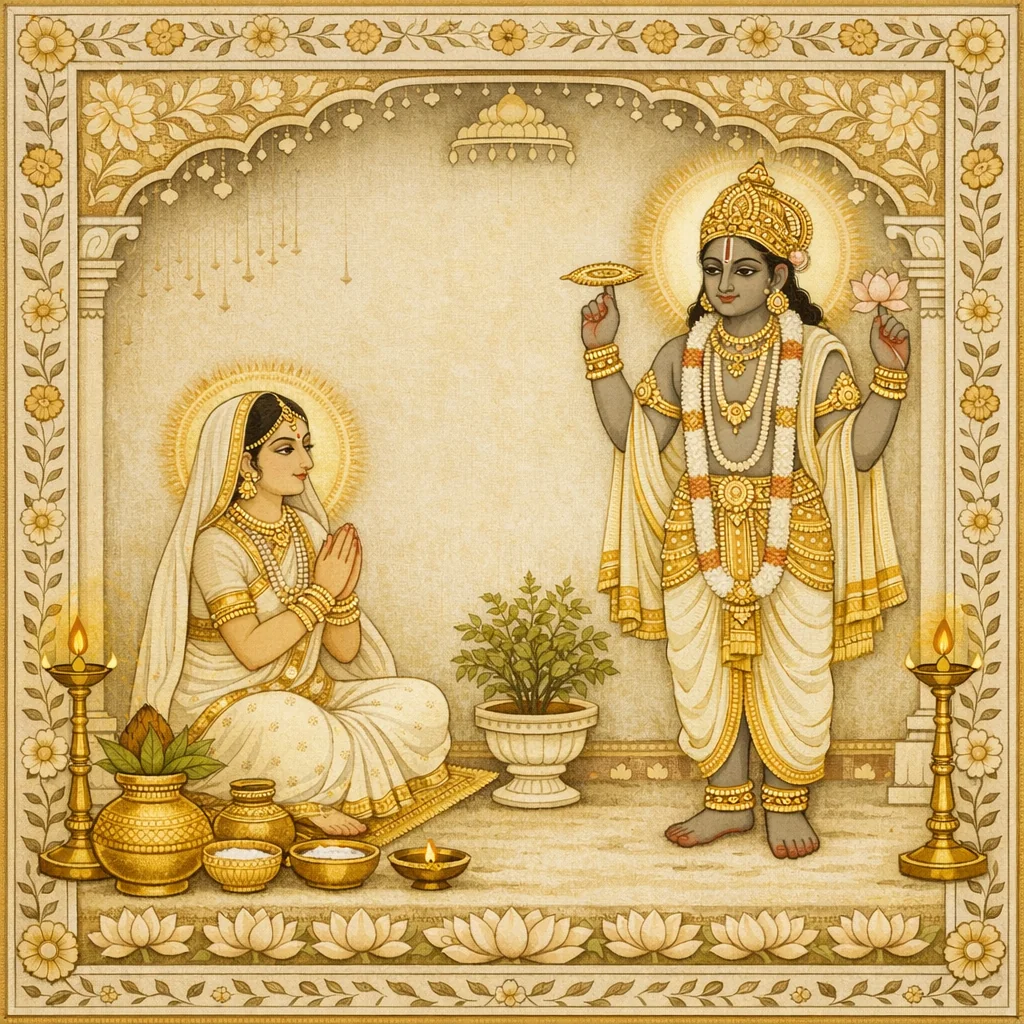
Continuing from Kaśyapa’s prior instruction, Aditi rigorously performs the payo-vrata with single-pointed meditation on Vāsudeva, bringing mind and senses under control. Pleased, the four-armed Lord appears before her; overwhelmed with sāttvika-bhāvas, she offers prayers praising Him as yajña-bhoktā, universal form, infallible controller, and the giver of all perfections. Viṣṇu reveals He already knows her intent: to restore the devas’ lost kingdom and honor, and to see the asuras defeated. Yet He cautions that the daitya leaders are presently “unconquerable” due to brāhmaṇa protection—thus direct force will not yield happiness. Because her vow has satisfied Him, He grants a strategic boon: He will become her son, entered through Kaśyapa, to protect the devas. Aditi is instructed to worship Kaśyapa while keeping the plan confidential. After the Lord disappears, Kaśyapa, in trance, perceives Viṣṇu’s plenary portion entering him; he places his potency into Aditi’s womb. Brahmā, recognizing the Lord’s descent, offers Vedic prayers—linking this chapter forward into the avatāra narrative that will unfold as Vāmana’s appearance and the reconfiguration of sovereignty in the next chapters.
Shlokas
Verse 1
श्रीशुक उवाच इत्युक्ता सादिती राजन्स्वभर्त्रा कश्यपेन वै । अन्वतिष्ठद् व्रतमिदं द्वादशाहमतन्द्रिता ॥ १ ॥
Śukadeva Gosvāmī said: O King, after Aditi was thus advised by her husband, Kaśyapa Muni, she strictly followed his instructions without laziness and in this way performed the payo-vrata ritualistic ceremony.
Verse 2
चिन्तयन्त्येकया बुद्ध्या महापुरुषमीश्वरम् । प्रगृह्येन्द्रियदुष्टाश्वान्मनसा बुद्धिसारथि: ॥ २ ॥ मनश्चैकाग्रया बुद्ध्या भगवत्यखिलात्मनि । वासुदेवे समाधाय चचार ह पयोव्रतम् ॥ ३ ॥
With full, undiverted attention, Aditi thought of the Supreme Personality of Godhead and in this way brought under full control her mind and senses, which resembled forceful horses. She concentrated her mind upon the Supreme Lord, Vāsudeva. Thus she performed the ritualistic ceremony known as payo-vrata.
Verse 3
चिन्तयन्त्येकया बुद्ध्या महापुरुषमीश्वरम् । प्रगृह्येन्द्रियदुष्टाश्वान्मनसा बुद्धिसारथि: ॥ २ ॥ मनश्चैकाग्रया बुद्ध्या भगवत्यखिलात्मनि । वासुदेवे समाधाय चचार ह पयोव्रतम् ॥ ३ ॥
With full, undiverted attention, Aditi thought of the Supreme Personality of Godhead and in this way brought under full control her mind and senses, which resembled forceful horses. She concentrated her mind upon the Supreme Lord, Vāsudeva. Thus she performed the ritualistic ceremony known as payo-vrata.
Verse 4
तस्या: प्रादुरभूत्तात भगवानादिपुरुष: । पीतवासाश्चतुर्बाहु: शङ्खचक्रगदाधर: ॥ ४ ॥
My dear King, the original Supreme Personality of Godhead, dressed in yellow garments and bearing a conchshell, disc, club and lotus in His four hands, then appeared before Aditi.
Verse 5
तं नेत्रगोचरं वीक्ष्य सहसोत्थाय सादरम् । ननाम भुवि कायेन दण्डवत् प्रीतिविह्वला ॥ ५ ॥
When the Supreme Personality of Godhead became visible to Aditi’s eyes, Aditi was so overwhelmed by transcendental bliss that she at once stood up and then fell to the ground like a rod to offer the Lord her respectful obeisances.
Verse 6
सोत्थाय बद्धाञ्जलिरीडितुं स्थिता नोत्सेह आनन्दजलाकुलेक्षणा । बभूव तूष्णीं पुलकाकुलाकृति- स्तद्दर्शनात्युत्सवगात्रवेपथु: ॥ ६ ॥
Aditi stood silently with folded hands, unable to offer prayers to the Lord. Because of transcendental bliss, tears filled her eyes, and the hairs on her body stood on end. Because she could see the Supreme Personality of Godhead face to face, she felt ecstasy, and her body trembled.
Verse 7
प्रीत्या शनैर्गद्गदया गिरा हरिं तुष्टाव सा देव्यदिति: कुरूद्वह । उद्वीक्षती सा पिबतीव चक्षुषा रमापतिं यज्ञपतिं जगत्पतिम् ॥ ७ ॥
O Mahārāja Parīkṣit, the demigoddess Aditi then began offering her prayers to the Supreme Personality of Godhead in a faltering voice and with great love. She appeared as though drinking through her eyes the Supreme Lord, who is the husband of the goddess of fortune, the enjoyer of all sacrificial ceremonies, and the master and Lord of the entire universe.
Verse 8
श्रीअदितिरुवाच यज्ञेश यज्ञपुरुषाच्युत तीर्थपाद तीर्थश्रव: श्रवणमङ्गलनामधेय । आपन्नलोकवृजिनोपशमोदयाद्य शं न: कृधीश भगवन्नसि दीननाथ: ॥ ८ ॥
The goddess Aditi said: O master and enjoyer of all sacrificial ceremonies, O infallible and most famous person, whose name, when chanted, spreads all good fortune! O original Supreme Personality of Godhead, supreme controller, shelter of all holy places, You are the shelter of all poor, suffering living entities, and You have appeared to diminish their suffering. Please be kind to us and spread our good fortune.
Verse 9
विश्वाय विश्वभवनस्थितिसंयमाय स्वैरं गृहीतपुरुशक्तिगुणाय भूम्ने । स्वस्थाय शश्वदुपबृंहितपूर्णबोध- व्यापादितात्मतमसे हरये नमस्ते ॥ ९ ॥
My Lord, You are the all-pervading universal form, the fully independent creator, maintainer and destroyer of this universe. Although You engage Your energy in matter, You are always situated in Your original form and never fall from that position, for Your knowledge is infallible and always suitable to any situation. You are never bewildered by illusion. O my Lord, let me offer my respectful obeisances unto You.
Verse 10
आयु: परं वपुरभीष्टमतुल्यलक्ष्मी- र्द्योभूरसा: सकलयोगगुणास्त्रिवर्ग: । ज्ञानं च केवलमनन्त भवन्ति तुष्टात् त्वत्तो नृणां किमु सपत्नजयादिराशी: ॥ १० ॥
O unlimited one, if Your Lordship is satisfied, one can very easily obtain a lifetime as long as that of Lord Brahmā, a body either in the upper, lower or middle planetary systems, unlimited material opulence, religion, economic development and satisfaction of the senses, full transcendental knowledge, and the eight yogic perfections, what to speak of such petty achievements as conquering one’s rivals.
Verse 11
श्रीशुक उवाच अदित्यैवं स्तुतो राजन्भगवान्पुष्करेक्षण: । क्षेत्रज्ञ: सर्वभूतानामिति होवाच भारत ॥ ११ ॥
Śukadeva Gosvāmī said: O King Parīkṣit, best of the Bharata dynasty, when the lotus-eyed Lord, the Supersoul of all living entities, was thus worshiped by Aditi, He replied as follows.
Verse 12
श्रीभगवानुवाच देवमातर्भवत्या मे विज्ञातं चिरकाङ्क्षितम् । यत् सपत्नैर्हृतश्रीणां च्यावितानां स्वधामत: ॥ १२ ॥
The Supreme Personality of Godhead said: O mother of the demigods, I have already understood your long-cherished desires for the welfare of your sons, who have been deprived of all opulences and driven from their residence by their enemies.
Verse 13
तान्विनिर्जित्य समरे दुर्मदानसुरर्षभान् । प्रतिलब्धजयश्रीभि: पुत्रैरिच्छस्युपासितुम् ॥ १३ ॥
O Devī, O goddess, I can understand that you want to regain your sons and be together with them to worship Me, after defeating the enemies in battle and retrieving your abode and opulences.
Verse 14
इन्द्रज्येष्ठै: स्वतनयैर्हतानां युधि विद्विषाम् । स्त्रियो रुदन्तीरासाद्य द्रष्टुमिच्छसि दु:खिता: ॥ १४ ॥
You want to see the wives of the demons lamenting for the death of their husbands when those demons, the enemies of your sons, are killed in battle by the demigods, of whom Indra is the chief.
Verse 15
आत्मजान्सुसमृद्धांस्त्वं प्रत्याहृतयश:श्रिय: । नाकपृष्ठमधिष्ठाय क्रीडतो द्रष्टुमिच्छसि ॥ १५ ॥
You want your sons to regain their lost reputation and opulence and live again on their heavenly planet as usual.
Verse 16
प्रायोऽधुना तेऽसुरयूथनाथा अपारणीया इति देवि मे मति: । यत्तेऽनुकूलेश्वरविप्रगुप्ता न विक्रमस्तत्र सुखं ददाति ॥ १६ ॥
O mother of the demigods, in My opinion almost all the chiefs of the demons are now unconquerable, for they are being protected by brāhmaṇas, whom the Supreme Lord always favors. Thus the use of power against them now will not at all be a source of happiness.
Verse 17
अथाप्युपायो मम देवि चिन्त्य: सन्तोषितस्य व्रतचर्यया ते । ममार्चनं नार्हति गन्तुमन्यथा श्रद्धानुरूपं फलहेतुकत्वात् ॥ १७ ॥
Yet because I have been satisfied by the activities of your vow, O goddess Aditi, I must find some means to favor you, for worship of Me never goes in vain but certainly gives the desired result according to what one deserves.
Verse 18
त्वयार्चितश्चाहमपत्यगुप्तये पयोव्रतेनानुगुणं समीडित: । स्वांशेन पुत्रत्वमुपेत्य ते सुतान् गोप्तास्मि मारीचतपस्यधिष्ठित: ॥ १८ ॥
You have prayed to Me and properly worshiped Me by performing the great payo-vrata ceremony for the sake of protecting your sons. Because of Kaśyapa Muni’s austerities, I shall agree to become your son and thus protect your other sons.
Verse 19
उपधाव पतिं भद्रे प्रजापतिमकल्मषम् । मां च भावयती पत्यावेवंरूपमवस्थितम् ॥ १९ ॥
Always thinking of Me as being situated within the body of your husband, Kaśyapa, go worship your husband, who has been purified by his austerity.
Verse 20
नैतत् परस्मा आख्येयं पृष्टयापि कथञ्चन । सर्वं सम्पद्यते देवि देवगुह्यं सुसंवृतम् ॥ २० ॥
O lady, even if someone inquires, you should not disclose this fact to anyone. That which is very confidential is successful if kept secret.
Verse 21
श्रीशुक उवाच एतावदुक्त्वा भगवांस्तत्रैवान्तरधीयत । अदितिर्दुर्लभं लब्ध्वा हरेर्जन्मात्मनि प्रभो: । उपाधावत् पतिं भक्त्या परया कृतकृत्यवत् ॥ २१ ॥
Śukadeva Gosvāmī said: After speaking in this way, the Supreme Personality of Godhead disappeared from that very spot. Aditi, having received the extremely valuable benediction that the Lord would appear as her son, considered herself very successful, and with great devotion she approached her husband.
Verse 22
स वै समाधियोगेन कश्यपस्तदबुध्यत । प्रविष्टमात्मनि हरेरंशं ह्यवितथेक्षण: ॥ २२ ॥
Being situated in a meditational trance, Kaśyapa Muni, whose vision is never mistaken, could see that a plenary portion of the Supreme Personality of Godhead had entered within him.
Verse 23
सोऽदित्यां वीर्यमाधत्त तपसा चिरसम्भृतम् । समाहितमना राजन्दारुण्यग्निं यथानिल: ॥ २३ ॥
O King, as the wind promotes friction between two pieces of wood and thus gives rise to fire, Kaśyapa Muni, whose transcendental position was fully absorbed in the Supreme Personality of Godhead, transferred his potency into the womb of Aditi.
Verse 24
अदितेर्धिष्ठितं गर्भं भगवन्तं सनातनम् । हिरण्यगर्भो विज्ञाय समीडे गुह्यनामभि: ॥ २४ ॥
When Lord Brahmā understood that the Supreme Personality of Godhead was now within the womb of Aditi, he began to offer prayers to the Lord by reciting transcendental names.
Verse 25
श्रीब्रह्मोवाच जयोरुगाय भगवन्नुरुक्रम नमोऽस्तु ते । नमो ब्रह्मण्यदेवाय त्रिगुणाय नमो नम: ॥ २५ ॥
Lord Brahmā said: O Supreme Personality of Godhead, all glories unto You, who are glorified by all and whose activities are all uncommon. I offer my respectful obeisances unto You, O Lord of the transcendentalists, controller of the three modes of nature. I offer my respectful obeisances unto You again and again.
Verse 26
नमस्ते पृश्निगर्भाय वेदगर्भाय वेधसे । त्रिनाभाय त्रिपृष्ठाय शिपिविष्टाय विष्णवे ॥ २६ ॥
I offer my respectful obeisances unto You, the all-pervading Lord Viṣṇu, who have entered the cores of the hearts of all living entities. All the three worlds reside within Your navel, yet You are above the three worlds. Formerly You appeared as the son of Pṛśni. To You, the supreme creator, who are understood only through Vedic knowledge, I offer my respectful obeisances.
Verse 27
त्वमादिरन्तो भुवनस्य मध्य- मनन्तशक्तिं पुरुषं यमाहु: । कालो भवानाक्षिपतीश विश्वं स्रोतो यथान्त:पतितं गभीरम् ॥ २७ ॥
O my Lord, You are the beginning, the manifestation and the ultimate dissolution of the three worlds, and You are celebrated in the Vedas as the reservoir of unlimited potencies, the Supreme Person. O my Lord, as waves attract branches and leaves that have fallen into deep water, You, the supreme eternal time factor, attract everything in this universe.
Verse 28
त्वं वै प्रजानां स्थिरजङ्गमानां प्रजापतीनामसि सम्भविष्णु: । दिवौकसां देव दिवश्च्युतानां परायणं नौरिव मज्जतोऽप्सु ॥ २८ ॥
My Lord, You are the original generator of all living entities, stationary or moving, and You are also the generator of the Prajāpatis. O my Lord, as a boat is the only hope for a person drowning in the water, You are the only shelter for the demigods, who are now bereft of their heavenly position.
Frequently Asked Questions
Payo-vrata exemplifies vrata elevated by bhakti: disciplined observance coupled with unwavering remembrance of Vāsudeva. The chapter shows that such worship compels divine response (poṣaṇa), not merely as material reward but as the Lord’s personal commitment to protect His devotees’ welfare through avatāra.
The text attributes their current invincibility to brāhmaṇa protection. Since the Supreme Lord favors and safeguards brāhmaṇas and the sanctity of their influence, attempts to overpower the asuras by sheer force—while they are aligned with brahminical backing—would not produce auspicious results; hence the Lord chooses a subtler, dharma-consistent strategy.
The narrative presents the Lord’s descent as voluntary and purpose-driven: satisfied by devotion, He enters Kaśyapa as a plenary portion and is placed into Aditi’s womb, establishing the avatāra’s human-like birth while maintaining divine transcendence. The theological emphasis is that the Lord becomes ‘bound’ by bhakti and vows, not by karma.
The chapter frames secrecy (guhya) as a condition for successful sacred strategy. Confidentiality prevents obstruction, preserves the integrity of the vow’s fruit, and aligns with the Purāṇic motif that divine plans unfold best when protected from premature disclosure and counteraction.