Adhyaya 16
Aditi’s Lament and Kaśyapa’s Instruction of the Payo-vrata (Milk Vow) to Please Keśava
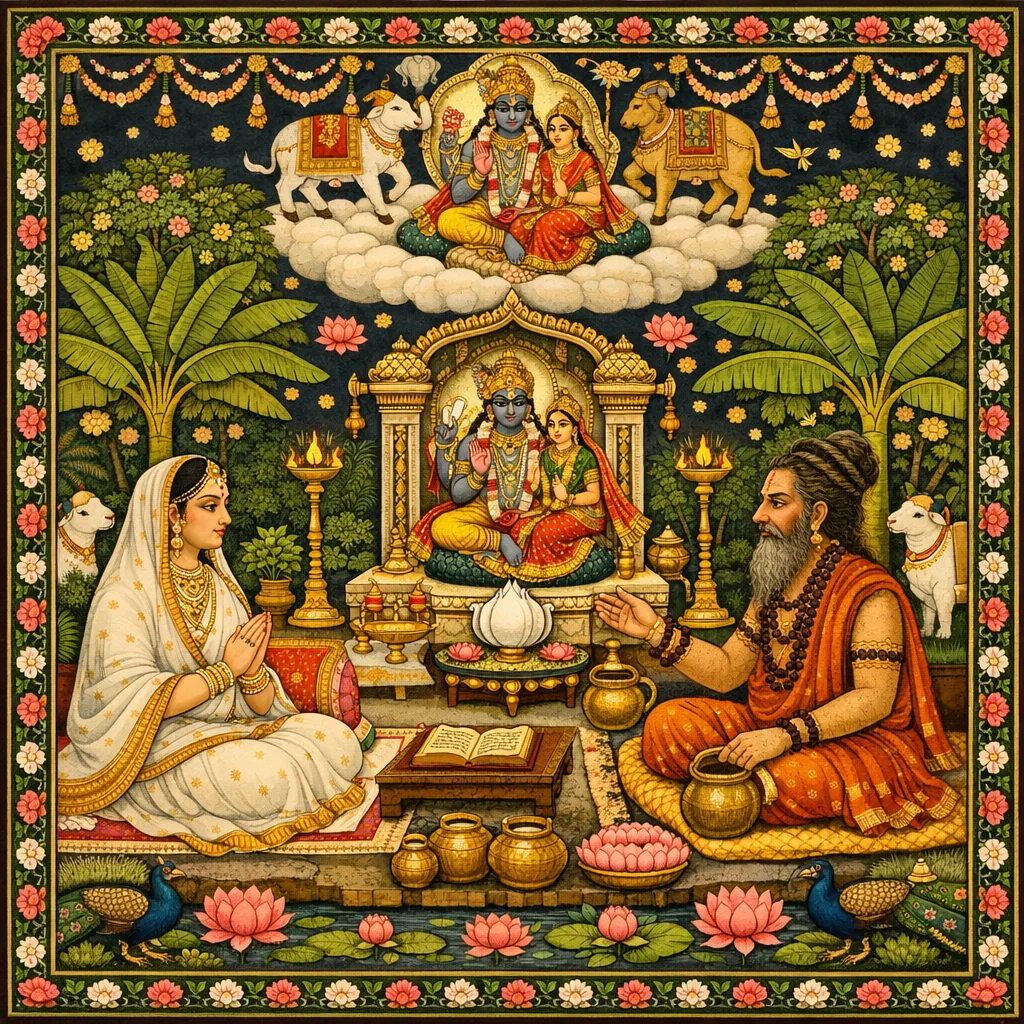
After the devas (Aditi’s sons) lose their heavenly position and the asuras occupy Svarga, Aditi grieves as though unprotected. Kaśyapa returns from meditation, observes the āśrama’s loss of festivity, and first diagnoses possible lapses in gṛhastha-dharma—hospitality to atithis, maintenance of sacrificial fire, and reverence to brāhmaṇas—underscoring the householder’s responsibility as a religious node of society. Aditi replies that all duties are intact; her sorrow is specifically the devas’ dispossession. She appeals to Kaśyapa for protection, noting the Lord’s impartiality yet special favor to devotees. Kaśyapa gently redirects her from bodily and familial attachment toward the ultimate remedy: exclusive devotional service to Vāsudeva, the heart-dwelling master who alone grants auspiciousness. At Aditi’s request for a practical method, Kaśyapa transmits Brahmā’s procedure: the payo-vrata observed for twelve days in Phālguna’s bright fortnight, featuring purification, mantra-prayers, Deity worship, offerings, feeding brāhmaṇas, celibacy, simplicity, and universal distribution of viṣṇu-prasāda. This chapter bridges the devas’ crisis to the forthcoming divine response—Aditi’s disciplined bhakti that prepares the narrative ground for the Lord’s avatāra intervention.
Shlokas
Verse 1
श्रीशुक उवाच एवं पुत्रेषु नष्टेषु देवमातादितिस्तदा । हृते त्रिविष्टपे दैत्यै: पर्यतप्यदनाथवत् ॥ १ ॥
Śukadeva Gosvāmī said: O King, when Aditi’s sons, the demigods, had thus disappeared from heaven and the demons had occupied their places, Aditi began lamenting, as if she had no protector.
Verse 2
एकदा कश्यपस्तस्या आश्रमं भगवानगात् । निरुत्सवं निरानन्दं समाधेर्विरतश्चिरात् ॥ २ ॥
After many, many days, the great powerful sage Kaśyapa Muni arose from a trance of meditation and returned home to see the āśrama of Aditi neither jubilant nor festive.
Verse 3
स पत्नीं दीनवदनां कृतासनपरिग्रह: । सभाजितो यथान्यायमिदमाह कुरूद्वह ॥ ३ ॥
O best of the Kurus, when Kaśyapa Muni had been properly received and welcomed, he took his seat and then spoke as follows to his wife, Aditi, who was very morose.
Verse 4
अप्यभद्रं न विप्राणां भद्रे लोकेऽधुनागतम् । न धर्मस्य न लोकस्य मृत्योश्छन्दानुवर्तिन: ॥ ४ ॥
O most gentle one, I wonder whether anything inauspicious has now taken place in regard to religious principles, the brāhmaṇas or the people in general, who are subject to the whims of death.
Verse 5
अपि वाकुशलं किञ्चिद् गृहेषु गृहमेधिनि । धर्मस्यार्थस्य कामस्य यत्र योगो ह्ययोगिनाम् ॥ ५ ॥
O my wife, who are very much attached to household life, if the principles of religion, economic development and satisfaction of the senses are properly followed in household life, one’s activities are as good as those of a transcendentalist. I wonder whether there have been any discrepancies in following these principles.
Verse 6
अपि वातिथयोऽभ्येत्य कुटुम्बासक्तया त्वया । गृहादपूजिता याता: प्रत्युत्थानेन वा क्वचित् ॥ ६ ॥
I wonder whether because of being too attached to the members of your family, you failed to properly receive uninvited guests, who therefore were not welcomed and went away.
Verse 7
गृहेषु येष्वतिथयो नार्चिता: सलिलैरपि । यदि निर्यान्ति ते नूनं फेरुराजगृहोपमा: ॥ ७ ॥
Homes from which guests go away without having been received even with an offering of a little water are like those holes in the field which are the homes of jackals.
Verse 8
अप्यग्नयस्तु वेलायां न हुता हविषा सति । त्वयोद्विग्नधिया भद्रे प्रोषिते मयि कर्हिचित् ॥ ८ ॥
O chaste and auspicious woman, when I left home for other places, were you in so much anxiety that you did not offer oblations of ghee into the fire?
Verse 9
यत्पूजया कामदुघान्याति लोकान्गृहान्वित: । ब्राह्मणोऽग्निश्च वै विष्णो: सर्वदेवात्मनो मुखम् ॥ ९ ॥
By worshiping the fire and the brāhmaṇas, a householder can achieve the desired goal of residing in the higher planets, for the sacrificial fire and the brāhmaṇas are to be considered the mouth of Lord Viṣṇu, who is the Supersoul of all the demigods.
Verse 10
अपि सर्वे कुशलिनस्तव पुत्रा मनस्विनि । लक्षयेऽस्वस्थमात्मानं भवत्या लक्षणैरहम् ॥ १० ॥
O great-minded lady, are all your sons faring well? Seeing your withered face, I can perceive that your mind is not tranquil. How is this so?
Verse 11
श्रीअदितिरुवाच भद्रं द्विजगवां ब्रह्मन्धर्मस्यास्य जनस्य च । त्रिवर्गस्य परं क्षेत्रं गृहमेधिन्गृहा इमे ॥ ११ ॥
Aditi said: O my respected brāhmaṇa husband, all is well with the brāhmaṇas, the cows, religion and the welfare of other people. O master of the house, the three principles of dharma, artha and kāma flourish in household life, which is consequently full of good fortune.
Verse 12
अग्नयोऽतिथयो भृत्या भिक्षवो ये च लिप्सव: । सर्वं भगवतो ब्रह्मन्ननुध्यानान्न रिष्यति ॥ १२ ॥
O beloved husband, the fires, guests, servants and beggars are all being properly cared for by me. Because I always think of you, there is no possibility that any of the religious principles will be neglected.
Verse 13
को नु मे भगवन्कामो न सम्पद्येत मानस: । यस्या भवान्प्रजाध्यक्ष एवं धर्मान्प्रभाषते ॥ १३ ॥
O my lord, since you are a Prajāpati and are personally my instructor in the principles of religion, where is the possibility that all my desires will not be fulfilled?
Verse 14
तवैव मारीच मन:शरीरजा: प्रजा इमा: सत्त्वरजस्तमोजुष: । समो भवांस्तास्वसुरादिषु प्रभो तथापि भक्तं भजते महेश्वर: ॥ १४ ॥
O son of Marīci, because you are a great personality you are equal toward all the demons and demigods, who are born either from your body or from your mind and who possess one or another of the three qualities — sattva-guṇa, rajo-guṇa or tamo-guṇa. But although the Supreme Personality of Godhead, the supreme controller, is equal toward all living entities, He is especially favorable to the devotees.
Verse 15
तस्मादीश भजन्त्या मे श्रेयश्चिन्तय सुव्रत । हृतश्रियो हृतस्थानान्सपत्नै: पाहि न: प्रभो ॥ १५ ॥
Therefore, most gentle lord, kindly favor your maidservant. We have now been deprived of our opulence and residence by our competitors, the demons. Kindly give us protection.
Verse 16
परैर्विवासिता साहं मग्ना व्यसनसागरे । ऐश्वर्यं श्रीर्यश: स्थानं हृतानि प्रबलैर्मम ॥ १६ ॥
The demons, our formidably powerful enemies, have taken away our opulence, our beauty, our fame and even our residence. Indeed, we have now been exiled, and we are drowning in an ocean of trouble.
Verse 17
यथा तानि पुन: साधो प्रपद्येरन् ममात्मजा: । तथा विधेहि कल्याणं धिया कल्याणकृत्तम ॥ १७ ॥
O best of sages, best of all those who grant auspicious benedictions, please consider our situation and bestow upon my sons the benedictions by which they can regain what they have lost.
Verse 18
श्रीशुक उवाच एवमभ्यर्थितोऽदित्या कस्तामाह स्मयन्निव । अहो मायाबलं विष्णो: स्नेहबद्धमिदं जगत् ॥ १८ ॥
Śukadeva Gosvāmī continued: When Kaśyapa Muni was thus requested by Aditi, he slightly smiled. “Alas,” he said, “how powerful is the illusory energy of Lord Viṣṇu, by which the entire world is bound by affection for children!”
Verse 19
क्व देहो भौतिकोऽनात्मा क्व चात्मा प्रकृते: पर: । कस्य के पतिपुत्राद्या मोह एव हि कारणम् ॥ १९ ॥
Kaśyapa Muni continued: What is this material body, made of five elements? It is different from the spirit soul. Indeed, the spirit soul is completely different from the material elements from which the body is made. But because of bodily attachment, one is regarded as a husband or son. These illusory relationships are caused by misunderstanding.
Verse 20
उपतिष्ठस्व पुरुषं भगवन्तं जनार्दनम् । सर्वभूतगुहावासं वासुदेवं जगद्गुरुम् ॥ २० ॥
My dear Aditi, engage in devotional service to the Supreme Personality of Godhead, who is the master of everything, who can subdue everyone’s enemies, and who sits within everyone’s heart. Only that Supreme Person — Kṛṣṇa, or Vāsudeva — can bestow all auspicious benedictions upon everyone, for He is the spiritual master of the universe.
Verse 21
स विधास्यति ते कामान्हरिर्दीनानुकम्पन: । अमोघा भगवद्भक्तिर्नेतरेति मतिर्मम ॥ २१ ॥
The Supreme Personality of Godhead, who is very merciful to the poor, will fulfill all of your desires, for devotional service unto Him is infallible. Any method other than devotional service is useless. That is my opinion.
Verse 22
श्रीअदितिरुवाच केनाहं विधिना ब्रह्मन्नुपस्थास्ये जगत्पतिम् । यथा मे सत्यसङ्कल्पो विदध्यात् स मनोरथम् ॥ २२ ॥
Śrīmatī Aditi said: O brāhmaṇa, tell me the regulative principles by which I may worship the supreme master of the world so that He will be pleased with me and fulfill all my desires.
Verse 23
आदिश त्वं द्विजश्रेष्ठ विधिं तदुपधावनम् । आशु तुष्यति मे देव: सीदन्त्या: सह पुत्रकै: ॥ २३ ॥
O best of the brāhmaṇas, kindly instruct me in the perfect method of worshiping the Supreme Personality of Godhead in devotional service, by which the Lord may very soon be pleased with me and save me, along with my sons, from this most dangerous condition.
Verse 24
श्रीकश्यप उवाच एतन्मे भगवान्पृष्ट: प्रजाकामस्य पद्मज: । यदाह ते प्रवक्ष्यामि व्रतं केशवतोषणम् ॥ २४ ॥
Śrī Kaśyapa Muni said: When I desired offspring, I placed inquiries before Lord Brahmā, who is born from a lotus flower. Now I shall explain to you the same process Lord Brahmā instructed me, by which Keśava, the Supreme Personality of Godhead, is satisfied.
Verse 25
फाल्गुनस्यामले पक्षे द्वादशाहं पयोव्रतम् । अर्चयेदरविन्दाक्षं भक्त्या परमयान्वित: ॥ २५ ॥
In the bright fortnight of the month of Phālguna [February and March], for twelve days ending with Dvādaśī, one should observe the vow of subsisting only on milk and should worship the lotus-eyed Supreme Personality of Godhead with all devotion.
Verse 26
सिनीवाल्यां मृदालिप्य स्नायात् क्रोडविदीर्णया । यदि लभ्येत वै स्रोतस्येतं मन्त्रमुदीरयेत् ॥ २६ ॥
If dirt dug up by a boar is available, on the day of the dark moon one should smear this dirt on his body and then bathe in a flowing river. While bathing, one should chant the following mantra.
Verse 27
त्वं देव्यादिवराहेण रसाया: स्थानमिच्छता । उद्धृतासि नमस्तुभ्यं पाप्मानं मे प्रणाशय ॥ २७ ॥
O mother earth, you were raised by the Supreme Personality of Godhead in the form of a boar because of your desiring to have a place to stay. I pray that you kindly vanquish all the reactions of my sinful life. I offer my respectful obeisances unto you.
Verse 28
निर्वर्तितात्मनियमो देवमर्चेत् समाहित: । अर्चायां स्थण्डिले सूर्ये जले वह्नौ गुरावपि ॥ २८ ॥
Thereafter, one should perform his daily spiritual duties and then, with great attention, offer worship to the Deity of the Supreme Personality of Godhead, and also to the altar, the sun, water, fire and the spiritual master.
Verse 29
नमस्तुभ्यं भगवते पुरुषाय महीयसे । सर्वभूतनिवासाय वासुदेवाय साक्षिणे ॥ २९ ॥
O Supreme Personality of Godhead, greatest of all, who lives in everyone’s heart and in whom everyone lives, O witness of everything, O Vāsudeva, supreme and all-pervading person, I offer my respectful obeisances unto You.
Verse 30
नमोऽव्यक्ताय सूक्ष्माय प्रधानपुरुषाय च । चतुर्विंशद्गुणज्ञाय गुणसङ्ख्यानहेतवे ॥ ३० ॥
I offer my respectful obeisances unto You, the Supreme Person. Being very subtle, You are never visible to material eyes. You are the knower of the twenty-four elements, and You are the inaugurator of the sāṅkhya-yoga system.
Verse 31
नमो द्विशीर्ष्णे त्रिपदे चतु:शृङ्गाय तन्तवे । सप्तहस्ताय यज्ञाय त्रयीविद्यात्मने नम: ॥ ३१ ॥
I offer my respectful obeisances unto You, the Supreme Personality of Godhead, who have two heads [prāyaṇīya and udāyanīya], three legs [savana-traya], four horns [the four Vedas] and seven hands [the seven chandas, such as Gāyatrī]. I offer my obeisances unto You, whose heart and soul are the three Vedic rituals [karma-kāṇḍa, jñāna-kāṇḍa and upāsanā-kāṇḍa] and who expand these rituals in the form of sacrifice.
Verse 32
नम: शिवाय रुद्राय नम: शक्तिधराय च । सर्वविद्याधिपतये भूतानां पतये नम: ॥ ३२ ॥
I offer my respectful obeisances unto You, Lord Śiva, or Rudra, who are the reservoir of all potencies, the reservoir of all knowledge, and the master of everyone.
Verse 33
नमो हिरण्यगर्भाय प्राणाय जगदात्मने । योगैश्वर्यशरीराय नमस्ते योगहेतवे ॥ ३३ ॥
I offer my respectful obeisances unto You, who are situated as Hiraṇyagarbha, the source of life, the Supersoul of every living entity. Your body is the source of the opulence of all mystic power. I offer my respectful obeisances unto You.
Verse 34
नमस्त आदिदेवाय साक्षिभूताय ते नम: । नारायणाय ऋषये नराय हरये नम: ॥ ३४ ॥
I offer my respectful obeisances unto You, who are the original Personality of Godhead, the witness in everyone’s heart, and the incarnation of Nara-Nārāyaṇa Ṛṣi in the form of a human being. O Personality of Godhead, I offer my respectful obeisances unto You.
Verse 35
नमो मरकतश्यामवपुषेऽधिगतश्रिये । केशवाय नमस्तुभ्यं नमस्ते पीतवाससे ॥ ३५ ॥
My Lord, I offer my respectful obeisances unto You, who are dressed in yellow garments, whose bodily hue resembles the marakata gem, and who have full control over the goddess of fortune. O my Lord Keśava, I offer my respectful obeisances unto You.
Verse 36
त्वं सर्ववरद: पुंसां वरेण्य वरदर्षभ । अतस्ते श्रेयसे धीरा: पादरेणुमुपासते ॥ ३६ ॥
O most exalted and worshipable Lord, best of those who bestow benediction, You can fulfill the desires of everyone, and therefore those who are sober, for their own welfare, worship the dust of Your lotus feet.
Verse 37
अन्ववर्तन्त यं देवा: श्रीश्च तत्पादपद्मयो: । स्पृहयन्त इवामोदं भगवान्मे प्रसीदताम् ॥ ३७ ॥
All the demigods, as well as the goddess of fortune, engage in the service of His lotus feet. Indeed, they respect the fragrance of those lotus feet. May the Supreme Personality of Godhead be pleased with me.
Verse 38
एतैर्मन्त्रैर्हृषीकेशमावाहनपुरस्कृतम् । अर्चयेच्छ्रद्धया युक्त: पाद्योपस्पर्शनादिभि: ॥ ३८ ॥
Kaśyapa Muni continued: By chanting all these mantras, welcoming the Supreme Personality of Godhead with faith and devotion, and offering Him items of worship [such as pādya and arghya], one should worship Keśava, Hṛṣīkeśa, Kṛṣṇa, the Supreme Personality of Godhead.
Verse 39
अर्चित्वा गन्धमाल्याद्यै: पयसा स्नपयेद् विभुम् । वस्त्रोपवीताभरणपाद्योपस्पर्शनैस्तत: । गन्धधूपादिभिश्चार्चेद्द्वादशाक्षरविद्यया ॥ ३९ ॥
In the beginning, the devotee should chant the dvādaśākṣara-mantra and offer flower garlands, incense and so on. After worshiping the Lord in this way, one should bathe the Lord with milk and dress Him with proper garments, a sacred thread, and ornaments. After offering water to wash the Lord’s feet, one should again worship the Lord with fragrant flowers, incense and other paraphernalia.
Verse 40
शृतं पयसि नैवेद्यं शाल्यन्नं विभवे सति । ससर्पि: सगुडं दत्त्वा जुहुयान्मूलविद्यया ॥ ४० ॥
If one can afford to, one should offer the Deity fine rice boiled in milk with clarified butter and molasses. While chanting the same original mantra, one should offer all this to the fire.
Verse 41
निवेदितं तद्भक्ताय दद्याद्भुञ्जीत वा स्वयम् । दत्त्वाचमनमर्चित्वा ताम्बूलं च निवेदयेत् ॥ ४१ ॥
One should offer all the prasāda to a Vaiṣṇava or offer him some of the prasāda and then take some oneself. After this, one should offer the Deity ācamana and then betel nut and then again worship the Lord.
Verse 42
जपेदष्टोत्तरशतं स्तुवीत स्तुतिभि: प्रभुम् । कृत्वा प्रदक्षिणं भूमौ प्रणमेद् दण्डवन्मुदा ॥ ४२ ॥
Thereafter, one should silently murmur the mantra 108 times and offer prayers to the Lord for His glorification. Then one should circumambulate the Lord and finally, with great delight and satisfaction, offer obeisances, falling straight like a rod [daṇḍavat].
Verse 43
कृत्वा शिरसि तच्छेषां देवमुद्वासयेत् तत: । द्वयवरान्भोजयेद् विप्रान्पायसेन यथोचितम् ॥ ४३ ॥
After touching to one’s head all the flowers and water offered to the Deity, one should throw them into a sacred place. Then one should feed at least two brāhmaṇas with sweet rice.
Verse 44
भुञ्जीत तैरनुज्ञात: सेष्ट: शेषं सभाजितै: । ब्रह्मचार्यथ तद्रात्र्यां श्वोभूते प्रथमेऽहनि ॥ ४४ ॥ स्नात: शुचिर्यथोक्तेन विधिना सुसमाहित: । पयसा स्नापयित्वार्चेद् यावद्व्रतसमापनम् ॥ ४५ ॥
One should perfectly honor the respectable brāhmaṇas one has fed, and then, after taking their permission, one should take prasāda with his friends and relatives. For that night, one should observe strict celibacy, and the next morning, after bathing again, with purity and attention one should bathe the Deity of Viṣṇu with milk and worship Him according to the methods formerly stated in detail.
Verse 45
भुञ्जीत तैरनुज्ञात: सेष्ट: शेषं सभाजितै: । ब्रह्मचार्यथ तद्रात्र्यां श्वोभूते प्रथमेऽहनि ॥ ४४ ॥ स्नात: शुचिर्यथोक्तेन विधिना सुसमाहित: । पयसा स्नापयित्वार्चेद् यावद्व्रतसमापनम् ॥ ४५ ॥
One should perfectly honor the respectable brāhmaṇas one has fed, and then, after taking their permission, one should take prasāda with his friends and relatives. For that night, one should observe strict celibacy, and the next morning, after bathing again, with purity and attention one should bathe the Deity of Viṣṇu with milk and worship Him according to the methods formerly stated in detail.
Verse 46
पयोभक्षो व्रतमिदं चरेद् विष्णवर्चनादृत: । पूर्ववज्जुहुयादग्निं ब्राह्मणांश्चापि भोजयेत् ॥ ४६ ॥
Worshiping Lord Viṣṇu with great faith and devotion and living only by drinking milk, one should follow this vow. One should also offer oblations to the fire and feed the brāhmaṇas as mentioned before.
Verse 47
एवं त्वहरह: कुर्याद्द्वादशाहं पयोव्रतम् । हरेराराधनं होममर्हणं द्विजतर्पणम् ॥ ४७ ॥
In this way, until twelve days have passed, one should observe this payo-vrata, worshiping the Lord every day, executing the routine duties, performing sacrifices and feeding the brāhmaṇas.
Verse 48
प्रतिपद्दिनमारभ्य यावच्छुक्लत्रयोदशीम् । ब्रह्मचर्यमध:स्वप्नं स्नानं त्रिषवणं चरेत् ॥ ४८ ॥
From pratipat until the thirteenth day of the next bright moon [śukla-trayodaśī], one should observe complete celibacy, sleep on the floor, bathe three times a day and thus execute the vow.
Verse 49
वर्जयेदसदालापं भोगानुच्चावचांस्तथा । अहिंस्र: सर्वभूतानां वासुदेवपरायण: ॥ ४९ ॥
During this period, one should not unnecessarily talk of material subjects or topics of sense gratification, one should be completely free from envy of all living entities, and one should be a pure and simple devotee of Lord Vāsudeva.
Verse 50
त्रयोदश्यामथो विष्णो: स्नपनं पञ्चकैर्विभो: । कारयेच्छास्त्रदृष्टेन विधिना विधिकोविदै: ॥ ५० ॥
Thereafter, following the directions of the śāstra with help from brāhmaṇas who know the śāstra, on the thirteenth day of the moon one should bathe Lord Viṣṇu with five substances [milk, yogurt, ghee, sugar and honey].
Verse 51
पूजां च महतीं कुर्याद् वित्तशाठ्यविवर्जित: । चरुं निरूप्य पयसि शिपिविष्टाय विष्णवे ॥ ५१ ॥ सूक्तेन तेन पुरुषं यजेत सुसमाहित: । नैवेद्यं चातिगुणवद् दद्यात्पुरुषतुष्टिदम् ॥ ५२ ॥
Giving up the miserly habit of not spending money, one should arrange for the gorgeous worship of the Supreme Personality of Godhead, Viṣṇu, who is situated in the heart of every living entity. With great attention, one must prepare an oblation of grains boiled in ghee and milk and must chant the Puruṣa-sūkta mantra. The offerings of food should be of varieties of tastes. In this way, one should worship the Supreme Personality of Godhead.
Verse 52
पूजां च महतीं कुर्याद् वित्तशाठ्यविवर्जित: । चरुं निरूप्य पयसि शिपिविष्टाय विष्णवे ॥ ५१ ॥ सूक्तेन तेन पुरुषं यजेत सुसमाहित: । नैवेद्यं चातिगुणवद् दद्यात्पुरुषतुष्टिदम् ॥ ५२ ॥
Giving up the miserly habit of not spending money, one should arrange for the gorgeous worship of the Supreme Personality of Godhead, Viṣṇu, who is situated in the heart of every living entity. With great attention, one must prepare an oblation of grains boiled in ghee and milk and must chant the Puruṣa-sūkta mantra. The offerings of food should be of varieties of tastes. In this way, one should worship the Supreme Personality of Godhead.
Verse 53
आचार्यं ज्ञानसम्पन्नं वस्त्राभरणधेनुभि: । तोषयेदृत्विजश्चैव तद्विद्ध्याराधनं हरे: ॥ ५३ ॥
One should satisfy the spiritual master [ācārya], who is very learned in Vedic literature, and should satisfy his assistant priests [known as hotā, udgātā, adhvaryu and brahma]. One should please them by offering them clothing, ornaments and cows. This is the ceremony called viṣṇu-ārādhana, or worship of Lord Viṣṇu.
Verse 54
भोजयेत् तान्गुणवता सदन्नेन शुचिस्मिते । अन्यांश्च ब्राह्मणाञ्छक्त्या ये च तत्र समागता: ॥ ५४ ॥
O most auspicious lady, one should perform all the ceremonies under the direction of learned ācāryas and should satisfy them and their priests. By distributing prasāda, one should also satisfy the brāhmaṇas and others who have assembled.
Verse 55
दक्षिणां गुरवे दद्यादृत्विग्भ्यश्च यथार्हत: । अन्नाद्येनाश्वपाकांश्च प्रीणयेत्समुपागतान् ॥ ५५ ॥
One should satisfy the spiritual master and assistant priests by giving them cloth, ornaments, cows and also some monetary contribution. And by distributing prasāda one should satisfy everyone assembled, including even the lowest of men, the caṇḍālas [eaters of dog flesh].
Verse 56
भुक्तवत्सु च सर्वेषु दीनान्धकृपणादिषु । विष्णोस्तत्प्रीणनं विद्वान्भुञ्जीत सह बन्धुभि: ॥ ५६ ॥
One should distribute viṣṇu-prasāda to everyone, including the poor man, the blind man, the nondevotee and the non-brāhmaṇa. Knowing that Lord Viṣṇu is very pleased when everyone is sumptuously fed with viṣṇu-prasāda, the performer of yajña should then take prasāda with his friends and relatives.
Verse 57
नृत्यवादित्रगीतैश्च स्तुतिभि: स्वस्तिवाचकै: । कारयेत्तत्कथाभिश्च पूजां भगवतोऽन्वहम् ॥ ५७ ॥
Every day from pratipat to trayodaśī, one should continue the ceremony, to the accompaniment of dancing, singing, the beating of a drum, the chanting of prayers and all-auspicious mantras, and recitation of Śrīmad-Bhāgavatam. In this way, one should worship the Supreme Personality of Godhead.
Verse 58
एतत्पयोव्रतं नाम पुरुषाराधनं परम् । पितामहेनाभिहितं मया ते समुदाहृतम् ॥ ५८ ॥
This is the religious ritualistic ceremony known as payo-vrata, by which one may worship the Supreme Personality of Godhead. I received this information from Brahmā, my grandfather, and now I have described it to you in all details.
Verse 59
त्वं चानेन महाभागे सम्यक्चीर्णेन केशवम् । आत्मना शुद्धभावेन नियतात्मा भजाव्ययम् ॥ ५९ ॥
O most fortunate lady, establishing your mind in a good spirit, execute this process of payo-vrata and thus worship the Supreme Personality of Godhead, Keśava, who is inexhaustible.
Verse 60
अयं वै सर्वयज्ञाख्य: सर्वव्रतमिति स्मृतम् । तप:सारमिदं भद्रे दानं चेश्वरतर्पणम् ॥ ६० ॥
This payo-vrata is also known as sarva-yajña. In other words, by performing this sacrifice one can perform all other sacrifices automatically. This is also acknowledged to be the best of all ritualistic ceremonies. O gentle lady, it is the essence of all austerities, and it is the process of giving charity and pleasing the supreme controller.
Verse 61
त एव नियमा: साक्षात्त एव च यमोत्तमा: । तपो दानं व्रतं यज्ञो येन तुष्यत्यधोक्षज: ॥ ६१ ॥
This is the best process for pleasing the transcendental Supreme Personality of Godhead, known as Adhokṣaja. It is the best of all regulative principles, the best austerity, the best process of giving charity, and the best process of sacrifice.
Verse 62
तस्मादेतद्व्रतं भद्रे प्रयता श्रद्धयाचर । भगवान्परितुष्टस्ते वरानाशु विधास्यति ॥ ६२ ॥
Therefore, my dear gentle lady, follow this ritualistic vow, strictly observing the regulative principles. By this process, the Supreme Person will very soon be pleased with you and will satisfy all your desires.
Frequently Asked Questions
Payo-vrata functions as a bridge from crisis to avatāra: it converts Aditi’s political loss into devotional qualification. The ritual’s elements—purity, mantra, Deity worship, feeding brāhmaṇas, celibacy, simplicity, and prasāda distribution—are framed as bhakti-aṅgas meant to please Keśava, establishing that lasting protection comes from Vāsudeva rather than from mere strategy or lineage power.
He first checks for disruptions in dharma within the āśrama—neglect of guests, sacrificial fire, and brāhmaṇa honor—because in Bhāgavata ethics, social and cosmic stability mirrors household religiosity. When Aditi confirms these duties are intact, the narrative clarifies that her grief is not domestic failure but the devas’ dispossession, which must be remedied through the Lord’s favor.
Kaśyapa states he received the method from Lord Brahmā. This establishes paramparā-authority (śāstric transmission) and signals that the vow is not a private invention but a vetted Vedic process, now repurposed in the Bhāgavata to culminate in devotion to Keśava.
Because the Bhāgavata frames Viṣṇu worship as inherently expansive and compassionate: the yajamāna’s offering becomes sanctified food meant for broad distribution. The text explicitly links the Lord’s pleasure to the community being fed, teaching that devotion expresses itself as both reverence to learned guides and mercy to all beings.