Adhyaya 8
Lakṣmī’s Emergence, Dhanvantari, and the Advent of Mohinī-mūrti
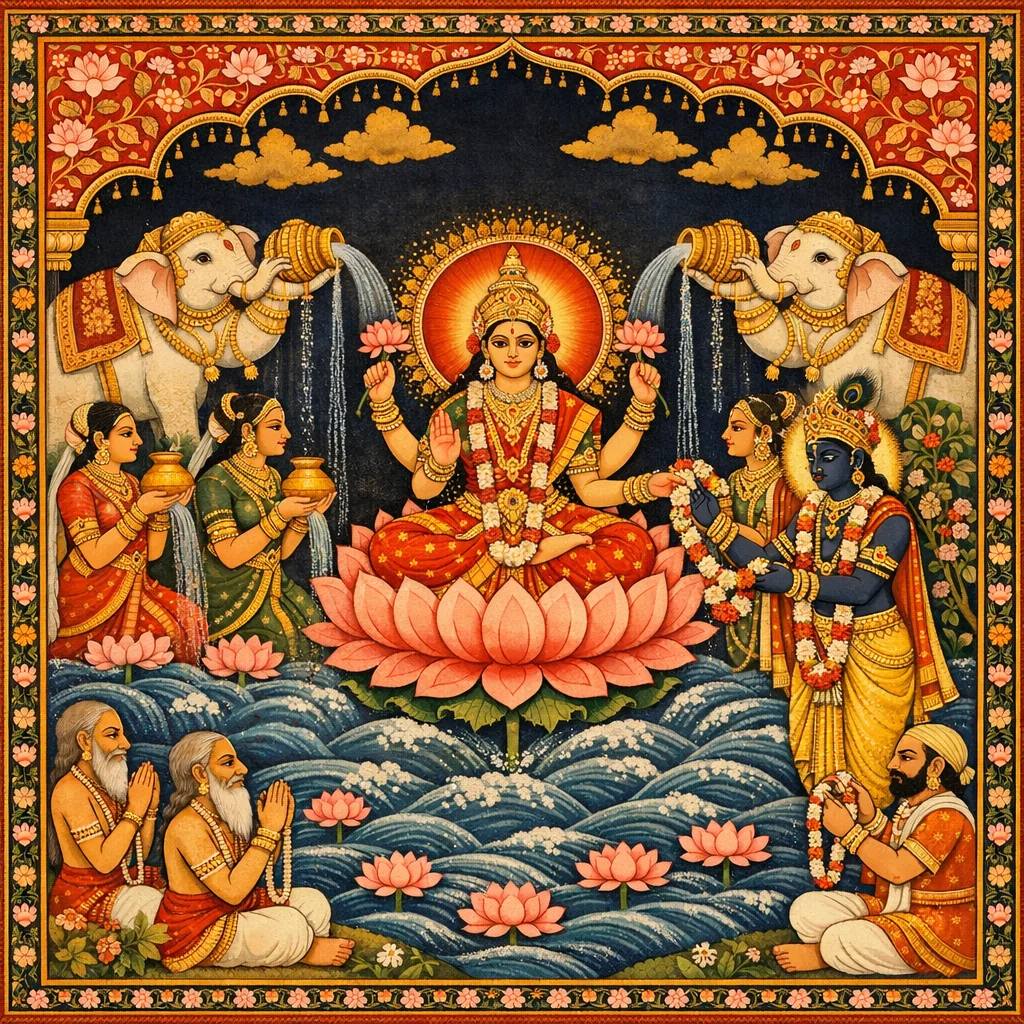
After Lord Śiva neutralizes the Hālāhala poison (linking from the prior churning crisis), devas and asuras resume Samudra-manthana with renewed force. A sequence of auspicious manifestations arises: Surabhi for sacrificial ghee, Uccaiḥśravā and Airāvata, directional elephants, celestial gems (Kaustubha, Padmarāga), the pārijāta flower, and apsarās. Then Lakṣmī (Ramā) appears and is installed through a cosmic abhiṣeka: rivers, earth, cows, seasons, sages, Gandharvas, and directional elephants contribute to her consecration. Lakṣmī surveys devas, asuras, and other beings, concluding that none are faultless or fully independent; therefore she accepts Mukunda, the self-sufficient Lord, and garlands Him—enriching the devas by her glance while the asuras become despondent. Next Vāruṇī appears and is taken by the demons. Dhanvantari emerges with the amṛta-kumbha, which the asuras seize, causing the devas to surrender to Hari. Viṣṇu promises to bewilder the demons, who begin quarreling over nectar—setting the transition into the next chapter where Mohinī-mūrti’s līlā orchestrates the distribution of amṛta and the unfolding of further divine strategy.
Shlokas
Verse 1
श्रीशुक उवाच पीते गरे वृषाङ्केण प्रीतास्तेऽमरदानवा: । ममन्थुस्तरसा सिन्धुं हविर्धानी ततोऽभवत् ॥ १ ॥
Śukadeva Gosvāmī continued: Upon Lord Śiva’s drinking the poison, both the demigods and the demons, being very pleased, began to churn the ocean with renewed vigor. As a result of this, there appeared a cow known as surabhi.
Verse 2
तामग्निहोत्रीमृषयो जगृहुर्ब्रह्मवादिन: । यज्ञस्य देवयानस्य मेध्याय हविषे नृप ॥ २ ॥
O King Parīkṣit, great sages who were completely aware of the Vedic ritualistic ceremonies took charge of that surabhi cow, which produced all the yogurt, milk and ghee absolutely necessary for offering oblations into the fire. They did this just for the sake of pure ghee, which they wanted for the performance of sacrifices to elevate themselves to the higher planetary systems, up to Brahmaloka.
Verse 3
तत उच्चै:श्रवा नाम हयोऽभूच्चन्द्रपाण्डुर: । तस्मिन्बलि: स्पृहां चक्रे नेन्द्र ईश्वरशिक्षया ॥ ३ ॥
Thereafter, a horse named Uccaiḥśravā, which was as white as the moon, was generated. Bali Mahārāja desired to possess this horse, and Indra, the King of heaven, did not protest, for he had previously been so advised by the Supreme Personality of Godhead.
Verse 4
तत ऐरावतो नाम वारणेन्द्रो विनिर्गत: । दन्तैश्चतुर्भि: श्वेताद्रेर्हरन्भगवतो महिम् ॥ ४ ॥
As the next result of the churning, the king of elephants, named Airāvata, was generated. This elephant was white, and with its four tusks it defied the glories of Kailāsa Mountain, the glorious abode of Lord Śiva.
Verse 5
ऐरावणादयस्त्वष्टौ दिग् गजा अभवंस्तत: । अभ्रमुप्रभृतयोऽष्टौ च करिण्यस्त्वभवन्नृप ॥ ५ ॥
Thereafter, O King, eight great elephants, which could go in any direction, were generated. They were headed by Airāvaṇa. Eight she-elephants, headed by Abhramu, were also generated.
Verse 6
कौस्तुभाख्यमभूद् रत्नं पद्मरागो महोदधे: । तस्मिन् मणौ स्पृहां चक्रे वक्षोऽलङ्करणे हरि: । ततोऽभवत् पारिजात: सुरलोकविभूषणम् । पूरयत्यर्थिनो योऽर्थै: शश्वद् भुवि यथा भवान् ॥ ६ ॥
Generated thereafter from the great ocean were the celebrated gems Kaustubha-maṇi and Padmarāga-maṇi. Lord Viṣṇu, to decorate His chest, desired to possess them. Generated next was the pārijāta flower, which decorates the celestial planets. O King, as you fulfill the desires of everyone on this planet by fulfilling all ambitions, the pārijāta fulfills the desires of everyone.
Verse 7
ततश्चाप्सरसो जाता निष्ककण्ठ्य: सुवासस: । रमण्य: स्वर्गिणां वल्गुगतिलीलावलोकनै: ॥ ७ ॥
Next there appeared the Apsarās [who are used as prostitutes on the heavenly planets]. They were fully decorated with golden ornaments and lockets and were dressed in fine and attractive clothing. The Apsarās move very slowly in an attractive style that bewilders the inhabitants of the heavenly planets.
Verse 8
ततश्चाविरभूत् साक्षाच्छ्री रमा भगवत्परा । रञ्जयन्ती दिश: कान्त्या विद्युत् सौदामनी यथा ॥ ८ ॥
Then there appeared the goddess of fortune, Ramā, who is absolutely dedicated to being enjoyed by the Supreme Personality of Godhead. She appeared like electricity, surpassing the lightning that might illuminate a marble mountain.
Verse 9
तस्यां चक्रु: स्पृहां सर्वे ससुरासुरमानवा: । रूपौदार्यवयोवर्णमहिमाक्षिप्तचेतस: ॥ ९ ॥
Because of her exquisite beauty, her bodily features, her youth, her complexion and her glories, everyone, including the demigods, the demons and the human beings, desired her. They were attracted because she is the source of all opulences.
Verse 10
तस्या आसनमानिन्ये महेन्द्रो महदद्भुतम् । मूर्तिमत्य: सरिच्छ्रेष्ठा हेमकुम्भैर्जलं शुचि ॥ १० ॥
The King of heaven, Indra, brought a suitable sitting place for the goddess of fortune. All the rivers of sacred water, such as the Ganges and Yamunā, personified themselves, and each of them brought pure water in golden waterpots for mother Lakṣmī, the goddess of fortune.
Verse 11
आभिषेचनिका भूमिराहरत् सकलौषधी: । गाव: पञ्च पवित्राणि वसन्तो मधुमाधवौ ॥ ११ ॥
The land became a person and collected all the drugs and herbs needed for installing the Deity. The cows delivered five products, namely milk, yogurt, ghee, urine and cow dung, and spring personified collected everything produced in spring, during the months of Caitra and Vaiśākha [April and May].
Verse 12
ऋषय: कल्पयांचक्रुराभिषेकं यथाविधि । जगुर्भद्राणि गन्धर्वा नट्यश्च ननृतुर्जगु: ॥ १२ ॥
The great sages performed the bathing ceremony of the goddess of fortune as directed in the authorized scriptures, the Gandharvas chanted all-auspicious Vedic mantras, and the professional women dancers very nicely danced and sang authorized songs prescribed in the Vedas.
Verse 13
मेघा मृदङ्गपणवमुरजानकगोमुखान् । व्यनादयन् शङ्खवेणुवीणास्तुमुलनि:स्वनान् ॥ १३ ॥
The clouds in personified form beat various types of drums, known as mṛdaṅgas, paṇavas, murajas and ānakas. They also blew conchshells and bugles known as gomukhas and played flutes and stringed instruments. The combined sound of these instruments was tumultuous.
Verse 14
ततोऽभिषिषिचुर्देवीं श्रियं पद्मकरां सतीम् । दिगिभा: पूर्णकलशै: सूक्तवाक्यैर्द्विजेरितै: ॥ १४ ॥
Thereafter, the great elephants from all the directions carried big water jugs full of Ganges water and bathed the goddess of fortune, to the accompaniment of Vedic mantras chanted by learned brāhmaṇas. While thus being bathed, the goddess of fortune maintained her original style, with a lotus flower in her hand, and she appeared very beautiful. The goddess of fortune is the most chaste, for she does not know anyone but the Supreme Personality of Godhead.
Verse 15
समुद्र: पीतकौशेयवाससी समुपाहरत् । वरुण: स्रजं वैजयन्तीं मधुना मत्तषट्पदाम् ॥ १५ ॥
The ocean, which is the source of all valuable jewels, supplied the upper and lower portions of a yellow silken garment. The predominating deity of the water, Varuṇa, presented flower garlands surrounded by six-legged bumblebees, drunken with honey.
Verse 16
भूषणानि विचित्राणि विश्वकर्मा प्रजापति: । हारं सरस्वती पद्ममजो नागाश्च कुण्डले ॥ १६ ॥
Viśvakarmā, one of the prajāpatis, supplied varieties of decorated ornaments. The goddess of learning, Sarasvatī, supplied a necklace, Lord Brahmā supplied a lotus flower, and the inhabitants of Nāgaloka supplied earrings.
Verse 17
तत: कृतस्वस्त्ययनोत्पलस्रजं नदद्द्विरेफां परिगृह्य पाणिना । चचाल वक्त्रं सुकपोलकुण्डलं सव्रीडहासं दधती सुशोभनम् ॥ १७ ॥
Thereafter, mother Lakṣmī, the goddess of fortune, having been properly celebrated with an auspicious ritualistic ceremony, began moving about, holding in her hand a garland of lotus flowers, which were surrounded by humming bumblebees. Smiling with shyness, her cheeks decorated by her earrings, she looked extremely beautiful.
Verse 18
स्तनद्वयं चातिकृशोदरी समं निरन्तरं चन्दनकुङ्कुमोक्षितम् । ततस्ततो नूपुरवल्गुशिञ्जितै- र्विसर्पती हेमलतेव सा बभौ ॥ १८ ॥
Her two breasts, which were symmetrical and nicely situated, were covered with sandalwood pulp and kuṅkuma powder, and her waist was very thin. As she walked here and there, her ankle bells jingling softly, she appeared like a creeper of gold.
Verse 19
विलोकयन्ती निरवद्यमात्मन: पदं ध्रुवं चाव्यभिचारिसद्गुणम् । गन्धर्वसिद्धासुरयक्षचारण- त्रैपिष्टपेयादिषु नान्वविन्दत ॥ १९ ॥
While walking among the Gandharvas, Yakṣas, asuras, Siddhas, Cāraṇas and denizens of heaven, Lakṣmīdevī, the goddess of fortune, was scrutinizingly examining them, but she could not find anyone naturally endowed with all good qualities. None of them was devoid of faults, and therefore she could not take shelter of any of them.
Verse 20
नूनं तपो यस्य न मन्युनिर्जयो ज्ञानं क्वचित् तच्च न सङ्गवर्जितम् । कश्चिन्महांस्तस्य न कामनिर्जय: स ईश्वर: किं परतोव्यपाश्रय: ॥ २० ॥
The goddess of fortune, examining the assembly, thought in this way: Someone who has undergone great austerity has not yet conquered anger. Someone possesses knowledge, but he has not conquered material desires. Someone is a very great personality, but he cannot conquer lusty desires. Even a great personality depends on something else. How, then, can he be the supreme controller?
Verse 21
धर्म: क्वचित् तत्र न भूतसौहृदं त्याग: क्वचित् तत्र न मुक्तिकारणम् । वीर्यं न पुंसोऽस्त्यजवेगनिष्कृतं न हि द्वितीयो गुणसङ्गवर्जित: ॥ २१ ॥
Someone may possess full knowledge of religion but still not be kind to all living entities. In someone, whether human or demigod, there may be renunciation, but that is not the cause of liberation. Someone may possess great power and yet be unable to check the power of eternal time. Someone else may have renounced attachment to the material world, yet he cannot compare to the Supreme Personality of Godhead. Therefore, no one is completely freed from the influence of the material modes of nature.
Verse 22
क्वचिच्चिरायुर्न हि शीलमङ्गलं क्वचित् तदप्यस्ति न वेद्यमायुष: । यत्रोभयं कुत्र च सोऽप्यमङ्गल: सुमङ्गल: कश्च न काङ्क्षते हि माम् ॥ २२ ॥
Someone may have longevity but not have auspiciousness or good behavior. Someone may have both auspiciousness and good behavior, but the duration of his life is not fixed. Although such demigods as Lord Śiva have eternal life, they have inauspicious habits like living in crematoriums. And even if others are well qualified in all respects, they are not devotees of the Supreme Personality of Godhead.
Verse 23
एवं विमृश्याव्यभिचारिसद्गुणै- र्वरं निजैकाश्रयतयागुणाश्रयम् । वव्रे वरं सर्वगुणैरपेक्षितं रमा मुकुन्दं निरपेक्षमीप्सितम् ॥ २३ ॥
Śukadeva Gosvāmī continued: In this way, after full deliberation, the goddess of fortune accepted Mukunda as her husband because although He is independent and not in want of her, He possesses all transcendental qualities and mystic powers and is therefore the most desirable.
Verse 24
तस्यांसदेश उशतीं नवकञ्जमालां माद्यन्मधुव्रतवरूथगिरोपघुष्टाम् । तस्थौ निधाय निकटे तदुर: स्वधाम सव्रीडहासविकसन्नयनेन याता ॥ २४ ॥
Approaching the Supreme Personality of Godhead, the goddess of fortune placed upon His shoulders the garland of newly grown lotus flowers, which was surrounded by humming bumblebees searching for honey. Then, expecting to get a place on the bosom of the Lord, she remained standing by His side, her face smiling in shyness.
Verse 25
तस्या: श्रियस्त्रिजगतो जनको जनन्या वक्षोनिवासमकरोत् परमं विभूते: । श्री: स्वा: प्रजा: सकरुणेन निरीक्षणेन यत्र स्थितैधयत साधिपतींस्त्रिलोकान् ॥ २५ ॥
The Supreme Personality of Godhead is the father of the three worlds, and His bosom is the residence of mother Lakṣmī, the goddess of fortune, the proprietor of all opulences. The goddess of fortune, by her favorable and merciful glance, can increase the opulence of the three worlds, along with their inhabitants and their directors, the demigods.
Verse 26
शङ्खतूर्यमृदङ्गानां वादित्राणां पृथु: स्वन: । देवानुगानां सस्त्रीणां नृत्यतां गायतामभूत् ॥ २६ ॥
The inhabitants of Gandharvaloka and Cāraṇaloka then took the opportunity to play their musical instruments, such as conchshells, bugles and drums. They began dancing and singing along with their wives.
Verse 27
ब्रह्मरुद्राङ्गिरोमुख्या: सर्वे विश्वसृजो विभुम् । ईडिरेऽवितथैर्मन्त्रैस्तल्लिङ्गै: पुष्पवर्षिण: ॥ २७ ॥
Lord Brahmā, Lord Śiva, the great sage Aṅgirā, and similar directors of universal management showered flowers and chanted mantras indicating the transcendental glories of the Supreme Personality of Godhead.
Verse 28
श्रियावलोकिता देवा: सप्रजापतय: प्रजा: । शीलादिगुणसम्पन्ना लेभिरे निर्वृतिं पराम् ॥ २८ ॥
All the demigods, along with the prajāpatis and their descendants, being blessed by Lakṣmījī’s glance upon them, were immediately enriched with good behavior and transcendental qualities. Thus they were very much satisfied.
Verse 29
नि:सत्त्वा लोलुपा राजन् निरुद्योगा गतत्रपा: । यदा चोपेक्षिता लक्ष्म्या बभूवुर्दैत्यदानवा: ॥ २९ ॥
O King, because of being neglected by the goddess of fortune, the demons and Rākṣasas were depressed, bewildered and frustrated, and thus they became shameless.
Verse 30
अथासीद् वारुणी देवी कन्या कमललोचना । असुरा जगृहुस्तां वै हरेरनुमतेन ते ॥ ३० ॥
Next appeared Vāruṇī, the lotus-eyed goddess who controls drunkards. With the permission of the Supreme Personality of Godhead, Kṛṣṇa, the demons, headed by Bali Mahārāja, took possession of this young girl.
Verse 31
अथोदधेर्मथ्यमानात् काश्यपैरमृतार्थिभि: । उदतिष्ठन्महाराज पुरुष: परमाद्भुत: ॥ ३१ ॥
O King, thereafter, while the sons of Kaśyapa, both demons and demigods, were engaged in churning the Ocean of Milk, a very wonderful male person appeared.
Verse 32
दीर्घपीवरदोर्दण्ड: कम्बुग्रीवोऽरुणेक्षण: । श्यामलस्तरुण: स्रग्वी सर्वाभरणभूषित: ॥ ३२ ॥
He was strongly built; his arms were long, stout and strong; his neck, which was marked with three lines, resembled a conchshell; his eyes were reddish; and his complexion was blackish. He was very young, he was garlanded with flowers, and his entire body was fully decorated with various ornaments.
Verse 33
पीतवासा महोरस्क: सुमृष्टमणिकुण्डल: । स्निग्धकुञ्चितकेशान्तसुभग: सिंहविक्रम: । अमृतापूर्णकलसं बिभ्रद् वलयभूषित: ॥ ३३ ॥
He was dressed in yellow garments and wore brightly polished earrings made of pearls. The tips of his hair were anointed with oil, and his chest was very broad. His body had all good features, he was stout and strong like a lion, and he was decorated with bangles. In his hand he carried a jug filled to the top with nectar.
Verse 34
स वै भगवत: साक्षाद्विष्णोरंशांशसम्भव: । धन्वन्तरिरिति ख्यात आयुर्वेददृगिज्यभाक् ॥ ३४ ॥
This person was Dhanvantari, a plenary portion of a plenary portion of Lord Viṣṇu. He was very conversant with the science of medicine, and as one of the demigods he was permitted to take a share in sacrifices.
Verse 35
तमालोक्यासुरा: सर्वे कलसं चामृताभृतम् । लिप्सन्त: सर्ववस्तूनि कलसं तरसाहरन् ॥ ३५ ॥
Upon seeing Dhanvantari carrying the jug of nectar, the demons, desiring the jug and its contents, immediately snatched it away by force.
Verse 36
नीयमानेऽसुरैस्तस्मिन्कलसेऽमृतभाजने । विषण्णमनसो देवा हरिं शरणमाययु: ॥ ३६ ॥
When the jug of nectar was carried off by the demons, the demigods were morose. Thus they sought shelter at the lotus feet of the Supreme Personality of Godhead, Hari.
Verse 37
इति तद्दैन्यमालोक्य भगवान्भृत्यकामकृत् । मा खिद्यत मिथोऽर्थं व: साधयिष्ये स्वमायया ॥ ३७ ॥
When the Supreme Personality of Godhead, who always desires to fulfill the ambitions of His devotees, saw that the demigods were morose, He said to them, “Do not be aggrieved. By My own energy I shall bewilder the demons by creating a quarrel among them. In this way I shall fulfill your desire to have the nectar.”
Verse 38
मिथ: कलिरभूत्तेषां तदर्थे तर्षचेतसाम् । अहं पूर्वमहं पूर्वं न त्वं न त्वमिति प्रभो ॥ ३८ ॥
O King, a quarrel then arose among the demons over who would get the nectar first. Each of them said, “You cannot drink it first. I must drink it first. Me first, not you!”
Verse 39
देवा: स्वं भागमर्हन्ति ये तुल्यायासहेतव: । सत्रयाग इवैतस्मिन्नेष धर्म: सनातन: ॥ ३९ ॥ इति स्वान्प्रत्यषेधन्वै दैतेया जातमत्सरा: । दुर्बला: प्रबलान् राजन्गृहीतकलसान् मुहु: ॥ ४० ॥
Some of the demons said, “All the demigods have taken part in churning the Ocean of Milk. Now, as everyone has an equal right to partake in any public sacrifice, according to the eternal religious system it is befitting that the demigods now have a share of the nectar.” O King, in this way the weaker demons forbade the stronger demons to take the nectar.
Verse 40
देवा: स्वं भागमर्हन्ति ये तुल्यायासहेतव: । सत्रयाग इवैतस्मिन्नेष धर्म: सनातन: ॥ ३९ ॥ इति स्वान्प्रत्यषेधन्वै दैतेया जातमत्सरा: । दुर्बला: प्रबलान् राजन्गृहीतकलसान् मुहु: ॥ ४० ॥
Some of the demons said, “All the demigods have taken part in churning the Ocean of Milk. Now, as everyone has an equal right to partake in any public sacrifice, according to the eternal religious system it is befitting that the demigods now have a share of the nectar.” O King, in this way the weaker demons forbade the stronger demons to take the nectar.
Verse 41
एतस्मिन्नन्तरे विष्णु: सर्वोपायविदीश्वर: । योषिद्रूपमनिर्देश्यं दधार परमाद्भुतम् ॥ ४१ ॥ प्रेक्षणीयोत्पलश्यामं सर्वावयवसुन्दरम् । समानकर्णाभरणं सुकपोलोन्नसाननम् ॥ ४२ ॥ नवयौवननिर्वृत्तस्तनभारकृशोदरम् । मुखामोदानुरक्तालिझङ्कारोद्विग्नलोचनम् ॥ ४३ ॥ बिभ्रत् सुकेशभारेण मालामुत्फुल्लमल्लिकाम् । सुग्रीवकण्ठाभरणं सुभुजाङ्गदभूषितम् ॥ ४४ ॥ विरजाम्बरसंवीतनितम्बद्वीपशोभया । काञ्च्या प्रविलसद्वल्गुचलच्चरणनूपुरम् ॥ ४५ ॥ सव्रीडस्मितविक्षिप्तभ्रूविलासावलोकनै: । दैत्ययूथपचेत:सु काममुद्दीपयन् मुहु: ॥ ४६ ॥
The Supreme Personality of Godhead, Viṣṇu, who can counteract any unfavorable situation, then assumed the form of an extremely beautiful woman. This incarnation as a woman, Mohinī-mūrti, was most pleasing to the mind. Her complexion resembled in color a newly grown blackish lotus, and every part of Her body was beautifully situated. Her ears were equally decorated with earrings, Her cheeks were very beautiful, Her nose was raised and Her face full of youthful luster. Her large breasts made Her waist seem very thin. Attracted by the aroma of Her face and body, bumblebees hummed around Her, and thus Her eyes were restless. Her hair, which was extremely beautiful, was garlanded with mallikā flowers. Her attractively constructed neck was decorated with a necklace and other ornaments, Her arms were decorated with bangles, Her body was covered with a clean sari, and Her breasts seemed like islands in an ocean of beauty. Her legs were decorated with ankle bells. Because of the movements of Her eyebrows as She smiled with shyness and glanced over the demons, all the demons were saturated with lusty desires, and every one of them desired to possess Her.
Verse 42
एतस्मिन्नन्तरे विष्णु: सर्वोपायविदीश्वर: । योषिद्रूपमनिर्देश्यं दधार परमाद्भुतम् ॥ ४१ ॥ प्रेक्षणीयोत्पलश्यामं सर्वावयवसुन्दरम् । समानकर्णाभरणं सुकपोलोन्नसाननम् ॥ ४२ ॥ नवयौवननिर्वृत्तस्तनभारकृशोदरम् । मुखामोदानुरक्तालिझङ्कारोद्विग्नलोचनम् ॥ ४३ ॥ बिभ्रत् सुकेशभारेण मालामुत्फुल्लमल्लिकाम् । सुग्रीवकण्ठाभरणं सुभुजाङ्गदभूषितम् ॥ ४४ ॥ विरजाम्बरसंवीतनितम्बद्वीपशोभया । काञ्च्या प्रविलसद्वल्गुचलच्चरणनूपुरम् ॥ ४५ ॥ सव्रीडस्मितविक्षिप्तभ्रूविलासावलोकनै: । दैत्ययूथपचेत:सु काममुद्दीपयन् मुहु: ॥ ४६ ॥
The Supreme Personality of Godhead, Viṣṇu, who can counteract any unfavorable situation, then assumed the form of an extremely beautiful woman. This incarnation as a woman, Mohinī-mūrti, was most pleasing to the mind. Her complexion resembled in color a newly grown blackish lotus, and every part of Her body was beautifully situated. Her ears were equally decorated with earrings, Her cheeks were very beautiful, Her nose was raised and Her face full of youthful luster. Her large breasts made Her waist seem very thin. Attracted by the aroma of Her face and body, bumblebees hummed around Her, and thus Her eyes were restless. Her hair, which was extremely beautiful, was garlanded with mallikā flowers. Her attractively constructed neck was decorated with a necklace and other ornaments, Her arms were decorated with bangles, Her body was covered with a clean sari, and Her breasts seemed like islands in an ocean of beauty. Her legs were decorated with ankle bells. Because of the movements of Her eyebrows as She smiled with shyness and glanced over the demons, all the demons were saturated with lusty desires, and every one of them desired to possess Her.
Verse 43
एतस्मिन्नन्तरे विष्णु: सर्वोपायविदीश्वर: । योषिद्रूपमनिर्देश्यं दधार परमाद्भुतम् ॥ ४१ ॥ प्रेक्षणीयोत्पलश्यामं सर्वावयवसुन्दरम् । समानकर्णाभरणं सुकपोलोन्नसाननम् ॥ ४२ ॥ नवयौवननिर्वृत्तस्तनभारकृशोदरम् । मुखामोदानुरक्तालिझङ्कारोद्विग्नलोचनम् ॥ ४३ ॥ बिभ्रत् सुकेशभारेण मालामुत्फुल्लमल्लिकाम् । सुग्रीवकण्ठाभरणं सुभुजाङ्गदभूषितम् ॥ ४४ ॥ विरजाम्बरसंवीतनितम्बद्वीपशोभया । काञ्च्या प्रविलसद्वल्गुचलच्चरणनूपुरम् ॥ ४५ ॥ सव्रीडस्मितविक्षिप्तभ्रूविलासावलोकनै: । दैत्ययूथपचेत:सु काममुद्दीपयन् मुहु: ॥ ४६ ॥
The Supreme Personality of Godhead, Viṣṇu, who can counteract any unfavorable situation, then assumed the form of an extremely beautiful woman. This incarnation as a woman, Mohinī-mūrti, was most pleasing to the mind. Her complexion resembled in color a newly grown blackish lotus, and every part of Her body was beautifully situated. Her ears were equally decorated with earrings, Her cheeks were very beautiful, Her nose was raised and Her face full of youthful luster. Her large breasts made Her waist seem very thin. Attracted by the aroma of Her face and body, bumblebees hummed around Her, and thus Her eyes were restless. Her hair, which was extremely beautiful, was garlanded with mallikā flowers. Her attractively constructed neck was decorated with a necklace and other ornaments, Her arms were decorated with bangles, Her body was covered with a clean sari, and Her breasts seemed like islands in an ocean of beauty. Her legs were decorated with ankle bells. Because of the movements of Her eyebrows as She smiled with shyness and glanced over the demons, all the demons were saturated with lusty desires, and every one of them desired to possess Her.
Verse 44
एतस्मिन्नन्तरे विष्णु: सर्वोपायविदीश्वर: । योषिद्रूपमनिर्देश्यं दधार परमाद्भुतम् ॥ ४१ ॥ प्रेक्षणीयोत्पलश्यामं सर्वावयवसुन्दरम् । समानकर्णाभरणं सुकपोलोन्नसाननम् ॥ ४२ ॥ नवयौवननिर्वृत्तस्तनभारकृशोदरम् । मुखामोदानुरक्तालिझङ्कारोद्विग्नलोचनम् ॥ ४३ ॥ बिभ्रत् सुकेशभारेण मालामुत्फुल्लमल्लिकाम् । सुग्रीवकण्ठाभरणं सुभुजाङ्गदभूषितम् ॥ ४४ ॥ विरजाम्बरसंवीतनितम्बद्वीपशोभया । काञ्च्या प्रविलसद्वल्गुचलच्चरणनूपुरम् ॥ ४५ ॥ सव्रीडस्मितविक्षिप्तभ्रूविलासावलोकनै: । दैत्ययूथपचेत:सु काममुद्दीपयन् मुहु: ॥ ४६ ॥
The Supreme Personality of Godhead, Viṣṇu, who can counteract any unfavorable situation, then assumed the form of an extremely beautiful woman. This incarnation as a woman, Mohinī-mūrti, was most pleasing to the mind. Her complexion resembled in color a newly grown blackish lotus, and every part of Her body was beautifully situated. Her ears were equally decorated with earrings, Her cheeks were very beautiful, Her nose was raised and Her face full of youthful luster. Her large breasts made Her waist seem very thin. Attracted by the aroma of Her face and body, bumblebees hummed around Her, and thus Her eyes were restless. Her hair, which was extremely beautiful, was garlanded with mallikā flowers. Her attractively constructed neck was decorated with a necklace and other ornaments, Her arms were decorated with bangles, Her body was covered with a clean sari, and Her breasts seemed like islands in an ocean of beauty. Her legs were decorated with ankle bells. Because of the movements of Her eyebrows as She smiled with shyness and glanced over the demons, all the demons were saturated with lusty desires, and every one of them desired to possess Her.
Verse 45
एतस्मिन्नन्तरे विष्णु: सर्वोपायविदीश्वर: । योषिद्रूपमनिर्देश्यं दधार परमाद्भुतम् ॥ ४१ ॥ प्रेक्षणीयोत्पलश्यामं सर्वावयवसुन्दरम् । समानकर्णाभरणं सुकपोलोन्नसाननम् ॥ ४२ ॥ नवयौवननिर्वृत्तस्तनभारकृशोदरम् । मुखामोदानुरक्तालिझङ्कारोद्विग्नलोचनम् ॥ ४३ ॥ बिभ्रत् सुकेशभारेण मालामुत्फुल्लमल्लिकाम् । सुग्रीवकण्ठाभरणं सुभुजाङ्गदभूषितम् ॥ ४४ ॥ विरजाम्बरसंवीतनितम्बद्वीपशोभया । काञ्च्या प्रविलसद्वल्गुचलच्चरणनूपुरम् ॥ ४५ ॥ सव्रीडस्मितविक्षिप्तभ्रूविलासावलोकनै: । दैत्ययूथपचेत:सु काममुद्दीपयन् मुहु: ॥ ४६ ॥
The Supreme Personality of Godhead, Viṣṇu, who can counteract any unfavorable situation, then assumed the form of an extremely beautiful woman. This incarnation as a woman, Mohinī-mūrti, was most pleasing to the mind. Her complexion resembled in color a newly grown blackish lotus, and every part of Her body was beautifully situated. Her ears were equally decorated with earrings, Her cheeks were very beautiful, Her nose was raised and Her face full of youthful luster. Her large breasts made Her waist seem very thin. Attracted by the aroma of Her face and body, bumblebees hummed around Her, and thus Her eyes were restless. Her hair, which was extremely beautiful, was garlanded with mallikā flowers. Her attractively constructed neck was decorated with a necklace and other ornaments, Her arms were decorated with bangles, Her body was covered with a clean sari, and Her breasts seemed like islands in an ocean of beauty. Her legs were decorated with ankle bells. Because of the movements of Her eyebrows as She smiled with shyness and glanced over the demons, all the demons were saturated with lusty desires, and every one of them desired to possess Her.
Verse 46
एतस्मिन्नन्तरे विष्णु: सर्वोपायविदीश्वर: । योषिद्रूपमनिर्देश्यं दधार परमाद्भुतम् ॥ ४१ ॥ प्रेक्षणीयोत्पलश्यामं सर्वावयवसुन्दरम् । समानकर्णाभरणं सुकपोलोन्नसाननम् ॥ ४२ ॥ नवयौवननिर्वृत्तस्तनभारकृशोदरम् । मुखामोदानुरक्तालिझङ्कारोद्विग्नलोचनम् ॥ ४३ ॥ बिभ्रत् सुकेशभारेण मालामुत्फुल्लमल्लिकाम् । सुग्रीवकण्ठाभरणं सुभुजाङ्गदभूषितम् ॥ ४४ ॥ विरजाम्बरसंवीतनितम्बद्वीपशोभया । काञ्च्या प्रविलसद्वल्गुचलच्चरणनूपुरम् ॥ ४५ ॥ सव्रीडस्मितविक्षिप्तभ्रूविलासावलोकनै: । दैत्ययूथपचेत:सु काममुद्दीपयन् मुहु: ॥ ४६ ॥
The Supreme Personality of Godhead, Viṣṇu, who can counteract any unfavorable situation, then assumed the form of an extremely beautiful woman. This incarnation as a woman, Mohinī-mūrti, was most pleasing to the mind. Her complexion resembled in color a newly grown blackish lotus, and every part of Her body was beautifully situated. Her ears were equally decorated with earrings, Her cheeks were very beautiful, Her nose was raised and Her face full of youthful luster. Her large breasts made Her waist seem very thin. Attracted by the aroma of Her face and body, bumblebees hummed around Her, and thus Her eyes were restless. Her hair, which was extremely beautiful, was garlanded with mallikā flowers. Her attractively constructed neck was decorated with a necklace and other ornaments, Her arms were decorated with bangles, Her body was covered with a clean sari, and Her breasts seemed like islands in an ocean of beauty. Her legs were decorated with ankle bells. Because of the movements of Her eyebrows as She smiled with shyness and glanced over the demons, all the demons were saturated with lusty desires, and every one of them desired to possess Her.
Frequently Asked Questions
Lakṣmī’s deliberation highlights a Bhāgavata criterion: conditioned greatness is mixed with faults under the guṇas. Austerity may coexist with anger, knowledge with desire, power with subjection to kāla, and even longevity with inauspicious conduct. Since none are fully independent or completely pure, she chooses Mukunda, who is svatantra (independent), nirguṇa (transcendent to material modes), and the reservoir of all auspicious qualities.
The chapter depicts a universal consecration: sacred rivers bring waters, earth brings herbs, cows provide pañca-gavya, seasons provide auspicious produce, sages conduct rites, and celestial musicians chant Vedic mantras. Theologically it signifies that śrī (prosperity and auspicious order) is not random wealth but a sanctified, dharma-aligned potency that naturally rests on Viṣṇu’s chest and blesses administrators (devas) who serve cosmic order.
Dhanvantari is a plenary expansion (aṁśa) connected to Viṣṇu who appears carrying the amṛta-kumbha and is expert in bhaiṣajya-vidyā (medicine/Ayurveda). His emergence teaches that healing and longevity are ultimately divine endowments within yajña and cosmic administration; it also becomes the narrative pivot for the conflict over nectar.
Their quarrel arises from possessiveness and entitlement: after seizing the nectar by force, they cannot establish a stable principle of distribution. This internal fracture is precisely what Hari anticipates; it sets the stage for Mohinī-mūrti, through whom Viṣṇu uses yogamāyā to protect the devas and restore dharmic allocation.
Vāruṇī is a goddess associated with intoxicants and the governance of drunkards. The demons’ taking her, with the Lord’s permission, reflects their attraction to sense-enjoyment and diversion, contrasting with the devas’ focus on sacrificial order and foreshadowing how asuric impulses make them vulnerable to delusion when Mohinī appears.