Adhyaya 24
Matsya-avatāra: The Lord as Fish Saves the Vedas and Guides Satyavrata
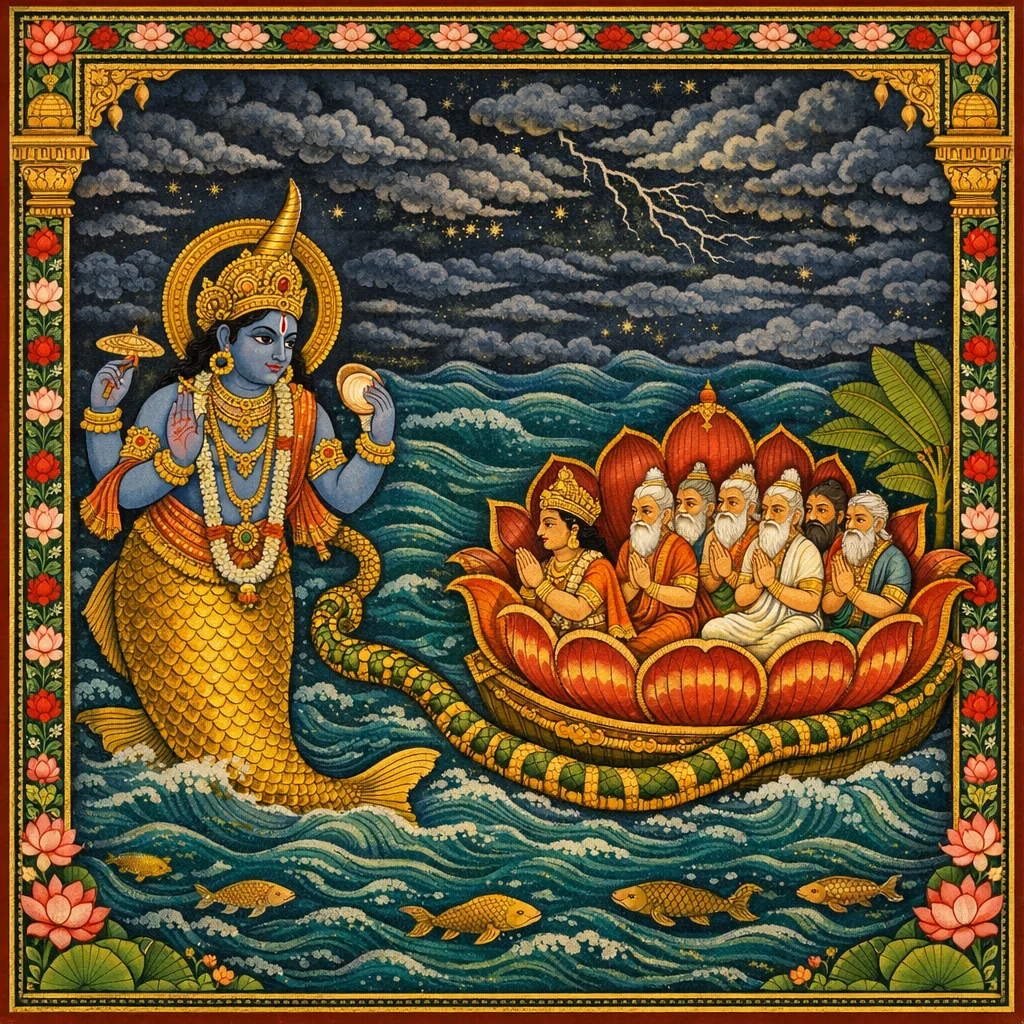
Prompted by Parīkṣit’s inquiry into why Hari would accept an apparently “abominable” fish form, Śukadeva clarifies the avatāra principle: the Lord descends to protect cows, brāhmaṇas, devas, devotees, Vedic literature, and dharma, remaining transcendental like air moving through varied atmospheres. The chapter situates the event at the end of Brahmā’s day, when pralaya waters rise and Hayagrīva steals the Vedas; Hari becomes Matsya to recover the Vedas and later slay the demon. In the Cākṣuṣa-manvantara, the devotee-king Satyavrata encounters a small fish that rapidly expands through pot, well, lake, and ocean, revealing divine identity and eliciting the king’s surrender. Matsya foretells a seven-day countdown to inundation, instructs Satyavrata to board a divinely sent boat with seeds, herbs, living beings, and the seven ṛṣis, and to tether it to Matsya’s horn using Vāsuki. As the deluge arrives, the king prays to the Lord as the original guru; Matsya then teaches sāṅkhya-yoga (as discernment culminating in bhakti) and Purāṇic-saṁhitā wisdom. The narrative prepares continuity into subsequent teachings about divine instruction, the restoration of Vedic knowledge, and the establishment of Vaivasvata Manu’s role in the ongoing manvantara lineage.
Shlokas
Verse 1
श्रीराजोवाच भगवञ्छ्रोतुमिच्छामि हरेरद्भुतकर्मण: । अवतारकथामाद्यां मायामत्स्यविडम्बनम् ॥ १ ॥
Mahārāja Parīkṣit said: The Supreme Personality of Godhead, Hari, is eternally situated in His transcendental position, yet He descends to this material world and manifests Himself in various incarnations. His first incarnation was that of a great fish. O most powerful Śukadeva Gosvāmī, I wish to hear from you the pastimes of that fish incarnation.
Verse 2
यदर्थमदधाद् रूपं मात्स्यं लोकजुगुप्सितम् । तम:प्रकृति दुर्मर्षं कर्मग्रस्त इवेश्वर: ॥ २ ॥ एतन्नो भगवन् सर्वं यथावद् वक्तुमर्हसि । उत्तमश्लोकचरितं सर्वलोकसुखावहम् ॥ ३ ॥
What was the purpose for which the Supreme Personality of Godhead accepted the abominable form of a fish, exactly as an ordinary living being accepts different forms under the laws of karma? The form of a fish is certainly condemned and full of terrible pain. O my lord, what was the purpose of this incarnation? Kindly explain this to us, for hearing about the pastimes of the Lord is auspicious for everyone.
Verse 3
यदर्थमदधाद् रूपं मात्स्यं लोकजुगुप्सितम् । तम:प्रकृति दुर्मर्षं कर्मग्रस्त इवेश्वर: ॥ २ ॥ एतन्नो भगवन् सर्वं यथावद् वक्तुमर्हसि । उत्तमश्लोकचरितं सर्वलोकसुखावहम् ॥ ३ ॥
What was the purpose for which the Supreme Personality of Godhead accepted the abominable form of a fish, exactly as an ordinary living being accepts different forms under the laws of karma? The form of a fish is certainly condemned and full of terrible pain. O my lord, what was the purpose of this incarnation? Kindly explain this to us, for hearing about the pastimes of the Lord is auspicious for everyone.
Verse 4
श्रीसूत उवाच इत्युक्तो विष्णुरातेन भगवान् बादरायणि: । उवाच चरितं विष्णोर्मत्स्यरूपेण यत् कृतम् ॥ ४ ॥
Sūta Gosvāmī said: When Parīkṣit Mahārāja thus inquired from Śukadeva Gosvāmī, that most powerful saintly person began describing the pastimes of the Lord’s incarnation as a fish.
Verse 5
श्रीशुक उवाच गोविप्रसुरसाधूनां छन्दसामपि चेश्वर: । रक्षामिच्छंस्तनूर्धत्ते धर्मस्यार्थस्य चैव हि ॥ ५ ॥
Śrī Śukadeva Gosvāmī said: O King, for the sake of protecting the cows, brāhmaṇas, demigods, devotees, the Vedic literature, religious principles, and principles to fulfill the purpose of life, the Supreme Personality of Godhead accepts the forms of incarnations.
Verse 6
उच्चावचेषु भूतेषु चरन् वायुरिवेश्वर: । नोच्चावचत्वं भजते निर्गुणत्वाद्धियो गुणै: ॥ ६ ॥
Like the air passing through different types of atmosphere, the Supreme Personality of Godhead, although appearing sometimes as a human being and sometimes as a lower animal, is always transcendental. Because He is above the material modes of nature, He is unaffected by higher and lower forms.
Verse 7
आसीदतीतकल्पान्ते ब्राह्मो नैमित्तिको लय: । समुद्रोपप्लुतास्तत्र लोका भूरादयो नृप ॥ ७ ॥
O King Parīkṣit, at the end of the past millennium, at the end of Brahmā’s day, because Lord Brahmā sleeps during the night, annihilation took place, and the three worlds were covered by the water of the ocean.
Verse 8
कालेनागतनिद्रस्य धातु: शिशयिषोर्बली । मुखतो नि:सृतान् वेदान् हयग्रीवोऽन्तिकेऽहरत् ॥ ८ ॥
At the end of Brahmā’s day, when Brahmā felt sleepy and desired to lie down, the Vedas were emanating from his mouth, and the great demon named Hayagrīva stole the Vedic knowledge.
Verse 9
ज्ञात्वा तद् दानवेन्द्रस्य हयग्रीवस्य चेष्टितम् । दधार शफरीरूपं भगवान् हरिरीश्वर: ॥ ९ ॥
Understanding the acts of the great demon Hayagrīva, the Supreme Personality of Godhead, Hari, who is full of all opulences, assumed the form of a fish and saved the Vedas by killing the demon.
Verse 10
तत्र राजऋषि: कश्चिन्नाम्ना सत्यव्रतो महान् । नारायणपरोऽतपत् तप: स सलिलाशन: ॥ १० ॥
During the Cākṣuṣa-manvantara there was a great king named Satyavrata who was a great devotee of the Supreme Personality of Godhead. Satyavrata performed austerities by subsisting only on water.
Verse 11
योऽसावस्मिन् महाकल्पे तनय: स विवस्वत: । श्राद्धदेव इति ख्यातो मनुत्वे हरिणार्पित: ॥ ११ ॥
In this [the present] millennium King Satyavrata later became the son of Vivasvān, the king of the sun planet, and was known as Śrāddhadeva. By the mercy of the Supreme Personality of Godhead, he was given the post of Manu.
Verse 12
एकदा कृतमालायां कुर्वतो जलतर्पणम् । तस्याञ्जल्युदके काचिच्छफर्येकाभ्यपद्यत ॥ १२ ॥
One day while King Satyavrata was performing austerities by offering water on the bank of the river Kṛtamālā, a small fish appeared in the water in his palms.
Verse 13
सत्यव्रतोऽञ्जलिगतां सह तोयेन भारत । उत्ससर्ज नदीतोये शफरीं द्रविडेश्वर: ॥ १३ ॥
Satyavrata, the King of Draviḍadeśa, threw the fish into the water of the river along with the water in his palm, O King Parīkṣit, descendant of Bharata.
Verse 14
तमाह सातिकरुणं महाकारुणिकं नृपम् । यादोभ्यो ज्ञातिघातिभ्यो दीनां मां दीनवत्सल । कथं विसृजसे राजन् भीतामस्मिन् सरिज्जले ॥ १४ ॥
With an appealing voice, the poor small fish said to King Satyavrata, who was very merciful: My dear King, protector of the poor, why are you throwing Me in the water of the river, where there are other aquatics who can kill Me? I am very much afraid of them.
Verse 15
तमात्मनोऽनुग्रहार्थं प्रीत्या मत्स्यवपुर्धरम् । अजानन् रक्षणार्थाय शफर्या: स मनो दधे ॥ १५ ॥
To please himself, King Satyavrata, not knowing that the fish was the Supreme Personality of Godhead, decided with great pleasure to give the fish protection.
Verse 16
तस्या दीनतरं वाक्यमाश्रुत्य स महीपति: । कलशाप्सु निधायैनां दयालुर्निन्य आश्रमम् ॥ १६ ॥
The merciful King, being moved by the pitiable words of the fish, placed the fish in a water jug and brought Him to his own residence.
Verse 17
सा तु तत्रैकरात्रेण वर्धमाना कमण्डलौ । अलब्ध्वात्मावकाशं वा इदमाह महीपतिम् ॥ १७ ॥
But in one night that fish grew so much that He could not move His body comfortably in the water of the pot. He then spoke to the King as follows.
Verse 18
नाहं कमण्डलावस्मिन् कृच्छ्रं वस्तुमिहोत्सहे । कल्पयौक: सुविपुलं यत्राहं निवसे सुखम् ॥ १८ ॥
O My dear King, I do not like living in this waterpot with such great difficulty. Therefore, please find some better reservoir of water where I can live comfortably.
Verse 19
स एनां तत आदाय न्यधादौदञ्चनोदके । तत्र क्षिप्ता मुहूर्तेन हस्तत्रयमवर्धत ॥ १९ ॥
Then, taking the fish out of the waterpot, the King threw Him in a large well. But within a moment the fish developed to the length of three cubits.
Verse 20
न म एतदलं राजन् सुखं वस्तुमुदञ्चनम् । पृथु देहि पदं मह्यं यत् त्वाहं शरणं गता ॥ २० ॥
The fish then said: My dear King, this reservoir of water is not fit for My happy residence. Please give Me a more extensive pool of water, for I have taken shelter of you.
Verse 21
तत आदाय सा राज्ञा क्षिप्ता राजन् सरोवरे । तदावृत्यात्मना सोऽयं महामीनोऽन्ववर्धत ॥ २१ ॥
O Mahārāja Parīkṣit, the King took the fish from the well and threw Him in a lake, but the fish then assumed a gigantic form exceeding the extent of the water.
Verse 22
नैतन्मे स्वस्तये राजन्नुदकं सलिलौकस: । निधेहि रक्षायोगेन ह्रदे मामविदासिनि ॥ २२ ॥
The fish then said: O King, I am a large aquatic, and this water is not at all suitable for Me. Now kindly find some way to save Me. It would be better to put Me in the water of a lake that will never reduce.
Verse 23
इत्युक्त: सोऽनयन्मत्स्यं तत्र तत्राविदासिनि । जलाशयेऽसम्मितं तं समुद्रे प्राक्षिपज्झषम् ॥ २३ ॥
When thus requested, King Satyavrata took the fish to the largest reservoir of water. But when that also proved insufficient, the King at last threw the gigantic fish into the ocean.
Verse 24
क्षिप्यमाणस्तमाहेदमिह मां मकरादय: । अदन्त्यतिबला वीर मां नेहोत्स्रष्टुमर्हसि ॥ २४ ॥
While being thrown in the ocean, the fish said to King Satyavrata: O hero, in this water there are very powerful and dangerous sharks that will eat Me. Therefore you should not throw Me in this place.
Verse 25
एवं विमोहितस्तेन वदता वल्गुभारतीम् । तमाह को भवानस्मान् मत्स्यरूपेण मोहयन् ॥ २५ ॥
After hearing these sweet words from the Supreme Personality of Godhead in the form of a fish, the King, being bewildered, asked Him: Who are You, sir? You simply bewilder us.
Verse 26
नैवंवीर्यो जलचरो दृष्टोऽस्माभि: श्रुतोऽपि वा । यो भवान् योजनशतमह्नाभिव्यानशे सर: ॥ २६ ॥
My Lord, in one day You have expanded Yourself for hundreds of miles, covering the water of the river and the ocean. Before this I had never seen or heard of such an aquatic animal.
Verse 27
नूनं त्वं भगवान् साक्षाद्धरिर्नारायणोऽव्यय: । अनुग्रहाय भूतानां धत्से रूपं जलौकसाम् ॥ २७ ॥
My Lord, You are certainly the inexhaustible Supreme Personality of Godhead, Nārāyaṇa, Śrī Hari. It is to show Your mercy to the living entities that You have now assumed the form of an aquatic.
Verse 28
नमस्ते पुरुषश्रेष्ठ स्थित्युत्पत्त्यप्ययेश्वर । भक्तानां न: प्रपन्नानां मुख्यो ह्यात्मगतिर्विभो ॥ २८ ॥
O my Lord, master of creation, maintenance and annihilation, O best of enjoyers, Lord Viṣṇu, You are the leader and destination of surrendered devotees like us. Therefore let me offer my respectful obeisances unto You.
Verse 29
सर्वे लीलावतारास्ते भूतानां भूतिहेतव: । ज्ञातुमिच्छाम्यदो रूपं यदर्थं भवता धृतम् ॥ २९ ॥
All Your pastimes and incarnations certainly appear for the welfare of all living entities. Therefore, my Lord, I wish to know the purpose for which You have assumed this form of a fish.
Verse 30
न तेऽरविन्दाक्ष पदोपसर्पणं मृषा भवेत् सर्वसुहृत्प्रियात्मन: । यथेतरेषां पृथगात्मनां सता- मदीदृशो यद् वपुरद्भुतं हि न: ॥ ३० ॥
O my Lord, possessing eyes like the petals of a lotus, the worship of the demigods, who are in the bodily concept of life, is fruitless in all respects. But because You are the supreme friend and dearmost Supersoul of everyone, worship of Your lotus feet is never useless. You have therefore manifested Your form as a fish.
Verse 31
श्रीशुक उवाच इति ब्रुवाणं नृपतिं जगत्पति: सत्यव्रतं मत्स्यवपुर्युगक्षये । विहर्तुकाम: प्रलयार्णवेऽब्रवी- च्चिकीर्षुरेकान्तजनप्रिय: प्रियम् ॥ ३१ ॥
Śukadeva Gosvāmī said: When King Satyavrata spoke in this way, the Supreme Personality of Godhead, who at the end of the yuga had assumed the form of a fish to benefit His devotee and enjoy His pastimes in the water of inundation, responded as follows.
Verse 32
श्रीभगवानुवाच सप्तमे ह्यद्यतनादूर्ध्वमहन्येतदरिंदम । निमङ्क्ष्यत्यप्ययाम्भोधौ त्रैलोक्यं भूर्भुवादिकम् ॥ ३२ ॥
The Supreme Personality of Godhead said: O King, who can subdue your enemies, on the seventh day from today the three worlds — Bhūḥ, Bhuvaḥ and Svaḥ — will all merge into the water of inundation.
Verse 33
त्रिलोक्यां लीयमानायां संवर्ताम्भसि वै तदा । उपस्थास्यति नौ: काचिद् विशाला त्वां मयेरिता ॥ ३३ ॥
When all the three worlds merge into the water, a large boat sent by Me will appear before you.
Verse 34
त्वं तावदोषधी: सर्वा बीजान्युच्चावचानि च । सप्तर्षिभि: परिवृत: सर्वसत्त्वोपबृंहित: ॥ ३४ ॥ आरुह्य बृहतीं नावं विचरिष्यस्यविक्लव: । एकार्णवे निरालोके ऋषीणामेव वर्चसा ॥ ३५ ॥
Thereafter, O King, you shall collect all types of herbs and seeds and load them on that great boat. Then, accompanied by the seven ṛṣis and surrounded by all kinds of living entities, you shall get aboard that boat, and without moroseness you shall easily travel with your companions on the ocean of inundation, the only illumination being the effulgence of the great ṛṣis.
Verse 35
त्वं तावदोषधी: सर्वा बीजान्युच्चावचानि च । सप्तर्षिभि: परिवृत: सर्वसत्त्वोपबृंहित: ॥ ३४ ॥ आरुह्य बृहतीं नावं विचरिष्यस्यविक्लव: । एकार्णवे निरालोके ऋषीणामेव वर्चसा ॥ ३५ ॥
Thereafter, O King, you shall collect all types of herbs and seeds and load them on that great boat. Then, accompanied by the seven ṛṣis and surrounded by all kinds of living entities, you shall get aboard that boat, and without moroseness you shall easily travel with your companions on the ocean of inundation, the only illumination being the effulgence of the great ṛṣis.
Verse 36
दोधूयमानां तां नावं समीरेण बलीयसा । उपस्थितस्य मे शृङ्गे निबध्नीहि महाहिना ॥ ३६ ॥
Then, as the boat is tossed about by the powerful winds, attach the vessel to My horn by means of the great serpent Vāsuki, for I shall be present by your side.
Verse 37
अहं त्वामृषिभि: सार्धं सहनावमुदन्वति । विकर्षन् विचरिष्यामि यावद् ब्राह्मी निशा प्रभो ॥ ३७ ॥
Pulling the boat, with you and all the ṛṣis in it, O King, I shall travel in the water of devastation until the night of Lord Brahmā’s slumber is over.
Verse 38
मदीयं महिमानं च परं ब्रह्मेति शब्दितम् । वेत्स्यस्यनुगृहीतं मे सम्प्रश्नैर्विवृतं हृदि ॥ ३८ ॥
You will be thoroughly advised and favored by Me, and because of your inquiries, everything about My glories, which are known as paraṁ brahma, will be manifest within your heart. Thus you will know everything about Me.
Verse 39
इत्थमादिश्य राजानं हरिरन्तरधीयत । सोऽन्ववैक्षत तं कालं यं हृषीकेश आदिशत् ॥ ३९ ॥
After thus instructing the King, the Supreme Personality of Godhead immediately disappeared. Then King Satyavrata began to wait for that time of which the Lord had instructed.
Verse 40
आस्तीर्य दर्भान् प्राक्कूलान् राजर्षि: प्रागुदङ्मुख: । निषसाद हरे: पादौ चिन्तयन् मत्स्यरूपिण: ॥ ४० ॥
After spreading kuśa with its tips pointing east, the saintly King, himself facing the northeast, sat down on the grass and began to meditate upon the Supreme Personality of Godhead, Viṣṇu, who had assumed the form of a fish.
Verse 41
तत: समुद्र उद्वेल: सर्वत: प्लावयन् महीम् । वर्धमानो महामेघैर्वर्षद्भि: समदृश्यत ॥ ४१ ॥
Thereafter, gigantic clouds pouring incessant water swelled the ocean more and more. Thus the ocean began to overflow onto the land and inundate the entire world.
Verse 42
ध्यायन् भगवदादेशं ददृशे नावमागताम् । तामारुरोह विप्रेन्द्रैरादायौषधिवीरुध: ॥ ४२ ॥
As Satyavrata remembered the order of the Supreme Personality of Godhead, he saw a boat coming near him. Thus he collected herbs and creepers, and, accompanied by saintly brāhmaṇas, he got aboard the boat.
Verse 43
तमूचुर्मुनय: प्रीता राजन् ध्यायस्व केशवम् । स वै न: सङ्कटादस्मादविता शं विधास्यति ॥ ४३ ॥
The saintly brāhmaṇas, being pleased with the King, said to him: O King, please meditate upon the Supreme Personality of Godhead, Keśava. He will save us from this impending danger and arrange for our well-being.
Verse 44
सोऽनुध्यातस्ततो राज्ञा प्रादुरासीन्महार्णवे । एकशृङ्गधरो मत्स्यो हैमो नियुतयोजन: ॥ ४४ ॥
Then, while the King constantly meditated upon the Supreme Personality of Godhead, a large golden fish appeared in the ocean of inundation. The fish had one horn and was eight million miles long.
Verse 45
निबध्य नावं तच्छृङ्गे यथोक्तो हरिणा पुरा । वरत्रेणाहिना तुष्टस्तुष्टाव मधुसूदनम् ॥ ४५ ॥
Following the instructions formerly given by the Supreme Personality of Godhead, the King anchored the boat to the fish’s horn, using the serpent Vāsuki as a rope. Thus being satisfied, he began offering prayers to the Lord.
Verse 46
श्रीराजोवाच अनाद्यविद्योपहतात्मसंविद- स्तन्मूलसंसारपरिश्रमातुरा: । यदृच्छयोपसृता यमाप्नुयु- र्विमुक्तिदो न: परमो गुरुर्भवान् ॥ ४६ ॥
The King said: By the grace of the Lord, those who have lost their self-knowledge since time immemorial, and who because of this ignorance are involved in a material, conditional life full of miseries, obtain the chance to meet the Lord’s devotee. I accept that Supreme Personality of Godhead as the supreme spiritual master.
Verse 47
जनोऽबुधोऽयं निजकर्मबन्धन: सुखेच्छया कर्म समीहतेऽसुखम् । यत्सेवया तां विधुनोत्यसन्मतिं ग्रन्थिं स भिन्द्याद् धृदयं स नो गुरु: ॥ ४७ ॥
In hopes of becoming happy in this material world, the foolish conditioned soul performs fruitive activities that result only in suffering. But by rendering service to the Supreme Personality of Godhead, one becomes free from such false desires for happiness. May my supreme spiritual master cut the knot of false desires from the core of my heart.
Verse 48
यत्सेवयाग्नेरिव रुद्ररोदनं पुमान् विजह्यान्मलमात्मनस्तम: । भजेत वर्णं निजमेष सोऽव्ययो भूयात् स ईश: परमो गुरोर्गुरु: ॥ ४८ ॥
One who wants to be free of material entanglement should take to the service of the Supreme Personality of Godhead and give up the contamination of ignorance, involving pious and impious activities. Thus one regains his original identity, just as a block of gold or silver sheds all dirt and becomes purified when treated with fire. May that inexhaustible Supreme Personality of Godhead become our spiritual master, for He is the original spiritual master of all other spiritual masters.
Verse 49
न यत्प्रसादायुतभागलेश- मन्ये च देवा गुरवो जना: स्वयम् । कर्तुं समेता: प्रभवन्ति पुंस- स्तमीश्वरं त्वां शरणं प्रपद्ये ॥ ४९ ॥
Neither all the demigods, nor the so-called gurus nor all other people, either independently or together, can offer mercy that equals even one ten-thousandth of Yours. Therefore I wish to take shelter of Your lotus feet.
Verse 50
अचक्षुरन्धस्य यथाग्रणी: कृत- स्तथा जनस्याविदुषोऽबुधो गुरु: । त्वमर्कदृक् सर्वदृशां समीक्षणो वृतो गुरुर्न: स्वगतिं बुभुत्सताम् ॥ ५० ॥
As a blind man, being unable to see, accepts another blind man as his leader, people who do not know the goal of life accept someone as a guru who is a rascal and a fool. But we are interested in self-realization. Therefore we accept You, the Supreme Personality of Godhead, as our spiritual master, for You are able to see in all directions and are omniscient like the sun.
Verse 51
जनो जनस्यादिशतेऽसतीं गतिं यया प्रपद्येत दुरत्ययं तम: । त्वं त्वव्ययं ज्ञानममोघमञ्जसा प्रपद्यते येन जनो निजं पदम् ॥ ५१ ॥
A materialistic so-called guru instructs his materialistic disciples about economic development and sense gratification, and because of such instructions the foolish disciples continue in the materialistic existence of ignorance. But Your Lordship gives knowledge that is eternal, and the intelligent person receiving such knowledge is quickly situated in his original constitutional position.
Verse 52
त्वं सर्वलोकस्य सुहृत् प्रियेश्वरो ह्यात्मा गुरुर्ज्ञानमभीष्टसिद्धि: । तथापि लोको न भवन्तमन्धधी- र्जानाति सन्तं हृदि बद्धकाम: ॥ ५२ ॥
My Lord, You are the supreme well-wishing friend of everyone, the dearmost friend, the controller, the Supersoul, the supreme instructor and the giver of supreme knowledge and the fulfillment of all desires. But although You are within the heart, the foolish, because of lusty desires in the heart, cannot understand You.
Verse 53
त्वं त्वामहं देववरं वरेण्यं प्रपद्य ईशं प्रतिबोधनाय । छिन्ध्यर्थदीपैर्भगवन् वचोभि- र्ग्रन्थीन् हृदय्यान् विवृणु स्वमोक: ॥ ५३ ॥
O Supreme Lord, for self-realization I surrender unto You, who are worshiped by the demigods as the supreme controller of everything. By Your instructions, exposing life’s purpose, kindly cut the knot from the core of my heart and let me know the destination of my life.
Verse 54
श्रीशुक उवाच इत्युक्तवन्तं नृपतिं भगवानादिपूरुष: । मत्स्यरूपी महाम्भोधौ विहरंस्तत्त्वमब्रवीत् ॥ ५४ ॥
Śukadeva Gosvāmī continued: When Satyavrata had thus prayed to the Supreme Personality of Godhead, who had assumed the form of a fish, the Lord, while moving in the water of inundation, explained to him the Absolute Truth.
Verse 55
पुराणसंहितां दिव्यां साङ्ख्ययोगक्रियावतीम् । सत्यव्रतस्य राजर्षेरात्मगुह्यमशेषत: ॥ ५५ ॥
The Supreme Personality of Godhead thus explained to King Satyavrata the spiritual science known as sāṅkhya-yoga, the science by which one distinguishes between matter and spirit [in other words, bhakti-yoga], along with the instructions contained in the Purāṇas [the old histories] and the saṁhitās. The Lord explained Himself in all these literatures.
Verse 56
अश्रौषीदृषिभि: साकमात्मतत्त्वमसंशयम् । नाव्यासीनो भगवता प्रोक्तं ब्रह्म सनातनम् ॥ ५६ ॥
While sitting in the boat, King Satyavrata, accompanied by the great saintly persons, listened to the instructions of the Supreme Personality of Godhead in regard to self-realization. These instructions were all from the eternal Vedic literature [brahma]. Thus the King and sages had no doubt about the Absolute Truth.
Verse 57
अतीतप्रलयापाय उत्थिताय स वेधसे । हत्वासुरं हयग्रीवं वेदान् प्रत्याहरद्धरि: ॥ ५७ ॥
At the end of the last inundation [during the period of Svāyambhuva Manu] the Supreme Personality of Godhead killed the demon named Hayagrīva and delivered all the Vedic literatures to Lord Brahmā when Lord Brahmā awakened from sleeping.
Verse 58
स तु सत्यव्रतो राजा ज्ञानविज्ञानसंयुत: । विष्णो: प्रसादात् कल्पेऽस्मिन्नासीद् वैवस्वतो मनु: ॥ ५८ ॥
King Satyavrata was illuminated with all Vedic knowledge by the mercy of Lord Viṣṇu, and in this period he has now taken birth as Vaivasvata Manu, the son of the sun-god.
Verse 59
सत्यव्रतस्य राजर्षेर्मायामत्स्यस्य शार्ङ्गिण: । संवादं महदाख्यानं श्रुत्वा मुच्येत किल्बिषात् ॥ ५९ ॥
This story concerning the great King Satyavrata and the fish incarnation of the Supreme Personality of Godhead, Viṣṇu, is a great transcendental narration. Anyone who hears it is delivered from the reactions of sinful life.
Verse 60
अवतारं हरेर्योऽयं कीर्तयेदन्वहं नर: । सङ्कल्पास्तस्य सिध्यन्ति स याति परमां गतिम् ॥ ६० ॥
One who narrates this description of the Matsya incarnation and King Satyavrata will certainly have all his ambitions fulfilled, and he will undoubtedly return home, back to Godhead.
Verse 61
प्रलयपयसि धातु: सुप्तशक्तेर्मुखेभ्य: श्रुतिगणमपनीतं प्रत्युपादत्त हत्वा । दितिजमकथयद् यो ब्रह्म सत्यव्रतानां तमहमखिलहेतुं जिह्ममीनं नतोऽस्मि ॥ ६१ ॥ स वै मन: कृष्णपदारविन्दयो- र्वचांसि वैकुण्ठगुणानुवर्णने । करौ हरेर्मन्दिरमार्जनादिषु श्रुतिं चकाराच्युतसत्कथोदये ॥
I offer my respectful obeisances unto the Supreme Personality of Godhead, who pretended to be a gigantic fish, who restored the Vedic literature to Lord Brahmā when Lord Brahmā awakened from sleep, and who explained the essence of Vedic literature to King Satyavrata and the great saintly persons.
Frequently Asked Questions
To protect the Vedas and uphold dharma during the naimittika pralaya at the end of Brahmā’s day, when Hayagrīva stole Vedic knowledge. The chapter also shows Matsya’s compassion toward His devotee Satyavrata—guiding him through the deluge and transmitting liberating knowledge—demonstrating that avatāras manifest for śāstra-rakṣā and bhakta-rakṣā, not due to karma.
Śukadeva explains that the Lord is like air moving through different atmospheres: He may appear as human or animal, yet He remains beyond the guṇas and unaffected by material designation. His forms are sac-cid-ānanda manifestations chosen for līlā and protection, whereas conditioned beings accept forms under karma.
Satyavrata is described as a great devotee performing austerities (subsisting on water) in the Cākṣuṣa-manvantara. By the Lord’s mercy and instruction during the deluge narrative, he becomes illuminated with Vedic knowledge and later appears as Śrāddhadeva, son of Vivasvān, attaining the post of Vaivasvata Manu.
On the narrative level, the boat preserves sages, beings, and the seeds of future life through the inundation, while Vāsuki binds the boat to Matsya’s horn so the Lord personally pilots them through devastation. On the theological level, it illustrates dependence (śaraṇāgati): survival and continuity of dharma occur by being tethered to Bhagavān, with Vedic sages as the guiding illumination.
The Lord taught spiritual science described as sāṅkhya-yoga—discernment of spirit and matter—presented in a way that culminates in bhakti-yoga, along with instructions from Purāṇas and saṁhitās. The result is niścaya (firm conviction) in the Absolute Truth and realization of the Lord as paraṁ brahma.