Adhyaya 6
The Lord Appears to the Devas and Instructs the Truce; Mandara Is Brought for Churning
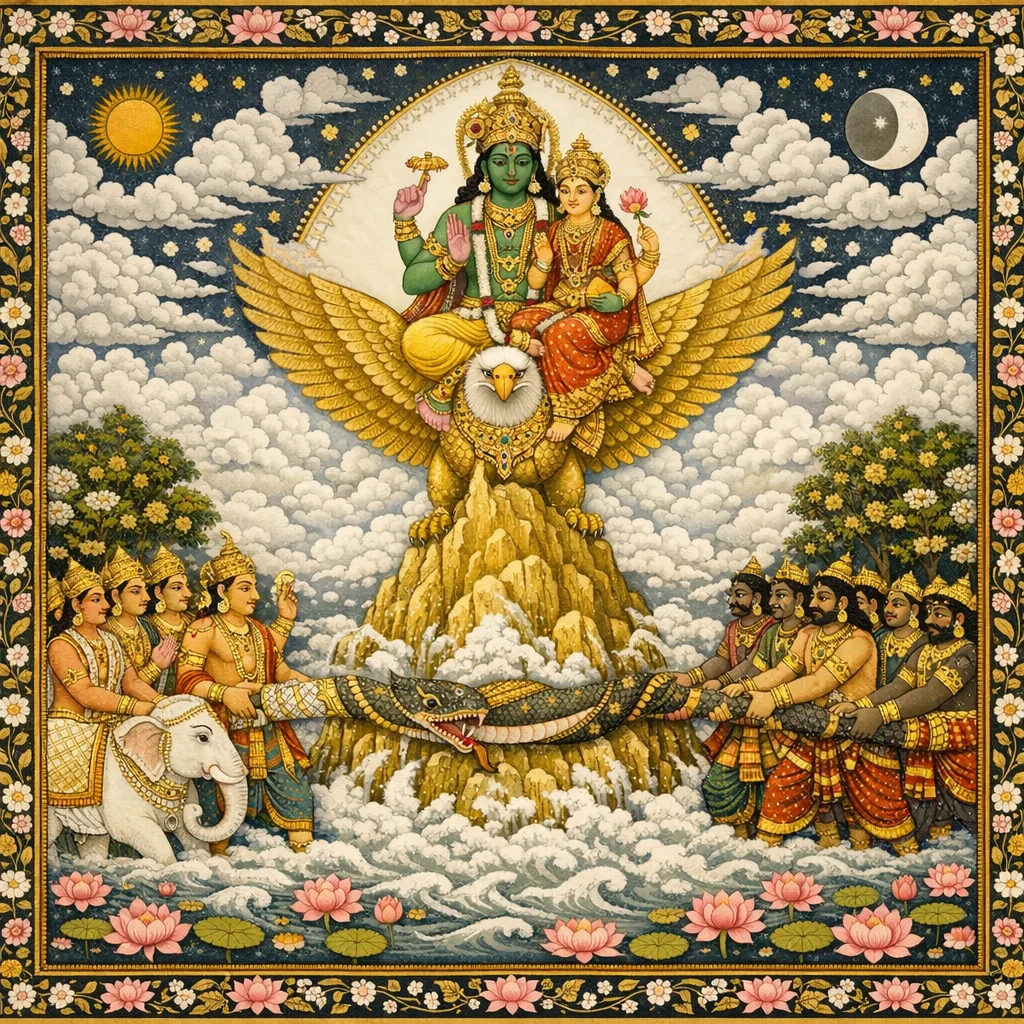
Continuing from the devas’ distress and their appeal for divine shelter, Hari manifests before Brahmā, Śiva, and the assembled demigods in an overwhelming effulgence that eclipses their vision. Brahmā and Śiva perceive the Lord’s marakata-hued form adorned with Kaustubha, Lakṣmī, and divine weapons; the devas fall in reverence. Brahmā offers philosophical prayers affirming the Lord’s guṇa-transcendence, His role as the source-resting-place-end of the cosmos, and bhakti-yoga as the means to approach Him. The devas then request guidance, and the Lord replies: make a strategic truce with the asuras (favored by time), churn the Ocean of Milk using Mandara as the rod and Vāsuki as the rope, remain patient, and do not fear the arising kālakūṭa poison or become greedy for interim products. After the Lord disappears, the devas approach Bali, who accepts Indra’s Viṣṇu-derived proposal; both sides uproot Mandara. Exhausted, they drop it, crushing many; Viṣṇu arrives on Garuḍa, revives the fallen, and effortlessly transports Mandara to the ocean—setting up the next chapter’s churning operations and ensuing manifestations.
Shlokas
Verse 1
श्रीशुक उवाच एवं स्तुत: सुरगणैर्भगवान् हरिरीश्वर: । तेषामाविरभूद् राजन्सहस्रार्कोदयद्युति: ॥ १ ॥
Śrī Śukadeva Gosvāmī said: O King Parīkṣit, the Supreme Personality of Godhead, Hari, being thus worshiped with prayers by the demigods and Lord Brahmā, appeared before them. His bodily effulgence resembled the simultaneous rising of thousands of suns.
Verse 2
श्रीएवं उक्त्वा हरिवंशेण शकुन्तला पुरो हृषीकेशम् । अभ्युपगम्य महाभागा हर्षेणाभिवाद्य भास्करम् ॥ २ ॥
The vision of all the demigods was blocked by the Lord’s effulgence. Thus they could see neither the sky, the directions, the land, nor even themselves, what to speak of seeing the Lord, who was present before them.
Verse 3
विरिञ्चो भगवान्दृष्ट्वा सह शर्वेण तां तनुम् । स्वच्छां मरकतश्यामां कञ्जगर्भारुणेक्षणाम् ॥ ३ ॥ तप्तहेमावदातेन लसत्कौशेयवाससा । प्रसन्नचारुसर्वाङ्गीं सुमुखीं सुन्दरभ्रुवम् ॥ ४ ॥ महामणिकिरीटेन केयूराभ्यां च भूषिताम् । कर्णाभरणनिर्भातकपोलश्रीमुखाम्बुजाम् ॥ ५ ॥ काञ्चीकलापवलयहारनूपुरशोभिताम् । कौस्तुभाभरणां लक्ष्मीं बिभ्रतीं वनमालिनीम् ॥ ६ ॥ सुदर्शनादिभि: स्वास्त्रैर्मूर्तिमद्भिरुपासिताम् । तुष्टाव देवप्रवर: सशर्व: पुरुषं परम् । सर्वामरगणै: साकं सर्वाङ्गैरवनिं गतै: ॥ ७ ॥
Lord Brahmā, along with Lord Śiva, saw the crystal-clear personal beauty of the Supreme Personality of Godhead, whose blackish body resembles a marakata gem, whose eyes are reddish like the depths of a lotus, who is dressed with garments that are yellow like molten gold, and whose entire body is attractively decorated. They saw His beautiful, smiling, lotuslike face, crowned by a helmet bedecked with valuable jewels. The Lord has attractive eyebrows, and His cheeks are adorned with earrings. Lord Brahmā and Lord Śiva saw the belt on the Lord’s waist, the bangles on His arms, the necklace on His chest, and the ankle bells on His legs. The Lord is bedecked with flower garlands, His neck is decorated with the Kaustubha gem, and He carries with Him the goddess of fortune and His personal weapons, like His disc and club. When Lord Brahmā, along with Lord Śiva and the other demigods, thus saw the form of the Lord, they all immediately fell to the ground, offering their obeisances.
Verse 4
विरिञ्चो भगवान्दृष्ट्वा सह शर्वेण तां तनुम् । स्वच्छां मरकतश्यामां कञ्जगर्भारुणेक्षणाम् ॥ ३ ॥ तप्तहेमावदातेन लसत्कौशेयवाससा । प्रसन्नचारुसर्वाङ्गीं सुमुखीं सुन्दरभ्रुवम् ॥ ४ ॥ महामणिकिरीटेन केयूराभ्यां च भूषिताम् । कर्णाभरणनिर्भातकपोलश्रीमुखाम्बुजाम् ॥ ५ ॥ काञ्चीकलापवलयहारनूपुरशोभिताम् । कौस्तुभाभरणां लक्ष्मीं बिभ्रतीं वनमालिनीम् ॥ ६ ॥ सुदर्शनादिभि: स्वास्त्रैर्मूर्तिमद्भिरुपासिताम् । तुष्टाव देवप्रवर: सशर्व: पुरुषं परम् । सर्वामरगणै: साकं सर्वाङ्गैरवनिं गतै: ॥ ७ ॥
Lord Brahmā, along with Lord Śiva, saw the crystal-clear personal beauty of the Supreme Personality of Godhead, whose blackish body resembles a marakata gem, whose eyes are reddish like the depths of a lotus, who is dressed with garments that are yellow like molten gold, and whose entire body is attractively decorated. They saw His beautiful, smiling, lotuslike face, crowned by a helmet bedecked with valuable jewels. The Lord has attractive eyebrows, and His cheeks are adorned with earrings. Lord Brahmā and Lord Śiva saw the belt on the Lord’s waist, the bangles on His arms, the necklace on His chest, and the ankle bells on His legs. The Lord is bedecked with flower garlands, His neck is decorated with the Kaustubha gem, and He carries with Him the goddess of fortune and His personal weapons, like His disc and club. When Lord Brahmā, along with Lord Śiva and the other demigods, thus saw the form of the Lord, they all immediately fell to the ground, offering their obeisances.
Verse 5
विरिञ्चो भगवान्दृष्ट्वा सह शर्वेण तां तनुम् । स्वच्छां मरकतश्यामां कञ्जगर्भारुणेक्षणाम् ॥ ३ ॥ तप्तहेमावदातेन लसत्कौशेयवाससा । प्रसन्नचारुसर्वाङ्गीं सुमुखीं सुन्दरभ्रुवम् ॥ ४ ॥ महामणिकिरीटेन केयूराभ्यां च भूषिताम् । कर्णाभरणनिर्भातकपोलश्रीमुखाम्बुजाम् ॥ ५ ॥ काञ्चीकलापवलयहारनूपुरशोभिताम् । कौस्तुभाभरणां लक्ष्मीं बिभ्रतीं वनमालिनीम् ॥ ६ ॥ सुदर्शनादिभि: स्वास्त्रैर्मूर्तिमद्भिरुपासिताम् । तुष्टाव देवप्रवर: सशर्व: पुरुषं परम् । सर्वामरगणै: साकं सर्वाङ्गैरवनिं गतै: ॥ ७ ॥
Lord Brahmā, along with Lord Śiva, saw the crystal-clear personal beauty of the Supreme Personality of Godhead, whose blackish body resembles a marakata gem, whose eyes are reddish like the depths of a lotus, who is dressed with garments that are yellow like molten gold, and whose entire body is attractively decorated. They saw His beautiful, smiling, lotuslike face, crowned by a helmet bedecked with valuable jewels. The Lord has attractive eyebrows, and His cheeks are adorned with earrings. Lord Brahmā and Lord Śiva saw the belt on the Lord’s waist, the bangles on His arms, the necklace on His chest, and the ankle bells on His legs. The Lord is bedecked with flower garlands, His neck is decorated with the Kaustubha gem, and He carries with Him the goddess of fortune and His personal weapons, like His disc and club. When Lord Brahmā, along with Lord Śiva and the other demigods, thus saw the form of the Lord, they all immediately fell to the ground, offering their obeisances.
Verse 6
विरिञ्चो भगवान्दृष्ट्वा सह शर्वेण तां तनुम् । स्वच्छां मरकतश्यामां कञ्जगर्भारुणेक्षणाम् ॥ ३ ॥ तप्तहेमावदातेन लसत्कौशेयवाससा । प्रसन्नचारुसर्वाङ्गीं सुमुखीं सुन्दरभ्रुवम् ॥ ४ ॥ महामणिकिरीटेन केयूराभ्यां च भूषिताम् । कर्णाभरणनिर्भातकपोलश्रीमुखाम्बुजाम् ॥ ५ ॥ काञ्चीकलापवलयहारनूपुरशोभिताम् । कौस्तुभाभरणां लक्ष्मीं बिभ्रतीं वनमालिनीम् ॥ ६ ॥ सुदर्शनादिभि: स्वास्त्रैर्मूर्तिमद्भिरुपासिताम् । तुष्टाव देवप्रवर: सशर्व: पुरुषं परम् । सर्वामरगणै: साकं सर्वाङ्गैरवनिं गतै: ॥ ७ ॥
Lord Brahmā, along with Lord Śiva, saw the crystal-clear personal beauty of the Supreme Personality of Godhead, whose blackish body resembles a marakata gem, whose eyes are reddish like the depths of a lotus, who is dressed with garments that are yellow like molten gold, and whose entire body is attractively decorated. They saw His beautiful, smiling, lotuslike face, crowned by a helmet bedecked with valuable jewels. The Lord has attractive eyebrows, and His cheeks are adorned with earrings. Lord Brahmā and Lord Śiva saw the belt on the Lord’s waist, the bangles on His arms, the necklace on His chest, and the ankle bells on His legs. The Lord is bedecked with flower garlands, His neck is decorated with the Kaustubha gem, and He carries with Him the goddess of fortune and His personal weapons, like His disc and club. When Lord Brahmā, along with Lord Śiva and the other demigods, thus saw the form of the Lord, they all immediately fell to the ground, offering their obeisances.
Verse 7
विरिञ्चो भगवान्दृष्ट्वा सह शर्वेण तां तनुम् । स्वच्छां मरकतश्यामां कञ्जगर्भारुणेक्षणाम् ॥ ३ ॥ तप्तहेमावदातेन लसत्कौशेयवाससा । प्रसन्नचारुसर्वाङ्गीं सुमुखीं सुन्दरभ्रुवम् ॥ ४ ॥ महामणिकिरीटेन केयूराभ्यां च भूषिताम् । कर्णाभरणनिर्भातकपोलश्रीमुखाम्बुजाम् ॥ ५ ॥ काञ्चीकलापवलयहारनूपुरशोभिताम् । कौस्तुभाभरणां लक्ष्मीं बिभ्रतीं वनमालिनीम् ॥ ६ ॥ सुदर्शनादिभि: स्वास्त्रैर्मूर्तिमद्भिरुपासिताम् । तुष्टाव देवप्रवर: सशर्व: पुरुषं परम् । सर्वामरगणै: साकं सर्वाङ्गैरवनिं गतै: ॥ ७ ॥
Lord Brahmā, along with Lord Śiva, saw the crystal-clear personal beauty of the Supreme Personality of Godhead, whose blackish body resembles a marakata gem, whose eyes are reddish like the depths of a lotus, who is dressed with garments that are yellow like molten gold, and whose entire body is attractively decorated. They saw His beautiful, smiling, lotuslike face, crowned by a helmet bedecked with valuable jewels. The Lord has attractive eyebrows, and His cheeks are adorned with earrings. Lord Brahmā and Lord Śiva saw the belt on the Lord’s waist, the bangles on His arms, the necklace on His chest, and the ankle bells on His legs. The Lord is bedecked with flower garlands, His neck is decorated with the Kaustubha gem, and He carries with Him the goddess of fortune and His personal weapons, like His disc and club. When Lord Brahmā, along with Lord Śiva and the other demigods, thus saw the form of the Lord, they all immediately fell to the ground, offering their obeisances.
Verse 8
श्रीब्रह्मोवाच अजातजन्मस्थितिसंयमाया- गुणाय निर्वाणसुखार्णवाय । अणोरणिम्नेऽपरिगण्यधाम्ने
Lord Brahmā said: Although You are never born, Your appearance and disappearance as an incarnation never cease. You are always free from the material qualities, and You are the shelter of transcendental bliss resembling an ocean. Eternally existing in Your transcendental form, You are the supreme subtle of the most extremely subtle. We therefore offer our respectful obeisances unto You, the Supreme, whose existence is inconceivable.
Verse 9
रूपं तवैतत् पुरुषर्षभेज्यं श्रेयोऽर्थिभिर्वैदिकतान्त्रिकेण । योगेन धात: सह नस्त्रिलोकान् पश्याम्यमुष्मिन्नु ह विश्वमूर्तौ ॥ ९ ॥
O best of persons, O supreme director, those who actually aspire for supreme good fortune worship this form of Your Lordship according to the Vedic Tantras. My Lord, we can see all the three worlds in You.
Verse 10
त्वय्यग्र आसीत् त्वयि मध्य आसीत् त्वय्यन्त आसीदिदमात्मतन्त्रे । त्वमादिरन्तो जगतोऽस्य मध्यं घटस्य मृत्स्नेव पर: परस्मात् ॥ १० ॥
My dear Lord, who are always fully independent, this entire cosmic manifestation arises from You, rests upon You and ends in You. Your Lordship is the beginning, sustenance and end of everything, like the earth, which is the cause of an earthen pot, which supports the pot, and to which the pot, when broken, finally returns.
Verse 11
त्वं माययात्माश्रयया स्वयेदं निर्माय विश्वं तदनुप्रविष्ट: । पश्यन्ति युक्ता मनसा मनीषिणो गुणव्यवायेऽप्यगुणं विपश्चित: ॥ ११ ॥
O Supreme, You are independent in Your self and do not take help from others. Through Your own potency, You create this cosmic manifestation and enter into it. Those who are advanced in Kṛṣṇa consciousness, who are fully in knowledge of the authoritative śāstra, and who, through the practice of bhakti-yoga, are cleansed of all material contamination, can see with clear minds that although You exist within the transformations of the material qualities, Your presence is untouched by these qualities.
Verse 12
यथाग्निमेधस्यमृतं च गोषु भुव्यन्नमम्बूद्यमने च वृत्तिम् । योगैर्मनुष्या अधियन्ति हि त्वां गुणेषु बुद्ध्या कवयो वदन्ति ॥ १२ ॥
As one can derive fire from wood, milk from the milk bag of the cow, food grains and water from the land, and prosperity in one’s livelihood from industrial enterprises, so, by the practice of bhakti-yoga, even within this material world, one can achieve Your favor or intelligently approach You. Those who are pious all affirm this.
Verse 13
तं त्वां वयं नाथ समुज्जिहानं सरोजनाभातिचिरेप्सितार्थम् । दृष्ट्वा गता निर्वृतमद्य सर्वे गजा दवार्ता इव गाङ्गमम्भ: ॥ १३ ॥
Elephants afflicted by a forest fire become very happy when they get water from the Ganges. Similarly, O my Lord, from whose navel grows a lotus flower, since You have now appeared before us, we have become transcendentally happy. By seeing Your Lordship, whom we have desired to see for a very long time, we have achieved our ultimate goal in life.
Verse 14
स त्वं विधत्स्वाखिललोकपाला वयं यदर्थास्तव पादमूलम् । समागतास्ते बहिरन्तरात्मन् किं वान्यविज्ञाप्यमशेषसाक्षिण: ॥ १४ ॥
My Lord, we, the various demigods, the directors of this universe, have come to Your lotus feet. Please fulfill the purpose for which we have come. You are the witness of everything, from within and without. Nothing is unknown to You, and therefore it is unnecessary to inform You again of anything.
Verse 15
अहं गिरित्रश्च सुरादयो ये दक्षादयोऽग्नेरिव केतवस्ते । किं वा विदामेश पृथग्विभाता विधत्स्व शं नो द्विजदेवमन्त्रम् ॥ १५ ॥
I [Lord Brahmā], Lord Śiva and all the demigods, accompanied by the prajāpatis like Dakṣa, are nothing but sparks illuminated by You, who are the original fire. Since we are particles of You, what can we understand about our welfare? O Supreme Lord, please give us the means of deliverance that is suitable for the brāhmaṇas and demigods.
Verse 16
श्रीशुक उवाच एवं विरिञ्चादिभिरीडितस्तद् विज्ञाय तेषां हृदयं यथैव । जगाद जीमूतगभीरया गिरा बद्धाञ्जलीन्संवृतसर्वकारकान् ॥ १६ ॥
Śukadeva Gosvāmī continued: When the Lord was thus offered prayers by the demigods, headed by Lord Brahmā, He understood the purpose for which they had approached Him. Therefore, in a deep voice that resembled the rumbling of clouds, the Lord replied to the demigods, who all stood there attentively with folded hands.
Verse 17
एक एवेश्वरस्तस्मिन्सुरकार्ये सुरेश्वर: । विहर्तुकामस्तानाह समुद्रोन्मथनादिभि: ॥ १७ ॥
Although the Supreme Personality of Godhead, the master of the demigods, was capable of performing the activities of the demigods by Himself, He wanted to enjoy pastimes in churning the ocean. Therefore He spoke as follows.
Verse 18
श्रीभगवानुवाच हन्त ब्रह्मन्नहो शम्भो हे देवा मम भाषितम् । शृणुतावहिता: सर्वे श्रेयो व: स्याद् यथा सुरा: ॥ १८ ॥
The Supreme Personality of Godhead said: O Lord Brahmā, Lord Śiva and other demigods, please hear Me with great attention, for what I say will bring good fortune for all of you.
Verse 19
यात दानवदैतेयैस्तावत् सन्धिर्विधीयताम् । कालेनानुगृहीतैस्तैर्यावद् वो भव आत्मन: ॥ १९ ॥
As long as you are not flourishing, you should make a truce with the demons and asuras, who are now being favored by time.
Verse 20
अरयोऽपि हि सन्धेया: सति कार्यार्थगौरवे । अहिमूषिकवद् देवा ह्यर्थस्य पदवीं गतै: ॥ २० ॥
O demigods, fulfilling one’s own interests is so important that one may even have to make a truce with one’s enemies. For the sake of one’s self-interest, one has to act according to the logic of the snake and the mouse.
Verse 21
अमृतोत्पादने यत्न: क्रियतामविलम्बितम् । यस्य पीतस्य वै जन्तुर्मृत्युग्रस्तोऽमरो भवेत् ॥ २१ ॥
Immediately endeavor to produce nectar, which a person who is about to die may drink to become immortal.
Verse 22
क्षिप्त्वा क्षीरोदधौ सर्वा वीरुत्तृणलतौषधी: । मन्थानं मन्दरं कृत्वा नेत्रं कृत्वा तु वासुकिम् ॥ २२ ॥ सहायेन मया देवा निर्मन्थध्वमतन्द्रिता: । क्लेशभाजो भविष्यन्ति दैत्या यूयं फलग्रहा: ॥ २३ ॥
O demigods, cast into the Ocean of Milk all kinds of vegetables, grass, creepers and drugs. Then, with My help, making Mandara Mountain the churning rod and Vāsuki the rope for churning, churn the Ocean of Milk with undiverted attention. Thus the demons will be engaged in labor, but you, the demigods, will gain the actual result, the nectar produced from the ocean.
Verse 23
क्षिप्त्वा क्षीरोदधौ सर्वा वीरुत्तृणलतौषधी: । मन्थानं मन्दरं कृत्वा नेत्रं कृत्वा तु वासुकिम् ॥ २२ ॥ सहायेन मया देवा निर्मन्थध्वमतन्द्रिता: । क्लेशभाजो भविष्यन्ति दैत्या यूयं फलग्रहा: ॥ २३ ॥
O demigods, cast into the Ocean of Milk all kinds of vegetables, grass, creepers and drugs. Then, with My help, making Mandara Mountain the churning rod and Vāsuki the rope for churning, churn the Ocean of Milk with undiverted attention. Thus the demons will be engaged in labor, but you, the demigods, will gain the actual result, the nectar produced from the ocean.
Verse 24
यूयं तदनुमोदध्वं यदिच्छन्त्यसुरा: सुरा: । न संरम्भेण सिध्यन्ति सर्वार्था: सान्त्वया यथा ॥ २४ ॥
My dear demigods, with patience and peace everything can be done, but if one is agitated by anger, the goal is not achieved. Therefore, whatever the demons ask, agree to their proposal.
Verse 25
न भेतव्यं कालकूटाद् विषाज्जलधिसम्भवात् । लोभ: कार्यो न वो जातु रोष: कामस्तु वस्तुषु ॥ २५ ॥
A poison known as kālakūṭa will be generated from the Ocean of Milk, but you should not fear it. And when various products are churned from the ocean, you should not be greedy for them or anxious to obtain them, nor should you be angry.
Verse 26
श्रीशुक उवाच इति देवान्समादिश्य भगवान् पुरुषोत्तम: । तेषामन्तर्दधे राजन्स्वच्छन्दगतिरीश्वर: ॥ २६ ॥
Śukadeva Gosvāmī continued: O King Parīkṣit, after advising the demigods in this way, the independent Supreme Personality of Godhead, the best of all living entities, disappeared from their presence.
Verse 27
अथ तस्मै भगवते नमस्कृत्य पितामह: । भवश्च जग्मतु: स्वं स्वं धामोपेयुर्बलिं सुरा: ॥ २७ ॥
Then Lord Brahmā and Lord Śiva, after offering their respectful obeisances to the Lord, returned to their abodes. All the demigods then approached Mahārāja Bali.
Verse 28
दृष्ट्वारीनप्यसंयत्ताञ्जातक्षोभान्स्वनायकान् । न्यषेधद् दैत्यराट् श्लोक्य: सन्धिविग्रहकालवित् ॥ २८ ॥
Mahārāja Bali, a most celebrated king of the demons, knew very well when to make peace and when to fight. Thus although his commanders and captains were agitated and were about to kill the demigods, Mahārāja Bali, seeing that the demigods were coming to him without a militant attitude, forbade his commanders to kill them.
Verse 29
ते वैरोचनिमासीनं गुप्तं चासुरयूथपै: । श्रिया परमया जुष्टं जिताशेषमुपागमन् ॥ २९ ॥
The demigods approached Bali Mahārāja, the son of Virocana, and sat down near him. Bali Mahārāja was protected by the commanders of the demons and was most opulent, having conquered the entire universe.
Verse 30
महेन्द्र: श्लक्ष्णया वाचा सान्त्वयित्वा महामति: । अभ्यभाषत तत् सर्वं शिक्षितं पुरुषोत्तमात् ॥ ३० ॥
After pleasing Bali Mahārāja with mild words, Lord Indra, the King of the demigods, who was most intelligent, very politely submitted all the proposals he had learned from the Supreme Personality of Godhead, Lord Viṣṇu.
Verse 31
तत्त्वरोचत दैत्यस्य तत्रान्ये येऽसुराधिपा: । शम्बरोऽरिष्टनेमिश्च ये च त्रिपुरवासिन: ॥ ३१ ॥
The proposals submitted by King Indra were immediately accepted by Bali Mahārāja and his assistants, headed by Śambara and Ariṣṭanemi, and by all the other residents of Tripura.
Verse 32
ततो देवासुरा: कृत्वा संविदं कृतसौहृदा: । उद्यमं परमं चक्रुरमृतार्थे परन्तप ॥ ३२ ॥
O Mahārāja Parīkṣit, chastiser of enemies, the demigods and the demons thereafter made an armistice between them. Then, with great enterprise, they arranged to produce nectar, as proposed by Lord Indra.
Verse 33
ततस्ते मन्दरगिरिमोजसोत्पाट्य दुर्मदा: । नदन्त उदधिं निन्यु: शक्ता: परिघबाहव: ॥ ३३ ॥
Thereafter, with great strength, the demons and demigods, who were all very powerful and who had long, stout arms, uprooted Mandara Mountain. Crying very loudly, they brought it toward the Ocean of Milk.
Verse 34
दूरभारोद्वहश्रान्ता: शक्रवैरोचनादय: । अपारयन्तस्तं वोढुं विवशा विजहु: पथि ॥ ३४ ॥
Because of conveying the great mountain for a long distance, King Indra, Mahārāja Bali and the other demigods and demons became fatigued. Being unable to carry the mountain, they left it on the way.
Verse 35
निपतन्स गिरिस्तत्र बहूनमरदानवान् । चूर्णयामास महता भारेण कनकाचल: ॥ ३५ ॥
The mountain known as Mandara, which was extremely heavy, being made of gold, fell and smashed many demigods and demons.
Verse 36
तांस्तथा भग्नमनसो भग्नबाहूरुकन्धरान् । विज्ञाय भगवांस्तत्र बभूव गरुडध्वज: ॥ ३६ ॥
The demigods and demons were frustrated and disheartened, and their arms, thighs and shoulders were broken. Therefore the Supreme Personality of Godhead, who knows everything, appeared there on the back of His carrier, Garuḍa.
Verse 37
गिरिपातविनिष्पिष्टान्विलोक्यामरदानवान् । ईक्षया जीवयामास निर्जरान् निर्व्रणान् यथा ॥ ३७ ॥
Observing that most of the demons and the demigods had been crushed by the falling of the mountain, the Lord glanced over them and brought them back to life. Thus they became free from grief, and they even had no bruises on their bodies.
Verse 38
गिरिं चारोप्य गरुडे हस्तेनैकेन लीलया । आरुह्य प्रययावब्धिं सुरासुरगणैर्वृत: ॥ ३८ ॥
The Lord very easily lifted the mountain with one hand and placed it on the back of Garuḍa. Then, He too got on the back of Garuḍa and went to the Ocean of Milk, surrounded by the demigods and demons.
Verse 39
अवरोप्य गिरिं स्कन्धात् सुपर्ण: पततां वर: । ययौ जलान्त उत्सृज्य हरिणा स विसर्जित: ॥ ३९ ॥
Thereafter, Garuḍa, the chief of birds, unloaded Mandara Mountain from his shoulder and brought it near the water. Then he was asked by the Lord to leave that place, and he left.
Frequently Asked Questions
The chapter states that the asuras were ‘favored by time’ (kāla), so direct confrontation would not yield the devas’ welfare. Viṣṇu teaches upāya-kauśalya: for a higher objective (amṛta and restoration of cosmic balance), one may adopt a temporary truce—even with enemies—while remaining internally steady and dharmically guided.
He is described as radiantly effulgent (blinding like thousands of suns), yet personally beautiful: marakata-like dark complexion, lotus-reddish eyes, yellow garments, jeweled helmet, ornaments, garlands, Kaustubha, weapons, and Lakṣmī. The theological point is that Bhagavān is simultaneously transcendent (beyond guṇas and ordinary perception) and personal (sac-cid-ānanda vigraha), approachable through devotion rather than material vision.
Viṣṇu’s warning frames the churning as a process where dangerous and distracting byproducts appear before the final goal (amṛta). It teaches steadiness (kṣānti/śānti), freedom from fear and greed, and trust in divine oversight—an ethical and spiritual template for pursuing higher ends without being derailed by intermediate crises or temptations.
Bali Mahārāja, son of Virocana, is the asura king portrayed as politically discerning—knowing when to fight and when to make peace. He accepts because the devas approach without hostility and because the proposal promises a strategic advantage (participation in producing nectar), aligning with statecraft even within asuric power politics.