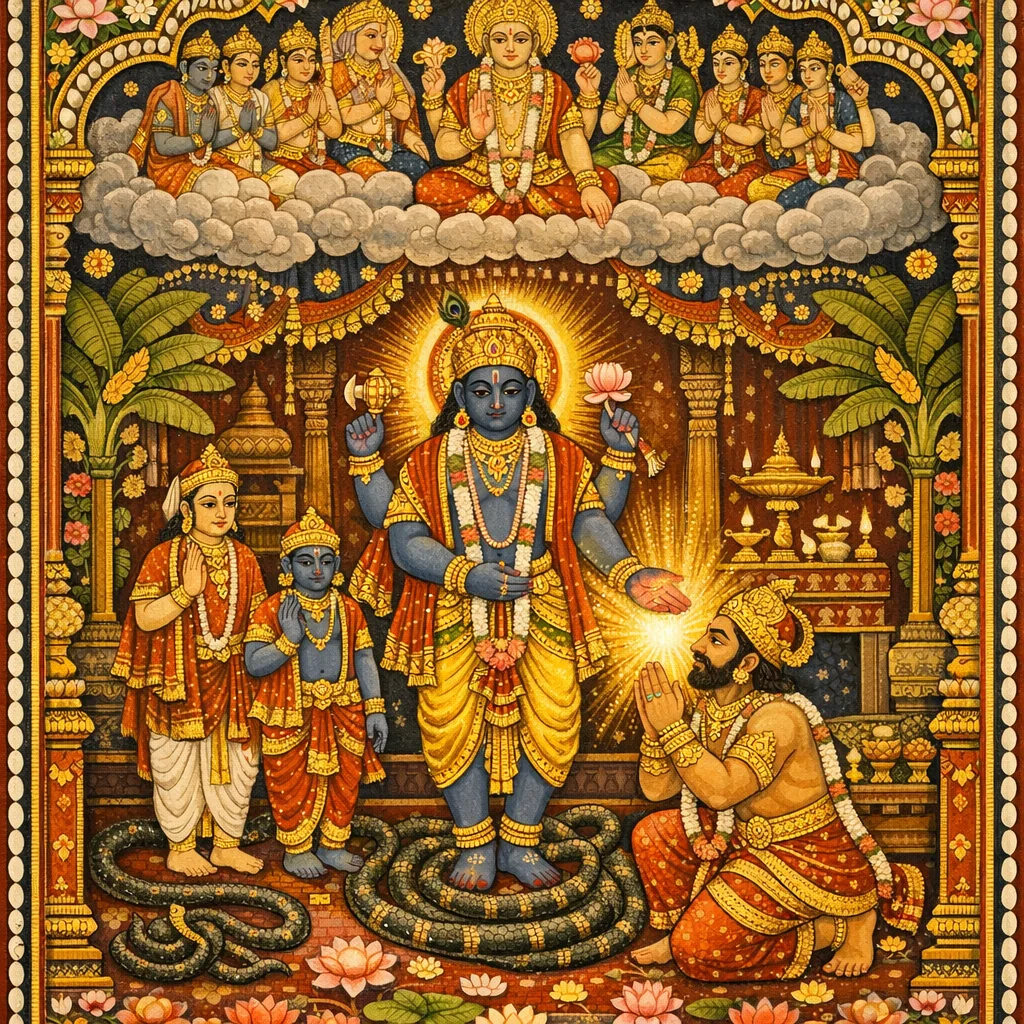
Adhyaya 23
Bali Liberated, Prahlāda Blessed, and Vāmana Accepted as Universal Protector
Following the Lord’s concluding words to Bali, Bali Mahārāja—overwhelmed with bhakti—offers prayers and obeisances. He is released from Varuṇa’s nāga-pāśa and enters Sutala, while the Lord restores the heavenly proprietorship to Indra, fulfilling Aditi’s desire and stabilizing universal administration. Prahlāda Mahārāja, hearing of Bali’s deliverance and benediction, offers profound devotional reflections: the Lord is equal as Supersoul yet especially favors devotees, like a desire tree reciprocating to one’s approach—thus His ‘partiality’ is actually divine consistency. The Lord then instructs Prahlāda to go to Sutala, promising personal darśana there in His four-armed Nārāyaṇa form, freeing Prahlāda from further fruitive bondage through constant vision. Next, Hari addresses Śukrācārya to identify and nullify any sacrificial discrepancies; Śukra affirms that chanting the Lord’s name perfects all ritual faults and complies with the Lord’s order to rectify details. The chapter culminates in the devas and sages accepting Upendra (Vāmana) as the supreme protector of Veda and dharma; Indra regains sovereignty under Vāmana’s protection. Śukadeva closes by praising the liberating merit of hearing Vāmana–Trivikrama kathā, linking this conclusion to the next narrative arc by reaffirming avatāra-kathā as the Bhāgavata’s pathway from governance (manvantara) to liberation (mokṣa).
Shlokas
Verse 1
श्रीशुक उवाच इत्युक्तवन्तं पुरुषं पुरातनं महानुभावोऽखिलसाधुसम्मत: । बद्धाञ्जलिर्बाष्पकलाकुलेक्षणो भक्त्युत्कलो गद्गदया गिराब्रवीत् ॥ १ ॥
Śukadeva Gosvāmī said: When the supreme, ancient, eternal Personality of Godhead had thus spoken to Bali Mahārāja, who is universally accepted as a pure devotee of the Lord and therefore a great soul, Bali Mahārāja, his eyes filled with tears, his hands folded and his voice faltering in devotional ecstasy, responded as follows.
Verse 2
श्रीबलिरुवाच अहो प्रणामाय कृत: समुद्यम: प्रपन्नभक्तार्थविधौ समाहित: । यल्लोकपालैस्त्वदनुग्रहोऽमरै- रलब्धपूर्वोऽपसदेऽसुरेऽर्पित: ॥ २ ॥
Bali Mahārāja said: What a wonderful effect there is in even attempting to offer respectful obeisances to You! I merely endeavored to offer You obeisances, but nonetheless the attempt was as successful as those of pure devotees. The causeless mercy You have shown to me, a fallen demon, was never achieved even by the demigods or the leaders of the various planets.
Verse 3
श्रीशुक उवाच इत्युक्त्वा हरिमानत्य ब्रह्माणं सभवं तत: । विवेश सुतलं प्रीतो बलिर्मुक्त: सहासुरै: ॥ ३ ॥
Śukadeva Gosvāmī continued: After speaking in this way, Bali Mahārāja offered his obeisances first to the Supreme Personality of Godhead, Hari, and then to Lord Brahmā and Lord Śiva. Thus he was released from the bondage of the nāga-pāśa [the ropes of Varuṇa], and in full satisfaction he entered the planet known as Sutala.
Verse 4
एवमिन्द्राय भगवान् प्रत्यानीय त्रिविष्टपम् । पूरयित्वादिते: काममशासत् सकलं जगत् ॥ ४ ॥
Thus having delivered the proprietorship of the heavenly planets to Indra and having fulfilled the desire of Aditi, mother of the demigods, the Supreme Personality of Godhead ruled the affairs of the universe.
Verse 5
लब्धप्रसादं निर्मुक्तं पौत्रं वंशधरं बलिम् । निशाम्य भक्तिप्रवण: प्रह्लाद इदमब्रवीत् ॥ ५ ॥
When Prahlāda Mahārāja heard how Bali Mahārāja, his grandson and descendant, had been released from bondage and had achieved the benediction of the Lord, he spoke as follows in a tone of greatly ecstatic devotion.
Verse 6
श्रीप्रह्लाद उवाच नेमं विरिञ्चो लभते प्रसादं न श्रीर्न शर्व: किमुतापरेऽन्ये । यन्नोऽसुराणामसि दुर्गपालो विश्वाभिवन्द्यैरभिवन्दिताङ्घ्रि: ॥ ६ ॥
Prahlāda Mahārāja said: O Supreme Personality of Godhead, You are universally worshiped; even Lord Brahmā and Lord Śiva worship Your lotus feet. Yet although You are such a great personality, You have kindly promised to protect us, the demons. I think that such kindness has never been achieved even by Lord Brahmā, Lord Śiva or the goddess of fortune, Lakṣmī, what to speak of other demigods or common people.
Verse 7
यत्पादपद्ममकरन्दनिषेवणेन ब्रह्मादय: शरणदाश्नुवते विभूती: । कस्माद् वयं कुसृतय: खलयोनयस्ते दाक्षिण्यदृष्टिपदवीं भवत: प्रणीता: ॥ ७ ॥
O supreme shelter of everyone, great personalities like Brahmā enjoy their perfection simply by tasting the honey of rendering service at Your lotus feet. But as for us, who are all rogues and debauchees born of an envious family of demons, how have we received Your mercy? It has been possible only because Your mercy is causeless.
Verse 8
चित्रं तवेहितमहोऽमितयोगमाया- लीलाविसृष्टभुवनस्य विशारदस्य । सर्वात्मन: समदृशोऽविषम: स्वभावो भक्तप्रियो यदसि कल्पतरुस्वभाव: ॥ ८ ॥
O my Lord, Your pastimes are all wonderfully performed by Your inconceivable spiritual energy; and by her perverted reflection, the material energy, You have created all the universes. As the Supersoul of all living entities, You are aware of everything, and therefore You are certainly equal toward everyone. Nonetheless, You favor Your devotees. This is not partiality, however, for Your characteristic is just like that of a desire tree, which yields everything according to one’s desire.
Verse 9
श्रीभगवानुवाच वत्स प्रह्लाद भद्रं ते प्रयाहि सुतलालयम् । मोदमान: स्वपौत्रेण ज्ञातीनां सुखमावह ॥ ९ ॥
The Supreme Personality of Godhead said: My dear son Prahlāda, all good fortune unto you. For the time being, please go to the place known as Sutala and there enjoy happiness with your grandson and your other relatives and friends.
Verse 10
नित्यं द्रष्टासि मां तत्र गदापाणिमवस्थितम् । मद्दर्शनमहाह्लादध्वस्तकर्मनिबन्धन: ॥ १० ॥
The Supreme Personality of Godhead assured Prahlāda Mahārāja: You shall be able to see Me there in My usual feature with conchshell, disc, club and lotus in My hand. Because of your transcendental bliss due to always personally seeing Me, you will have no further bondage to fruitive activities.
Verse 11
श्रीशुक उवाच आज्ञां भगवतो राजन्प्रह्लादो बलिना सह । बाढमित्यमलप्रज्ञो मूर्ध्न्याधाय कृताञ्जलि: ॥ ११ ॥ परिक्रम्यादिपुरुषं सर्वासुरचमूपति: । प्रणतस्तदनुज्ञात: प्रविवेश महाबिलम् ॥ १२ ॥
Śrīla Śukadeva Gosvāmī said: Accompanied by Bali Mahārāja, my dear King Parīkṣit, Prahlāda Mahārāja, the master of all the chiefs of the demons, took the Supreme Lord’s order on his head with folded hands. After saying yes to the Lord, circumambulating Him and offering Him respectful obeisances, he entered the lower planetary system known as Sutala.
Verse 12
श्रीशुक उवाच आज्ञां भगवतो राजन्प्रह्लादो बलिना सह । बाढमित्यमलप्रज्ञो मूर्ध्न्याधाय कृताञ्जलि: ॥ ११ ॥ परिक्रम्यादिपुरुषं सर्वासुरचमूपति: । प्रणतस्तदनुज्ञात: प्रविवेश महाबिलम् ॥ १२ ॥
Śrīla Śukadeva Gosvāmī said: Accompanied by Bali Mahārāja, my dear King Parīkṣit, Prahlāda Mahārāja, the master of all the chiefs of the demons, took the Supreme Lord’s order on his head with folded hands. After saying yes to the Lord, circumambulating Him and offering Him respectful obeisances, he entered the lower planetary system known as Sutala.
Verse 13
अथाहोशनसं राजन्हरिर्नारायणोऽन्तिके । आसीनमृत्विजां मध्ये सदसि ब्रह्मवादिनाम् ॥ १३ ॥
Hari, the Supreme Personality of Godhead, Nārāyaṇa, thereafter addressed Śukrācārya, who was sitting nearby in the midst of the assembly with the priests [brahma, hotā, udgātā and adhvaryu]. O Mahārāja Parīkṣit, these priests were all brahma-vādīs, followers of the Vedic principles for performing sacrifices.
Verse 14
ब्रह्मन् सन्तनु शिष्यस्य कर्मच्छिद्रं वितन्वत: । यत् तत् कर्मसु वैषम्यं ब्रह्मदृष्टं समं भवेत् ॥ १४ ॥
O best of the brāhmaṇas, Śukrācārya, please describe the fault or discrepancy in your disciple Bali Mahārāja, who engaged in performing sacrifices. This fault will be nullified when judged in the presence of qualified brāhmaṇas.
Verse 15
श्रीशुक्र उवाच कुतस्तत्कर्मवैषम्यं यस्य कर्मेश्वरो भवान् । यज्ञेशो यज्ञपुरुष: सर्वभावेन पूजित: ॥ १५ ॥
Śukrācārya said: My Lord, You are the enjoyer and lawgiver in all performances of sacrifice, and You are the yajña-puruṣa, the person to whom all sacrifices are offered. If one has fully satisfied You, where is the chance of discrepancies or faults in his performances of sacrifice?
Verse 16
मन्त्रतस्तन्त्रतश्छिद्रं देशकालार्हवस्तुत: । सर्वं करोति निश्छिद्रमनुसङ्कीर्तनं तव ॥ १६ ॥
There may be discrepancies in pronouncing the mantras and observing the regulative principles, and, moreover, there may be discrepancies in regard to time, place, person and paraphernalia. But when Your Lordship’s holy name is chanted, everything becomes faultless.
Verse 17
तथापि वदतो भूमन् करिष्याम्यनुशासनम् । एतच्छ्रेय: परं पुंसां यत् तवाज्ञानुपालनम् ॥ १७ ॥
Lord Viṣṇu, I must nonetheless act in obedience to Your order because obeying Your order is most auspicious and is the first duty of everyone.
Verse 18
श्रीशुक उवाच प्रतिनन्द्य हरेराज्ञामुशना भगवानिति । यज्ञच्छिद्रं समाधत्त बलेर्विप्रर्षिभि: सह ॥ १८ ॥
Śukadeva Gosvāmī continued: In this way, the most powerful Śukrācārya accepted the order of the Supreme Personality of Godhead with full respect. Along with the best brāhmaṇas, he began to compensate for the discrepancies in the sacrifices performed by Bali Mahārāja.
Verse 19
एवं बलेर्महीं राजन् भिक्षित्वा वामनो हरि: । ददौ भ्रात्रे महेन्द्राय त्रिदिवं यत्परैर्हृतम् ॥ १९ ॥
O King Parīkṣit, thus having taken all the land of Bali Mahārāja by begging, the Supreme Personality of Godhead, Lord Vāmanadeva, delivered to His brother Indra all the land taken away by Indra’s enemy.
Verse 20
प्रजापतिपतिर्ब्रह्मा देवर्षिपितृभूमिपै: । दक्षभृग्वङ्गिरोमुख्यै: कुमारेण भवेन च ॥ २० ॥ कश्यपस्यादिते: प्रीत्यै सर्वभूतभवाय च । लोकानां लोकपालानामकरोद् वामनं पतिम् ॥ २१ ॥
Lord Brahmā [the master of King Dakṣa and all other Prajāpatis], accompanied by all the demigods, the great saintly persons, the inhabitants of Pitṛloka, the Manus, the munis, and such leaders as Dakṣa, Bhṛgu and Aṅgirā, as well as Kārttikeya and Lord Śiva, accepted Lord Vāmanadeva as the protector of everyone. He did this for the pleasure of Kaśyapa Muni and his wife Aditi and for the welfare of all the inhabitants of the universe, including their various leaders.
Verse 21
प्रजापतिपतिर्ब्रह्मा देवर्षिपितृभूमिपै: । दक्षभृग्वङ्गिरोमुख्यै: कुमारेण भवेन च ॥ २० ॥ कश्यपस्यादिते: प्रीत्यै सर्वभूतभवाय च । लोकानां लोकपालानामकरोद् वामनं पतिम् ॥ २१ ॥
Lord Brahmā [the master of King Dakṣa and all other Prajāpatis], accompanied by all the demigods, the great saintly persons, the inhabitants of Pitṛloka, the Manus, the munis, and such leaders as Dakṣa, Bhṛgu and Aṅgirā, as well as Kārttikeya and Lord Śiva, accepted Lord Vāmanadeva as the protector of everyone. He did this for the pleasure of Kaśyapa Muni and his wife Aditi and for the welfare of all the inhabitants of the universe, including their various leaders.
Verse 22
वेदानां सर्वदेवानां धर्मस्य यशस: श्रिय: । मङ्गलानां व्रतानां च कल्पं स्वर्गापवर्गयो: ॥ २२ ॥ उपेन्द्रं कल्पयांचक्रे पतिं सर्वविभूतये । तदा सर्वाणि भूतानि भृशं मुमुदिरे नृप ॥ २३ ॥
O King Parīkṣit, Indra was considered the King of all the universe, but the demigods, headed by Lord Brahmā, wanted Upendra, Lord Vāmanadeva, as the protector of the Vedas, the principles of religion, fame, opulence, auspiciousness, vows, elevation to the higher planetary system, and liberation. Thus they accepted Upendra, Lord Vāmanadeva, as the supreme master of everything. This decision made all living entities extremely happy.
Verse 23
वेदानां सर्वदेवानां धर्मस्य यशस: श्रिय: । मङ्गलानां व्रतानां च कल्पं स्वर्गापवर्गयो: ॥ २२ ॥ उपेन्द्रं कल्पयांचक्रे पतिं सर्वविभूतये । तदा सर्वाणि भूतानि भृशं मुमुदिरे नृप ॥ २३ ॥
O King Parīkṣit, Indra was considered the King of all the universe, but the demigods, headed by Lord Brahmā, wanted Upendra, Lord Vāmanadeva, as the protector of the Vedas, the principles of religion, fame, opulence, auspiciousness, vows, elevation to the higher planetary system, and liberation. Thus they accepted Upendra, Lord Vāmanadeva, as the supreme master of everything. This decision made all living entities extremely happy.
Verse 24
ततस्त्विन्द्र: पुरस्कृत्य देवयानेन वामनम् । लोकपालैर्दिवं निन्ये ब्रह्मणा चानुमोदित: ॥ २४ ॥
Thereafter, along with all the leaders of the heavenly planets, Indra, the King of heaven, placed Lord Vāmanadeva before him and, with the approval of Lord Brahmā, brought Him to the heavenly planet in a celestial airplane.
Verse 25
प्राप्य त्रिभुवनं चेन्द्र उपेन्द्रभुजपालित: । श्रिया परमया जुष्टो मुमुदे गतसाध्वस: ॥ २५ ॥
Indra, King of heaven, being protected by the arms of Vāmanadeva, the Supreme Personality of Godhead, thus regained his rule of the three worlds and was reinstated in his own position, supremely opulent, fearless and fully satisfied.
Verse 26
ब्रह्मा शर्व: कुमारश्च भृग्वाद्या मुनयो नृप । पितर: सर्वभूतानि सिद्धा वैमानिकाश्च ये ॥ २६ ॥ सुमहत् कर्म तद् विष्णोर्गायन्त: परमद्भुतम् । धिष्ण्यानि स्वानि ते जग्मुरदितिं च शशंसिरे ॥ २७ ॥
Lord Brahmā, Lord Śiva, Lord Kārttikeya, the great sage Bhṛgu, other saintly persons, the inhabitants of Pitṛloka and all other living entities present, including the inhabitants of Siddhaloka and living entities who travel in outer space by airplane, all glorified the uncommon activities of Lord Vāmanadeva. O King, while chanting about and glorifying the Lord, they returned to their respective heavenly planets. They also praised the position of Aditi.
Verse 27
ब्रह्मा शर्व: कुमारश्च भृग्वाद्या मुनयो नृप । पितर: सर्वभूतानि सिद्धा वैमानिकाश्च ये ॥ २६ ॥ सुमहत् कर्म तद् विष्णोर्गायन्त: परमद्भुतम् । धिष्ण्यानि स्वानि ते जग्मुरदितिं च शशंसिरे ॥ २७ ॥
Lord Brahmā, Lord Śiva, Lord Kārttikeya, the great sage Bhṛgu, other saintly persons, the inhabitants of Pitṛloka and all other living entities present, including the inhabitants of Siddhaloka and living entities who travel in outer space by airplane, all glorified the uncommon activities of Lord Vāmanadeva. O King, while chanting about and glorifying the Lord, they returned to their respective heavenly planets. They also praised the position of Aditi.
Verse 28
सर्वमेतन्मयाख्यातं भवत: कुलनन्दन । उरुक्रमस्य चरितं श्रोतृणामघमोचनम् ॥ २८ ॥
O Mahārāja Parīkṣit, pleasure of your dynasty, I have now described to you everything about the wonderful activities of the Supreme Personality of Godhead Vāmanadeva. Those who hear about this are certainly freed from all the results of sinful activities.
Verse 29
पारं महिम्न उरुविक्रमतो गृणानो य: पार्थिवानि विममे स रजांसि मर्त्य: । किं जायमान उत जात उपैति मर्त्य इत्याह मन्त्रदृगृषि: पुरुषस्य यस्य ॥ २९ ॥
One who is subject to death cannot measure the glories of the Supreme Personality of Godhead, Trivikrama, Lord Viṣṇu, any more than he can count the number of atoms on the entire planet earth. No one, whether born already or destined to take birth, is able to do this. This has been sung by the great sage Vasiṣṭha.
Verse 30
य इदं देवदेवस्य हरेरद्भुतकर्मण: । अवतारानुचरितं शृण्वन् याति परां गतिम् ॥ ३० ॥
If one hears about the uncommon activities of the Supreme Personality of Godhead in His various incarnations, he is certainly elevated to the higher planetary system or even brought back home, back to Godhead.
Verse 31
क्रियमाणे कर्मणीदं दैवे पित्र्येऽथ मानुषे । यत्र यत्रानुकीर्त्येत तत् तेषां सुकृतं विदु: ॥ ३१ ॥
Whenever the activities of Vāmanadeva are described in the course of a ritualistic ceremony, whether the ceremony be performed to please the demigods, to please one’s forefathers in Pitṛloka, or to celebrate a social event like a marriage, that ceremony should be understood to be extremely auspicious.
Frequently Asked Questions
Bali’s release shows that the Lord’s ‘punishment’ of a devotee is actually purification and protection (poṣaṇa). Sutala is not mere exile; it becomes a divinely guarded realm where the Lord’s presence ensures Bali’s security and spiritual elevation. The episode teaches that surrender may involve apparent loss (kingdom) but culminates in a higher gain—direct divine shelter and lasting auspiciousness.
Prahlāda explains that the Lord, as Supersoul, is fully aware and equal toward all, but He reciprocates with living beings according to their approach. Just as a desire tree yields according to one’s desire, the Lord’s special favor is a response to bhakti and surrender, not arbitrary bias. Therefore, His devotion-centered ‘preference’ is an expression of spiritual justice, not material partiality.
Śukrācārya acknowledges that ritual performance can suffer defects of mantra pronunciation, timing, place, personnel, and paraphernalia. Yet because Viṣṇu is the yajña-puruṣa (the true recipient and lawgiver of sacrifice), sincere invocation of His holy name reconnects the act to its divine center, neutralizing technical shortcomings. The theological point is that bhakti (nāma) perfects karma-kāṇḍa by aligning it with the Lord’s pleasure.
Indra represents delegated cosmic administration, but he remains a jīva within the system and thus vulnerable to rivalry and karmic fluctuation. Upendra (Vāmana/Viṣṇu) is the transcendent protector of Veda, dharma, fame, opulence, auspiciousness, vows, elevation, and liberation—values that exceed political control. By accepting Vāmana as protector, the devas affirm that cosmic order is secure only when rooted in Viṣṇu-tattva, not merely in bureaucratic power.