Adhyaya 2
Trikūṭa Mountain, Ṛtumat Garden, and the Beginning of Gajendra’s Crisis
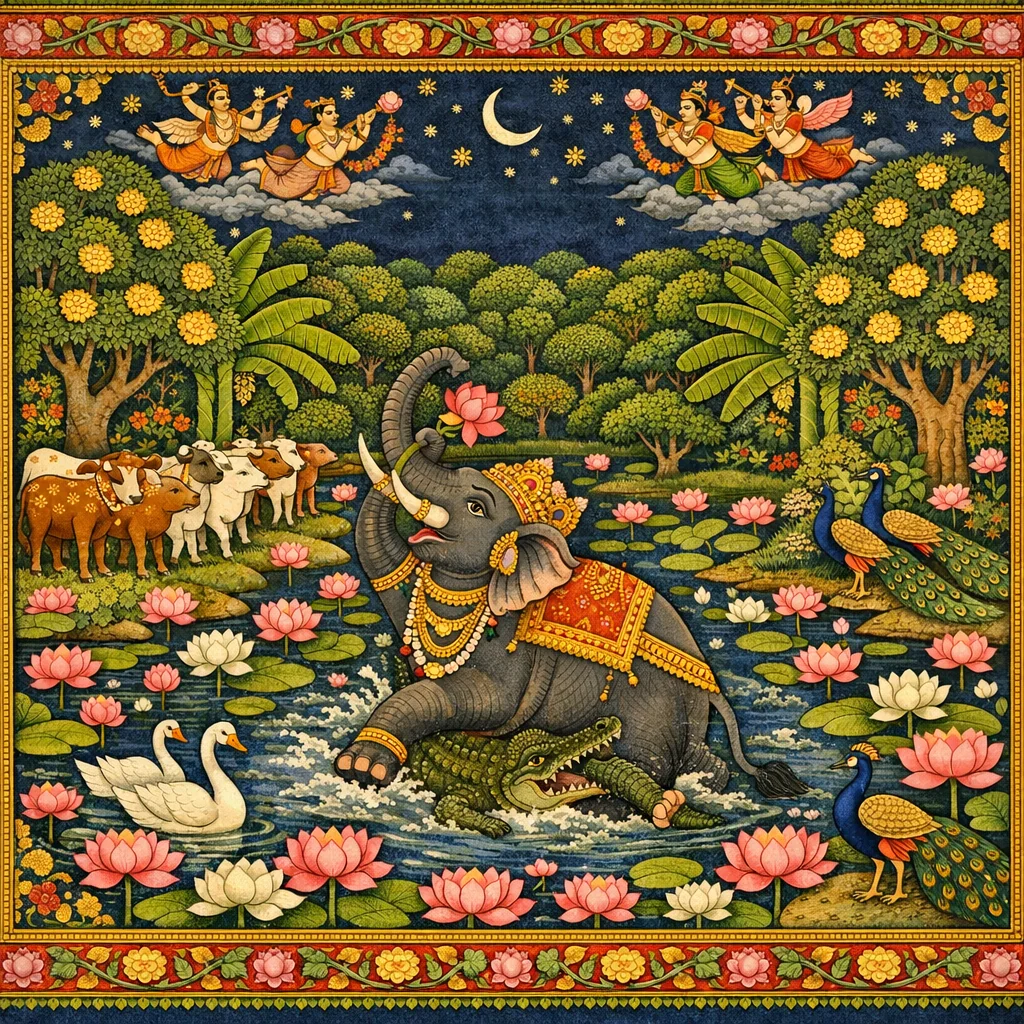
Śukadeva Gosvāmī describes to Mahārāja Parīkṣit the majestic Trikūṭa Mountain rising within the Kṣīra-samudra (Ocean of Milk), detailing its three principal peaks and the celestial ecology of jeweled valleys, waterfalls, birds, and heavenly residents. The narration narrows to Ṛtumat, Varuṇa’s all-season garden, and its lotus-filled lake—an aesthetic prelude that frames the stage for a decisive spiritual event. Into this setting comes Gajapati (Gajendra), leader of the elephants, moving with his herd to the lake, bathing and drinking, and affectionately serving his family—an image used to illustrate embodied attachment under māyā. By daiva (providence), a powerful crocodile attacks Gajendra’s leg, initiating a prolonged struggle that lasts a thousand years. As Gajendra’s strength wanes and the crocodile’s increases (being in its element), Gajendra recognizes the futility of worldly assistance and resolves to seek the Supreme Lord as the only universal shelter. This chapter thus transitions from cosmic beauty to existential danger, setting up the forthcoming prayer of surrender and divine intervention in the next section.
Shlokas
Verse 1
श्रीशुक उवाच आसीद् गिरिवरो राजंस्त्रिकूट इति विश्रुत: । क्षीरोदेनावृत: श्रीमान्योजनायुतमुच्छ्रित: ॥ १ ॥
Śukadeva Gosvāmī said: My dear King, there is a very large mountain called Trikūṭa. It is ten thousand yojanas [eighty thousand miles] high. Being surrounded by the Ocean of Milk, it is very beautifully situated.
Verse 2
तावता विस्तृत: पर्यक्त्रिभि: शृङ्गै: पयोनिधिम् । दिश: खं रोचयन्नास्ते रौप्यायसहिरण्मयै: ॥ २ ॥ अन्यैश्च ककुभ: सर्वा रत्नधातुविचित्रितै: । नानाद्रुमलतागुल्मैर्निर्घोषैर्निर्झराम्भसाम् ॥ ३ ॥
The length and breadth of the mountain are of the same measurement [eighty thousand miles]. Its three principal peaks, which are made of iron, silver and gold, beautify all directions and the sky. The mountain also has other peaks, which are full of jewels and minerals and are decorated with nice trees, creepers and shrubs. The sounds of the waterfalls on the mountain create a pleasing vibration. In this way the mountain stands, increasing the beauty of all directions.
Verse 3
तावता विस्तृत: पर्यक्त्रिभि: शृङ्गै: पयोनिधिम् । दिश: खं रोचयन्नास्ते रौप्यायसहिरण्मयै: ॥ २ ॥ अन्यैश्च ककुभ: सर्वा रत्नधातुविचित्रितै: । नानाद्रुमलतागुल्मैर्निर्घोषैर्निर्झराम्भसाम् ॥ ३ ॥
The length and breadth of the mountain are of the same measurement [eighty thousand miles]. Its three principal peaks, which are made of iron, silver and gold, beautify all directions and the sky. The mountain also has other peaks, which are full of jewels and minerals and are decorated with nice trees, creepers and shrubs. The sounds of the waterfalls on the mountain create a pleasing vibration. In this way the mountain stands, increasing the beauty of all directions.
Verse 4
स चावनिज्यमानाङ्घ्रि: समन्तात् पयऊर्मिभि: । करोति श्यामलां भूमिं हरिन्मरकताश्मभि: ॥ ४ ॥
The ground at the foot of the mountain is always washed by waves of milk that produce emeralds all around in the eight directions [north, south, east, west and the directions midway between them].
Verse 5
सिद्धचारणगन्धर्वैर्विद्याधरमहोरगै: । किन्नरैरप्सरोभिश्च क्रीडद्भिर्जुष्टकन्दर: ॥ ५ ॥
The inhabitants of the higher planets — the Siddhas, Cāraṇas, Gandharvas, Vidyādharas, serpents, Kinnaras and Apsarās — go to that mountain to sport. Thus all the caves of the mountain are full of these denizens of the heavenly planets.
Verse 6
यत्र सङ्गीतसन्नादैर्नदद्गुहममर्षया । अभिगर्जन्ति हरय: श्लाघिन: परशङ्कया ॥ ६ ॥
Because of the resounding vibrations of the denizens of heaven singing in the caves, the lions there, being very proud of their strength, roar with unbearable envy, thinking that another lion is roaring in that way.
Verse 7
नानारण्यपशुव्रातसङ्कुलद्रोण्यलङ्कृत: । चित्रद्रुमसुरोद्यानकलकण्ठविहङ्गम: ॥ ७ ॥
The valleys beneath Trikūṭa Mountain are beautifully decorated by many varieties of jungle animals, and in the trees, which are maintained in gardens by the demigods, varieties of birds chirp with sweet voices.
Verse 8
सरित्सरोभिरच्छोदै: पुलिनैर्मणिवालुकै: । देवस्त्रीमज्जनामोदसौरभाम्ब्वनिलैर्युत: ॥ ८ ॥
Trikūṭa Mountain has many lakes and rivers, with beaches covered by small gems resembling grains of sand. The water is as clear as crystal, and when the demigod damsels bathe in it, their bodies lend fragrance to the water and the breeze, thus enriching the atmosphere.
Verse 9
तस्य द्रोण्यां भगवतो वरुणस्य महात्मन: । उद्यानमृतुमन्नाम आक्रीडं सुरयोषिताम् ॥ ९ ॥ सर्वतोऽलङ्कृतं दिव्यैर्नित्यपुष्पफलद्रुमै: । मन्दारै: पारिजातैश्च पाटलाशोकचम्पकै: ॥ १० ॥ चूतै: पियालै: पनसैराम्रैराम्रातकैरपि । क्रमुकैर्नारिकेलैश्च खर्जूरैर्बीजपूरकै: ॥ ११ ॥ मधुकै: शालतालैश्च तमालैरसनार्जुनै: । अरिष्टोडुम्बरप्लक्षैर्वटै: किंशुकचन्दनै: ॥ १२ ॥ पिचुमर्दै: कोविदारै: सरलै: सुरदारुभि: । द्राक्षेक्षुरम्भाजम्बुभिर्बदर्यक्षाभयामलै: ॥ १३ ॥
In a valley of Trikūṭa Mountain there was a garden called Ṛtumat. This garden belonged to the great devotee Varuṇa and was a sporting place for the damsels of the demigods. Flowers and fruits grew there in all seasons. Among them were mandāras, pārijātas, pāṭalas, aśokas, campakas, cūtas, piyālas, panasas, mangoes, āmrātakas, kramukas, coconut trees, date trees and pomegranates. There were madhukas, palm trees, tamālas, asanas, arjunas, ariṣṭas, uḍumbaras, plakṣas, banyan trees, kiṁśukas and sandalwood trees. There were also picumardas, kovidāras, saralas, sura-dārus, grapes, sugarcane, bananas, jambu, badarīs, akṣas, abhayas and āmalakīs.
Verse 10
तस्य द्रोण्यां भगवतो वरुणस्य महात्मन: । उद्यानमृतुमन्नाम आक्रीडं सुरयोषिताम् ॥ ९ ॥ सर्वतोऽलङ्कृतं दिव्यैर्नित्यपुष्पफलद्रुमै: । मन्दारै: पारिजातैश्च पाटलाशोकचम्पकै: ॥ १० ॥ चूतै: पियालै: पनसैराम्रैराम्रातकैरपि । क्रमुकैर्नारिकेलैश्च खर्जूरैर्बीजपूरकै: ॥ ११ ॥ मधुकै: शालतालैश्च तमालैरसनार्जुनै: । अरिष्टोडुम्बरप्लक्षैर्वटै: किंशुकचन्दनै: ॥ १२ ॥ पिचुमर्दै: कोविदारै: सरलै: सुरदारुभि: । द्राक्षेक्षुरम्भाजम्बुभिर्बदर्यक्षाभयामलै: ॥ १३ ॥
In a valley of Trikūṭa Mountain there was a garden called Ṛtumat. This garden belonged to the great devotee Varuṇa and was a sporting place for the damsels of the demigods. Flowers and fruits grew there in all seasons. Among them were mandāras, pārijātas, pāṭalas, aśokas, campakas, cūtas, piyālas, panasas, mangoes, āmrātakas, kramukas, coconut trees, date trees and pomegranates. There were madhukas, palm trees, tamālas, asanas, arjunas, ariṣṭas, uḍumbaras, plakṣas, banyan trees, kiṁśukas and sandalwood trees. There were also picumardas, kovidāras, saralas, sura-dārus, grapes, sugarcane, bananas, jambu, badarīs, akṣas, abhayas and āmalakīs.
Verse 11
तस्य द्रोण्यां भगवतो वरुणस्य महात्मन: । उद्यानमृतुमन्नाम आक्रीडं सुरयोषिताम् ॥ ९ ॥ सर्वतोऽलङ्कृतं दिव्यैर्नित्यपुष्पफलद्रुमै: । मन्दारै: पारिजातैश्च पाटलाशोकचम्पकै: ॥ १० ॥ चूतै: पियालै: पनसैराम्रैराम्रातकैरपि । क्रमुकैर्नारिकेलैश्च खर्जूरैर्बीजपूरकै: ॥ ११ ॥ मधुकै: शालतालैश्च तमालैरसनार्जुनै: । अरिष्टोडुम्बरप्लक्षैर्वटै: किंशुकचन्दनै: ॥ १२ ॥ पिचुमर्दै: कोविदारै: सरलै: सुरदारुभि: । द्राक्षेक्षुरम्भाजम्बुभिर्बदर्यक्षाभयामलै: ॥ १३ ॥
In a valley of Trikūṭa Mountain there was a garden called Ṛtumat. This garden belonged to the great devotee Varuṇa and was a sporting place for the damsels of the demigods. Flowers and fruits grew there in all seasons. Among them were mandāras, pārijātas, pāṭalas, aśokas, campakas, cūtas, piyālas, panasas, mangoes, āmrātakas, kramukas, coconut trees, date trees and pomegranates. There were madhukas, palm trees, tamālas, asanas, arjunas, ariṣṭas, uḍumbaras, plakṣas, banyan trees, kiṁśukas and sandalwood trees. There were also picumardas, kovidāras, saralas, sura-dārus, grapes, sugarcane, bananas, jambu, badarīs, akṣas, abhayas and āmalakīs.
Verse 12
तस्य द्रोण्यां भगवतो वरुणस्य महात्मन: । उद्यानमृतुमन्नाम आक्रीडं सुरयोषिताम् ॥ ९ ॥ सर्वतोऽलङ्कृतं दिव्यैर्नित्यपुष्पफलद्रुमै: । मन्दारै: पारिजातैश्च पाटलाशोकचम्पकै: ॥ १० ॥ चूतै: पियालै: पनसैराम्रैराम्रातकैरपि । क्रमुकैर्नारिकेलैश्च खर्जूरैर्बीजपूरकै: ॥ ११ ॥ मधुकै: शालतालैश्च तमालैरसनार्जुनै: । अरिष्टोडुम्बरप्लक्षैर्वटै: किंशुकचन्दनै: ॥ १२ ॥ पिचुमर्दै: कोविदारै: सरलै: सुरदारुभि: । द्राक्षेक्षुरम्भाजम्बुभिर्बदर्यक्षाभयामलै: ॥ १३ ॥
In a valley of Trikūṭa Mountain there was a garden called Ṛtumat. This garden belonged to the great devotee Varuṇa and was a sporting place for the damsels of the demigods. Flowers and fruits grew there in all seasons. Among them were mandāras, pārijātas, pāṭalas, aśokas, campakas, cūtas, piyālas, panasas, mangoes, āmrātakas, kramukas, coconut trees, date trees and pomegranates. There were madhukas, palm trees, tamālas, asanas, arjunas, ariṣṭas, uḍumbaras, plakṣas, banyan trees, kiṁśukas and sandalwood trees. There were also picumardas, kovidāras, saralas, sura-dārus, grapes, sugarcane, bananas, jambu, badarīs, akṣas, abhayas and āmalakīs.
Verse 13
तस्य द्रोण्यां भगवतो वरुणस्य महात्मन: । उद्यानमृतुमन्नाम आक्रीडं सुरयोषिताम् ॥ ९ ॥ सर्वतोऽलङ्कृतं दिव्यैर्नित्यपुष्पफलद्रुमै: । मन्दारै: पारिजातैश्च पाटलाशोकचम्पकै: ॥ १० ॥ चूतै: पियालै: पनसैराम्रैराम्रातकैरपि । क्रमुकैर्नारिकेलैश्च खर्जूरैर्बीजपूरकै: ॥ ११ ॥ मधुकै: शालतालैश्च तमालैरसनार्जुनै: । अरिष्टोडुम्बरप्लक्षैर्वटै: किंशुकचन्दनै: ॥ १२ ॥ पिचुमर्दै: कोविदारै: सरलै: सुरदारुभि: । द्राक्षेक्षुरम्भाजम्बुभिर्बदर्यक्षाभयामलै: ॥ १३ ॥
In a valley of Trikūṭa Mountain there was a garden called Ṛtumat. This garden belonged to the great devotee Varuṇa and was a sporting place for the damsels of the demigods. Flowers and fruits grew there in all seasons. Among them were mandāras, pārijātas, pāṭalas, aśokas, campakas, cūtas, piyālas, panasas, mangoes, āmrātakas, kramukas, coconut trees, date trees and pomegranates. There were madhukas, palm trees, tamālas, asanas, arjunas, ariṣṭas, uḍumbaras, plakṣas, banyan trees, kiṁśukas and sandalwood trees. There were also picumardas, kovidāras, saralas, sura-dārus, grapes, sugarcane, bananas, jambu, badarīs, akṣas, abhayas and āmalakīs.
Verse 14
८.२.१४-१९ बिल्वै: कपित्थैर्जम्बीरैर्वृतो भल्लातकादिभि: । तस्मिन्सर: सुविपुलं लसत्काञ्चनपङ्कजम् ॥ १४ ॥ कुमुदोत्पलकह्लारशतपत्रश्रियोर्जितम् । मत्तषट्पदनिर्घुष्टं शकुन्तैश्च कलस्वनै: ॥ १५ ॥ हंसकारण्डवाकीर्णं चक्राह्वै: सारसैरपि । जलकुक्कुटकोयष्टिदात्यूहकुलकूजितम् ॥ १६ ॥ मत्स्यकच्छपसञ्चारचलत्पद्मरज:पय: । कदम्बवेतसनलनीपवञ्जुलकैर्वृतम् ॥ १७ ॥ कुन्दै: कुरुबकाशोकै: शिरीषै: कूटजेङ्गुदै: । कुब्जकै: स्वर्णयूथीभिर्नागपुन्नागजातिभि: ॥ १८ ॥ मल्लिकाशतपत्रैश्च माधवीजालकादिभि: । शोभितं तीरजैश्चान्यैर्नित्यर्तुभिरलं द्रुमै: ॥ १९ ॥
In that garden there was a very large lake filled with shining golden lotus flowers and the flowers known as kumuda, kahlāra, utpala and śatapatra, which added excellent beauty to the mountain. There were also bilva, kapittha, jambīra and bhallātaka trees. Intoxicated bumblebees drank honey and hummed with the chirping of the birds, whose songs were very melodious. The lake was crowded with swans, kāraṇḍavas, cakrāvakas, cranes, and flocks of water chickens, dātyūhas, koyaṣṭis and other murmuring birds. Because of the agitating movements of the fish and tortoises, the water was decorated with pollen that had fallen from the lotus flowers. The lake was surrounded by kadamba flowers, vetasa flowers, nalas, nīpas, vañjulakas, kundas, kurubakas, aśokas, śirīṣas, kūṭajas, iṅgudas, kubjakas, svarṇa-yūthīs, nāgas, punnāgas, jātīs, mallikās, śatapatras, jālakās and mādhavī-latās. The banks were also abundantly adorned with varieties of trees that yielded flowers and fruits in all seasons. Thus the entire mountain stood gloriously decorated.
Verse 15
८.२.१४-१९ बिल्वै: कपित्थैर्जम्बीरैर्वृतो भल्लातकादिभि: । तस्मिन्सर: सुविपुलं लसत्काञ्चनपङ्कजम् ॥ १४ ॥ कुमुदोत्पलकह्लारशतपत्रश्रियोर्जितम् । मत्तषट्पदनिर्घुष्टं शकुन्तैश्च कलस्वनै: ॥ १५ ॥ हंसकारण्डवाकीर्णं चक्राह्वै: सारसैरपि । जलकुक्कुटकोयष्टिदात्यूहकुलकूजितम् ॥ १६ ॥ मत्स्यकच्छपसञ्चारचलत्पद्मरज:पय: । कदम्बवेतसनलनीपवञ्जुलकैर्वृतम् ॥ १७ ॥ कुन्दै: कुरुबकाशोकै: शिरीषै: कूटजेङ्गुदै: । कुब्जकै: स्वर्णयूथीभिर्नागपुन्नागजातिभि: ॥ १८ ॥ मल्लिकाशतपत्रैश्च माधवीजालकादिभि: । शोभितं तीरजैश्चान्यैर्नित्यर्तुभिरलं द्रुमै: ॥ १९ ॥
In that garden there was a very large lake filled with shining golden lotus flowers and the flowers known as kumuda, kahlāra, utpala and śatapatra, which added excellent beauty to the mountain. There were also bilva, kapittha, jambīra and bhallātaka trees. Intoxicated bumblebees drank honey and hummed with the chirping of the birds, whose songs were very melodious. The lake was crowded with swans, kāraṇḍavas, cakrāvakas, cranes, and flocks of water chickens, dātyūhas, koyaṣṭis and other murmuring birds. Because of the agitating movements of the fish and tortoises, the water was decorated with pollen that had fallen from the lotus flowers. The lake was surrounded by kadamba flowers, vetasa flowers, nalas, nīpas, vañjulakas, kundas, kurubakas, aśokas, śirīṣas, kūṭajas, iṅgudas, kubjakas, svarṇa-yūthīs, nāgas, punnāgas, jātīs, mallikās, śatapatras, jālakās and mādhavī-latās. The banks were also abundantly adorned with varieties of trees that yielded flowers and fruits in all seasons. Thus the entire mountain stood gloriously decorated.
Verse 16
८.२.१४-१९ बिल्वै: कपित्थैर्जम्बीरैर्वृतो भल्लातकादिभि: । तस्मिन्सर: सुविपुलं लसत्काञ्चनपङ्कजम् ॥ १४ ॥ कुमुदोत्पलकह्लारशतपत्रश्रियोर्जितम् । मत्तषट्पदनिर्घुष्टं शकुन्तैश्च कलस्वनै: ॥ १५ ॥ हंसकारण्डवाकीर्णं चक्राह्वै: सारसैरपि । जलकुक्कुटकोयष्टिदात्यूहकुलकूजितम् ॥ १६ ॥ मत्स्यकच्छपसञ्चारचलत्पद्मरज:पय: । कदम्बवेतसनलनीपवञ्जुलकैर्वृतम् ॥ १७ ॥ कुन्दै: कुरुबकाशोकै: शिरीषै: कूटजेङ्गुदै: । कुब्जकै: स्वर्णयूथीभिर्नागपुन्नागजातिभि: ॥ १८ ॥ मल्लिकाशतपत्रैश्च माधवीजालकादिभि: । शोभितं तीरजैश्चान्यैर्नित्यर्तुभिरलं द्रुमै: ॥ १९ ॥
In that garden there was a very large lake filled with shining golden lotus flowers and the flowers known as kumuda, kahlāra, utpala and śatapatra, which added excellent beauty to the mountain. There were also bilva, kapittha, jambīra and bhallātaka trees. Intoxicated bumblebees drank honey and hummed with the chirping of the birds, whose songs were very melodious. The lake was crowded with swans, kāraṇḍavas, cakrāvakas, cranes, and flocks of water chickens, dātyūhas, koyaṣṭis and other murmuring birds. Because of the agitating movements of the fish and tortoises, the water was decorated with pollen that had fallen from the lotus flowers. The lake was surrounded by kadamba flowers, vetasa flowers, nalas, nīpas, vañjulakas, kundas, kurubakas, aśokas, śirīṣas, kūṭajas, iṅgudas, kubjakas, svarṇa-yūthīs, nāgas, punnāgas, jātīs, mallikās, śatapatras, jālakās and mādhavī-latās. The banks were also abundantly adorned with varieties of trees that yielded flowers and fruits in all seasons. Thus the entire mountain stood gloriously decorated.
Verse 17
८.२.१४-१९ बिल्वै: कपित्थैर्जम्बीरैर्वृतो भल्लातकादिभि: । तस्मिन्सर: सुविपुलं लसत्काञ्चनपङ्कजम् ॥ १४ ॥ कुमुदोत्पलकह्लारशतपत्रश्रियोर्जितम् । मत्तषट्पदनिर्घुष्टं शकुन्तैश्च कलस्वनै: ॥ १५ ॥ हंसकारण्डवाकीर्णं चक्राह्वै: सारसैरपि । जलकुक्कुटकोयष्टिदात्यूहकुलकूजितम् ॥ १६ ॥ मत्स्यकच्छपसञ्चारचलत्पद्मरज:पय: । कदम्बवेतसनलनीपवञ्जुलकैर्वृतम् ॥ १७ ॥ कुन्दै: कुरुबकाशोकै: शिरीषै: कूटजेङ्गुदै: । कुब्जकै: स्वर्णयूथीभिर्नागपुन्नागजातिभि: ॥ १८ ॥ मल्लिकाशतपत्रैश्च माधवीजालकादिभि: । शोभितं तीरजैश्चान्यैर्नित्यर्तुभिरलं द्रुमै: ॥ १९ ॥
In that garden there was a very large lake filled with shining golden lotus flowers and the flowers known as kumuda, kahlāra, utpala and śatapatra, which added excellent beauty to the mountain. There were also bilva, kapittha, jambīra and bhallātaka trees. Intoxicated bumblebees drank honey and hummed with the chirping of the birds, whose songs were very melodious. The lake was crowded with swans, kāraṇḍavas, cakrāvakas, cranes, and flocks of water chickens, dātyūhas, koyaṣṭis and other murmuring birds. Because of the agitating movements of the fish and tortoises, the water was decorated with pollen that had fallen from the lotus flowers. The lake was surrounded by kadamba flowers, vetasa flowers, nalas, nīpas, vañjulakas, kundas, kurubakas, aśokas, śirīṣas, kūṭajas, iṅgudas, kubjakas, svarṇa-yūthīs, nāgas, punnāgas, jātīs, mallikās, śatapatras, jālakās and mādhavī-latās. The banks were also abundantly adorned with varieties of trees that yielded flowers and fruits in all seasons. Thus the entire mountain stood gloriously decorated.
Verse 18
८.२.१४-१९ बिल्वै: कपित्थैर्जम्बीरैर्वृतो भल्लातकादिभि: । तस्मिन्सर: सुविपुलं लसत्काञ्चनपङ्कजम् ॥ १४ ॥ कुमुदोत्पलकह्लारशतपत्रश्रियोर्जितम् । मत्तषट्पदनिर्घुष्टं शकुन्तैश्च कलस्वनै: ॥ १५ ॥ हंसकारण्डवाकीर्णं चक्राह्वै: सारसैरपि । जलकुक्कुटकोयष्टिदात्यूहकुलकूजितम् ॥ १६ ॥ मत्स्यकच्छपसञ्चारचलत्पद्मरज:पय: । कदम्बवेतसनलनीपवञ्जुलकैर्वृतम् ॥ १७ ॥ कुन्दै: कुरुबकाशोकै: शिरीषै: कूटजेङ्गुदै: । कुब्जकै: स्वर्णयूथीभिर्नागपुन्नागजातिभि: ॥ १८ ॥ मल्लिकाशतपत्रैश्च माधवीजालकादिभि: । शोभितं तीरजैश्चान्यैर्नित्यर्तुभिरलं द्रुमै: ॥ १९ ॥
In that garden there was a very large lake filled with shining golden lotus flowers and the flowers known as kumuda, kahlāra, utpala and śatapatra, which added excellent beauty to the mountain. There were also bilva, kapittha, jambīra and bhallātaka trees. Intoxicated bumblebees drank honey and hummed with the chirping of the birds, whose songs were very melodious. The lake was crowded with swans, kāraṇḍavas, cakrāvakas, cranes, and flocks of water chickens, dātyūhas, koyaṣṭis and other murmuring birds. Because of the agitating movements of the fish and tortoises, the water was decorated with pollen that had fallen from the lotus flowers. The lake was surrounded by kadamba flowers, vetasa flowers, nalas, nīpas, vañjulakas, kundas, kurubakas, aśokas, śirīṣas, kūṭajas, iṅgudas, kubjakas, svarṇa-yūthīs, nāgas, punnāgas, jātīs, mallikās, śatapatras, jālakās and mādhavī-latās. The banks were also abundantly adorned with varieties of trees that yielded flowers and fruits in all seasons. Thus the entire mountain stood gloriously decorated.
Verse 19
८.२.१४-१९ बिल्वै: कपित्थैर्जम्बीरैर्वृतो भल्लातकादिभि: । तस्मिन्सर: सुविपुलं लसत्काञ्चनपङ्कजम् ॥ १४ ॥ कुमुदोत्पलकह्लारशतपत्रश्रियोर्जितम् । मत्तषट्पदनिर्घुष्टं शकुन्तैश्च कलस्वनै: ॥ १५ ॥ हंसकारण्डवाकीर्णं चक्राह्वै: सारसैरपि । जलकुक्कुटकोयष्टिदात्यूहकुलकूजितम् ॥ १६ ॥ मत्स्यकच्छपसञ्चारचलत्पद्मरज:पय: । कदम्बवेतसनलनीपवञ्जुलकैर्वृतम् ॥ १७ ॥ कुन्दै: कुरुबकाशोकै: शिरीषै: कूटजेङ्गुदै: । कुब्जकै: स्वर्णयूथीभिर्नागपुन्नागजातिभि: ॥ १८ ॥ मल्लिकाशतपत्रैश्च माधवीजालकादिभि: । शोभितं तीरजैश्चान्यैर्नित्यर्तुभिरलं द्रुमै: ॥ १९ ॥
In that garden there was a very large lake filled with shining golden lotus flowers and the flowers known as kumuda, kahlāra, utpala and śatapatra, which added excellent beauty to the mountain. There were also bilva, kapittha, jambīra and bhallātaka trees. Intoxicated bumblebees drank honey and hummed with the chirping of the birds, whose songs were very melodious. The lake was crowded with swans, kāraṇḍavas, cakrāvakas, cranes, and flocks of water chickens, dātyūhas, koyaṣṭis and other murmuring birds. Because of the agitating movements of the fish and tortoises, the water was decorated with pollen that had fallen from the lotus flowers. The lake was surrounded by kadamba flowers, vetasa flowers, nalas, nīpas, vañjulakas, kundas, kurubakas, aśokas, śirīṣas, kūṭajas, iṅgudas, kubjakas, svarṇa-yūthīs, nāgas, punnāgas, jātīs, mallikās, śatapatras, jālakās and mādhavī-latās. The banks were also abundantly adorned with varieties of trees that yielded flowers and fruits in all seasons. Thus the entire mountain stood gloriously decorated.
Verse 20
तत्रैकदा तद्गिरिकाननाश्रय: करेणुभिर्वारणयूथपश्चरन् । सकण्टकं कीचकवेणुवेत्रवद् विशालगुल्मं प्ररुजन्वनस्पतीन् ॥ २० ॥
The leader of the elephants who lived in the forest of the mountain Trikūṭa once wandered toward the lake with his female elephants. He broke many plants, creepers, thickets and trees, not caring for their piercing thorns.
Verse 21
यद्गन्धमात्राद्धरयो गजेन्द्रा व्याघ्रादयो व्यालमृगा: सखड्गा: । महोरगाश्चापि भयाद्द्रवन्ति सगौरकृष्णा: सरभाश्चमर्य: ॥ २१ ॥
Simply by catching scent of that elephant, all the other elephants, the tigers and the other ferocious animals, such as lions, rhinoceroses, great serpents and black and white sarabhas, fled in fear. The camarī deer also fled.
Verse 22
गोपुच्छशालावृकमर्कटाश्च । अन्यत्र क्षुद्रा हरिणा: शशादय- श्चरन्त्यभीता यदनुग्रहेण ॥ २२ ॥
By the mercy of this elephant, animals like the foxes, wolves, buffalos, bears, boars, gopucchas, porcupines, monkeys, rabbits, the other deer and many other small animals loitered elsewhere in the forest. They were not afraid of him.
Verse 23
स घर्मतप्त: करिभि: करेणुभि- र्वृतो मदच्युत्करभैरनुद्रुत: । गिरिं गरिम्णा परित: प्रकम्पयन् निषेव्यमाणोऽलिकुलैर्मदाशनै: ॥ २३ ॥ सरोऽनिलं पङ्कजरेणुरूषितं जिघ्रन्विदूरान्मदविह्वलेक्षण: । वृत: स्वयूथेन तृषार्दितेन तत् सरोवराभ्यासमथागमद्द्रुतम् ॥ २४ ॥
Surrounded by the herd’s other elephants, including females, and followed by the young ones, Gajapati, the leader of the elephants, made Trikūṭa Mountain tremble all around because of the weight of his body. He was perspiring, liquor dripped from his mouth, and his vision was overwhelmed by intoxication. He was being served by bumblebees who drank honey, and from a distance he could smell the dust of the lotus flowers, which was carried from the lake by the breeze. Thus surrounded by his associates, who were afflicted by thirst, he soon arrived at the bank of the lake.
Verse 24
स घर्मतप्त: करिभि: करेणुभि- र्वृतो मदच्युत्करभैरनुद्रुत: । गिरिं गरिम्णा परित: प्रकम्पयन् निषेव्यमाणोऽलिकुलैर्मदाशनै: ॥ २३ ॥ सरोऽनिलं पङ्कजरेणुरूषितं जिघ्रन्विदूरान्मदविह्वलेक्षण: । वृत: स्वयूथेन तृषार्दितेन तत् सरोवराभ्यासमथागमद्द्रुतम् ॥ २४ ॥
Surrounded by the herd’s other elephants, including females, and followed by the young ones, Gajapati, the leader of the elephants, made Trikūṭa Mountain tremble all around because of the weight of his body. He was perspiring, liquor dripped from his mouth, and his vision was overwhelmed by intoxication. He was being served by bumblebees who drank honey, and from a distance he could smell the dust of the lotus flowers, which was carried from the lake by the breeze. Thus surrounded by his associates, who were afflicted by thirst, he soon arrived at the bank of the lake.
Verse 25
विगाह्य तस्मिन्नमृताम्बु निर्मलं हेमारविन्दोत्पलरेणुरूषितम् । पपौ निकामं निजपुष्करोद्धृत- मात्मानमद्भि: स्नपयन्गतक्लम: ॥ २५ ॥
The King of the elephants entered the lake, bathed thoroughly and was relieved of his fatigue. Then, with the aid of his trunk, he drank the cold, clear, nectarean water, which was mixed with the dust of lotus flowers and water lilies, until he was fully satisfied.
Verse 26
स पुष्करेणोद्धृतशीकराम्बुभि- र्निपाययन्संस्नपयन्यथा गृही । घृणी करेणु: करभांश्च दुर्मदो नाचष्ट कृच्छ्रं कृपणोऽजमायया ॥ २६ ॥
Like a human being who lacks spiritual knowledge and is too attached to the members of his family, the elephant, being illusioned by the external energy of Kṛṣṇa, had his wives and children bathe and drink the water. Indeed, he raised water from the lake with his trunk and sprayed it over them. He did not mind the hard labor involved in this endeavor.
Verse 27
तं तत्र कश्चिन्नृप दैवचोदितो ग्राहो बलीयांश्चरणे रुषाग्रहीत् । यदृच्छयैवं व्यसनं गतो गजो यथाबलं सोऽतिबलो विचक्रमे ॥ २७ ॥
By the arrangement of providence, O King, a strong crocodile was angry at the elephant and attacked the elephant’s leg in the water. The elephant was certainly strong, and he tried his best to get free from this danger sent by providence.
Verse 28
तथातुरं यूथपतिं करेणवो विकृष्यमाणं तरसा बलीयसा । विचुक्रुशुर्दीनधियोऽपरे गजा: पार्ष्णिग्रहास्तारयितुं न चाशकन् ॥ २८ ॥
Thereafter, seeing Gajendra in that grave condition, his wives felt very, very sorry and began to cry. The other elephants wanted to help Gajendra, but because of the crocodile’s great strength, they could not rescue him by grasping him from behind.
Verse 29
नियुध्यतोरेवमिभेन्द्रनक्रयो- र्विकर्षतोरन्तरतो बहिर्मिथ: । समा: सहस्रं व्यगमन् महीपते सप्राणयोश्चित्रममंसतामरा: ॥ २९ ॥
O King, the elephant and the crocodile fought in this way, pulling one another in and out of the water, for one thousand years. Upon seeing the fight, the demigods were very surprised.
Verse 30
ततो गजेन्द्रस्य मनोबलौजसां कालेन दीर्घेण महानभूद् व्यय: । विकृष्यमाणस्य जलेऽवसीदतो विपर्ययोऽभूत् सकलं जलौकस: ॥ ३० ॥
Thereafter, because of being pulled into the water and fighting for many long years, the elephant became diminished in his mental, physical and sensual strength. The crocodile, on the contrary, being an animal of the water, increased in enthusiasm, physical strength and sensual power.
Verse 31
इत्थं गजेन्द्र: स यदाप सङ्कटं प्राणस्य देही विवशो यदृच्छया । अपारयन्नात्मविमोक्षणे चिरं दध्याविमां बुद्धिमथाभ्यपद्यत ॥ ३१ ॥
When the King of the elephants saw that he was under the clutches of the crocodile by the will of providence and, being embodied and circumstantially helpless, could not save himself from danger, he was extremely afraid of being killed. He consequently thought for a long time and finally reached the following decision.
Verse 32
न मामिमे ज्ञातय आतुरं गजा: कुत: करिण्य: प्रभवन्ति मोचितुम् । ग्राहेण पाशेन विधातुरावृतो- ऽप्यहं च तं यामि परं परायणम् ॥ ३२ ॥
The other elephants, who are my friends and relatives, could not rescue me from this danger. What then to speak of my wives? They cannot do anything. It is by the will of providence that I have been attacked by this crocodile, and therefore I shall seek shelter of the Supreme Personality of Godhead, who is always the shelter of everyone, even of great personalities.
Verse 33
य: कश्चनेशो बलिनोऽन्तकोरगात् प्रचण्डवेगादभिधावतो भृशम् । भीतं प्रपन्नं परिपाति यद्भया- न्मृत्यु: प्रधावत्यरणं तमीमहि ॥ ३३ ॥
The Supreme Personality of Godhead is certainly not known to everyone, but He is very powerful and influential. Therefore, although the serpent of eternal time, which is fearful in force, endlessly chases everyone, ready to swallow him, if one who fears this serpent seeks shelter of the Lord, the Lord gives him protection, for even death runs away in fear of the Lord. I therefore surrender unto Him, the great and powerful supreme authority who is the actual shelter of everyone.
Frequently Asked Questions
The ornate cosmographic description establishes the divine setting within the Kṣīra-samudra and highlights a key Bhāgavatam motif: even the most exalted, pleasure-filled environments cannot protect an embodied being from daiva and kāla (time). The contrast intensifies the lesson that true safety lies not in circumstance but in taking shelter of Bhagavān.
Gajendra’s affectionate care for wives and children—bathing them, providing water, and laboring for their comfort—is explicitly likened to a human lacking spiritual knowledge who is bound by family attachment. The point is not to condemn duty, but to show how māyā can eclipse awareness of the Lord until crisis reveals the limits of worldly dependence.
A powerful crocodile, arranged by providence, seizes Gajendra’s leg in the lake. The crocodile’s growing strength in water symbolizes how material nature empowers different forces according to their ‘element’ (field of advantage), teaching that embodied power is conditional and that reliance on strength alone cannot overcome divinely arranged danger.
They attempted to pull him from behind but could not overcome the crocodile’s superior strength in its domain. The narrative underscores that even sincere social support has limits against daiva; this prepares the doctrinal pivot toward exclusive dependence on the Supreme Lord.