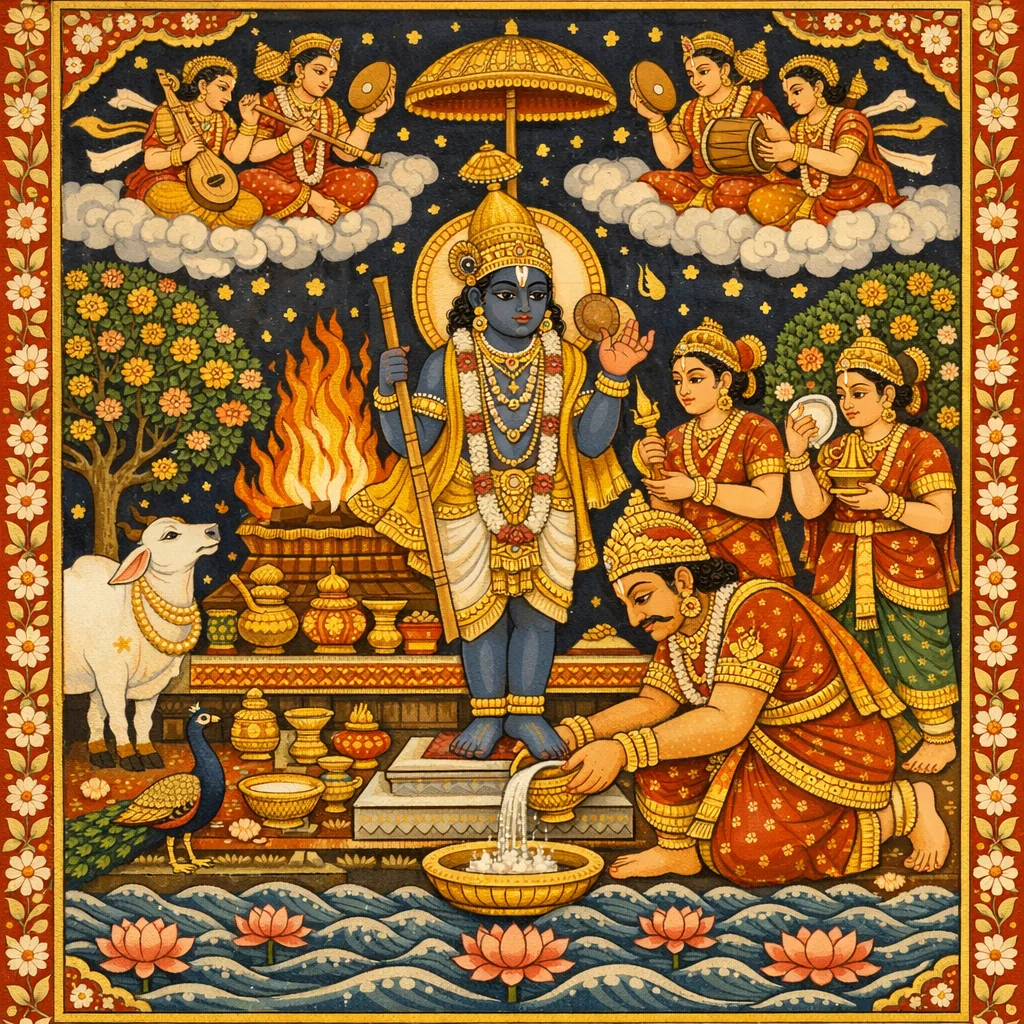
Adhyaya 18
The Appearance of Vāmanadeva and His Arrival at Bali’s Sacrifice
Following Brahmā’s glorification and the devas’ appeal for divine protection, the Supreme Lord appears from Aditi’s womb as Viṣṇu—radiant, four-armed, and adorned with śaṅkha-cakra-gadā-padma—signaling Poṣaṇa in action. Cosmic auspiciousness accompanies the advent: sacred calendrical markers (Śravaṇa-dvādaśī, Abhijit-muhūrta, Vijayā-dvādaśī) and universal celebration by devas, sages, and celestial beings establish the avatāra within sacred time. The Lord then adopts the dramatic guise of a brahmacārī dwarf, Vāmana, and undergoes saṁskāras: upanayana, gifts from deities (daṇḍa, kamaṇḍalu, ajina, mekhalā, rudrākṣa), and the setting of sacrificial fire—showing that the transcendent Lord honors dharma’s forms. Hearing of Bali Mahārāja’s aśvamedha at Bhṛgukaccha on the Narmadā, Vāmana proceeds there, overwhelming the assembly with effulgence. The Bhṛgu priests and Bali rise to receive Him; Bali worships by washing the Lord’s feet and welcomes Him to ask a boon—setting the immediate bridge to the next chapter where the “three steps of land” request initiates Bali’s decisive test of charity, truthfulness, and surrender.
Shlokas
Verse 1
श्रीशुक उवाच इत्थं विरिञ्चस्तुतकर्मवीर्य: प्रादुर्बभूवामृतभूरदित्याम् । चतुर्भुज: शङ्खगदाब्जचक्र: पिशङ्गवासा नलिनायतेक्षण: ॥ १ ॥
Śukadeva Gosvāmī said: After Lord Brahmā had thus spoken, glorifying the Supreme Lord’s activities and prowess, the Supreme Personality of Godhead, who is never subject to death like an ordinary living being, appeared from the womb of Aditi. His four hands were decorated with a conchshell, club, lotus and disc, He was dressed in yellow garments, and His eyes appeared like the petals of a blooming lotus.
Verse 2
श्यामावदातो झषराजकुण्डल- त्विषोल्लसच्छ्रीवदनाम्बुज: पुमान् । श्रीवत्सवक्षा बलयाङ्गदोल्लस- त्किरीटकाञ्चीगुणचारुनूपुर: ॥ २ ॥
The body of the Supreme Personality of Godhead, blackish in complexion, was free from all inebrieties. His lotus face, decorated with earrings resembling sharks, appeared very beautiful, and on His bosom was the mark of Śrīvatsa. He wore bangles on His wrists, armlets on His arms, a helmet on His head, a belt on His waist, a sacred thread across His chest, and ankle bells decorating His lotus feet.
Verse 3
मधुव्रतव्रातविघुष्टया स्वया विराजित: श्रीवनमालया हरि: । प्रजापतेर्वेश्मतम: स्वरोचिषा विनाशयन् कण्ठनिविष्टकौस्तुभ: ॥ ३ ॥
An uncommonly beautiful garland of flowers decorated His bosom, and because the flowers were extremely fragrant, a large group of bees, making their natural humming sounds, invaded them for honey. When the Lord appeared, wearing the Kaustubha gem on His neck, His effulgence vanquished the darkness in the home of the Prajāpati Kaśyapa.
Verse 4
दिश: प्रसेदु: सलिलाशयास्तदा प्रजा: प्रहृष्टा ऋतवो गुणान्विता: । द्यौरन्तरीक्षं क्षितिरग्निजिह्वा गावो द्विजा: सञ्जहृषुर्नगाश्च ॥ ४ ॥
At that time, there was happiness in all directions, in the reservoirs of water like the rivers and oceans, and in the core of everyone’s heart. The various seasons displayed their respective qualities, and all living entities in the upper planetary system, in outer space and on the surface of the earth were jubilant. The demigods, the cows, the brāhmaṇas and the hills and mountains were all filled with joy.
Verse 5
श्रोणायां श्रवणद्वादश्यां मुहूर्तेऽभिजिति प्रभु: । सर्वे नक्षत्रताराद्याश्चक्रुस्तज्जन्म दक्षिणम् ॥ ५ ॥
On the day of Śravaṇa-dvādaśī [the twelfth day of the bright fortnight in the month of Bhādra], when the moon came into the lunar mansion Śravaṇa, at the auspicious moment of Abhijit, the Lord appeared in this universe. Considering the Lord’s appearance very auspicious, all the stars and planets, from the sun to Saturn, were munificently charitable.
Verse 6
द्वादश्यां सवितातिष्ठन्मध्यन्दिनगतो नृप । विजयानाम सा प्रोक्ता यस्यां जन्म विदुर्हरे: ॥ ६ ॥
O King, when the Lord appeared — on dvādaśī, the twelfth day of the moon — the sun was at the meridian, as every learned scholar knows. This dvādaśī is called Vijayā.
Verse 7
शङ्खदुन्दुभयो नेदुर्मृदङ्गपणवानका: । चित्रवादित्रतूर्याणां निर्घोषस्तुमुलोऽभवत् ॥ ७ ॥
Conchshells, kettledrums, drums, paṇavas and ānakas vibrated in concert. The sound of these and various other instruments was tumultuous.
Verse 8
प्रीताश्चाप्सरसोऽनृत्यन्गन्धर्वप्रवरा जगु: । तुष्टुवुर्मुनयो देवा मनव: पितरोऽग्नय: ॥ ८ ॥
Being very pleased, the celestial dancing girls [Apsarās] danced in jubilation, the best of the Gandharvas sang songs, and the great sages, demigods, Manus, Pitās and fire-gods offered prayers to satisfy the Lord.
Verse 9
सिद्धविद्याधरगणा: सकिम्पुरुषकिन्नरा: । चारणा यक्षरक्षांसि सुपर्णा भुजगोत्तमा: ॥ ९ ॥ गायन्तोऽतिप्रशंसन्तो नृत्यन्तो विबुधानुगा: । अदित्या आश्रमपदं कुसुमै: समवाकिरन् ॥ १० ॥
The Siddhas, Vidyādharas, Kimpuruṣas, Kinnaras, Cāraṇas, Yakṣas, Rākṣasas, Suparṇas, the best of serpents, and the followers of the demigods all showered flowers on Aditi’s residence, covering the entire house, while glorifying and praising the Lord and dancing.
Verse 10
सिद्धविद्याधरगणा: सकिम्पुरुषकिन्नरा: । चारणा यक्षरक्षांसि सुपर्णा भुजगोत्तमा: ॥ ९ ॥ गायन्तोऽतिप्रशंसन्तो नृत्यन्तो विबुधानुगा: । अदित्या आश्रमपदं कुसुमै: समवाकिरन् ॥ १० ॥
The Siddhas, Vidyādharas, Kimpuruṣas, Kinnaras, Cāraṇas, Yakṣas, Rākṣasas, Suparṇas, the best of serpents, and the followers of the demigods all showered flowers on Aditi’s residence, covering the entire house, while glorifying and praising the Lord and dancing.
Verse 11
दृष्ट्वादितिस्तं निजगर्भसम्भवं परं पुमांसं मुदमाप विस्मिता । गृहीतदेहं निजयोगमायया प्रजापतिश्चाह जयेति विस्मित: ॥ ११ ॥
When Aditi saw the Supreme Personality of Godhead, who had appeared from her own womb, having accepted a transcendental body by His own spiritual potency, she was struck with wonder and was very happy. Upon seeing the child, Prajāpati Kaśyapa exclaimed, “Jaya! Jaya!” in great happiness and wonder.
Verse 12
यत् तद् वपुर्भाति विभूषणायुधै- रव्यक्तचिद्वयक्तमधारयद्धरि: । बभूव तेनैव स वामनो वटु: सम्पश्यतोर्दिव्यगतिर्यथा नट: ॥ १२ ॥
The Lord appeared in His original form, with ornaments and weapons in His hands. Although this ever-existing form is not visible in the material world, He nonetheless appeared in this form. Then, in the presence of His father and mother, He assumed the form of Vāmana, a brāhmaṇa-dwarf, a brahmacārī, just like a theatrical actor.
Verse 13
तं वटुं वामनं दृष्ट्वा मोदमाना महर्षय: । कर्माणि कारयामासु: पुरस्कृत्य प्रजापतिम् ॥ १३ ॥
When the great sages saw the Lord as the brahmacārī-dwarf Vāmana, they were certainly very pleased. Thus they placed before them Kaśyapa Muni, the Prajāpati, and performed all the ritualistic ceremonies, such as the birthday ceremony.
Verse 14
तस्योपनीयमानस्य सावित्रीं सविताब्रवीत् । बृहस्पतिर्ब्रह्मसूत्रं मेखलां कश्यपोऽददात् ॥ १४ ॥
At the sacred thread ceremony of Vāmanadeva, the sun-god personally uttered the Gāyatrī mantra, Bṛhaspati offered the sacred thread, and Kaśyapa Muni offered a straw belt.
Verse 15
ददौ कृष्णाजिनं भूमिर्दण्डं सोमो वनस्पति: । कौपीनाच्छादनं माता द्यौश्छत्रं जगत: पते: ॥ १५ ॥
Mother earth gave Him a deerskin, and the demigod of the moon, who is the king of the forest, gave Him a brahma-daṇḍa [the rod of a brahmacārī]. His mother, Aditi, gave Him cloth for underwear, and the deity presiding over the heavenly kingdom offered Him an umbrella.
Verse 16
कमण्डलुं वेदगर्भ: कुशान्सप्तर्षयो ददु: । अक्षमालां महाराज सरस्वत्यव्ययात्मन: ॥ १६ ॥
O King, Lord Brahmā offered a waterpot to the inexhaustible Supreme Personality of Godhead, the seven sages offered Him kuśa grass, and mother Sarasvatī gave Him a string of Rudrākṣa beads.
Verse 17
तस्मा इत्युपनीताय यक्षराट् पात्रिकामदात् । भिक्षां भगवती साक्षादुमादादम्बिका सती ॥ १७ ॥
When Vāmanadeva had thus been given the sacred thread, Kuvera, King of the Yakṣas, gave Him a pot for begging alms, and mother Bhagavatī, the wife of Lord Śiva and most chaste mother of the entire universe, gave Him His first alms.
Verse 18
स ब्रह्मवर्चसेनैवं सभां सम्भावितो वटु: । ब्रह्मर्षिगणसञ्जुष्टामत्यरोचत मारिष: ॥ १८ ॥
Having thus been welcomed by everyone, Lord Vāmanadeva, the best of the brahmacārīs, exhibited His Brahman effulgence. Thus He surpassed in beauty that entire assembly, which was filled with great saintly brāhmaṇas.
Verse 19
समिद्धमाहितं वह्निं कृत्वा परिसमूहनम् । परिस्तीर्य समभ्यर्च्य समिद्भिरजुहोद् द्विज: ॥ १९ ॥
After Lord Śrī Vāmanadeva set a sacrificial fire, He offered worship and performed a fire sacrifice on the sacrificial field.
Verse 20
श्रुत्वाश्वमेधैर्यजमानमूर्जितं बलिं भृगूणामुपकल्पितैस्तत: । जगाम तत्राखिलसारसम्भृतो भारेण गां सन्नमयन्पदे पदे ॥ २० ॥
When the Lord heard that Bali Mahārāja was performing aśvamedha sacrifices under the patronage of brāhmaṇas belonging to the Bhṛgu dynasty, the Supreme Lord, who is full in every respect, proceeded there to show His mercy to Bali Mahārāja. By His weight, He pushed down the earth with every step.
Verse 21
तं नर्मदायास्तट उत्तरे बले- र्य ऋत्विजस्ते भृगुकच्छसंज्ञके । प्रवर्तयन्तो भृगव: क्रतूत्तमं व्यचक्षतारादुदितं यथा रविम् ॥ २१ ॥
While engaged in performing the sacrifice in the field known as Bhṛgukaccha, on the northern bank of the Narmadā River, the brahminical priests, the descendants of Bhṛgu, saw Vāmanadeva to be like the sun rising nearby.
Verse 22
ते ऋत्विजो यजमान: सदस्या हतत्विषो वामनतेजसा नृप । सूर्य: किलायात्युत वा विभावसु: सनत्कुमारोऽथ दिदृक्षया क्रतो: ॥ २२ ॥
O King, because of Vāmanadeva’s bright effulgence, the priests, along with Bali Mahārāja and all the members of the assembly, were robbed of their splendor. Thus they began to ask one another whether the sun-god himself, Sanat-kumāra or the fire-god had personally come to see the sacrificial ceremony.
Verse 23
इत्थं सशिष्येषु भृगुष्वनेकधा वितर्क्यमाणो भगवान्स वामन: । छत्रं सदण्डं सजलं कमण्डलुं विवेश बिभ्रद्धयमेधवाटम् ॥ २३ ॥
While the priests of the Bhṛgu dynasty and their disciples talked and argued in various ways, the Supreme Personality of Godhead, Vāmanadeva, holding in His hands the rod, the umbrella and a waterpot full of water, entered the arena of the aśvamedha sacrifice.
Verse 24
मौञ्ज्या मेखलया वीतमुपवीताजिनोत्तरम् । जटिलं वामनं विप्रं मायामाणवकं हरिम् ॥ २४ ॥ प्रविष्टं वीक्ष्य भृगव: सशिष्यास्ते सहाग्निभि: । प्रत्यगृह्णन्समुत्थाय सङ्क्षिप्तास्तस्य तेजसा ॥ २५ ॥
Appearing as a brāhmaṇa boy, wearing a belt of straw, a sacred thread, an upper garment of deerskin, and matted locks of hair, Lord Vāmanadeva entered the arena of sacrifice. His brilliant effulgence diminished the brilliance of all the priests and their disciples, who thus stood from their seats and welcomed the Lord properly by offering obeisances.
Verse 25
मौञ्ज्या मेखलया वीतमुपवीताजिनोत्तरम् । जटिलं वामनं विप्रं मायामाणवकं हरिम् ॥ २४ ॥ प्रविष्टं वीक्ष्य भृगव: सशिष्यास्ते सहाग्निभि: । प्रत्यगृह्णन्समुत्थाय सङ्क्षिप्तास्तस्य तेजसा ॥ २५ ॥
Appearing as a brāhmaṇa boy, wearing a belt of straw, a sacred thread, an upper garment of deerskin, and matted locks of hair, Lord Vāmanadeva entered the arena of sacrifice. His brilliant effulgence diminished the brilliance of all the priests and their disciples, who thus stood from their seats and welcomed the Lord properly by offering obeisances.
Verse 26
यजमान: प्रमुदितो दर्शनीयं मनोरमम् । रूपानुरूपावयवं तस्मा आसनमाहरत् ॥ २६ ॥
Bali Mahārāja, jubilant at seeing Lord Vāmanadeva, whose beautiful limbs contributed equally to the beauty of His entire body, offered Him a seat with great satisfaction.
Verse 27
स्वागतेनाभिनन्द्याथ पादौ भगवतो बलि: । अवनिज्यार्चयामास मुक्तसङ्गमनोरमम् ॥ २७ ॥
Thus offering a proper reception to the Supreme Personality of Godhead, who is always beautiful to the liberated souls, Bali Mahārāja worshiped Him by washing His lotus feet.
Verse 28
तत्पादशौचं जनकल्मषापहं स धर्मविन्मूर्ध्न्यदधात् सुमङ्गलम् । यद् देवदेवो गिरिशश्चन्द्रमौलि- र्दधार मूर्ध्ना परया च भक्त्या ॥ २८ ॥
Lord Śiva, the best of demigods, who carries on his forehead the emblem of the moon, receives on his head with great devotion the Ganges water emanating from the toe of Viṣṇu. Being aware of religious principles, Bali Mahārāja knew this. Consequently, following in the footsteps of Lord Śiva, he also placed on his head the water that had washed the Lord’s lotus feet.
Verse 29
श्रीबलिरुवाच स्वागतं ते नमस्तुभ्यं ब्रह्मन्किं करवाम ते । ब्रह्मर्षीणां तप: साक्षान्मन्ये त्वार्य वपुर्धरम् ॥ २९ ॥
Bali Mahārāja then said to Lord Vāmanadeva: O brāhmaṇa, I offer You my hearty welcome and my respectful obeisances. Please let us know what we may do for You. We think of You as the personified austerity of the great brāhmaṇa-sages.
Verse 30
अद्य न: पितरस्तृप्ता अद्य न: पावितं कुलम् । अद्य स्विष्ट: क्रतुरयं यद् भवानागतो गृहान् ॥ ३० ॥
O my Lord, because You have kindly arrived at our home, all my forefathers are satisfied, our family and entire dynasty have been sanctified, and the sacrifice we are performing is now complete because of Your presence.
Verse 31
अद्याग्नयो मे सुहुता यथाविधि द्विजात्मज त्वच्चरणावनेजनै: । हतांहसो वार्भिरियं च भूरहो तथा पुनीता तनुभि: पदैस्तव ॥ ३१ ॥
O son of a brāhmaṇa, today the fire of sacrifice is ablaze according to the injunction of the śāstra, and I have been freed from all the sinful reactions of my life by the water that has washed Your lotus feet. O my Lord, by the touch of Your small lotus feet the entire surface of the world has been sanctified.
Verse 32
यद् वटो वाञ्छसि तत्प्रतीच्छ मे त्वामर्थिनं विप्रसुतानुतर्कये । गां काञ्चनं गुणवद् धाम मृष्टं तथान्नपेयमुत वा विप्रकन्याम् । ग्रामान् समृद्धांस्तुरगान् गजान् वा रथांस्तथार्हत्तम सम्प्रतीच्छ ॥ ३२ ॥
O son of a brāhmaṇa, it appears that You have come here to ask me for something. Therefore, whatever You want You may take from me. O best of those who are worshipable. You may take from me a cow, gold, a furnished house, palatable food and drink, the daughter of a brāhmaṇa for Your wife, prosperous villages, horses, elephants, chariots or whatever You desire.
Frequently Asked Questions
The text anchors the avatāra in sacred time to show that divine descent is not random but dharma-structured: tithi (dvadāśī), nakṣatra (Śravaṇa), and muhūrta (Abhijit) collectively signify auspicious alignment. The calendrical precision also reinforces Īśānukathā by portraying the cosmos itself—planets, seasons, and beings—responding harmoniously to the Lord’s manifestation.
Vāmana’s saṁskāras are līlā: the Lord, though aja (unborn) and pūrṇa (complete), adopts the social-religious form of a brāhmaṇa student to teach by example. By honoring dharma’s institutions (upanayana, yajña etiquette, brahmacarya symbols), He demonstrates that spiritual authority is compatible with humility and that dharma’s outer forms should culminate in devotion and surrender to the Supreme.
The celebration is pan-cosmic: devas, sages (ṛṣis), Manus, Pitās, fire-gods, Gandharvas, Apsarās, Siddhas, Vidyādharas, Kinnaras, Yakṣas, and others. Their collective worship signals that the avatāra serves universal welfare, not a sectarian interest—an expression of Poṣaṇa and the restoration of dharmic balance.
It highlights bhakti embedded in royal dharma: Bali recognizes the sanctity of Viṣṇu’s pāda-tīrtha, recalling that even Śiva bears Gaṅgā from Viṣṇu’s toe. The act foreshadows Bali’s deeper offering—moving from ceremonial hospitality to existential surrender—central to the theological arc of the Vāmana–Bali narrative.