Adhyaya 4
Aftermath of Gajendra’s Deliverance: Hūhū’s Release, Indradyumna’s Curse, and Sārūpya-mukti
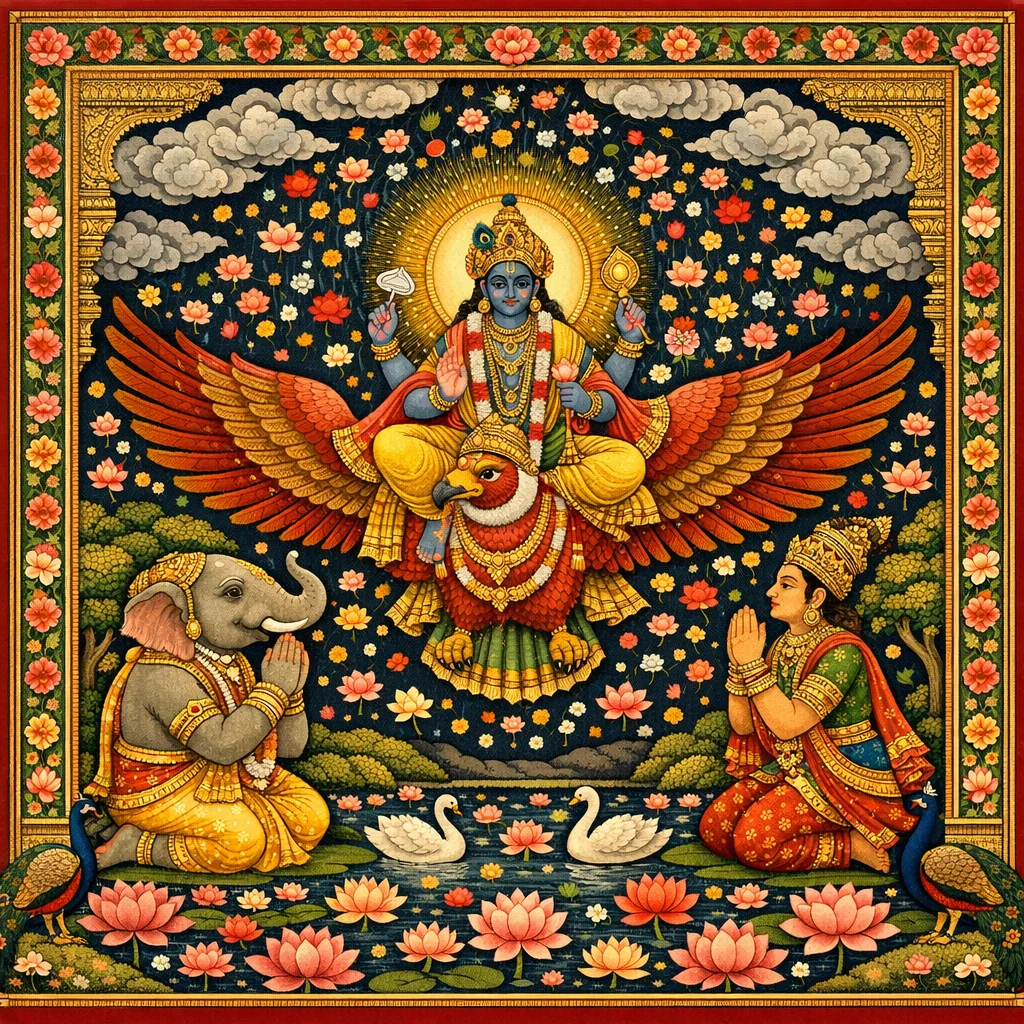
Following the Lord’s dramatic rescue of Gajendra (the elephant king) from the crocodile, the cosmos responds in celebration: devas, sages, Gandharvas, Cāraṇas, and Siddhas praise Puruṣottama with drums, song, and showers of flowers (vv.1–2). The crocodile is revealed as King Hūhū, a Gandharva cursed by Devala; upon being delivered by the Lord, he regains his celestial form, offers fitting prayers, circumambulates the Lord, and returns purified to Gandharvaloka (vv.3–5). Gajendra, having been directly touched by Bhagavān, is freed from avidyā and bondage and receives sārūpya-mukti—attaining a four-armed form with yellow garments like the Lord (v.6). Śukadeva then discloses Gajendra’s prior identity as the Vaiṣṇava king Indradyumna of Pāṇḍya in Draviḍa, whose absorbed worship and vow of silence led to Agastya’s anger and curse to become an elephant; the devotee accepts the curse as the Lord’s will and retains devotional memory (vv.7–12). The Lord returns to His abode on Garuḍa, taking Gajendra with Him (v.13). Śukadeva concludes with the śravaṇa-phala: hearing this account grants auspiciousness, protection from Kali’s taint, and relief from bad dreams; it is recommended for morning recitation. The chapter then transitions as the pleased Lord prepares to speak blessings to Gajendra before all present (vv.14–16), setting up the next dialogue.
Shlokas
Verse 1
श्रीशुक उवाच तदा देवर्षिगन्धर्वा ब्रह्मेशानपुरोगमा: । मुमुचु: कुसुमासारं शंसन्त: कर्म तद्धरे: ॥ १ ॥
Śrī Śukadeva Gosvāmī said: When the Lord delivered Gajendra, King of the elephants, all the demigods, sages and Gandharvas, headed by Brahmā and Śiva, praised this activity of the Supreme Personality of Godhead and showered flowers upon both the Lord and Gajendra.
Verse 2
नेदुर्दुन्दुभयो दिव्या गन्धर्वा ननृतुर्जगु: । ऋषयश्चारणा: सिद्धास्तुष्टुवु: पुरुषोत्तमम् ॥ २ ॥
There was a beating of kettledrums in the heavenly planets, the inhabitants of Gandharvaloka began to dance and sing, while great sages and the inhabitants of Cāraṇaloka and Siddhaloka offered prayers to the Supreme Personality of Godhead, Puruṣottama.
Verse 3
योऽसौ ग्राह: स वै सद्य: परमाश्चर्यरूपधृक् । मुक्तो देवलशापेन हूहूर्गन्धर्वसत्तम: ॥ ३ ॥ प्रणम्य शिरसाधीशमुत्तमश्लोकमव्ययम् । अगायत यशोधाम कीर्तन्यगुणसत्कथम् ॥ ४ ॥
The best of the Gandharvas, King Hūhū, having been cursed by Devala Muni, had become a crocodile. Now, having been delivered by the Supreme Personality of Godhead, he assumed a very beautiful form as a Gandharva. Understanding by whose mercy this had happened, he immediately offered his respectful obeisances with his head and began chanting prayers just suitable for the transcendental Lord, the supreme eternal, who is worshiped by the choicest verses.
Verse 4
योऽसौ ग्राह: स वै सद्य: परमाश्चर्यरूपधृक् । मुक्तो देवलशापेन हूहूर्गन्धर्वसत्तम: ॥ ३ ॥ प्रणम्य शिरसाधीशमुत्तमश्लोकमव्ययम् । अगायत यशोधाम कीर्तन्यगुणसत्कथम् ॥ ४ ॥
The best of the Gandharvas, King Hūhū, having been cursed by Devala Muni, had become a crocodile. Now, having been delivered by the Supreme Personality of Godhead, he assumed a very beautiful form as a Gandharva. Understanding by whose mercy this had happened, he immediately offered his respectful obeisances with his head and began chanting prayers just suitable for the transcendental Lord, the supreme eternal, who is worshiped by the choicest verses.
Verse 5
सोऽनुकम्पित ईशेन परिक्रम्य प्रणम्य तम् । लोकस्य पश्यतो लोकं स्वमगान्मुक्तकिल्बिष: ॥ ५ ॥
Having been favored by the causeless mercy of the Supreme Personality of Godhead and having regained his original form, King Hūhū circumambulated the Lord and offered his obeisances. Then, in the presence of all the demigods, headed by Brahmā, he returned to Gandharvaloka. He had been freed of all sinful reactions.
Verse 6
गजेन्द्रो भगवत्स्पर्शाद् विमुक्तोऽज्ञानबन्धनात् । प्राप्तो भगवतो रूपं पीतवासाश्चतुर्भुज: ॥ ६ ॥
Because Gajendra, King of the elephants, had been touched directly by the hands of the Supreme Personality of Godhead, he was immediately freed of all material ignorance and bondage. Thus he received the salvation of sārūpya-mukti, in which he achieved the same bodily features as the Lord, being dressed in yellow garments and possessing four hands.
Verse 7
स वै पूर्वमभूद् राजा पाण्ड्यो द्रविडसत्तम: । इन्द्रद्युम्न इति ख्यातो विष्णुव्रतपरायण: ॥ ७ ॥
This Gajendra had formerly been a Vaiṣṇava and the king of the country known as Pāṇḍya, which is in the province of Draviḍa [South India]. In his previous life, he was known as Indradyumna Mahārāja.
Verse 8
स एकदाराधनकाल आत्मवान् गृहीतमौनव्रत ईश्वरं हरिम् । जटाधरस्तापस आप्लुतोऽच्युतं समर्चयामास कुलाचलाश्रम: ॥ ८ ॥
Indradyumna Mahārāja retired from family life and went to the Malaya Hills, where he had a small cottage for his āśrama. He wore matted locks on his head and always engaged in austerities. Once, while observing a vow of silence, he was fully engaged in the worship of the Lord and absorbed in the ecstasy of love of Godhead.
Verse 9
यदृच्छया तत्र महायशा मुनि: समागमच्छिष्यगणै: परिश्रित: । तं वीक्ष्य तूष्णीमकृतार्हणादिकं रहस्युपासीनमृषिश्चुकोप ह ॥ ९ ॥
While Indradyumna Mahārāja was engaged in ecstatic meditation, worshiping the Supreme Personality of Godhead, the great sage Agastya Muni arrived there, surrounded by his disciples. When the Muni saw that Mahārāja Indradyumna, who was sitting in a secluded place, remained silent and did not follow the etiquette of offering him a reception, he was very angry.
Verse 10
तस्मा इमं शापमदादसाधु- रयं दुरात्माकृतबुद्धिरद्य । विप्रावमन्ता विशतां तमिस्रं यथा गज: स्तब्धमति: स एव ॥ १० ॥
Agastya Muni then spoke this curse against the King: This King Indradyumna is not at all gentle. Being low and uneducated, he has insulted a brāhmaṇa. May he therefore enter the region of darkness and receive the dull, dumb body of an elephant.
Verse 11
श्रीशुक उवाच एवं शप्त्वा गतोऽगस्त्यो भगवान् नृप सानुग: । इन्द्रद्युम्नोऽपि राजर्षिर्दिष्टं तदुपधारयन् ॥ ११ ॥ आपन्न: कौञ्जरीं योनिमात्मस्मृतिविनाशिनीम् । हर्यर्चनानुभावेन यद्गजत्वेऽप्यनुस्मृति: ॥ १२ ॥
Śukadeva Gosvāmī continued: My dear King, after Agastya Muni had thus cursed King Indradyumna, the Muni left that place along with his disciples. Since the King was a devotee, he accepted Agastya Muni’s curse as welcome because it was the desire of the Supreme Personality of Godhead. Therefore, although in his next life he got the body of an elephant, because of devotional service he remembered how to worship and offer prayers to the Lord.
Verse 12
श्रीशुक उवाच एवं शप्त्वा गतोऽगस्त्यो भगवान् नृप सानुग: । इन्द्रद्युम्नोऽपि राजर्षिर्दिष्टं तदुपधारयन् ॥ ११ ॥ आपन्न: कौञ्जरीं योनिमात्मस्मृतिविनाशिनीम् । हर्यर्चनानुभावेन यद्गजत्वेऽप्यनुस्मृति: ॥ १२ ॥
Śukadeva Gosvāmī continued: My dear King, after Agastya Muni had thus cursed King Indradyumna, the Muni left that place along with his disciples. Since the King was a devotee, he accepted Agastya Muni’s curse as welcome because it was the desire of the Supreme Personality of Godhead. Therefore, although in his next life he got the body of an elephant, because of devotional service he remembered how to worship and offer prayers to the Lord.
Verse 13
एवं विमोक्ष्य गजयूथपमब्जनाभ- स्तेनापि पार्षदगतिं गमितेन युक्त: । गन्धर्वसिद्धविबुधैरुपगीयमान- कर्माद्भुतं स्वभवनं गरुडासनोऽगात् ॥ १३ ॥
Upon delivering the King of the elephants from the clutches of the crocodile, and from material existence, which resembles a crocodile, the Lord awarded him the status of sārūpya-mukti. In the presence of the Gandharvas, the Siddhas and the other demigods, who were praising the Lord for His wonderful transcendental activities, the Lord, sitting on the back of His carrier, Garuḍa, returned to His all-wonderful abode and took Gajendra with Him.
Verse 14
एतन्महाराज तवेरितो मया कृष्णानुभावो गजराजमोक्षणम् । स्वर्ग्यं यशस्यं कलिकल्मषापहं दु:स्वप्ननाशं कुरुवर्य शृण्वताम् ॥ १४ ॥
My dear King Parīkṣit, I have now described the wonderful power of Kṛṣṇa, as displayed when the Lord delivered the King of the elephants. O best of the Kuru dynasty, those who hear this narration become fit to be promoted to the higher planetary systems. Simply because of hearing this narration, they gain a reputation as devotees, they are unaffected by the contamination of Kali-yuga, and they never see bad dreams.
Verse 15
यथानुकीर्तयन्त्येतच्छ्रेयस्कामा द्विजातय: । शुचय: प्रातरुत्थाय दु:स्वप्नाद्युपशान्तये ॥ १५ ॥
Therefore, after getting up from bed in the morning, those who desire their own welfare — especially the brāhmaṇas, kṣatriyas, vaiśyas and in particular the brāhmaṇa Vaiṣṇavas — should chant this narration as it is, without deviation, to counteract the troubles of bad dreams.
Verse 16
इदमाह हरि: प्रीतो गजेन्द्रं कुरुसत्तम । शृण्वतां सर्वभूतानां सर्वभूतमयो विभु: ॥ १६ ॥
O best of the Kuru dynasty, the Supreme Personality of Godhead, the Supersoul of everyone, being thus pleased, addressed Gajendra in the presence of everyone there. He spoke the following blessings.
Frequently Asked Questions
The crocodile was King Hūhū, a Gandharva cursed by Devala Muni. The Bhāgavata presents his animal embodiment as the karmic and juridical effect of a brāhmaṇa’s śāpa, yet his deliverance shows that contact with the Lord overrides accumulated reactions and restores the soul’s higher destiny.
Sārūpya-mukti is liberation in which the devotee attains a form resembling the Lord’s, here described as four-armed and clad in yellow garments. Gajendra receives it because the Lord personally touches and rescues him, indicating both the intensity of his surrender and the Lord’s independent bestowal of grace upon a devotee.
The narrative frames the curse as arising from a perceived breach of etiquette toward Agastya Muni, but it also emphasizes divine orchestration: Indradyumna, being a devotee, accepts the curse as the Lord’s will. The theological point is that bhakti is not destroyed by adverse karma; rather, devotion can persist and mature through it.
Śukadeva states that hearing this account makes one fit for higher destinations, grants a devotional reputation, protects from Kali-yuga’s contamination, and prevents bad dreams. The text further recommends morning recitation—especially by the varṇas and particularly brāhmaṇa Vaiṣṇavas—as a practical śāstric remedy rooted in śravaṇa and smṛti.