Adhyaya 7
Kūrma Supports Mandara; Hālahala Appears; Śiva Becomes Nīlakaṇṭha
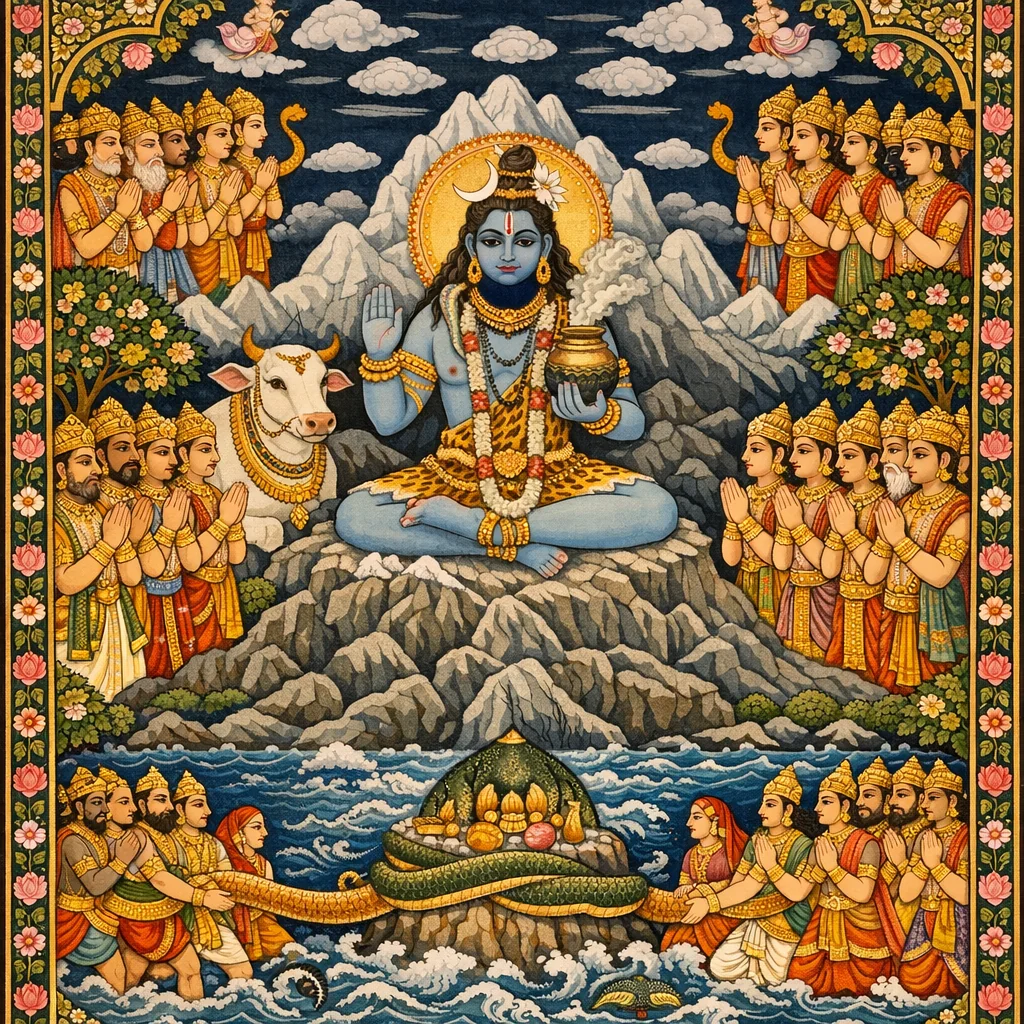
Continuing the devas–asuras alliance for amṛta, both parties invite Vāsuki and coil him around Mandara as the churning rope. A dispute arises over auspiciousness—demons demand the ‘front’ of the serpent—yet Ajita (Viṣṇu) silently accepts the tail, reversing their calculation. When Mandara sinks for lack of support, the Lord assumes the Kūrma-avatāra, lifting the mountain upon His back and transforming failure into renewed momentum. Viṣṇu further empowers the participants by entering devas, asuras, and Vāsuki through the guṇas (sattva, rajas, tamas), and He steadies Mandara from above with thousand hands as the churning intensifies. The first product is not nectar but the catastrophic hālahala poison, spreading across the worlds. Terrified, devas seek Sadāśiva on Kailāsa; the prajāpatis offer hymns describing Śiva’s cosmic identity and transcendence. Moved by compassion and dharma of protection, Śiva resolves to drink the poison for the welfare of all, with Satī’s consent. The poison marks his throat blue—Nīlakaṇṭha—turning peril into an emblem of benevolent sacrifice, setting the stage for subsequent auspicious emergences from the ocean.
Shlokas
Verse 1
श्रीशुक उवाच ते नागराजमामन्त्र्य फलभागेन वासुकिम् । परिवीय गिरौ तस्मिन् नेत्रमब्धिं मुदान्विता: । आरेभिरे सुरा यत्ता अमृतार्थे कुरूद्वह ॥ १ ॥
Śukadeva Gosvāmī said: O best of the Kurus, Mahārāja Parīkṣit, the demigods and demons summoned Vāsuki, king of the serpents, requesting him to come and promising to give him a share of the nectar. They coiled Vāsuki around Mandara Mountain as a churning rope, and with great pleasure they endeavored to produce nectar by churning the Ocean of Milk.
Verse 2
हरि: पुरस्ताज्जगृहे पूर्वं देवास्ततोऽभवन् ॥ २ ॥
The Personality of Godhead, Ajita, grasped the front portion of the snake, and then the demigods followed.
Verse 3
तन्नैच्छन् दैत्यपतयो महापुरुषचेष्टितम् । न गृह्णीमो वयं पुच्छमहेरङ्गममङ्गलम् । स्वाध्यायश्रुतसम्पन्ना: प्रख्याता जन्मकर्मभि: ॥ ३ ॥
The leaders of the demons thought it unwise to hold the tail, the inauspicious portion of the snake. Instead, they wanted to hold the front, which had been taken by the Personality of Godhead and the demigods, because that portion was auspicious and glorious. Thus the demons, on the plea that they were all highly advanced students of Vedic knowledge and were all famous for their birth and activities, protested that they wanted to hold the front of the snake.
Verse 4
इति तूष्णीं स्थितान्दैत्यान् विलोक्य पुरुषोत्तम: । स्मयमानो विसृज्याग्रं पुच्छं जग्राह सामर: ॥ ४ ॥
Thus the demons remained silent, opposing the desire of the demigods. Seeing the demons and understanding their motive, the Personality of Godhead smiled. Without discussion, He immediately accepted their proposal by grasping the tail of the snake, and the demigods followed Him.
Verse 5
कृतस्थानविभागास्त एवं कश्यपनन्दना: । ममन्थु: परमं यत्ता अमृतार्थं पयोनिधिम् ॥ ५ ॥
After thus adjusting how the snake was to be held, the sons of Kaśyapa, both demigods and demons, began their activities, desiring to get nectar by churning the Ocean of Milk.
Verse 6
मथ्यमानेऽर्णवे सोऽद्रिरनाधारो ह्यपोऽविशत् । ध्रियमाणोऽपि बलिभिर्गौरवात् पाण्डुनन्दन ॥ ६ ॥
O son of the Pāṇḍu dynasty, when Mandara Mountain was thus being used as a churning rod in the Ocean of Milk, it had no support, and therefore although held by the strong hands of the demigods and demons, it sank into the water.
Verse 7
ते सुनिर्विण्णमनस: परिम्लानमुखश्रिय: । आसन् स्वपौरुषे नष्टे दैवेनातिबलीयसा ॥ ७ ॥
Because the mountain had been sunk by the strength of providence, the demigods and demons were disappointed, and their faces seemed to shrivel.
Verse 8
विलोक्य विघ्नेशविधिं तदेश्वरो दुरन्तवीर्योऽवितथाभिसन्धि: । कृत्वा वपु: कच्छपमद्भुतं महत् प्रविश्य तोयं गिरिमुज्जहार ॥ ८ ॥
Seeing the situation that had been created by the will of the Supreme, the unlimitedly powerful Lord, whose determination is infallible, took the wonderful shape of a tortoise, entered the water, and lifted the great Mandara Mountain.
Verse 9
तमुत्थितं वीक्ष्य कुलाचलं पुन: समुद्यता निर्मथितुं सुरासुरा: । दधार पृष्ठेन स लक्षयोजन- प्रस्तारिणा द्वीप इवापरो महान् ॥ ९ ॥
When the demigods and demons saw that Mandara Mountain had been lifted, they were enlivened and encouraged to begin churning again. The mountain rested on the back of the great tortoise, which extended for eight hundred thousand miles like a large island.
Verse 10
सुरासुरेन्द्रैर्भुजवीर्यवेपितं परिभ्रमन्तं गिरिमङ्ग पृष्ठत: । बिभ्रत् तदावर्तनमादिकच्छपो मेनेऽङ्गकण्डूयनमप्रमेय: ॥ १० ॥
O King, when the demigods and demons, by the strength of their arms, rotated Mandara Mountain on the back of the extraordinary tortoise, the tortoise accepted the rolling of the mountain as a means of scratching His body, and thus He felt a pleasing sensation.
Verse 11
तथासुरानाविशदासुरेण रूपेण तेषां बलवीर्यमीरयन् । उद्दीपयन् देवगणांश्च विष्णु- र्दैवेन नागेन्द्रमबोधरूप: ॥ ११ ॥
Thereafter, Lord Viṣṇu entered the demons as the quality of passion, the demigods as the quality of goodness, and Vāsuki as the quality of ignorance to encourage them and increase their various types of strength and energy.
Verse 12
उपर्यगेन्द्रं गिरिराडिवान्य आक्रम्य हस्तेन सहस्रबाहु: । तस्थौ दिवि ब्रह्मभवेन्द्रमुख्यै- रभिष्टुवद्भि: सुमनोऽभिवृष्ट: ॥ १२ ॥
Manifesting Himself with thousands of hands, the Lord then appeared on the summit of Mandara Mountain, like another great mountain, and held Mandara Mountain with one hand. In the upper planetary systems, Lord Brahmā and Lord Śiva, along with Indra, King of heaven, and other demigods, offered prayers to the Lord and showered flowers upon Him.
Verse 13
उपर्यधश्चात्मनि गोत्रनेत्रयो: परेण ते प्राविशता समेधिता: । ममन्थुरब्धिं तरसा मदोत्कटा महाद्रिणा क्षोभितनक्रचक्रम् ॥ १३ ॥
The demigods and demons worked almost madly for the nectar, encouraged by the Lord, who was above and below the mountain and who had entered the demigods, the demons, Vāsuki and the mountain itself. Because of the strength of the demigods and demons, the Ocean of Milk was so powerfully agitated that all the alligators in the water were very much perturbed. Nonetheless the churning of the ocean continued in this way.
Verse 14
अहीन्द्रसाहस्रकठोरदृङ्मुख- श्वासाग्निधूमाहतवर्चसोऽसुरा: । पौलोमकालेयबलील्वलादयो दवाग्निदग्धा: सरला इवाभवन् ॥ १४ ॥
Vāsuki had thousands of eyes and mouths. From his mouths he breathed smoke and blazing fire, which affected the demons, headed by Pauloma, Kāleya, Bali and Ilvala. Thus the demons, who appeared like sarala trees burned by a forest fire, gradually became powerless.
Verse 15
देवांश्च तच्छ्वासशिखाहतप्रभान् धूम्राम्बरस्रग्वरकञ्चुकाननान् । समभ्यवर्षन्भगवद्वशा घना ववु: समुद्रोर्म्युपगूढवायव: ॥ १५ ॥
Because the demigods were also affected by the blazing breath of Vāsuki, their bodily lusters diminished, and their garments, garlands, weapons and faces were blackened by smoke. However, by the grace of the Supreme Personality of Godhead, clouds appeared on the sea, pouring torrents of rain, and breezes blew, carrying particles of water from the sea waves, to give the demigods relief.
Verse 16
मथ्यमानात् तथा सिन्धोर्देवासुरवरूथपै: । यदा सुधा न जायेत निर्ममन्थाजित: स्वयम् ॥ १६ ॥
When nectar did not come from the Ocean of Milk, despite so much endeavor by the best of the demigods and demons, the Supreme Personality of Godhead, Ajita, personally began to churn the ocean.
Verse 17
मेघश्याम: कनकपरिधि: कर्णविद्योतविद्यु- न्मूर्ध्नि भ्राजद्विलुलितकच: स्रग्धरो रक्तनेत्र: । जैत्रैर्दोर्भिर्जगदभयदैर्दन्दशूकं गृहीत्वा मथ्नन् मथ्ना प्रतिगिरिरिवाशोभताथो धृताद्रि: ॥ १७ ॥
The Lord appeared like a blackish cloud. He was dressed with yellow garments, His earrings shone on His ears like lightning, and His hair spread over His shoulders. He wore a garland of flowers, and His eyes were pinkish. With His strong, glorious arms, which award fearlessness throughout the universe, He took hold of Vāsuki and began churning the ocean, using Mandara Mountain as a churning rod. When engaged in this way, the Lord appeared like a beautifully situated mountain named Indranīla.
Verse 18
निर्मथ्यमानादुदधेरभूद्विषं महोल्बणं हालहलाह्वमग्रत: । सम्भ्रान्तमीनोन्मकराहिकच्छपात् तिमिद्विपग्राहतिमिङ्गिलाकुलात् ॥ १८ ॥
The fish, sharks, tortoises and snakes were most agitated and perturbed. The entire ocean became turbulent, and even the large aquatic animals like whales, water elephants, crocodiles and timiṅgila fish [large whales that can swallow small whales] came to the surface. While the ocean was being churned in this way, it first produced a fiercely dangerous poison called hālahala.
Verse 19
तदुग्रवेगं दिशि दिश्युपर्यधो विसर्पदुत्सर्पदसह्यमप्रति । भीता: प्रजा दुद्रुवुरङ्ग सेश्वरा अरक्ष्यमाणा: शरणं सदाशिवम् ॥ १९ ॥
O King, when that uncontrollable poison was forcefully spreading up and down in all directions, all the demigods, along with the Lord Himself, approached Lord Śiva [Sadāśiva]. Feeling unsheltered and very much afraid, they sought shelter of him.
Verse 20
विलोक्य तं देववरं त्रिलोक्या भवाय देव्याभिमतं मुनीनाम् । आसीनमद्रावपवर्गहेतो- स्तपो जुषाणं स्तुतिभि: प्रणेमु: ॥ २० ॥
The demigods observed Lord Śiva sitting on the summit of Kailāsa Hill with his wife, Bhavānī, for the auspicious development of the three worlds. He was being worshiped by great saintly persons desiring liberation. The demigods offered him their obeisances and prayers with great respect.
Verse 21
श्रीप्रजापतय ऊचु: देवदेव महादेव भूतात्मन् भूतभावन । त्राहि न: शरणापन्नांस्त्रैलोक्यदहनाद् विषात् ॥ २१ ॥
The prajāpatis said: O greatest of all demigods, Mahādeva, Supersoul of all living entities and cause of their happiness and prosperity, we have come to the shelter of your lotus feet. Now please save us from this fiery poison, which is spreading all over the three worlds.
Verse 22
त्वमेक: सर्वजगत ईश्वरो बन्धमोक्षयो: । तं त्वामर्चन्ति कुशला: प्रपन्नार्तिहरं गुरुम् ॥ २२ ॥
O lord, you are the cause of bondage and liberation of the entire universe because you are its ruler. Those who are advanced in spiritual consciousness surrender unto you, and therefore you are the cause of mitigating their distresses, and you are also the cause of their liberation. We therefore worship Your Lordship.
Verse 23
गुणमय्या स्वशक्त्यास्य सर्गस्थित्यप्ययान्विभो । धत्से यदा स्वदृग् भूमन्ब्रह्मविष्णुशिवाभिधाम् ॥ २३ ॥
O lord, you are self-effulgent and supreme. You create this material world by your personal energy, and you assume the names Brahmā, Viṣṇu and Maheśvara when you act in creation, maintenance and annihilation.
Verse 24
त्वं ब्रह्म परमं गुह्यं सदसद्भावभावनम् । नानाशक्तिभिराभातस्त्वमात्मा जगदीश्वर: ॥ २४ ॥
You are the cause of all causes, the self-effulgent, inconceivable, impersonal Brahman, which is originally Parabrahman. You manifest various potencies in this cosmic manifestation.
Verse 25
त्वं शब्दयोनिर्जगदादिरात्मा प्राणेन्द्रियद्रव्यगुण: स्वभाव: । काल: क्रतु: सत्यमृतं च धर्म- स्त्वय्यक्षरं यत् त्रिवृदामनन्ति ॥ २५ ॥
O lord, you are the original source of Vedic literature. You are the original cause of material creation, the life force, the senses, the five elements, the three modes and the mahat-tattva. You are eternal time, determination and the two religious systems called truth [satya] and truthfulness [ṛta]. You are the shelter of the syllable om, which consists of three letters a-u-m.
Verse 26
अग्निर्मुखं तेऽखिलदेवतात्मा क्षितिं विदुर्लोकभवाङ्घ्रिपङ्कजम् । कालं गतिं तेऽखिलदेवतात्मनो दिशश्च कर्णौ रसनं जलेशम् ॥ २६ ॥
O father of all planets, learned scholars know that fire is your mouth, the surface of the globe is your lotus feet, eternal time is your movement, all the directions are your ears, and Varuṇa, master of the waters, is your tongue.
Verse 27
नाभिर्नभस्ते श्वसनं नभस्वान् सूर्यश्च चक्षूंषि जलं स्म रेत: । परावरात्माश्रयणं तवात्मा सोमो मनो द्यौर्भगवन् शिरस्ते ॥ २७ ॥
O lord, the sky is your navel, the air is your breathing, the sun is your eyes, and the water is your semen. You are the shelter of all kinds of living entities, high and low. The god of the moon is your mind, and the upper planetary system is your head.
Verse 28
कुक्षि: समुद्रा गिरयोऽस्थिसङ्घा रोमाणि सर्वौषधिवीरुधस्ते । छन्दांसि साक्षात् तव सप्त धातव- स्त्रयीमयात्मन् हृदयं सर्वधर्म: ॥ २८ ॥
O lord, you are the three Vedas personified. The seven seas are your abdomen, and the mountains are your bones. All drugs, creepers and vegetables are the hairs on your body, the Vedic mantras like Gāyatrī are the seven layers of your body, and the Vedic religious system is the core of your heart.
Verse 29
मुखानि पञ्चोपनिषदस्तवेश यैस्त्रिंशदष्टोत्तरमन्त्रवर्ग: । यत् तच्छिवाख्यं परमात्मतत्त्वं देव स्वयंज्योतिरवस्थितिस्ते ॥ २९ ॥
O lord, the five important Vedic mantras are represented by your five faces, from which the thirty-eight most celebrated Vedic mantras have been generated. Your Lordship, being celebrated as Lord Śiva, is self-illuminated. You are directly situated as the supreme truth, known as Paramātmā.
Verse 30
छाया त्वधर्मोर्मिषु यैर्विसर्गो नेत्रत्रयं सत्त्वरजस्तमांसि । साङ्ख्यात्मन: शास्त्रकृतस्तवेक्षा छन्दोमयो देव ऋषि: पुराण: ॥ ३० ॥
O lord, your shadow is seen in irreligion, which brings about varieties of irreligious creations. The three modes of nature — goodness, passion and ignorance — are your three eyes. All the Vedic literatures, which are full of verses, are emanations from you because their compilers wrote the various scriptures after receiving your glance.
Verse 31
न ते गिरित्राखिललोकपाल- विरिञ्चवैकुण्ठसुरेन्द्रगम्यम् । ज्योति: परं यत्र रजस्तमश्च सत्त्वं न यद् ब्रह्म निरस्तभेदम् ॥ ३१ ॥
O Lord Girīśa, since the impersonal Brahman effulgence is transcendental to the material modes of goodness, passion and ignorance, the various directors of this material world certainly cannot appreciate it or even know where it is. It is not understandable even to Lord Brahmā, Lord Viṣṇu or the King of heaven, Mahendra.
Verse 32
कामाध्वरत्रिपुरकालगराद्यनेक- भूतद्रुह: क्षपयत: स्तुतये न तत् ते । यस्त्वन्तकाल इदमात्मकृतं स्वनेत्र- वह्निस्फुलिङ्गशिखया भसितं न वेद ॥ ३२ ॥
When annihilation is performed by the flames and sparks emanating from your eyes, the entire creation is burned to ashes. Nonetheless, you do not know how this happens. What then is to be said of your destroying the Dakṣa-yajña, Tripurāsura and the kālakūṭa poison? Such activities cannot be subject matters for prayers offered to you.
Verse 33
ये त्वात्मरामगुरुभिर्हृदि चिन्तिताङ्घ्रि- द्वन्द्वं चरन्तमुमया तपसाभितप्तम् । कत्थन्त उग्रपरुषं निरतं श्मशाने ते नूनमूतिमविदंस्तव हातलज्जा: ॥ ३३ ॥
Exalted, self-satisfied persons who preach to the entire world think of your lotus feet constantly within their hearts. However, when persons who do not know your austerity see you moving with Umā, they misunderstand you to be lusty, or when they see you wandering in the crematorium they mistakenly think that you are ferocious and envious. Certainly they are shameless. They cannot understand your activities.
Verse 34
तत् तस्य ते सदसतो: परत: परस्य नाञ्ज: स्वरूपगमने प्रभवन्ति भूम्न: । ब्रह्मादय: किमुत संस्तवने वयं तु तत्सर्गसर्गविषया अपि शक्तिमात्रम् ॥ ३४ ॥
Even personalities like Lord Brahmā and other demigods cannot understand your position, for you are beyond the moving and nonmoving creation. Since no one can understand you in truth, how can one offer you prayers? It is impossible. As far as we are concerned, we are creatures of Lord Brahmā’s creation. Under the circumstances, therefore, we cannot offer you adequate prayers, but as far as our ability allows, we have expressed our feelings.
Verse 35
एतत् परं प्रपश्यामो न परं ते महेश्वर । मृडनाय हि लोकस्य व्यक्तिस्तेऽव्यक्तकर्मण: ॥ ३५ ॥
O greatest of all rulers, your actual identity is impossible for us to understand. As far as we can see, your presence brings flourishing happiness to everyone. Beyond this, no one can appreciate your activities. We can see this much, and nothing more.
Verse 36
श्रीशुक उवाच तद्वीक्ष्य व्यसनं तासां कृपया भृशपीडित: । सर्वभूतसुहृद् देव इदमाह सतीं प्रियाम् ॥ ३६ ॥
Śrīla Śukadeva Gosvāmī continued: Lord Śiva is always benevolent toward all living entities. When he saw that the living entities were very much disturbed by the poison, which was spreading everywhere, he was very compassionate. Thus he spoke to his eternal consort, Satī, as follows.
Verse 37
श्रीशिव उवाच अहो बत भवान्येतत् प्रजानां पश्य वैशसम् । क्षीरोदमथनोद्भूतात् कालकूटादुपस्थितम् ॥ ३७ ॥
Lord Śiva said: My dear Bhavānī, just see how all these living entities have been placed in danger because of the poison produced from the churning of the Ocean of Milk.
Verse 38
आसां प्राणपरीप्सूनां विधेयमभयं हि मे । एतावान्हि प्रभोरर्थो यद् दीनपरिपालनम् ॥ ३८ ॥
It is my duty to give protection and safety to all living entities struggling for existence. Certainly it is the duty of the master to protect his suffering dependents.
Verse 39
प्राणै: स्वै: प्राणिन: पान्ति साधव: क्षणभङ्गुरै: । बद्धवैरेषु भूतेषु मोहितेष्वात्ममायया ॥ ३९ ॥
People in general, being bewildered by the illusory energy of the Supreme Personality of Godhead, are always engaged in animosity toward one another. But devotees, even at the risk of their own temporary lives, try to save them.
Verse 40
पुंस: कृपयतो भद्रे सर्वात्मा प्रीयते हरि: । प्रीते हरौ भगवति प्रीयेऽहं सचराचर: । तस्मादिदं गरं भुञ्जे प्रजानां स्वस्तिरस्तु मे ॥ ४० ॥
My dear gentle wife Bhavānī, when one performs benevolent activities for others, the Supreme Personality of Godhead, Hari, is very pleased. And when the Lord is pleased, I am also pleased, along with all other living creatures. Therefore, let me drink this poison, for all the living entities may thus become happy because of me.
Verse 41
श्रीशुक उवाच एवमामन्त्र्य भगवान्भवानीं विश्वभावन: । तद् विषं जग्धुमारेभे प्रभावज्ञान्वमोदत ॥ ४१ ॥
Śrīla Śukadeva Gosvāmī continued: After informing Bhavānī in this way, Lord Śiva began to drink the poison, and Bhavānī, who knew perfectly well the capabilities of Lord Śiva, gave him her permission to do so.
Verse 42
तत: करतलीकृत्य व्यापि हालाहलं विषम् । अभक्षयन्महादेव: कृपया भूतभावन: ॥ ४२ ॥
Thereafter, Lord Śiva, who is dedicated to auspicious, benevolent work for humanity, compassionately took the whole quantity of poison in his palm and drank it.
Verse 43
तस्यापि दर्शयामास स्ववीर्यं जलकल्मष: । यच्चकार गले नीलं तच्च साधोर्विभूषणम् ॥ ४३ ॥
As if in defamation, the poison born from the Ocean of Milk manifested its potency by marking Lord Śiva’s neck with a bluish line. That line, however, is now accepted as an ornament of the Lord.
Verse 44
तप्यन्ते लोकतापेन साधव: प्रायशो जना: । परमाराधनं तद्धि पुरुषस्याखिलात्मन: ॥ ४४ ॥
It is said that great personalities almost always accept voluntary suffering because of the suffering of people in general. This is considered the highest method of worshiping the Supreme Personality of Godhead, who is present in everyone’s heart.
Verse 45
निशम्य कर्म तच्छम्भोर्देवदेवस्य मीढुष: । प्रजा दाक्षायणी ब्रह्मा वैकुण्ठश्च शशंसिरे ॥ ४५ ॥
Upon hearing of this act, everyone, including Bhavānī [the daughter of Mahārāja Dakṣa], Lord Brahmā, Lord Viṣṇu, and the people in general, very highly praised this deed performed by Lord Śiva, who is worshiped by the demigods and who bestows benedictions upon the people.
Verse 46
प्रस्कन्नं पिबत: पाणेर्यत् किञ्चिज्जगृहु: स्म तत् । वृश्चिकाहिविषौषध्यो दन्दशूकाश्च येऽपरे ॥ ४६ ॥
Scorpions, cobras, poisonous drugs and other animals whose bites are poisonous took the opportunity to drink whatever little poison had fallen and scattered from Lord Śiva’s hand while he was drinking.
Frequently Asked Questions
The asuras sought the ‘auspicious’ front out of pride in status and ritual calculation, rejecting the tail as inauspicious. In the churning, Vāsuki’s fiery breath and smoke primarily afflicted the demons near the head, draining their strength—showing how adharmic motivation converts ‘auspiciousness’ into suffering under the Lord’s higher arrangement.
Kūrma-avatāra embodies rakṣā and līlā: when the cosmic enterprise collapses (Mandara sinks), the Lord becomes the very support (ādhāra) of the work. The mountain’s rotation becomes ‘scratching’ pleasure to Him, teaching that what is burden for worlds is effortless play for Bhagavān, while still being real protection for creation.
Hālahala emerges from the Ocean of Milk as the first result of intense churning. The narrative teaches a moral-cosmic sequence: purification and boons often follow the surfacing of latent toxicity. The Lord’s plan allows danger to manifest so that dharma (Śiva’s protective sacrifice) and divine dependence (seeking shelter) are revealed before amṛta appears.
Although Viṣṇu is present, the devas approach Sadāśiva because Śiva’s cosmic role includes bearing and neutralizing destructive forces, and because devotion in the Bhāgavata honors the Lord’s devotees as empowered protectors. The episode also establishes Śiva’s unique compassion and his service to Hari’s larger purpose.
Śiva, capable of containing cosmic dissolution energies, takes the poison into his palm and drinks it; its potency manifests as a blue mark on his throat rather than killing him. Nīlakaṇṭha (‘blue-throated’) becomes a theological symbol: voluntary acceptance of suffering for universal welfare is the highest worship of Hari present in all hearts, and Śiva’s ‘scar’ becomes an ornament of compassion.