Adhyaya 144
Nakula–Śakuni Duel and the Night Battle; Śikhaṇḍin–Kṛpa Engagement (नकुल-शकुनियुद्धं तथा रात्रियुद्धवर्णनम्)
Upa-parva: Night Battle Escalation (Rātri-yuddha Prasaṅga) — within Droṇa Parva
Saṃjaya reports that Nakula, actively striking the Kaurava host, is confronted by Śakuni (Saubala), who challenges him directly. The two exchange dense volleys of arrows, appearing bristled with shafts; Śakuni lands a decisive, sharp arrow to Nakula’s chest/heart-region, causing Nakula to slump into distress. Śakuni roars in apparent triumph, but Nakula regains composure, counterattacks with a heavy barrage, cuts Śakuni’s bow at the grip, fells his banner, and forces him to collapse on the chariot-floor. Śakuni’s charioteer rapidly withdraws him from the front. Nakula, after this local victory, orders his driver toward Droṇa’s formation. In parallel, Śikhaṇḍin advances toward Droṇa, but Kṛpa intercepts; they exchange arrows in a severe duel, Śikhaṇḍin cuts Kṛpa’s bow, Kṛpa hurls a spear that is cut down mid-flight, then resumes archery with another bow and presses Śikhaṇḍin until he weakens, drawing protective encirclement from Pāñcāla and Somaka forces while Kaurava princes similarly surround Kṛpa. The chapter widens to a night-battle panorama: torches and lamps render the field day-like, yet confusion intensifies—fighters strike friend and kin amid the tumult, and the narration emphasizes the breakdown of boundaries and the fear-bearing, indiscriminate character of nocturnal combat.
Chapter Arc: रणधूलि और जयद्रथ-वध की उथल-पुथल के बीच सोमदत्तपुत्र भूरिश्रवा शिनिप्रवर सात्यकि को लक्ष्य कर गर्जता है—आज वह शत्रु उसके नेत्रों के सामने आया है, जिसे वह चिरकाल से चाहता था। → भूरिश्रवा और सात्यकि का संवाद कटु प्रतिज्ञाओं में बदलता है; दोनों शस्त्रों से भिड़ते हैं, फिर निकट-युद्ध में भुजाघात, पकड़-धकड़ और दाँव-पेंच (निग्रह-प्रग्रह) तक उतर आते हैं—दो यूथपति गजराजों की तरह परस्पर टकराते हुए। → जब सात्यकि क्षीणायुध/विरथ-सा होकर भी जूझता दिखता है, कृष्ण अर्जुन से कहते हैं—देखो, यह श्रेष्ठ धनुर्धर कैसे रथहीन होकर भी लड़ रहा है; और उसी क्षण अर्जुन का बाण भूरिश्रवा की भुजा काट देता है, जिससे वह सात्यकि का शिर काटने को उद्यत था। → भूरिश्रवा का आक्रमण-वेग टूटता है; सात्यकि तत्काल मृत्यु के मुख से लौटता है और युद्ध का प्रवाह एक क्षण के लिए पाण्डव-पक्ष के हित में झुकता है, जबकि धर्म-अधर्म की बहस का बीज और गहरा हो जाता है। → कटे हुए बाहु के साथ भूरिश्रवा का क्रोध और प्रतिशोध-भाव किस रूप में फूटेगा—और इस हस्तक्षेप पर योद्धाओं की धर्म-व्याख्या क्या मोड़ लेगी?
Shlokas
Verse 1
ऑपनआक्रात बछ। >> आर: 2 द्विचत्वारिशर्दाधिकशततमो< ध्याय: भूरिश्रवा और सात्यकिका कक वक सम्भाषण और युद्ध तथा सात्यकिका सिर काटनेके लिये उद्यत हुए भूरिश्रवाकी भुजाका अर्जुनद्वारा उच्छेद संजय उवाच तमापततन्तं सम्प्रेक्ष्य सात्वतं युद्धदुर्मदम् । क्रोधाद् भूरिश्रवा राजन् सहसा समुपाद्रवत्,संजय कहते हैं--राजन्! रणदुर्मद सात्यकिको आते देख भूरिश्रवाने क्रोधपूर्वक सहसा उनपर आक्रमण किया
Sañjaya said: O King, seeing the Sātvata warrior Sātyaki rushing forward, Bhūriśravā—inflamed with anger—suddenly charged at him. The verse frames the encounter as a surge of wrath within the chaos of battle, foreshadowing how passion (krodha) can drive warriors into ethically fraught acts amid war’s frenzy.
Verse 2
तमब्रवीन्महाराज कौरव्य: शिनिपुड्गवम् | अद्य प्राप्तोडसि दिष्ट्या मे चक्षुरविषयमित्युत,महाराज! कुरुनन्दन भूरिश्रवाने उस समय शिनिप्रवर सात्यकिसे इस प्रकार कहा --'युयुधान! बड़े सौभाग्यकी बात है कि आज तुम मेरी आँखोंके सामने आ गये। आज युद्धमें मैं अपनी बहुत दिनोंकी इच्छा पूर्ण करूँगा। यदि तुम मैदान छोड़कर भाग नहीं गये तो आज मेरे हाथसे जीवित नहीं बचोगे
Sañjaya said: “O King, the Kaurava warrior addressed the foremost of the Śinis: ‘Yuyudhāna, by good fortune you have come today within the range of my sight. Today, in battle, I shall fulfill a long-cherished desire. If you do not abandon the field and flee, you will not escape alive from my hands.’”
Verse 3
चिराभिलषितं काममहं प्राप्स्यामि संयुगे । न हि मे मोक्ष्यसे जीवन् यदि नोत्सूजसे रणम्,महाराज! कुरुनन्दन भूरिश्रवाने उस समय शिनिप्रवर सात्यकिसे इस प्रकार कहा --'युयुधान! बड़े सौभाग्यकी बात है कि आज तुम मेरी आँखोंके सामने आ गये। आज युद्धमें मैं अपनी बहुत दिनोंकी इच्छा पूर्ण करूँगा। यदि तुम मैदान छोड़कर भाग नहीं गये तो आज मेरे हाथसे जीवित नहीं बचोगे
Sanjaya said: “In this battle I shall attain the desire I have long cherished. You will not escape me alive, O King, unless you abandon the fight.” In context, this is a warrior’s vow of personal vengeance and martial pride, intensifying the ethical tension of war where private hatred seeks fulfillment under the cover of duty and combat.
Verse 4
अद्य त्वां समरे हत्वा नित्यं शूराभिमानिनम् | नन्दयिष्यामि दाशार्ह कुरुराजं॑ सुयोधनम्,“दाशाई! तुम सदा अपनेको बड़ा शूरवीर मानते हो। आज मैं समरभूमिमें तुम्हारा वध करके कुरुराज दुर्योधनको आनन्दित करूँगा
Sañjaya said: “Today, after slaying you on the battlefield—you who are ever proud of your own heroism—I shall gladden Suyodhana, the Kuru king, by this deed.”
Verse 5
अद्य मद्वाणनिर्दग्ध॑ पतितं धरणीतले । द्रक्ष्यतस्त्वां रणे वीरी सहितौ केशवार्जुनौ,“आज युद्धमें वीर श्रीकृष्ण और अर्जुन दोनों एक साथ तुम्हें मेरे बाणोंसे दग्ध होकर पृथ्वीपर पड़ा हुआ देखेंगे
Sanjaya said: “Today, scorched by my arrows, you will fall upon the earth; and in the battle the two heroes—Keśava (Kṛṣṇa) and Arjuna—standing together will behold you lying there.” The line conveys the fierce certainty and moral hardening that war can produce, where triumph is imagined as the enemy’s public downfall before revered witnesses.
Verse 6
अद्य धर्मसुतो राजा श्रुत्वा त्वां निहतं मया । सव्रीडो भविता सद्यो येनासीह प्रवेशित:
Sañjaya said: “Today, when King Dharmasuta hears that you have been slain by me, he will at once be overcome with shame—for it was he who brought you into this battle.”
Verse 7
“आज जिन्होंने इस सेनाके भीतर तुम्हारा प्रवेश कराया है, वे धर्मपुत्र राजा युधिष्छिर मेरे द्वारा तुम्हारे मारे जानेका समाचार सुनकर तत्काल लज्जित हो जायाँगे ।। अद्य मे विक्रमं पार्थो विज्ञास्यति धनंजय: । त्वयि भूमौ विनिहते शयाने रुधिरोक्षिते,“आज जब तुम मारे जाकर खूनसे लथपथ हो धरतीपर सो जाओगे, उस समय कुन्तीपुत्र अर्जुन मेरे पराक्रमको अच्छी तरह जान लेंगे
Sañjaya said: “Those by whose efforts you were enabled to enter within this army—King Yudhiṣṭhira, the son of Dharma—will, on hearing from me at once the news that you have been slain, be overcome with shame. Today Arjuna, Pṛthā’s son—Dhanañjaya—will truly come to know my prowess, when you, struck down, lie on the earth, drenched in blood.”
Verse 8
चिराभिलषितो होष त्वया सह समागम: । पुरा देवासुरे युद्धे शक्रस्य बलिना यथा,जैसे पूर्वकालमें देवासुर-संग्राममें इन्द्रका राजा बलिके साथ युद्ध हुआ था, उसी प्रकार तुम्हारे साथ मेरा युद्ध हो, यह मेरी बहुत दिनोंकी अभिलाषा थी
Sanjaya said: “For a long time I have yearned for this encounter with you—may my battle with you be like that ancient clash in the war between gods and demons, when Indra fought with King Bali.”
Verse 9
अद्य युद्ध महाघोरं तव दास्यामि सात्वत । ततो ज्ञास्यसि तत्त्वेन मद्वीर्यबलपौरुषम्,'सात्वत! आज मैं तुम्हें अत्यन्त घोर संग्रामका अवसर दूँगा। इससे तुम मेरे बल, वीर्य और पुरुषार्थका यथार्थ परिचय प्राप्त करोगे
Sañjaya said: “Today I shall grant you, O Sātvata, the occasion of a most dreadful battle. Then you will truly come to know—without illusion—my valor, my strength, and my manly prowess.”
Verse 10
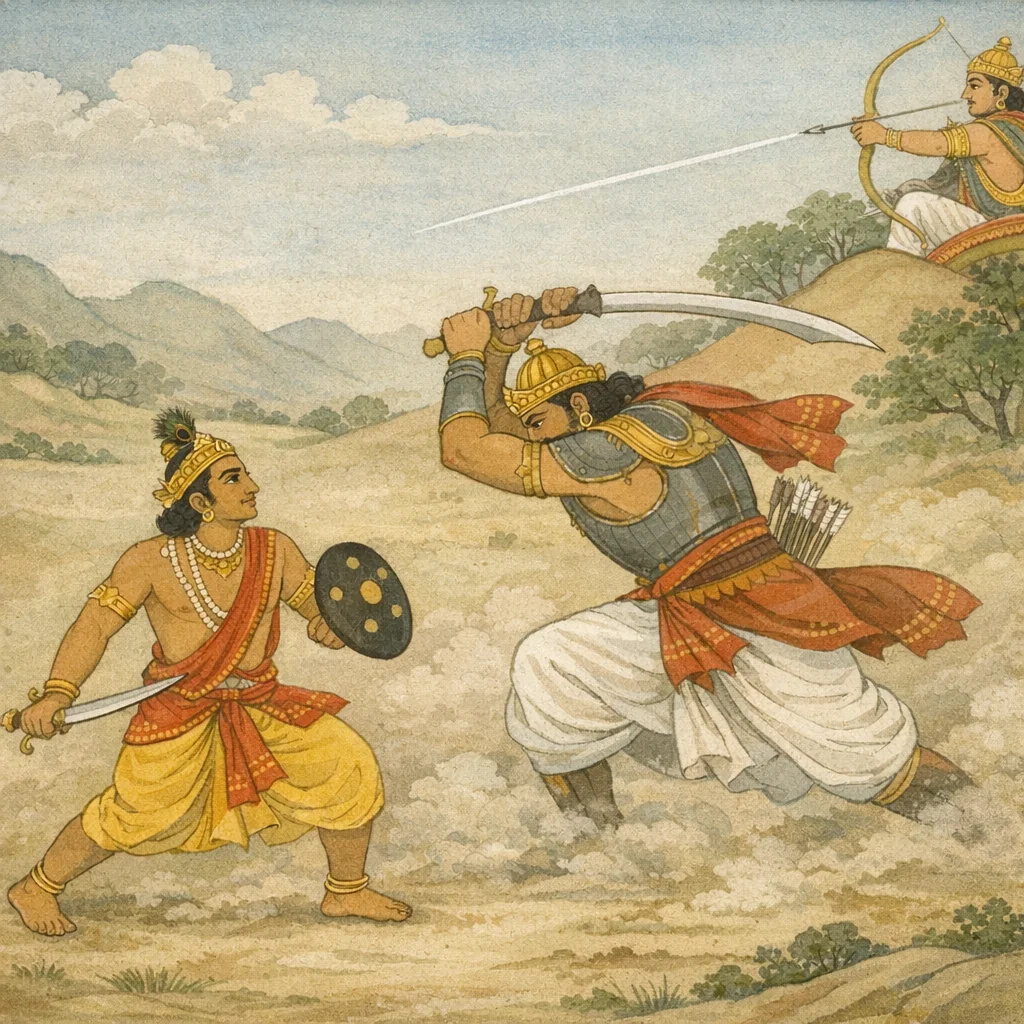
अद्य संयमनीं याता मया त्वं निहतो रणे । यथा रामानुजेनाजौ रावणिर्लक्ष्मणेन ह,'जैसे पूर्वकालमें श्रीरामचन्द्रजीके भाई लक्ष्मणके द्वारा युद्धमें रावणकुमार इन्द्रजित् मारा गया था, उसी प्रकार इस रणभूमिमें मेरे द्वारा मारे जाकर तुम आज ही यमराजकी संयमनीपुरीकी ओर प्रस्थान करोगे
Sañjaya said: “Today, slain by me in battle, you will depart for Saṃyamanī, the city of Yama. Just as in former times Rāvaṇa’s son Indrajit was killed in combat by Lakṣmaṇa, the younger brother of Śrī Rāma, so too will you, struck down on this battlefield, go now to the Lord of Death’s abode.”
Verse 11
अद्य कृष्णश्ष पार्थश्व॒ धर्मराजश्न माधव । हते त्वयि निरुत्साहा रण त्यक्ष्यन्त्यसंशयम्,“माधव! आज तुम्हारे मारे जानेपर श्रीकृष्ण, अर्जुन और धर्मराज युधिष्ठिर उत्साहशून्य हो युद्ध बंद कर देंगे, इसमें संशय नहीं है
Sañjaya said: “Mādhava, if you are slain today, Kṛṣṇa, Arjuna (Pārtha), and King Yudhiṣṭhira (Dharmarāja) will surely lose all resolve and abandon the battle. Of this there is no doubt.”
Verse 12
अद्य ते5पचितिं कृत्वा शितैर्माधव सायकै: । तत्स्त्रियो नन्दयिष्यामि ये त्वया निहता रणे,“मधुकुलनन्दन! आज तीखे बाणोंसे तुम्हारी पूजा करके मैं उन वीरोंकी स्त्रियोंको आनन्दित करूँगा, जिन्हें रणभूमिमें तुमने मार डाला है
Sañjaya said: “Today, O Mādhava, having rendered you ‘honour’ with my sharp arrows, I shall gladden the women of those warriors whom you have slain in battle.” The line is charged with bitter irony: the speaker twists the language of reverence into a threat, presenting violence as a perverse ‘offering’ and aiming to repay grief with further cruelty.
Verse 13
मच्चक्षुविंषयं प्राप्तो न त्वं माधव मोक्ष्यसे । सिंहस्य विषयं प्राप्तो यथा क्षुद्रमृगस्तथा,“माधव! जैसे कोई क्षुद्र मृग सिंहकी दृष्टिमें पड़कर जीवित नहीं रह सकता, उसी प्रकार मेरी आँखोंके सामने आकर अब तुम जीवित नहीं छूट सकोगे'
Sañjaya said: “O Mādhava, now that you have come within the range of my eyes, you will not escape alive. Just as a petty deer, once it falls within a lion’s sight, cannot survive, so too you—having come before me—will not be spared.” The utterance reflects the war-mindset of predatory certainty, where pride and wrath eclipse restraint and the ethical hesitation that dharma would otherwise demand.
Verse 14
युयुधानस्तु तं राजन प्रत्युवाच हसन्निव । कौरवेय न संत्रासो विद्यते मम संयुगे,राजन! युयुधानने भूरिश्रवाकी यह बात सुनकर हँसते हुए-से यह उत्तर दिया --“कुरुनन्दन! युद्धमें मुझे कभी किसीसे भय नहीं होता है
Sañjaya said: Then Yuyudhāna, as if smiling, replied to him, “O descendant of the Kurus, in battle no fear arises in me.” The statement frames Yuyudhāna’s warrior-ethic: steadfastness under danger and refusal to yield to intimidation, even amid the moral weight of fratricidal war.
Verse 15
नाहं भीषयितुं शक््यो वाड्मात्रेण तु केवलम् । स मां निहन्यात् संग्रामे यो मां कुर्यान्निरायुधम्,“मुझे केवल बातें बनाकर नहीं डराया जा सकता। संग्राममें जो मुझे शस्त्रहीन कर दे, वही मेरा वध कर सकता है
Sañjaya said: “I cannot be frightened by mere words alone. In battle, only the one who can render me weaponless is capable of slaying me.” The statement underscores a warrior’s ethic: fear is not to be induced by speech, but by actual martial superiority that deprives one of the means to fight.
Verse 16
समास्तु शाश्चतीह्न्याद् यो मां हन्याद्धि संयुगे । किं वृथोक्तेन बहुना कर्मणा तत् समाचर,'जो युद्धमें मुझे मार सकता है, वह सदा सर्वत्र अपने शत्रुओंका वध कर सकता है। अस्तु, व्यर्थ ही बहुत-सी बातें बनानेसे क्या लाभ? तुमने जो कुछ कहा है, उसे करके दिखाओ
Sañjaya said: “So be it. Indeed, whoever can strike me down in battle is, everywhere and always, capable of slaying his enemies. What is the use of spinning many words in vain? Put into action what you have said—show it through deeds.”
Verse 17
शारदस्येव मेघस्य गर्जितं निष्फलं हि ते । श्र॒त्वा त्वदगर्जितं वीर हास्यं हि मम जायते,“शरत्कालके मेघके समान तुम्हारे इस गर्जन-तर्जनका कुछ फल नहीं है। वीर! तुम्हारी यह गर्जना सुनकर मुझे हँसी आती है
Sañjaya said: “Your roaring is as fruitless as the thunder of a cloud in the autumn season. O hero, hearing your bluster, laughter arises in me.”
Verse 18
चिरकालेप्सितं लोके युद्धमद्यास्तु कौरव । त्वरते मे मतिस्तात तव युद्धाभिकाड्क्षिणी
Sañjaya said: “O Kaurava, let the war—long desired in the world—take place today. My mind hastens, dear one, intent upon your battle.”
Verse 19
अन्योन्यं तौ तथा वाग्भिस्तक्षन्तौ नरपुड़वी
Sañjaya said: Those two foremost of men, striking at one another with words, continued to wound each other through sharp speech—an exchange of verbal blows that mirrored the violence of the battlefield and revealed how anger can turn even the noble into instruments of harm.
Verse 20
समेतौ तौ महेष्वासौ शुष्मिणौ स्पर्थिनौ रणे
Sañjaya said: Those two mighty archers met together in battle—both fierce in spirit and eager to outdo one another—driven by the competitive ardor that fuels the clash of warriors.
Verse 21
भूरिश्रवा: सात्यकिश्न ववर्षतुररिंदमौ
Sañjaya said: Bhūriśravā and Sātyaki—both famed as subduers of foes—poured down a relentless shower of blows upon each other, intensifying the fierce contest on the battlefield.
Verse 22
सौमदत्तिस्तु शैनेयं प्रच्छाद्येषुभिराशुगै:
Sañjaya said: But Saumadatti, showering Śaineya with swift-flying arrows, sought to cover and overwhelm him in the press of battle—an image of how, in war, prowess is measured by the ability to check an opponent’s advance through relentless force.
Verse 23
दशभि: सात्यकि विद्ध्वा सौमदत्तिरथापरान्
Sañjaya said: Having struck Sātyaki with ten arrows, Saumadatti then turned his assault upon the others as well. The scene underscores the relentless momentum of battle, where prowess is measured by restraint and purpose as much as by force, even amid escalating violence.
Verse 24
तानस्य विशिखांस्तीक्ष्णानन्तरिक्षे विशाम्पते
Sañjaya said: “O lord of the people, those sharp arrows of his were seen coursing through the mid-air.”
Verse 25
तौ पृथक् शस्त्रवर्षाभ्यामवर्षेतां परस्परम्
Sañjaya said: The two warriors, keeping their positions distinct, rained down showers of weapons upon one another—each answering the other in the relentless code of battle.
Verse 26
तौ नखैरिव शार्दूलौ दन्तैरिव महाद्विपौ
Sañjaya said: Those two, like tigers with their claws and like mighty elephants with their tusks, closed in upon each other—each seeking to overpower the other in the fierce press of battle, where strength and resolve are tested without respite.
Verse 27
रथशक्तिभिरन्योन्यं विशिखैश्लवाप्पकृन्तताम् । जैसे दो सिंह नखोंसे और दो बड़े-बड़े गजराज दाँतोंसे परस्पर प्रहार करते हैं, उसी प्रकार वे दोनों वीर रथ-शक्तियों तथा बाणोंद्वारा एक-दूसरेको क्षत-विक्षत करने लगे || २६ ई | निर्भिन्दन्तौ हि गात्राणि विक्षरन्ती च शोणितम्
Sañjaya said: The two warriors struck one another with ratha-spears and with arrows, cutting and tearing each other as if two lions clawed at each other, or as two mighty lordly elephants gored with their tusks. Indeed, they pierced each other’s limbs and made the blood flow—an image of battle’s relentless fury, where valor is displayed through endurance and mutual wounding rather than restraint.
Verse 28
एवमुत्तमकर्माणौ कुरुवृष्णियशस्करौ
Sañjaya said: “Thus were those two, whose deeds were of the highest order, acting in a way that enhanced the renown of the Kurus and the Vṛṣṇis.”
Verse 29
तावदीर्घेण कालेन ब्रह्मलोकपुरस्कृतो
Sañjaya said: “After that, in the course of a long time, he came to be honored as one who had Brahmaloka set before him—his destiny and merit pointing toward the world of Brahmā.”
Verse 30
सात्यकि: सौमदत्तिश्व शरवृष्ट्या परस्परम्
Sañjaya said: Sātyaki and Saumadatti confronted one another, showering each other with volleys of arrows—an image of the war’s relentless reciprocity, where valor and enmity meet in equal measure on the battlefield.
Verse 31
सम्प्रैक्षन्त जनास्तौ तु युध्यमानौ युधाम्पती
Sañjaya said: The people looked on as those two lords of battle fought, watching their combat with tense attention amid the moral weight and spectacle of war.
Verse 32
यूथपौ वासिताहेतो: प्रयुद्धाविव कुड्जरौ । जैसे हथिनीके लिये दो यूथपति गजराज परस्पर घोर युद्ध करते हैं, उसी प्रकार आपसमें लड़नेवाले उन योद्धाओंके अधिपतियोंको सब लोग दर्शक बनकर देखने लगे ३१३ || अन्योन्यस्य हयान् हत्वा धनुषी विनिकृत्य च
Sañjaya said: “Like two lordly elephants, each the leader of his herd, battling fiercely for the sake of a she-elephant, those two champions fought one another. After striking down each other’s horses and cutting the bows, they pressed on in close combat—while the surrounding warriors looked on as spectators at the clash of their chiefs.”
Verse 33
आर्षभे चर्मणी चित्रे प्रगृह् विपुले शुभे
Sañjaya said: Taking up a splendid, broad, and auspicious hide—made from a noble bull and adorned with variegated markings—(he prepared it for use), as part of the warlike preparations being described.
Verse 34
चरन्तौ विविधान् मार्गान् मण्डलानि च भागश:,क्रोधमें भरे हुए वे दोनों शत्रुमर्दन वीर पृथक्-पृथक् नाना प्रकारके मार्ग और मण्डल (पैंतरे और दाँव-पेंच) दिखाते हुए एक-दूसरेपर बारंबार चोट करने लगे। उनके हाथोंमें तलवारें चमक रही थीं। उन दोनोंके ही कवच विचित्र थे तथा वे निष्क और अंगद आदि आभूषणोंसे विभूषित थे
Sañjaya said: Moving along many kinds of paths and circling in measured patterns, those two enemy-crushing heroes—hearts swollen with wrath—separated and rejoined again and again, displaying varied feints and tactical turns as they repeatedly struck at one another. Their swords flashed in their hands. Both wore wondrous armor and were adorned with ornaments such as necklaces and armlets, shining amid the fury of combat.
Verse 35
मुहुराजघ्नतुः क्रुद्धावन्योन्यमरिमर्दनौ । सखड्गौ चित्रवर्माणौ सनिष्काड्रदभूषणौ,क्रोधमें भरे हुए वे दोनों शत्रुमर्दन वीर पृथक्-पृथक् नाना प्रकारके मार्ग और मण्डल (पैंतरे और दाँव-पेंच) दिखाते हुए एक-दूसरेपर बारंबार चोट करने लगे। उनके हाथोंमें तलवारें चमक रही थीं। उन दोनोंके ही कवच विचित्र थे तथा वे निष्क और अंगद आदि आभूषणोंसे विभूषित थे
Sañjaya said: Again and again, the two enemy-crushing warriors, inflamed with wrath, struck one another. With swords in hand, displaying varied maneuvers and circling feints, they repeatedly sought openings. Their blades flashed; their armor was ornate, and they were adorned with neck-ornaments and armlets—splendor set amid the fury of battle.
Verse 36
भ्रान्तमुद्भ्रान्तमाविद्धमाप्लुतं विप्लुतं सृतम् । सम्पातं समुदीर्ण च दर्शयन्तौ यशस्विनौ
Sañjaya said: Those two illustrious warriors displayed every mode of movement in battle—whirling and reeling, being hurled and struck, leaping and springing aside, slipping and rushing onward, swooping down and surging up—making manifest the full, bewildering dynamism of combat. In this depiction, prowess is shown not merely as force, but as disciplined mastery amid chaos, where fame is earned through steadiness and skill under the pressure of war.
Verse 37
उभौ छिद्रेषिणौ वीरावुभौ चित्र ववल्गतु:,दोनों ही वीर एक-दूसरेके छिद्र (प्रहार करनेके अवसर) पानेकी इच्छा रखते हुए विचित्र रीतिसे उछलते-कूदते थे। दोनों ही अपनी शिक्षा, फुर्ती तथा युद्ध-कौशल दिखाते हुए रणभूमिमें एक-दूसरेको खींच रहे थे। वे दोनों ही योद्धाओंमें श्रेष्ठ थे
Verse 38
दर्शयन्तायुभौ शिक्षां लाघवं सौष्ठवं तथा । रणे रणकृतां श्रेष्ठावन्योन्यं पर्यकर्षताम्,दोनों ही वीर एक-दूसरेके छिद्र (प्रहार करनेके अवसर) पानेकी इच्छा रखते हुए विचित्र रीतिसे उछलते-कूदते थे। दोनों ही अपनी शिक्षा, फुर्ती तथा युद्ध-कौशल दिखाते हुए रणभूमिमें एक-दूसरेको खींच रहे थे। वे दोनों ही योद्धाओंमें श्रेष्ठ थे
Sañjaya said: Both warriors, eager to find an opening in the other, sprang and wheeled in varied ways. Displaying their training, agility, and refined skill, those two—foremost among men of battle—strove to draw and press one another on the field, each seeking advantage without yielding ground.
Verse 39
मुहूर्तमिव राजेन्द्र समाहत्य परस्परम् । पश्यतां सर्वसैन्यानां वीरावाश्वसतां पुन:,राजेन्द्र! उस समय विश्राम करती हुई सम्पूर्ण सेनाओंके देखते-देखते लगभग दो घड़ीतक एक-दूसरेपर तलवारोंसे चोट करके दोनोंने दोनोंकी सौ चन्द्राकार चिह्लोंसे सुशोभित विचित्र ढालें काट डालीं। नरेश्वर! फिर वे दोनों पुरुषसिंह भुजाओंद्वारा मल्ल-युद्ध करने लगे
Sañjaya said: O king, for what seemed like a brief while, the two heroes struck each other in close combat, as all the armies looked on. Then, after catching their breath again, they continued the duel—its intensity displayed before the resting troops—pressing the fight onward with unwavering resolve.
Verse 40
असिशभ्यां चर्मणी चित्रे शतचन्द्रे नराधिप । निकृत्य पुरुषव्याप्रौ बाहुयुद्ध प्रचक्रतु:,राजेन्द्र! उस समय विश्राम करती हुई सम्पूर्ण सेनाओंके देखते-देखते लगभग दो घड़ीतक एक-दूसरेपर तलवारोंसे चोट करके दोनोंने दोनोंकी सौ चन्द्राकार चिह्लोंसे सुशोभित विचित्र ढालें काट डालीं। नरेश्वर! फिर वे दोनों पुरुषसिंह भुजाओंद्वारा मल्ल-युद्ध करने लगे
Sañjaya said: O king, those two tiger-like warriors, striking with their swords, cut to pieces each other’s wondrous shields marked with a hundred moon-emblems, while the armies looked on. Then, having destroyed the shields, they engaged in hand-to-hand combat with their arms, like wrestlers—displaying valor and endurance amid the disciplined spectacle of war.
Verse 41
व्यूढोरस्कौ दीर्घभुजौ नियुद्धकुशलावुभौ । बाहुभि: समसज्जेतामायसै: परिघैरिव,दोनोंके वक्ष:स्थल चौड़े और भुजाएँ बड़ी-बड़ी थीं। दोनों ही मल्ल-युद्धमें कुशल थे और लोहेके परिघोंके समान सुदृढ़ भुजाओंद्वारा एक-दूसरेसे गुथ गये थे
Sañjaya said: Both warriors had broad, well-set chests and long, powerful arms. Skilled in close combat, they locked onto one another with their arms—firm and unyielding, like iron clubs—showing the grim intensity of the duel amid the wider slaughter of war.
Verse 42
तयो राजन् भुजाघातनिग्रहप्रग्रहास्तथा । शिक्षाबलसमुद्भूता: सर्वयोधप्रहर्षणा:,राजन! उन दोनोंके भुजाओंद्वारा आघात, निग्रह (हाथ पकड़ना) और प्रग्रह (गलेमें हाथ लगाना) आदि दाँव उनकी शिक्षा और बलके अनुरूप प्रकट होकर समस्त योद्धाओंका हर्ष बढ़ा रहे थे
Sañjaya said: O King, between those two, the various grappling maneuvers—strikes delivered by the arms, holds and restraints, and clinches and neck-grips—arose in accordance with their training and strength, and they heightened the exhilaration of all the warriors watching. The scene underscores how disciplined skill, when turned to combat, can inflame the martial spirit of an entire host.
Verse 43
तयोरनवरयो राजन् समरे युध्यमानयो: । भीमो5भवन्महाशब्दो वज्रपर्वतयोरिव
Sañjaya said: O King, as those two fought on without yielding in the battlefield, a terrifying, thunderous roar arose—like the crash of a thunderbolt striking a mountain. The verse underscores the relentless, uncompromising nature of martial fury, where steadfastness and pride can harden into a contest of sheer force rather than restraint.
Verse 44
राजन्! समरभूमिमें जूझते हुए उन दोनों नरश्रेष्ठोंके पारस्परिक आघातसे प्रकट होनेवाला महान् शब्द वज्र और पर्वतके टकरानेके समान भयंकर जान पड़ता था ।। द्विपाविव विषाणाग्रै: शुद्भरिव महर्षभौ । भुजयोक्त्रावबन्धैश्न शिरोभ्यां चावघातनै:,जैसे दो हाथी दाँतोंके अग्रभागसे तथा दो साँड़ सीगोंसे लड़ते हैं, उसी प्रकार वे दोनों वीर कभी भुजपाशोंसे बाँधकर, कभी सिरोंकी टक्कर लगाकर, कभी पैरोंसे खींचकर, कभी पैरमें पैर लपेटकर, कभी तोमर-प्रहारके समान ताल ठोंककर, कभी अंकुश गड़ानेके समान एक-दूसरेको नोचकर, कभी पादबन्ध, उदरबन्ध, उद्भ्रमणःर, गतः, प्रत्यागतः॑, आक्षेपर%ँ, पातनः, उत्थान और संप्लुत* आदि दावोंका प्रदर्शन करते हुए वे दोनों महामनस्वी कुरु और सात्वतवंशके प्रमुख वीर परस्पर युद्ध कर रहे थे
Sañjaya said: O King, as those two foremost of men grappled on the battlefield, the tremendous sound born of their mutual blows seemed terrifying—like a thunderbolt crashing against a mountain. Like two elephants clashing with the tips of their tusks, or like two great bulls locking horns, the two heroes fought in close combat: now binding each other with arm-locks, now butting with their heads, now dragging with their feet, now entwining leg with leg; now striking their palms like the impact of a spear, now tearing at one another as though driving in a goad. Displaying the wrestler’s holds and maneuvers—foot-locks, waist-locks, whirling turns, advances and retreats, throws, takedowns, rises, and leaps—the high-souled champions, chief among the Kurus and the Sātvatas, battled each other without yielding.
Verse 45
पादावकर्षसंधानैस्तोमराड्कुशलासनै: । पादोदरविबन्धैश्व भूमावुद्भ्रमणैस्तथा,जैसे दो हाथी दाँतोंके अग्रभागसे तथा दो साँड़ सीगोंसे लड़ते हैं, उसी प्रकार वे दोनों वीर कभी भुजपाशोंसे बाँधकर, कभी सिरोंकी टक्कर लगाकर, कभी पैरोंसे खींचकर, कभी पैरमें पैर लपेटकर, कभी तोमर-प्रहारके समान ताल ठोंककर, कभी अंकुश गड़ानेके समान एक-दूसरेको नोचकर, कभी पादबन्ध, उदरबन्ध, उद्भ्रमणःर, गतः, प्रत्यागतः॑, आक्षेपर%ँ, पातनः, उत्थान और संप्लुत* आदि दावोंका प्रदर्शन करते हुए वे दोनों महामनस्वी कुरु और सात्वतवंशके प्रमुख वीर परस्पर युद्ध कर रहे थे
Sañjaya said: Like two elephants clashing with the tips of their tusks, or like two bulls locking horns, those two heroes fought each other at close quarters—now seizing and binding with their arms, now butting head to head, now dragging by the feet, now entwining leg with leg; striking and stamping as in a tomara-blow, gouging as with an elephant-goad; displaying holds and locks of foot and waist, and whirling turns upon the ground. Thus the great-souled champions—the foremost of the Kurus and the leading hero of the Sātvata line—contended in a fierce, disciplined duel.
Verse 46
गतप्रत्यागताक्षेपै: पातनोत्थानसम्प्लुतै: । युयुधाते महात्मानौ कुरुसात्वतपुड्वौ,जैसे दो हाथी दाँतोंके अग्रभागसे तथा दो साँड़ सीगोंसे लड़ते हैं, उसी प्रकार वे दोनों वीर कभी भुजपाशोंसे बाँधकर, कभी सिरोंकी टक्कर लगाकर, कभी पैरोंसे खींचकर, कभी पैरमें पैर लपेटकर, कभी तोमर-प्रहारके समान ताल ठोंककर, कभी अंकुश गड़ानेके समान एक-दूसरेको नोचकर, कभी पादबन्ध, उदरबन्ध, उद्भ्रमणःर, गतः, प्रत्यागतः॑, आक्षेपर%ँ, पातनः, उत्थान और संप्लुत* आदि दावोंका प्रदर्शन करते हुए वे दोनों महामनस्वी कुरु और सात्वतवंशके प्रमुख वीर परस्पर युद्ध कर रहे थे
Sañjaya said: The two great-souled champions—the foremost of the Kurus and the foremost of the Sātvatas—fought on, displaying a succession of wrestling maneuvers: advances and counter-advances, throws and counter-throws, takedowns and recoveries, and leaps. Their combat is presented not as random brutality but as disciplined martial skill within the larger, grim ethic of battlefield duty, where prowess and endurance become the visible currency of a war that tests the limits of dharma.
Verse 47
द्वात्रिंशत्करणानि स्युर्यानि युद्धानि भारत । तान्यदर्शयतां तत्र युध्यमानौ महाबलौ,भारत! इस प्रकार वे दोनों महाबली वीर परस्पर जूझते हुए मल्ल-युद्धकी जो बत्तीस कलाएंँ हैं, उनका प्रदर्शन करने लगे
Sañjaya said: O Bhārata, there are said to be thirty-two combat-manoeuvres used in wrestling and close fighting. There, the two mighty warriors, locked in combat, began displaying those techniques—each testing the other’s strength and skill as the battle’s violence narrowed into a disciplined, rule-bound contest of prowess.
Verse 48
क्षीणायुधे सात्वते युध्यमाने ततोअब्रवीदर्जुनं वासुदेव: । पश्यस्वैनं विरथं युध्यमानं रणे वरं सर्वधनुर्धराणाम्
Sañjaya said: When the Sātvata hero was fighting with his weapons spent, Vāsudeva then spoke to Arjuna: “Look at him—fighting on though bereft of his chariot—foremost in battle among all bowmen.” The moment underscores steadfast valor and the ethical weight of witnessing courage even in an enemy, amid the harsh demands of war.
Verse 49
तदनन्तर जब अस्त्र-शस्त्र नष्ट हो जानेपर सात्यकि युद्ध कर रहे थे, उस समय भगवान् श्रीकृष्णने अर्जुनसे कहा--'पार्थ! रणमें समस्त धनुर्धारियोंमें श्रेष्ठ इस सात्यकिकी ओर देखो। यह रथहीन होकर युद्ध कर रहा है ।। (सीदन्तं सात्यकिं पश्य पार्थन परिरक्ष च ।।) प्रविष्टो भारतीं भित्त्वा तव पाण्डव पृष्ठत: । योधितश्न महावीर्य: सर्वेर्भारत भारतै:,“कुन्तीनन्दन! देखो, सात्यकि शिथिल हो गया है। इसकी रक्षा करो। भारत! पाण्डुनन्दन! तुम्हारे पीछे-पीछे यह कौरव-सेनाका व्यूह भेदकर भीतर घुस आया है और भरतवंशके प्राय: सभी महापराक्रमी योद्धाओंके साथ युद्ध कर चुका है
Sañjaya said: “O Pārtha, look at Sātyaki—he is growing weary; protect him. O son of Pāṇḍu, he has broken through the Bharata battle-formation and entered from behind you, and that mighty warrior has been fighting against nearly all the great heroes of the Bharata line.” The moment frames a moral urgency within war: even amid strategic chaos, the duty of comradeship and protection of an ally becomes a direct command, turning attention from personal glory to safeguarding one who has risked himself for the cause.
Verse 50
(धार्तराष्ट्रश्न ये मुख्या ये च मुख्या महारथा: । निहता वृष्णिवीरेण शतशो5थ सहस््रश: ।।) “दुर्योधनकी सेनामें जो मुख्य योद्धा और प्रधान महारथी थे, वे सैकड़ों और हजारोंकी संख्यामें इस वृष्णिवंशी वीरके हाथसे मारे गये हैं ।। परिश्रान्तं युधां श्रेष्ठ सम्प्राप्तो भूरिदक्षिण: । युद्धाकाड़क्षी समायान्तं नैतत् सममिवार्जुन,“अर्जुन! यहाँ आता हुआ योद्धाओंमें श्रेष्ठ सात्यकि बहुत थक गया है, तो भी उनके साथ युद्ध करनेकी इच्छासे यज्ञोंमें पर्याप्त दक्षिणा देनेवाले भूरिश्रवा आये हैं। यह युद्ध समान योग्यताका नहीं है'
Sanjaya said: The foremost warriors of the Dhartarashtras—those principal champions and leading great chariot-fighters—have been slain by this hero of the Vrishni line, in hundreds and in thousands. And now, O Arjuna, as Satyaki, best among fighters, comes forward exhausted, Bhurishravas—renowned for giving abundant sacrificial fees—approaches desiring battle with him. This encounter does not appear to be an equal match.
Verse 51
ततो भूरिश्रवा: क्रुद्धः सात्यकिं युद्धदुर्मद: । उद्यम्याभ्याहनद् राजन् मत्तो मत्तमिव द्विपम्,राजन! इसी समय क्रोधमें भरे हुए रणदुर्मद भूरिश्रवाने उद्योग करके सात्यकिपर उसी प्रकार आघात किया, जैसे एक मतवाला हाथी दूसरे मदोन्मत्त हाथीपर चोट करता है
Sañjaya said: Then Bhūriśravas, inflamed with anger and intoxicated by the frenzy of battle, rose up and struck Sātyaki, O king—like one rut-maddened elephant battering another. The simile underscores how wrath and martial pride can turn combat into blind, overpowering violence, eclipsing restraint and right conduct.
Verse 52
रथस्थयोर्दयोर्युद्धे क्रुद्धयोर्योधमुख्ययो: । केशवार्जुनयो राजन् समरे प्रेक्षमाणयो:,नरेश्वर! समरांगणमें रथपर बैठे हुए क्रोधभरे योद्धाओंमें श्रेष्ठ श्रीकृष्ण और अर्जुन वह युद्ध देख रहे थे
Sañjaya said: O King, as the two foremost warriors fought in fury from their chariots, Keśava and Arjuna—watching that clash upon the battlefield—looked on with focused attention. The verse underscores the gravity of war as a witnessed moral event: even the greatest agents of action (Kṛṣṇa as charioteer-guide and Arjuna as warrior) pause to observe, assess, and choose the next righteous course amid escalating violence.
Verse 53
अथ कृष्णो महाबाहुरर्जुनं प्रत्यभाषत । पश्य वृष्ण्यन्धकव्याप्र॑ं सौमदत्तिवशं गतम्,तब महाबाहु श्रीकृष्णने अर्जुनसे कहा--'पार्थ! देखो, वृष्णि और अंधकवंशका वह श्रेष्ठ वीर भूरिश्रवाके वशमें हो गया है
Sañjaya said: Then mighty-armed Kṛṣṇa addressed Arjuna, saying, “Look, Pārtha—see that tiger among the Vṛṣṇis and Andhakas now fallen under the power of Saumadatti.” The remark draws Arjuna’s attention to a sudden reversal on the battlefield, where a renowned warrior is brought under an opponent’s control, raising urgent questions of duty, restraint, and the ethics of intervention amid chaos.
Verse 54
परिश्रान्तं गतं भूमौ कृत्वा कर्म सुदुष्करम् । तवान्तेवासिनं वीरं पालयार्जुन सात्यकिम्,“वह अत्यन्त दुष्कर कर्म करके परिश्रमसे चूर-चूर हो पृथ्वीपर गिर गया है। अर्जुन! वीर सात्यकि तुम्हारा ही शिष्य है। उसकी रक्षा करो
Sañjaya said: “Having accomplished a most arduous deed, he is utterly exhausted and has fallen to the ground. O Arjuna, the heroic Sātyaki is your own disciple—protect him.”
Verse 55
न वशं यज्ञशीलस्य गच्छेदेष वरो<र्जुन । त्वत्कृते पुरुषव्याप्र तदाशु क्रियतां विभो,'पुरुषसिंह अर्जुन! प्रभो! यह श्रेष्ठ वीर तुम्हारे लिये यज्ञशील भूरिश्रवाके अधीन न हो जाय, ऐसा शीघ्र प्रयत्न करो”
Sañjaya said: “O Arjuna, best of men—see that this noble warrior does not fall under the control of the sacrifice-minded Bhūriśravas. For your sake, O tiger among men, act at once, O mighty one.”
Verse 56
अथाब्रवीद्धृष्टमना वासुदेवं॑ धनंजय: । पश्य वृष्णिप्रवीरेण क्रीडन्तं कुरुपुज्वम्
Sañjaya said: Then Dhanañjaya (Arjuna), his heart made bold, spoke to Vāsudeva (Kṛṣṇa): “Look—see that foremost of the Kurus sporting as though in play, even while being met by the Vṛṣṇi hero.” The line underscores a warrior’s perilous pride in battle: when combat is treated like sport, ethical discernment and the gravity of violence can be eclipsed, inviting swift reversal of fortune.
Verse 57
संजय उवाच इत्येवं भाषमाणे तु पाण्डवे वै धनंजये,संजय कहते हैं--भरतश्रेष्ठ! पाण्डुनन्दन अर्जुन इस प्रकार कह ही रहे थे कि सैनिकोंमें महान् हाहाकार मच गया। महाबाहु भूरिश्रवाने सात्यकिको उठाकर धरतीपर पटक दिया
Sañjaya said: “O best of the Bharatas, while the Pāṇḍava Arjuna (Dhanañjaya) was still speaking in this manner, a great uproar arose among the troops. At that moment the mighty-armed Bhūriśravas seized Sātyaki, lifted him up, and hurled him down upon the earth.”
Verse 58
हाहाकारो महानासीत् सैन्यानां भरतर्षभ । तदुद्यम्य महाबाहु: सात्यकिं न्यहनद् भुवि,संजय कहते हैं--भरतश्रेष्ठ! पाण्डुनन्दन अर्जुन इस प्रकार कह ही रहे थे कि सैनिकोंमें महान् हाहाकार मच गया। महाबाहु भूरिश्रवाने सात्यकिको उठाकर धरतीपर पटक दिया
Sanjaya said: O bull among the Bharatas, a great outcry arose among the troops. Then the mighty-armed Bhūriśravas, having lifted Sātyaki up, hurled him down upon the ground. The scene underscores how, in the frenzy of battle, strength and rage can eclipse restraint, and how the suffering of warriors becomes a collective moral shock to the army that witnesses it.
Verse 59
स सिंह इव मातजूं विकर्षन् भूरिदक्षिण: । व्यरोचत कुरुश्रेष्ठ: सात्वतप्रवरं युधि,जैसे सिंह किसी मतवाले हाथीको खींचता है, उसी प्रकार प्रचुर दक्षिणा देनेवाले कुरुश्रेष्ठ भूरिश्रवा युद्धस्थलमें सात्वतवंशके प्रमुख वीर सात्यकिको घसीटते हुए बड़ी शोभा पा रहे थे
Verse 60
अथ कोशाद् विनिष्कृष्य खड्गं भूरिश्रवा रणे । मूर्थजेषु निजग्राह पदा चोरस्यताडयत्,तदनन्तर भूरिश्रवाने रणभूमिमें तलवारको म्यानसे बाहर निकालकर सात्यकिकी चुटिया पकड़ ली और उनकी छातीमें लात मारी
Sañjaya said: Then, in the midst of battle, Bhūriśravā drew his sword from its scabbard. Seizing Sātyaki by the hair on his head, he struck him on the chest with his foot—an act that shows how, when fury overtakes restraint, the struggle can slip from warriorly discipline into humiliating violence.
Verse 61
ततोअस्य छेत्तुमारब्ध: शिर: कायात् सकुण्डलम् | तावत्क्षणात् सात्वतो5ति शिर: सम्भ्रमयंस्त्वरन्,फिर उसने उनके कुण्डलमण्डित मस्तकको धड़से अलग कर देनेका उद्योग आरम्भ किया। उस समय सात्यकि भी बड़ी शीघ्रताके साथ अपने मस्तकको घुमाने लगे
Sañjaya said: Then he began the attempt to sever his head—adorned with earrings—from the body. In that very instant, the Sātvata warrior too, acting with urgent speed, started to whirl his head about, seeking to evade the blow. The scene underscores the brutal immediacy of battlefield intent and the quick, self-preserving reflex that arises when life is threatened.
Verse 62
यथा चक्र तु कौलालो दण्डविद्धं तु भारत । सहैव भूरिश्रवसो बाहुना केशधारिणा,भारत! जैसे कुम्हार छेदमें डंडा डालकर अपनी चाकको घुमाता है, उसी प्रकार केश पकड़े हुए भूरिश्रवाके बाँहके साथ ही सात्यकि अपने सिरको घुमाने लगे
Sanjaya said: “O Bhārata, just as a potter spins his wheel by inserting a stick into its socket, so did Sātyaki whirl about, still holding Bhūriśravas’s arm together with the lock of hair he had seized.”
Verse 63
त॑ तथा परिकृष्यन्तं दृष्टवा सात्वतमाहवे । वासुदेवस्ततो राजन् भूयो<र्जुनमभाषत,राजन! इस प्रकार युद्धभूमिमें केश खींचे जानेके कारण सात्यकिको कष्ट पाते देख भगवान् श्रीकृष्ण अर्जुनसे पुनः इस प्रकार बोले--
Sañjaya said: Seeing Sātyaki of the Sātvata line being dragged about in that manner on the battlefield, Vāsudeva (Kṛṣṇa) said again to Arjuna, “O King…”. The scene underscores the moral urgency of protecting one’s ally from humiliation and unjust violence amid the chaos of war.
Verse 64
पश्य वृष्ण्यन्धकव्याप्र॑ं सौमदत्तिवशं गतम् | तव शिष्यं महाबाहो धनुष्यनवरं त्वया,“महाबाहो! देखो, वृष्णि और अन्धकवंशका वह सिंह भूरिश्रवाके वशमें पड़ गया है। यह तुम्हारा शिष्य है और धर्नुर्विद्यामें तुमसे कम नहीं है
Sañjaya said: “Behold—the tiger among the Vṛṣṇis and Andhakas has fallen under the power of Saumadatti (Bhūriśravas). O mighty-armed one, this is your disciple, a master of the bow who is not inferior to you.” In the moral tension of the war, Sañjaya’s words both report a battlefield reversal and implicitly press the question of responsibility: how a teacher’s training and a warrior’s prowess are being turned toward ruthless advantage in a fratricidal conflict.
Verse 65
असत्यो विक्रम: पार्थ यत्र भूरिश्रवा रणे । विशेषयति वार्ष्णेयं सात्यकिं सत्यविक्रमम्,'पार्थ! पराक्रम मिथ्या है, जिसका आश्रय लेनेपर भी वृष्णिवंशी सत्यपराक्रमी सात्यकिसे रणभूमिमें भूरिश्रवा बढ़ गये हैं!
Sañjaya said: “O Pārtha, ‘valor’ seems false indeed—since on the battlefield Bhūriśravā has gained the upper hand over Sātyaki, the Vārṣṇeya, whose prowess is famed as true.” The line carries a bitter irony: in war, reputation and moral expectation can be overturned by circumstance, and ‘truth’ in strength is tested by outcomes rather than claims.
Verse 66
एवमुक्तो महाबाहुर्वासुदेवेन पाण्डव: । मनसा पूजयामास भूरिश्रवसमाहवे
Sañjaya said: Thus addressed by Vāsudeva, the mighty-armed Pāṇḍava, even amid the battle, inwardly honored Bhūriśravas—affirming that reverence for valor and worth can be maintained in war without abandoning one’s own duty.
Verse 67
भगवान् श्रीकृष्णके ऐसा कहनेपर पाण्डुपुत्र महाबाहु अर्जुनने मन-ही-मन युद्धस्थलमें भूरिश्रवाकी प्रशंसा की ।। विकर्षन् सात्वतश्रेष्ठ क्रीडमान इवाहवे । संहर्षयति मां भूय: कुरूणां कीर्तिवर्धन:,कुरुकुलकी कीर्ति बढ़ानेवाले भूरिश्रवा इस युद्ध-स्थलमें सात्वतकुलके श्रेष्ठ वीर सात्यकिको घसीटते हुए खेल-सा कर रहे हैं और बारंबार मेरा हर्ष बढ़ा रहे हैं
Sañjaya said: When the Blessed Śrī Kṛṣṇa spoke thus, the mighty-armed Arjuna, son of Pāṇḍu, inwardly praised Bhūriśravā on the battlefield. Dragging the foremost of the Sātvatas, as though playing in the fight, Bhūriśravā—enhancer of the Kurus’ fame—again and again increases my exhilaration. The scene underscores how, amid the moral weight of war, even an opponent’s prowess can be acknowledged, while the narrator’s admiration reveals the intoxicating pull of martial glory.
Verse 68
प्रवरं वृष्णिवीराणां यन्न हन्याद्धि सात्यकिम् । महाद्विपमिवारण्ये मृगेन्द्र इव कर्षति,जैसे सिंह वनमें किसी महान् गजराजको खींचता है, उसी प्रकार ये भूरिश्रवा वृष्णिवंशके प्रमुख वीर सात्यकिको खींच रहे हैं, उसे मार नहीं रहे हैं
Sañjaya said: “Bhūriśravas is not striking down Sātyaki, the foremost among the Vṛṣṇi heroes; rather, he is dragging him—just as a lion in the forest drags a mighty elephant. The scene underscores a grim restraint amid battle: the intent is to overpower and humiliate by forceful capture, not to kill at that instant.”
Verse 69
एवं तु मनसा राजन् पार्थ: सम्पूज्य कौरवम् | वासुदेव॑ महाबाहुरर्जुन: प्रत्यभाषत,राजन! इस प्रकार मन-ही-मन उस कुरुवंशी वीरकी प्रशंसा करके महाबाहु कुन्तीकुमार अर्जुनने भगवान् श्रीकृष्णसे कहा--
Sañjaya said: “O King, having thus, within his own mind, honored and praised that Kuru hero, the mighty-armed Arjuna, son of Pṛthā, addressed Vāsudeva (Kṛṣṇa).”
Verse 70
सैन्धवे सक्तदृष्टित्वान्नैनं पश्यामि माधवम् । एतत् त्वसुकरं कर्म यादवार्थे करोम्यहम्,'प्रभो! मेरी दृष्टि सिन्धुराज जयद्रथपर लगी हुई थी। इसलिये मैं सात्यकिको नहीं देख रहा था; परंतु अब मैं इस यदुवंशी वीरकी रक्षाके लिये यह दुष्कर कर्म करता हूँ”
Sañjaya said: “Because my gaze was fixed upon the king of Sindhu (Jayadratha), I did not notice Mādhava. But now, for the sake of that Yādava hero, I undertake this difficult deed—an act of protection amid the press of war.”
Verse 71
इत्युक्त्वा वचन कुर्वन् वासुदेवस्य पाण्डव: । ततः क्षुरप्रं निशितं गाण्डीवे समयोजयत्,ऐसा कहकर भगवान् श्रीकृष्णकी आज्ञाका पालन करते हुए पाण्डुनन्दन अर्जुनने गाण्डीव धनुषपर एक तीखा क्षुरप्र रखा
Having spoken thus, the Pāṇḍava (Arjuna), carrying out the command of Vāsudeva (Kṛṣṇa), then fitted a keen, razor-edged arrow onto the Gāṇḍīva bow—signaling resolute obedience and readiness to act within the grim demands of righteous war.
Verse 72
पार्थबाहुविसृष्ट: स महोल्केव नभश्ष्युता सखडूगं यज्ञशीलस्य साड्ुदं बाहुमच्छिनत्,अर्जुनकी भुजाओंसे छोड़े गये उस क्षुरप्रने आकाशसे गिरी हुई बहुत बड़ी उल्काके समान उन यज्ञशील भूरिश्रवाकी बाजूबंदविभूषित (दाहिनी) भुजाको खड्गसहित काट गिराया
Sanjaya said: Released from Arjuna’s arm, that razor-edged missile—like a great meteor fallen from the sky—severed the sacrificially devoted Bhūriśravas’s right arm, adorned with an armlet, cutting it down together with the sword. The scene underscores how, amid the fury of war, even the pious are not spared when the contest turns to ruthless, decisive blows.
Verse 141
इस प्रकार श्रीमहाभारत द्रोणपर्वके अन्तर्गत जयद्रथवधपर्वमें सात्यकि और अजुनिका परस्पर साक्षात्कारविषयक एक सौ इकतालीसवाँ अध्याय पूरा हुआ
Sañjaya said: Thus ends the one hundred and forty-first chapter of the Śrī Mahābhārata’s Droṇa Parva, within the Jayadratha-slaying section, describing the mutual encounter of Sātyaki and Arjuna. The narrative marks a decisive moment in the war’s moral pressure: allies reunite amid chaos to uphold their shared vow and duty, reaffirming resolve against adharma even when the battlefield threatens to sever bonds and purpose.
Verse 142
इति श्रीमहाभारते द्रोणपर्वणि जयद्रथवधपर्वणि भूरिश्रवोबाहुच्छेदे द्विचत्वारिंशदधिकशततमो< ध्याय:,इस प्रकार श्रीमह्या भारत द्रोणपर्वके अन्तर्गत जयद्रथवधपर्वमें भूरिश्रवाकी भुजाका उच्छेदविषयक एक सौ बयालीसवाँ अध्याय पूरा हुआ
Sañjaya said: Thus, in the Śrī Mahābhārata, within the Droṇa Parva, in the section concerning the slaying of Jayadratha, the one-hundred-and-forty-second chapter—dealing with the cutting off of Bhūriśravas’s arm—comes to an end. The colophon marks the close of this episode, underscoring how the war’s violence culminates in irreversible acts that raise questions of righteous conduct amid rage, vows, and battlefield necessity.
Verse 183
नाहत्वाहं निवर्तिष्ये त्वामद्य पुरुषाधम । “कौरव! इस लोकमें मेरी भी तुम्हारे साथ युद्ध करनेकी बहुत दिनोंसे अभिलाषा थी। वह आज पूरी हो जाय। तात! तुमसे युद्धकी अभिलाषा रखनेवाली मेरी बुद्धि मुझे जल्दी करनेके लिये प्रेरणा दे रही है। पुरुषाधम! आज तुम्हारा वध किये बिना मैं पीछे नहीं हटूँगा'
Sañjaya said: “O vilest of men, I will not turn back today without slaying you.” The line conveys a warrior’s irrevocable resolve in the midst of battle, framing the encounter as a moral confrontation where the opponent is judged as having fallen from righteous conduct, and thus becomes the object of uncompromising retribution.
Verse 196
जिघांसू परमक्रुद्धावभिजध्नतुराहवे । इस प्रकार एक-दूसरेको मार डालनेकी इच्छावाले वे दोनों नरश्रेष्ठ वीर परस्पर वाग्बाणोंका प्रहार करते हुए उस युद्धस्थलमें अत्यन्त कुपित हो बाणोंद्वारा आघात करने लगे
Sañjaya said: Burning with the desire to kill and inflamed with supreme wrath, the two foremost of men struck at each other in the battle. Hurling ‘word-arrows’ in mutual taunts and then wounding with real arrows, they fought on that field in a fury—showing how anger in war turns speech into a weapon and drives violence to its extreme.
Verse 203
द्विरदाविव संक़ुद्धौ वासितार्थे मदोत्कटौ । वे दोनों महाधनुर्धर और पराक्रमी वीर उस रणक्षेत्रमें एक-दूसरेसे स्पर्धा रखते हुए हथिनीके लिये अत्यन्त कुपित होकर परस्पर युद्ध करनेवाले दो मदोन्मत्त हाथियोंकी तरह एक-दूसरेसे भिड़ गये
Sañjaya said: Like two enraged elephants, maddened and violently impelled by the same coveted aim, the two mighty bowmen—each striving to outdo the other—closed upon one another on the battlefield, colliding in fierce combat. The image underscores how rivalry and intoxication with power can drive warriors into a blinding, animal-like fury amid war.
Verse 216
शरवर्षाणि घोराणि मेघाविव परस्परम् | भूरिश्रवा और सात्यकि दोनों शत्रुदमन वीरोंने दो मेघोंकी भाँति परस्पर भयंकर बाण- वर्षा प्रारम्भ कर दी
Sañjaya said: Like two storm-clouds confronting one another, Bhūriśravas and Sātyaki—both heroes famed for subduing foes—began to pour upon each other a dreadful rain of arrows. The scene underscores how, in the fury of war, valor and enmity mirror each other, and combatants answer violence with violence, escalating the peril on both sides.
Verse 236
मुमोच निशितान् बाणान् जिधघांसु: शिनिपुड्भवम् । शिनिवंशके प्रधान वीर सात्यकिके वधकी इच्छासे भूरिश्रवाने उन्हें दस बाणोंसे घायल करके उनपर और भी बहुत-से पैने बाण छोड़े
Sañjaya said: Burning with the desire to slay Sātyaki—the foremost hero of the Śini line—Bhūriśravā, the son of Śinipuḍ, released sharp arrows. After wounding him with ten shafts, he rained many more keen missiles upon him, intensifying the violence of the duel and revealing the war-driven resolve to kill rather than merely repel.
Verse 243
अप्राप्तानस्त्रमायाभिरग्रसत् सात्यकि: प्रभो । प्रजानाथ! प्रभो! सात्यकिने भूरिश्रवाके उन तीखे बाणोंको अपने पास आनेके पूर्व ही अपने अस्त्र-बलसे आकाश्में ही नष्ट कर दिये
Sañjaya said: O lord, before those sharp arrows could even reach him, Sātyaki, by the power of his weapons and counter-missiles, destroyed them in mid-air. Thus, in the heat of battle, Bhūriśravā’s assault was checked without allowing harm to fall upon the warrior—an image of disciplined skill used to avert injury rather than merely to retaliate.
Verse 253
उत्तमाभिजनीौ वीरौ कुरुवृष्णियशस्करौ । वे दोनों वीर उत्तम कुलमें उत्पन्न हुए थे। एक कुरुकुलकी कीर्तिका विस्तार कर रहा था तो दूसरा वृष्णिवंशका यश बढ़ा रहा था। उन दोनोंने एक-दूसरेपर पृथक्-पृथक् अस्त्र- शस्त्रोंकी वर्षा की
Sañjaya said: Those two heroes were born of the noblest lineage—one enhancing the fame of the Kuru house, the other increasing the renown of the Vṛṣṇi clan. They showered upon each other, separately and in turn, volleys of diverse weapons and missiles, each striving to uphold the honor of his own line amid the ruthless demands of war.
Verse 276
व्यष्टम्भयेतामन्योन्यं प्राणद्यूताभिदेविनौ । प्राणोंकी बाजी लगाकर युद्धका जूआ खेलनेवाले वे दोनों वीर एक-दूसरेके अंगोंको विदीर्ण करते और खून बहाते हुए एक-दूसरेको रोकने लगे
Sañjaya said: Those two heroes, as if presiding deities of a deadly wager where life itself was the stake, checked one another. Tearing each other’s limbs and spilling blood, they fought to halt the other’s advance—war reduced to a grim game in which the price was breath and the measure was endurance.
Verse 296
यियासन्तौ परं स्थानमन्योन्यं संजगर्जतु: । ब्रह्मतोकको सामने रखकर परमपद प्राप्त करनेकी इच्छावाले वे दोनों वीर कुछ कालतक एक-दूसरेकी ओर देखकर गर्जन-तर्जन करते रहे
Sañjaya said: Aspiring to the highest state, the two heroes stood facing one another for a while, roaring and challenging each other—each seeking glory and the supreme goal through valor in battle.
Verse 306
हृष्टवद् धार्तराष्ट्राणां पश्यताम भ्यवर्षताम् | सात्यकि और भूरिश्रवा दोनों परस्पर बाणोंकी बौछार कर रहे थे और धृतराष्ट्रके सभी पुत्र हर्षमें भरकर उनके युद्धका दृश्य देख रहे थे
Sañjaya said: As the sons of Dhṛtarāṣṭra looked on in exhilaration, Sātyaki and Bhūriśravā rained volleys of arrows upon one another. The scene reveals how war can become spectacle—stirring joy in onlookers even as it intensifies mutual harm between two formidable warriors.
Verse 323
विरथावसियुद्धाय समेयातां महारणे । दोनोंने दोनोंके घोड़े मारकर धनुष काट दिये तथा उस महासमरमें दोनों ही रथहीन होकर खड्ग-युद्धके लिये एक-दूसरेके सामने आ गये
Sañjaya said: In that great battle, the two warriors closed in for sword-fighting. Each struck down the other’s horses and cut the other’s bow; and thus, in that vast clash, both were left without chariots and came face to face, ready for combat with swords.
Verse 336
विकोशौ चाप्यसी कृत्वा समरे तौ विचेरतु: । बैलके चमड़ेसे बनी हुई दो विचित्र, सुन्दर एवं विशाल ढालें लेकर और तलवारोंको म्यानसे बाहर निकालकर वे दोनों समरांगणमें विचरने लगे
Sañjaya said: Drawing their swords from the scabbards and holding their shields ready, the two warriors moved about the battlefield—poised for close combat, displaying both resolve and the grim discipline of war.
Verse 366
असिशभ्यां सम्प्रजह्गवाते परस्परमरिंदमौ । शत्रुओंका दमन करनेवाले वे दोनों यशस्वी वीर भ्रान्त, उद्धान्त, आविद्ध, आप्लुत, विप्लुत, सृत, सम्पात और समुदीर्ण आदि गति और पैंतरे दिखाते हुए परस्पर तलवारोंका वार करने लगे
Sañjaya said: The two illustrious heroes, breakers of their foes, closed with one another in a sword-fight. Intent on subduing their enemies, they began to strike at each other with their blades, displaying a succession of martial movements and feints—whirling, leaping, darting, springing aside, rushing in, and surging forward—each seeking advantage without yielding ground. In this grim theatre of dharma’s crisis, prowess and discipline are shown at their highest, even as the violence of war tightens its moral cost.
Verse 566
महाद्विपेनेव वने मत्तेन हरियूथपम् | तब अर्जुनने प्रसन्नचित्त होकर भगवान् श्रीकृष्णसे कहा--“भगवन्! देखिये, जैसे कोई सिंहोंका यूथपषति वनमें मतवाले महान् गजके साथ क्रीडा करे, उसी प्रकार कुरुकुलशिरोमणि भूरिश्रवा वृष्णिवंशके प्रमुख वीर सात्यकिके साथ रणक्रीडा कर रहे हैं!
Sanjaya said: Arjuna, his mind bright with confidence, spoke to Lord Śrī Kṛṣṇa: “O Blessed One, look! Just as the leader of lions in the forest toys with a great, intoxicated elephant, so does Bhūriśravā—crown-jewel of the Kuru line—sport in battle with Sātyaki, the foremost hero of the Vṛṣṇis.” The image underscores the moral tension of war: prowess can appear as ‘play’ to the mighty, yet it is deadly earnest for those caught within it.
Verse 2236
जिधघांसुर्भरतश्रेष्ठ विव्याध निशितै: शरै: । भरतश्रेष्ठ! सोमदत्तपुत्र भूरिश्रवाने शिनिप्रवर सात्यकिको मार डालनेकी इच्छासे शीघ्रगामी बाणोंद्वारा आच्छादित करके तीखे बाणोंसे घायल कर दिया
Sañjaya said: O best of the Bharatas, intent on killing, Sātyaki—foremost among the Śinis—swiftly covered Bhūriśravas, the son of Somadatta, with fast-flying arrows and pierced him with sharp shafts. The scene underscores the grim momentum of battle, where resolve to slay overrides restraint and the warrior’s duty is pursued through relentless force.
Verse 2836
परस्परमयुध्येतां वारणाविव यूथपौ । कुरुकुल तथा वृष्णिवंशके यशके विस्तार करनेवाले उत्तमकर्मा भूरिश्रवा और सात्यकि इस प्रकार दो यूथपति गजराजोंके समान परस्पर युद्ध करने लगे
Sañjaya said: Thus Bhūriśravā—renowned for noble deeds and for spreading the fame of the Kuru line—and Sātyaki—an enhancer of the glory of the Vṛṣṇi race—engaged one another in battle, like two leader-elephants contending within their herds. Their duel, driven by loyalty to their respective houses, displays the fierce honor-code of warriors even as it deepens the tragedy of kin-based war.
Frequently Asked Questions
The chapter frames a situational dharma-risk: night combat amplifies misrecognition, leading to inadvertent harm among allies and kin, challenging the feasibility of restraint while fulfilling martial duty.
Competence and courage are insufficient without clarity and control; when conditions degrade perception (darkness, noise, speed), ethical intention can fail in execution, underscoring the need for disciplined procedure and accountability.
No explicit phalaśruti appears; the meta-commentary is narrative: the description of indiscriminate night fighting functions as an ethical annotation on how environment and strategy can precipitate moral breakdown.