Adhyaya 124
Chapter Arc: रात्रि बीतते ही कुरुक्षेत्र के रण-आँगन में एक विचित्र शान्ति उतरती है—शरशय्या पर पड़े कुरुश्रेष्ठ भीष्म के दर्शन को पाण्डव-पक्ष और अन्य क्षत्रिय-नरेश एकत्र होते हैं, मानो युद्ध के बीच धर्म का न्यायालय खुल गया हो। → भीष्म असह्य वेदना को धैर्य से दबाए सर्प-सा दीर्घ निःश्वास लेते हैं; उनके चारों ओर राजाओं की भीड़, कन्याओं द्वारा चन्दन-चूर्ण, लाजा और पुष्प-वर्षा, और सबके मन में एक ही प्रश्न—क्या यह महाविनाश अब भी रोका जा सकता है? इसी बीच अर्जुन का ‘अतिमानुष’ पराक्रम प्रकट होता है: दिव्य जल उत्पन्न कर वह पितामह की प्यास बुझाता है, जिससे कौरव-सभा भीतर तक काँप उठती है। → भीष्म जल से तृप्त होकर समस्त नरेशों के सम्मुख अर्जुन की प्रशंसा करते हैं और दुर्योधन को कठोर, स्पष्ट उपदेश देते हैं—अर्जुन के झुकी गाँठ वाले बाणों से तुम्हारी पूरी सेना नष्ट होने से पहले संधि कर लो; पाण्डवों को राज्य का अर्ध भाग दे दो, इन्द्रप्रस्थ सहित धर्मराज को स्वीकार करो, अन्यथा मित्रद्रोह और पापकीर्ति तुम्हें घेर लेगी। → भीष्म का वचन युद्धभूमि में नीति-धर्म का घोष बनकर गूँजता है; शंख-दुन्दुभि का तुमुल निनाद उठता है, नरेश विस्मय से चकित होते हैं, और कौरव-मन भय तथा हठ के बीच डोलता है—पर उपदेश के बावजूद युद्ध का प्रवाह थमता नहीं। → भीष्म की चेतावनी के बाद भी दुर्योधन क्या संधि की ओर झुकेगा, या उसी हठ से अगले दिन का रक्तपात और तीव्र करेगा?
Shlokas
Verse 1
ऑपन-माजल बक। अकाल एकविशर्त्याधेकशततमो< ध्याय: अर्जुनका दिव्य जल प्रकट करके भीष्मजीकी प्यास बुझाना तथा भीष्मजीका अर्जुनकी प्रशंसा करते हुए दुर्योधनको संधिके लिये समझाना संजय उवाच व्युष्टायां तु महाराज शर्वर्या सर्वपार्थिवा: | पाण्डवा धार्तराष्ट्रश्न उपातिष्ठनू पितामहम्,संजय कहते हैं--महाराज! जब रात बीती और सबेरा हुआ, उस समय सब राजा, पाण्डव तथा आपके पुत्र पुनः वीर-शय्यापर सोये हुए वीर पितामह भीष्मकी सेवामें उपस्थित हुए। कुरुश्रेष्ठ! वे सब क्षत्रिय क्षत्रियशिरोमणि भीष्मजीको प्रणाम करके उनके समीप खड़े हो गये
Sañjaya said: “O King, when the night had passed and morning had come, all the rulers—both the Pāṇḍavas and the sons of Dhṛtarāṣṭra—again gathered to attend upon Grandfather Bhīṣma as he lay upon his hero’s bed of arrows. Having bowed to that foremost of Kuru warriors, they stood near him in reverent service.”
Verse 2
तं वीरशयने वीरं शयानं कुरुसत्तम । अभिवाद्योपतस्थुर्व क्षत्रिया: क्षत्रियर्षभम्,संजय कहते हैं--महाराज! जब रात बीती और सबेरा हुआ, उस समय सब राजा, पाण्डव तथा आपके पुत्र पुनः वीर-शय्यापर सोये हुए वीर पितामह भीष्मकी सेवामें उपस्थित हुए। कुरुश्रेष्ठ! वे सब क्षत्रिय क्षत्रियशिरोमणि भीष्मजीको प्रणाम करके उनके समीप खड़े हो गये
Sañjaya said: O best of the Kurus, the warriors approached that heroic Bhīṣma as he lay upon the hero’s bed (the bed of arrows). Having bowed in reverence, the kṣatriyas stood near him—honouring the bull among kṣatriyas. The scene underscores the ethic of respect for valour and seniority even amid the harshness of war, as rulers and princes attend upon the fallen elder with due homage.
Verse 3
कन्याश्रन्दनचूर्णैश्न लाजैममाल्यैश्व सर्वश: । अवाकिर|ज्छान्तनवं तत्र गत्वा सहस्रश:,सहस्रों कन्याएँ वहाँ जाकर चन्दन-चूर्ण, लाजा (खील) और माला-फ़ूल आदि सब प्रकारकी शुभ सामग्री शान्तनुनन्दन भीष्मके ऊपर बिखेरने लगीं
Sañjaya said: Then thousands of maidens went there and, from every side, showered Śāntanava Bhīṣma with auspicious offerings—sandalwood powder, parched grains (lājā), garlands, and flowers—an act of reverence that frames him as a venerable elder even amid the harsh ethics of war.
Verse 4
स्त्रियो वृद्धास्तथा बाला: प्रेक्षकाश्न पृथग्जना: । समभ्ययु: शान्तनवं भूतानीव तमोनुदम्,स्त्रियाँ, बूढ़े, बालक तथा अन्य साधारण जन शान्तनुकुमार भीष्मजीका दर्शन करनेके लिये वहाँ आये, मानो समस्त प्रजा अन्धकारनाशक भगवान् सूर्यकी उपासनाके लिये उपस्थित हुई हो
Verse 5
तूर्याणि शतसंख्यानि तथैव नटनर्तका: । शिल्पिनश्न॒ तथा55जग्मु: कुरुवृद्धं पितामहम्,सैकड़ों बाजे और बजानेवाले, नट, नर्तक और बहुत-से शिल्पी कुरुवंशके वृद्ध पुरुष पितामह भीष्मके पास आये
Sañjaya said: Hundreds of trumpets and other instruments, along with their players, and likewise actors and dancers, and many craftsmen too, went to the aged grandsire of the Kurus—Bhīṣma. The scene conveys a public, ceremonial approach to the revered elder, where art, music, and skilled service gather around authority and tradition even amid the looming moral gravity of war.
Verse 6
उपारम्य च युद्धेभ्य: संनाहान् विप्रमुच्य ते । आयुधानि न निज्षिप्य सहिता: कुरुपाण्डवा:,कौरव तथा पाण्डव युद्धसे निवृत्त हो कवच खोलकर अस्त्र-शस्त्र नीचे डालकर पहलेकी भाँति परस्पर प्रेमभाव रखते हुए अवस्थाकी छोटाई-बड़ाईके अनुसार यथोचित क्रमसे शत्रुदमन दुर्जय वीर देवव्रत भीष्मके समीप एक साथ बैठ गये
Sañjaya said: Having ceased from the fighting, they loosened their armor and, without casting aside their weapons, the Kurus and the Pāṇḍavas remained together. The verse signals a temporary pause in violence: even amid enmity, discipline and restraint are observed, and the warriors keep their arms while stepping back from immediate slaughter—an interval where order and propriety reassert themselves within the chaos of war.
Verse 7
अन्वासन्त दुराधर्ष देवव्रतमरिंदमम् । अन्योन्यं प्रीतिमन्तस्ते यथापूर्व यथावय:,कौरव तथा पाण्डव युद्धसे निवृत्त हो कवच खोलकर अस्त्र-शस्त्र नीचे डालकर पहलेकी भाँति परस्पर प्रेमभाव रखते हुए अवस्थाकी छोटाई-बड़ाईके अनुसार यथोचित क्रमसे शत्रुदमन दुर्जय वीर देवव्रत भीष्मके समीप एक साथ बैठ गये
Sañjaya said: Then those warriors—Kauravas and Pāṇḍavas—who were hard to assail, laid aside their armour and set down their weapons, withdrew from the fighting, and, as before, sat together near Devavrata Bhīṣma, the subduer of foes. Maintaining mutual goodwill, they took their seats in due order according to age and seniority—showing that even amid war, respect for elders and the bonds of kinship could reassert themselves when hostilities paused.
Verse 8
सा पार्थिवशताकीर्णा समितिर्भीष्मशोभिता । शुशुभे भारती दीप्ता दिवीवादित्यमण्डलम्,सैकड़ों राजाओंसे भरी और भीष्मसे सुशोभित हुई वह भरतवंशियोंकी दीप्तिशालिनी सभा आकाशमें सूर्यममण्डलकी भाँति उस रणभूमिमें शोभा पाने लगी
Sañjaya said: That assembly of battle, crowded with hundreds of kings and made resplendent by Bhīṣma’s presence, shone with the glory of the Bhāratas—like the orb of the sun blazing in the sky—upon the field of war. The verse underscores how leadership and collective resolve can lend a formidable, almost cosmic radiance to a cause, even amid the moral gravity of impending slaughter.
Verse 9
विबभौ च नृपाणां सा गंगासुतमुपासताम् । देवानामिव देवेशं पितामहमुपासताम्,गंगानन्दन भीष्मके पास बैठी हुई राजाओंकी वह मण्डली देवेश्वर ब्रह्माजीकी उपासना करनेवाले देवताओंके समान सुशोभित हो रही थी
Sañjaya said: That assembly of kings, seated in attendance upon Bhīṣma, the son of the Gaṅgā, shone with splendor—like the gods who, in reverent worship, attend upon the Lord of the gods, the Grandsire (Brahmā). The verse frames Bhīṣma as a moral and strategic center whose presence draws disciplined reverence even amid the impending violence of war.
Verse 10
भीष्मस्तु वेदनां धैर्यान्निगृह्म भरतर्षभ । अभितप्त: शरैश्वैव नि:श्वसन्नुरगो यथा,भरतश्रेष्ठ! भीष्मजी बाणोंसे संतप्त होकर सर्पके समान लम्बी साँस खींच रहे थे। वे अपनी वेदनाको धैर्यपूर्वक सह रहे थे। बाणोंकी जलनसे उनका सारा शरीर जल रहा था। वे शस्त्रोंके आघातसे मूर्च्छित-से हो रहे थे। उस समय उन्होंने राजाओंकी ओर देखकर केवल इतना ही कहा 'पानी”
Sañjaya said: O bull among the Bharatas, Bhīṣma, restraining his pain through steadfast courage, lay scorched by arrows and drew long breaths like a serpent. Even amid the burning torment of weapons, he endured with composure—an image of disciplined fortitude in the very heart of war.
Verse 11
शराभितप्तकायो<पि शस्त्रसम्पातमूर्च्छित: । पानीयमिति सम्प्रेक्ष्य राज्ञस्तान् प्रत्यभाषत,भरतश्रेष्ठ! भीष्मजी बाणोंसे संतप्त होकर सर्पके समान लम्बी साँस खींच रहे थे। वे अपनी वेदनाको धैर्यपूर्वक सह रहे थे। बाणोंकी जलनसे उनका सारा शरीर जल रहा था। वे शस्त्रोंके आघातसे मूर्च्छित-से हो रहे थे। उस समय उन्होंने राजाओंकी ओर देखकर केवल इतना ही कहा 'पानी”
Sañjaya said: Though his body was scorched by arrows and he was nearly fainting under the onslaught of weapons, Bhīṣma looked toward those kings and spoke only this—“Water,” O best of the Bharatas. The scene underscores the stark humanity of the battlefield: even the mightiest warrior, steadfast in endurance, asks simply for the basic relief needed to sustain life amid suffering.
Verse 12
ततस्ते क्षत्रिया राजन्नुपाजहु: समनन््ततः । भक्ष्यानुच्चावचान् राजन् वारिकुम्भांश्न शीतलान्,राजन! तब वे क्षत्रियनरेश चारों ओरसे भोजनकी उत्तमोत्तम सामग्री और शीतल जलसे भरे हुए घड़े ले आये
Sañjaya said: Then, O King, those kṣatriyas approached from all sides, bringing various excellent kinds of food and cool water-jars. In the midst of war’s austerity, the scene highlights the royal duty of orderly provision and hospitality—sustaining warriors and attendants through disciplined care rather than disorderly indulgence.
Verse 13
उपानीतं तु पानीयं दृष्टवा शान्तनवोडब्रवीत् | नाद्यातीता मया शक््या भोगा: केचन मानुषा:,उनके द्वारा लाये हुए उस जलको देखकर शान्तनुनन्दन भीष्मने कहा--'अब मैं मनुष्यलोकके कोई भी भोग अपने उपयोगमें नहीं ला सकता, मैं उन्हें छोड़ चुका हूँ। यद्यपि यहाँ बाणशय्यापर सो रहा हूँ, तथापि मनुष्यलोकसे ऊपर उठ चुका हूँ। केवल सूर्य- चन्द्रमाके उत्तरपथपर आनेकी प्रतीक्षामें यहाँ रुका हुआ हूँ!
Sanjaya said: Seeing the water that had been brought, Bhishma, the son of Shantanu, spoke: “Now I am no longer able to partake of any human enjoyments; I have renounced them. Though I lie here upon a bed of arrows, I have risen beyond the ordinary human sphere. I remain here only, awaiting the sun and moon’s turning to the northern course.”
Verse 14
अफक्रान्तो मनुष्येभ्य: शरशय्यां गतो हाहम् । प्रतीक्षमाणस्तिष्ठामि निवृत्ति शशिसूर्ययो:,उनके द्वारा लाये हुए उस जलको देखकर शान्तनुनन्दन भीष्मने कहा--'अब मैं मनुष्यलोकके कोई भी भोग अपने उपयोगमें नहीं ला सकता, मैं उन्हें छोड़ चुका हूँ। यद्यपि यहाँ बाणशय्यापर सो रहा हूँ, तथापि मनुष्यलोकसे ऊपर उठ चुका हूँ। केवल सूर्य- चन्द्रमाके उत्तरपथपर आनेकी प्रतीक्षामें यहाँ रुका हुआ हूँ!
Sañjaya said: “I have withdrawn from the world of men; alas, I have come to lie upon a bed of arrows. Yet I remain here, waiting for the turning of the moon and the sun.” In context, Bhīṣma’s words express deliberate renunciation and disciplined timing: though grievously wounded, he refuses ordinary human enjoyments and holds to a dharmic resolve to depart only at an auspicious cosmic moment, demonstrating mastery over desire and steadfastness in duty even amid the devastation of war.
Verse 15
एवमुक््त्वा शान्तनवो निन्दन् वाक्येन पार्थिवान् । अर्जुन द्रष्टमिच्छामीत्यभ्यभाषत भारत,भारत! ऐसा कहकर शान्तनुनन्दन भीष्मने अपनी वाणीद्वारा अन्य राजाओंकी निन्दा करते हुए कहा--“अब मैं अर्जुनको देखना चाहता हूँ
Having spoken thus, Bhīṣma, the son of Śāntanu, censuring the other kings with his words, declared: “Now I wish to see Arjuna.” The statement carries both a warrior’s ethical appraisal of the battlefield’s leaders and a pointed desire to confront the one he deems truly formidable.
Verse 16
अथोपेत्य महाबाहुरभिवाद्य पितामहम् । अतिष्ठत् प्राञ्जलि: प्रह्न:ः कि करोमीति चाब्रवीत्,तब महाबाहु अर्जुन पितामह भीष्मके पास जाकर उन्हें प्रणाम करके हाथ जोड़े खड़े हो गये और विनयपूर्वक बोले--“मेरे लिये क्या आज्ञा है, मैं कौन-सी सेवा करूँ?”
Then the mighty-armed Arjuna approached the grandsire Bhīṣma, bowed to him, and stood with folded hands in humble submission. With courteous restraint he asked, “What is your command for me—what service shall I render?”
Verse 17
त॑ दृष्टवा पाण्डवं राजन्नभिवाद्याग्रत: स्थितम् । अभ्यभाषत धर्मात्मा भीष्म: प्रीतो धनंजयम्,राजन! प्रणाम करके आगे खड़े हुए पाण्डुपुत्र अर्जुनको देखकर धर्मात्मा भीष्म बड़े प्रसन्न हुए और इस प्रकार बोले--
Seeing the Pāṇḍava prince Arjuna standing in front after offering his respectful salutation, Bhīṣma—steadfast in dharma—was filled with joy, O King, and addressed Dhanañjaya. The scene underscores the ethical weight of reverence and rightful conduct even on the brink of war, where elders and warriors recognize virtue and discipline in one another.
Verse 18
दह्यृतीव शरीरं मे संवृतस्य तवेषुभि: । मर्माणि परिदूयन्ते मुखं च परिशुष्यति,“अर्जुन! तुम्हारे बाणोंसे मेरे सम्पूर्ण अंग बिंधे हुए हैं; अतः मेरा यह शरीर दग्ध-सा हो रहा है। सारे मर्मस्थानोंमें अत्यन्त पीड़ा हो रही है। मुँह सूखता जा रहा है
Sañjaya said: “My body feels as though it is burning, for it is completely covered by your arrows. My vital joints and vulnerable points throb with intense pain, and my mouth is drying up.” The verse underscores the stark moral weight of battle: even rightful warfare (dharma-yuddha) entails real suffering, and the warrior must face the consequences of violence with clarity and restraint.
Verse 19
वेदनार्तशरीरस्य प्रयच्छापो ममार्जुन । त्वं हि शक्तो महेष्वास दातुमापो यथाविधि,“महाथनुर्धर अर्जुन! वेदनासे पीड़ित शरीरवाले मुझ वृद्धको तुम पानी लाकर दो। तुम्हीं विधिपूर्वक मेरे लिये दिव्य जल प्रस्तुत करनेमें समर्थ हो”
Sanjaya said: “O Arjuna, my body is tormented by pain—bring me water. You, mighty archer, are indeed capable of presenting water to me in the proper manner.”
Verse 20
अर्जुनस्तु तथेत्युक्त्वा रथमारुहय[ वीर्यवान् | अधिज्यं बलवत् कृत्वा गाण्डीवं व्याक्षिपद् धनु:,तब “बहुत अच्छा" कहकर पराक्रमी अर्जुन रथपर आरूढ़ हो गये और गाण्डीव धनुषपर बलपूर्वक प्रत्यंचा चढ़ाकर उसे खींचने लगे
Sañjaya said: Having replied, “So be it,” the valiant Arjuna mounted his chariot. Then, stringing the Gāṇḍīva with force, he drew the bow—signaling firm resolve to enter the battle in accordance with his warrior duty.
Verse 21
तस्य ज्यातलनिर्घोषं विस्फूर्जितमिवाशने: । वित्रेसु: सर्वभूतानि सर्वे श्रुत्वा च पार्थिवा:,उनके धनुषकी टंकारथध्वनि वज्गनकी गड़गड़ाहटके समान जान पड़ती थी। उसे सुनकर सभी प्राणी और समस्त भूपाल डर गये
Sañjaya said: The thunderous twang of his bowstring sounded like the roaring of a thunderbolt. Hearing it, all creatures were shaken with fear, and all the kings as well were terrified—an omen of the overwhelming force about to be unleashed on the battlefield.
Verse 22
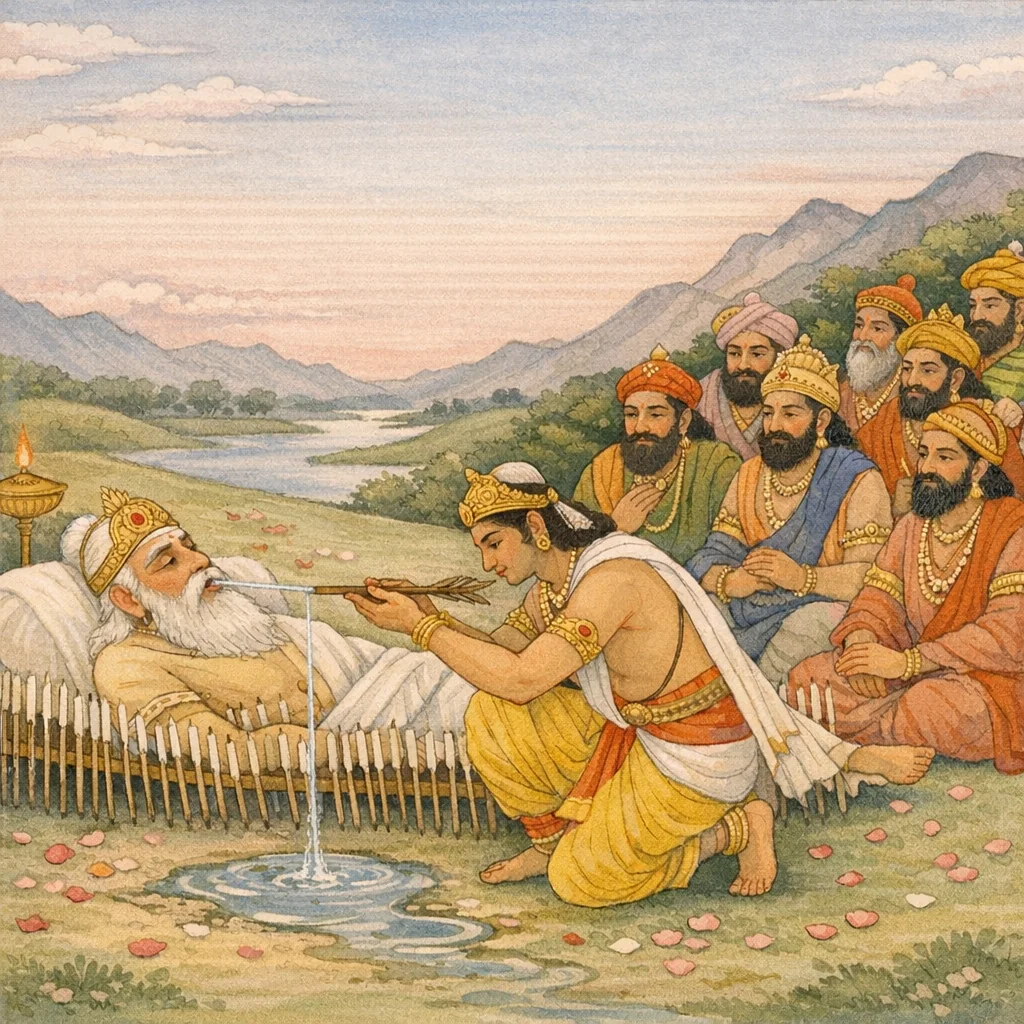
ततः प्रदक्षिणं कृत्वा रथेन रथिनां वर: । शयानं भरतमश्रेष्ठं सर्वशस्त्रभूृतां वरम्,अविध्यत् पृथिवीं पार्थ: पाश्वे भीष्मस्य दक्षिणे । अर्जुनका बाणद्ारा पृथ्वीसे जल प्रकट करके भीष्मजीको पिलाना तब रथियोंमें श्रेष्ठ पाण्डुपुत्र अर्जुनने शरशय्यापर सोये हुए सम्पूर्ण शस्त्रधारियोंमें उत्तम भरतशिरोमणि भीष्मकी रथद्वारा ही परिक्रमा करके अपने धनुषपर एक तेजस्वी बाणका संधान किया और सब लोगोंके देखते-देखते मन्त्रोच्चारणपूर्वक उस बाणको पर्जन्यास्त्रसे संयुक्त करके भीष्मके दाहिने पार्श्व॒में पृथ्वीपर उसे चलाया
Sañjaya said: Then Pārtha Arjuna, best among chariot-warriors, drove his chariot in reverent circumambulation and, beside Bhīṣma’s right flank, struck the earth with an arrow. Thus, honoring the fallen elder while still acting within the demands of battle, Arjuna caused water to spring forth for Bhīṣma—an act that joins martial skill with filial duty and compassion toward a revered opponent.
Verse 23
संधाय च शरं दीप्तमभिमन्त्रय स पाण्डव: पर्जन्यास्त्रेण संयोज्य सर्वलोकस्य पश्यत:
Sañjaya said: The Pāṇḍava, having fitted a blazing arrow and empowered it with mantra, yoked it to the Parjanya-weapon; and this he did in the sight of all, before the watching world—an act that displays both martial mastery and the grave responsibility of invoking cosmic forces amid war.
Verse 24
उत्पपात ततो धारा वारिणो विमला शुभा
Sañjaya said: Then there suddenly sprang forth a clear and auspicious stream of water—pure in appearance—signaling a favorable omen amid the grim momentum of war.
Verse 25
शीतस्यामृतकल्पस्य दिव्यगन्धरसस्य च । अतर्पयत् ततः पार्थ: शीतया जलधारया
Sañjaya said: Then Pārtha (Arjuna) refreshed and satisfied him by pouring a cool stream of water—water that felt like nectar in its chillness, and that seemed endowed with a divine fragrance and taste. The scene underscores a moment of humane care amid the violence of war, where compassion and duty coexist on the battlefield.
Verse 26
भीष्म कुरूणामृषभं दिव्यकर्मपराक्रमम् । फिर तो शीतल, अमृतके समान मधुर तथा दिव्य सुगन्ध एवं दिव्यरससे संयुक्त जलकी सुन्दर स्वच्छ धारा ऊपरकी ओर उठ-(कर भीष्मके मुखमें पड़)-ने लगी। उस शीतल जलधारासे अर्जुनने दिव्यकर्म एवं पराक्रमवाले कुरुश्रेष्ठ भीष्मको तृप्त कर दिया || २४-२५ - कर्मणा तेन पार्थस्य शक्रस्थेव विकुर्वत:
Sañjaya said: By that deed of Pārtha—wrought with a power like Indra’s—Bhīṣma, the bull among the Kurus, renowned for divine exploits and heroic might, was satisfied. In the narrative context, Arjuna’s act is not mere prowess but a dharmic service to a fallen elder-warrior: even amid war, reverence and compassionate duty toward a venerable opponent are upheld.
Verse 27
तत् कर्म प्रेक्ष्य बीभत्सोरतिमानुषविक्रमम्
Sañjaya said: Seeing that deed—Bhībhatsu’s prowess, surpassing what is human—(the warriors were struck with awe and dread).
Verse 28
विस्मयाच्चोत्तरीयाणि व्याविध्यन् सर्वतो नूपा:
Sañjaya said: Struck with astonishment, the women all around began to wave their upper garments about. The scene conveys a spontaneous, collective surge of emotion—wonder and agitation—arising from the extraordinary events unfolding on the battlefield, where human resolve and fate collide.
Verse 29
तृप्त: शान्तनवश्लापि राजन् बीभत्सुमब्रवीत्
Sañjaya said: O King, the son of Śāntanu, now satisfied and composed, addressed Bībhatsu (Arjuna). The moment signals a pause in the turmoil of war, where inner steadiness and fulfilled resolve allow counsel to be given with clarity and moral weight.
Verse 30
नैतच्चित्रं महाबाहो त्वयि कौरवनन्दन
Sañjaya said: “This is not at all surprising, O mighty-armed one, O delight of the Kuru line—such conduct and resolve are fully in keeping with your nature and station.”
Verse 31
कथितो नारदेनासि पूर्वर्षिरमितद्धुते । वासुदेवसहायस्त्वं महत् कर्म करिष्यसि
Sañjaya said: “O you of immeasurable splendor, the ancient sage Nārada has already spoken of you before. With Vāsudeva as your ally, you will accomplish a great deed.”
Verse 32
यन्नोत्सहति देवेन्द्र: सह देवैरपि ध्रुवम् “महाबाहु कौरवनन्दन! तुममें ऐसे पराक्रमका होना आश्वर्यकी बात नहीं है। अमिततेजस्वी वीर! मुझे नारदजीने पहले ही बता दिया था कि तुम पुरातन महर्षि नर हो और नारायणस्वरूप भगवान् श्रीकृष्णकी सहायतासे इस भूतलपर ऐसे-ऐसे महान् कर्म करोगे, जिन्हें निश्चय ही सम्पूर्ण देवताओंके साथ देवराज इन्द्र भी नहीं कर सकते ।। ३०-३१ ह || विदुस्त्वां निधन पार्थ सर्वक्षत्रस्य तद्विद:,'पार्थ! जानकार लोग तुम्हें सम्पूर्ण क्षत्रियोंकी मृत्युरूप जानते हैं। तुम भूतलपर मनुष्योंमें श्रेष्ठ और धनुर्धरोंमें प्रधान हो
Sañjaya said: “That deed which Indra, even together with all the gods, certainly does not have the power to accomplish…” (He implies that Arjuna’s destined exploits—supported by Nārāyaṇa in the form of Śrī Kṛṣṇa—surpass even the combined capacity of the devas, underscoring the extraordinary, divinely-backed force at work in the coming war.)
Verse 33
धनुर्धराणामेकस्त्वं पृथिव्यां प्रवरो नृषु,'पार्थ! जानकार लोग तुम्हें सम्पूर्ण क्षत्रियोंकी मृत्युरूप जानते हैं। तुम भूतलपर मनुष्योंमें श्रेष्ठ और धनुर्धरोंमें प्रधान हो
Sanjaya said: “O Partha, among all bowmen on this earth you stand foremost among men. Those who truly understand know you as the very embodiment of death to the entire host of kshatriyas.”
Verse 34
मनुष्या जगति श्रेष्ठा: पक्षिणां पतगेश्वर: | सरितां सागर: श्रेष्ठो गौर्वरिष्ठा चतुष्पदाम्,“जंगम प्राणियोंमें मनुष्य श्रेष्ठ हैं, पक्षियोंमें पक्षिराज गरुड़ श्रेष्ठ माने जाते हैं, सरिताओंमें समुद्र श्रेष्ठ हैं और चौपायोंमें गौ उत्तम मानी गयी है
Sañjaya said: “Among moving beings in the world, human beings are regarded as foremost; among birds, Garuḍa, the lord of winged creatures, is supreme; among rivers and waters, the ocean is held to be greatest; and among four-footed animals, the cow is considered the best.” The statement frames a traditional hierarchy of excellence, pointing to exemplary standards by which worth and responsibility are judged.
Verse 35
आदित्यस्तेजसां श्रेष्ठो गिरीणां हिमवान् वर: । जातीनां ब्राह्मण: श्रेष्ठ: श्रेष्टस्त्व्मसि धन्विनाम्,“तेजोमय पदार्थोमें सूर्य श्रेष्ठ हैं, पर्वतोंमें हिमालय महान् है, जातियोंमें ब्राह्मण श्रेष्ठ है और तुम सम्पूर्ण धनुर्धरोंमें श्रेष्ठ हो
Sañjaya said: “Among sources of radiance, the Sun is the foremost; among mountains, Himavān (the Himalaya) is the most excellent; among social orders, the Brāhmaṇa is the श्रेष्ठ (best). In the same way, you are the foremost among all bowmen.” The verse functions as a chain of exemplary comparisons to affirm recognized hierarchies of excellence and to strengthen resolve by praising martial pre-eminence within the dharmic frame of the war.
Verse 36
न वैश्रुतं धार्तराष्ट्रेण वाक््यं मयोच्यमानं विदुरेण चैव । द्रोणेन रामेण जनार्दनेन मुहुर्मुहु: संजयेनापि चोक्तम्
Sañjaya said: Dhṛtarāṣṭra did not heed the counsel spoken by me, nor that spoken by Vidura. Again and again the same was urged by Droṇa, by Rāma, and by Janārdana—and repeatedly by Sañjaya as well. Yet he would not listen. In this, the verse underscores the ethical tragedy of willful deafness to wise advice: when attachment and partiality rule, even the most authoritative voices fail to restrain a ruler from the path that leads to ruin.
Verse 37
“मैंने, विदुरने, द्रोणाचार्यने, परशुरामजीने, भगवान् श्रीकृष्णने तथा संजयने भी बारंबार युद्ध न करनेकी सलाह दी है; परंतु दुर्योधनने हमलोगोंकी बातें नहीं सुनीं ।। परीतबुद्धि्हिं विसंज्ञकल्पो दुर्योधनो न च तच्छुद्दधाति । स शेष्यते वै निहतश्चिराय शास्त्रातिगो भीमबलाभिभूत:,“दुर्योधनकी बुद्धि विपरीत हो गयी है, वह अचेत-सा हो रहा है; इसलिये हमलोगोंकी बातपर विश्वास नहीं करता है। वह शास्त्रोंकी मर्यादाका उल्लंघन कर रहा है। इसलिये भीमसेनके बलसे पराजित हो मारा जाकर रणभूमिमें दीर्घकालके लिये सो जायगा”
Sañjaya said: Duryodhana’s understanding has turned perverse; he is as though senseless, and therefore he does not place faith in what is said. Transgressing the bounds laid down by the śāstras, he will, overpowered by Bhīma’s might, be slain and lie long upon the battlefield. Thus, despite repeated counsel against war from Vidura, Droṇa, Paraśurāma, Śrī Kṛṣṇa, and even myself, he refuses to listen—choosing obstinacy over dharma and bringing ruin upon himself.
Verse 38
एतच्छुत्वा तद्गच: कौरवेन्द्रो दुर्योधनो दीनमना बभूव । तमब्रवीच्छान्तनवो5भिवीक्ष्य निबोध राजन् भव वीतमन्यु:,भीष्मजीकी यह बात सुनकर कौरवराज दुर्योधन मन-ही-मन बहुत दुःखी हो गया। तब शान्तनुनन्दन भीष्मने उसकी ओर देखकर कहा--'राजन्! मेरी बातपर ध्यान दो और क्रोधशून्य हो जाओ
Hearing this, Duryodhana, lord of the Kurus, became downcast at heart. Seeing him, Bhīṣma, the son of Śāntanu, addressed the king: “Understand, O King; attend to my words and become free from anger.”
Verse 39
दृष्ट दुर्योधनैतत् ते यथा पार्थेन धीमता । जलस्य धारा जनिता शीतस्यामृतगन्धिन:,“दुर्योधन! बुद्धिमान् अर्जुनने जिस प्रकार शीतल, अमृतके समान मधुर गन्धयुक्त जलकी धारा प्रकट की है, उसे तुमने प्रत्यक्ष देख लिया है
Sañjaya said: “Duryodhana, you have now seen with your own eyes how the wise Pārtha (Arjuna) has brought forth a stream of water—cool and fragrant, as though it were nectar.”
Verse 40
एतस्य कर्ता लोकेडस्मिन् नान्य: कश्नन विद्यते । आग्नेयं वारुणं सौम्यं वायव्यमथ वैष्णवम्,“इस संसारमें ऐसा पराक्रम करनेवाला दूसरा कोई नहीं है। आग्नेय, वारुण, सौम्य, वायव्य, वैष्णव, ऐन्द्र, पाशुपत, ब्राह्म, पारमेष्ठ्य, प्राजापत्य, धात्र, त्वाष्ट, सावित्र और वैवस्वत आदि सम्पूर्ण दिव्यास्त्रोंको इस समस्त मानव-जगतूमें एकमात्र अर्जुन अथवा देवकीनन्दन भगवान् श्रीकृष्ण जानते हैं। दूसरा कोई यहाँ इन अस्त्रोंको नहीं जानता है
Sañjaya said: “In this world there is no one else who can accomplish such a feat. The divine weapons—Agneya (of Fire), Vāruṇa (of Water), Saumya, Vāyavya (of Wind), and Vaiṣṇava—are known here only to Arjuna or to Kṛṣṇa, the son of Devakī; no other person in the human realm truly knows these celestial missiles.”
Verse 41
ऐन्द्रं पाशुपतं ब्राह्मंं पारमेष्ठ्यं प्रजापते: । धातुस्त्वष्ट श्व सवितुर्वैवस्वतमथापि वा,“इस संसारमें ऐसा पराक्रम करनेवाला दूसरा कोई नहीं है। आग्नेय, वारुण, सौम्य, वायव्य, वैष्णव, ऐन्द्र, पाशुपत, ब्राह्म, पारमेष्ठ्य, प्राजापत्य, धात्र, त्वाष्ट, सावित्र और वैवस्वत आदि सम्पूर्ण दिव्यास्त्रोंको इस समस्त मानव-जगतूमें एकमात्र अर्जुन अथवा देवकीनन्दन भगवान् श्रीकृष्ण जानते हैं। दूसरा कोई यहाँ इन अस्त्रोंको नहीं जानता है
Sañjaya said: “(He knows) the Indra-weapon, the Pāśupata, the Brahmā-weapon, the weapon of the Supreme Lord (Prajāpati/Brahmā), and those of Prajāpati; likewise the weapons of Dhātṛ, Tvaṣṭṛ, Savitṛ, and even Vaivasvata. In this world there is no other person capable of such prowess. Among all humans, only Arjuna—or Deva-kī’s son, Lord Śrī Kṛṣṇa—truly knows these divine missiles; no one else here knows them.”
Verse 42
सर्वस्मिन् मानुषे लोके वेत्त्येको हि धनंजय: । कृष्णो वा देवकीपुत्रो नान्यो वेदेह कश्चन,“इस संसारमें ऐसा पराक्रम करनेवाला दूसरा कोई नहीं है। आग्नेय, वारुण, सौम्य, वायव्य, वैष्णव, ऐन्द्र, पाशुपत, ब्राह्म, पारमेष्ठ्य, प्राजापत्य, धात्र, त्वाष्ट, सावित्र और वैवस्वत आदि सम्पूर्ण दिव्यास्त्रोंको इस समस्त मानव-जगतूमें एकमात्र अर्जुन अथवा देवकीनन्दन भगवान् श्रीकृष्ण जानते हैं। दूसरा कोई यहाँ इन अस्त्रोंको नहीं जानता है
Sañjaya said: “In all the human world, only one truly knows this—Dhanañjaya (Arjuna); or else Kṛṣṇa, the son of Devakī. No one else here possesses such knowledge.” In context, the statement underscores that extraordinary martial capability and the responsible use of divine weapons are not merely matters of strength, but of rare mastery and discernment—qualities concentrated in those fit to bear the burden of dharma in war.
Verse 43
अशक्य: पाण्डवस्तात युद्धे जेतुं कथंचन । अमानुषाणि कर्माणि यस्यैतानि महात्मन:,“तात! पाण्डुपुत्र अर्जुनको युद्धमें किसी प्रकार भी जीतना असम्भव है। जिन महामनस्वी पुरुषके ये अलौकिक कर्म प्रत्यक्ष दिखायी देते हैं; जो धैर्यवान्, युद्धमें शूरता दिखानेवाले तथा संग्राममें सुशोभित होनेवाले हैं, राजन्! उन अस्त्र-विद्याके विद्वान् अर्जुनके साथ इस समरभूमिमें तुम्हारी शीघ्र संधि हो जानी चाहिये। इसमें विलम्ब न हो
Sañjaya said: “O dear one, that Pāṇḍava cannot be conquered in battle by any means. For these deeds of his are beyond human measure—such is the greatness of that high-souled warrior.”
Verse 44
तेन सत्त्ववता संख्ये शूरेणाहवशोभिना । कृतिना समरे राजन् संधिर्भवतु मा चिरम्,“तात! पाण्डुपुत्र अर्जुनको युद्धमें किसी प्रकार भी जीतना असम्भव है। जिन महामनस्वी पुरुषके ये अलौकिक कर्म प्रत्यक्ष दिखायी देते हैं; जो धैर्यवान्, युद्धमें शूरता दिखानेवाले तथा संग्राममें सुशोभित होनेवाले हैं, राजन्! उन अस्त्र-विद्याके विद्वान् अर्जुनके साथ इस समरभूमिमें तुम्हारी शीघ्र संधि हो जानी चाहिये। इसमें विलम्ब न हो
Sañjaya said: “O King, let there be a swift peace with that courageous Arjuna on this battlefield—heroic, resplendent in combat, and accomplished in war. Do not delay. Against him, victory in battle is not truly possible; therefore, prudence and dharma counsel timely reconciliation rather than prolonged destruction.”
Verse 45
यावत् कृष्णो महाबाहु: स्वाधीन: कुरुसत्तम | तावत् पार्थेन शूरेण संधिस्ते तात युज्यताम्,“तात! कुरुश्रेष्ठी] जबतक महाबाहु भगवान् श्रीकृष्ण अपने लोगोंके प्रेमके अधीन हैं, तभीतक शूरवीर अर्जुनके साथ तुम्हारी संधि हो जाय तो ठीक है
Sañjaya said: “O best of the Kurus, so long as mighty-armed Kṛṣṇa remains within your influence and goodwill, let a reconciliation be concluded with the heroic Pārtha (Arjuna), dear child. This is the fitting moment.”
Verse 46
यावन्न ते चमू: सर्वा: शरै: संनतपर्वभि: | नाशयत्यर्जुनस्तावत् संधिस्ते तात युज्यताम्,“तात! जबतक अर्जुन झुकी हुई गाँठवाले बाणोंद्वारा तुम्हारी सारी सेनाका विनाश नहीं कर डालते हैं, तभीतक उनके साथ तुम्हारी संधि हो जानी चाहिये
Sañjaya said: “Dear son, until Arjuna destroys your entire host with his arrows—shafts whose joints are bent down—let a settlement be made with him. Before ruin becomes inevitable, choose reconciliation over the pride that leads to slaughter.”
Verse 47
यावत् तिष्ठन्ति समरे हतशेषा: सहोदरा: । नृपाश्न बहवो राजंस्तावत् संधि: प्रयुज्यताम्,“राजन! इस समरभूमिमें मरनेसे बचे हुए तुम्हारे सहोदर भाई जबतक मौजूद हैं और जबतक बहुत-से नरेश भी जीवन धारण कर रहे हैं, तभीतक तुम अर्जुनके साथ संधि कर लो
Sañjaya said: “O King, so long as your brothers who have survived the slaughter still stand upon the battlefield, and so long as many kings yet remain alive, let a treaty be pursued now. While life and kin still endure, choose reconciliation over further ruin.”
Verse 48
न निर्दहति ते यावत् क्रोधदीप्तेक्षण श्वमूम् । युधिष्ठिरो रणे तावत् संधिस्ते तात युज्यताम्,“तात! जबतक युधिष्ठिर रणभूमिमें क्रोधसे प्रज्वलितनेत्र होकर तुम्हारी सारी सेनाको भस्म नहीं कर डालते हैं, तभीतक उनके साथ तुम्हें संधि कर लेनी चाहिये
Sañjaya said: “Dear one, so long as Yudhiṣṭhira—his eyes blazing with anger on the battlefield—has not yet burned your entire host to ashes, until then you should enter into a settlement with him.”
Verse 49
नकुलः सहदेवश्न भीमसेनश्च पाण्डव: । यावच्चमूं महाराज नाशयन्ति न सर्वश:,“महाराज! नकुल-सहदेव तथा पाण्डुपुत्र भीमसेन--ये सब मिलकर जबतक तुम्हारी सेनाका सर्वनाश नहीं कर डालते हैं, तभीतक पाण्डववीरोंके साथ तुम्हारा सौहार्द स्थापित हो जाय, यही मुझे अच्छा लगता है। तात! मेरे साथ ही इस युद्धका भी अन्त हो जाय। तुम पाण्डवोंके साथ संधि कर लो
Sañjaya said: “O King, Nakula and Sahadeva, and Bhīmasena the Pāṇḍava—until they have not utterly destroyed your army, it seems best to me that goodwill and reconciliation be established between you and the Pāṇḍava heroes. Let this war come to an end along with my own life; make peace with the Pāṇḍavas.”
Verse 50
तावत् ते पाण्डवैवीरै: सौहार्द मम रोचते । युद्ध मदनन््तमेवास्तु तात संशाम्य पाण्डवै:,“महाराज! नकुल-सहदेव तथा पाण्डुपुत्र भीमसेन--ये सब मिलकर जबतक तुम्हारी सेनाका सर्वनाश नहीं कर डालते हैं, तभीतक पाण्डववीरोंके साथ तुम्हारा सौहार्द स्थापित हो जाय, यही मुझे अच्छा लगता है। तात! मेरे साथ ही इस युद्धका भी अन्त हो जाय। तुम पाण्डवोंके साथ संधि कर लो
Sañjaya said: “So long as your friendship with the Pāṇḍava heroes can be restored, that alone seems right to me. Let this war not become endless, dear one—make peace with the Pāṇḍavas.”
Verse 51
एतत् तु रोचतां वाक्य यदुक्तोडसि मयानघ । एतत् क्षेममहं मनन््ये तव चैव कुलस्यथ च,“अनघ! मैंने जो बातें तुमसे कही हैं, वे तुम्हें रचिकर प्रतीत हों। मैं संधिको ही तुम्हारे तथा कौरवकुलके लिये कल्याणकारी मानता हूँ
Sañjaya said: “Blameless one, may the words I have spoken to you be pleasing to your heart. I consider this course to be the truly safe and beneficial one—both for you and for your entire lineage.”
Verse 52
त्यक्त्वा मन्युं व्युपशाम्यस्व पार्थ: पर्याप्तमेतद् यत् कृतं फाल्गुनेन । भीष्मस्यान्तादस्तु वः सौहदं च जीवन्तु शेषा: साधु राजन् प्रसीद,“राजन! तुम क्रोध छोड़कर कुन्तीकुमारोंके साथ संधि स्थापित कर लो। अर्जुनने आजतक जो कुछ किया है, उतना ही बहुत है। मुझ भीष्मके जीवनका अन्त होनेसे (तुम्हारे वैरका भी अन्त हो जाय) तुमलोगोंमें प्रेम-सम्बन्ध स्थापित हो और जो लोग मरनेसे बचे हैं, वे अच्छी तरह जीवित रहें। इसके लिये तुम प्रसन्न हो जाओ
Sañjaya said: “O son of Pṛthā, cast off your anger and become calm; let there be reconciliation with the sons of Kuntī. What Phālguna (Arjuna) has done is enough. With the end of Bhīṣma’s life, may your enmity also come to an end; may friendship be established among you, and may those who remain alive live well. O King, be gracious—be appeased.”
Verse 53
राज्यस्यार्ध दीयतां पाण्डवाना- मिन्द्रप्रस्थं धर्मराजो$भियातु । मा मित्रध्रुक् पार्थिवानां जघन्य: पापां कीर्ति प्राप्स्यसे कौरवेन्द्र,“तुम पाण्डवोंका आधा राज्य दे दो। धर्मराज युधिष्छिर इन्द्रप्रस्थ चले जायँँ। कौरवराज! ऐसा करनेसे तुम राजाओंमें मित्रद्रोही और नीच नहीं कहलाओगे तथा तुम्हें पापपूर्ण अपयश नहीं प्राप्त होगा
Sañjaya said: “Let half the kingdom be given to the Pāṇḍavas, and let Dharmarāja (Yudhiṣṭhira) depart to Indraprastha. O lord of the Kurus, by doing so you will not be branded among kings as a treacherous betrayer of allies, the basest of men; nor will you incur sinful notoriety and disgrace.”
Verse 54
ममावसानाच्छान्तिरस्तु प्रजानां संगच्छन्तां पार्थिवा: प्रीतिमन्त:ः । पिता पुत्र मातुलं भागिनेयो भ्राता चैव क्षातरं प्रैतु राजन्,“राजन! मेरे जीवनका अन्त होनेसे प्रजाओंमें शान्ति हो जाय। सब राजा प्रसन्नतापूर्वक एक-दूसरेसे मिलें। पिता पुत्रसे, भानजा मामासे और भाई भाईसे मिले
Sanjaya said: “O King, may peace come upon the people with the end of my life. May the kings meet one another in goodwill and reconciliation. Let a father be united with his son, a nephew with his maternal uncle, and brother with brother—may the warrior order return to concord, O King.”
Verse 55
न चेदेवं प्राप्तकालं वचो मे मोहाविष्ट: प्रतिपत्स्यस्यबुद्धया । तप्स्यस्यन्ते एतदन्ता: स्थ सर्वे सत्यामेतां भारतीमीरयामि,“दुर्योधन! यदि तुम मोहवश अपनी मूर्खताके कारण मेरे इस समयोचित वचनको नहीं मानोगे तो अन्तमें पछताओगे और इस युद्धमें ही तुम सब लोगोंका अन्त हो जायगा। यह मैं तुमसे सच्ची बात कह रहा हूँ"
Sañjaya said: “If, deluded, you do not accept with understanding this timely counsel of mine, then in the end you will burn with remorse. All of you stand at the edge of destruction—this war will be your end. I speak this to you as the plain truth.”
Verse 56
एतद् वाक््यं सौहृददादापगेयो मध्ये राज्ञां भारतं श्रावयित्वा । तूष्णीमासीच्छल्यसंतप्तमर्मा योज्यात्मानं वेदनां संनियम्य,गंगानन्दन भीष्म समस्त राजाओंके बीच सौहार्दवश दुर्योधनको यह बात सुनाकर मौन हो गये। बाणोंसे उनके मर्मस्थलोंमें अत्यन्त पीड़ा हो रही थी। उन्होंने उस व्यथाको किसी प्रकार काबूमें करके अपने मनको परमात्माके चिन्तनमें लगा दिया
Sañjaya said: Having, out of goodwill, conveyed this message to Duryodhana in the midst of the assembled kings, Bhīṣma—the son of Gaṅgā—fell silent. His vital points were seared with the pain of arrows; yet restraining that anguish, he gathered his mind and fixed it in contemplation of the Supreme Self. The scene underscores a warrior’s endurance and inner discipline even amid the extremity of battle.
Verse 57
संजय उवाच धर्मार्थसहितं वाक््यं श्रुत्वा हितमनामयम् | नारोचयत पुत्रस्ते मुमूर्षरिव भेषजम्,संजय कहते हैं--राजन्! जैसे मरणासन्न पुरुषको कोई दवा अच्छी नहीं लगती है, उसी प्रकार महात्मा भीष्मका वह धर्म और अर्थसे युक्त परम हितकर और निर्दोष वचन भी आपके पुत्रको पसंद नहीं आया
Sanjaya said: O King, after hearing that statement of Bhishma—grounded in dharma and practical good, wholly beneficial and free from fault—your son did not approve of it, just as a man on the verge of death finds no medicine agreeable. The verse underscores how moral counsel, though sound and well-intended, can be rejected when one is seized by obstinacy and ruinous desire.
Verse 120
इस प्रकार श्रीमह्म भारत भीष्मपर्वके अन्तर्गत भीष्मवधपर्वमें भीष्मको तकिया देनेसे सम्बन्ध रखनेवाला एक सौ बीसवाँ अध्याय पूरा हुआ
Sanjaya concludes: Thus, in the revered Mahābhārata, within the Bhīṣma Parva, the one-hundred-and-twentieth chapter—connected with the episode of providing a pillow to Bhīṣma in the section concerning Bhīṣma’s fall—comes to an end. The closing note underscores the epic’s ethical attention to dignity and care even amid the brutality of war, honoring a fallen elder-warrior with humane regard.
Verse 121
इति श्रीमहाभारते भीष्मपर्वणि भीष्मवधपर्वणि दुर्योधन प्रति भीष्मवाक्ये एकविंशत्यधिकशततमो<ध्याय:
Sañjaya said: Thus ends, in the Śrī Mahābhārata, within the Bhīṣma Parva—specifically in the section concerning the slaying of Bhīṣma—the discourse of Bhīṣma addressed to Duryodhana: the one hundred and twenty-first chapter. This closing formula frames the episode as a moral and strategic counsel given amid war, marking the completion of a unit of instruction and narrative before the account proceeds further.
Verse 236
अविध्यत् पृथिवीं पार्थ: पाश्वे भीष्मस्य दक्षिणे । अर्जुनका बाणद्ारा पृथ्वीसे जल प्रकट करके भीष्मजीको पिलाना तब रथियोंमें श्रेष्ठ पाण्डुपुत्र अर्जुनने शरशय्यापर सोये हुए सम्पूर्ण शस्त्रधारियोंमें उत्तम भरतशिरोमणि भीष्मकी रथद्वारा ही परिक्रमा करके अपने धनुषपर एक तेजस्वी बाणका संधान किया और सब लोगोंके देखते-देखते मन्त्रोच्चारणपूर्वक उस बाणको पर्जन्यास्त्रसे संयुक्त करके भीष्मके दाहिने पार्श्व॒में पृथ्वीपर उसे चलाया
Sanjaya said: Arjuna, son of Pāṇḍu, struck the earth on the right side of Bhīṣma. In the unfolding of this scene, Arjuna—foremost among chariot-warriors—circled Bhīṣma as he lay upon his bed of arrows and, before all onlookers, invoked sacred formulae and released a radiant arrow empowered like a rain-bringing weapon, causing water to spring forth from the ground so that the grandsire could drink. The episode highlights disciplined compassion expressed even amid war: martial skill is directed not to cruelty, but to service and reverence for an elder bound by his vow.
Verse 266
विस्मयं परमं जग्मुस्ततस्ते वसुधाधिपा: । इन्द्रके समान पराक्रमी अर्जुनके उस अद्भुत कर्मसे वहाँ बैठे हुए समस्त भूपाल बड़े विस्मयको प्राप्त हुए
Sañjaya said: Then those kings were struck with the utmost astonishment. Seated there, all the rulers beheld Arjuna—whose prowess was equal to Indra’s—and, at his wondrous deed, they were filled with great wonder. The scene underscores how extraordinary valor, when displayed with mastery and purpose, compels even rival sovereigns to acknowledge excellence amid the moral gravity of war.
Verse 276
सम्प्रावेपन्त कुरवो गाव: शीतार्दिता इव । अर्जुनका वह अलौकिक कर्म देखकर समस्त कौरव सर्दीकी सतायी हुई गौओंके समान थर-थर काँपने लगे
Sanjaya said: Seeing Arjuna’s extraordinary feat, the Kauravas began to tremble violently—like cattle shivering when afflicted by bitter cold. The verse underscores how the spectacle of superhuman prowess on the battlefield can break morale and expose the fragility of pride and aggression.
Verse 286
शड्खदुन्दुभिनिर्घोषस्तुमुल: सर्वतो5भवत् | वहाँ बैठे हुए नरेशगण आश्वर्यसे चकित हो सब ओर अपने दुपट्टे हिलाने लगे। चारों ओर शंख और नगाड़ोंकी गम्भीर ध्वनि गूँज उठी
Sañjaya said: From every side there arose a tumultuous roar—the deep, reverberating sound of conches and kettle-drums. The assembled kings, struck with astonishment, waved their cloths in excitement, as the battlefield atmosphere swelled with martial fervor and collective resolve.
Verse 296
सर्वपार्थिववीराणां संनिधौ पूजयन्निव । राजन! उस जलसे तृप्त होकर शान्तनुनन्दन भीष्मने अर्जुनसे समस्त वीरनरेशोंके समीप उनकी प्रशंसा करते हुए इस प्रकार कहा--
Sañjaya said: O King, as though honoring him in the very presence of all the warrior-kings, Bhīṣma—the son of Śāntanu—having been satisfied by that ceremonial offering, spoke to Arjuna, praising him before the assembled heroes. The scene underscores the ethical weight of public commendation in a royal council: valor is not merely personal glory, but a standard held up before the whole community of rulers and warriors.