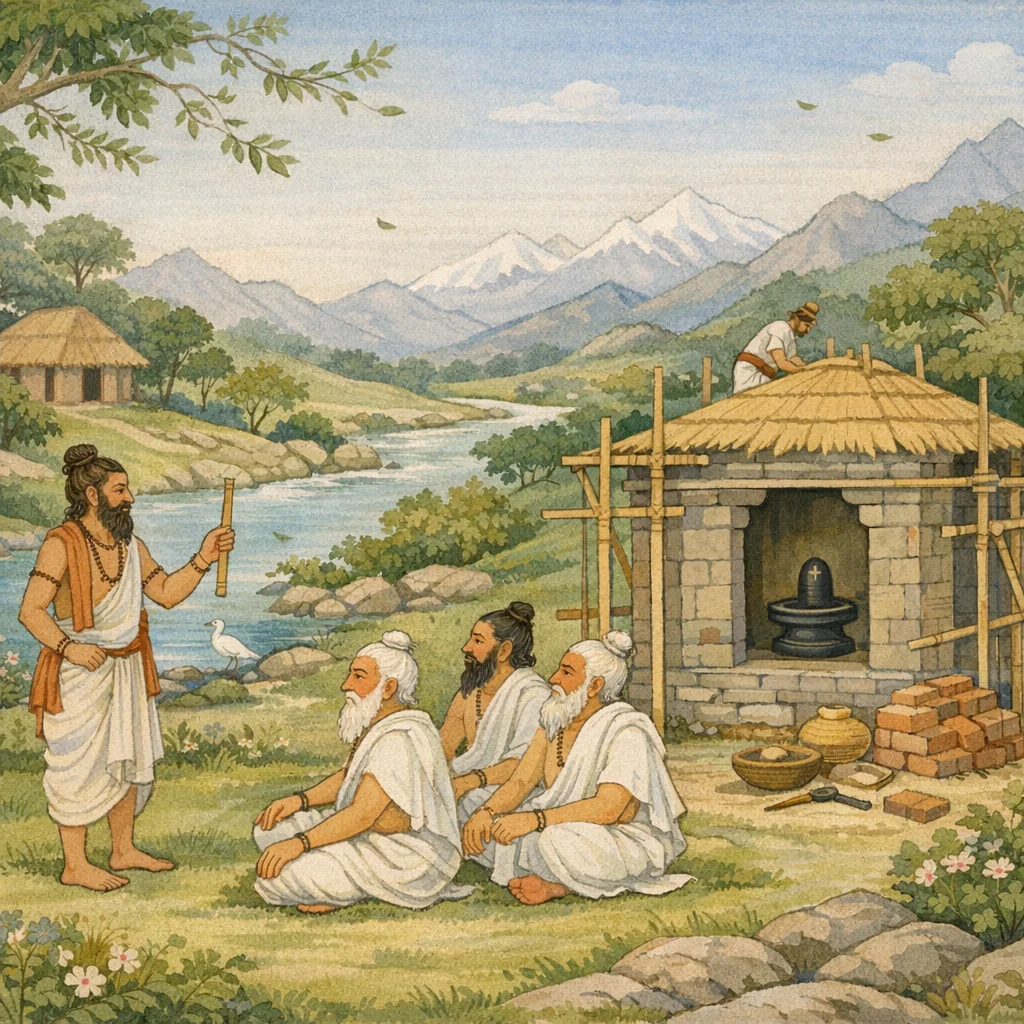
Liṅga-pratiṣṭhāvidhiḥ — Installation Standards and Auspicious Parameters for Liṅga Worship
Adhyāya 11 is a technical Q&A. The ṛṣis ask about (i) the procedure for establishing a liṅga (pratiṣṭhā), (ii) the marks of an auspicious “vāta” (favorable winds and environmental omens for choosing ritual timing), and (iii) proper worship with regard to deśa (place) and kāla (time). Sūta replies by first stressing śubha kāla and meritorious sacred locales (puṇya tīrtha), then detailing practical standards: selecting a movable or fixed liṅga, choosing suitable materials (earth/stone/metal), and ensuring a coherent liṅga–pīṭha design for stable installation. Proportional norms are given (an ideal of twelve aṅgulas for the maker): deficiency lessens the fruit of worship, while excess is not faulted. Architectural preliminaries—building a vimāna and preparing a firm, refined garbhagṛha—link Śiva’s presence to correct form (lakṣaṇa), measure (pramāṇa), and auspicious circumstance, teaching that pūjā-phala arises from such alignment.
Shlokas
Verse 1
ऋषय ऊचुः । कथं लिंगं प्रतिष्ठाप्यं कथं वातस्य लक्षणम् । कथं वा तत्समभ्यर्च्यं देशे काले च केन हि
The sages said: “How is the Śiva-liṅga to be duly installed? What are the characteristics of the sacred vow (vrata) and its proper observances? And how is that Liṅga to be worshipped—by whom, and according to what place and time?”
Verse 2
सूत उवाच । युष्मदर्थं प्रवक्ष्यामि बुद्ध्यतामवधानतः । अनुकूले शुभे काले पुण्ये तीर्थे तटे तथा
Sūta said: “For your sake I shall expound it—grasp it with attentive discernment—(to be performed) at a favorable and auspicious time, and likewise at a holy tīrtha, upon its sacred bank.”
Verse 3
यथेष्टं लिंगमारोप्यं यत्र स्यान्नित्यमर्चनम् । पार्थिवेन तथाप्येनं तैजसेन यथारुचि
Having installed the Liṅga as one wishes in a place fit for daily worship, one should venerate it continually—either as an earthen (pārthiva) Liṅga or likewise in a fiery (taijasa) form—according to one’s means and devotion.
Verse 4
कल्पलक्षणसंयुक्तं लिंगं पूजाफलं लभेत् । सर्वलक्षणसंयुक्तं सद्यः पूजाफलप्रदम्
By worshipping a Śiva-liṅga endowed with the scripturally prescribed marks, one attains the fruit of worship. Yet a liṅga bearing all auspicious characteristics bestows the fruit of worship at once.
Verse 5
चरे विशिष्यते सूक्ष्मं स्थावरे स्थूलमेव हि । सलक्षणं सपीठं च स्थापयेच्छिवनिर्मितम्
In a movable (portable) form, the emblem is preferred as subtle; but in an immovable (fixed) form, it is indeed preferred as large. One should install the Śiva-made (Śiva-sanctioned) emblem with its proper marks and together with its pedestal (pīṭha).
Verse 6
मंडलं चतुरस्रं वा त्रिकोणमथवा तथा । खट्वांगवन्मध्यसूक्ष्मं लिंगपीठं महाफलं
The worship-maṇḍala may be made either square or triangular. The Liṅga’s pedestal should be fashioned with a subtle, refined center—like a khaṭvāṅga-staff—and such a Liṅga-pīṭha bestows great spiritual fruit.
Verse 7
प्रथमं मृच्छिलादिभ्यो लिगं लोहादिभिः कृतम् । येन लिंगं तेन पीठं स्थावरे हि विशिष्यते
First, the Liṅga is fashioned from clay, stone, and the like, or it is made from metals and similar materials. Whatever the material of the Liṅga may be, the pedestal (pīṭha/yoni) should be made of that very material—this is considered especially proper for a fixed installation.
Verse 8
लिंगं पीठं चरे त्वेकं लिंगं बाणकृतं विना । लिंगप्रमाणं कर्तृणां द्वादशांगुलमुत्तमम्
The Liṅga and its pedestal (pīṭha) should be fashioned as one unified piece—except for a Liṅga of bāṇa, a naturally formed stone. For the makers, the finest standard measure of the Liṅga is twelve aṅgulas (finger-breadths).
Verse 9
न्यूनं चेत्फलमल्पं स्यादधिकं नैव दूष्यते । कर्तुरेकांगुलन्यूनं चरेपि च तथैव हि
If the offering is deficient, the fruit becomes meagre; but if it is in excess, it is not deemed a fault. Likewise, even if it falls short of the prescribed measure for the performer by a single aṅgula, the result is reduced accordingly.
Verse 10
आदौ विमानं शिल्पेन कार्यं देवगणैर्युतम् । तत्र गर्भगृहे रम्ये दृढे दर्पणसंनिभे
First, the temple superstructure (vimāna) should be fashioned according to sacred architectural science, adorned with divine hosts. Within it, in the beautiful sanctum (garbha-gṛha)—firmly built and shining like a mirror—the worshipful presence of Śiva is to be established.
Verse 11
इति श्रीशिवमहापुराणे विद्येश्वरसंहितायांएकदशोऽध्यायः
Thus ends the Eleventh Chapter in the Vidyeśvara-saṃhitā of the Śrī Śiva Mahāpurāṇa.
Verse 12
मुक्ताप्रवालगोमेदवज्राणि नवरत्नकम् । मध्ये लिंगं महद्द्रव्यं निक्षिपेत्सहवैदिके
He should place the nine precious gems—pearls, coral, gomedaka (hessonite), and diamond—together with Vedic sanctity; and in their midst he should install the great sacred substance, the Liṅga.
Verse 13
संपूज्य लिंगं सद्याद्यैः पंचस्थाने यथाक्रमम् । अग्नौ च हुत्वा बहुधा हविषास कलं च माम्
Having duly worshipped the Śiva-liṅga with the five offerings beginning with sadyā, in the five prescribed places in proper order, one should then make many oblations into the sacred fire with ghee and other offerings—thus worshipping Me, the Lord, in My manifested power (kalā).
Verse 14
अभ्यर्च्य गुरुमाचार्यमर्थैः कामैश्च बांधवम् । दद्यादैश्वर्यमर्थिभ्यो जडमप्यजडं तथा
Having duly honored one’s guru and ācārya—and also one’s kinsmen—through rightful resources and appropriate services, one should bestow prosperity upon those who seek it; thus even one who is dull becomes not-dull, refined and awakened.
Verse 15
स्थावरं जंगमं जीवं सर्वं संतोष्य यत्नतः । सुवर्णपूरिते श्वभ्रे नवरत्नैश्च पूरिते
Having diligently satisfied every living being—both the immobile and the mobile—one should prepare a pit filled with gold, and also filled with the nine precious gems (navaratna).
Verse 16
सद्यादि ब्रह्म चोच्चार्य ध्यात्वा देवं परं शुभम् । उदीर्य च महामंत्रमओंकारं नादघोषितम्
Having uttered the sacred Brahman-formula beginning with “sadyaḥ…”, and meditating on the Supreme Auspicious Deity, one should then intone the great mantra—Oṃkāra—resounding as the sound-current (nāda).
Verse 17
लिंगं तत्र प्रतिष्ठाप्य लिगं पीठेन योजयेत् । लिंगं सपीठं निक्षिप्य नित्यलेपेन बंधयेत्
Having installed the Liṅga there, one should unite the Liṅga with its pedestal (pīṭha). Setting the Liṅga together with the pedestal, one should secure it firmly by applying the prescribed binding-plaster (nitya-lepa) regularly.
Verse 18
एवं बेरं च संस्थाप्यं तत्रैव परमं शुभम् । पंचाक्षरेण बेरं तु उत्सवार्थं वहिस्तथा
Thus, one should install the bera—the consecrated icon of Śiva—there itself in the most auspicious manner. And for festival worship, one should also carry the bera outside, continually sanctifying it with the Pañcākṣarī mantra, “Namaḥ Śivāya.”
Verse 19
बेरं गुरुभ्यो गृह्णीयात्साधुभिः पूजितं तु वा । एवं लिंगे च बेरे च पूजा शिवपदप्रदा
One should receive the Berā (the consecrated emblem/image used for worship) from the Guru, or else one that has already been worshipped by holy devotees. Thus, worship offered to both the Liṅga and the Berā becomes a bestower of Śivapada, Śiva’s supreme state (liberation).
Verse 20
पुनश्च द्विविधं प्रोक्तं स्थावरं जंगमं तथा । स्थावरं लिंगमित्याहुस्तरुगुल्मादिकं तथा
Again, it is declared to be of two kinds: the immovable and the movable. The immovable is called the Liṅga—such as trees, shrubs, and the like, revered as Śiva’s abiding presence.
Verse 21
जंगमं लिंगमित्याहुः कृमिकीटादिकं तथा । स्थावरस्य च शुश्रूषा जंगमस्य च तर्पणम्
They declare that the “movable liṅga” is truly living beings—even worms, insects, and the like. Service to the immovable (Śiva-liṅga) and the nourishing satisfaction offered to the movable (living beings) are both to be regarded as acts of worship.
Verse 22
तत्तत्सुखानुरागेण शिवपूजां विदुर्बुधाः । पीठमंबामयं सर्वं शिवलिंगं च चिन्मयम्
The wise know that Śiva-worship is to be performed with loving devotion toward that supreme bliss. They understand the entire pedestal (pīṭha) as pervaded by the Divine Mother (Ambā), and the Śiva-liṅga as of the very nature of pure Consciousness (cinmaya).
Verse 23
यथा देवीमुमामंके धृत्वा तिष्ठति शंकरः । तथा लिंगमिदं पीठं धृत्वा तिष्ठति संततम्
Just as Śaṅkara ever abides holding the Goddess Umā upon His lap, so too this sacred pīṭha continually abides, bearing this liṅga.
Verse 24
एवं स्थाप्य महालिंगं पूजयेदुपचारकैः । नित्यपूजा यथा शक्तिध्वजादिकरणं तथा
Thus, having duly installed the great Liṅga, one should worship it with the prescribed offerings and ritual services (upacāras). One should perform the daily worship in proper order, and likewise arrange the Śakti-flag, banner, and other customary adjuncts, according to one’s capacity and the rule.
Verse 25
इति संस्थापयेल्लिंगं साक्षाच्छिवपदप्रदम् । अथवा चरलिंगं तु षोडशैरुपचारकैः
Thus one should establish the Liṅga, which directly bestows the state of Śiva (liberation). Or else, one may worship the movable liṅga with the sixteen ritual services (upacāras).
Verse 26
पूजयेच्च यथान्यायं क्रमाच्छिवपदप्रदम् । आवाहनं चासनं च अर्घ्यं पाद्यं तथैव च
One should worship in the proper manner, step by step, in a way that bestows the state of Śiva—beginning with invocation (āvāhana), offering a seat (āsana), presenting the respectful oblation (arghya), and offering water for the feet (pādya) as well.
Verse 27
तदंगाचमनं चैव स्नानमभ्यंगपूर्वकम् । वस्त्रं गंधं तथा पुष्पं धूपं दीपं निवेदनम्
Then one should perform ācamana for those purified limbs, and bathe (snāna) preceded by an oil-massage (abhyanga). Thereafter one should offer cloth, fragrance (sandal-paste), flowers, incense, a lamp, and naivedya—the food-offering—to the Lord.
Verse 28
नीराजनं च तांबूलं नमस्कारो विसर्जनम् । अथवाऽर्घ्यादिकं कृत्वा नैवेद्यां तं यथाविधि
Then one should perform nīrājana, the waving of lights, offer tāmbūla (betel), make reverent prostration, and conclude with visarjana, the formal dismissal. Or else, having duly offered arghya and the other customary offerings, one should present the naivedya to Him according to the prescribed rite.
Verse 29
अथाभिषेकं नैवेद्यं नमस्कारं च तर्पणम् । यथाशक्ति सदाकुर्यात्क्रमाच्छिवपदप्रदम्
Thereafter, according to one’s capacity, one should always perform in due order the abhiṣeka (ritual ablution), the naivedya (offering of food), the namaskāra (reverential prostration), and the tarpaṇa (rite of satisfaction). Done sequentially, these bestow Śivapada—the state of Śiva.
Verse 30
अथवा मानुषे लिंगेप्यार्षे दैवे स्वयंभुवि । स्थापितेऽपूर्वके लिंगे सोपचारं यथा तथा
Or, whether the Liṅga is human-made, established by a Ṛṣi, divine, or self-manifest (svayambhū)—when such a newly installed, unprecedented Liṅga has been set up, it should be worshipped with proper offerings and services (sopacāra), in the prescribed manner.
Verse 31
पूजोपकरणे दत्ते यत्किंचित्फलमश्नुते । प्रदक्षिणानमस्कारैः क्रमाच्छिवपदप्रदम्
When one offers even a small item connected with worship, one partakes of some spiritual fruit. Through pradakṣiṇā (circumambulation) and namaskāra (reverential prostrations), performed in due order, that merit gradually becomes a bestower of Śivapada—the state of Śiva.
Verse 32
लिंगं दर्शनमात्रं वा नियमेन शिवप्रदम् । मृत्पिष्टगोशकृत्पुष्पैः करवीरेण वा फलैः
Even merely beholding the Śiva-liṅga—when done with proper observance—bestows Śiva: His grace and auspicious attainment. Likewise, worship offered with simple materials—such as a liṅga shaped of clay, flowers prepared from cow-dung, karavīra blossoms, or even fruits—becomes a means for Śiva to grant blessings.
Verse 33
गुडेन नवनीतेन भस्मनान्नैर्यथारुचि । लिंगं यत्नेन कृत्वांते यजेत्तदनुसारतः
With jaggery, fresh butter, sacred ash (bhasma), or food-grains—according to one’s inclination—one should carefully fashion the Liṅga; and having made it, one should worship it in a manner suited to that very substance and method.
Verse 34
अंगुष्ठादावपि तथा पूजामिच्छंति केचन । लिंगकर्मणि सर्वत्र निषेधोस्ति न कर्हिचित्
Some devotees even wish to perform worship beginning with the thumb and the other fingers, as prescribed. In all acts connected with the Śiva-liṅga, there is never any prohibition at any time—such worship is always permissible.
Verse 35
सर्वत्र फलदाता हि प्रयासानुगुणं शिवः । अथवा लिंगदानं वा लिंगमौल्यमथापि वा
Everywhere indeed, Śiva grants fruits in proportion to one’s sincere effort. Thus, whether one gifts a Liṅga or even offers its equivalent value, it becomes meritorious.
Verse 36
श्रद्धया शिवभक्ताय दत्तं शिवपदप्रदम् । अथवा प्रणवं नित्यं जपेद्दशसहस्रकम्
Whatever is given with faith to a devotee of Śiva becomes a bestower of Śiva-pada—the state of Śiva, liberation. Or else, one should daily repeat the Praṇava (Oṁ) ten thousand times.
Verse 37
संध्ययोश्च सहस्रं वा ज्ञेयं शिवपदप्रदम् । जपकाले मकारांतं मनःशुद्धिकरं भजेत्
At the two sandhyā junctions—dawn and dusk—know that one thousand repetitions bestow the state and abode of Śiva. During japa, worship the mantra ending in “ma,” the five-syllabled “namaḥ śivāya,” for it purifies the mind.
Verse 38
समाधौ मानसं प्रोक्तमुपांशु सार्वकालिकम् । समानप्रणवं चेमं बिंदुनादयुतं विदुः
In samādhi, mental repetition (mānasa-japa) is declared the proper mode; whispered repetition (upāṃśu-japa) is suitable at all times. Know this japa to be united with the same Praṇava, “Oṃ,” and endowed with bindu and nāda—the subtle seed and the inner sound.
Verse 39
अथ पंचाक्षरं नित्यं जपेदयुतमादरात् । संध्ययोश्च सहस्रं वा ज्ञेयं शिवपदप्रदम्
Therefore, one should constantly recite the five-syllabled mantra with reverence—ten thousand times; or else, at the two twilight junctions (dawn and dusk), one thousand times. This is to be known as the practice that bestows the state (abode) of Śiva.
Verse 40
प्रणवेनादिसंयुक्तं ब्राह्मणानां विशिष्यते । दीक्षायुक्तं गुरोर्ग्राह्यं मंत्रं ह्यथ फलाप्तये
A mantra that begins with the Praṇava (Oṁ) is especially prescribed for Brāhmaṇas. And for the attainment of its true fruit, the mantra should be received from the Guru, being properly endowed with dīkṣā (initiation).
Verse 41
कुंभस्नानं मंत्रदीक्षां मातृकान्यासमेव च । ब्राह्मणः सत्यपूतात्मा गुरुर्ज्ञानी विशिष्यते
One who has performed the sacred kumbha-bath, received mantra-initiation, and practiced the installation of the Mātrikā letters (Mātṛkā-nyāsa)—such a brāhmaṇa, whose inner being is purified by truth, becomes distinguished as a true Guru, a knower of spiritual wisdom.
Verse 42
द्विजानां च नमःपूर्वमन्येषां च नमोन्तकम् । स्त्रीणां च क्वचिदिच्छंति नमो तं च यथाविधि
For the twice-born, the salutation is to be uttered with “namaḥ” placed at the beginning; for others, it is to be spoken with “namo” placed at the end. In certain cases, women also desire that same respectful salutation—therefore offer it properly, in the prescribed manner.
Verse 43
विप्रस्त्रीणां नमः पूर्वमिदमिच्छंति केचन । पंचकोटिजपं कृत्वा सदा शिवसमो भवेत्
Some first desire this salutation: “Obeisance to the wives of the brāhmaṇas.” Having completed five crores of mantra-japa, one ever becomes like Śiva, attaining Śiva-sāyujya by His grace.
Verse 44
एकद्वित्रिचतुःकोट्याब्रह्मादीनां पदं व्रजेत् । जपेदक्षरलक्षंवा अक्षराणां पृथक्पृथक्
By performing japa in measures of one, two, three, or four koṭi, one attains the exalted state attained even by Brahmā and the other gods. Or else, one should perform a lakh of repetitions of the syllables, repeating each syllable separately.
Verse 45
अथवाक्षरलक्षं वा ज्ञेयं शिवपदप्रदम् । सहस्रं तु सहस्राणां सहस्रेण दिनेन हि
Or else, one should know that the recitation totaling one lakh (100,000) of the mantra’s syllables bestows Śiva-pada, the supreme state of Shiva. Indeed, a thousand recitations each day completes the required thousands in a thousand days.
Verse 46
जपेन्मंत्रादिष्टसिद्धिर्नित्यं ब्राह्मणभोजनात् । अष्टोत्तरसहस्रं वै गायत्रीं प्रातरेव हि
One should perform japa continually; the mantra’s ordained success is secured by regularly feeding brāhmaṇas. Indeed, one should recite the Gāyatrī one thousand and eight times—especially in the morning.
Verse 47
ब्राह्मणस्तु जपेन्नित्यं क्रमाच्छिवपदप्रदान् । वेदमंत्रांस्तु सूक्तानि जपेन्नियममास्थितः
But a brāhmaṇa should daily perform japa, in due order, of those Śiva-mantras that bestow the state of Śiva; and, established in disciplined observances, he should also recite the Vedic mantras and hymns.
Verse 48
एकं दशार्णं मंत्रं च शतोनं च तदूर्ध्वकम् । अयुतं च सहस्रं च शतमेकं विना भवेत्
For the ten-syllabled mantra, the count should be one hundred and above; it is also prescribed as ten thousand, one thousand, or one hundred and one—never should it be done without a definite, complete count.
Verse 49
वेदपारायणं चैव ज्ञेयं शिवपदप्रदम् । अन्यान्बहुतरान्मंत्राञ्जपेदक्षरलक्षतः
The recitation of the Vedas should be understood as bestowing Śivapada, the state of Śiva. Likewise, one should repeat many other mantras too, performing japa to the measure of a hundred thousand syllables.
Verse 50
एकाक्षरांस्तथा मंत्राञ्जपेदक्षरकोटितः । ततः परं जपेच्चैव सहस्रं भक्तिपूर्वकम्
One should repeat the one-syllabled (seed) mantras and other mantras for koṭis of syllables—an immense count. After that, one should further perform a thousand repetitions as well, done with devotion.
Verse 51
एवं कुर्याद्यथाशक्ति क्रमाच्छिव पदं लभेत् । नित्यं रुचिकरं त्वेकं मंत्रमामरणांतिकम्
Practising in this way, according to one’s capacity, a person gradually attains Śivapada, the state of Śiva. Therefore, one should daily take up a single mantra that is pleasing to the heart and continue it steadily until the end of life.
Verse 52
जपेत्सहस्रमोमिति सर्वाभीष्टं शिवाज्ञया । पुष्पारामादिकं वापि तथा संमार्जनादिकम्
By Śiva’s command, one should repeat “Om” a thousand times, and thereby attain all desired aims. One may also serve Him through works such as tending flower-gardens and the like, and through acts of sweeping and cleansing the sacred place.
Verse 53
शिवाय शिवकार्याथे कृत्वा शिवपदं लभेत् । शिवक्षेत्रे तथा वासं नित्यं कुर्याच्च भक्तितः
By performing works for Śiva, for Śiva’s sake, one attains the state—the abode—of Śiva. Likewise, with devotion one should always dwell in a Śiva-kṣetra, a holy place of Śiva.
Verse 54
जडानामजडानां च सर्वेषां भुक्तिमुक्तिदम् । तस्माद्वासं शिवक्षेत्रे कुर्यदामरणं बुधः
For all beings—whether dull-witted or discerning—that sacred kṣetra of Śiva bestows both bhukti (worldly fulfillment) and mukti (liberation). Therefore, the wise should dwell in Śiva’s holy field until life’s end.
Verse 55
लिंगाद्धस्तशतं पुण्यं क्षेत्रे मानुषके विदुः । सहस्रारत्निमात्रं तु पुण्यक्षेत्रे तथार्षके
The wise declare that, in a sacred precinct established by human hands, the effective meritorious area extends one hundred hastas from the Śiva-liṅga. But in a truly holy field, sanctified by ṛṣis, it extends as far as a thousand rays (of the sun).
Verse 56
दैवलिंगे तथा ज्ञेयं सहस्रारत्निमानतः । धनुष्प्रमाणसाहस्रं पुण्यं क्षेत्रे स्वयं भुवि
Likewise, for the Daiva-liṅga one should understand its extent to be a thousand aratnis (cubits). And upon the earth itself, by its very presence, the kṣetra becomes meritorious all around for a thousand measures of dhanu (bow-length).
Verse 57
पुण्यक्षेत्रे स्थिता वापी कूपाद्यं पुष्कराणि च । शिवगंगेति विज्ञेयं शिवस्य वचनं यथा
Any stepwell (vāpī), well, or other water-reservoir situated within a sacred place should be understood as “Śiva-Gaṅgā,” in accordance with Lord Śiva’s own declaration.
Verse 58
तत्र स्नात्वा तथा दत्त्वा जपित्वा हि शिवं व्रजेत् । शिवक्षेत्रं समाश्रित्य वसेदामरणं तथा
There, having bathed, duly given gifts, and performed japa, one should indeed go to Śiva. Taking refuge in Śiva’s sacred kṣetra, one should dwell there likewise—attaining the state beyond death (immortality).
Verse 59
दाहं दशाहं मास्यं वा सपिंडीकरणं तु वा । आब्दिकं वा शिवक्षेत्रे क्षेत्रे पिंडमथापि वा
Whether it be the cremation rites, the tenth-day observance, the monthly rite, the sapiṇḍīkaraṇa ceremony, or the annual śrāddha—if these are performed in Śiva’s sacred field, then even the offering of piṇḍas there becomes spiritually efficacious.
Verse 60
सर्वपाप विनिर्मुक्तः सद्यः शिवपदं लभेत् । अथवा सप्तरात्रं वा वसेद्वा पंचरात्रकम्
Freed from all sins, one attains the state of Śiva immediately. Or else, one should reside there for seven nights—or at least for five nights.
Verse 61
त्रिरात्रमेकरात्रं वा क्रमाच्छिवपदं लभेत् । स्ववर्णानुगुणं लोके स्वाचारात्प्राप्नुते नरः
By observing the prescribed rite for three nights—or even for a single night—a person gradually attains the state of Śiva. In this world, one gains the fruit befitting one’s own station (varna) through conduct faithful to one’s proper discipline and vows.
Verse 62
वर्णोद्धारेण भक्त्या च तत्फलातिशयं नरः । सर्वं कृतं कामनया सद्यः फलमवाप्नुयात्
By extracting and contemplating the sacred syllables (varṇoddhāra) with devotion, a person attains the supreme excellence of results. Whatever is done with a cherished intention (kāmanā) yields its fruit at once.
Verse 63
सर्वं कृतमकामेन साक्षाच्छिवपदप्रदम् । प्रातर्मध्याह्नसायाह्नमहस्त्रिष्वेकतः क्रमात्
All of this, when performed without selfish desire, directly bestows the state of Śiva. It should be undertaken in proper order at the three sacred times—morning, midday, and evening—each as a complete observance.
Verse 64
प्रातर्विधिकरं ज्ञेयं मध्याह्नं कामिकं तथा । सायाह्नं शांतिकं ज्ञेयं रात्रावपि तथैव हि
Morning worship should be understood as that which upholds dharma and proper observance of rites. Midday worship is said to fulfill desires. Evening worship should be known as pacifying and peace-bestowing; and worship performed at night is likewise of that same pacificatory nature.
Verse 65
कालो निशीथो वै प्रोक्तोमध्ययामद्वयं निशि । शिवपूजा विशेषेण तत्कालेऽभीष्टसिद्धिदा
The time called Niśītha is declared to be the middle two watches of the night. Worship of Lord Śiva performed especially at that time becomes the giver of the desired attainments.
Verse 66
एवं ज्ञात्वा नरः कुर्वन्यथोक्तफलभाग्भवेत् । कलौ युगे विशेषेण फलसिद्धिस्तु कर्मणा
Knowing thus, a person who performs the practice as prescribed becomes a rightful recipient of the stated fruits. In the Kali Yuga especially, the attainment of results is accomplished through rightly performed action (karman) in accordance with the teaching.
Verse 67
उक्तेन केनचिद्वापि अधिकारविभेदतः । सद्वृत्तिः पापभीरुश्चेत्ततत्फलमवाप्नुयात्
Even if this has been stated by anyone, it stands true according to the differing spiritual eligibility of seekers: one who is of good conduct and fearful of sin attains the corresponding fruit.
Verse 68
ऋषय ऊचुः । अथ क्षेत्राणि पुण्यानि समासात्कथयस्व नः । सर्वाः स्त्रियश्च पुरुषा यान्याश्रित्य पदं लभेत्
The sages said: “Now, tell us concisely about the sacred holy places—those by taking refuge in which all women and men may attain the supreme state (liberation).”
Verse 69
सूत योगिवरश्रेष्ठ शिवक्षेत्रागमांस्तथा । सूत उवाच । शृणुत श्रद्धया सर्वक्षेत्राणि च तदागमान्
Sūta said: “O best among exalted yogins, listen with faith to all the sacred Śiva-kṣetras (holy places of Śiva) and to the āgamas (authoritative teachings) connected with those holy sites.”
Frequently Asked Questions
Rather than a mythic episode, the chapter presents a theological-ritual argument: Śiva’s worship becomes reliably efficacious when the liṅga is installed and maintained according to śāstric parameters (deśa–kāla suitability, lakṣaṇa, and pramāṇa), converting metaphysical doctrine into verifiable liturgical procedure.
The liṅga–pīṭha ensemble functions as a symbolic and operative axis: the liṅga signifies Śiva’s transcendent presence while the pīṭha stabilizes that presence in the world of form; measurements, shapes (maṇḍala/caturasra/trikoṇa), and sanctum construction encode the principle that cosmic order (ṛta) must be mirrored in ritual geometry for grace and ‘phala’ to manifest.
The emphasis is on Śiva as present through the installed liṅga (a non-anthropomorphic manifestation suited to continuous worship), with no single anthropomorphic form of Śiva or a distinct form of Gaurī foregrounded in the sampled discourse; the chapter’s focus is procedural consecration rather than icon-specific mythology.