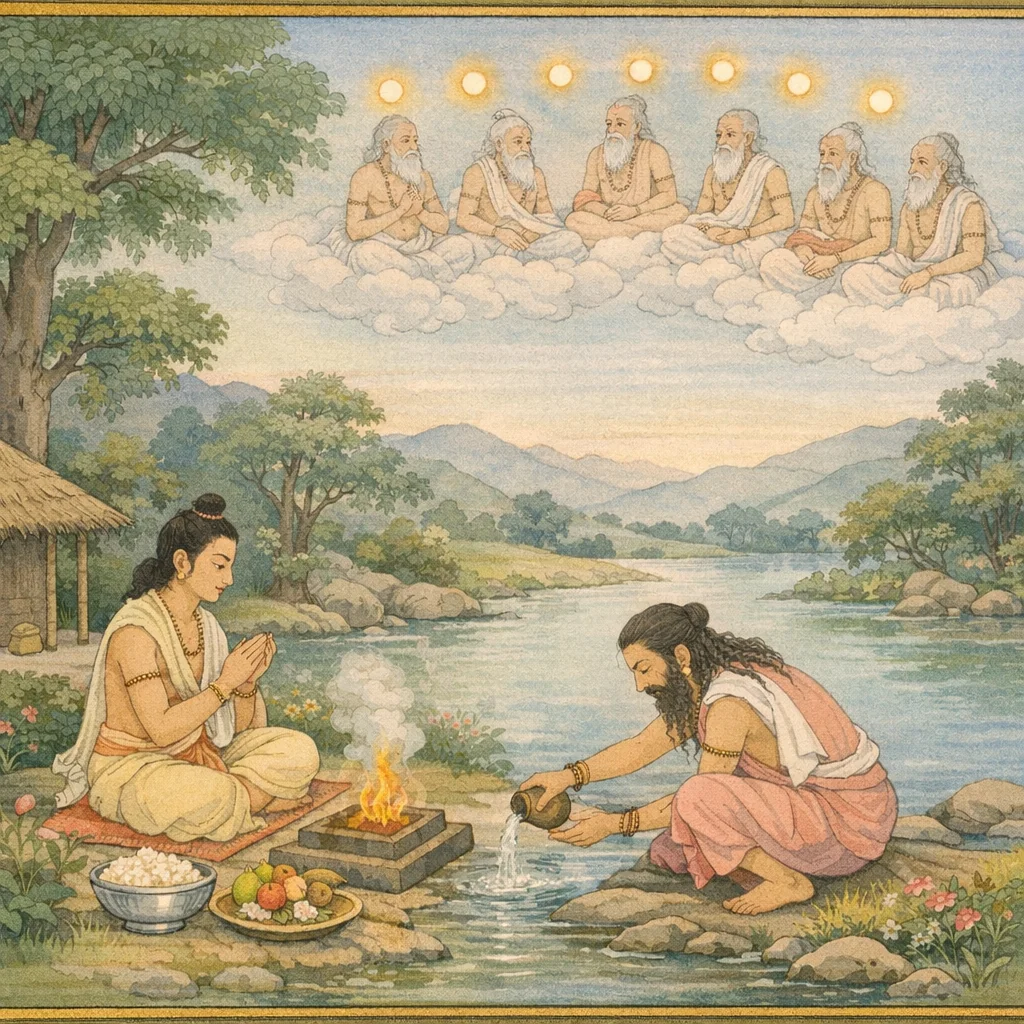
Pitṛbhakti and Śrāddha: The Classification of Pitṛs and the Superiority of Pitṛ-kārya
Adhyāya 41 is a didactic discourse in which Sanatkumāra sets forth the taxonomy of the pitṛ-gaṇas: seven principal ancestral collectives in heaven, divided into four mūrti-mant (with form) and three amūrta (formless) classes. He then gives ritual prescriptions, urging that śrāddha be offered with special emphasis for yogins, and noting proper materials such as a silver vessel (rājata pātra) or silver-adorned utensils. The rite is said to satisfy the pitṛs through svadhā and correctly ordered oblations, performed in fire (agni) or, if fire is unavailable, in water as an alternative medium. Its fruits are explicitly listed—nourishment, progeny, heaven, health, increase, and other desired aims. A key theological claim follows: pitṛ-kārya is declared superior even to deva-kārya, and pitṛ-bhakti is praised for granting a gati unattainable by yoga alone, making ancestral devotion a privileged spiritual means. The narrative frame then shifts to Mārkaṇḍeya, signaling the transmission of rare knowledge and preparing for further exempla and cautions regarding yogic conduct and fallibility.
Shlokas
Verse 1
सनत्कुमार उवाच । सप्त ते तपतां श्रेष्ठ स्वर्गे पितृगणास्स्मृताः । चत्वारो मूर्त्तिमंतो वै त्रयश्चैव ह्यमूर्तयः
Sanatkumāra said: O best among ascetics, those Pitṛ-groups in heaven are remembered as seven in number—indeed, four are embodied (with form), and three are formless.
Verse 2
तान्यजंते देवगणा आद्या विप्रादयस्तथा । आप्याययंति ते पूर्वं सोमं योगबलेन वै
The hosts of the gods, and likewise the primordial sages beginning with the brāhmaṇas, perform those rites; and first, by the power of yoga, they cause Soma to be replenished and strengthened.
Verse 3
तस्माच्छ्राद्धानि देयानि योगिनां तु विशेषतः । सर्वेषां राजतं पात्रमथ वा रजतान्वितम्
Therefore, śrāddha offerings should certainly be given—especially to yogins. For all such rites, one should use a silver vessel, or at least a vessel fitted or lined with silver.
Verse 4
दत्तं स्वधां पुरोधाय श्राद्धे प्रीणाति वै पितॄन् । वह्नेराप्यायनं कृत्वा सोमस्य तु यमस्य वै
When, during the śrāddha rite, an offering is made with the invocation “svadhā” placed foremost, it indeed gladdens the Pitṛs (ancestral beings). And by thereby nourishing the sacred Fire, it also becomes an act of satisfaction for Soma and for Yama as well.
Verse 5
उदगायनमप्यग्नावग्न्यभावेऽप्सु वा पुनः । पितॄन्प्रीणाति यो भक्त्या पितरः प्रीणयंति तम्
Even the Udāgāyana rite, performed when the sun turns northward—offered into fire, or, when fire is lacking, offered again into water—when done with devotion, gladdens the Pitṛs (ancestral spirits); and the Pitṛs, being pleased, bestow their favor upon that devotee.
Verse 6
यच्छंति पितरः पुष्टिं प्रजाश्च विपुलास्तथा । स्वर्गमारोग्यवृद्धिं च यदन्यदपि चेप्सितम्
The Pitṛs bestow nourishment and well-being; abundant progeny too is granted. Heaven, health, and prosperity are obtained—indeed, whatever else a devotee may desire is also fulfilled (through this Shiva-centered merit).
Verse 7
देवकार्यादपि मुने पितृकार्य्यं विशिष्यते । पितृभक्तोऽसि विप्रर्षे तेन त्वमजरामरः
O sage, even compared with service rendered to the gods, the duty performed for the Pitṛs, the ancestors, is declared superior. Since you are devoted to the Pitṛs, O best of brāhmaṇas, you therefore become free from decay and death.
Verse 8
न योगेन गतिस्सा तु पितृभक्तस्य या मुने । पितृभक्तिर्विशेषेण तस्मात्कार्या महामुने
O sage, the blessed attainment gained by one devoted to the Pitṛs (ancestral fathers) is not reached merely by yogic practice. Therefore, O great sage, devotion to the Pitṛs should be performed with special earnestness.
Verse 9
मार्कण्डेय उवाच । एवमुक्त्वाऽऽशु देवेशो देवानामपि दुर्लभम् । चक्षुर्दत्त्वा सविज्ञानं जगाम यौगिकीं गतिम्
Mārkaṇḍeya said: Having spoken thus, the Lord of the gods swiftly bestowed a divine eye—rare even among the devas—together with true inner discernment, and then departed, entering the yogic state of transcendence.
Verse 10
शृणु भीष्म पुरा भूयो भारद्वाजात्मजा द्विजाः । योगधर्ममनुप्राप्य भ्रष्टा दुश्चरितेन वै
Listen, O Bhīṣma: long ago, the twice-born sons of Bharadvāja attained the discipline of yoga; yet, through evil conduct indeed, they fell away from that yogic path.
Verse 11
वाग्दुष्टः क्रोधनो हिंस्रः पिशुनः कविरेव च । स्वसृषः पितृवर्ती च नामभिः कर्मभिस्तथा
“(Such a person is) foul in speech, prone to anger, violent, a slanderer, and also a deceiver; and likewise one who is devoted to his own sister and one who follows his father’s ways—(all these are known) by such names and by such deeds.”
Verse 12
कौशिकस्य सुतास्तात शिष्या गर्गस्य चाभवन् । पितर्युपरते सर्वे प्रवसंतस्तदाभवन्
O dear one, the sons of Kauśika became disciples of Garga. When their father had passed away, all of them then lived away from home, dwelling in distant places.
Verse 13
विनियोगाद्गुरोस्तस्य गां दोग्ध्रीं समकालयन् । समानवत्सां कपिलां सर्वेऽन्यायागतास्तदा
By the command and appointment of their guru, they arranged for the cow to be milked. Then all of them—having come there improperly and without rightful claim—gathered around that tawny kapilā cow, with her calf beside her.
Verse 14
तेषां पथि क्षुधार्तानां बाल्यान्मोहाच्च भारत । क्रूरा बुद्धिस्समुत्पन्ना तां गां तै हिंसितुं तदा
O Bhārata, as they travelled on the road, tormented by hunger and deluded by childish folly, a cruel intention arose in them then—to injure that cow.
Verse 15
तां कविसस्वसृपश्चैव याचेते नैति वै तदा । न चाशक्यास्तु ताभ्यां वा तदा वारयितुं निजाः
Then Kavi and her own sister’s son (her nephew) begged her, but she did not go. At that time, even her own people were unable to restrain her through those two.
Verse 16
पितृवर्ती तु यस्तेषां नित्यं श्राद्धाह्निको द्विजः । स सर्वानब्रवीत्कोपात्पितृभक्तिसमन्वितः
But among them, the twice-born who was devoted to the ancestral path—one who regularly performed the daily rites and the śrāddha—rebuked them all in anger, being filled with reverence and devotion toward the Pitṛs.
Verse 17
यद्यशक्यं प्रकर्तव्यं पितॄनुद्दिश्य साध्यताम् । प्रकुर्वंतो हि श्राद्धं तु सर्व एव समाहिताः
Even if (the full rite) seems difficult to perform, one should still accomplish what is possible, dedicating it to the Pitṛs (ancestors). For those who perform the śrāddha indeed—all of them—do so with collected and reverent minds.
Verse 18
एवमेषा च गौर्धर्मं प्राप्स्यते नात्र संशयः । पितॄनभ्यर्च्य धर्मेण नाधर्मो नो भविष्यति
Thus, this cow will surely attain dharma—of this there is no doubt. By duly worshipping the Pitṛs in accordance with dharma, no adharma will arise for us.
Verse 19
एवमुक्ताश्च ते सर्वे प्रोक्षयित्वा च गां तदा । पितृभ्यः कल्पयित्वा तु ह्युपायुंजत भारत
Thus instructed, all of them then sprinkled the cow with sanctified water; and, having duly assigned it as an offering for the Pitṛs (ancestral spirits), they proceeded to make use of it—O Bhārata.
Verse 20
उपयुज्य च गां सर्वे गुरोस्तस्य न्यवेदयन् । शार्दूलेन हता धेनुर्वत्सा वै गृह्यतामिति
After making use of the cow’s service, they all reported the matter to their teacher: “The milch-cow has been killed by a tiger; therefore, let the calf be taken in and cared for.”
Verse 21
आर्तवत्स तु तं वत्सं प्रतिजग्राह वै द्विजः । मिथ्योपचारतः पापमभूत्तेषां च गोघ्नताम्
Out of tender, distressed compassion for the calf, the brāhmaṇa accepted that calf. Yet, because the transaction was conducted through a false pretext, sin arose for them, and they incurred the taint of ‘cow-slaying’.
Verse 22
ततः कालेन कियता कालधर्ममुपागताः । ते सप्त भ्रातरस्तात बभूवुस्स्वायुषःक्षये
Then, after some time had passed, they came under the law of Kāla, Time—death. O dear one, those seven brothers met their end when the span of their own lives was exhausted.
Verse 23
ते वै क्रूरतया हैंस्त्र्यात्स्वानार्य्यत्वाद्गुरोस्तथा । उग्रहिंसाविहाराश्च जातास्सप्त सहोदराः
Indeed, through cruelty and their own uncivil nature, they became slayers—even of their teacher. Given to fierce and violent conduct, seven brothers were thus born.
Verse 24
लुब्धकस्य सुतास्तावद्बलवंतो मनस्विनः । जाता व्याधा दशार्णेषु सप्त धर्मविचक्षणाः
Now, that hunter’s sons—strong and high-spirited—were born in the land of Daśārṇa as seven hunters, each discerning in matters of dharma.
Verse 25
स्वधर्मनिरतास्सर्वे मृगा मोहविवर्जिताः । आसन्नुद्वेगसंविग्ना रम्ये कालंजरे गिरौ
On the beautiful Kālañjara mountain, all the deer were devoted to their own natural duty; free from delusion, they lived without agitation or fear—calm and untroubled.
Verse 26
तमेवार्थमनुध्याय ज्ञानं मरणसंभवम् । आसन्वनचराः क्षांता निर्द्वंद्वा निष्परिग्रहाः
Meditating only on that Supreme Reality, they cultivated the liberating knowledge born from the remembrance of mortality. They lived as forest-dwellers, patient and forbearing, free from the pairs of opposites, and without possessiveness.
Verse 27
ते सर्वे शुभकर्माणस्सद्धर्माणो वनेचराः । विधर्माचरणैर्हीना जातिस्मरणसिद्धयः
All of them were dwellers of the forest, engaged in auspicious deeds and established in righteous conduct. Free from the practice of unrighteous ways, they had attained the yogic accomplishment of remembering their former births.
Verse 28
पूर्वजातिषु यो धर्मः श्रुतो गुरुकुलेषु वै । तथैव चास्थिता बुद्धौ संसारेऽप्य निवर्तने
The dharma learned in former births in the teacher’s hermitage remains established in one’s intellect; and even amid worldly existence, it does not turn back, but continues to guide and impel one onward.
Verse 29
गिरिमध्ये जहुः प्राणांल्लब्धाहारास्तपस्विनः । तेषां तु पतितानां च यानि स्थानानि भारत
O Bhārata, within the mountain region the ascetics—having obtained their sustenance—gave up their very life-breath. And the places where those fallen bodies lay are remembered as sacred spots.
Verse 30
तथैवाद्यापि दृश्यंते गिरौ कालञ्जरे नृप । कर्मणा तेन ते जाताः शुभाशुभविवर्जकाः
Even today, O King, they are seen on Mount Kālañjara. By that very act (karma), they came to be free from both the auspicious and the inauspicious, transcending the dualities that bind the soul.
Verse 31
शुभाऽशुभतरां योनिं चक्रवाकत्वमागताः । शुभे देशे शरद्वीपे सप्तैवासञ्जलौकसः
Entering a mixed destiny—partly auspicious yet more inauspicious—they attained birth as cakravāka birds. Indeed, seven of them became water-dwelling beings on Śaradvīpa, in an auspicious region.
Verse 32
त्यक्त्वा सहचरीधर्मं मुनयो धर्मधारिणः । निस्संगा निर्ममाश्शांता निर्द्वंद्वा निष्परिग्रहाः
Abandoning the duties tied to worldly companionship, the sages—upholders of dharma—became free from attachment, free from possessiveness, tranquil, beyond the pairs of opposites, and without acquisitiveness. Resting their consciousness in the Lord (Pati) who alone is independent, they moved toward liberation.
Verse 33
निवृत्तिनिर्वृताश्चैव शकुना नामतः स्मृताः । ते ब्रह्मचारिणस्सर्वे शकुना धर्मधारिणः
They are remembered by name as the Śakunās—those established in nivṛtti, withdrawal from the world, and in nirvṛti, inner contentment. All of them are brahmacārins, celibate keepers of sacred discipline, and the Śakunās stand firm as upholders of dharma.
Verse 34
जातिस्मरास्सुसंवृद्धास्सप्तैव ब्रह्मचारिणः । स्थिता एकत्र सद्धर्मा विकाररहितास्सदा
Seven celibate ascetics—endowed with memory of former births and well matured in discipline—dwelt together in one place, ever established in true dharma and always free from inner disturbance and change.
Verse 35
विप्रयोनौ तु यन्मोहान्मिथ्यापचरितं गुरौ । तिर्य्यग्योनौ तथा जन्म श्राद्धाज्ज्ञानं च लेभिरे
Through delusion, though born in a brāhmaṇa lineage, they behaved wrongly and deceitfully toward their guru. Therefore they were born in animal wombs; yet, by the power of śrāddha—rites offered for the departed—they again obtained right knowledge.
Verse 36
तथा तु पितृकार्य्यार्थं कृतं श्राद्धं व्यवस्थितैः । तदा ज्ञानं च जातिं च क्रमात्प्राप्तं गुणोत्तरम्
Likewise, for the sake of the rites due to the Pitṛs, the disciplined ones duly performed the śrāddha. Thereupon, in proper sequence, they attained higher excellence of qualities—gaining true knowledge and an elevated state of birth.
Verse 37
पूर्वजादिषु यद्ब्रह्म श्रुतं गुरुकुलेषु वै । तथैव संस्थितज्ञानं तस्माज्ज्ञानं समभ्यसेत्
Therefore one should diligently cultivate that liberating knowledge of Brahman which has been heard from the ancients and in the guru’s household-school; for knowledge becomes firmly established only in the same way—by steady practice and assimilation.
Verse 38
सुमनाश्च सुवाक्छुद्धः पञ्चमश्छिद्रदर्शकः । स्वतंत्रश्च सुयज्ञश्च कुलीना नामतः स्मृताः
They are remembered by name as the Kulīnas: Sumanā, Suvākśuddha, the fifth called Chidradarśaka, Svatantra, and Suyajña.
Verse 39
तेषां तत्र विहंगानां चरतां धर्मचारिणाम् । सुवृत्तमभवत्तत्र तच्छृणुष्व महामुने
Of those birds dwelling there—moving about as followers of dharma—an auspicious and exemplary course of conduct arose in that place. Listen to that, O great sage.
Verse 40
नीपानामीश्वरो राजा प्रभावेण समन्वितः । श्रीमानन्तःपुरवृतो वनं तत्राविवेश ह
Then the king—lord of the Nīpas—endowed with royal splendor and power, glorious and accompanied by his inner household, entered that forest.
Verse 41
स्वतंत्रश्चक्रवाकस्सस्पृहयामास तं नृपम् । दृष्ट्वा यांतं सुखोपेतं राज्यशोभासमन्वितम्
That free-roaming cakravāka bird, seeing the king proceed in ease—adorned with the splendor of sovereignty—began to yearn for him.
Verse 42
यद्यस्ति सुकृतं किंचित्तपो वा नियमोऽपि वा । खिन्नोहमुपवासेन तपसा निश्चलेन च
If there is any merit in me at all—whether from some good deed, or from austerity, or even from sacred observances—still, I am worn out by fasting and by unbroken, motionless penance.
Verse 43
तस्य सर्वस्य पूर्णेन फलेनापि कृतेन हि । सर्वसौभाग्यपात्रश्च भवेयमहमीदृशः
Indeed, even by accomplishing the complete fruit of all that, may I become such a one—fit to receive every kind of auspicious fortune.
Verse 44
मार्कण्डेय उवाच । ततस्तु चक्रवाकौ द्वावासतुस्सहचारिणौ । आवां वै सचिवौ स्याव तव प्रियहितैषिणौ
Mārkaṇḍeya said: “Then those two cakravāka birds lived together as companions. ‘We shall indeed be your attendants (ministers), seeking what is dear and beneficial to you.’”
Verse 45
तथेत्युक्त्वा तु तस्यासीत्तदा योगात्मनो गतिः । एवं तौ चक्रवाकौ च स्ववाक्यं प्रत्यभाषताम्
Having said, “So be it,” at that very moment the yogic-souled one attained his destined course (entered his yogic state and departed). Thus, the pair of cakravāka birds also responded in accordance with their own words.
Verse 46
यस्मात्कर्मब्रुवाणस्वं योगधर्ममवाप्य तम् । एवं वरं प्रार्थयसे तस्माद्वाक्यं निबोध मे
Since you—though speaking in terms of ritual action (karma)—have attained that very discipline of Yoga, and now you ask for such a boon, therefore understand my words.
Verse 47
राजा त्वं भविता तात कांपिल्ये नगरोत्तमे । एतौ ते सचिवौ स्यातां व्यभिचारप्रधर्षितौ
Dear son, you shall become king in Kāmpilya, the foremost of cities. And these two shall serve as your ministers—men brought low and disgraced by their own transgression.
Verse 48
न तानूचुस्त्रयो राज्यं चतुरस्सहचारिणः । सप्रसादं पुनश्चक्रे तन्मध्ये सुमनाब्रवीत्
Those three did not speak to the four companions about the kingdom. Then he again became gracious, and in their midst Sumanā spoke.
Verse 49
अंतर्वो भविता शापः पुनर्योगमवाप्स्यथ । सर्वसत्त्वः सुयज्ञश्च स्वतंत्रोऽयं भविष्यति
“This curse upon you will be only inward and limited; thereafter you shall attain union again. This one will be endowed with all noble qualities, will perform sacred rites, and will indeed become independent.”
Verse 50
पितृप्रसादाद्युष्माभिस्संप्राप्तं सुकृतं भवेत् । गां प्रोक्षयित्वा धर्मेण पितृभ्यश्चोपकल्पिताः
By the grace of the Pitṛs (ancestors), the merit you have obtained will indeed bear fruit. Having ritually sprinkled the cow with sanctified water according to dharma, offer it duly for the sake of the Pitṛs.
Verse 51
अस्माकं ज्ञानसंयोगस्सर्वेषां योगसाधनम् । इदं च कार्यं संरब्धं श्लोकमेकमुदाहृतम्
“Our union with true knowledge is the means of yogic attainment for all. And with this purpose firmly undertaken, a single verse has been declared.”
Verse 52
पुरुषान्तरितं श्रुत्वा ततो योगमवाप्स्यथ । इत्युक्त्वा स तु मौनोभूद्विहंगस्सुमना बुधः
“Having heard the teaching concerning the indwelling Person (the Inner Self), you shall thereafter attain Yoga.” Saying so, that wise sage—serene like a bird—fell silent, his mind composed.
Verse 53
मार्कण्डेय उवाच । लोकानां स्वस्तये तात शन्तनुप्रवरात्मज । इत्युक्तं तच्चरित्रं मे किं भूयश्श्रोतुमिच्छसि
Mārkaṇḍeya said: “Dear one, descendant of Śantanu’s illustrious line—this I have spoken for the welfare of the worlds. Thus have I recounted that sacred account; what more do you wish to hear?”
Frequently Asked Questions
The chapter argues for the primacy of ancestral obligation: pitṛ-kārya is stated to be superior even to deva-kārya, and pitṛbhakti is said to confer a spiritual ‘gati’ that is not attained by yoga alone, thereby elevating śrāddha and ancestor-devotion as decisive sādhanā.
Agni functions as the canonical carrier of offerings, while water is authorized as a secondary medium when fire is unavailable, preserving transmissibility of the rite across contexts. The preference for a silver vessel signals ritual refinement and suitability (pātratva), aligning material purity with intended recipients (pitṛs) and reinforcing that correct form supports the efficacy (phala) of svadhā-centered offerings.
Rather than a new form of Śiva/Umā, the chapter highlights the pitṛ-gaṇas and the regulatory deities implicated in śrāddha’s economy—Soma (nourishment/augmentation), Yama (ancestral jurisdiction), and Agni (oblation-transmission)—showing how ancestral rites operate within a broader sacred administration.