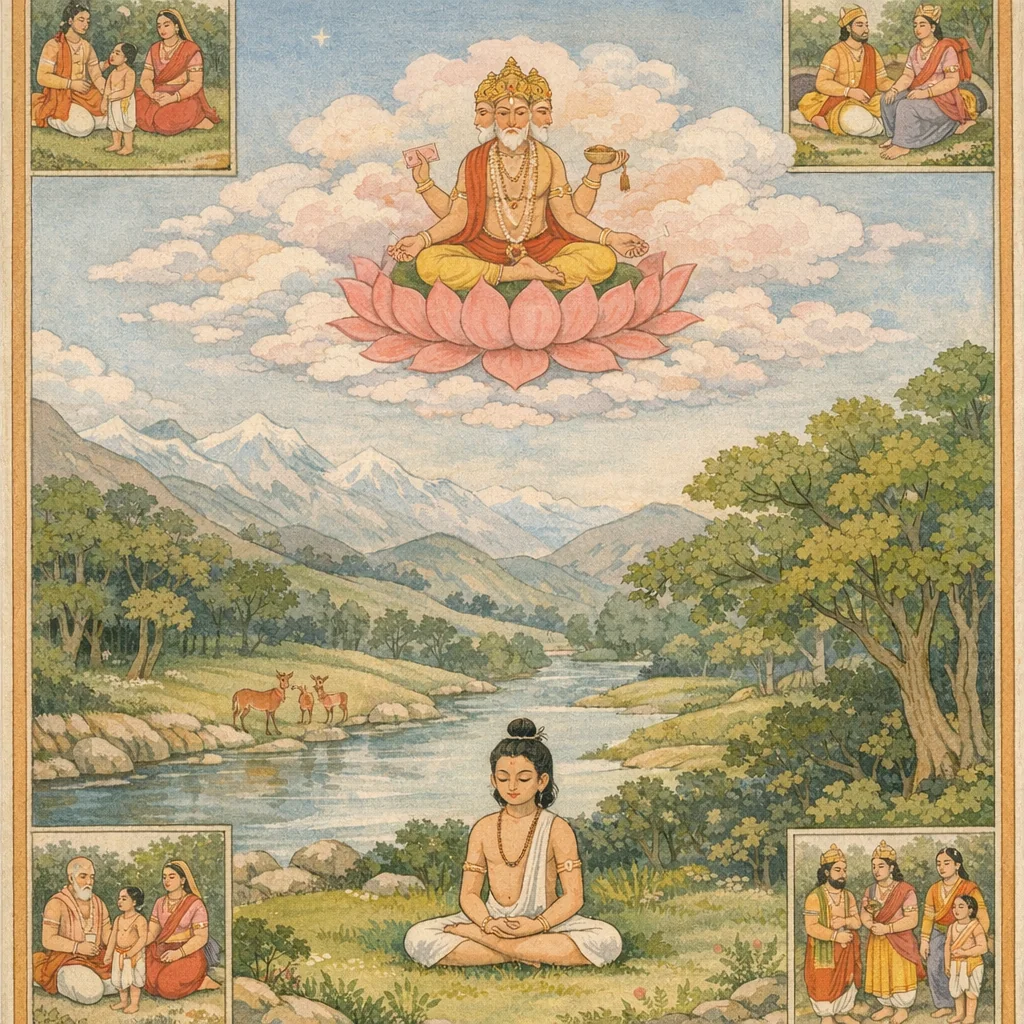
स्वायम्भुव-मन्वन्तर-वंशवर्णनम् (Genealogy of Svāyambhuva Manu and the Dhruva Episode)
Narrated by Sūta, this Adhyāya compresses early cosmic genealogy and a model of ascetic attainment into a didactic account. It begins with the Prajāpati (Āpava/associated progenitor in this recension) and the manifestation of Śatarūpā through dharma and tapas, teaching that progeny and cosmic order arise from disciplined righteousness, not mere biological generation. Svāyambhuva Manu is then identified, and his Manvantara is set as a measurable cosmological epoch within cyclical time. The lineage proceeds through Priyavrata and Uttānapāda and introduces Dhruva, whose mother Sunīti is linked with Dharma, embedding moral legitimacy in the line. Dhruva’s forest austerities for three thousand divine years become the ascetic paradigm, driven by the unwavering quest for an “avyaya sthāna” (imperishable station). Brahmā, the cosmic administrator, grants Dhruva an exalted, immovable position before the Seven Ṛṣis, illustrating the Purāṇic principle that sustained tapas under dharma yields stable cosmic and spiritual attainment. Esoterically, the fixed stellar station mirrors the yogic fixity (acalatā) of consciousness.
Shlokas
Verse 1
सूत उवाच । संसृष्टासु प्रजास्वेव आपवोऽथ प्रजाप्रतिः । लेभे वै पुरुषः पत्नीं शतरूपामयो निजाम्
Sūta said: When the progeny had thus been brought forth, then Prajāpati Āpava, Lord of creatures, obtained for that Puruṣa his own consort—Śatarūpā, endowed with manifold forms.
Verse 2
आपवस्य महिम्ना तु दिवमावृत्य तिष्ठतः । धर्मेणैव महात्मा स शतरूपाप्यजायत
By the greatness of that austerity, he stood, enveloping even heaven; and by righteousness (dharma) alone, that great-souled one was born again in a hundred forms.
Verse 3
सा तु वर्षशतं तप्त्वा तपः परमदुश्चरम् । भर्तारं दीप्ततपसं पुरुषं प्रत्यपद्यत
Having performed supremely arduous austerity for a full hundred years, she attained her Lord—the Puruṣa radiant with the power of tapas—by taking refuge in Him and receiving Him as her husband.
Verse 4
स वै स्वायंभुवो जज्ञे पुरुषो मनुरुच्यते । तस्यैकसप्ततियुगं मन्वंतरमिहोच्यते
Indeed the self-born progenitor came into being; he is called Manu. Here it is declared that his Manvantara consists of seventy-one yugas.
Verse 5
वैराजात्पुरुषाद्वीरा शतरूपा व्यजायत । प्रियव्रतोत्तानपादौ वीरकायामजायताम्
From the Virāja-Puruṣa was born the illustrious Śatarūpā. And from Vīrakā as mother were born the two heroic sons—Priyavrata and Uttānapāda.
Verse 6
काम्या नाम महाभागा कर्दमस्य प्रजापतेः । काम्यापुत्रास्त्रयस्त्वासन्सम्राट्साक्षिरविट्प्रभुः
Kāmyā, the greatly blessed consort of the Prajāpati Kardama, had three sons: Samrāṭ, Sākṣi, and Aviṭprabhu.
Verse 7
उत्तानपादोऽजनयत्पुत्राञ्छक्रसमान्प्रभुः । ध्रुवं च तनयं दिव्यमात्मानंदसुवर्चसम्
Lord Uttānapāda begot sons equal to Indra in prowess; and he also begot Dhruva, his divine son, whose radiance shone with the splendour born of inner bliss.
Verse 8
धर्मस्य कन्या सुश्रोणी सुनीतिर्नाम विश्रुता । उत्पन्ना चापि धर्म्मेण धुवस्य जननी तथा
From Dharma was born a renowned daughter named Sunīti, graceful in form; begotten by Dharma, she became the mother of Dhruva as well.
Verse 9
ध्रुवो वर्षसहस्राणि त्रीणि दिव्यानि कानने । तपस्तेपे स बालस्तु प्रार्थयन्स्थानमव्ययम्
In the forest, the boy Dhruva performed austerities for three thousand divine years, praying for an imperishable station—an enduring, unfailing state.
Verse 10
तस्मै ब्रह्मा ददौ प्रीतस्स्थानमात्मसमं प्रभुः । अचलं चैव पुरतस्सप्तर्षीणां प्रजापतिः
Pleased with him, Brahmā—the Lord, the Prajāpati—granted him a station equal to his own; and he also bestowed an immovable seat of honor in the presence of the Seven Sages.
Verse 11
तस्मात्पुष्टिश्च धान्यश्च ध्रुवात्पुत्रौ व्यजायताम् । पुष्टिरेवं समुत्थायाः पञ्चपुत्रानकल्मषान्
Therefore, from Dhruva were born two sons—Puṣṭi and Dhānya. And Puṣṭi, in due course, gave rise to five sons, all stainless and free from blemish.
Verse 12
रिपुं रिपुंजयं विप्रं वृकलं वृषतेजसम् । रिपोरेवं च महिषी चाक्षुषं सर्वतोदिशम्
“He is the foe of evil, the conqueror of foes, the brahmin-sage; wolf-like, blazing with the splendour of the Bull of Dharma. Thus too he subdues even hostile powers; he is the all-seeing one, whose vision extends in every direction.”
Verse 13
अजीजनत्पुष्करिण्यां वरुणं चाक्षुषो मनुः । मनोरजायन्त दश नड्वलायां महौजसः
From Puṣkariṇī, the Cākṣuṣa Manu begot Varuṇa; and from Naḍvalā were born the ten sons named Manoraja, all of great splendor and power.
Verse 14
कन्यायां हि मुनिश्रेष्ठ वैश्यजन्म प्रजायतेः । पुरुर्मासः शतद्युम्नस्तपस्वी सत्यवित्कविः
O best of sages, from the maiden was indeed born a son of the Vaiśya order—Purūrmāsa, named also Śatadyumna—an ascetic, a knower of truth, and a poet-sage.
Verse 15
अग्निष्टोमोऽतिरात्रश्चातिमन्युस्सुयशा दश । पूरोरजनयत्पुत्रान्षडाग्नेयी महाप्रभान्
From Puru, through Agneyī, were born six mighty sons: Agniṣṭoma, Atirātra, Atimanyu, and Suyaśā—renowned as “ten” in name and fame.
Verse 16
अङ्गं सुमनसं ख्यातिं सृतिमंगिरसं गयम् । अङ्गात्सुनीथा भार्य्या वै वेनमेकमसूयत
From King Aṅga were born Sumanas, Khyāti, Sṛti, Aṅgirasa, and Gaya. And from Aṅga’s wife Sunīthā, indeed, a single son—Vena—was born.
Verse 17
अपचारेण वेनस्य कोपस्तेषां महानभूत् । हुंकारेणैव तं जघ्नुर्मुनयो धर्मतत्पराः
Because of Vena’s act of disrespect, great anger arose in those sages. Devoted to dharma, the munis struck him down merely with a thunderous utterance of “huṃ.”
Verse 18
अथ प्रजार्थमृषयः प्रार्थिताश्च सुनीथया । सारस्वतास्तदा तस्य ममंथुर्दक्षिणं करम्
Then, for the sake of progeny, the sages—urged by Sunīthā—began at that time to churn his right hand as a sacred rite, so that creation’s continuity might arise by divine ordinance.
Verse 19
वेनस्य पाणौ मथिते संबभूव ततः पृथुः । स धन्वी कवची जातस्तेजसादित्यसन्निभः
When Vena’s hand was churned by the sages, Pṛthu was born from it. He emerged bearing a bow and armour, radiant with a splendour like the Sun.
Verse 20
अवतारस्य विष्णोर्हि प्रजापालनहे तवे । धर्मसंरक्षणार्थाय दुष्टानां दंडहेतवे
Indeed, the descent (avatāra) of Lord Viṣṇu is for the protection and governance of beings—so that dharma may be preserved and the wicked may be punished.
Verse 21
पृथुर्वैन्यस्तदा पृध्वीमरक्षत्क्षत्रपूर्वजः । राजसूयाभिषिक्तानामाद्यस्स वसुधापतिः
Then Pṛthu, the son of Vena—born in the royal warrior line—protected the Earth. Among those consecrated by the Rājasūya sacrifice, he was the first, the primordial lord of the world, upholding righteous kingship in service of dharma.
Verse 22
तस्माच्चैव समुत्पन्नौ निपुणौ सूतमागधौ । तेनेयं गौर्मुनिश्रेष्ठ दुग्धा सर्वहिताय वै
From that sacred source there indeed arose two skilled ones—the Sūta and the Māgadha. Therefore, O best of sages, this Cow has been milked, truly, for the welfare of all.
Verse 23
सर्वेषां वृत्तिदश्चाभूद्देवर्षिसुर रक्षसाम् । मनुष्याणां विशेषेण शतयज्ञकरो नृपः
He became the ordainer of livelihood and the regulator of conduct for all—deva-sages, gods, and even the rākṣasas; and among human beings in particular, that king became renowned as the performer of a hundred sacrifices.
Verse 24
पृथोः पुत्रौ तु जज्ञाते धर्मज्ञौ भुवि पार्थिवौ । विजिताश्वश्च हर्यक्षो महावीरौ सुविश्रुतौ
To King Pṛthu were born two sons, righteous-minded rulers upon the earth—Vijitāśva and Haryakṣa—both great heroes and widely renowned.
Verse 25
शिखंडिनी चाजनयत्पुत्रं प्राचीनबर्हिषम् । प्राचीनाग्राः कुशास्तस्य पृथिवीतलचारिणः
And Śikhaṇḍinī gave birth to a son named Prācīnabarhiṣ. The blades of his kuśa-grass bore ancient tips, and they moved upon the surface of the earth.
Verse 26
समुद्रतनया तेन धर्मतस्सुविवाहिता । रेजेऽधिकतरं राजा कृतदारो महाप्रभुः
Thus the daughter of the Ocean was duly married to him according to dharma. Having taken a lawful wife, that mighty king shone forth even more brilliantly.
Verse 27
समुद्रतनयायास्तु दश प्राचीनबर्हिषः । बभूवुस्तनया दिव्या बहुयज्ञकरस्य वै
From the daughter of the Ocean, ten divine sons were born to Prācīnabarhis—renowned indeed for performing many yajñas (sacrificial rites).
Verse 28
सर्वे प्राचेतसा नाम्ना धनुर्वेदस्य पारगाः । अपृथग्धर्माचरणास्तेऽतप्यंत महत्तपः
All of them, known by the name Prācetasa, were masters of Dhanurveda, the sacred science of archery. United and undivided in righteous dharma-conduct, they performed mighty austerities—tapas of great intensity.
Verse 29
दशवर्षसहस्राणि समुद्रसलिलेशयाः । रुद्रगीतं जपंतश्च शिवध्यानपरायणाः
For ten thousand years they lay immersed in the ocean’s waters, ceaselessly chanting the Rudra-gīta, wholly devoted to meditation upon Lord Śiva.
Verse 30
तपश्चरत्सु पृथिव्यामभवंश्च महीरुहाः । अरक्ष्यमाणायां पृथ्व्यां बभूवाथ प्रजाक्षयः
While the ascetics practiced tapas upon the earth, trees and great growths sprang up everywhere. But when the earth was left unprotected and unguided, there arose destruction—an alarming decline of living beings.
Verse 31
तान्दृष्ट्वा तु निवृत्तास्ते तपसो लब्धसद्वराः । चुक्रुधुर्मुनिशार्दूल दग्धुकामा स्तपोबलाः
But on seeing them, those ascetics—withdrawn from worldly ways and granted excellent boons through austerity—grew enraged, O tiger among sages, longing to burn them by the power of their penance.
Verse 32
प्राचेतसा मुखेभ्यस्ते प्रासृजन्नग्निमारुतौ । वृक्षानुन्मूल्य वायुस्तानदहद्धव्यवाहनः
Then, from the mouths of those Prācetasas, fire and wind were released. The wind uprooted the trees, and Agni—the carrier of oblations—burned them down.
Verse 33
वृक्षक्षयं ततो दृष्ट्वा किंचिच्छेषेषु शाखिषु । उपगम्याब्रवीदेतान्राजा सोमः प्रतापवान्
Then, seeing the destruction of the trees and noticing that only a few branches still remained, the mighty King Soma approached them and spoke to those who survived.
Verse 34
सोम उवाच । कोपं यच्छत राजानस्सर्वे प्राचीनबर्हिषः । अनुभूतानुकन्येयं वृक्षाणां वरवर्णिनी
Soma said: “O kings, all you descendants of Prācīnabarhis, restrain your wrath. This fair-hued maiden has already borne the consequences that arose from the trees.”
Verse 35
भविष्यं जानता सा तु धृता गर्भेण वै मया । भार्य्या वोऽस्तु महाभागास्सोमवंशविवर्द्धिनी
Knowing what was to come, I indeed caused her to conceive. O fortunate ones, let her become your wife—she who will increase and strengthen the Somavaṃśa, the Lunar dynasty.
Verse 36
अस्यामुत्पत्स्यते विद्वान्दक्षो नाम प्रजापतिः । सृष्टिकर्ता महातेजा ब्रह्मपुत्रः पुरातनः
From her will be born the wise Prajāpati named Dakṣa—an ancient son of Brahmā, of great splendor, appointed as an agent for the work of creation.
Verse 37
युष्माकं तेजसार्द्धेन मम चानेन तेजसा । ब्रह्मतेजोमयो भूपः प्रजा संवर्द्धयिष्यति
By the shared power of your spiritual radiance and by this radiance of mine as well, the king—made resplendent with Brahmā-like splendor—will nurture the subjects and cause them to prosper.
Verse 38
ततस्सोमस्य वचनाज्जगृहुस्ते प्रचेतसः । भार्य्यां धर्मेण तां प्रीत्या वृक्षजां वरवर्णिनीम्
Then, at Soma’s word, those Pracetas accepted her—born of the tree, of excellent complexion—as their wife, in accordance with dharma and with loving goodwill.
Verse 39
तेभ्यस्तस्यास्तु संजज्ञे दक्षो नाम प्रजापतिः । सोऽपि जज्ञे महातेजास्सोमस्यांशेन वै मुने
From them, indeed, was born Dakṣa, the Prajāpati. And he too, O sage, was born exceedingly radiant, as a partial manifestation of Soma (the Moon).
Verse 40
अचरांश्च चरांश्चैव द्विपदोऽथ चतुष्पदः । संसृज्य मनसा दक्षो मैथुनीं सृष्टिमारभत्
Having mentally brought forth both the immobile and the mobile beings—those with two feet and those with four—Dakṣa then commenced the creation that proceeds through male–female pairing (sexual generation).
Verse 41
वीरणस्य सुतां नाम्ना वीरणीं स प्रजापतेः । उपयेमे सुविधिना सुधर्मेण पतिव्रताम्
According to proper rites and righteous custom, he married Vīraṇī—the devoted wife, daughter of the Prajāpati named Vīraṇa.
Verse 42
हर्य्यश्वानयुतं तस्यां सुतान्पुण्यानजीजनत् । ते विरक्ता बभूवुश्च नारदस्योपदेशतः
In her, he begot the holy sons known as the Haryaśvas. But, following Nārada’s instruction, they became detached from worldly life and turned their minds toward renunciation.
Verse 43
तच्छुत्वा स पुनर्दक्षस्सुबलाश्वानजीजनत् । नामतस्तनयांस्तस्यां सहस्रपरिसंख्यया
Hearing that, Dakṣa once again begot sons from Subalā, numbering a thousand in all, each distinguished by name.
Verse 44
तेऽपि भ्रातृपथा यातास्तन्मुनेरुपदेशतः । नागमन्पितृसान्निध्यं विरक्ता भिक्षुमार्गिणः
Following that sage’s instruction, they too set out upon the path their brothers had taken. Casting off worldly ties and embracing the mendicant’s way, they did not return again to their father’s presence.
Verse 45
तच्छ्रुत्वा शापमाक्रुद्धो मुनये दुस्सहं ददौ । कुत्रचिन्न लभस्वेति संस्थितिं कलहप्रिय
Hearing that curse, the quarrel-loving one grew enraged and in turn laid a grievous curse upon the sage: “May you find no settled abode anywhere.”
Verse 46
सांत्वितोऽथ विधात्रा हि स पश्चादसृजत्स्त्रियः । महाज्वालास्वरूपेण गुणैश्चापि मुनीश्वरः
Then, being consoled by the Creator (Brahmā), that great lord among sages thereafter created the women—endowed with a nature like a mighty flame, and also with distinct qualities.
Verse 47
ददौ स दश धर्माय कश्यपाय त्रयोदश । द्वे चैवं ब्रह्मपुत्राय द्वे चैवाङ्गिरसे तदा
Then he bestowed ten (daughters) upon Dharma, thirteen upon Kaśyapa, and likewise two upon the son of Brahmā, and two upon Aṅgiras at that time.
Verse 48
द्वे कृशाश्वाय विदुषे मुनये मुनिसत्तम । शिष्टास्सोमाय दक्षोऽपि नक्षत्राख्या ददौ प्रभुः
O best of sages, Dakṣa, the august Prajāpati, gave two daughters to the learned sage Kṛśāśva; and he also bestowed the remaining daughters—known as the Nakṣatras—upon Soma, the Moon.
Verse 49
ताभ्यो दक्षस्य पुत्रीभ्यो जाता देवासुरादयः । बहवस्तनया ख्यातास्तैस्सर्वैः पूरितं जगत्
From those daughters of Dakṣa were born the gods, the asuras, and other orders of beings. Their progeny became widely renowned, and by them all the worlds were filled.
Verse 50
ततः प्रभृति विप्रेन्द्र प्रजा मैथुनसंभवाः । संकल्पाद्दर्शनात्स्पर्शात्पूर्वेषां सृष्टिरुच्यते
From that time onward, O best of Brahmins, beings came to be through sexual union. But the creation of the earlier ones is said to have arisen through mere intention (will), through sight, and through touch.
Verse 51
शौनक उवाच । अंगुष्ठाद्ब्रह्मणो जज्ञे दक्षश्चोक्तस्त्वया पुरा । कथं प्राचेतसत्वं हि पुनर्लेभे महातपाः
Śaunaka said: “You previously told us that Dakṣa was born from Brahmā’s thumb. How, then, did that great ascetic again attain the state of being a Prācetasa (son of the Pracetas)?”
Verse 52
एतं मे संशयं सूत प्रत्याख्यातुं त्वमर्हसि । चित्रमेतत्स सोमस्य कथं श्वशुरतां गतः
O Sūta, you are worthy to resolve this doubt of mine. This is indeed astonishing—how did Soma come to attain the status of a father-in-law?
Verse 53
सूत उवाच । उत्पत्तिश्च निरोधश्च नित्यं भूतेषु वर्तते । कल्पेकल्पे भवंत्येते सर्वे दक्षादयो मुने
Sūta said: “In living beings, creation and dissolution are ever at work. In each kalpa, all these—Dakṣa and the others—come into manifestation again, O sage.”
Verse 54
इमां विसृष्टिं दक्षस्य यो विद्यात्सचराचराम् । प्रजावानायुषा पूर्णस्स्वर्गलोके महीयते
Whoever truly understands this creation set forth by Dakṣa—comprising both the moving and the unmoving—becomes endowed with progeny, complete in lifespan, and is honored in the heavenly worlds.
Frequently Asked Questions
The chapter presents a compact cosmo-genealogical argument: dharma and tapas generate legitimate cosmic order (Śatarūpā’s emergence; Manu’s epoch), culminating in Dhruva’s austerity and Brahmā’s grant of an imperishable “sthāna,” demonstrating tapas as a lawful means to stable attainment.
“Sthāna” (station) and “acala” (immovable) function as symbols of yogic fixation: the mind made steady through tapas becomes ‘stellar’—i.e., established beyond fluctuation. The Manvantara frame adds the rahasya that inner discipline participates in cosmic time-order rather than opposing it.
No discrete iconographic manifestation (mūrti/avatāra) of Śiva or Gaurī is foregrounded in the sampled verses; instead, Śiva-tattva is indirectly taught through dharma–tapas causality and the doctrine that steadfast austerity yields an enduring spiritual-cosmic status.