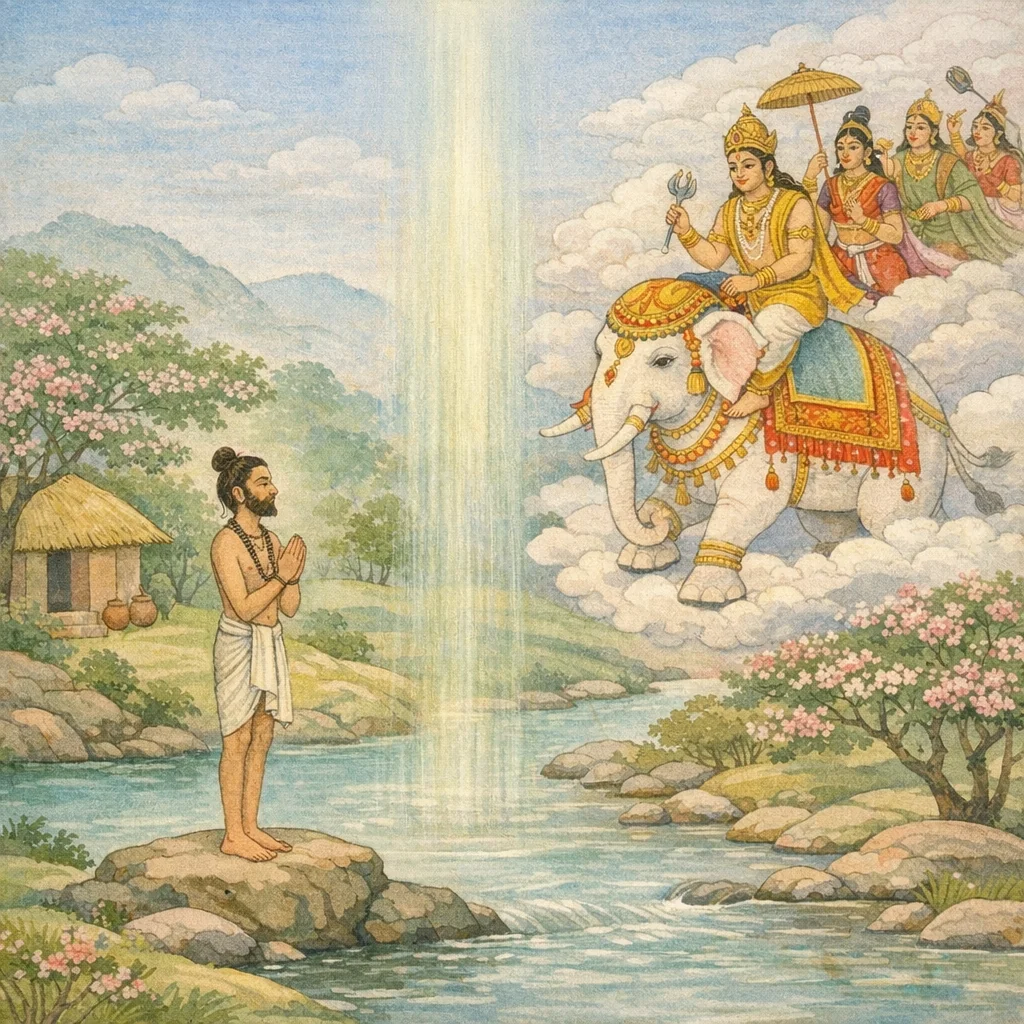
नन्दिकेशावतारवर्णनम् (Nandikeśa Avatāra Varṇanam) — “Account of the Descent/Origin of Nandikeśvara”
This adhyāya unfolds as a dialogue: Sanatkumāra asks about Nandīśvara’s origin and how he attained the status of being a portion of Śiva (Mahādeva-aṃśaja). Nandīśvara replies with a genealogical and theological account centered on the sage Śilāda, whose longing for a son leads him to sustained, disciplined tapas. The chapter upholds ascetic effort as a rightful means to divine encounter, yet marks a hierarchy of boons: even when Indra (Śakra) is pleased and offers a vara, Śilāda’s request is framed in liberative terms—an extraordinary son who is ayonija (not womb-born) and mṛtyu-hīna (free from death). In this way it links gaṇa-theology—Nandikeśa as Śiva’s intimate attendant and manifestation—with Purāṇic causality: intention → austerity → divine response → exceptional birth. Esoterically, it teaches that nearness to Śiva is not merely spatial (Kailāsa/Śivaloka) but ontological, attained through steadfastness, purity of aim, and turning boon-seeking toward immortality and service to the Divine.
Shlokas
Verse 1
अथ नन्दीश्वरावतारमाह । सनत्कुमार उवाच । भवान्कथमनुप्राप्तो महादेवांशजः शिवम् । श्रोतुमिच्छामि तत्सर्वं वक्तुमर्हसि मे प्रभो
Now (the text) relates the descent of Nandīśvara. Sanatkumāra said: “O Lord, how did you come to be—an emanated portion of Mahādeva—and how did you attain the state of Śiva’s own attendant? I wish to hear all of it; be pleased to tell me everything, O Prabhu.”
Verse 2
नन्दीश्वर उवाच । सनत्कुमार सर्वज्ञ सावधानतया शृणु । यथाहं च शिवं प्राप्तो महादेवांशजो मुने
Nandīśvara said: “O omniscient Sanatkumāra, listen with full attention. O sage, I shall tell you how I—born as a portion of Mahādeva—attained Śiva.”
Verse 3
प्रजाकामः शिलादोऽभूदुक्तः पितृभिरादरात् । तदुद्धर्तुमना भक्त्या समुद्धारमभीप्सुभिः
Desiring progeny, Śilāda respectfully followed the counsel of the Pitṛs, the venerable ancestors. With a mind intent on uplifting them, he sought their complete deliverance through devoted bhakti.
Verse 4
अधोदृष्टिः सुधर्मात्मा शिलादो नाम वीर्यवान् । तस्यासीन्मुनिकैर्वृत्तिः शिवलोके च सोगमत्
There was a man named Śilāda, virtuous and righteous-souled, renowned for strength and vigor. The sages provided his livelihood, and in the end he attained the world of Śiva.
Verse 5
शक्रमुद्दिश्य स मुनिस्तपस्तेपे सुदुः सहम् । निश्चलात्मा शिलादाख्यो बहुकालं दृढव्रतः
Aiming his austerity toward Śakra (Indra), that sage performed a most difficult tapas. Named Śilāda, steady in mind and firm in his vow, he continued for a long time without wavering.
Verse 6
इति श्रीशिवमहापुराणे तृतीयायां शतरुद्रसंहितायां नन्दिकेशावतारवर्णनं नाम षष्ठोऽध्यायः
Thus, in the Śrī Śiva Mahāpurāṇa, in the Third Book—the Śatarudra Saṃhitā—ends the sixth chapter, entitled “The Description of the Manifestation of Nandikeśa.”
Verse 7
शिलादमाह सुप्रीत्या शक्रस्तुष्टोऽस्मि तेऽनघ । तेन त्वं मुनिशार्दूल वरयस्व वरानिति
With heartfelt affection, Śakra (Indra) said to Śilāda: “O sinless one, I am pleased with you. Therefore, O tiger among sages, choose the boons you desire.”
Verse 8
ततः प्रणम्य देवेशं स्तुत्वा स्तुतिभिरादरात् । शिलादो मुनिशार्दूलस्तमाह सुकृताञ्जलिः
Then, having bowed to the Lord of the gods and praised Him with reverent hymns, the great sage Śilāda—foremost among ascetics—addressed Him with palms joined in devotion.
Verse 9
शिलाद उवाच । शतक्रतो सुरेशान सन्तुष्टो यदि मे प्रभो । अयोनिजं मुत्युहीनं पुत्रमिच्छामि सुव्रतम्
Śilāda said: “O Śatakratu, O Lord of the gods—if you are pleased with me, O Master, I desire a son of pure vow: one not born from a womb and free from death.”
Verse 10
शक्र उवाच । पुत्रं दास्यामि पुत्रार्थिन्योनिजं मृत्युसंयुतम् । अन्यथा ते न दास्यामि मृत्युहीना न सन्ति वै
Śakra (Indra) said: “I will grant you a son—born from a woman who longs for a child—yet he will be joined with mortality (that is, subject to death). Otherwise, I will not grant him to you, for indeed there are no beings who are free from death.”
Verse 11
न दास्यामि सुतं तेऽहं मृत्युहीनमयोनिजम् । हरिर्विधिश्च भगवान्किमुतान्यो महामुने
I shall not grant you a son who is deathless and not born of a womb. Even Bhagavān Hari and Bhagavān Vidhi (Brahmā) are not beyond this—what then of anyone else, O great sage?
Verse 12
तावपि त्रिपुरार्यंगसम्भावौ मरणान्वितौ । तयोरप्यायुषा मानं कथितं निगमे पृथक्
Even those two—Tripura and Āryaṃga—though exalted in origin, were still bound to death. And for each of them, the measure of their lifespan is stated separately in the Nigamas, the Vedic revelations.
Verse 13
तस्मादयोनिजे पुत्रे मृत्युहीने प्रयत्नतः । परित्यजाशां विप्रेन्द्र गृहाणात्मक्षमं सुतम्
Therefore, O best of brāhmaṇas, strive earnestly for a son not born of the womb, one free from death. Abandon worldly expectation and accept that son who is fit for the Self (Ātman), able to lead you toward mokṣa.
Verse 14
किन्तु देवेश्वरो रुद्रः प्रसीदति महेश्वरः । सुदुर्लभो मृत्युहीनस्तव पुत्रो ह्ययोनिजः
But Rudra—the Lord of the gods, Mahēśvara—has become gracious. Therefore a son will indeed be granted to you: exceedingly rare, free from death, and not born from any womb.
Verse 15
अहं च विष्णुर्भगवान्द्रुहिणश्च महामुने । अयोनिजं मृत्युहीनं पुत्रं दातुं न शक्नुमः
O great sage, neither I, nor the blessed Lord Viṣṇu, nor Druhiṇa (Brahmā) is able to grant a son who is not born of the womb and is free from death. Such a boon lies beyond us; only the Supreme Śiva, the Pati beyond birth and decay, can bestow what transcends created nature.
Verse 16
आराधय महादेवं तत्पुत्रविनिकाम्यया । सर्वेश्वरो महाशक्तः स ते पुत्रं प्रदास्यति
Worship Mahādeva with the earnest desire for that son. For He is the Lord of all and supremely powerful; He will grant you a son.
Verse 17
नन्दीश्वर उवाच । एवं व्याहृत्य विप्रेन्द्रमनुगृह्य च तं घृणी । देवैर्वृतः सुरेशानस्स्वलोकं समगान्मुने
Nandīśvara said: Having thus spoken, the compassionate Lord of the gods graciously favored that foremost brāhmaṇa; then, surrounded by the devas, the Supreme Lord of the suras departed to His own realm, O sage.
Verse 18
गते तस्मिंश्च वरदे सहस्राक्षे शिलाशनः । आराधयन्महादेवं तपसातोषयद्भवम्
When that boon‑granting, thousand‑eyed one had departed, the sage seated upon a stone continued to worship Mahādeva, and by his austerity he pleased Bhava (Lord Śiva).
Verse 19
अथ तस्यैवमनिशन्तत्परस्य द्विजस्त वै । दिव्यम्वर्षसहस्रं तु गतं क्षणमिवाद्भुतम्
Then, for that Brahmin—ever intent, continuously contemplating with single‑pointed devotion—an entire thousand divine years passed, astonishingly, as though it were only a moment.
Verse 20
वल्मीकेन वृतांगश्च लक्षकोटगणैर्मुनिः । सूचीमुखैश्चान्यै रक्तभुग्भिश्च सर्वतः
That sage’s body was enclosed by an anthill, and he was surrounded on every side by countless swarms—needle‑mouthed insects and other creatures that fed on blood.
Verse 21
निर्मांसरुधिर त्वग्वै बिले तस्मिन्नवस्थितः । अस्थिशेषोभवत्पश्चाच्छिलादो मुनिसत्तमः
Remaining within that cave, the great sage Śilāda became devoid of flesh, blood, and skin; afterward, only a residue of bones was left of him.
Verse 22
तुष्टः प्रभुस्तदा तस्मै दर्शयामास स्वां तनुम् । दिव्यां दिव्यगुणैर्युक्तामलभ्यां वामबुद्धिभिः
Then the Lord, being pleased, revealed to him His own form—divine, endowed with divine attributes, and unattainable to those of perverse understanding.
Verse 23
दिव्यवर्षसहस्रेण तप्यमानाय शूलधृक् । सर्वदेवाधिपस्तस्मै वरदोस्मीत्यभाषत
After he had performed austerities for a thousand divine years, the Trident-bearer—Śiva, Lord of all the gods—spoke to him: “I am the granter of boons to you.”
Verse 24
महासमाधिसंलीनस्स शिलादो महामुनिः । नाशृणोत्तद्गिरं शम्भोर्भक्त्यधीनरतस्य वै
Absorbed in the great samādhi, the great sage Śilāda did not hear that utterance of Śambhu, for his mind was wholly engaged and held fast under the sway of devotion.
Verse 25
यदा स्पृष्टो मुनिस्तेन करेण त्रिपुरारिणा । तदैव मुनिशार्दूल उत्ससर्ज तपःक्रमम्
When that sage was touched by the hand of Tripurāri (Śiva, the destroyer of Tripura), at that very moment the tiger among sages abandoned the course of his austerities.
Verse 26
अथोन्मील्य मुनिर्नेत्रे सोमं शंभुं विलोकयन् । द्रुतं प्रणम्य स मुदा पादयोर्न्यपतन्मुने
Then the sage opened his eyes and beheld Soma—Śambhu Himself. Quickly bowing down with joy, he fell at the Lord’s feet in reverent surrender.
Verse 27
हर्षगद्गदया वाचा नतस्कंधः कृताञ्जलिः । प्रसन्नात्मा शिलादस्स तुष्टाव परमेश्वरम्
With a voice choked by joy, his shoulders bowed and his hands joined in reverence, the serene-souled Śilāda then praised Parameśvara—Lord Śiva, the Supreme Lord.
Verse 28
ततः प्रसन्नो भगवान्देवदेवस्त्रिलोचनः । वरदोऽस्मीति तम्प्राह शिलादं मुनिपुंगवम्
Then the Blessed Lord—the Deva of devas, the Three-eyed One—being pleased, said to Śilāda, foremost among sages: “I am the giver of boons to you.”
Verse 29
तपसानेन किं कार्यं भवते हि महा मते । ददामि पुत्रं सर्वज्ञं सर्वशास्त्रार्थपारगम्
“O great-minded one, what further need have you of this austerity? I shall grant you a son—omniscient, and fully accomplished in the true purport of all the śāstras.”
Verse 30
ततः प्रणम्य देवेशं तच्छ्रुत्वा च शिलाशनः । हर्षगद्गदया वाचोवाच सोमविभूषणम्
Then, having bowed down to the Lord of the gods and heard those words, Śilāśana—his voice choked with joy—spoke to the Moon-adorned Lord (Śiva).
Verse 31
शिलाद उवाच । महेश यदि तुष्टोऽसि यदि वा वरदश्च मे । इच्छामि त्वत्समं पुत्रं मृत्युहीनमयोनिजम्
Śilāda said: “O Maheśa, if You are pleased—indeed, if You are a giver of boons to me—then I desire a son equal to You: deathless and not born from a womb.”
Verse 32
नंदीश्वर उवाच । एवमुक्तस्ततो देवस्त्र्यम्बकस्तेन शङ्करः । प्रत्युवाच प्रसन्नात्मा शिलादं मुनिसत्तमम्
Nandīśvara said: Thus addressed by him, the Lord—Tryambaka, Śaṅkara—then replied with a serene and gracious heart to Śilāda, the foremost of sages.
Verse 33
शिव उवाच । पूर्वमाराधितो विप्र ब्रह्मणाहं तपोधन । तपसा चावतारार्थं मुनिभिश्च सुरोत्तमैः
Śiva said: “O brāhmaṇa, O treasure of austerity—formerly Brahmā worshipped Me, and the supreme gods and sages too worshipped Me through tapas, for the very purpose of My descent and manifestation (avatāra).”
Verse 34
तव पुत्रो भविष्यामि नन्दी नाम्ना त्वयोनिजः । पिता भविष्यसि मम पितुर्वै जगतां मुने
“I shall become your son—Nandī by name—born not from a womb. And you, O sage, shall become My father indeed, as the father of the worlds.”
Verse 35
नन्दीश्वर उवाच । एवमुक्त्वा मुनिं प्रेक्ष्य प्रणिपत्यास्थितं घृणी । सोमस्तूर्णं तमादिश्य तत्रैवान्तर्दधे हरः
Nandīśvara said: Having spoken thus, Hari (Śiva), compassionate by nature, looked upon the sage who stood there after bowing in reverence. Then Soma promptly instructed him, and right there the Lord vanished from sight.
Verse 36
गते तस्मिन्महादेवे स शिलादो महामुनिः । स्वमाश्रयमुपागम्य ऋषिभ्योऽकथयत्ततः
When that Mahādeva had departed, the great sage Śilāda returned to his own hermitage and then recounted the matter to the assembled ṛṣis.
Verse 37
कियता चैव कालेन तदासौ जनकः स मे । यज्ञांगणं चकर्षाशु यज्ञार्थं यज्ञवित्तमः
After some time had passed, my father—most skilled in the knowledge and means of the yajña—swiftly prepared the sacrificial ground for the sake of performing the yajña.
Verse 38
ततः क्षणादहं शंभोस्तनुजस्तस्य चाज्ञया । स जातः पूर्व्वमेवाहं युगान्ताग्निसमप्रभः
Then, in an instant, by the command of Śambhu, I became his son. Indeed, I had already manifested before—radiant like the fire that blazes at the end of an age.
Verse 39
अवर्षंस्तदा पुष्करावर्तकाद्या जगुः खेचराः किन्नराः सिद्धसाध्या । शिलादात्मजत्वं गते मय्यृषीन्द्रास्समन्ताच्च वृष्टिं व्यधुः कौसुमीं ते
Then the Puṣkarāvarta and other clouds rained down, while the Khecaras, Kinnaras, Siddhas, and Sādhyas sang hymns in the sky. And when I had become the son of Śilāda, the foremost sages all around caused a shower of flowers to fall.
Verse 40
अथ ब्रह्मादयो देवा देवपल्यश्च सर्वशः । तत्राजग्मुश्च सुप्रीत्या हरिश्चैव शिवोऽम्बिका
Then Brahmā and the other gods, along with all the wives of the gods, came there with great joy; and Hari (Viṣṇu) also came—together with Lord Śiva and Ambikā (Pārvatī).
Verse 41
तदोत्सवो महानासीन्ननृतुश्चाप्सरोगणाः । आदृत्य मां तथा लिंगं तुष्टुवुर्हर्षिताश्च ते
That celebration became truly grand; the hosts of Apsarās danced. With reverence they honored Me as well as the Liṅga, and, filled with joy, they offered praises.
Verse 42
सुप्रशस्य शिलादं तं स्तुत्वा च सुस्तवैः शिवौ । सर्वे जग्मुश्च धामानि शिवावप्यखिलेश्वरौ
After highly praising Śilāda and extolling him with excellent hymns, Śiva and Devī too—those two Lords of all—departed. Then all present returned to their respective abodes.
Verse 43
शिलादोऽपि च मां दृष्ट्वा कालसूर्य्यानलप्रभम् । त्र्यक्षं चतुर्भुजं बालं जटामुकुटधारिणम्
Śilāda too, on beholding Me—radiant like Time itself, like the sun and blazing fire—saw Me as a child with three eyes and four arms, wearing a crown of matted locks.
Verse 44
त्रिशूलाद्यायुधं दीप्तं सर्वथा रुद्ररूपिणम् । महानन्दभरः प्रीत्या प्रणम्यं प्रणनाम च
Beholding the radiant weapons—beginning with the trident—shining forth as the very form of Rudra in every way, he, filled with great bliss, bowed down with loving devotion and again offered reverent prostration.
Verse 45
शिलाद उवाच । त्वयाहं नन्दितो यस्मान्नन्दी नाम्ना सुरेश्वर । तस्मात्त्वां देवमानन्दं नमामि जगदीश्वरम्
Śilāda said: “O Lord of the gods, since it is by You that I have been gladdened—and therefore (he is known) by the name ‘Nandī’—for that reason I bow to You, O divine Bliss, the Lord of the universe.”
Verse 46
नन्दीश्वर उवाच । मया सह पिता हृष्टः सुप्रणम्य महेश्वरम् । उटजं स्वं जगामाशु निधिं लब्ध्वेव निर्धनः
Nandīśvara said: “Together with me, my father—filled with joy—bowed deeply to Maheśvara, and quickly returned to his own hermitage, like a poor man who has suddenly obtained a treasure.”
Verse 47
मानुष्यमास्थितं दृष्ट्वा पिता मे लोकपूजितः । विललापातिदुःखार्त्तः स्वजनैश्च समावृतः
Seeing me established in a human state, my father—honoured by the world—lamented, afflicted by overwhelming sorrow, and surrounded by his own kinsmen.
Verse 49
जातकर्मादिकान्येव सर्वाण्यपि चकार मे । शालंकायनपुत्रो वै शिलादः पुत्रवत्सलः
Śilāda—son of Śālaṃkāyana and deeply affectionate to his child—performed for me all the rites beginning with the birth-ceremony (jātakarma) and every other sacrament as well.
Verse 50
वेदानध्यापयामास सांगोपांगानशेषतः । शास्त्राण्यन्यान्यपि तथा पञ्चवर्षे पिता च माम्
When I was five years old, my father had me thoroughly taught the Vedas—together with their limbs (aṅgas) and subsidiary disciplines—without omission; and likewise he had me instructed in other śāstras as well.
Verse 51
सम्पूर्णे सप्तमे वर्षे मित्रावरुणसंज्ञकौ । मुनी तस्याश्रमं प्राप्तौ द्रष्टुं मां चाज्ञया विभोः
When the seventh year was fully completed, the two sages known as Mitra and Varuṇa arrived at his hermitage—by the command of the Almighty Lord—to see that person and also to see me.
Verse 52
सत्कृतौ मुनिना तेन सूपविष्टो महामुनी । ऊचतुश्च महात्मानौ मां निरीक्ष्य मुहुर्मुहुः
Thus honored by that sage, the great ascetic was respectfully seated. Then the two noble, great-souled ones, repeatedly looking at me, spoke.
Verse 53
मित्रावरुणावूचतुः । तात नंदीस्तवाल्पायुः सर्वशास्त्रार्थपारगः । न दृष्टमेव चापश्यं ह्यायुर्वर्षादतः परम्
Mitra and Varuṇa said: “Dear child, Nandī’s lifespan is short, though he is a master who has crossed to the far shore of the meaning of all the śāstras. Indeed, we do not see his life extending beyond a year from now.”
Verse 54
विप्रयोरित्युक्तवतोः शिलादः पुत्रवत्सलः । तमालिङ्ग्य च दुःखार्त्तो रुरोदातीव विस्वरम्
When the two brāhmaṇas had spoken thus, Śilāda—ever affectionate toward his son—embraced him; and, stricken with sorrow, he wept loudly, as though his voice had broken.
Verse 55
मृतवत्पतितं दृष्ट्वा पितरं च पितामहम् । प्रत्यवोचत्प्रसन्नात्मा स्मृत्वा शिवपदाम्बुजम्
Seeing his father and grandfather fallen as if dead, he—his mind made serene by remembering the lotus-feet of Lord Śiva—spoke in reply.
Verse 56
केन त्वं तात दुःखेन वेपमानश्च रोदिषि । दुःखं ते कुत उत्पन्नं ज्ञातुमिच्छामि तत्त्वतः
“Dear child, why do you tremble and weep in sorrow? From where has this grief arisen for you? I wish to know the truth of it exactly.”
Verse 57
पितोवाच । तवाल्पमृत्युदुःखेन दुःखितोऽतीव पुत्रक । को मे दुःखं हरतु वै शरणं प्रयामि हि
The father said: “My dear son, I am deeply distressed by your suffering and the fear of untimely death. Who indeed will remove my sorrow? Truly, I seek refuge.”
Verse 58
पुत्र उवाच । देवो वा दानवो वापि यमः कालोथ वापि हि । ऋध्येयुर्यद्यपि ह्येते मामन्येपि जनास्तथा
The son said: “Be it a god or a demon, or even Yama or Time itself—though all these may indeed prosper—so too may other people prosper by opposing me.”
Verse 59
अथापि चाल्पमृत्युर्मे न भविष्यति मां तुदः । सत्यं ब्रवीमि जनकं शपथन्ते करोम्यहम्
“Even so, for me there will be no untimely death that can strike and torment me. I speak the truth—O father—upon you I make this solemn oath.”
Verse 60
पितोवाच । किं तपः किं परिज्ञानं को योगश्च प्रभुश्च ते । येन त्वं दारुणं दुःखं वञ्चयिष्यसि पुत्र मे
The father said: “What austerity (tapas) is yours? What true discernment and realization (parijñāna) do you possess? What is your yoga, and who is your Lord and protector? By what means will you, my son, overcome and elude this dreadful sorrow?”
Verse 61
पुत्र उवाच । न तात तपसा मृत्युं वंचयिष्ये न विद्यया । महादेवस्य भजनान्मृत्युं जेष्यामि नान्यथा
The son said: “O Father, I shall not cheat death by austerities, nor by mere learning. Only by the devoted worship of Mahādeva will I conquer death—by no other means.”
Verse 62
नन्दीश्वर उवाच । इत्युक्त्वाहं पितुः पादौ प्रणम्य शिरसा मुने । प्रदक्षिणीकृत्य च तमगच्छं वनमुत्तमम्
Nandīśvara said: “Having spoken thus, O sage, I bowed with my head at my father’s feet. After circumambulating him in reverence, I went to that most excellent forest.”
Frequently Asked Questions
It presents the origin-account of Nandikeśvara through Śilāda’s austerities and the ensuing boon-granting episode with Indra, arguing implicitly that extraordinary divine attendants (gaṇas) arise through Śiva-centered tapas and grace, not merely through ordinary biological lineage.
Key terms function symbolically: 'tapas' encodes yogic concentration and ethical heat; 'ayonija' signals a supra-physical mode of manifestation (purity beyond karmic heredity); 'mṛtyu-hīna' points to participation in Śiva’s death-transcending nature; and 'Śivaloka' denotes not only a realm but a state of alignment with Śiva-tattva.
The chapter highlights Nandikeśvara/Nandīśvara as a Mahādeva-aṃśa (emanational presence of Śiva) and foregrounds Śiva as the ultimate telos of austerity and devotion; Gaurī is not prominent in the sampled passage, with the theological focus remaining on Śiva’s attendant-manifestation paradigm.