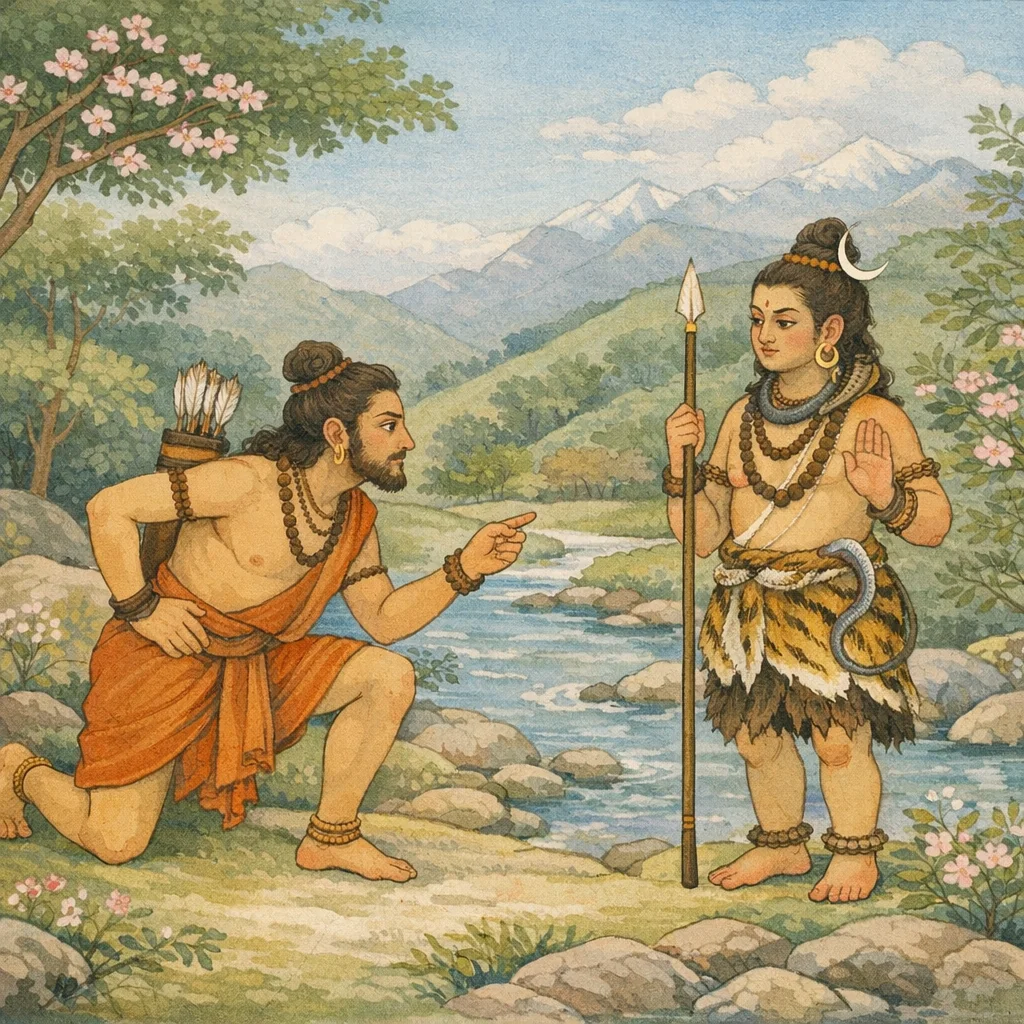
Arjuna–Gaṇa Saṃvāda: Bāṇādhikāra, Tāpasa-veṣa, and the Ethics of Tapas (अर्जुन-गणसंवादः)
This adhyāya, narrated by Nandīśvara to Sanatkumāra, presents a didactic līlā on authority, humility, and genuine asceticism. A Śiva-gaṇa (dramatically staged as a forest-dwelling bhilla) is sent regarding a bāṇa (arrow/weapon), and Arjuna arrives at the same time seeking the same object. A dispute arises over ownership and the right to release it (bāṇādhikāra): Arjuna rebukes the gaṇa and claims the arrow as his, citing identifying marks and personal entitlement. The gaṇa does not escalate violence; instead he exposes a deeper fault—Arjuna’s outward ascetic guise (tāpasa-veṣa) is contradicted by proud, false, and aggressive speech. The admonition reframes tapas as ethical integrity rather than costume, affirming that true spiritual authority is inseparable from truthful conduct. The esoteric lesson is that Śiva’s agents serve as corrective mirrors, testing the hero so egoic appropriation yields to dharmic restraint and Śaṅkara-centered remembrance (śaṃkara-smaraṇa).
Shlokas
Verse 1
नन्दीश्वर उवाच । सनत्कुमार सर्वज्ञ शृणु लीलाम्परात्मनः । भक्तवात्सल्यसंयुक्तां तद्दृढत्वविदर्भिताम्
Nandīśvara said: O Sanatkumāra, all-knowing one, listen to the divine līlā of the Supreme Self—filled with tender love for devotees, and shaped to reveal the steadfast firmness of that devotion.
Verse 2
शिवोप्यथ स्वभृत्यं वै प्रेषयामास स द्रुतम् । बाणार्थे च तदा तत्रार्जुनोपि समगात्ततः
Then Lord Śiva, too, swiftly dispatched his own attendant. And at that time, Arjuna also arrived there, seeking the arrows.
Verse 3
एकस्मिन् समये प्राप्तौ बाणार्थं तद्गणार्जुनौ । अर्जुनस्तं पराभर्त्स्य स्वबाणं चाग्रहीत्तदा
At one time, Arjuna and a member of that divine host arrived seeking arrows. Then Arjuna rebuked him and at once took up his own arrows, readying himself for action.
Verse 4
गण प्रोवाच तं तत्र किमर्थं गृह्यते शरः । बाणश्चैवास्मदीयो वै मुच्यतां ऋषिसत्तम
The Gaṇas said to him there: “For what purpose are you taking up this arrow? Truly, this arrow belongs to Bāṇa, to our own side. O best of sages, release it—set it down.”
Verse 5
इत्युक्तस्तेन भिल्लस्य गणेन मुनिसत्तमः । सोर्जुनः शंकरं स्मृत्वा वचनं च तमब्रवीत्
Thus addressed by that troop of Bhillas, Arjuna—the foremost of sages—remembered Śaṅkara, Lord Śiva, and then spoke these words to the Bhilla leader.
Verse 6
अर्जुन उवाच । अज्ञात्वा किंच वदसि मूर्खोसि त्वं वनेचर । बाणश्च मोचितो मेऽद्य त्वदीयश्च कथं पुनः
Arjuna said: “Not knowing the truth, why do you speak at all, O foolish dweller of the forest? Today the arrow that was released is mine—how could it again be called yours?”
Verse 7
रेखारूपं च पिच्छानि मन्नामांकित एव च । त्वदीयश्च कथं जातः स्वभावो दुस्त्यजस्तव
“These line-like marks and these plumes are indeed inscribed with My Name. Yet how has this nature of yours become ‘your own’—a disposition so hard for you to abandon?”
Verse 8
नन्दीश्वर उवाच । इत्येवन्तद्वचः श्रुत्वा विहस्य स गणेश्वरः । अर्जुनं ऋषिरूपं तं भिल्लो वाक्यमुपाददे
Nandīśvara said: Hearing those words, Gaṇeśvara laughed; then, assuming the role of a Bhilla (hunter), he addressed Arjuna, who had taken on the form of a sage.
Verse 9
तापस श्रूयतां रे त्वं न तपः क्रियते त्वया । वेषतश्च तपस्वी त्वं न यथार्थं छलायते
O ascetic, listen! You are not truly performing tapas. You are an ascetic only in outward dress; in reality you are engaged in deception, not in genuine austerity.
Verse 10
तपस्वी च कथं मिथ्या भाषते कुरुते नरः । नैकाकिनं च मां त्वं च जानीहि वाहिनीपतिम्
How could an ascetic ever speak or act falsely? Know this: neither I am alone, nor are you—understand me as the Lord of the celestial hosts and armies (Vāhinīpati).
Verse 11
बहुभिर्वनभिल्लैश्च युक्तः स्वामी स आसत । समर्थस्सर्वथा कर्तुं विग्रहानुग्रहौ पुनः
That Lord remained accompanied by many forest-dwellers. Fully capable in every way, He could again bring about both opposition and grace—bestowing favor upon His devotees and restraining those who stood against dharma.
Verse 12
वर्तते तस्य वाणीयं यो नीतश्च त्वयाधुना । अयं बाणश्च ते पार्श्वे न स्थास्यति कदाचन
His command still stands—he whom you have just now led away. And this arrow of yours will never remain at your side again.
Verse 13
तपःफलं कथं त्वं च हातुमिच्छसि तापस । चौर्य्याच्छलार्द्यमानाच्च विस्मयात्सत्य भञ्जनात्
O ascetic, how can you wish to abandon the fruit of your austerities? For it is assailed by theft and deceit, and by bewilderment that leads to the breaking of truth.
Verse 14
तपसा क्षीयते सत्यमेतदेव मया श्रुतम् । तस्माच्च तपसस्तेद्य भविष्यति फलं कुतः
“It is indeed true—this I have heard—that by austerity one becomes diminished (worn down). Therefore, O venerable one, how could any fruit arise from such austerity?”
Verse 15
तस्माच्च मुच्यते बाणात्कृतघ्नस्त्वं भविष्यसि । ममैव स्वामिनो बाणस्तवार्थे मोचितो ध्रुवम्
Therefore you shall be released from the arrow; yet you will surely become known as an ingrate. Indeed, this arrow of my own Lord has certainly been discharged for your sake.
Verse 16
शत्रुश्च मारितस्तेन पुनर्बाणश्च रक्षितः । अत्यन्तं च कृतघ्नोसि तपोशुभकरस्तथा
By him the enemy was slain, and yet Bāṇa was protected again. Even so, you are exceedingly ungrateful—though your austerity is said to be auspicious and merit-bearing.
Verse 17
सत्यं न भाषसे त्वं च किमतः सिद्धिमिच्छसि । प्रयोजनं चेद्बाणेन स्वामी च याच्यतां मम
You do not speak the truth—so how can you seek siddhi from this? If you have some purpose involving Bāṇa, then ask my lord, Śiva, for it.
Verse 18
ईदृशांश्च बहून्बाणांस्तदा दातुं क्षमः स्वयम् । राजा च वर्तते मेऽद्य किं त्वेवं याच्यते त्वया
“I myself am able to grant many arrows of this kind. Moreover, the king is with me today—so why do you ask me in this manner?”
Verse 19
उपकारं परित्यज्य ह्यपकारं समीहसे । नैतद्युक्तं त्वयाद्यैव क्रियते त्यज चापलम्
Abandoning beneficence, you are striving to do harm. This is not proper for you to do—give up this rash, fickle conduct at once.
Verse 20
नन्दीश्वर उवाच । इत्येवं वचनन्तस्य श्रुत्वा पार्थोर्जुनस्तदा । क्रोधं कृत्वा शिवं स्मृत्वा मितं वाक्यमथाब्रवीत्
Nandīśvara said: Having thus heard his words, Pārtha (Arjuna) then became angered; yet, remembering Lord Śiva, he spoke measured words.
Verse 21
अर्जुन उवाच । शृणु भिल्ल प्रवक्ष्यामि न सत्यं तव भाषणम् । यथा जातिस्तथा त्वां च जानामि हि वनेचर
Arjuna said: “Listen, O Bhilla. I tell you—your speech is not true. Just as your birth and kind are, so too are you; indeed, I know you as a dweller of the forest.”
Verse 22
अहं राजा भवांश्चौरः कथं युद्धप्रयुक्तता । युद्धं मे सबलैः कार्यं नाधमैर्हि कदाचन
“I am the king, and you are a thief—how can there be any proper engagement in battle between us? If I must fight, my battle should be waged only with the strong, never at any time with the base.”
Verse 23
तस्मात्ते च तथा स्वामी भविष्यति भवादृशः । दातारश्च वयं प्रोक्ताश्चौरा यूयं वनेचराः
Therefore, over you too there will indeed be a master like yourself. We are declared to be the givers, while you, forest-dwellers, are proclaimed to be thieves.
Verse 24
कथं याच्यो मया भिल्लराज एवं च साम्प्रतम् । त्वमेव याचसे नैव बाणं मां किं वनेचरः
“O Bhilla-king, how could I beg from you—especially at this time? Rather, it is you who are begging from me. O forest-dweller, why do you ask me for an arrow?”
Verse 25
ददामि ते तथा बाणान्सन्ति मे बहवो ध्रुवम् । राजा च ग्रहणं चैव न दास्यति तथा भवेत्
I shall give you arrows as well—surely I have many. And in the same way, the king too will not grant acceptance; thus it shall be.
Verse 26
किम्पुनश्च तथा बाणान्प्रयच्छामि वनेचर । यदि मे या चिकीर्षा स्यात्कथं नागम्यतेऽधुना
Moreover, O forest-dweller, why should I hand over such arrows? If I truly had some purpose to accomplish, why would it not be accomplished right now?
Verse 27
यथागच्छतु ते भर्ता किमर्थं भाषतेऽधुना । आगत्य च मया सार्द्धं जित्वा युद्धे च माम्पुनः
“Let your husband come as he pleases—why are you speaking like this now? Let him come and, after fighting with me, conquer me again in battle.”
Verse 28
नीत्वा बाणमिमं भिल्ल स्वामी ते वाहिनीपतिः । निजालयं सुखं यातु विलंबः क्रियते कथम्
“O Bhilla, take this arrow. Your lord, the commander of the army, should go happily to his own abode. Why is any delay being made?”
Verse 29
नन्दीश्वर उवाच । महेश्वरकृपाप्राप्तसद्बलस्यार्जुनस्य हि । इत्येतद्वचनं श्रुत्वा भिल्लो वाक्यमथाब्रवीत्
Nandīśvara said: “Thus, Arjuna—whose true strength had been gained through the grace of Mahādeva—having heard these words, the Bhilla hunter then spoke in reply.”
Verse 30
भिल्ल उवाच । अज्ञोसि त्वं ऋषिर्नासि मरणं त्वीहसे कथम् । देहि बाणं सुखन्तिष्ठ त्वन्यथा क्लेशभाग्भवेः
The Bhilla said: “You are ignorant; you are no sage. How can you seek death here? Hand over the arrow and remain at ease; otherwise you will become a share-holder in suffering.”
Verse 31
नन्दीश्वर उवाच । इत्युक्तस्तेन भिल्लेन शिवसच्छक्तिशोभिना । गणेन पाण्डवस्तं च प्राह स्मृत्वा च शङ्करम्
Nandīśvara said: Thus addressed by that Bhilla, the Pāṇḍava—after remembering Śaṅkara—replied to him, together with the gaṇa who shone with the true power of Śiva.
Verse 32
अर्जुन उवाच । मद्वाक्यन्तत्त्वतो भिल्ल शृणु त्वं च वनेचर । आगमिष्यति ते स्वामी दर्शयिष्ये फलन्तदा
Arjuna said: “O Bhilla, forest-dweller, listen to my words in their true purport. Your lord will soon arrive; at that time I shall show you the fruit (result) of this counsel.”
Verse 33
न शोभते त्वया युद्धं करिष्ये स्वामिना तव । उपहासकरं ज्ञेयं युद्धं सिंहसृगालयोः
This battle does not befit you; I shall fight with your master. Know that a fight between a lion and a jackal is only a cause for ridicule.
Verse 34
श्रुतं च मद्वचस्तेऽद्य द्रक्ष्यसि त्वं महाबलम् । गच्छ स्वस्वामिनं भिल्ल यथेच्छसि तथा कुरु
“Today you have heard my words; now you shall behold great power. Return to your own master, O Bhilla, and do exactly as you wish.”
Verse 35
नन्दीश्वर उवाच । इत्युक्तस्तु गतस्तत्र भिल्लः पार्थेन वै मुने । शिवावतारो यत्रास्ते किरातो वाहिनीपतिः
Nandīśvara said: Thus instructed, O sage, that Bhilla went there at Pārtha’s (Arjuna’s) bidding—to the place where the Lord’s incarnation as the Kirāta, commander of the host, was abiding.
Verse 36
अथार्जुनस्य वचनं भिल्लनाथाय विस्तरात् । सर्वं निवेदयामास तस्यै भिल्लपरात्मने
Then, in full detail, he reported Arjuna’s words to the lord of the Bhillas, conveying everything to that Bhilla chief—who, in his innermost being, was devoted to the Supreme Lord (Śiva).
Verse 37
स किरातेश्वरः श्रुत्वा तद्वचो हर्षमागतः । आजगाम स्वसैन्येन शंकरो भिल्लरूपधृक्
Hearing those words, Kirāteśvara was filled with joy. Then Śaṅkara arrived with His own retinue, assuming the form of a Bhilla— a tribal hunter—revealing His saguna līlā for the fulfillment of the unfolding divine purpose.
Verse 38
अर्जुनश्च तदा सेनां किरातस्य च पाण्डवः । दृष्ट्वा गृहीत्वा सशरन्धनुः सन्मुख आययौ
Then the Pāṇḍava Arjuna, seeing the Kirāta’s army, took up his bow together with arrows and advanced straight toward them, facing them head-on.
Verse 39
अथो किरातश्च पुनः प्रेषयामास तं चरम् । तन्मुखेन जगौ वाक्यम्भारताय महात्मने
Then the Kirāta once again dispatched that spy-messenger; and through his mouth he conveyed a message to the great-souled Bhārata (Arjuna).
Verse 40
इति श्रीशिवमहापुराणे तृतीयायां शतरुद्रसंहितायाम किरातावतारवर्णने भिल्लार्जुनसंवादोनाम चत्वारिंशोऽध्यायः
Thus, in the Śrī Śiva Mahāpurāṇa, in the Third Book, the Śatarudra Saṃhitā—within the narration of Śiva’s Kirāta incarnation—ends the fortieth chapter, entitled “The Dialogue between the Bhil and Arjuna.”
Verse 41
भ्रातरस्तव दुःखार्त्ताः कलत्रं च ततः परम् । पृथिवी हस्ततस्तेद्य यास्यतीति मतिर्मम
“Your brothers are stricken with sorrow, and after them your wife as well. Today, even the earth will slip from your hands—such is my conviction.”
Verse 42
नन्दीश्वर उवाच । इत्युक्तं परमेशेन पार्थदार्ढ्यपरीक्षया । सर्वथार्जुनरक्षार्थं धृतरूपेण शंभुना
Nandīśvara said: Thus was it spoken by the Supreme Lord, to test the steadfastness of Pārtha (Arjuna). Indeed, Śambhu—having assumed a fitting form—did so wholly for the protection of Arjuna.
Verse 43
इत्युक्तस्तु तदागत्य सगणश्शंकरश्च तत् । विस्तराद्वृत्तमखिलमर्जुनाय न्यवेदयत्
Thus addressed, Śaṅkara came there with his attendants, and in full detail related the entire course of events to Arjuna.
Verse 44
तच्छ्रुत्वा तु पुनः प्राह प्रार्थस्तं दूतमागतम् । वाहिनीपतये वाच्यम्विपरीतम्भविष्यति
Hearing that, he again spoke to the messenger who had come with a request: “Tell your commander of the army—things will turn out contrary to what you expect.”
Verse 45
यद्यहं चैव ते बाणं यच्छामि च मदीयकम् । कुलस्य दूषणं चाहं भविष्यामि न संशयः
“If I indeed give you my own arrow, then I will surely become a blemish upon my lineage—of this there is no doubt.”
Verse 46
भ्रातरश्चैव दुखार्ताः भवन्तु च तथा ध्रुवम् । विद्याश्च निष्फलाः स्युस्तास्तस्मादागच्छ वै ध्रुवम्
“May your brothers too be afflicted with sorrow—indeed, certainly. And may their learning prove fruitless; therefore, come back at once—surely.”
Verse 47
सिंहश्चैव शृगालाद्वा भीतो नैव मया श्रुतः । तथा वनेचराद्राजा न बिभेति कदाचन
I have never heard of a lion being afraid of a jackal. In the same way, the king among forest-dwellers never fears at any time; so too one established in the Lord (Śiva), the true Sovereign, is not shaken by lesser threats.
Verse 48
नन्दीश्वर उवाच । इत्युक्तस्तं पुनर्गत्वा स्वामिनं पाण्डवेन सः । सर्वं निवेदयामास तदुक्तं हि विशेषतः
Nandīśvara said: Thus instructed, he went back again to his lord and reported everything—especially the message that had been spoken by the Pāṇḍava.
Verse 49
अथ सोपि किराताह्वो महादेवस्ससैन्यकः । तच्छ्रुत्वा सैन्यसंयुक्तो ह्यर्जुनं चागमत्तदा
Then Mahādeva Himself—known there as the Kirāta, the hunter—together with His attendant host, on hearing this, advanced at once with His forces and came to Arjuna.
Frequently Asked Questions
A contest over a bāṇa between Arjuna and a Śiva-gaṇa is used as a theological-ethical argument: divine authority is not validated by status or outward marks but by dharmic conduct, and Śiva’s agents intervene to correct ego and reorient the aspirant toward authentic discipline.
The bāṇa symbolizes appropriative agency (the impulse to claim power as ‘mine’), while tāpasa-veṣa symbolizes performative spirituality. Their clash teaches that spiritual ‘weapons’ (power, merit, status) become legitimate only when governed by satya, humility, and inner tapas—i.e., when aligned with Śiva-smaraṇa rather than ego.
Rather than a distinct iconographic form of Śiva or Gaurī, the chapter highlights Śiva’s operative presence through his gaṇas (attendant powers) and through the inner imperative of Śiva-smaraṇa, presenting Śiva as the ethical and pedagogical sovereign acting within worldly encounters.