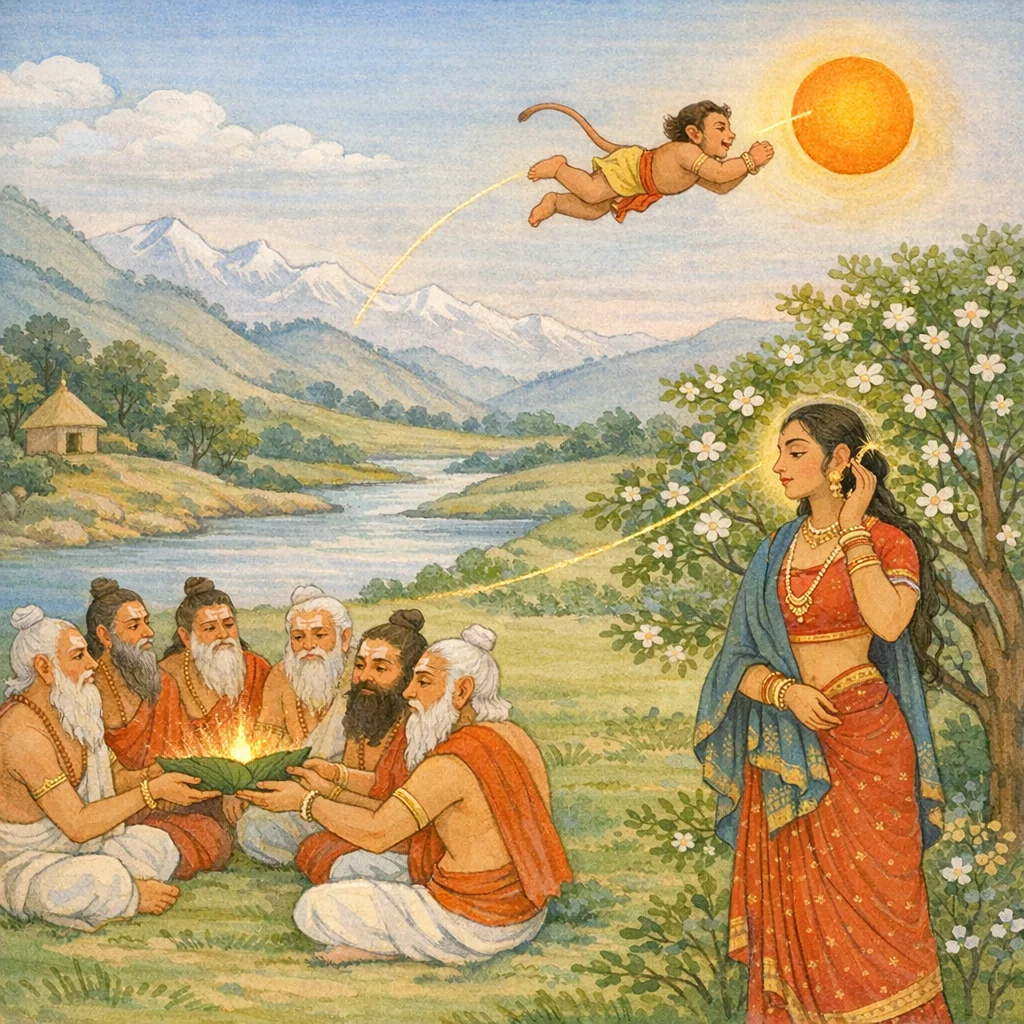
हनूमत्प्रादुर्भावः (Hanūmat-prādurbhāvaḥ) — The Manifestation/Birth of Hanumān as Śiva’s Agency
Adhyāya 20 is taught by Nandīśvara to a sage and turns to a focused Hanumān-carita, declared to be Śiva’s līlā undertaken for Rāma’s purpose (rāma-kāryārtha). Śambhu beholds Viṣṇu in the Mohinī-form, and the ensuing arousal motif is portrayed as controlled and purposeful, not merely erotic. Śiva’s vīrya is received and safeguarded by the Saptarṣis in a leaf-vessel, signifying ritual containment and cosmic stewardship. It is then transferred to Añjanā—linked with Gautama’s lineage and a “through-the-ear” transmission motif—highlighting dharmic intentionality. Hanumān is born with a kapi body as a manifestation of Śambhu, endowed with mahā-bala and mahā-parākrama. His childhood attempt to consume the sun is read as a sign of superhuman potency. The devas intervene; Hanumān is recognized as a Śiva-avatāra and receives boons from gods and seers. He returns to his mother and recounts the events, closing with didactic clarity: Śiva’s transcendence is not diminished by embodiment, and avatāra functions as delegated, targeted grace in service of dharma and Rāma’s mission.
Shlokas
Verse 1
नन्दीश्वर उवाच । अतः परं श्रुणु प्रीत्या हनुमच्चरितम्मुने । यथा चकाराशु हरो लीलास्तद्रूपतो वराः
Nandīśvara said: “Now then, O sage, listen with devotion to the sacred account of Hanumān—how Hara (Lord Śiva), assuming that excellent form, swiftly enacted His divine play.”
Verse 2
चकार सुहितं प्रीत्या रामस्य परमेश्वराः । तत्सर्वं चरितं विप्र शृणु सर्वसुखावहम्
Out of loving grace, the Supreme Lord (Śiva) brought about what was most beneficial for Rāma. O brāhmaṇa, listen to that entire sacred account—it is the giver of every auspicious joy.
Verse 3
एकस्मिन्समये शम्भुरद्भुतोतिकरः प्रभुः । ददर्श मोहिनीरूपं विष्णोस्स हि वसद्गुणः
At one time, the Lord Śambhu—whose presence brings forth wondrous marvels—beheld Viṣṇu’s enchanting form as Mohinī, a manifestation arising from Viṣṇu’s own indwelling power.
Verse 4
चक्रे स्वं क्षुभितं शम्भुः कामबाणहतो यथा । स्वम्वीर्यम्पातयामास रामकार्यार्थमीश्वरः
Śambhu, the Lord, stirred His own being—like one struck by Kāma’s arrows—and, for the sake of Rāma’s divine purpose, the Supreme Lord caused His own potent energy (vīrya) to be released.
Verse 5
तद्वीर्यं स्थापयामासुः पत्रे सप्तर्षयश्च ते । प्रेरिता मनसा तेन रामकार्यार्थ मादरात
Moved inwardly by him, those Seven Sages carefully placed that potent essence upon a leaf, with reverence, for the fulfillment of Rāma’s divine purpose.
Verse 6
तैर्गौतमसुतायां तद्वीर्यं शम्भोर्महर्षिभिः । कर्णद्वारा तथांजन्यां रामकार्यार्थमाहितम्
Through those great sages, the divine potency of Śambhu was transmitted into the daughter of Gautama; and likewise, through the ear it was implanted into Añjanā, for the fulfillment of Rāma’s sacred purpose.
Verse 7
ततश्च समये तस्माद्धनूमा निति नामभाक् । शम्भुर्जज्ञे कपितनुर्महाबलपराक्रमः
Then, at that very time, Śambhu (Lord Śiva) was born in a monkey form, bearing the name Hanūmānīti, endowed with immense strength and heroic prowess.
Verse 8
हनूमान्स कपीशानः शिशुरेव महाबलः । रविबिम्बं बभक्षाशु ज्ञात्वा लघुफलम्प्रगे
Hanumān, lord of the monkeys—though still a child, yet of immense strength—swiftly leapt to swallow the solar orb, taking it for a small fruit at daybreak.
Verse 9
देवप्रार्थनया तं सोऽत्यजज्ज्ञात्वा महाबलम् । शिवावतारं च प्राप वरान्दत्तान्सुरर्षिभिः
At the gods’ supplication, he released him, recognizing his immense might; and he attained the incarnation of Śiva, along with the boons granted by the gods and the divine seers.
Verse 10
स्वजनन्यन्तिकम्प्रागादथ सोतिप्रहर्षितः । हनूमान्सर्वमाचख्यौ तस्यै तद्वृत्तमादरात्
Then, filled with great joy, Hanumān went at once to his own mother. With reverent care, he narrated to her the entire account of what had occurred.
Verse 11
तदाज्ञया ततो धीरस्सर्वविद्यामयत्नतः । सूर्यात्पपाठ स कपिर्गत्वा नित्यं तदान्तिकम्
Obeying his command, that steadfast one effortlessly mastered every branch of knowledge. That monkey-hero went daily into the presence of the Sun and learned from him.
Verse 12
सूर्याज्ञया तदंशत्य सुग्रीवस्यान्तिकं ययौ । मातुराज्ञामनुप्राप्य रुद्रांशः कपिसत्तमः
By the command of Sūrya, that exalted portion went into the presence of Sugrīva. Having duly received his mother’s command, that foremost of monkeys—an incarnation-part of Rudra—set forth accordingly.
Verse 13
ज्येष्ठभ्रात्रा वालिना हि स्वस्त्रीभोक्त्रा तिरस्कृतः । ऋष्यमृकगिरौ तेन न्यवसत्स हनूमता
Indeed, he was scorned by his elder brother Vāli, who had taken his wife. Therefore, along with Hanūmān, he dwelt on Mount Ṛṣyamūka.
Verse 14
ततोऽभूत्स सुकण्ठस्य मन्त्री कपिवरस्सुधीः । सर्वथा सुहितं चक्रे सुग्रीवस्य हरांशजः
Thereupon, the supremely wise lord among the monkeys became Sukaṇṭha’s minister. As an emanation of Hara (Śiva), he brought about, in every way, Sugrīva’s welfare and prosperity.
Verse 15
तत्रागतेन सभ्रात्रा हृतभार्येण दुःखिना । कारयामास रामेण तस्य सख्यं सुखावहम्
When he arrived there with his brother—grief-stricken because his wife had been taken away—he had Rāma establish friendship with him, a bond that became a source of happiness.
Verse 16
घातयामास रामश्च वालिनं कपिकुञ्जरम् । भ्रातृपत्न्याश्च भोक्तारं पापिनम्वीरमानिनम्
Rāma slew Vālin, the elephant-like lord among monkeys—who had sinned by taking his brother’s wife and who, though truly fallen, still imagined himself a hero.
Verse 17
ततो रामाऽऽज्ञया तात हनूमान्वानरेश्वरः । स सीतान्वेषणञ्चक्रे बहुभिर्वानरैस्सुधीः
Then, O dear one, by Rāma’s command, Hanūmān—the lord among the Vānara chiefs—wisely undertook the search for Sītā, along with many Vānara warriors.
Verse 18
ज्ञात्वा लङ्कागतां सीतां गतस्तत्र कपीश्वरः । द्रुतमुल्लंघ्य सिंधुन्तमनिस्तीर्य्यं परैस्स वै
Having learned that Sītā had reached Laṅkā, the lord of monkeys went there; swiftly he leapt across the ocean—an impassable expanse that none of the others could cross.
Verse 19
चक्रेऽद्भुतचरित्रं स तत्र विक्रमसंयुतम् । अभिज्ञानन्ददौ प्रीत्या सीतायै स्वप्रभोर्वरम्
There he performed a wondrous deed, endowed with heroic prowess; and, with affection, he joyfully gave Sītā a token of recognition—an excellent gift belonging to his own lord.
Verse 20
सीताशोकं जहाराशु स वीरः कपिनायकः । श्रावयित्वा रामवृत्तं तत्प्राणावनकारकम्
That heroic lord of the monkeys quickly dispelled Sītā’s sorrow by recounting to her the deeds of Rāma—deeds that were life‑saving and restored her very breath of hope.
Verse 21
तदभिज्ञानमादाय निवृत्तो रामसन्निधिम् । रावणाऽऽराममाहत्य जघान बहुराक्षसान्
Taking that token of recognition, he returned to the presence of Rāma; and, having struck down Rāvaṇa’s grove, he slew many rākṣasas.
Verse 22
तदेव रावणसुतं हत्वा सबहुराक्षसम् । स महोपद्रवं चक्रे महोतिस्तत्र निर्भयः
Having slain that very son of Rāvaṇa along with many rākṣasas, he—Mahoṭi—fearlessly wrought a great upheaval there.
Verse 23
यदा दग्धो रावणेनावगुंठ्य वसनानि च । तैलाभ्यक्तानि सुदृढं महाबलवता मुने
O sage, when he was set ablaze by the mighty Rāvaṇa—after being tightly wrapped in garments that had been thoroughly smeared with oil—
Verse 24
उत्प्लुत्योत्प्लुत्य च तदा महादेवांशजः कपिः । ददाह लंकां निखिलां कृत्वा व्याजन्तमेव हि
Then that monkey—born of a portion of Mahādeva—leapt again and again, and indeed burned the entire city of Laṅkā, making it blaze forth in flames.
Verse 25
दग्ध्वा लंकां वंचयित्वा विभीषणगृहं ततः । अपतद्वारिधौ वीरस्ततस्स कपिकुञ्जरः
Having burned Laṅkā, and then sparing (passing by without harming) Vibhīṣaṇa’s dwelling, that heroic elephant among monkeys thereafter leapt down into the ocean.
Verse 26
स्वपुच्छ तत्र निर्वाप्य प्राप तस्य परन्तटम् । अखिन्नस्स ययौ रामसन्निधिं गिरिशांशजः
Having extinguished the fire there with his own tail, the son who bore a portion of Girīśa (Śiva) reached the far bank. Unwearied, he then went into the presence of Rāma.
Verse 27
अविलंबेन सुजवो हनूमान् कपिसत्तमः । रामोपकण्ठमागत्य ददौ सीताशिरोमणिम्
Without delay, swift Hanumān—the foremost among the Vānaras—came near Lord Rāma and offered him Sītā’s crest-jewel.
Verse 28
ततस्तदाज्ञया वीरस्सिन्धौ सेतुमबन्धयत् । वानरस्स समानीय बहून्गिरिवरान्बली
Then, acting on that command, the mighty hero had a causeway built across the ocean; gathering the Vānaras together, he brought many excellent mountains to accomplish the task.
Verse 29
गत्वा तत्र ततो रामस्तर्तुकामो यथा ततः । शिवलिंगं समानर्च प्रतिष्ठाप्य जयेप्सया
Having gone there, Rāma—desiring to cross over—duly worshipped a Śiva-liṅga, and, longing for victory, had it ritually established.
Verse 30
तद्वरात्स जयं प्राप्य वरं तीर्त्वोदधिं ततः । लंकामावृत्य कपिभी रणं चक्रे स राक्षसैः
By the power of that boon he attained victory; then, in accordance with the granted favor, he crossed the ocean, surrounded Laṅkā with hosts of Vānaras, and waged battle with the Rākṣasas.
Verse 31
जघानाथासुरान्वीरो रामसैन्यं ररक्ष सः । शक्ति क्षतं लक्ष्मणं च संजीविन्या ह्यजीवयत्
That heroic one slew the Asuras and protected Rāma’s army; and Lakṣmaṇa, wounded by the Śakti spear, he restored to life by the Saṃjīvinī herb.
Verse 32
सर्वथा सुखिनं चक्रे सरामं लक्ष्मणं हि सः । सर्वसैन्यं ररक्षासौ महादेवात्मजः प्रभुः
In every way, he made Lakṣmaṇa—together with Rāma—fully at ease. That sovereign Lord, the son of Mahādeva, also protected the entire army.
Verse 33
रावणं परिवाराढ्यं नाशयामास विश्रमः । सुखीचकार देवान्स महाबलग्रहः कपि
That mighty monkey Viśrama destroyed Rāvaṇa along with his retinue, and he made the gods happy and secure again.
Verse 34
महीरावणसंज्ञं स हत्वा रामं सलक्ष्मणम् । तत्स्थानादानयामास स्वस्थानम्परिपाल्य च
Having slain the one known as Mahīrāvaṇa, he brought Rāma together with Lakṣmaṇa back from that place; and, safeguarding his own abode as well, he returned them.
Verse 35
रामकार्यं चकाराशु सर्वथा कपिपुंगवः । असुरान्नमयामास नानालीलां चकार च
That foremost of monkeys swiftly accomplished Rāma’s mission in every way. He humbled the asuras and performed many wondrous exploits—līlā that reveal divine power at work in the world for the restoration of dharma.
Verse 36
स्थापयामास भूलोके रामभक्तिं कपीश्वरः । स्वयं भक्तवरो भूत्वा सीतारामसुखप्रदः
The Lord of the monkeys established devotion to Rāma upon the earth. Becoming himself the foremost of devotees, he became the bestower of joy to Sītā and Rāma.
Verse 37
लक्ष्मणप्राणदाता च सर्वदेवमदापहः । रुद्रावतारो भगवान्भक्तोद्धारकरस्स वै
He is the giver of life to Lakṣmaṇa and the remover of the pride of all the gods. Truly, he is Bhagavān—an incarnation of Rudra—who surely uplifts his devotees and grants them liberation.
Verse 38
हनुमान्स महावीरो रामकार्यकरस्सदा । रामदूताभिधो लोके दैत्यघ्नो भक्तवत्सलः
Hanumān is that great hero who ever carries out Rāma’s work. Known in the world as Rāma’s messenger, he is the slayer of the daityas and ever affectionate to devotees.
Verse 39
इति ते कथितं तात हनुमच्चरितम्वरम् । धन्यं यशस्यमायुष्यं सर्वकामफलप्रदम्
Thus, dear child, I have told you the excellent sacred account of Hanumān. It is auspicious and blessed, bestowing fame and long life, and it grants the fruits of all rightful desires.
Verse 40
य इदं शृणुयाद्भक्त्या श्रावयेद्वा समाहितः । स भुक्त्वेहाखिलान्कामानन्ते मोक्षं लभेत्परम्
Whoever hears this with devotion, or, being composed, causes it to be recited for others—having enjoyed here all desired aims, in the end attains the supreme liberation.
Frequently Asked Questions
It presents Hanumān’s manifestation as Śiva’s intentional līlā undertaken for Rāma’s task: Śiva beholds Viṣṇu’s Mohinī-form, his potency is ritually safeguarded by the Saptarṣis, transmitted to Añjanā, and results in Hanumān’s birth as a kapi-bodied Śiva-avatāra endowed with extraordinary power and boons.
The ‘leaf-vessel’ containment and ṛṣi-custodianship symbolize regulated tejas (spiritual potency) under dharmic governance; the ‘ear-door’ transmission motif encodes non-ordinary conception through sanctioned śakti-transfer rather than biological accident; the sun-consumption episode functions as a semiotic proof of avatāric energy and the necessity of divine/social regulation (devas’ intervention).
Śiva is highlighted as Śambhu/Hara acting through avatāra-agency culminating in Hanumān as a Śiva-avatāra; the chapter’s cited verses do not foreground a distinct Gaurī-form, focusing instead on Śiva’s purposeful embodiment and empowerment of Hanumān for the Rāma-kārya.