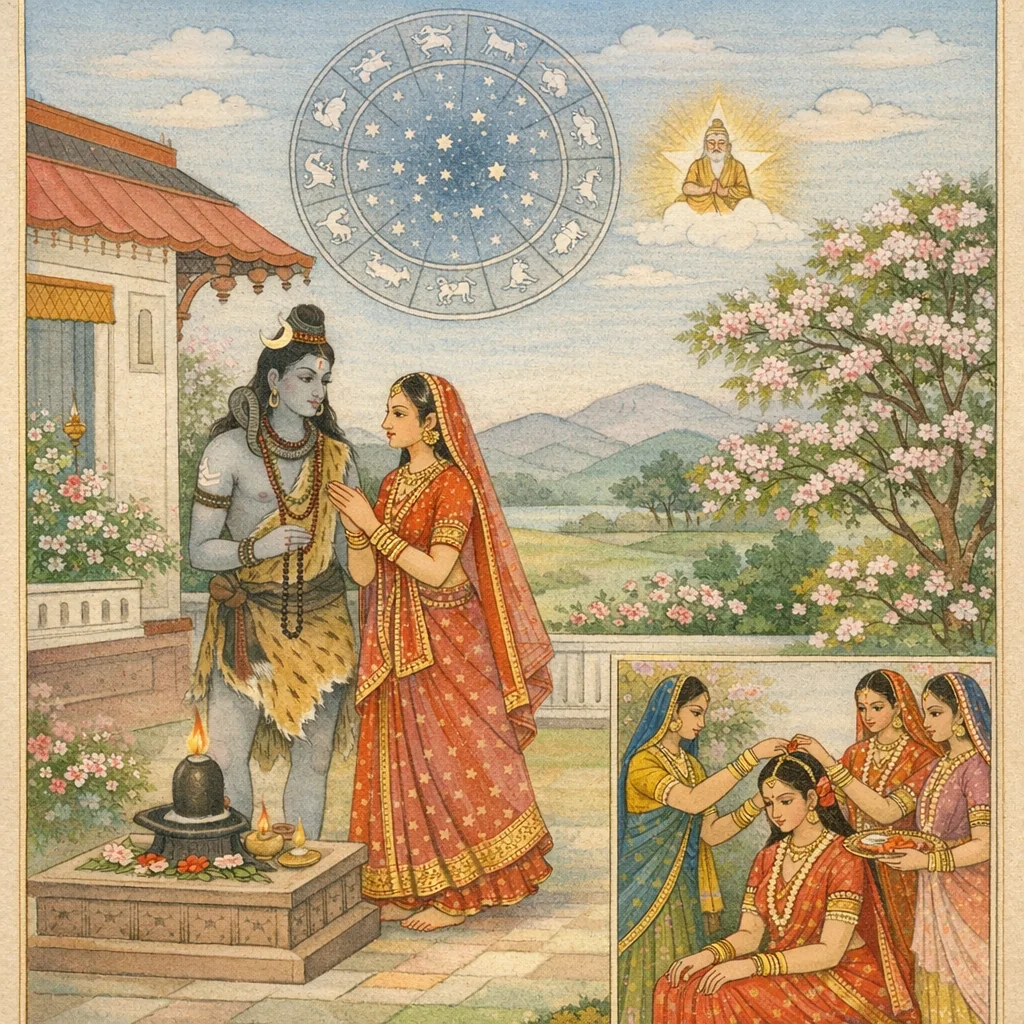
गृहस्थ-जीवनसंस्काराः तथा पुत्रजन्म-शुभलक्षणवर्णनम् / Household Saṃskāras and the Auspicious Portents of a Son’s Birth
Adhyāya 14, spoken by Nandīśvara in an authoritative voice, presents a tightly ordered account of household piety through the proper sequencing of saṃskāras. A brāhmaṇa returns home in great joy and recounts events to his wife, affirming the home as a true sphere of dharma and Śaiva auspiciousness. The wife responds with purity and affection, and the narrative moves through prenatal rites performed according to gṛhya-vidhi: garbhādhāna (conception), puṃsavana (for the fetus’s well-being and desired qualities), and sīmanta (hair-parting), all done with care. Auspicious timing and astrology then appear—benefic stars, a favorable lagna, and guru in a kendra—linking cosmic order to embodied life. The birth of a son is described apotropaically as the extinguishing of misfortunes and the destruction of all ariṣṭa, followed by cosmic rejoicing: fragrant flowers rain down, divine drums resound, the directions grow serene, waters clear, and darkness and dust diminish. The Purāṇic teaching is that correct rite, auspicious time, and Śiva-aligned order transform both household destiny and the surrounding cosmos, making a private saṃskāra a public metaphysical event.
Shlokas
Verse 1
नन्दीश्वर उवाच । स विप्रो गृहमागत्य महाहर्षसमन्वितः । प्रियायै कथयामास तद्वृत्तान्तमशेषतः
Nandīśvara said: That brāhmaṇa returned home, filled with great joy, and told his beloved the entire account of all that had occurred, leaving nothing unsaid.
Verse 2
तच्छ्रुत्वा विप्रपत्नी सा मुदम्प्राप शुचिष्मती । अतीव प्रेमसंयुक्ता प्रशशंस विधिन्निजम्
Hearing this, the brāhmaṇa’s wife—pure and radiant—was filled with joy. Overwhelmed with deep love, she praised the dharma and the rightly ordained conduct that was hers to follow.
Verse 3
अथ कालेन तद्योषिदन्तर्वत्नी बभूव ह । विधिवद्विहिते तेन गर्भाधानाख्यकर्मणि
In due course of time, his wife indeed became pregnant, for he had duly performed, in the prescribed manner, the rite known as Garbhādhāna.
Verse 4
ततः पुंसवनन्तेन स्यन्दनात्प्राग्विपश्चिता । गृह्योक्तविधिना सम्यक्कृतम्पुंस्त्वविवृद्धये
Thereafter, before her pregnancy became outwardly evident, the wise woman duly performed the Puṃsavana rite as taught in the Gṛhya-sūtras, for the proper growth and well-being of the male-generative principle and of the child.
Verse 5
सीमन्तोऽथाष्टमे मासे गर्भरूपसमृद्धिकृत् । सुखप्रसवसिद्धौ च तेनाकरि कृपाविदा
Then, in the eighth month, the rite called Sīmanta was performed, which nourishes and perfects the child’s form within the womb; and through that compassionate, wise observance, the attainment of an easy and auspicious delivery was ensured.
Verse 6
अथातश्शुभतारासु ताराधिपवराननः । केन्द्रे गुरौ शुभे लग्ने सुग्रहेषु युगेषु च
Now then—when the lunar asterisms are auspicious, when the Moon, lord of the stars, is bright and favorable, when Jupiter (Guru) holds a benefic central position, when the ascendant is auspicious, and when the planets and their combinations are propitious—one should undertake the sacred Śaiva rite at that time.
Verse 7
अरिष्टदीपनिर्वाणस्सर्वारिष्टविनाशकृत् । तनयो नाम तस्यान्तु शुचिष्मत्याम्बभूव ह
From her was born a son named Ariṣṭadīpanirvāṇa, the destroyer of all inauspicious portents; and indeed, he was born of Śuciṣmatī.
Verse 8
शर्वस्समस्तसुखदो भूर्भुवः स्वर्न्निवासिनाम् । गन्धवाहनवाहाश्च दिग्वधूर्मुखवाससः
Śarva (Lord Śiva) bestows all happiness upon the dwellers of Bhūr, Bhuvaḥ, and Svar. He is borne by the Wind as His vehicle, and the very faces of the Directions are His raiment—revealing Him as the all-pervading Lord (Pati) who supports and transcends the worlds.
Verse 9
इष्टगन्धप्रसूनौघैर्ववृषुस्ते घनाघनाः । देवदुन्दुभयो नेदुः प्रसेदुस्सर्व्वतो दिशः
Then those dense, rain-bearing clouds poured down torrents of fragrant, choice blossoms. The celestial kettledrums resounded, and in every direction the quarters grew clear and serene—an auspicious sign of Śiva’s grace manifesting in the world.
Verse 10
परितस्सरितस्स्वच्छा भूतानां मानसैस्सह । तमोऽताम्यत्तु नितरां रजोऽपि विरजोऽभवत्
All around, the currents became clear and pure, together with the minds of beings. Darkness (tamas) was utterly dispelled, and even passion (rajas) became free from impurity—refined into clarity—by the sovereign presence of Rudra.
Verse 11
सत्त्वास्सत्त्वसमायुक्ताः सुधावृष्टिर्बभूव वै । कल्याणी सर्वथा वाणी प्राणिनः प्रियवत्यभूत्
All beings became filled with sattva (purity and clarity). Truly, it was as though a rain of nectar fell; and speech became auspicious in every way, so that it turned dear and pleasing to all living creatures.
Verse 12
रंभामुख्या अप्सरसो मङ्गलद्रव्यपाणयः । विद्याधर्यश्च किन्नर्य्यस्तथा मर्य्यस्सहस्रशः
Led by Rambhā, hosts of apsarās arrived with auspicious offerings in their hands; with them came the Vidyādharīs, the Kinnarīs, and thousands of mortals as well.
Verse 13
गन्धर्वोरगयक्षाणां सुमानियः शुभस्वराः । गायन्त्यो मंगलं गीतन्तत्राजग्मुरनेकशः
Then many celestial beings—Gandharvas, Nāgas (Uragas), and Yakṣas—arrived there in great numbers, bearing beautiful garlands and singing auspicious songs in sweet and sacred tones.
Verse 14
इति श्रीशिवमहापुराणे तृतीयायां शतरुद्रसंहितायां गृहपत्यवतारोपाख्याने गृहपत्यवतारवर्णनंनाम चतुर्दशोऽध्यायः
Thus, in the Śrī Śiva Mahāpurāṇa, in the Third Book, the Śatarudra-saṃhitā, within the narrative of the Gṛhapatya incarnation, concludes the Fourteenth Chapter entitled “Description of the Gṛhapatya Incarnation.”
Verse 15
लोमशो रोमचरणो भरद्वाजोऽथ गौतमः । भृगुस्तु गालवो गर्गो जातूकर्ण्यः पराशरः
“(The sages) Lomaśa, Romacaraṇa, Bharadvāja, and then Gautama; and also Bhṛgu, Gālava, Garga, Jātūkarṇya, and Parāśara (were present/are to be known).”}]}]}
Verse 16
आपस्तम्बो याज्ञवल्क्यो दक्षवाल्मीकिमुद्गलाः । शातातपश्च लिखितश्शिलादः शंख उञ्छभुक्
Āpastamba, Yājñavalkya, Dakṣa, Vālmīki, Mudgala, Śātātapa, Likhita, Śilāda, Śaṅkha, and Uñchabhuk—these revered sages too are remembered here as authorities; their disciplines and teachings uphold the path of dharma and the devotional understanding of Lord Śiva’s many forms.
Verse 17
जमदग्निश्च संवर्तो मतंगो भरतोंशुमान् । व्यासः कात्यायनः कुत्सः शौनकस्तु श्रुतश्शुकः
Jamadagni, Saṃvarta, Mataṅga, Bharata, and the radiant Aṃśumān; Vyāsa, Kātyāyana, Kutsa, Śaunaka, and Śrutaśśuka—these revered sages too are counted among those celebrated in this account of Śiva’s manifold manifestations.
Verse 18
ऋष्यशृङ्गोऽथ दुर्व्वासाश्शुचिर्नारद तुम्बुरुः । उत्तंको वामदेवश्च पवनोऽसितदेवलौ
Then there were Ṛṣyaśṛṅga, Durvāsā, Śuci, Nārada, and Tumburu; also Uttaṅka, Vāmadeva, Pavana, and Asita and Devala—revered seers and celestial devotees, renowned for austerity and devotion directed to Śiva, the Supreme Lord (Pati) who bestows grace and liberation.
Verse 19
सालंकायनहारीतौ विश्वामित्रोऽथ भार्गवः । मृकण्डस्सह पुत्रेण पर्व्वतो दारुकस्तथा
There were Sālaṃkāyana and Hārīta; then Viśvāmitra and Bhārgava (Paraśurāma); Mṛkaṇḍa together with his son; and also Parvata and Dāruka—thus were these revered sages enumerated as present.
Verse 20
धौम्योपमन्युवत्साद्या मुनयो मुनिकन्यकाः । तच्छान्त्यर्थं समाजग्मुर्धन्यं विश्वानराश्रमम्
Sages such as Dhaumya, Upamanyu, and Vatsa—along with the daughters of the sages—assembled there; and to pacify that affliction, they went together to the blessed hermitage of Viśvānara.
Verse 21
ब्रह्मा बृहस्पतियुतो देवो गरुडवाहनः । नन्दिभृङ्गि समायुक्तो गौर्य्या सह वृषध्वजः
There were Brahmā accompanied by Bṛhaspati, and also the god who rides Garuḍa (Viṣṇu); and the Bull-bannered Lord (Śiva) as well—together with Gaurī—attended by Nandī and Bhṛṅgī.
Verse 22
महेन्द्रमुख्या गीर्वाणा नागाः पातालवासिनः । रत्नान्यादाय बहुशस्ससरित्का महाब्धयः
Indra and the other gods, the Nāgas who dwell in Pātāla, and the great oceans with their rivers—again and again brought forth precious gems as offerings, in reverent homage.
Verse 23
स्थावरा जंगमं रूपं धृत्वा यातास्सहस्रशः । महामहोत्सवे तस्मिन्बभूवाकालकौमुदी
Assuming forms as both the immovable and the moving, they went forth by the thousands. In that great and supreme festival, there arose a moonlit radiance out of season—an untimely, wondrous brilliance—signifying the overflowing grace of Śiva’s manifest (saguṇa) presence.
Verse 24
जातकर्म स्वयं तस्य कृतवान्विधिरानतः । श्रुतिं विचार्य्य तद्रूपन्नाम्ना गृहपतिस्त्वयम्
With reverence, Vidhi (Brahmā) himself performed his birth-rite (jātakarma). Then, reflecting upon the testimony of the Śruti, you became the lord of the household, bearing a name suited to that very form, as ordained by revelation.
Verse 25
इति नाम ददौ तस्मै देयमेकादशेऽहनि । नामकर्मविधानेन तदर्थश्रुतिमुच्चरन्
Thus he bestowed a name upon the child, to be given on the eleventh day. Following the prescribed rite of name-giving (nāma-karma), he pronounced the sacred utterance that conveys the meaning and intent of that name.
Verse 26
चतुर्निगममन्त्रोक्तैराशीर्भिरभिनन्द्य च । समयाद्धंसमारुह्य सर्वेषाञ्च पितामहः
And then, blessing them with benedictions uttered through the mantras of the four Vedas, the Grandsire of all beings (Brahmā) honored them; at the appointed time, he mounted his swan and departed.
Verse 27
कृत्वा बालोचितां रक्षां लौकिकीं गतिमाश्रितः । आरुह्य यानं स्वन्धाम हरोऽपि हरिणा ययौ
Having arranged a simple, child-appropriate protection in an ordinary worldly manner, Hara too—following the customary course—mounted his conveyance and, together with Hari, went to his own abode.
Verse 28
अहो रूपमहो तेजस्त्वहो सर्वांगलक्षणम् । अहो शुचिष्मती भाग्यमाविरासीत्स्वयं हरः
Ah! What a wondrous form! Ah! What splendour! Truly, in every limb are perfect auspicious marks. O marvel—how pure and blessed is this fortune: Hara Himself has manifested in person.
Verse 29
अथवा किमिदं चित्रं शर्वभक्तजनेष्वहो । स्वयमाविरभूद्रुद्रो ययो रुद्रस्तदर्चितः
Or else, what is so wondrous about this among the devotees of Śarva? Rudra Himself manifested—so that Rudra (Śiva) might be worshipped through that very manifestation.
Verse 30
इति स्तुवन्तस्तेन्योन्यं सम्प्रहृष्टतनूरुहः । विश्वानरं समापृच्छ्य जग्मुः सर्वे यथागतम्
Thus, praising (Śiva) and gladdening one another—hair standing on end in devotional rapture—they took leave of Viśvānara, and all departed, each returning to his own place as he had come.
Verse 31
अतः पुत्रं समीहन्ते गृहस्थाश्रमवासिनः । पुत्रेण लोकाञ्जयति श्रुतिरेषा सनातनी
Therefore, those who abide in the householder āśrama strive for a son; for through a son one conquers (attains) the worlds—this is the eternal teaching of the Śruti.
Verse 32
अपुत्रस्य गृहं शून्यमपुत्रस्यार्जनं वृथा । अपुत्रस्य तपश्छिन्नं नो पवित्रत्यपुत्रतः
For one without a son, the home is said to be empty; for one without a son, the gathering of wealth is deemed futile. For one without a son, austerity (tapas) is considered broken in its continuity; and without a son, the expected sanctifying merit—bound to lineage and rites—is not attained.
Verse 33
न पुत्रात्परमो लाभो न पुत्रात्परमं सुखम् । न पुत्रात्परमं मित्रम्परत्रेह च कुत्रचित्
There is no gain greater than a son, no happiness greater than a son, and no friend greater than a son—whether in this world or in the world beyond, anywhere at all.
Verse 34
निष्क्रमोऽथ चतुर्थेऽस्य मासि पित्रा कृतो गृहात् । अन्नप्राशनमब्दार्द्धे चूडार्द्धे चार्थवत्कृता
Then, in his fourth month, the father performed the rite of taking the child out of the house. At the half-year mark he carried out the first-feeding ceremony, and at the proper time he also performed the tonsure (cūḍā)—each rite done with due sanctity and purpose.
Verse 35
कर्णवेधन्ततः कृत्वा श्रवणर्क्षे स कर्मवित् । ब्रह्मतेजोभिवृद्ध्यर्थं पञ्चमेऽब्दे व्रतन्ददौ
Then the knower of sacred rites performed the ear‑piercing ceremony under the Śravaṇa asterism, and in the child’s fifth year he undertook (and bestowed) a vow so that the splendor of brahman—spiritual radiance and purity—might increase.
Verse 36
उपाकर्मं ततः कृत्वा वेदानध्यापयत्सुधीः । अब्दं वेदान्स विधिनाऽध्यैष्ट सांगपदक्रमान्
Then, having duly performed the Upākarman rite, the wise one began the regular instruction of the Vedas. For a full year he studied the Vedas according to proper rule—together with their auxiliaries (Vedāṅgas) and with the Pada and Krama methods of recitation—so that the sacred sound might be preserved in its flawless order.
Verse 37
विद्याजातं समस्तं च साक्षिमात्रं गुरोमुखात् । विनयादिगुणानाविष्कुर्वञ्जग्राह शक्तिमान्
From the mouth of his guru, the powerful one received the entire multitude of branches of knowledge merely as a witness; and while receiving them, he manifested virtues such as humility and disciplined conduct.
Verse 38
ततोऽथ नवमे वर्षे पित्रोश्शुश्रूषणे रतम् । वैश्वानरं गृहपतिं द्रष्टुमायाच्च नारदः
Then, in the ninth year, while he was devoted to attentive service of his parents, the sage Nārada came there, wishing to see Vaiśvānara, the Lord of the household-fire.
Verse 39
विश्वानरोटजम्प्राप्य देवर्षिस्तं तु कौतुकी । अपृच्छत्कुशलन्तत्र गृहीतार्धासनः क्रमात्
Having reached Viśvānara’s hermitage, the divine sage—stirred by reverent curiosity—accepted a half-seat in proper order and then asked there after his well-being.
Verse 40
ततः सर्वं च तद्भाग्यं पुत्रधर्मं च सम्मुखे । वैश्वानरं समवदत्स्मृत्वा शिवपदाम्बुजम्
Then, remembering the lotus-feet of Lord Śiva, he spoke in their very presence of everything—his own good fortune and the righteous duties of a son—and he duly addressed Vaiśvānara as well.
Verse 41
नन्दीश्वर उवाच । इत्युक्तो मुनिना बालः पित्रोराज्ञामवाप्य सः । प्रणम्य नारदं श्रीमान् भक्त्या प्रह्व उपाविशत
Nandīśvara said: Thus instructed by the sage, the noble boy obtained his parents’ consent. Then, bowing to Nārada with devotion, he sat down in humility.
Verse 42
वैश्वानर समभ्येहि ममोत्संगे निषीद भोः । लक्षणानि परीक्षेऽहं पाणिन्दर्शय दक्षिणम्
“O Vaiśvānara, come here and sit upon my lap. I shall examine your auspicious marks—show me your right hand.”
Verse 43
ततो दृष्ट्वा तु सर्वं हि तालुजिह्वादि नारदः । विश्वानरं समवदच्छिवप्रेरणया सुधीः
Then, having observed everything—beginning with the palate and the tongue—Nārada, the wise one, spoke to Vaiśvānara, impelled by Lord Śiva’s inspiration.
Verse 44
नारद उवाच । विश्वानर मुने वच्मि शृणु पुत्रांकमादरात् । सर्वांगस्वंकवान्पुत्रो महालक्षणवानयम्
Narada said: “O sage Viśvānara, I shall speak—listen with reverence as you hold your son upon your lap. This son bears auspicious marks in every limb and is endowed with great characteristics.”
Verse 45
किन्तु सर्वगुणोपेतं सर्वलक्षणलक्षितम् । सम्पूर्णनिर्मलकलं पालयेद्विधुवद्विधिः
But the wise devotee should preserve and maintain (that sacred form) as one endowed with all auspicious qualities, marked by every proper sign, complete and stainless in its parts—cherishing it with steady, moon-like gentleness and disciplined observance.
Verse 46
तस्मात्सर्वप्रयत्नेन रक्षणीयस्त्वसौ शिशु । गुणोऽपि दोषतां याति वक्रीभूते विधातरि
Therefore, with every effort this child must be protected; for even a virtue can turn into a fault when the Disposer of destiny becomes adverse.
Verse 47
शंकेऽस्य द्वादशे मासि प्रत्यूहो विद्युदग्नितः । इत्युक्त्वा नारदोऽगच्छद्देवलोकं यथागतम्
“I suspect that, in his twelfth month, an obstacle will arise from lightning and fire.” Having said this, Nārada departed again to the world of the gods, as he had come.
Frequently Asked Questions
Rather than a large-scale mythic battle or cosmogony, the chapter presents a theological argument through domestic narrative: properly performed prenatal saṃskāras and auspicious timing produce not only a healthy birth but also cosmically visible auspiciousness (flowers, divine drums, serenity of directions), implying that household rite participates in Śiva-governed cosmic order.
The rain of fragrant flowers and the sounding of deva-dundubhis symbolize divine ratification of dharmic-ritual correctness; the clearing of waters and the reduction of darkness/dust encode the restoration of sattva and the pacification of disorder. The ‘ariṣṭa-dīpa-nirvāṇa’ motif frames the newborn as an apotropaic pivot—an embodied sign that inauspicious forces are extinguished when life is generated under aligned rite and time.
No single iconographic form (mūrti) of Śiva or Gaurī is foregrounded in the sample verses; instead, Śiva’s function appears implicitly as Rudraic auspiciousness and protection (ariṣṭa-vināśa). The chapter highlights Śiva as the unseen regulator of auspicious order rather than as a named avatāra or localized manifestation.