अध्याय ५५ — बाणस्य पुनर्युद्धप्रवृत्तिः (Bāṇa’s Renewed Engagement in Battle)
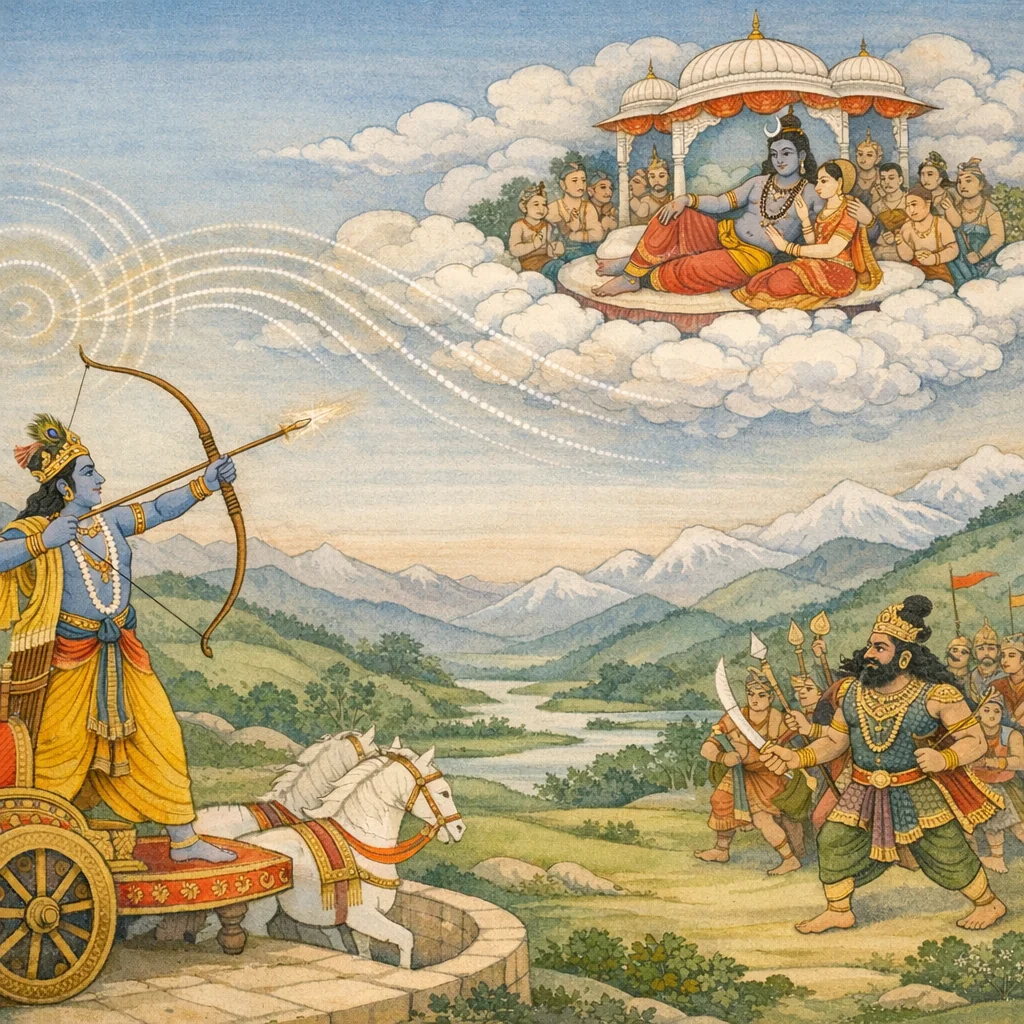
Adhyāya 55 continues the Bāṇa–Kṛṣṇa battle after Śrī Kṛṣṇa releases a counter-weapon that nullifies the earlier danger. Told through layered transmission—Sūta narrating, Vyāsa questioning, and Sanatkumāra replying—the chapter stresses authoritative tradition. Vyāsa asks what Bāṇa does once his forces are checked; Sanatkumāra presents it as an extraordinary līlā involving Kṛṣṇa and Śaṅkara. While Rudra rests briefly with his son and the gaṇas, Bāṇa, the daitya-king and son of Bali, re-enters the fight. Enraged at seeing his army diminished, he renews the assault with heightened effort and many weapons. Kṛṣṇa’s heroic confidence is then highlighted: he roars, treats Bāṇa as insignificant, and makes his bow Śārṅga resound so mightily that the space between heaven and earth is said to be filled with its reverberation. The chapter emphasizes escalation, sound-as-power (nāda), and the rhetorical diminishing of daitya strength before divinely sanctioned might, preparing for the exchanges that follow.
Shlokas
Verse 1
व्यास उवाच । सनत्कुमार सर्वज्ञ ब्रह्मपुत्र नमोस्तु ते । अद्भुतेयं कथा तात श्राविता मे त्वया मुने
Vyāsa said: “O Sanatkumāra, all-knowing son of Brahmā, salutations to you. O revered sage, dear one—this wondrous sacred account has been made known to me by you.”
Verse 2
जृंभिते जृंभणास्त्रेण हरिणा समरे हरे । हते बाणबले बाणः किमकार्षीच्च तद्वद
When, in the battle, Hari struck Hara with the Jṛmbhaṇa weapon and Hara was made to yawn and falter, then—when the force of Bāṇa’s army was destroyed—what did Bāṇa do next? Tell that as well.
Verse 4
सनत्कुमार उवाच । शृणु व्यास महाप्राज्ञ कथां च परमाद्भुताम् । कृष्णशंकरयोस्तात लोकलीलानुसारिणोः
Sanatkumāra said: “Listen, O Vyāsa, great sage, to this most wondrous account—O dear one—concerning Kṛṣṇa and Śaṅkara, who conduct their divine play in harmony with the ways of the world.”
Verse 5
शयिते लीलया रुद्रे सपुत्रे सगणे सति । बाणो विनिर्गतो युद्धं कर्तुं कृष्णेन दैत्यराट्
While Rudra, at ease in sacred play, lay there with his sons and surrounded by his gaṇas, Bāṇa—the king among the daityas—set forth to wage war with Kṛṣṇa.
Verse 6
कुंभांडसंगृहीताश्वो नानाशस्त्रास्त्रधृक् ततः । चकार युद्धमतुलं बलिपुत्रो महाबलः
Then Bali’s mighty son—mounted on a horse seized from Kumbhāṇḍa and bearing many kinds of weapons and missiles—waged a battle beyond compare.
Verse 7
दृष्ट्वा निजबलं नष्टं स दैत्येन्द्रोऽत्यमर्षितः । चकार युद्धमतुलं बलि पुत्रो महाबलः
Seeing his own forces destroyed, that lord of the Daityas was seized by fierce rage; then Bali’s mighty son launched an incomparable battle.
Verse 8
श्रीकृष्णोपि महावीरो गिरिशाप्तमहाबलः । उच्चैर्जगर्ज तत्राजौ बाणं मत्वा तृणोपमम्
Even Śrī Kṛṣṇa—the great hero, endowed with immense strength by the ordinance of Girīśa (Lord Śiva)—roared aloud upon the battlefield, deeming Bāṇa no more than a blade of grass.
Verse 9
धनुष्टंकारयामास शार्ङ्गाख्यं निजमद्भुतम् । त्रासयन्बाणसैन्यं तदवशिष्टं मुनीश्वर
O best of sages, he made his own wondrous bow—named Śārṅga—resound with a thunderous twang, thereby terrifying the remaining forces of Bāṇa.
Verse 10
तेन नादेन महता धनुष्टंकारजेन हि । द्यावाभूम्योरंतरं वै व्याप्तमासीदनंतरम्
By that mighty roar—indeed, born of the twang of the bow—the entire space between heaven and earth was at once pervaded in an instant.
Verse 11
चिक्षेप विविधान्बाणान्बाणाय कुपितो हरिः । कर्णान्तं तद्विकृष्याथ तीक्ष्णानाशीविषोपमान्
Enraged, Hari (Viṣṇu) hurled many kinds of arrows at Bāṇa. Then, drawing his bow back to his ear, he shot sharp shafts—like poisonous serpents in their deadly force.
Verse 12
आयातांस्तान्निरीक्ष्याऽथ स बाणो बलिनन्दनः । अप्राप्तानेव चिच्छेद स्वशरैस्स्वधनुश्च्युतैः
Then Bāṇa, the son of Bali, seeing those missiles rushing toward him, cut them down with his own arrows released from his bow—shattering them before they could even reach their target.
Verse 13
पुनर्जगर्ज स विभुर्बाणो वैरिगणार्दनः । तत्रसुर्वृष्णयस्सर्वे कृष्णात्मानो विचेतसः
Then the mighty Bāṇa—crusher of hostile ranks—roared again. Thereupon all the Vṛṣṇis present, their minds fixed on Kṛṣṇa, became unsteady and bewildered (amid the terror of battle).
Verse 14
स्मृत्वा शिवपदाम्भोजं चिक्षेप निजसायकान् । स कृष्णायातिशूराय महागर्वो बलेस्सुतः
Remembering the lotus-feet of Lord Śiva, the greatly arrogant son of Bala hurled his own arrows at Kṛṣṇa, the exceedingly valiant hero advancing into battle.
Verse 15
कृष्णोपि तानसंप्राप्तानच्छिनत्सशरैर्द्रुतम् । स्मृत्वा शिवपदाम्भोजममरारि महाबलः
Even Kṛṣṇa—mighty, the foe of the gods’ enemies—remembered the lotus-feet of Lord Śiva; and at once, with swift arrows, he cut down those who had come upon him.
Verse 16
रामादयो वृष्णयश्च स्वंस्वं योद्धारमाहवे । निजघ्नुर्बलिनस्सर्वे कृत्वा क्रोधं समाकुलाः
Then Rāma and the others, and the Vṛṣṇis too—each in the thick of battle—struck down his own opposing warrior. All those mighty ones, their minds churned by wrath, became utterly agitated and slew their foes.
Verse 17
इत्थं चिरतरं तत्र बलिनोश्च द्वयोरपि । बभूव तुमुलं युद्धं शृण्वतां विस्मयावहम्
Thus, for a long time there, between those two mighty ones, a tumultuous battle raged on—astonishing to all who heard of it.
Verse 18
तस्मिन्नवसरे तत्र क्रोधं कृत्वाऽतिपक्षिराट् । बाणासुरबलं सर्वं पक्षाघातैरमर्दयत्
At that very moment, the mighty king of birds, roused to wrath, crushed the entire army of Bāṇāsura there with the blows of his wings.
Verse 19
मर्दितं स्वबलं दृष्ट्वा मर्दयंतं च तं बली । चुकोपाति बलेः पुत्रः शैवराड् दितिजेश्वरः
Seeing his own forces crushed, and seeing that mighty one still crushing them, Bali’s son—the lord of the Daityas, the Śaiva king—was inflamed with wrath.
Verse 20
स्मृत्वा शिवपदाम्भोजं सहस्रभुजवान्द्रुतम् । महत्पराक्रमं चक्रे वैरिणां दुस्सहं स वै
Remembering the lotus-feet of Lord Śiva, that thousand-armed one swiftly sprang into action and displayed mighty valor—truly unbearable to his enemies.
Verse 21
चिक्षेप युगपद्बाणानमितांस्तत्र वीरहा । कृष्णादिसर्वयदुषु गरुडे च पृथक्पृथक्
There the slayer of heroes hurled countless arrows all at once—separately and distinctly—at Kṛṣṇa and at all the Yādavas, and also at Garuḍa.
Verse 22
जघानैकेन गरुडं कृष्णमेकेन पत्त्रिणा । बलमेकेन च मुने परानपि तथा बली
With a single feather he struck down Garuḍa; with another he felled Kṛṣṇa. And with yet another, O sage, that mighty one shattered the strength of the others as well.
Verse 23
ततः कृष्णो महावीर्यो विष्णुरूपस्सुरारिहा । चुकोपातिरणे तस्मिञ्जगर्ज च महेश्वरः
Then Kṛṣṇa—of great valor, taking on the form of Viṣṇu, the destroyer of the enemies of the gods—became fiercely enraged in that battle. And Mahādeva (Maheśvara) also roared there, shaking the battlefield with His sovereign might.
Verse 24
जघान बाणं तरसा शार्ङ्गनिस्सृतसच्छरैः । अति तद्बलमत्युग्रं युगपत्स्मृतशंकरः
Then, with great speed, he struck down Bāṇa with the excellent arrows released from Śārṅga. Though Bāṇa’s power was exceedingly fierce, he was simultaneously subdued—Shiva being remembered at that very moment.
Verse 25
चिच्छेद तद्धनुश्शीघ्रं छत्रादिकमना कुलः । हयांश्च पातयामास हत्वा तान्स्वशरैर्हरिः
Unperturbed, Hari swiftly cut that bow to pieces, along with the parasol and the other royal insignia; and with his own arrows he struck down and killed the horses, causing them to fall.
Verse 26
बाणोऽपि च महावीरो जगर्जाति प्रकुप्य ह । कृष्णं जघान गदया सोऽपतद्धरणीतले
Then Bāṇa too—an exceedingly mighty hero—roared in fury and struck Kṛṣṇa with his mace; and Kṛṣṇa fell upon the surface of the earth.
Verse 27
उत्थायारं ततः कृष्णो युयुधे तेन शत्रुणा । शिवभक्तेन देवर्षे लोकलीलाऽनुसारतः
Then Kṛṣṇa rose up and fought with that enemy—who was in truth a devotee of Śiva—O divine sage, in accordance with the Lord’s play in the world.
Verse 28
एवं द्वयोश्चिरं काल बभूव सुमहान्रणः । शिवरूपो हरिः कृष्णः स च शैवोत्तमो बली
Thus, for a long time a very great battle raged between the two. Hari—Kṛṣṇa—appearing in the form and bearing the majesty of Śiva, stood forth as a supremely devoted Śaiva and a mighty warrior.
Verse 29
कृष्णोऽथ कृत्वा समरं चिरं बाणेन वीर्यवान् । शिवाऽऽज्ञया प्राप्तबलश्चुकोपाति मुनीश्वरः
Then Kṛṣṇa, the valiant, after battling Bāṇa for a long while, flared up in wrath; for that great sage had gained strength by the command of Śiva.
Verse 30
ततस्सुदर्शनेनाशु कृष्णो बाणभुजान्बहून् । चिच्छेद भगवाञ्शंभु शासनात्परवीरहा
Then, at the command of Bhagavān Śambhu (Lord Śiva), Kṛṣṇa, wielder of the Sudarśana, swiftly severed many of Bāṇa’s arms, becoming the slayer of the enemy’s champions.
Verse 31
अवशिष्टा भुजास्तस्य चत्वारोऽतीव सुन्दराः । गतव्यथो बभूवाशु शंकरस्य प्रसादतः
By the gracious favor of Śaṅkara, the four arms that remained to him became exceedingly beautiful, and he was quickly freed from pain and distress.
Verse 32
गतस्मृतिर्यदा बाण शिरश्छेत्तुं समुद्यतः । कृष्णो वीरत्वमापन्नस्तदा रुद्रस्समुत्थितः
When Bāṇa, having lost all sense, rose up to cut off (Kṛṣṇa’s) head, and Kṛṣṇa stood firm in heroic resolve—at that very moment Rudra rose up (to intervene).
Verse 33
रुद्र उवाच । भगवन्देवकीपुत्र यदाज्ञप्तं मया पुरा । तत्कृतं च त्वया विप्र मदाज्ञाकारिणा सदा
Rudra said: “O Blessed One, son of Devakī! Whatever was formerly commanded by me has indeed been carried out by you, O venerable brāhmaṇa—for you are ever one who acts in accordance with my command.”
Verse 34
मा बाणस्य शिरश्छिंधि संहरस्व सुदर्शनम् । मदाज्ञया चक्रमिदं स्यान्मोघं मज्जने सदा
“Do not sever Bāṇa’s head. Withdraw the Sudarśana discus. By my command, let this discus ever remain ineffective, unable to submerge or destroy him.”
Verse 35
दत्तं मया पुरा तुभ्यमनिवार्यं रणे तव । चक्रं जयं च गोविन्द निवर्तस्व रणात्ततः
“Formerly I granted you, for your battle, an irresistible discus and victory. Therefore, O Govinda, withdraw now from that battlefield.”
Verse 36
दधीचे रावणे वीरे तारकादिपुरेष्वपि । विना मदाज्ञां लक्ष्मीश रथाङ्गं नामुचः पुरा
“O Lord of Lakṣmī, even against the heroic Rāvaṇa, and even in cities such as Tārakā’s, the discus (Sudarśana) was not released without My command. Formerly, it was not hurled even against Nāmuci.”
Verse 37
त्वं तु योगीश्वरस्स्साक्षात्परमात्मा जनार्दन । विचार्यतां स्वमनसा सर्वभूतहिते रतः
But you, O Janārdana, are in truth the Lord of Yoga—indeed the Supreme Self (Paramātman). Therefore, reflecting within your own mind, act while remaining intent on the welfare of all beings.
Verse 38
वरमस्य मया दत्तं न मृत्युर्भयमस्ति वै । तन्मे वचस्सदा सत्यं परितुष्टोस्म्यहं तव
“I have indeed granted him this boon—there shall be no fear of death for him. Therefore, let my word ever remain true; I am well pleased with you.”
Verse 39
पुराऽयं गर्वितो मत्तो युद्धं देहीति मेऽब्रवीत् । भुजान्कण्डूयमानस्तु विस्मृतात्मगतिर्हरे
Formerly, this one—swollen with pride—said to me, “Grant me battle.” And, O Hari, while merely scratching his arms in swagger, he forgot the true course of his own Self.
Verse 40
तदाहमशपं तं वै भुजच्छेत्ताऽऽगमिष्यति । अचिरेणातिकालेन गतगर्वो भविष्यसि
“Therefore I curse you: a cutter of your arms shall surely come. Before long, in no great time, your pride will be shattered and you will become bereft of arrogance.”
Verse 41
मदाज्ञया हरिः प्राप्तो भुजच्छेत्ता तवाऽथ वै । निवर्तस्व रणाद्गच्छ स्वगृहं सवधूवरः
“By my command, Hari has arrived—indeed, he is the cutter of your arms. Therefore withdraw from this battle; depart and go to your own home, together with your bride, O excellent one.”
Verse 42
इत्युक्तः स तयोमैत्रीं कारयित्वा महेश्वरः । तममुज्ञाप्य सगणः सपुत्रः स्वालयं ययौ
Having spoken thus, Lord Maheśvara established friendship between the two. Then, granting him leave, Śiva—together with His attendants and with His son—departed for His own abode.
Verse 43
सनत्कुमार उवाच । इत्याकर्ण्य वचश्शंभोस्संहृत्य च सुदर्शनम् । अक्षतांगस्तु विजयी तत्कृष्णोंतःपुरं ययौ
Sanatkumāra said: Hearing these words of Śambhu (Lord Śiva), he withdrew the Sudarśana discus. Unwounded in body and victorious, that Kṛṣṇa then went into the inner palace.
Verse 44
अनिरुद्धं समाश्वास्य सहितं भार्यया पुनः । जग्राह रत्नसंघातं बाणदत्तमनेकशः
After consoling Aniruddha—now reunited with his wife—they accepted again and again the heaps of jewels bestowed by Bāṇa.
Verse 45
तत्सखीं चित्रलेखां च गृहीत्वा परयोगिनीम् । प्रसन्नोऽभूत्ततः कृष्णः कृतकार्यः शिवाज्ञया
Then, taking with him her friend Citralekhā—the supreme yoginī—Kṛṣṇa was pleased, for the task had been fulfilled in accordance with Śiva’s command.
Verse 46
हृदा प्रणम्य गिरिशमामंत्र्य च बलेस्तुतम् । परिवारसमेतस्तु जगाम स्वपुरीं हरिः
Bowing from the heart to Girīśa (Lord Śiva) and respectfully taking leave of Bali, who had praised him, Hari (Viṣṇu), accompanied by his retinue, departed for his own city.
Verse 47
पथि जित्वा च वरुणं विरुद्धं तमनेकधा । द्वारकां च पुरीं प्राप्तस्समुत्सवसमन्वितः
On the way he overcame Varuṇa, who opposed him in many ways; then he reached the city of Dvārakā amid great celebrations and festivity.
Verse 48
विसर्जयित्वा गरुडं सखीन्वीक्ष्योपहस्य च । द्वारकायां ततो दृष्ट्वा कामचारी चचार ह
Having dismissed Garuḍa, and after looking at his companions with a gentle smile, he then beheld Dvārakā; moving at will, he wandered there freely.
Verse 55
इति श्रीशिवमहापुराणे द्वितीयायां रुद्रसंहितायां पंचमे युद्धखंडे बाणभुजकृंतनगर्वापहारवर्णनं नाम पञ्चपञ्चाशत्तमोध्यायः
Thus ends the fifty-fifth chapter, called “The Description of the Cutting of Bāṇa’s Arms and the Removal of His Pride,” in the fifth section, the Yuddha-khaṇḍa, of the second part, the Rudra-saṃhitā, of the Śrī Śiva Mahāpurāṇa.
Frequently Asked Questions
The chapter centers on Bāṇa (son of Bali) re-entering and escalating the battle against Śrī Kṛṣṇa after a prior weapon-countermeasure episode; it highlights his anger, weaponry, and Kṛṣṇa’s overpowering response (notably the thunderous Śārṅga bow-sound).
It signals that the conflict is not random violence but a purposeful divine dramaturgy: events reveal hierarchy among powers, the limits of boon-based might, and the reassertion of dharma under Śiva’s overarching auspice.
Astra-power (Jṛṃbhaṇāstra), heroic tejas (splendor/force) of Kṛṣṇa, and nāda-śakti (the bow’s resonance filling the cosmic space), alongside Bāṇa’s daitya-bala and multi-weapon engagement.