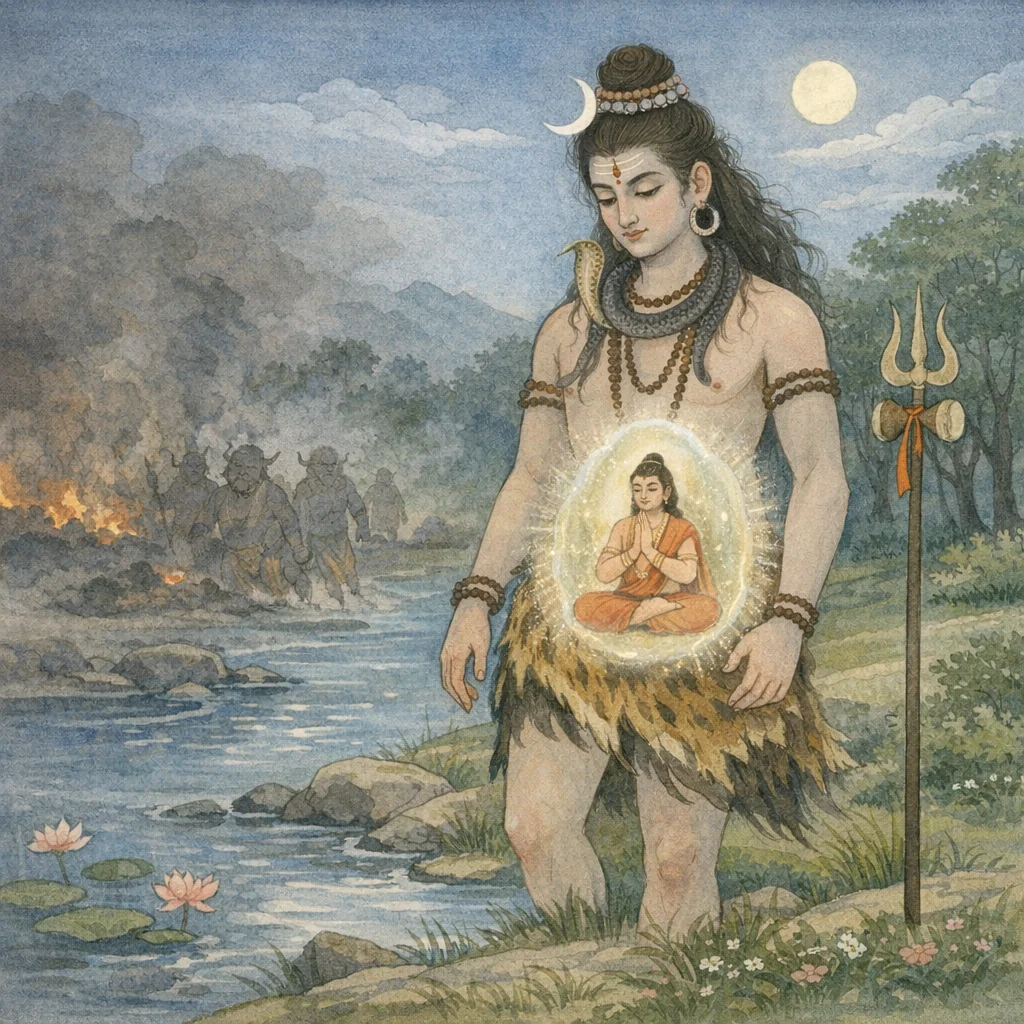
शुक्रस्य जठरस्थत्वं तथा मृत्युशमनी-विद्या (Śukra in Śiva’s belly and the death-subduing vidyā)
Adhyāya 47 opens with Vyāsa’s questions about a startling battlefield report: Śukra (Bhārgava), the learned preceptor and leader of the daityas, is said to have been “swallowed” by Tripurāri (Śiva). Vyāsa asks what the Mahāyogin Pinākin did while Śukra remained within His belly, why the terrible inner “belly-fire” did not burn him, and how Śukra later emerged from Śiva’s abdominal “cage.” He further inquires into Śukra’s subsequent worship—its duration, method, and fruit—especially his attainment of the supreme mṛtyu-śamanī vidyā, the knowledge/mantra that pacifies or wards off death. Vyāsa also asks how Andhaka gained gaṇapatya status and how the śūla (trident/śūla-force) manifested here, stressing that Śiva’s līlā is the key to understanding. The frame then shifts as Brahmā reports that Sanatkumāra begins the authoritative exposition, placing the episode within the ongoing Śaṅkara–Andhaka war and its strategic formations. The chapter thus serves as a doctrinal-narrative hinge: it resolves the paradox of divine consumption without destruction, highlights devotion and mantra-knowledge as means of deliverance, and re-anchors the war story in Śaiva cosmology and sacred pedagogy.
Shlokas
Verse 1
व्यास उवाच । तस्मिन्महति संग्रामे दारुणे लोमहर्षणे । शुक्रो दैत्यपतिर्विद्वान्भक्षितस्त्रिपुरारिणा
Vyāsa said: In that great battle—terrible and hair-raising—Śukra, the learned lord of the Daityas, was consumed by the Foe of Tripura, Lord Śiva.
Verse 2
इति श्रुतं समासान्मे तत्पुनर्ब्रूहि विस्तरात । किं चकार महायोगी जठरस्थः पिनाकिनः
“Thus I have heard it in brief; now tell it to me again in detail. What did the great Yogin—Pinākin, Lord Śiva who bears the bow Pināka—do while abiding within the belly?”
Verse 3
न ददाह कथं शभोश्शुक्रं तं जठरानलः । कल्पान्तदहनः कालो दीप्ततेजाश्च भार्गवः
How could the gastric fire (jatharāgni) fail to burn that seed of Śambhu? Even Time (Kāla), the blaze that consumes the world at the end of a kalpa, and Bhārgava of blazing splendour could not burn it.
Verse 4
विनिष्क्रांतः कथं धीमाच्छंभोर्जठरपंजरात् । कथमाराधयामास कियत्कालं स भार्गवः
How did that wise Bhārgava come forth from the cage-like belly of Śambhu? And in what manner did he perform ārādhana—devotional worship—of Him, and for how long a time?
Verse 5
अथ च लब्धवान्विद्यां तां मृत्युशमनीं पराम् । का सा विद्या परा तात यथा मृत्युर्हि वार्यते
“And further, he obtained that supreme vidyā—highest sacred knowledge—which pacifies death. What, dear one, is that highest knowledge by which death itself is truly held back?”
Verse 6
लेभेन्धको गाणपत्यं कथं शूला द्विनिर्गतः । देवदेवस्य वै शंभोर्मुनेर्लीलाविहारिणः
How did Andhaka obtain the status and power of lordship over the Gaṇas (gaṇapatya)? And how did the Śūla—the trident—come forth in twofold form from trident-bearing Lord Śambhu, Śiva, the God of gods, who sports in divine līlā like a sage?
Verse 7
एतत्सर्वमशेषेण महाधीमन् कृपां कुरु । शिवलीलामृतं तात शृण्वत कथयस्व मे
O great-souled sage, show compassion and relate all of this in full, without omission. Dear father, tell me the nectar of Śiva’s divine līlā, as I listen with reverent attention.
Verse 8
ब्रह्मोवाच । इति तस्य वचः श्रुत्वा व्यासस्यामिततेजसः । सनत्कुमारः प्रोवाच स्मृत्वा शिवपदांबुजम्
Brahmā said: Having thus heard the words of Vyāsa of immeasurable splendor, Sanatkumāra began to speak, first remembering the lotus-feet of Lord Śiva.
Verse 9
सनत्कुमार उवाच । शृणु व्यास महाबुद्धे शिवलीलामृतं परम् । धन्यस्त्वं शैवमुख्योसि ममानन्दकरः स्वतः
Sanatkumāra said: O Vyāsa, great in wisdom, listen to the supreme nectar of Śiva’s divine līlā. Blessed are you—foremost among Śiva’s devotees—for by your very nature you bring joy to me.
Verse 10
प्रवर्तमाने समरे शंकरांधकयोस्तयोः । अनिर्भेद्यपविव्यूहगिरिव्यूहाधिनाथयोः
As the battle raged between Śaṅkara and Andhaka—those two sovereign commanders of war-formations (vyūha), whose arrays were like unbreakable fortresses and mountain-like ranks—the combat continued with unabated force.
Verse 11
पुरा जयो बभूवापि दैत्यानां बलशालिनाम् । शिवप्रभा वादभवत्प्रमथानां मुने जयः
Formerly, victory did indeed belong to the mighty Daityas. But through the radiant power of Śiva, O sage, victory came to the Pramathas.
Verse 12
तच्छुत्वासीद्विषण्णो हि महादैत्योंधकासुरः । कथं स्यान्मे जय इति विचारणपरोऽभवत्
Hearing that, the mighty Daitya Andhakāsura became deeply dejected. He then turned wholly to reflection, thinking, “How can victory be mine?”
Verse 13
अपसृत्य ततो युद्धादंधकः परबुद्धिमान् । द्रुतमभ्यगमद्वीर एकलश्शुक्रसन्निधिम्
Then, withdrawing from the battle, Andhaka—keen of intellect—swiftly went, O hero, alone into the presence of Śukra.
Verse 14
प्रणम्य स्वगुरुं काव्यमवरुह्य रथाच्च सः । बभाषेदं विचार्याथ सांजलिर्नीतिवित्तमः
Having bowed to his own guru, Kāvyā (Śukrācārya), and having descended from the chariot, he then spoke after due reflection—hands joined in reverence—being the most discerning in matters of statecraft and righteous conduct.
Verse 15
अंधक उवाच । भगवंस्त्वामुपाश्रित्य गुरोर्भावं वहामहे । पराजिता भवामो नो सर्वदा जयशालिनः
Andhaka said: “O venerable one, having taken refuge in you, we bear the attitude of discipleship toward our guru. May we never be defeated; may we always be endowed with victory.”
Verse 16
त्वत्प्रभावात्सदा देवान्समस्तान्सानुगान्वयम् । मन्यामहे हरोषेन्द्रमुखानपि हि कत्तृणान्
By the power of your glory, we always regard all the gods together with their followers as mere blades of grass—even Hari (Viṣṇu) and Indra and the rest.
Verse 17
अस्मत्तो बिभ्यति सुरास्तदा भवदनुग्रहात् । गजा इव हरिभ्यश्च तार्क्ष्येभ्य इव पन्नगाः
By your gracious favour, the devas then become afraid of us—just as elephants fear lions, and serpents fear Garuḍa.
Verse 18
अनिर्भेद्यं पविव्यूहं विविशुर्दैत्य दानवाः । प्रमथानीकमखिलं विधूय त्वदनुग्रहात्
By your grace, the Daityas and Dānavas forced their way into the impenetrable thunderbolt-formation (pavi-vyūha), having shaken and scattered the entire host of the Pramathas.
Verse 19
वयं त्वच्छरणा भूत्वा सदा गा इव निश्चलाः । स्थित्वा चरामो निश्शंकमाजावपि हि भार्गव
Having taken refuge in you, we remain ever steady—like cows that do not stray. Standing firm, we move about without fear, even in the midst of battle, O Bhārgava.
Verse 20
रक्षरक्षाभितो विप्र प्रव्रज्य शरणागतान् । असुराञ्छत्रुभिर्वीरैरर्दितांश्च मृतानपि
O brāhmaṇa, crying out again and again, “Protect us, protect us!”, the refugees went forth to seek shelter—those who had been tormented by heroic enemies, even those slain by the asuras.
Verse 21
प्रथमैर्भीमविक्रांतैः क्रांतान्मृत्युप्रमाथिभिः । सूदितान्पतितान्पश्य हुंडादीन्मद्गणान्वरान्
“Look—my excellent gaṇas, beginning with Huṇḍa and others, have been struck down and have fallen, overwhelmed by those foremost warriors of dreadful prowess—death-dealing assailants who trample all before them.”
Verse 22
यः पीत्वा कणधूमं वै सहस्रं शरदां पुरा । त्वया प्राप्ता वरा विद्या तस्याः कालोयमागतः
He who, long ago, drank the smoke of chaff for a thousand autumns—of that excellent sacred knowledge (vidyā) which you obtained as a boon, the time for its fruition has now arrived.
Verse 23
अद्य विद्याफलं तत्ते सर्वे पश्यंतु भार्गव । प्रमथा असुरान्सर्वान् कृपया जीवयिष्यतः
“Today, O Bhārgava, let everyone behold the fruit of your sacred knowledge. The Pramathas, moved by compassion, will spare the lives of all the Asuras.”
Verse 24
सनत्कुमार उवाच । इत्थमन्धकवाक्यं स श्रुत्वा धीरो हि भार्गवः । तदा विचारयामास दूयमानेन चेतसा
Sanatkumāra said: Having thus heard the words of Andhaka, the steadfast Bhārgava remained composed; yet, with a heart inwardly burning, he then began to reflect deeply on what should be done.
Verse 25
किं कर्तव्यं मयाद्यापि क्षेमं मे स्यात्कथं त्विति । सन्निपातविधिर्जीवः सर्वथानुचितो मम
“What should I do even now? How may there be safety and well-being for me?”—thinking thus, I realize that for me, in every way, the living being’s prescribed course in this crisis is wholly improper (and cannot be properly followed).
Verse 26
विधेयं शंकरात्प्राप्ता तद्गुणान् प्रति योजये । तद्रणे मर्दितान्वीरः प्रमथैश्शंकरानुगैः
Having obtained the command from Śaṅkara, I shall now apply myself according to His qualities and will. In that battle, the hero was crushed by the Pramathas—Śaṅkara’s devoted attendants.
Verse 27
शरणागतधर्मोथ प्रवरस्सर्वतो हृदा । विचार्य शुक्रेण धिया तद्वाणी स्वीकृता तदा
Then, foremost in the dharma of protecting those who seek refuge, he pondered with all his heart—and, after due reflection with a clear and discerning intellect—accepted those words.
Verse 28
किंचित्स्मितं तदा कृत्वा सोऽब्रवीद्दानवाधिपम् । भार्गवश्शिवपादाब्जं सप्पा स्वस्थेन चेतसा
Then, with a slight smile, Bhārgava spoke to the lord of the Dānavas. Having reverently worshipped the lotus-feet of Śiva, he spoke with a steady and composed mind.
Verse 29
शुक्र उवाच । यत्त्वया भाषितं तात तत्सर्वं तथ्यमेव हि । एतद्विद्योपार्जनं हि दानवार्थं कृतं मया
Śukra said: “O dear one, whatever you have spoken is entirely true indeed. This acquisition of sacred vidyā was undertaken by me for the sake of the Dānavas.”
Verse 30
दुस्सहं कणधूमं वै पीत्वा वर्षसहस्रकम् । विद्येयमीश्वरात्प्राप्ता बंधूनां सुखदा सदा
Having endured and inhaled the unbearable smoke of chaff for a thousand years, this sacred vidyā was obtained from the Lord (Īśvara); it ever bestows happiness upon one’s kinsmen.
Verse 31
प्रमथैर्मथितान्दैत्यान्रणेहं विद्ययानया । उत्थापयिष्ये म्लानानि शस्यानि जलभुग्यथा
“Here in battle, the Daityas who have been crushed by the Pramathas—I shall revive them by this very vidyā, just as water makes withered crops rise again.”
Verse 32
निर्व्रणान्नीरुजः स्वस्थान्सुप्त्वेव पुन रुत्थितान् । मुहूर्तेस्मिंश्च द्रष्टासि दैत्यांस्तानुत्थितान्निजान्
“In just a moment you will see those Dānavas—your own troops—risen again as if awakened from sleep: free from wounds, free from pain, and restored to their former strength.”
Verse 33
सनत्कुमार उवाच । इत्युक्त्वा सोधकं शुक्रो विद्यामावर्तयत्क विः । एकैकं दैत्यमुद्दिश्य स्मृत्वा विद्येशमादरात्
Sanatkumāra said: Having spoken thus, Śukra—the wise one—began to set the purificatory rite in motion by invoking his sacred knowledge. Remembering Vidyeśa with reverence, he directed that power toward each Daitya, one by one.
Verse 34
विद्यावर्तनमात्रेण ते सर्वे दैत्यदानवाः । उत्तस्थुर्युगपद्वीरास्सुप्ता इव धृतायुधाः
By the mere turning of that mystic spell, all those heroic Daityas and Dānavas rose up at once—like warriors awakened from sleep, already holding their weapons.
Verse 35
सदाभ्यस्ता यथा वेदास्समरे वा यथाम्बुदा । श्रदयार्थास्तथा दत्ता ब्राह्मणेभ्यो यथापदि
Just as the Vedas are practiced constantly, and just as clouds gather in time for battle, so too were gifts—offered with faith—given to the brāhmaṇas at every proper occasion, according to due rule.
Verse 36
उज्जीवितांस्तु तान्दृष्ट्वा हुंडादींश्च महासुरान् । विनेदुरसुराः सर्वे जलपूर्णा इवांबुदाः
But on seeing them restored to life—and also beholding the mighty Asuras beginning with Huṃḍa—all the Asuras roared aloud, like clouds swollen and heavy with water.
Verse 37
रणोद्यताः पुनश्चासन्गर्जंतो विकटान्रवान् । प्रमथैस्सह निर्भीता महाबलपराक्रमाः
Once again they stood ready for battle, roaring with dreadful cries. Fearless, they advanced together with the Pramathas—mighty in strength and heroic in prowess.
Verse 38
शुक्रेणोज्जीवितान्दृष्ट्वा प्रमथा दैत्यदानवान् । विसिष्मिरे ततस्सर्वे नंद्याद्या युद्धदुर्मदाः
Seeing that the Dāityas and Dānavas had been restored to life by Śukra, all the Pramathas—Nandī and the others, intoxicated with the pride of battle—were struck with astonishment.
Verse 39
विज्ञाप्यमेवं कर्मैतद्देवेशे शंकरेऽखिलम् । विचार्य बुद्धिमंतश्च ह्येवं तेऽन्योन्यमब्रुवन्
Thus this entire course of action was duly reported to Śaṅkara, the Lord of the gods. Then those wise ones, having reflected, spoke among themselves in this manner.
Verse 40
आश्चर्यरूपे प्रमथेश्वराणां तस्मिंस्तथा वर्तति युद्धयज्ञे । अमर्षितो भार्गवकर्म दृष्ट्वा शिलादपुत्रोऽभ्यगमन्महेशम्
As that battle-sacrifice proceeded in wondrous form under the command of the Lords of the Gaṇas, Nandin, son of Śilāda, seeing the deed wrought by the Bhārgava (Paraśurāma), flared with indignation and went straight to Mahādeva.
Verse 41
जयेति चोक्त्वा जययोनिमुग्रमुवाच नंदी कनकावदातम् । गणेश्वराणां रणकर्म देव देवैश्च सेन्द्रैरपि दुष्करं सत्
Crying “Victory! Victory!”, Nandī spoke to that fierce, radiant one, golden and spotless in splendor: “O Lord, the warfare undertaken by the Gaṇeśvaras is truly difficult—even for the gods, even for Indra together with them.”
Verse 42
तद्भार्गवेणाद्य कृतं वृथा नस्संजीवतांस्तान्हि मृतान्विपक्षान् । आवर्त्य विद्यां मृतजीवदात्रीमेकेकमुद्दिश्य सहेलमीश
O Lord, what Bhārgava has done today is futile for us, for he is reviving those enemy warriors who were already dead. Recalling the life-restoring vidyā that brings the dead back to life, he is easily reviving them one by one.
Verse 43
तुहुंडहुंडादिककुंभजंभविपा कपाकादिमहासुरेन्द्राः । यमालयादद्य पुनर्निवृत्ता विद्रावयंतः प्रमथांश्चरंति
The mighty lords of the Asuras—Tuhuṇḍa, Huṇḍa, Kumbha, Jambha, Vipāka, Kapāka and others—having today returned again from Yama’s abode, now roam about, driving away the Pramathas.
Verse 44
यदि ह्यसौ दैत्यवरान्निरस्तान्संजीवयेदत्र पुनः पुनस्तान् । जयः कुतो नो भविता महेश गणेश्वराणां कुत एव शांतिः
For if he were to revive again and again those foremost demons who have been cast down here, then how could victory ever be ours, O Maheśa? And how indeed could there be peace for the Gaṇeśvaras, Śiva’s attendant hosts?
Verse 45
सनत्कुमार उवाच । इत्येवमुक्तः प्रमथेश्वरेण स नंदिना वै प्रमथेश्वरेशः । उवाच देवः प्रहसंस्तदानीं तं नंदिनं सर्वगणेशराजम्
Sanatkumāra said: Thus addressed by Nandin, the Lord of the Pramathas, that divine Lord—smiling at that moment—spoke to Nandin, the king over all the gaṇas.
Verse 46
शिव उवाच । नन्दिन्प्रयाहि त्वरितोऽति मात्रं द्विजेन्द्रवर्यं दितिनन्दनानाम् । मध्यात्समुद्धृत्य तथा नयाशु श्येनो यथा लावकमंडजातम्
Lord Śiva said: “O Nandin, go at once—swiftly indeed. From the midst of Diti’s sons, lift up that foremost of brāhmaṇas and bring him here quickly, just as a hawk snatches up a young bird from a flock.”
Verse 47
इति श्रीशिव महापुराणे द्वितीयायां रुद्रसंहितायां पञ्चमे युद्धखंडे अंधकयुद्धे शुक्रनिगीर्णनवर्णनं नाम सप्तचत्वारिंशोऽध्यायः
Thus, in the Śrī Śiva Mahāpurāṇa—within the Second Book, the Rudra Saṃhitā, in the Fifth section called the Yuddha-khaṇḍa—during the battle with Andhaka, concludes the forty-seventh chapter entitled “The Account of Śukra Being Swallowed.”
Verse 48
तं रक्ष्यमाणं दितिजैस्समस्तैः पाशासिवृक्षोपलशैलहस्तैः । विक्षोभ्य दैत्यान्बलवाञ्जहार काव्यं स नन्दी शरभो यथेभम्
Though guarded on all sides by the Diti-born demons—bearing nooses and swords, trees, boulders, and even mountain-crags in their hands—mighty Nandī, like a fierce śarabha overpowering an elephant, shook the daityas in battle and carried off Kāvya (Śukrācārya) by force.
Verse 49
स्रस्तांबरं विच्युतभूषणं च विमुक्तकेशं बलिना गृहीतम् । विमोचयिष्यंत इवानुजग्मुः सुरारयस्सिंहरवांस्त्यजंतः
His garments had slipped, his ornaments had fallen away, and his hair was loosened—thus seized by the mighty one. The enemies of the gods followed after him as though they would set him free, all the while letting out lion-like roars.
Verse 50
दंभोलि शूलासिपरश्वधानामुद्दंडचक्रोपलकंपनानाम् । नंदीश्वरस्योपरि दानवेन्द्रा वर्षं ववर्षुर्जलदा इवोग्रम्
Like fierce storm-clouds pouring a violent rain, the lords of the Dānavas showered upon Nandīśvara a dreadful barrage—vajra-thunderbolts, tridents, swords, axes, heavy clubs, discs, and stone-missiles—until the battlefield itself shook.
Verse 51
तं भार्गवं प्राप्य गणाधिराजो मुखाग्निना शस्त्रशतानि दग्ध्वा । आयात्प्रवृद्धेऽसुरदेवयुद्धे भवस्य पार्श्वे व्यथितारिपक्षः
Reaching Bhārgava (Śukra), the lord of Śiva’s gaṇas burned up hundreds of weapons with the fire that issued from his mouth. Then, as the war between asuras and devas grew ever more fierce, he came to Bhava’s side, having sorely harried the enemy host.
Verse 52
अयं स शुक्रो भगवन्नितीदं निवेदयामास भवाय शीघ्रम् । जग्राह शुक्रं स च देवदेवो यथोपहारं शुचिना प्रदत्तम्
Thus Śukra, the preceptor of the Asuras, swiftly reported this matter to Lord Bhava (Śiva). And the Deva of Devas accepted Śukra, just as one reverently accepts a pure offering presented by a spotless heart.
Verse 53
न किंचिदुक्त्वा स हि भूतगोप्ता चिक्षेप वक्त्रे फलवत्कवीन्द्रम् । हाहारवस्तैरसुरैस्समस्तैरुच्चैर्विमुक्तो हहहेति भूरि
Without uttering a word, that Protector of the hosts of beings hurled the foremost of poets—like a ripe fruit—straight into His mouth. Then, as all the asuras cried “Hā! Hā!” in alarm, a loud, repeated peal of laughter—“ha ha he”—burst forth in abundance.
Frequently Asked Questions
The chapter centers on the episode where Śukra (Bhārgava), daitya-leader and guru, is ‘consumed’ by Śiva during the Andhaka war, prompting questions about his survival, release, and subsequent acquisition of a death-pacifying vidyā.
It explores a Shaiva paradox: divine ‘ingestion’ does not imply ordinary destruction. Śiva’s jaṭharānala is invoked as cosmic fire, yet the devotee/agent is preserved—signaling yogic control, grace, and the distinction between divine action and material causality.
Śiva is highlighted as Tripurāri and Pinākin (wielder of the bow), as Mahāyogin with an internal cosmic fire, alongside the appearance of śūla-power and the institutional motif of gaṇapatya connected with Andhaka and Śiva’s līlā.