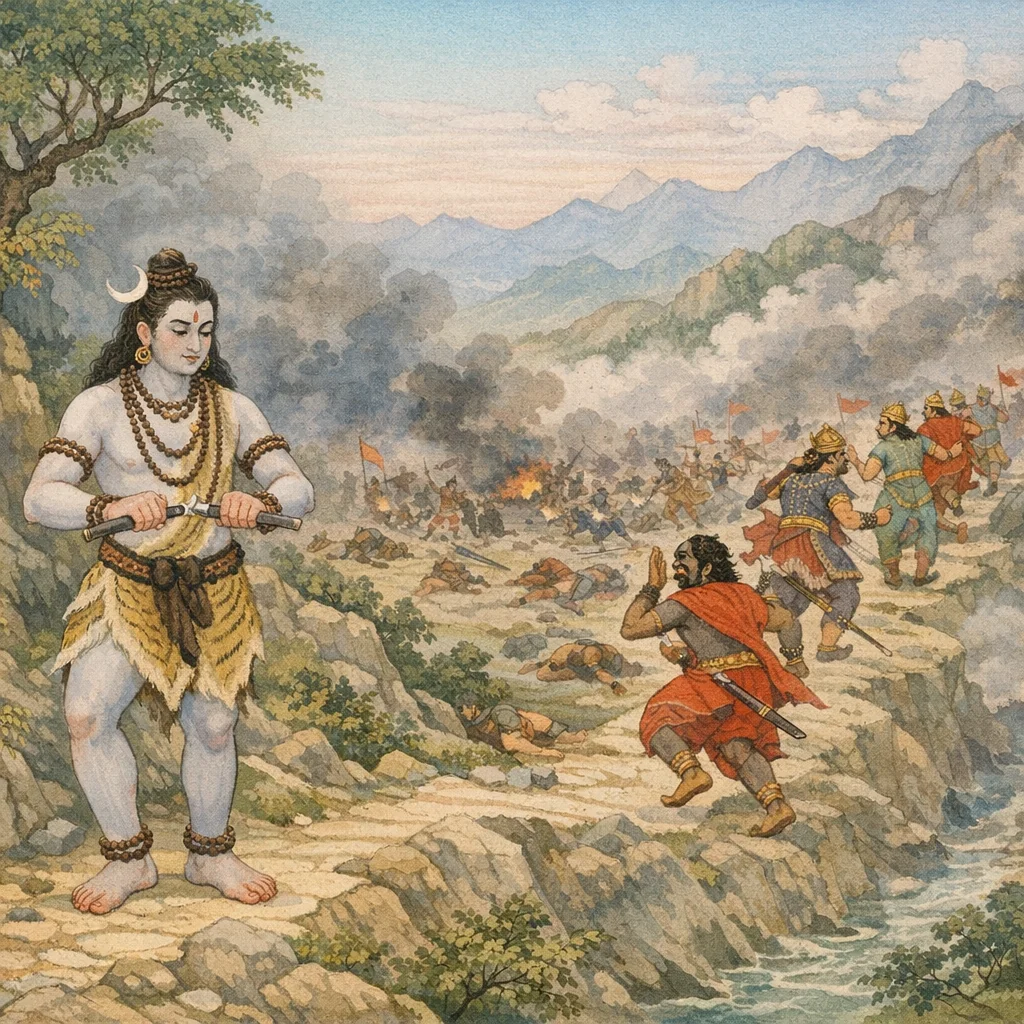
अन्धकादिदैत्ययुद्धे वीरकविजयः — Vīraka’s Victory over Andhaka’s Forces
Adhyāya 45, spoken by Sanatkumāra, continues the war between Andhaka and the allied daityas, highlighting the gaṇa Vīraka as the instrument of Śiva’s martial will. Andhaka—struck by Kāma’s arrows, intoxicated and mentally unsteady—advances with a vast army along a perilous, obstructed path, like an insect drawn to flame. Amid terrifying battlefield forces of stone and trees, lightning, water and fire, serpents, weapons, and frightful apparitions, Vīraka remains unconquered and challenges the intruder’s identity. A brief, decisive clash follows: the daitya is defeated, retreats hungry and thirsty, and flees when his fine sword is shattered. Then major daitya leaders—Prahlāda’s faction, Virocana, Bali, Bāṇa, Sahasrabāhu, Śambara, Vṛtra, and others—enter the fray but are routed and even split apart by Vīraka, as siddhas acclaim the victory. Through gruesome images of blood-mire and carrion-feeders, the chapter teaches that desire-driven, deluded power collapses before Śiva’s gaṇic force and the inevitability of dharma.
Shlokas
Verse 1
सनत्कुमार उवाच । गतस्ततो मत्तगजेन्द्रगामी पीत्वा सुरां घूर्णितलोचनश्च । महानुभावो बहुसैन्ययुक्तः प्रचंडवीरो वरवीरयायी
Sanatkumāra said: Then he went forth, moving like an intoxicated lord of elephants; having drunk liquor, his eyes rolled unsteadily. A man of great might, accompanied by many troops, he was a fierce and formidable warrior, marching out in search of battle with the best of heroes.
Verse 2
ददर्श दैत्यः स्मरबाणविद्धो गुहां ततो वीरकरुद्धमार्गाम् । स्निग्धं यथा वीक्ष्य पतंगसंज्ञः दशाप्रदीपं च कृमिर्ह्युपेत्य
Then the demon—pierced by Kāma’s arrows—caught sight of a cave whose passage had been blocked by a hero. Drawn onward by delusion, he moved toward it like a moth rushing to a lamp’s glow, like a worm creeping up to a shining light only to meet its ruin.
Verse 3
तथा प्रदर्श्याशु पुनः पुनश्च संपीड्यमानोपि स वीरकेण । बभूव कामाग्निसुदग्धदेहोंऽधको महादैत्यपतिः स मूढः
Thus, even though he was repeatedly seized and crushed by that valiant warrior, Andhaka—the deluded lord of the great Daityas—soon became like one whose body is scorched by the fire of desire.
Verse 4
पाषाणवृक्षाशनितोयवह्निभुजंगशस्त्रास्त्रविभीषिकाभिः । संपीडितोऽसौ न पुनः प्रपीड्यः पृष्टश्च कस्त्वं समुपागतोसि
Assailed by terrors of stones, trees, thunderbolts, floods, fire, serpents, weapons, and missiles, he was pressed hard—yet he could not be crushed again. Then he asked: “Who are you that have come here?”
Verse 5
निशम्य तद्गां स्वमतं स तस्मै चकार युद्धं स तु वीरकेण । मुहूर्तमाश्चर्यवदप्रमेयं संख्ये जितो वीरतरेण दैत्यः
Hearing those words and firm in his own resolve, he engaged that foe in battle; and the valiant Vīraka fought. For a while the combat was wondrous, beyond all measure—until, in the thick of the fray, the demon was conquered by the still more heroic warrior.
Verse 6
ततस्तु संग्रामशिरो विहाय क्षुत्क्षामकंठस्तृषितो गतोऽभूत् । चूर्णीकृते खड्गवरे च खिन्ने पलायमानो गतविस्मयः सः
Then, abandoning the forefront of the battle, he withdrew—his throat parched with hunger and his whole being tormented by thirst. And when his excellent sword was shattered and he was spent with weariness, he fled, his pride and astonishment utterly gone.
Verse 7
चक्रुस्तदाजिं सह वीरकेण प्रह्लादमुख्या दितिजप्रधानाः । लज्जांकुशाकृष्टधियो बभूवुस्सुदारुणाः शस्त्रशतैरनेकैः
Then the foremost Dānavas—led by Prahlāda—joined battle together with Vīraka. Their minds, as though driven by the goad of shame, turned fierce; and with countless hundreds of weapons they became exceedingly terrible in combat.
Verse 8
विरोचनस्तत्र चकार युद्धं बलिश्च बाणश्च सहस्रबाहुः । भजिः कुजंभस्त्वथ शंबरश्च वृत्रादयश्चाप्यथ वीर्यवंतः
There Virocana engaged in battle; and Bali, and Bāṇa of a thousand arms; Bhaji, Kujambha, and Śambara too; and Vṛtra and the others—heroes endowed with great valor—also fought.
Verse 9
ते युद्ध्यमाना विजिताः समंताद्द्विधाकृता वै गणवीरकेण । शेषे हतानां बहुदानवानामुक्तं जयत्येव हि सिद्धसंघैः
Even as they fought, they were overcome on every side and truly split in two by the heroic Gaṇa. When many Dānavas had been slain and only a remnant remained, the hosts of Siddhas proclaimed, “Victory! Victory indeed!”
Verse 10
भेरुंडजानाभिनयप्रवृत्ते मेदोवसामांससुपूयमध्ये । क्रव्यादसंघातसमाकुले तु भयंकरे शोणितकर्दमे तु
There, frightful creatures and carrion-beasts busily played—amid fat, grease, flesh, and foul pus—crowded with swarms of flesh-eaters; the battlefield grew terrifying, a mire of blood.
Verse 11
भग्नैस्तु दैत्यैर्भगवान् पिनाकी व्रतं महापाशुपतं सुघोरम् । प्रियेः मया यत्कृतपूर्वमासीद्दाक्षायणीं प्राह सुसांत्वयित्वा
When the daityas had been shattered, the Blessed Lord Pinākin (Śiva), having gently consoled Dākṣāyaṇī (Satī), spoke of that exceedingly fierce Mahāpāśupata observance which he had formerly undertaken for her sake.
Verse 12
शिव उवाच । तस्माद्बलं यन्मम तत्प्रणष्टं मर्त्यैरमर्त्यस्य यतः प्रपातः । पुण्यक्षयाही ग्रह एव जातो दिवानिशं देवि तव प्रसंगात्
Śiva said: Therefore my power has been impaired—since, through mortals, there has been a fall of the Immortal. O Devī, from association with you, the serpent-like ‘Graha’ of merit’s exhaustion has indeed arisen, tormenting me day and night.
Verse 13
उत्पाद्य दिव्यं परमाद्भुतं तु पुनर्वरं घोरतरं च गत्वा । तस्माद्व्रतं घोरतरं चरामि सुनिर्भयः सुन्दरि वै विशोका
Having brought forth a divine and most wondrous boon, and then having again proceeded to what is even more dreadful, I therefore undertake a vow still more formidable—fearless, O fair one, and indeed free from sorrow.
Verse 14
सनत्कुमार उवाच । एतावदुक्त्वा वचनं महात्मा उपाद्य घोषं शनकैश्चकार । स तत्र गत्वा व्रतमुग्रदीप्तो गतो वनं पुण्यतमं सुघोरम्
Sanatkumāra said: Having spoken these words, that great-souled one gradually raised his solemn proclamation. Then, going there—his vow blazing with fierce austerity—he proceeded to a most holy yet exceedingly formidable forest.
Verse 15
चर्तुं हि शक्यं तु सुरासुरैर्यत्र तादृशं वर्षसहस्रमात्रम् । सा पार्वती मंदरपर्वतस्था प्रतीक्ष्यमाणागमनं भवस्य
In that place, even the gods and the asuras could remain and move about for only a thousand years of such a kind. There, Pārvatī, dwelling on Mount Mandara, kept waiting for the arrival of Bhava (Lord Śiva).
Verse 16
पतिव्रता शीलगुणोपपन्ना एकाकिनी नित्यमथो विभीता । गुहांतरे दुःखपरा बभूव संरक्षिता सा सुतवीरकेण
Endowed with noble conduct and steadfast wifely fidelity, she remained alone and ever afraid. Living within a cave, she was overwhelmed by sorrow—yet there the brave youth Sutavīraka protected her.
Verse 17
ततस्स दैत्यो वरदानमत्तस्तैर्योधमुख्यैस्सहितो गुहां ताम् । विभिन्नधैर्यः पुनराजगाम शिलीमुखैर्मारसमुद्भवैश्च
Then that demon, intoxicated by the boon, returned again to that very cave, accompanied by his foremost warriors—his courage shattered by the arrows and by those born of Māra’s power.
Verse 18
अत्यद्भुतं तत्र चकार युद्धं हित्वा तदा भोजनपाननिद्राः । रात्रिं दिवं पंचशतानि पंच क्रुद्धस्स सैन्यैस्सह वीरकेण
There he waged a most wondrous battle, having abandoned food, drink, and sleep. Enraged, he fought with his armies and with the hero Vīraka for five hundred and five days and nights.
Verse 19
खड्गैस्सकुंतैस्सह भिंदिपालर्गदाभुशुंडीभिरथो प्रकांडैः । शिलीमुखैरर्द्धशशीभिरुग्रैर्वितस्तिभिः कूर्ममुखैर्ज्वलद्भिः
With swords and spears, with bhindipāla javelins, with maces and heavy clubs, and with stout shafts; with sharp arrows, with fierce crescent-headed missiles, with vitasti weapons, and with blazing turtle-mouthed projectiles—the warriors struck amid the tumult of battle.
Verse 20
नाराचमुख्यै निशितैश्च शूलैः परश्वधैस्तोमरमुद्गरैश्च । खड्गैर्गुडैः पर्वतपादपैश्च दिव्यैरथास्त्रैररपि दैत्यसंघैः
The hosts of Daityas, too, assailed with celestial missiles and chariot-weapons—using razor-sharp nārācas, tridents, axes, spears, and maces, as well as swords, heavy clubs, and even mountain-like boulders torn up as weapons.
Verse 21
न दीधितिर्भिन्नतनुः पपात द्वारं गुहाया पिहितं समस्तम् । तैरायुधैर्दैत्यभुजप्रयुक्तैर्गुहामुखे मूर्छित एव पश्चात्
Then Dīdhiti, his body torn apart, fell at the very doorway of the cave, which had been completely sealed. Struck by the weapons hurled by the demons’ mighty arms, he collapsed at the cave’s entrance and thereafter lay unconscious.
Verse 22
आच्छादितं वीरकमस्त्रजालैर्दैत्यैश्च सर्वैस्तु मुहूर्तमात्रम् । अपावृतं कर्तुमशक्यमासीन्निरीक्ष्य देवी दितिजान् सुघोरान्
For a brief while, the hero was wholly covered by the demons’ dense net of weapons. Beholding those exceedingly dreadful sons of Diti, the Goddess found it impossible to clear away that covering.
Verse 23
भयेन सस्मार पितामहं तु देवी सखीभिस्सहिता च विष्णुम् । सैन्यं च मद्वीरवरस्य सर्वं सस्मारयामास गुहांतरस्था
Overcome by fear, the Devī—together with her companions, abiding within a cave—remembered Pitāmaha (Brahmā) and also Viṣṇu; and she caused the entire army of the best of heroes to be summoned to her aid.
Verse 24
ब्रह्मा तया संस्मृतमात्र एव स्त्रीरूपधारी भगवांश्च विष्णुः । इन्द्रश्च सर्वेः सह सैन्यकैश्च स्त्रीरूपमास्थाय समागतास्ते
The moment she merely remembered them, Brahmā came; and Lord Viṣṇu too arrived, assuming a woman’s form. Indra as well, together with all his forces, took on a woman’s form and came there.
Verse 25
भूत्वा स्त्रियस्ते विविशुस्तदानीं मुनीन्द्रसंघाश्च महानुभावाः । सिद्धाश्च नागास्त्वथ गुह्यकाश्च गुहांतरं पर्वतराजपुत्र्याः
Assuming the forms of women, they entered at that very moment—those eminent hosts of great sages, along with the Siddhas, the Nāgas, and the Guhyakas—into the inner cavern belonging to the Mountain-King’s daughter (Pārvatī).
Verse 26
यस्मात्सुराज्य सनसंस्थितानामंतः पुरे संगमनं विरुद्धम् । ततस्सहस्राणि नितंबिनीनामनंतसंख्यान्यपि दर्शयंत्यः
Since, for those firmly established in the noble royal order, union within the inner palace was forbidden, thereupon thousands of women with shapely hips came forward—indeed, women beyond counting—presenting themselves.
Verse 27
रूपाणि दिव्यानि महाद्भुतानि गौर्ये गुहायां तु सवीरकार्यैः । स्त्रियः प्रहृष्टा गिरिराजकन्या गुहांतरं पर्वतराजपुत्र्या
Within Gaurī’s cave, wondrous and truly divine forms were revealed, accomplishing heroic aims. Delighted at heart, the women—together with the Mountain-King’s daughter, Pārvatī—entered further into the cave’s inner chamber.
Verse 28
स्त्रीभिस्सहस्रैश्च शतैरनेकैर्नेदुश्च कल्पांतरमेघघोषाः । भेर्य्यश्च संग्रामजयप्रदास्तु ध्मातास्सुशंखाः सुनितम्बिनीभिः
Then, with thousands of women and many hundreds besides, a roar resounded like thunderclouds at the end of an age. War-drums that grant victory were beaten, and auspicious conches were blown by the well-hipped women, raising a triumphant clamor as the hosts of Dharma surged forward under Śiva’s sovereign will.
Verse 29
मूर्छां विहायाद्भुत चंडवीर्यस्स वीरको वै पुरतः स्थितस्तु । प्रगृह्य शस्त्राणि महारथानां तैरेव शस्त्रैर्दितिजं जघान
Casting off his swoon, Vīraka—of wondrous and fierce prowess—stood firm at the front. Seizing the weapons of the great chariot-warriors, he struck down the Dānava with those very weapons.
Verse 30
ब्राह्मी ततो दंड करा विरुद्धा गौरी तदा क्रोधपरीतचेताः । नारायणी शंखगदासुचक्रधनुर्द्धरा पूरितबाहुदंडा
Then Brāhmī, staff in hand, stood opposed to the foe. At that time Gaurī, her mind enveloped in wrath, appeared as Nārāyaṇī—bearing the conch, mace, sword, discus, and bow—her mighty arms drawn up for battle.
Verse 31
विनिर्ययौ लांगलदण्डहस्ता व्योमालका कांचनतुल्यवर्णा । धारासहस्राकुलमुग्रवेगं बैडौजसी वज्रकरा तदानीम्
Then she surged forth—holding the plough-staff in her hand, wearing a garland like the vault of the sky, her complexion like shining gold. At that very moment, the mighty Baiḍaujasī, thunderbolt in hand, rushed on with fierce speed, surrounded by torrents in their thousands.
Verse 32
सहस्रनेत्रा युधि सुस्थिरा च सदुर्जया दैत्यशतैरधृष्या । वैश्वानरी शक्तिरसौम्यवक्त्रा याम्या च दंडोद्यतपाणिरुग्रा
In that battle stood the Śakti called Sahasranetrā—firm and unshakable in combat—hard to overcome and unconquerable even by hundreds of Dānavas. There too was the Śakti named Vaiśvānarī, with a fierce and unsmiling face; and the Śakti of Yama’s direction (Yāmyā), terrible, holding aloft the staff of punishment—each manifesting the Lord’s invincible power in the war.
Verse 33
सुतीक्ष्णखङ्गोद्यतपाणिरूपा समाययौ नैरृति घोरचापा । तोयालिका वारणपाशहस्ता विनिर्गता युद्धमभीप्समाना
Nairṛti arrived, her form with a razor-sharp sword raised in her hand and a dreadful bow. Toyālikā also came forth, holding an elephant-noose in her hand, desiring battle.
Verse 34
प्रचंडवातप्रभवा च देवी क्षुधावपुस्त्वंकुशपाणि रेव । कल्पान्तवह्निप्रतिमां गदां च पाणौ गृहीत्वा धनदोद्भवा च
Then the Goddess—born of a furious tempest—appeared in the very form of Hunger, holding a goad (aṅkuśa) in her hand. Revatī too, and the Goddess sprung from Dhanada (Kubera), each seized a blazing mace like the fire at the end of a kalpa, and advanced for battle.
Verse 35
याक्षेश्वरी तीक्ष्णमुखा विरूपा नखायुधा नागभयंकरी च । एतास्तथान्याश्शतशो हि देव्यः सुनिर्गताः संकुलयुद्धभूमिम्
Yakṣeśvarī, Tīkṣṇamukhā, Virūpā, Nakhāyudhā, and Nāgabhayaṅkarī—and hundreds of other goddesses besides—came forth in full force, surging onto the densely crowded battlefield.
Verse 36
दृष्ट्वा च तत्सैन्यमनंतपारं विवर्णवर्णाश्च सुविस्मिताश्च । समाकुलास्संचकिताभयाद्वै देव्यो बभूबुर्हृददीनसत्त्वाः
Seeing that army—boundless and beyond all measure—the goddesses turned pale, greatly astonished, and inwardly shaken. Struck by fear, they grew agitated and startled, their hearts losing steadiness and courage.
Verse 37
चक्रुस्समाधाय मनस्समस्तास्ता देववध्वो विधिशक्तिमुख्याः । सुसंमत त्वेन गिरीशपुत्र्याः सेनापतिर्वीरसुघोरवीर्यः
Then all those celestial ladies—foremost among them the Śaktis of the Creator—gathered their minds into deep samādhi. With the full assent of Girīśa’s daughter (Pārvatī), the heroic commander, possessed of exceedingly formidable valor, was appointed.
Verse 38
चक्रुर्महायुद्धमभूतपूर्वं निधाय बुद्धौ दितिजाः प्रधानाः । निवर्तनं मृत्युमथात्मनश्च नारीभिरन्ये वरदानसत्त्वाः
The foremost Dānava warriors, sons of Diti, set their resolve firmly in mind and waged an unprecedented great battle. Others too—strengthened by the power of boons—fought alongside their womenfolk, their hearts set either on withdrawing from the field or on meeting death themselves.
Verse 39
अत्यद्भुतं तत्र चकार युद्धं गौरी तदानीं सहिता सखीभिः । कृत्वा रणे चाद्भुतबुद्धिशौण्डं सेनापतिं वीरकघोरवीर्यम्
There, at that time, Gaurī—accompanied by her companions—waged a most astonishing battle. And in the thick of combat she made the army‑commander Vīraka, famed for dreadful heroism, meet wondrous strategic prowess.
Verse 40
हिरण्यनेत्रात्मज एव भूपश्चक्रे महाव्यूहमरं सुकर्मा । संभाव्य विष्णुं च निरीक्ष्य याम्यां सुदारुणं तद्गिलनामधेयम्
Then the king—Hiraṇyanetra’s own son, the valiant Sukarmā—swiftly arranged a vast battle‑formation. After duly taking account of Viṣṇu and surveying the southern quarter, he set up a most dreadful array known as “Tad-gila”, the “All‑devouring”.
Verse 41
मुखं करालं विधिसेवयास्य तस्मिन् कृते भगवानाजगाम । कल्पान्तघोरार्कसहस्रकांतिकीर्णञ्च वै कुपितः कृत्ति वासाः
When Brahmā (Vidhī) had thus served Him, the Lord arrived—His face fearsome; and Kṛttivāsā (Śiva, the Skin‑clad One) was truly wrathful—radiant with a splendor like a thousand dreadful suns at the end of an aeon (kalpa).
Verse 42
गते ततो वर्षसहस्रमात्रे तमागतं प्रेक्ष्य महेश्वरं च । चक्रुर्महायुद्धमतीवमात्रं नार्यः प्रहृष्टास्सह वीरकेण
Then, when about a thousand years had passed and they beheld Maheśvara (Śiva) arriving there, the women—rejoicing together with Vīraka—at once set in motion a very great battle.
Verse 43
प्रणम्य गौरी गिरिशं च मूर्ध्ना संदर्शयन् भर्तुरतीव शौर्यमम् । गौरी प्रयुद्धं च चकार हृष्टा हरस्ततः पर्वतराजपुत्रीम्
Bowing her head to Girīśa (Śiva), Gaurī—eager to display her Lord’s extraordinary valor—joyfully entered the battle. Thereupon Hara (Śiva) encouraged the daughter of the Mountain-King (Pārvatī).
Verse 44
कंठे गृहीत्वा तु गुहां प्रविष्टो रमासहस्राणि विसर्जितानि । गौरी च सन्मानशतैः प्रपूज्य गुहामुखे वीरकमेव स्थापयन्
Seizing him by the throat, he entered the cave and cast away thousands of treasures. Then, having honored Goddess Gaurī with hundreds of marks of reverence, he stationed Vīraka right at the mouth of the cave as a guard.
Verse 45
इति श्रीशिवमहापुराणे द्वितीयायां रुद्रसंहितायां पञ्चमे युद्धखण्डे युद्धप्रारंभदूतसम्वादवर्णनंनाम पञ्चचत्वारिंशोऽध्यायः
Thus ends the forty-fifth chapter, called “The description of the dialogue with the messenger at the commencement of war,” in the fifth section (Yuddhakhaṇḍa) of the second part (Rudra-saṃhitā) of the Śrī Śiva Mahāpurāṇa.
Verse 46
तैस्तैः प्रहारैरपि जर्ज रांगस्तस्मिन् रणे देवगणेरितैर्यः । जगाद वाक्यं तु सगर्वमुग्रं प्रविश्य शंभुं प्रणिपत्य मूर्ध्ना
Though his body was shattered by many blows in that battle, urged on by the hosts of the gods, he still entered before Śambhu (Lord Śiva) and, bowing his head in submission, spoke fierce words filled with pride.
Verse 47
दूत उवाच । संप्रेषितोहं विविशे गुहांतु ह्यषौऽन्धकस्त्वां समुवाच वाक्यम् । नार्या न कार्यं तव किंचिदस्तिविमुच नारीं तरुणीं सुरूपाम्
The messenger said: “Sent by him, I entered the cave. Andhaka spoke these words to you: ‘You have no need at all of this woman. Release the young and beautiful lady.’”
Verse 48
प्रायोभवास्तापसस्तज्जुषस्व क्षांतं मया यत्कमनीयमन्तः । मुनिर्विरोधव्य इति प्रचिंत्य न त्वं मुनिस्तापस किं तु शत्रुः
O ascetic, if you truly live by restraint and fasting, then accept this: I have endured a grievous pain within. Thinking, “A muni should not be opposed,” I held myself back; but you are no sage, O tapasvin—you are, in truth, an enemy.
Verse 49
अतीव दैत्येषु महाविरोधी युध्यस्व वेगेन मया प्रमथ्य । नयामि पातालतलानुरूपं यमक्षयं तापस धूर्त हि त्वाम्
“You are an exceedingly obstinate foe among the Daityas—fight at once, with speed, after I have crushed you! I shall drive you down to the nether regions befitting Pātāla—indeed, to Yama’s abode, O deceitful ascetic, to your destruction.”
Verse 50
सनत्कुमार उवाच । एतद्वचो दूतमुखान्निशम्य कपालमाली तमुवाच कोपात् । ज्वलन्विषादेन महांस्त्रिनेत्रस्सतां गतिर्दुष्टमदप्रहर्ता
Sanatkumāra said: Hearing these words from the messenger’s mouth, Kapālamālī—the Lord garlanded with skulls—spoke to him in anger. The great Three‑Eyed One, blazing with grief, refuge of the righteous and crusher of the wicked’s pride, replied.
Verse 51
शिव उवाच । व्यक्तं वचस्ते तदतीव चोग्रं प्रोक्तं हि तत्त्वं त्वरितं प्रयाहि । कुरुष्व युद्धं हि मया प्रसह्य यदि प्रशक्तोसि बलेन हि त्वम्
Śiva said: “Your words are plain indeed—and exceedingly fierce. The truth has been spoken; now go forth at once. Engage in battle with Me, even by force, if you are truly capable by your strength.”
Verse 52
यः स्यादशक्तो भुवि तस्य कोर्थो दारैर्धनैर्वा सुमनोहरैश्च । आयांतु दैत्याश्च बलेन मत्ता विचार्यमेवं तु कृतं मयै तत्
He who is powerless upon the earth—what use has he for wives, for wealth, or for any delightful pleasures? Let the Daityas too come, intoxicated by their strength. Having reflected thus, I have acted accordingly.
Verse 53
शरीरयात्रापि कुतस्त्वशक्तेः कुर्वन्तु यद्यद्विहितं तु तेषाम् । ममापि यद्यत्करणीयमस्ति तत्तत्त्करिष्यामि न संश योत्र
How could even the mere upkeep of the body be possible for one who is powerless? Let them do whatever duties are enjoined upon them. As for me, whatever is to be done, that I shall do—of this there is no doubt.
Verse 54
सनत्कुमार उवाच । एतद्वचस्तद्विधसोपि तस्माच्छ्रुत्वा हरान्निर्गत एव हृष्टः । प्रागात्ततो गर्जितहुंकृतानि कुर्वंस्ततोदैत्यपतेस्सकाशम्
Sanatkumāra said: Hearing those words, he too—having come forth from Lord Hara—was filled with delight. Then, uttering roars and fierce battle-cries, he advanced toward the presence of the lord of the Daityas.
Frequently Asked Questions
Sanatkumāra narrates a battle episode in which Śiva’s gaṇa Vīraka defeats Andhaka and then routs prominent daitya leaders allied in the conflict.
It encodes a moral-psychological reading: desire and intoxication pull beings toward self-destruction, while the battlefield’s horrors externalize inner delusion and karmic consequence.
The chapter highlights the gaṇa Vīraka as Śiva’s martial agency, with siddha acclamations underscoring divine sanction and cosmic alignment of the victory.