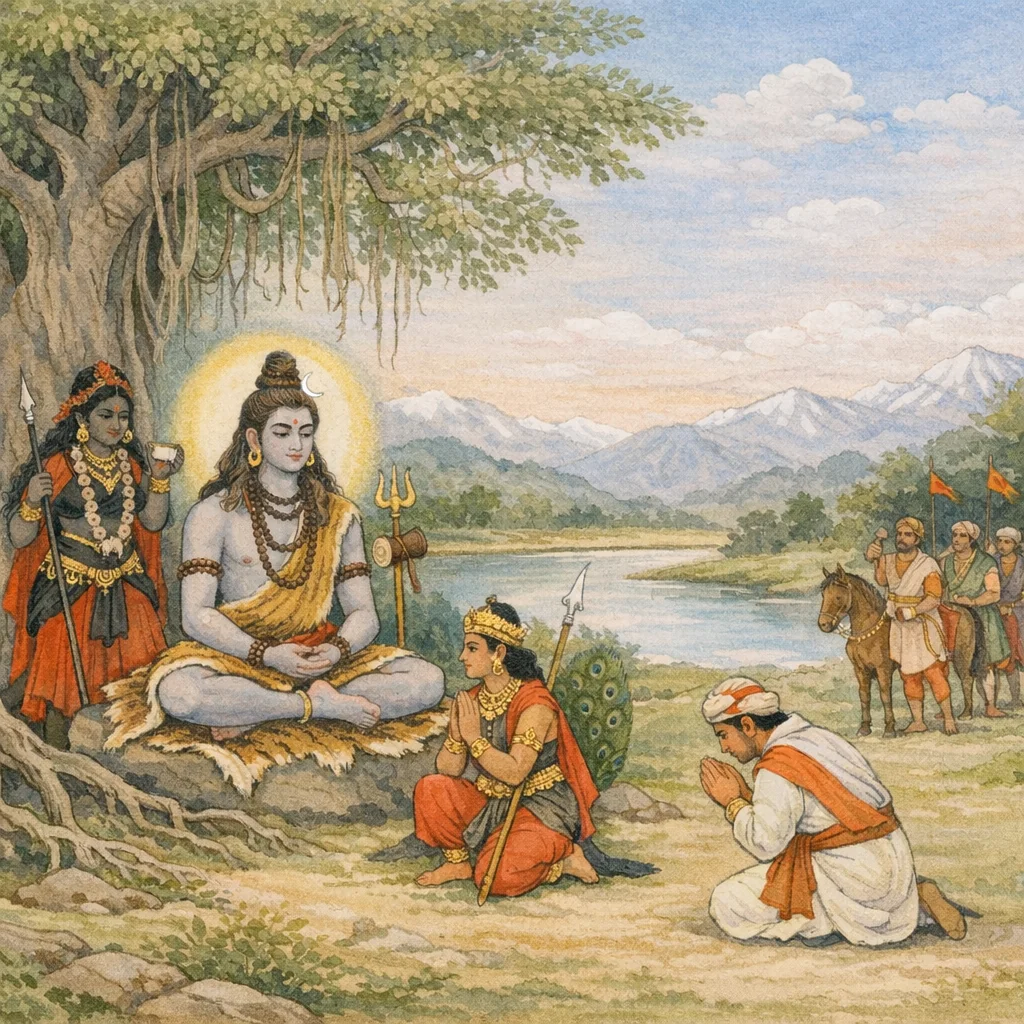
शङ्खचूडदूतागमनम् — The Arrival of Śaṅkhacūḍa’s Envoy (and Praise of Śiva)
Adhyāya 35 begins with Sanatkumāra recounting a diplomatic moment within the war-cycle. The asuric side connected with Śaṅkhacūḍa sends a highly learned envoy (dūta) to Śaṅkara. Arriving, the messenger beholds Śiva seated beneath the banyan’s root (vaṭamūla), radiant like millions of suns, established in yogic posture with controlled gaze and mudrā. The text then unfolds a dense praise of epithets: Śiva is serene, three-eyed, clad in tiger-skin, weapon-bearing, the remover of devotees’ fear of death, the giver of the fruits of tapas, and the maker of all prosperities; he is also declared Viśvanātha/Viśvabīja/Viśvarūpa, the supreme cause enabling passage across the hell-ocean (narakārṇava-tāraṇa). The envoy dismounts, bows in reverence, and receives auspicious blessings, with Bhadrakālī at Śiva’s left and Skanda before him. The chapter then moves into the envoy’s formally proper address after prostration, setting the hinge for negotiation, warning, or demand before the coming escalation.
Shlokas
Verse 1
सनत्कुमार उवाच । तत्र स्थित्वा दानवेन्द्रो महान्तं दानवेश्वरम् । दूतं कृत्वा महाविज्ञं प्रेषयामास शंकरम्
Sanatkumāra said: Remaining there, the lord of the Dānavas appointed a great ruler among the Dānavas—wise and discerning—as his envoy, and sent him to Śaṅkara (Lord Śiva).
Verse 2
स तत्र गत्वा दूतश्च चन्द्रभालं ददर्श ह । वटमूले समासीनं सूर्यकोटिसमप्रभम्
Going there, the messenger saw Candrabhāla—seated at the foot of a banyan tree, radiant with a splendor equal to ten million suns.
Verse 3
कृत्वा योगासनं दृष्ट्या मुद्रायुक्तं च सस्मितम् । शुद्धस्फटिकसंकाशं ज्वलंतं ब्रह्मतेजस
Assuming a yogic posture, with a steady gaze and endowed with a sacred hand-gesture, and smiling gently, he shone like pure crystal—blazing with the splendor of Brahman.
Verse 4
त्रिशूलपट्टिशधरं व्याघ्रचर्मांबरावृतम् । भक्तमृत्युहरं शांतं गौरीकान्तं त्रिलोचनम्
He bears the trident and the battle-axe, and is clad in a tiger-skin garment. Serene and tranquil, the beloved Lord of Gaurī, the Three-eyed One—he removes even death for his devotees.
Verse 5
तपसां फलदातारं कर्त्तारं सर्वसंपदाम् । आशुतोषं प्रसन्नास्य भक्तानुग्रहकारकम्
He is the bestower of the fruits of austerities, the ordainer of all prosperities—Aśutoṣa, the Lord quickly pleased, whose face is ever serene—Śiva, who acts only to show grace to His devotees.
Verse 6
विश्वनाथं विश्वबीजं विश्वरूपं च विश्वजम् । विश्वंभरं विश्वकरं विश्वसंहारकारणम्
I bow to Viśvanātha—Lord of the universe—the seed of all creation, whose form is the universe and who is born as the universe; the sustainer of the cosmos, the maker of all, and the very cause of the dissolution of the world.
Verse 7
कारणं कारणानां च नरकार्णवतारणम् । ज्ञानप्रदं ज्ञानबीजं ज्ञानानन्दं सनातनम्
He is the Cause of all causes, the One who ferries beings across the ocean of hellish suffering. He bestows liberating knowledge; He is the very seed of knowledge; He is the eternal bliss born of true knowledge—everlasting.
Verse 8
अवरुह्य रथाद् दूतस्तं दृष्ट्वा दानवेश्वरः । शंकरं सकुमारं च शिरसा प्रणनाम सः
Descending from his chariot, the envoy—on beholding the lord of the Dānavas—bowed his head in reverence, offering obeisance to Śaṅkara and also to the divine Kumāra (Skanda).
Verse 9
वामतो भद्रकाली च स्कंदं तत्पुरतः स्थितम् । लोकाशिषं ददौ तस्मै काली स्कंदश्च शंकरः
On his left stood Bhadrakālī, and before him stood Skanda. Then Kālī, Skanda, and Śaṅkara bestowed upon him the auspicious blessings of all the worlds.
Verse 10
अथासौ शंखचूडस्य दूतः परमशास्त्रवित् । उवाच शंकरं नत्वा करौ बद्ध्वा शुभं वचः
Then the emissary of Śaṅkhacūḍa—well-versed in the highest codes of conduct—bowed to Śaṅkara and, with hands joined in reverence, spoke auspicious words.
Verse 11
दूत उवाच । शंखचूडस्य दूतोऽहं त्वत्सकाशमिहागतः । वर्तते ते किमिच्छाद्य तत्त्वं ब्रूहि महेश्वर
The messenger said: “I am the envoy of Śaṅkhacūḍa, and I have come here into your presence. What do you wish to do now? Tell me the truth, O Maheśvara.”
Verse 12
सनत्कुमार उवाच । इति श्रुत्वा च वचनं शंखचूडस्य शंकरः । प्रसन्नात्मा महादेवो भगवांस्तमुवाच ह
Sanatkumāra said: Hearing these words of Śaṅkhacūḍa, Śaṅkara—Mahādeva, the Blessed Lord—became serene in heart and then spoke to him.
Verse 13
महादेव उवाच । शृणु दूत महाप्राज्ञ वचो मम सुखावहम् । कथनीयमिदं तस्मै निर्विवादं विचार्य च
Mahādeva said: “Listen, O messenger of great wisdom, to my words that bring welfare and peace. After due reflection, convey this to him in a manner free from dispute and contention.”
Verse 14
विधाता जगतां ब्रह्मा पिता धर्मस्य धर्मवित् । मरीचिस्तस्य पुत्रश्च कश्यपस्तत्सुतः स्मृतः
Brahmā, the ordainer of the worlds and knower of Dharma, is remembered as the father of Dharma. Marīci is said to be his son, and Kaśyapa is remembered as the son of Marīci.
Verse 15
दक्षः प्रीत्या ददौ तस्मै निजकन्यास्त्रयोदश । तास्वेका च दनुस्साध्वी तत्सौभाग्यविवर्द्धिनी
Pleased at heart, Dakṣa bestowed upon him his own thirteen daughters. Among them was the virtuous Danu, who increased his fortune and auspicious prosperity.
Verse 16
चत्वारस्ते दनोः पुत्रा दानवास्तेजसोल्बणाः । तेष्वेको विप्रचित्तिस्तु महाबलपराक्रमः
Danu had four sons—Dānava demons blazing with fierce splendor. Among them, one was Vipracitti, renowned for great strength and formidable valor.
Verse 17
तत्पुत्रो धार्मिको दंभो दानवेन्द्रो महामतिः । तस्य त्वं तनयः श्रेष्ठो धर्मात्मा दानवेश्वरः
His son was Dambha—righteous in conduct, a great-minded lord among the Dānavas. And you are his excellent son, virtuous in nature, the ruler of the Dānavas.
Verse 18
पुरा त्वं पाषर्दो गोपो गोपेष्वेव च धार्मिकः । अधुना राधिकाशापाज्जातस्त्वं दानवेश्वरः
Formerly you were a cowherd among the cowherds—righteous in conduct. But now, due to Rādhikā’s curse, you have been born as the lord of the Dānavas.
Verse 19
दानवीं योनिमायातस्तत्त्वतो न हि दानवः । निजवृतं पुरा ज्ञात्वा देववैरं त्यजाधुना
Though you have entered a Dānava womb, in truth you are not a Dānava. Knowing your own former course of conduct, abandon at once this enmity toward the Devas.
Verse 20
द्रोहं न कुरु तैस्सार्द्धं स्वपदं भुंक्ष्व सादरम् । नाधिकं सविकारं च कुरु राज्यं विचार्य च
Commit no treachery against them. Reverently enjoy your own rightful station. And, after due deliberation, do not rule the kingdom with excess, nor with agitation born of passion and distortion.
Verse 21
देहि राज्यं च देवानां मत्प्रीतिं रक्ष दानव । निजराज्ये सुखं तिष्ठ तिष्ठंतु स्वपदे सुराः
“O Dānava, restore the sovereignty of the Devas and preserve my favor. Abide happily within your own kingdom, and let the Suras remain established in their rightful station.”
Verse 22
अलं भूतविरोधेन देवद्रोहेण किं पुनः । कुलीनाश्शुद्धकर्माणः सर्वे कश्यपवंशजाः
Enough of hostility toward beings—how much more, then, of treachery toward the gods? All are noble, pure in conduct, and born in the lineage of Kaśyapa.
Verse 23
यानि कानि च पापानि ब्रह्महत्या दिकानि च । ज्ञातिद्रोहजपापस्य कलां नार्हंति षोडशीम्
Whatever sins there are—beginning with brahmin-slaying and the like—do not amount even to a sixteenth part of the sin that arises from betraying one’s own kin.
Verse 24
सनत्कुमार उवाच । इत्यादिबहुवार्त्तां च श्रुतिस्मृतिपरां शुभाम् । प्रोवाच शंकरस्तस्मै बोधयन् ज्ञानमुत्तमम्
Sanatkumāra said: Thus, after hearing many auspicious teachings grounded in Śruti and Smṛti, Śaṅkara spoke to him, instructing him in the highest knowledge—leading the soul toward the supreme understanding of Śiva, the Lord (Pati), and liberation.
Verse 25
शिक्षितश्शंखचूडेन स दूतस्तर्कवित्तम । उवाच वचनं नम्रो भवितव्यविमोहितः
Trained by Śaṅkhacūḍa, that envoy—skilled in reasoning—spoke his message with humility, yet his understanding was deluded by the force of destiny.
Verse 26
दूत उवाच । त्वया यत्कथितं देव नान्यथा तत्तथा वचः । तथ्यं किंचिद्यथार्थं च श्रूयतां मे निवेदनम्
The messenger said: “O Lord, the words you have spoken are not otherwise—indeed, they are exactly so. Yet, please listen to my submission as well, something true and in accordance with what is proper.”
Verse 27
ज्ञातिद्रोहे महत्पापं त्वयोक्तमधुना च यत् । तत्किमीशासुराणां च न सुराणां वद प्रभो
You have just said that betraying one’s own kinsmen is a great sin. Then tell me, O Lord—does this apply to the Īśa-asuras as well, and not to the devas?
Verse 28
सर्वेषामिति चेत्तद्वै तदा वच्मि विचार्य च । निर्णयं ब्रूहि तत्राद्य कुरु संदेहभंजनम्
If you say, “It is so for all,” then indeed I shall speak after due reflection. Now, in this matter, declare the decisive conclusion and shatter my doubt.
Verse 29
मधुकैटभयोर्दैत्यवरयोः प्रलयार्णवे । शिरश्छेदं चकारासौ कस्माच्चक्री महेश्वर
In the ocean of dissolution, why did Mahādeva—becoming the wielder of the discus—sever the heads of the two foremost demons, Madhu and Kaiṭabha, O Maheśvara?
Verse 30
त्रिपुरैस्सह संयुद्धं भस्मत्वकरणं कुतः । भवाञ्चकार गिरिश सुरपक्षीति विश्रुतम्
“How indeed did the battle with Tripura end in their being reduced to ash? O Girīśa, Lord of the Mountain, it is renowned that you acted as the protector and champion of the gods (surapakṣa).”
Verse 31
गृहीत्वा तस्य सर्वस्वं कुतः प्रस्थापितो बलिः । सुतलादि समुद्धर्तुं तद्द्वारे च गदाधरः
“Having seized all that belonged to him, how was Bali then sent away? And for the purpose of raising (him) up from Sutala and the other nether realms, the wielder of the mace (Viṣṇu) stood at that gate.”
Verse 32
सभ्रातृको हिरण्याक्षः कथं देवैश्च हिंसितः । शुंभादयोऽसुराश्चैव कथं देवैर्निपातिताः
“How was Hiraṇyākṣa, along with his brother, struck down by the Devas? And how were Śumbha and the other Asuras likewise felled by the gods?”
Verse 33
पुरा समुद्रमथने पीयूषं भक्षितं सुरैः । क्लेशभाजो वयं तत्र ते सर्वे फलभोगिनः
“Formerly, during the churning of the Ocean, the Devas consumed the pīyūṣa, the nectar. In that affair, we became the ones who bore the hardship, while they all became enjoyers of the resulting reward.”
Verse 34
क्रीडाभांडमिदं विश्वं कालस्य परमात्मनः । स ददाति यदा यस्मै तस्यै तस्यैश्वर्यं भवे त्तदा
“This entire universe is but a plaything of the Supreme Self who is Time. When He grants (power and fortune) to whomever He chooses, then for that very person lordship and prosperity arise.”
Verse 35
इति श्रीशिवमहापुराणे द्वितीयायां रुद्रसंहितायां पञ्चमे युद्धखंडे शंखचूडवधे शिवदूतसंवादो नाम पंचत्रिंशोऽध्यायः
Thus, in the Śrī Śiva Mahāpurāṇa—within the Second Rudra-saṃhitā, in the Fifth section called the Yuddha-khaṇḍa, in the account of the slaying of Śaṅkhacūḍa—concludes the thirty-fifth chapter, entitled “The Dialogue with Shiva’s Messenger (Śivadūta).”
Verse 36
तवानयोर्विरोधे च गमनं निष्फलं भवेत् । समसंबंधिनां तद्वै रोचते नेश्वरस्य ते
If you go while these two are in conflict, your going will be fruitless. Such a course may appeal to those who see only worldly ties as equal, but it does not befit you—the Lord.
Verse 37
सुरासुराणां सर्वेषामीश्वरस्य महात्मनः । इयं ते रहिता लज्जा स्पर्द्धास्माभिस्सहाधुना
O great-souled Lord, sovereign of all the devas and asuras—have you become devoid of shame? Why do you now contend and compete with us?
Verse 38
यतोधिका चैव कीर्तिर्हानिश्चैव पराजये । तवैतद्विपरीतं च मनसा संविचार्य ताम्
In defeat, the loss of fame is indeed greater. But in your case it is the opposite—reflect upon that matter carefully in your mind.
Verse 39
सनत्कुमार उवाच । इत्येतद्वचनं श्रुत्वा संप्रहस्य त्रिलोचनः । यथोचितं च मधुरमुवाच दानवेश्वरम्
Sanatkumāra said: Hearing these words, the Three‑eyed Lord (Śiva) smiled gently and then spoke to the lord of the Dānavas in a manner both fitting to the moment and sweet in tone.
Verse 40
महेश उवाच । वयं भक्तपराधीना न स्वतंत्राः कदापि हि । तदिच्छया तत्कर्माणो न कस्यापि च पक्षिणः
Mahesha said: “We are bound to our devotees; indeed, we are never independent. By their very will we act—never taking anyone’s side out of partiality.”
Verse 41
पुरा विधिप्रार्थनया युद्धमादौ हरेरपि । मधुकैटभयोर्देत्यवरयोः प्रलयार्णवे
Long ago, at the very beginning, even Hari (Viṣṇu) was drawn into battle—at the supplication of Vidhi (Brahmā)—against the two foremost demons, Madhu and Kaiṭabha, in the ocean of dissolution (pralaya).
Verse 42
देवप्रार्थनया तेन हिरण्यकशिपोः पुरा । प्रह्रादार्थं वधोऽकारि भक्तानां हितकारिणा
Formerly, at the prayer of the gods, that benefactor of devotees brought about the slaying of Hiraṇyakaśipu—so that Prahlāda might be protected and the welfare of the Lord’s devotees be secured.
Verse 43
त्रिपुरैस्सह संयुद्धं भस्मत्वकरणं ततः । देवप्रार्थनयाकारि मयापि च पुरा श्रुतम्
Then there was a battle with Tripura, and thereafter their reduction to ashes was brought about—done in response to the gods’ supplication; this too I have heard from ancient tradition.
Verse 44
सर्वेश्वर्यास्सर्वमातुर्देवप्रार्थनया पुरा । आसीच्छुंभादिभिर्युद्धं वधस्तेषां तया कृतः
Formerly, at the gods’ supplication, the All-Sovereign Power—the Mother of all—entered battle with Śumbha and his followers, and she herself brought about their destruction.
Verse 45
अद्यापि त्रिदशास्सर्वे ब्रह्माणं शरणं ययुः । स सदेवो हरिर्मां च देवश्शरणमागतः
Even now, all the gods have gone to Brahmā for refuge. And Hari (Viṣṇu) as well—together with the gods—has come to me seeking protection.
Verse 46
हरिब्रह्मादिकानां च प्रार्थनावशतोप्यहम् । सुराणामीश्वरो दूत युद्धार्थमगमं खलु
Even I—moved by the entreaties of Hari, Brahmā, and the other gods—indeed went forth as a messenger for the sake of the battle, though I am the Lord of the Devas.
Verse 47
पार्षदप्रवरस्त्वं हि कृष्णस्य च महात्मनः । ये ये हताश्च दैतेया नहि केपि त्वया समाः
Truly, you are the foremost attendant of the great-souled Kṛṣṇa. Of all the Daitya-demons who have been slain, none at all are equal to you in prowess.
Verse 48
का लज्जा महती राजन् मम युद्धे त्वया सह । देवकार्यार्थमीशोहं विनयेन च प्रेषितः
O King, what great shame could there be for me in fighting with you? For the sake of the gods’ purpose, I—though a lord—have been sent here with humility and due submission.
Verse 49
गच्छ त्वं शंखचूडे वै कथनीयं च मे वचः । स च युक्तं करोत्वत्र सुरकार्यं करोम्यहम्
Go indeed to Śaṅkhacūḍa and convey my words. Let him act fittingly in this matter; as for me, I shall accomplish here the task of the gods.
Verse 50
इत्युक्त्वा शंकरस्तत्र विरराम महेश्वरः । उत्तस्थौ शंखचूडस्य दूतोऽगच्छत्तदंतिकम्
Having spoken thus, Śaṅkara—the Great Lord—paused there. Then the messenger of Śaṅkhacūḍa rose and went into his presence.
Frequently Asked Questions
A formal embassy: Śaṅkhacūḍa’s learned messenger is sent to Śiva, beholds him in yogic majesty, bows, receives blessings (with Kālī and Skanda present), and begins delivering his message.
The envoy’s ‘vision’ functions as a darśana-structure: the narrative pauses for a stotra-like ontology where Śiva is named as cosmic seed, universal form, and ultimate cause—embedding metaphysics inside a diplomatic scene.
Śiva as yogin and three-eyed lord; Bhadrakālī as protective śakti at his left; Skanda as martial-divine presence before him—together representing sovereignty, power, and command in the war context.