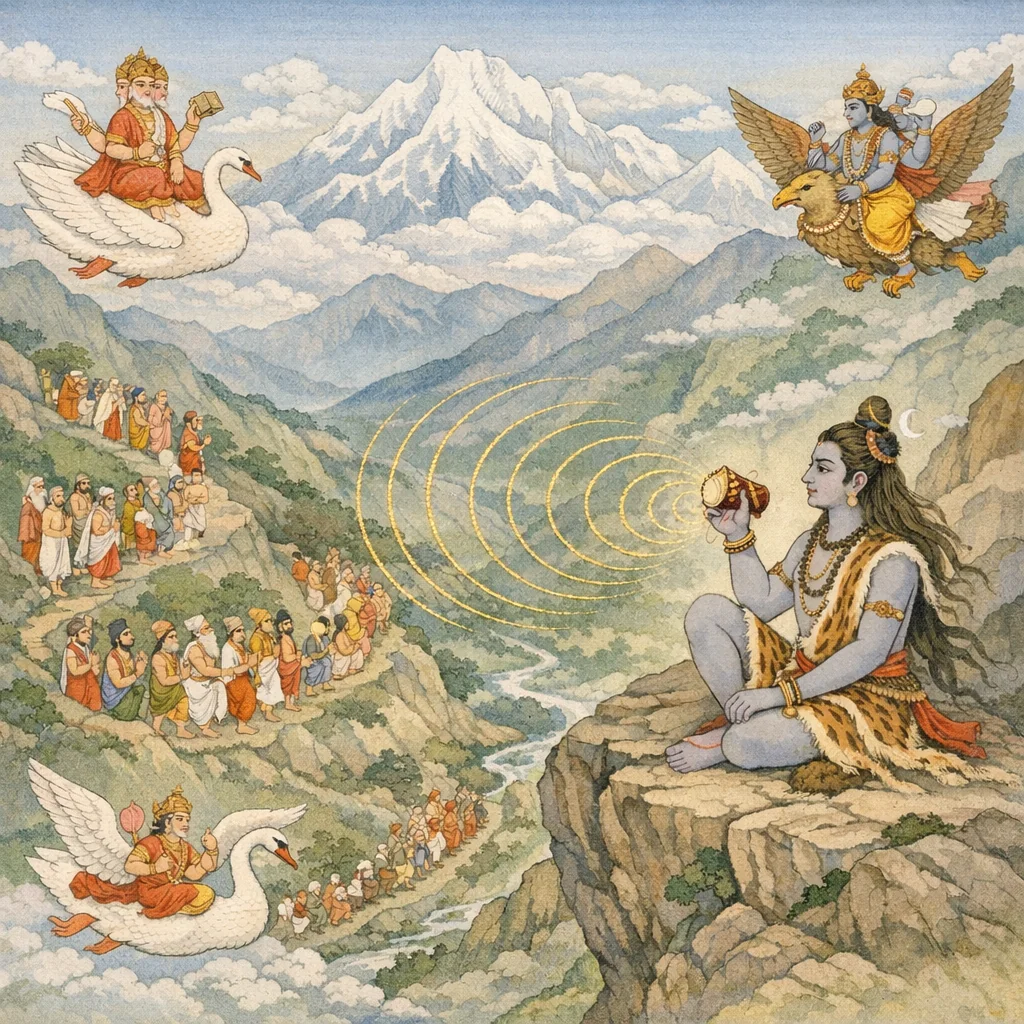
शिवागमन-नाद-समागमः (Śiva’s Advent, the Drum-Sound, and the Cosmic Assembly)
This chapter is framed as Brahmā’s instruction to Nārada, recounting an exemplary episode of Śiva’s “advent” (āgamana) to Kailāsa in connection with Kubera. After granting Kubera the boon of lordship over treasures (nidhipatva), Viśveśa reflects on a deliberate mode of manifestation: Rudra is portrayed as the full portion born from Brahmā’s heart, yet stainless and non-different from the Supreme—served by Hari (Viṣṇu) and Brahmā, while transcending them. Rudra resolves to go to Kailāsa in that very form, to dwell as a friend and undertake great tapas in relation to Kubera’s sphere. The decisive element is nāda: Rudra sounds his ḍhakkā (drum), a dense and wondrous call that both summons and propels. Hearing it, Viṣṇu, Brahmā, devas, munis, siddhas, and even personifications of āgama/nigama converge; likewise suras and asuras, and the pramathas and gaṇas from many regions assemble in festival-like anticipation. The chapter then turns to listing and quantifying the gaṇas and their stature, using Purāṇic enumeration to convey cosmic scale and to present Śiva’s retinue as an ontological category rather than merely a crowd.
Shlokas
Verse 1
ब्रह्मोवाच । नारद त्वं शृणु मुने शिवागमनसत्तमम् । कैलासे पर्वतश्रेष्ठे कुबेरस्य तपोबलात्
Brahmā said: “O Nārada, O sage, listen to this most excellent account of Śiva’s auspicious arrival—how, upon Kailāsa, the best of mountains, it came to pass through the power of Kubera’s austerities.”
Verse 2
निधिपत्व वरं दत्त्वा गत्वा स्वस्थानमुत्तमम् । विचिन्त्य हृदि विश्वेशः कुबेरवरदायकः
Having granted the boon of lordship over the treasures, Kubera—the bestower of boons—returned to his most excellent abode. Then Viśveśa (Lord Śiva), the Lord of the universe, reflected within His heart.
Verse 3
विध्यंगजस्स्वरूपो मे पूर्णः प्रलयकार्यकृत् । तद्रूपेण गमिष्यामि कैलासं गुह्यकालयम्
“My own complete form is that which is born of Vidhyāṅga, and it performs the work of dissolution. In that very form I shall go to Kailāsa, the secret abode.”
Verse 4
रुद्रो हृदयजो मे हि पूर्णांशो ब्रह्मनिष्फलः । हरि ब्रह्मादिभिस्सेव्यो मदभिन्नो निरंजन
“Indeed, Rudra is born from My heart—My complete and perfect portion, beyond the fruitive domain of Brahmā’s creative activity. He is worshipped even by Hari and Brahmā and the other gods; he is not different from Me, and he is the stainless, untainted One.”
Verse 5
तत्स्वरूपेण तत्रैव सुहृद्भूवा विलास्यहम् । कुबेरस्य च वत्स्यामि करिष्यामि तपो महत्
“Assuming that very form, I shall sport there itself as a well-wishing friend. I shall dwell with Kubera, and I shall undertake a great austerity.”
Verse 6
इति संचिंत्य रुद्रोऽसौ शिवेच्छां गंतुमुत्सुकः । ननाद तत्र ढक्कां स्वां सुगतिं नादरूपिणीम्
Having thus reflected, that Rudra—eager to proceed according to Śiva’s will—then sounded his own ḍhakkā (drum) there, whose resonance became the very form of auspicious progress toward the Supreme Goal.
Verse 7
त्रैलोक्यामानशे तस्या ध्वनिरुत्साहकारकः । आह्वानगतिसंयुक्तो विचित्रः सांद्रशब्दकः
In the mind of the three worlds, her resonant sound became an awakener of zeal. Endowed with the power of invocation and onward movement, it was wondrous—deep, compact, and full-bodied in tone.
Verse 8
तच्छ्रुत्वा विष्णुब्रह्माद्याः सुराश्च मुनयस्तथा । आगमा निगमामूर्तास्सिद्धा जग्मुश्च तत्र वै
Hearing that, Viṣṇu, Brahmā, and the other gods, along with the sages, went there indeed; and even the Siddhas—embodiments of the Āgamas and Nigamas—also proceeded to that place.
Verse 9
सुरासुराद्यास्सकलास्तत्र जग्मुश्च सोत्सवाः । सर्वेऽपि प्रमथा जग्मुर्यत्र कुत्रापि संस्थिताः
There, all beings—Devas, Asuras, and the rest—arrived in a festive spirit. Even all the Pramathas, wherever they were stationed, came to that place.
Verse 10
गणपाश्च महाभागास्सर्वलोक नमस्कृताः । तेषां संख्यामहं वच्मि सावधानतया शृणु
“Those Gaṇas too are greatly fortunate and are revered by all the worlds. Now I shall declare their number—listen with full attention.”
Verse 11
अभ्ययाच्छंखकर्णश्च गणकोट्या गणेश्वरः । दशभिः केकराक्षश्च विकृतोऽष्टाभिरेव च
Then the Gaṇa-lord Śaṅkhakarṇa approached, accompanied by a crore of Gaṇas; Kekarākṣa came with ten, and Vikṛta came with eight as well.
Verse 12
चतुःषष्ट्या विशाखश्च नवभिः पारियात्रकः । षड्भिः सर्वान्तकः श्रीमान्दुन्दुभोऽष्टाभिरेव च
Viśākha (is born) from sixty-four parts; Pāriyātraka from nine; the illustrious Sarvāntaka from six; and Dundubha from eight parts as well.
Verse 13
जालंको हि द्वादशभिः कोटिभिर्गणपुंगवः । सप्तभिस्समदः श्रीमांस्तथैव विकृताननः
Indeed, Jālaṅka is the foremost among Shiva’s gaṇas, attended by twelve crores of followers. Likewise, the illustrious Samada is attended by seven crores, and so too is Vikṛtānana.
Verse 14
पंचभिश्च कपाली हि षड्भिः सन्दारकश्शुभः । कोटिकोटिभिरेवेह कण्डुकः कुण्डकस्तथा
With five (koṭis) is Kapālī indeed; with six (koṭis) is the auspicious Sandāraka. Here too, by koṭis upon koṭis, are Kaṇḍuka and Kuṇḍaka.
Verse 15
विष्टंभोऽष्टाभिरगमदष्टभिश्चन्द्रतापनः
Viṣṭambha proceeded with eight (powers/parts), and Candratāpana likewise with eight—thus they move according to the measures appointed within the order of creation.
Verse 16
महाकेशस्सहस्रेण कोटीनां गणपो वृतः
Gaṇapa, the chief of Śiva’s hosts, was surrounded by a thousand mighty, long-haired attendants—indeed, by crores of gaṇas.
Verse 17
कुण्डी द्वादशभिर्वाहस्तथा पर्वतकश्शुभः । कालश्च कालकश्चैव महाकालः शतेन वै
Kuṇḍī is to be worshipped with twelve offerings; likewise the auspicious Parvataka. Kāla and Kālakā too are to be worshipped; and Mahākāla, indeed, with a hundred offerings.
Verse 18
अग्निकश्शतकोट्या वै कोट्याभिमुख एव च । आदित्यमूर्द्धा कोट्या च तथा चैव धनावहः
Indeed, there are a hundred crores whose face is Fire; a crore whose head is the Sun; and likewise one who bears and bestows wealth—thus are these great cosmic manifestations described.
Verse 19
सन्नाहश्च शतेनैव कुमुदः कोटिभिस्तथा । अमोघः कोकिलश्चैव कोटिकोट्या सुमंत्रकः
Sannāha was present in a hundredfold measure; Kumuda likewise in crores. Amogha and Kokila too were there; and Sumantraka in crores upon crores—thus were Śiva’s mighty attendants enumerated.
Verse 20
काकपादोऽपरः षष्ट्या षष्ट्या संतानकः प्रभुः । महाबलश्च नवभिर्मधु पिंगश्च पिंगलः
Another manifestation is called Kākapāda. From sixty and sixty arose further offspring—Saṃtānaka, the Lord; and with nine others, Mahābala; also Madhu, Piṅga, and Piṅgala.
Verse 21
नीलो नवत्या देवेशं पूर्णभद्रस्तथैव च । कोटीनां चैव सप्तानां चतुर्वक्त्रो महाबलः
Nīla commands ninety koṭis; likewise Pūrṇabhadra commands the host of divine lords; and Caturvaktra, of great might, commands seven koṭis as well.
Verse 22
कोटिकोटिसहस्राणां शतैर्विंशतिभिर्वृतः । तत्राजगाम सर्वेशः कैलासगमनाय वै
Surrounded by hosts counted in hundreds and twenties—koṭis upon koṭis and thousands of koṭis—the Lord of all (Śiva) arrived there indeed, intending to go to Kailāsa.
Verse 23
काष्ठागूढश्चतुष्षष्ट्या सुकेशो वृषभस्तथा । कोटिभिस्सप्तभिश्चैत्रो नकुलीशस्त्वयं प्रभुः
Among these, Kāṣṭhāgūḍha is reckoned as sixty-four; likewise are Sukeśa and Vṛṣabha. And Caitra is reckoned with seven koṭis; this Lord is Nakulīśa.
Verse 24
लोकांतकश्च दीप्तात्मा तथा दैत्यांतकः प्रभुः । देवो भृंगी रिटिः श्रीमान्देवदेवप्रियस्तथा
“Among Śiva’s divine attendants are Lokāntaka, radiant in soul, and Daityāntaka, the sovereign who destroys the Daityas. There are also the deva Bhṛṅgī and the illustrious Riṭi—each likewise dear to the Deva of devas (Śiva).”
Verse 25
अशनिर्भानुकश्चैव चतुष्षष्ट्या सनातनः । नंदीश्वरो गणाधीशः शतकोट्या महाबलः
And there was Aśanirbhānuka as well, together with the Eternal one among the sixty‑four chief attendants. Nandīśvara, lord of the Gaṇas, possessed immense strength—equal to a hundred crores.
Verse 26
एते चान्ये च गणपा असंख्याता महाबलः । सर्वे सहस्रहस्ताश्च जटामुकुटधारिणः
These and many other attendants (gaṇas) are innumerable and immensely powerful. All of them are thousand‑armed and wear crowns of matted locks (jaṭā), bearing the marks of Śiva’s own divine retinue.
Verse 27
सर्वे चंद्रावतंसाश्च नीलकण्ठास्त्रिलोचनाः । हारकुण्डलकेयूरमुकुटाद्यैरलंकृताः
All of them bore the crescent moon as an ornament upon their matted locks; all were blue‑throated and three‑eyed, and were adorned with garlands, earrings, armlets, crowns, and other ornaments.
Verse 28
ब्रह्मेन्द्रविष्णुसंकाशा अणिमादि गणैर्वृताः । सूर्यकोटिप्रतीकाशास्तत्राजग्मुर्गणेश्वराः
Resembling Brahmā, Indra, and Viṣṇu in splendour, and surrounded by hosts endowed with powers such as aṇimā, the Lords of the Gaṇas arrived there—radiant like ten million suns.
Verse 29
एते गणाधिपाश्चान्ये महान्मानोऽमलप्रभाः । जग्मुस्तत्र महाप्रीत्या शिवदर्शनलालसाः
Those other leaders of Śiva’s gaṇas—great-souled and radiant with stainless splendor—went there in immense joy, longing for the blessed darśana of Lord Śiva.
Verse 30
गत्वा तत्र शिवं दृष्ट्वा नत्वा चक्रुः परां नुतिम् । सर्वे साञ्जलयो विष्णुप्रमुखा नतमस्तकाः
Going there and beholding Lord Śiva, they bowed down and offered Him the highest praise. All of them—led by Viṣṇu—stood with joined palms and lowered heads in reverent submission.
Verse 31
इति विष्ण्वादिभिस्सार्द्धं महेशः परमेश्वरः । कैलासमगमत्प्रीत्या कुबेरस्य महात्मनः
Thus, accompanied by Viṣṇu and the other gods, Mahesha—the Supreme Lord—joyfully proceeded to Kailāsa, the sacred abode of the great-souled Kubera.
Verse 32
कुबेरोप्यागतं शंभुं पूजयामास सादरम् । भक्त्या नानोपहारैश्च परिवारसमन्वितः
Kubera too, having come before Śambhu, worshipped Him with great reverence—full of devotion, offering many kinds of gifts and services, accompanied by his attendants.
Verse 33
ततो विष्ण्वादिकान्देवान्गणांश्चान्यानपि ध्रुवम् । शिवानुगान्समानर्च शिवतोषणहेतवे
Thereafter, with steadfast resolve, he duly worshipped Viṣṇu and the other gods, along with the various attendant hosts; and he likewise honoured the followers of Śiva, solely to please Lord Śiva.
Verse 34
अथ शम्भुस्तमालिंग्य कुबेरं प्रीतमानसः । मूर्ध्निं चाघ्राय संतस्थावलकां निकषाखिलैः
Then Śambhu, his heart well pleased, embraced Kubera; and, smelling the crown of his head in blessing, He remained there at Alakā together with all His attendant hosts.
Verse 35
शशास विश्वकर्माणं निर्माणार्थं गिरौ प्रभुः । नानाभक्तैर्निवासाय स्वपरेषां यथोचितम्
Then the Lord commanded Viśvakarmā to build upon the mountain, creating dwellings for the many devotees—each suited as was proper for oneself and for others.
Verse 36
विश्वकर्मा ततो गत्वा तत्र नानाविधां मुने । रचनां रचयामास द्रुतं शम्भोरनुज्ञया
Then Viśvakarmā went there, O sage, and—by Śambhu’s permission—swiftly fashioned a structure of many kinds, with varied design and arrangement.
Verse 37
अथ शम्भुः प्रमुदितो हरिप्रार्थनया तदा
Then Śambhu became greatly pleased at that time, moved by Hari’s prayer.
Verse 38
कुबेरानुग्रहं कृत्वा ययौ कैलासपर्वतम् । सुमुहूर्ते प्रविश्यासौ स्वस्थानं परमेश्वरः
Having bestowed His grace upon Kubera, the Supreme Lord, Parameśvara, departed for Mount Kailāsa. Entering there at an auspicious moment, He returned to His own transcendent abode.
Verse 39
अकरोदखिलान्प्रीत्या सनाथान्भक्तवत्सलः । अथ सर्वे प्रमुदिता विष्णुप्रभृतयस्सुराः । मुनयश्चापरे सिद्धा अभ्यषिंचन्मुदा शिवम्
Out of loving grace, the Lord—ever affectionate to His devotees—made all beings secure and well-protected. Then all the delighted gods, led by Viṣṇu, along with sages and other perfected beings, joyfully performed the auspicious consecration (abhiṣeka) of Śiva.
Verse 40
समानर्चुः क्रमात्सर्वे नानोपायनपाणयः । नीराजनं समाकार्षुर्महोत्सवपुरस्सरम्
Then all of them, in due order and with various offerings in their hands, worshipped together; and they performed the auspicious ārati (nīrājana), preceded by a great festive celebration.
Verse 41
तदासीत्सुमनोवृष्टिर्मंगलायतना मुने । सुप्रीता ननृतुस्तत्राप्सरसो गानतत्पराः
Then, O sage, an auspicious shower of heavenly blossoms fell. Delighted, the Apsarās there began to dance, intent on song, and that sacred occasion became an abode of blessedness.
Verse 42
जयशब्दो नमश्शब्दस्तत्रासीत्सर्वसंस्कृतः । तदोत्साहो महानासीत्सर्वेषां सुखवर्धनः
There, the cries of “Jaya!” and the utterance of “Namaḥ!” arose—fully refined and auspicious. From that, a great ardour was kindled, increasing the happiness of all.
Verse 43
स्थित्वा सिंहासने शंभुर्विराजाधिकं तदा । सर्वैस्संसेवितोऽभीक्ष्णं विष्ण्वाद्यैश्च यथोचितम्
Then Śambhu, seated upon the throne and shining with surpassing splendour, was continually attended upon by all—by Viṣṇu and the other divine beings—each serving Him in the manner proper to their station.
Verse 44
अथ सर्वे सुराद्याश्च तुष्टुवुस्तं पृथक्पृथक् । अर्थ्याभिर्वाग्भिरिष्टाभिश्शकरं लोकशंकरम्
Then all the gods and other celestial beings, each in their own way, hymned Him with fitting and beloved words—Śaṅkara, the beneficent Lord who bestows auspiciousness upon the worlds.
Verse 45
प्रसन्नात्मा स्तुतिं श्रुत्वा तेषां कामान्ददौ शिवः । मनोभिलषितान्प्रीत्या वरान्सर्वेश्वरः प्रभुः
Pleased at heart on hearing their hymn of praise, Lord Śiva granted them their desires. With affection, the Supreme Lord—the Īśvara of all—bestowed the boons they had wished for within their minds.
Verse 46
शिवाज्ञयाथ ते सर्वे स्वंस्वं धाम ययुर्मुने । प्राप्तकामाः प्रमुदिता अहं च विष्णुना सह
O sage, then—by Śiva’s command—all of them departed to their own abodes, their aims fulfilled and their hearts rejoicing; and I too went, together with Viṣṇu.
Verse 47
उपवेश्यासने विष्णुं माञ्च शम्भुरुवाच ह । बहु सम्बोध्य सुप्रीत्यानुगृह्य परमेश्वरः
Having seated Viṣṇu upon an āsana like a couch-throne, Śambhu spoke. After instructing him at length with gladness, the Supreme Lord, Parameśvara, graciously favored him with great affection.
Verse 48
शिव उवाच । हे हरे हे विधे तातौ युवां प्रियतरौ मम । सुरोत्तमौ त्रिजगतोऽवनसर्गकरौ सदा
Śiva said: “O Hari, O Vidhātr̥ (Brahmā), my dear sons—both of you are most beloved to me. You are the foremost among the gods, ever engaged in the protection and the emanation (creation) of the three worlds.”
Verse 49
गच्छतं निर्भयन्नित्यं स्वस्थानश्च मदाज्ञया । सुखप्रदाताहं वै वाम्विशेषात्प्रेक्षकस्सदा
“Go, ever fearless, to your own abode by My command. Truly, I am the bestower of happiness, and I shall always watch over you with special care.”
Verse 50
इत्याकर्ण्य वचश्शम्भोस्सुप्रणम्य तदाज्ञया । अहं हरिश्च स्वं धामागमाव प्रीतमानसौ
Having thus heard the words of Śambhu, and bowing down deeply in obedience to His command, I and Hari returned to our own abodes, our hearts filled with joy and contentment.
Verse 51
तदानीमेव सुप्रीतश्शंकरो निधिपम्मुदा । उपवेश्य गृहीत्वा तं कर आह शुभं वचः
At that very moment, Śaṅkara—deeply pleased—joyfully seated the lord of treasures, took him by the hand, and spoke auspicious words.
Verse 52
शिव उवाच । तव प्रेम्णा वशीभूतो मित्रतागमनं सखे । स्वस्थानङ्गच्छ विभयस्सहायोहं सदानघ
Śiva said: “O friend, I have been won over by your love and by your coming in friendship. Go now to your own place without fear; I am ever your helper, O ever-blameless one.”
Verse 53
इत्याकर्ण्य वचश्शम्भोः कुबेरः प्रीतमानसः । तदाज्ञया स्वकं धाम जगाम प्रमुदान्वितः
Hearing the words of Śambhu (Lord Śiva), Kubera’s heart was filled with delight; and, obeying His command, he departed joyfully to his own abode.
Verse 54
स उवाच गिरौ शम्भुः कैलासे पर्वतोत्तमे । सगणो योगनिरतस्स्वच्छन्दो ध्यान तत्परः
On Mount Kailāsa, the supreme of mountains, Śambhu spoke. Surrounded by His gaṇas, He was absorbed in yoga, moving in perfect freedom, wholly intent on meditation.
Verse 55
क्वचिद्दध्यौ स्वमात्मानं क्वचिद्योगरतोऽभवत् । इतिहासगणान्प्रीत्यावादीत्स्वच्छन्दमानसः
At times he contemplated his own Self (Ātman), and at times he became absorbed in yoga. With a mind moving freely at will, he joyfully recounted hosts of sacred narratives.
Verse 56
क्वचित्कैलास कुधरसुस्थानेषु महेश्वरः । विजहार गणैः प्रीत्या विविधेषु विहारवित्
At times, Maheśvara—well-versed in many forms of divine sport—would joyfully play with His gaṇas in the lofty, auspicious regions of Mount Kailāsa and in other mountain-abodes.
Verse 57
इत्थं रुद्रस्वरूपोऽसौ शंकरः परमेश्वरः । अकार्षीत्स्वगिरौ लीला नाना योगिवरोऽपि यः
Thus Śaṅkara, the Supreme Lord whose very nature is Rudra, performed His divine play upon His own mountain, even while appearing in many ways as the foremost of yogins.
Verse 58
नीत्वा कालं कियन्तं सोऽपत्नीकः परमेश्वरः । पश्चादवाप स्वाम्पत्नीन्दक्षपत्नीसमुद्भवाम्
After passing some time as the Supreme Lord without a consort, Parameśvara later attained His own divine wife—she who arose as the daughter born from Dakṣa’s wife.
Verse 59
विजहार तया सत्या दक्षपुत्र्या महेश्वरः । सुखी बभूव देवर्षे लोकाचारपरायणः
O divine sage, Maheśvara sported joyfully with Satī, the daughter of Dakṣa; devoted to upholding the righteous conduct of the world, He remained content and happy.
Verse 60
इत्थं रुद्रावतारस्ते वर्णितोऽयं मुनीश्वर । कैलासागमनञ्चास्य सखित्वान्निधिपस्य हि
Thus, O lord among sages, this manifestation of Rudra has been described to you; and his coming to Kailāsa, together with his friendship with Kubera, the Lord of treasures, has also been related.
Verse 61
तदन्तर्गतलीलापि वर्णिता ज्ञानवर्धिनी । इहामुत्र च या नित्यं सर्वकामफलप्रदा
Even the divine play (līlā) contained within that account has been described—knowledge-enhancing in nature—one that unfailingly grants the fruits of all rightful desires, both here in this world and hereafter.
Verse 62
इमां कथाम्पठेद्यस्तु शृणुयाद्वा समाहितः । इह भुक्तिं समासाद्य लभेन्मुक्तिम्परत्र सः
Whoever, with a collected mind, recites this sacred account—or even listens to it—attains well-being in this world; and thereafter, in the beyond, he gains liberation (mokṣa).
Frequently Asked Questions
Brahmā recounts Śiva/Rudra’s intentional advent to Kailāsa in connection with Kubera—after granting him nidhipatva—signaled by the sounding of Rudra’s ḍhakkā that summons a vast cosmic assembly.
Nāda functions as a revelatory trigger: it is not merely sound but a metaphysical summons that aligns beings across lokas, indicating that divine presence is recognized through an epistemic “call” that gathers and orders consciousness and cosmos.
Rudra is presented as heart-born from Brahmā yet a full, stainless portion—served by Viṣṇu and Brahmā—while remaining non-different from the supreme; his form is adopted deliberately for līlā, friendship, tapas, and cosmic administration.