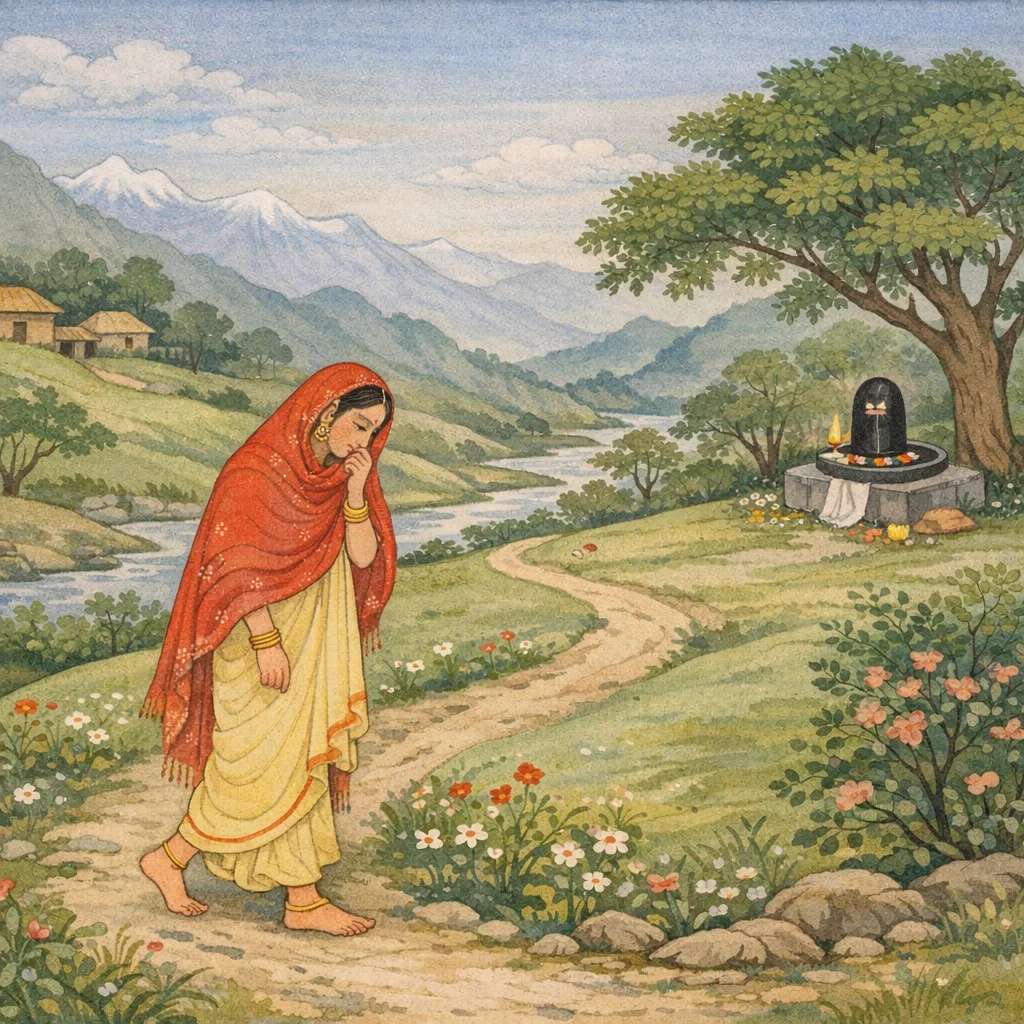
चाण्डालीसद्गतिवर्णनम् (Cāṇḍālī-sadgati-varṇanam) — “Account of the Cāṇḍālī’s Attainment of a Good Destiny”
In Adhyāya 9, the sages ask Sūta to explain the identity and story of a woman remembered as a cāṇḍālī, as an instructive moral-theological example. Sūta presents it as a “Śiva-prabhāva-saṃmiśrā” narrative meant to deepen devotion by revealing Śiva’s power to transform. The woman was once a brāhmaṇa maiden named Sauminī, marked with auspicious signs, married by proper rite to a brāhmaṇa youth. After a short household life, her husband dies prematurely through kāla-yoga, and she becomes a widow. Overcome by desire in youth, she falls into adultery; when discovered, her kin deem it a defilement of the lineage (kula-dūṣaṇa) and expel her from the community. Yet the chapter’s deeper teaching is that even severe social and moral downfall can be reversed through devotion and Śiva’s grace: “impurity” is not final when rightly oriented toward Śiva, leading to purification, redemption, and sadgati—a good destiny—through His saving agency.
Shlokas
Verse 1
ऋषय ऊचुः । सूतसूत महाभाग धन्यस्त्वं शैवसत्तमः । चाण्डाली का समाख्याता तत्कथां कथय प्रभो
The sages said: “O Sūta, O noble one! Truly blessed are you—the foremost among the devotees of Śiva. Who is she known as Cāṇḍālī? O lord, please narrate her story.”
Verse 2
सूत उवाच । द्विजाः शृणुत सद्भक्त्या तां कथां परमाद्भुताम् । शिवप्रभावसंमिश्रां शृण्वतां भक्तिवर्द्धिनीम्
Sūta said: “O twice-born sages, listen with true devotion to this supremely wondrous account—imbued with the power and glory of Śiva—which, for those who hear it, increases bhakti.”
Verse 3
चांडाली सा पूर्वभरेऽभवद्ब्राह्मणकन्यका । सौमिनी नाम चन्द्रास्या सर्वलक्षणसंयुता
That woman, though now known as a Caṇḍālī, had in a former life been a Brahmin maiden. Her name was Sauminī; she was moon-faced and endowed with every auspicious mark.
Verse 4
अथ सा समये कन्या युवतिः सौमिनी द्विजाः । पित्रा दत्ता च कस्मैचिद्विधिना द्विजसूनवे
Then, at that time, the maiden Sauminī, a Brahmin girl now of marriageable youth, gentle and auspicious, was duly given by her father in accordance with rite to a certain brāhmaṇa’s son.
Verse 5
सा भर्तारमनुप्राप्य किंचित्कालं शुभव्रता । रेमे तेन द्विजश्रेष्ठा नवयौवनशालिनी
Having reached her husband, that woman of auspicious vows lived happily with him for some time; O best of the twice-born, she delighted with him, radiant in the freshness of new youth.
Verse 6
अथ तस्याः पतिर्विप्रस्तरुणस्सुरुजार्दितः । सौमिन्याः कालयोगात्तु पञ्चत्वमगमद्द्विजाः
Then, O twice-born sages, her husband—a young brāhmaṇa—stricken by grievous illness, by the ordained conjunction of Time (kāla), attained death, leaving Sauminī widowed.
Verse 7
मृते भर्तरि सा नारी दुखितातिविषण्णधीः । किंचित्कालं शुभाचारा सुशीलोवास सद्मनि
When her husband had died, that woman—overwhelmed with grief and deeply dejected in mind—continued for some time to live in her home, maintaining auspicious conduct and a virtuous disposition.
Verse 8
ततस्सा मन्मथाविष्टहृदया विधवापि च । युवावस्थाविशेषेण बभूव व्यभिचारिणी
Thereafter, though she was a widow, her heart was seized by Kāma, the god of desire; and by the particular force of youth, she strayed into unchaste conduct.
Verse 9
इति श्रीशिवमहापुराणे चतुर्थ्यां कोटिरुद्रसंहितायां चाण्डालीसद्गतिवर्णनं नाम नवमोऽध्यायः
Thus, in the Śrī Śiva Mahāpurāṇa, in the Fourth (Samhitā)—the Koṭirudra-saṃhitā—ends the ninth chapter, entitled “The Description of the Chāṇḍālī’s Attainment of a Blessed Destiny.”
Verse 10
कश्चिच्छूद्रवरस्तां वै विचरन्तीं निजेच्छया । दृष्ट्वा वने स्त्रियं चक्रे निनाय स्वगृहं तत
A certain Śūdra of base conduct, seeing that woman wandering in the forest of her own free will, seized her and then took her away to his own house.
Verse 11
अथ सा पिशिताहारा नित्यमापीतवारुणी । अजीजनत्सुतान्तेन शूद्रेण सुरतप्रिया
Then she—living on flesh and continually drinking liquor—being fond of sensual pleasure, bore a son by that Śūdra.
Verse 12
कदाचिद्भर्तरि क्वापि याते पीतसुराथ सा । इयेष पिशिताहारं सौमिनी व्यभिचारिणी
Once, when her husband had gone away somewhere, that Sauminī—having drunk liquor and being unchaste—developed a desire to eat flesh.
Verse 13
ततो मेषेषु बद्धेषु गोभिस्सह बहिर्व्रजे । निशामुखे तमोऽन्धे हि खड्गमादाय सा ययौ
Then, after the rams had been tied up, she went out of the cattle-pen along with the cows—at the very onset of night, in pitch darkness—taking a sword in her hand.
Verse 14
अविमृश्य मदावेशान्मेषबुद्याऽऽमिष प्रिया । एकं जघान गोवत्सं क्रोशंतमतिदुर्भगा
Overpowered by intoxication and acting without reflection, that most unfortunate woman—fond of meat—mistook it for a ram and struck down a single calf of a cow even as it cried out.
Verse 15
हतं तं गृहमानीय ज्ञात्वा गोवत्समंगना । भीता शिवशिवेत्याह केनचित्पुण्यकर्मणा
The woman—tender as a young calf—brought him home; realizing he had been slain, she was seized with fear and, by the power of merit earned before, cried out, “Śiva! Śiva!”
Verse 16
सा मुहूर्तं शिवं ध्यात्वामिषभोजनलालसा । छित्त्वा तमेव गोवत्सं चकाराहारमीप्सितम्
Craving meat, she meditated on Lord Śiva for a moment; then, cutting up that very calf, she prepared for herself the food she desired.
Verse 17
एवं बहुतिथे काले गते सा सौमिनी द्विजाः । कालस्य वशमापन्ना जगाम यमसंक्षयम्
Thus, when a long time had passed, that gentle brahmin lady, O twice-born ones, having fallen under the dominion of Time, went to Yama’s abode—the appointed end for embodied life.
Verse 18
यमोऽपि धर्ममालोक्य तस्याः कर्म च पौर्विकम् । निवर्त्य निरयावासाच्चक्रे चाण्डालजातिकाम्
Even Yama, beholding her righteousness and her former deeds, withdrew her from the dwelling of hell and made her take birth in the caste of a Caṇḍāla.
Verse 19
साथ भ्रष्टा यमपुराच्चाण्डालीगर्भमाश्रिता । ततो बभूव जन्मान्धा प्रशांतांगारमेचका
Then, cast away from Yama’s city, she entered the womb of a Caṇḍāla woman. From that she was born blind from birth, her body dark like soot and embers—her radiance utterly extinguished.
Verse 20
जन्मान्धा साथ बाल्येऽपि विध्वस्तपितृमातृका । ऊढा न केनचिद्दुष्टा महाकुष्ठरुजार्दिता
She was blind from birth; and even in childhood she was bereft of both father and mother. No one would marry her, and she was afflicted by grievous leprosy (kuṣṭha) and its tormenting pain.
Verse 21
ततः क्षुधार्दिता दीना यष्टिपाणिर्गतेक्षणा । चाण्डालोच्छिष्टपिंडेन जठराग्निमतपर्यत्
Then, tormented by hunger and utterly wretched, holding a staff in her hand and with her eyes cast down, she sought to appease the fire of her belly with a lump of leftover food from a caṇḍāla.
Verse 22
एवं कृच्छ्रेण महता नीत्वा स्वविपुलं वयः । जरयाग्रस्तसवार्ङ्गी दुःखमाप दुरत्ययम्
Thus, having borne her long span of life with great hardship, her whole body seized by old age, she fell into suffering difficult to overcome—hinting that only refuge in Pati, Lord Śiva, carries one beyond the grip of decay.
Verse 23
कदाचित्साथ चांडाली गोकर्णं तं महाजनान् । आयास्यंत्यां शिवतिथौ गच्छतो बुबुधेऽन्वगान्
Once, a Caṇḍālī woman, intending to go to sacred Gokarṇa on an auspicious Śiva holy day (tithi), noticed a great multitude setting out and followed behind them.
Verse 24
अथासावपि चांडाली वसनासनतृष्णया । महाजनान् याचयितुं संचचार शनैः शनैः
Then that Caṇḍālī woman too, driven by longing for clothing and a place to sit, went about slowly, seeking to beg from respectable people.
Verse 25
गत्वा तत्राथ चांडाली प्रार्थयन्ती महाजनान् । यत्र तत्र चचारासौ दीनवाक्प्रसृताञ्जलिः
Having gone there, the Caṇḍālī woman began imploring the prominent people; with sorrowful words and hands extended in supplication, she wandered here and there.
Verse 26
एवमभ्यर्थयंत्यास्तु चांडाल्याः प्रसृताञ्जलौ । एकः पुण्यतमः पान्थः प्राक्षिपद्बिल्वमंजरीम्
As that Caṇḍāla woman thus pleaded, her palms outstretched in anjali, a traveller—most virtuous among men—cast a cluster of bilva blossoms as an offering upon Śiva’s sacred liṅga.
Verse 27
तामंजलौ निपतिता सा विमृश्य पुनः पुनः । अभक्ष्यमिति मत्वाथ दूरे प्राक्षिपदातुरा
When it fell into the hollow of her joined palms, she examined it again and again. Concluding, in her distress, that it was unfit to be eaten, she threw it far away.
Verse 28
तस्याः कराद्विनिर्मुक्ता रात्रौ सा बिल्वमंजरी । पपात कस्यचिद्दिष्ट्या शिवलिंगस्य मस्तके
At night, that cluster of bilva blossoms slipped from her hand; by some divine dispensation it fell upon the top of the Śiva-liṅga.
Verse 29
सैवं शिवचतुर्दश्यां रात्रौ पान्थजनान्मुहुः । याचमानापि यत्किंचिन्न लेभे दैवयोगतः
Thus, on the night of Śiva-caturdaśī, she repeatedly begged the passing travelers; yet, by the dispensation of destiny, she did not obtain anything at all.
Verse 30
एवं शिवचतुर्दश्या व्रतं जातं च निर्मलम् । अज्ञानतो जागरणं परमानन्ददायकम्
Thus the vow of Śiva-caturdaśī becomes pure and sanctifying; even a vigil (jāgaraṇa) kept unknowingly, by the grace of Lord Śiva, becomes a giver of supreme bliss.
Verse 31
ततः प्रभाते सा नारी शोकेन महता वृता । शनैर्निववृते दीना स्वदेशायैव केवलम्
Then, at daybreak, that woman—overwhelmed by great sorrow—slowly turned back, distressed, and set out only toward her own homeland.
Verse 32
श्रांता चिरोपवासेन निपतंती पदेपदे । अतीत्य तावतीं भूमिं निपपात विचेतना
Worn out by prolonged fasting, she kept stumbling and falling at every step. After crossing that much ground, she finally collapsed upon the earth, bereft of consciousness.
Verse 33
अथ सा शंभुकृपया जगाम परमं पदम् । आरुह्य सुविमानं च नीतं शिवगणैर्द्रुतम्
Then, by Śambhu’s grace, she attained the supreme abode. Mounting a splendid celestial car (vimāna), she was swiftly escorted by Śiva’s gaṇas.
Verse 34
आदौ यदेषा शिवनाम नारी प्रमादतो वाप्यसती जगाद । तेनेह भूयः सुकृतेन विप्रा महाबलस्थानमवाप दिव्यम्
O brāhmaṇa, because this woman—though not virtuous—at first uttered the sacred Name of Śiva, even if only through carelessness, she thereafter, by that very merit, attained in this world the divine abode known as Mahābala.
Verse 35
श्रीगोकर्णे शिवतिथावुपोष्य शिवमस्तके । कृत्वा जागरणं सा हि चक्रे बिल्वार्चनं निशि
At holy Gokarṇa, on the sacred tithi dear to Śiva, she observed a fast. Then, keeping vigil through the night at Śiva’s shrine, she performed worship in the night with bilva leaves.
Verse 36
अकामतः कृतस्यास्य पुण्यस्यैव च तत्फलम् । भुनक्त्यद्यापि सा चैव महाबलप्रसादतः
Even though that meritorious act was done without any personal desire, she still enjoys its very fruit even today—by the gracious favor of the greatly powerful Lord Śiva.
Verse 37
एवंविधं महालिंगं शंकरस्य महाबलम् । सर्वपापहरं सद्यः परमानन्ददायकम्
Such is this great Liṅga—an embodiment of Śaṅkara’s mighty power—destroying all sins at once and bestowing the supreme bliss of liberation.
Verse 38
एवं वः कथितं विप्रा माहात्म्यं परमं मया । महाबलाभिधानस्य शिवलिंगवरस्य हि
Thus, O Brāhmaṇa sages, I have told you the supreme glory of that excellent Śiva-liṅga known as Mahābala.
Verse 39
अथान्यदपि वक्ष्यामि माहात्म्यं तस्य चाद्भुतम् । श्रुतमात्रेण येनाशु शिवे भक्तिः प्रजायते
Now I shall also proclaim another wondrous glory of it—by merely hearing it, devotion to Lord Śiva swiftly arises.
Frequently Asked Questions
It presents a redemption-argument through narrative: a brāhmaṇa widow (Sauminī) falls into transgressive conduct, is expelled as a social pollutant, yet the chapter’s stated aim (sadgati) frames how Śiva’s power can convert even stigmatized existence into a spiritually favorable end.
They function as symbolic intensifiers of impurity and exclusion—testing the limits of ritual-social identity—so the text can foreground a Śaiva soteriology where grace and devotion are stronger than inherited status, and where moral rupture becomes the occasion for purification and reorientation toward Śiva.
No distinct iconographic form (e.g., a named Rudra-mūrti or Pārvatī-svarūpa) is foregrounded in the sampled verses; the emphasis is on Śiva’s generalized prabhāva (efficacious power) as the salvific principle operating through the narrative arc toward sadgati.