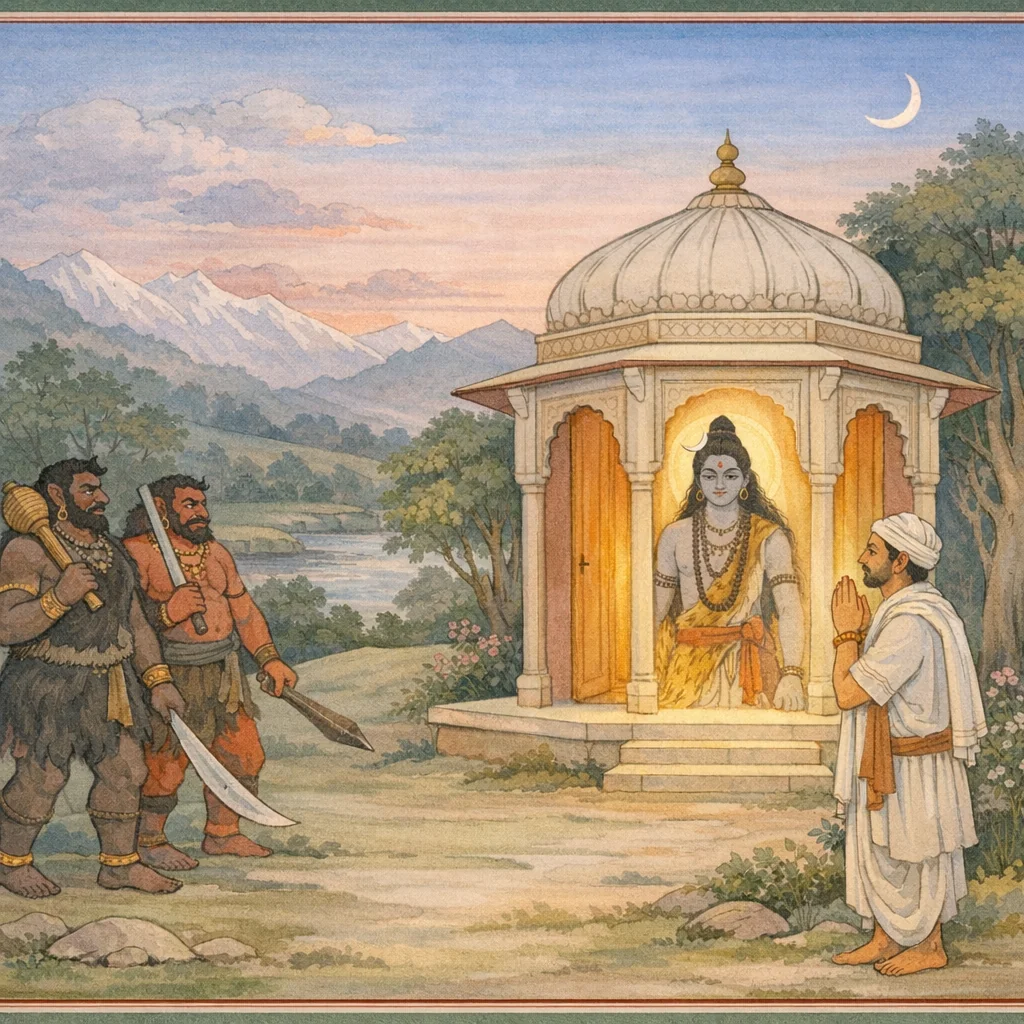
Śiva-nāma-smaraṇa and Śambhu’s Protective Manifestation (Dāruka Episode)
Narrated by Sūta, this adhyāya presents a crisis: a servant of the demonic king Dāruka beholds Śaṅkara’s beautiful form and reports it. Dāruka arrives and interrogates a vaiśya (merchant/householder) absorbed in contemplation of Śaṅkara; when the devotee cannot or will not disclose what is demanded, Dāruka orders his rākṣasas to kill him. As armed attackers close in, fear becomes the catalyst for explicit Śiva-bhakti: the devotee lovingly remembers Śiva, repeatedly utters His names (Śaṃkara, Śambhu, Śiva), and declares total dependence, calling Śiva “all” to him. The theological turning point comes when Śambhu, invoked in prayer, manifests from an opening/space, linked with an excellent abode of four doors—an epiphanic, protective intervention. The chapter affirms that nāma-japa and śaraṇāgati transform vulnerability into divine nearness, and that hostile power is ultimately subordinate to the Lord who answers sincere remembrance.
Shlokas
Verse 1
सूत उवाच । कदाचित्सेवकस्तस्य राक्षसस्य दुरात्मनः । तदग्रे सुंदरं रूपं शंकरस्य ददर्श ह
Sūta said: Once, a servant of that wicked-minded rākṣasa beheld, right before him, the beautiful form of Śaṅkara (Lord Śiva).
Verse 2
तस्मै निवेदितं राज्ञे राक्षसानां यथार्थकम् । सर्वं तच्चरितं तेन सकौतुकमथाद्भुतम्
Then he reported to that king the true account of the Rākṣasas—indeed, all their deeds—relating it with keen curiosity, as something wondrous to behold.
Verse 3
राजापि तत्र चागत्य राक्षसानां स दारुकः । विह्वलस्सबलश्शीघ्रं पर्यपृच्छच्च तं शिवम्
Then King Dāruka of the Rākṣasas also came there. Distressed, yet accompanied by his forces, he swiftly questioned Lord Śiva, seeking refuge and protection in the Supreme Lord.
Verse 4
दारुक उवाच । किं ध्यायसि हि वैश्य त्वं सत्यं वद ममाग्रतः । एवं सति न मृत्युस्ते मम वाक्यं च नान्यथा
Dāruka said: “O vaiśya, what indeed are you meditating upon? Speak the truth before me. If it is so, then death will not come to you—my word shall not be otherwise.”
Verse 5
सूत उवाच । तेनोक्तं च न जानामि तच्छ्रुत्वा कुपितस्य वै । राक्षसान्प्रेरयामास हन्यतां राक्षसा अयम्
Sūta said: “I do not know what he spoke; but on hearing it, that one became enraged and urged the Rākṣasas, saying, ‘O Rākṣasas, let this one be slain!’”
Verse 6
तदुक्तास्ते तदा हंतुं नानायुधधरा गताः । द्रुतं तं वैश्यशार्दूलं शंकरासक्तचेतसम्
Thus instructed, they at once set out to kill him, bearing many kinds of weapons, rushing swiftly toward that lion among Vaiśyas whose mind was steadfastly devoted to Śaṅkara.
Verse 7
तानागतांस्तदा दृष्ट्वा भयवित्रस्तलोचनः । शिवं सस्मार सुप्रीत्या तन्नामानि जगौ मुहुः
Seeing them arrive, his eyes trembling with fear, he lovingly remembered Lord Śiva and repeatedly uttered His sacred names.
Verse 8
वैश्यपतिरुवाच । पाहि शंकर देवेश पाहि शंभो शिवेति च । दुष्टादस्मात्त्रिलोकेश खलहन्भक्तवत्सल
Vaiśyapati said: “Protect me, O Śaṅkara, Lord of the gods! Protect me, O Śambhu—O auspicious Śiva! O Lord of the three worlds, destroyer of the wicked, lover of Your devotees—save me from this evil one.”
Verse 9
सर्वस्वं च भवानद्य मम देव त्वमेव हि । त्वदधीनस्त्वदीयोऽहं त्वत्प्राणस्सर्वदा प्रभो
O Lord, truly You alone are my all-in-all. I am wholly dependent on You; I belong to You. O Master, at all times my very life-breath rests in You.
Verse 10
सूत उवाच । इति संप्रार्थितश्शंभुर्विवरान्निर्गतस्तदा । भवनेनोत्तमेनाथ चतुर्द्वारयुतेन च
Sūta said: Thus earnestly entreated, Śambhu then emerged from the opening, and the Lord was seen together with an excellent divine abode, furnished with four gateways.
Verse 11
मध्यज्योतिस्स्वरूपं च शिवरूपं तदद्भुतम् । परिवारसमायुक्तं दृष्ट्वा चापूजयत्स वै
Beholding that wondrous form of Śiva—manifest as the radiant Light in the very center—and seeing Him attended by His divine retinue, he indeed offered worship.
Verse 12
पूजितश्च तदा शंभुः प्रसन्नो ह्यभवत्स्वयम् । अस्त्रं पाशुपतं नाम दत्त्वा राक्षसपुंगवान्
Then Śambhu, duly worshipped, became pleased of His own accord; and He bestowed the weapon called Pāśupata upon the foremost of the Rākṣasas.
Verse 13
जघान सोपकरणांस्तान्सर्वान्सगणान्द्रुतम् । अरक्षच्च स्वभक्तं वै दुष्टहा स हि शंकरः
Śaṅkara, the destroyer of the wicked, swiftly struck down all those attendants together with their weapons, and indeed protected His own devotee.
Verse 14
सर्वांस्तांश्च तदा हत्वा वरं प्रादाद्वनस्य च । अत्यद्भुतकरश्शंभुस्स्वलीलात्तसुविग्रहः
Having then slain all of them, Śambhu—whose deeds are wondrous, and who assumes forms by His own divine play—bestowed a boon upon that forest as well.
Verse 15
अस्मिन्वने सदा वर्णधर्मा वै संभवंतु च । ब्राह्मणक्षत्रियविशां शूद्राणां हि तथैव च
“In this forest, may the duties proper to each varṇa always prevail. May the ordained conduct of the brāhmaṇas, kṣatriyas, vaiśyas, and likewise of the śūdras, continually be established.”
Verse 16
भवत्वत्र मुनिश्रेष्ठास्तामसा न कदाचन । शिवधर्मप्रवक्तारश्शिवधर्मप्रवर्तकाः
O best of sages, may you here never fall into tamas (spiritual darkness). May you become proclaimers of the Dharma of Śiva and active promoters of Śiva’s sacred path.
Verse 17
सूत उवाच । एतस्मिन्समये सा वै राक्षसी दारुकाह्वया । देव्याः स्तुतिं चकारासौ पार्वत्या दीनमानसा
Sūta said: At that time, the rākṣasī named Dārukā, her heart humbled and distressed, offered a hymn of praise to the Goddess Pārvatī.
Verse 18
प्रसन्ना च तदा देवी किं करोमीत्युवाच हि । साप्युवाच पुनस्तत्र वंशो मे रक्ष्यतां त्वया
Then the Goddess, well pleased, said, “What shall I do?” And again she spoke there: “By you my lineage must be protected.”
Verse 19
रक्षयिष्यामि ते वंशं सत्यं च कथ्यते मया । इत्युक्त्वा च शिवेनैव विग्रहं सा चकार ह
“I shall protect your lineage—this truth I declare.” Having spoken thus, that very being, by the will of Śiva, then assumed a manifest form.
Verse 20
शिवोपि कुपितां देवीं दृष्ट्वा वरवशः प्रभुः । प्रत्युवाचेति सुप्रीत्या यथेच्छसि तथा कुरु
Seeing the Goddess enraged, Lord Śiva—though the Supreme—yet bound by the boon He had granted, replied with affectionate delight: “As you wish, so be it; do accordingly.”
Verse 21
सूत् उवाच । इति श्रुत्वा वचस्तस्य स्वपतेश्शंकरस्य वै । सुप्रसन्ना विहस्याशु पार्वती वाक्यमब्रवीत्
Sūta said: Having thus heard the words of her own Lord—Śaṅkara—Pārvatī, greatly pleased, smiled at once and spoke in reply.
Verse 22
पार्वत्युवाच । भवदीयं वचस्तथ्यं युगांते संभविष्यति । तावच्च तामसी सृष्टिर्भवत्विति मतं मम
Pārvatī said: “Your words are true; at the end of the age they will surely come to pass. Until then, let the creation remain in the mode of tamas—this is my considered view.”
Verse 23
अन्यथा प्रलयस्स्याद्वै सत्यं मे व्याहृतं शिव । प्रमाणीक्रियतां नाथ त्वदीयास्मि त्वदाश्रया
Otherwise, indeed, there would be dissolution. O Śiva, what I have spoken is truth. O Lord, let it be accepted as authoritative; I belong to You and I take refuge in You alone.
Verse 24
इयं च दारुका देवी राक्षसी शक्तिका मम । बलिष्ठा राक्षसीनां च रक्षोराज्यं प्रशास्तु च
“And this goddess Dārukā—my rākṣasī consort, endowed with power—is the strongest among the rākṣasīs; let her indeed govern and rule the kingdom of the rākṣasas.”
Verse 25
इमा राक्षसपत्न्यस्तु प्रसविष्यंति पुत्रकान् । ते सर्वे मिलिताश्चैव वने वासाय मे मताः
These wives of the rākṣasas will indeed give birth to sons. All those sons, gathered together, are—according to my resolve—meant to dwell in the forest.
Verse 26
सूत उवाच । इत्येवं वचनं श्रुत्वा पार्वत्यास्स्वस्त्रियाः प्रभुः । प्रसन्नमानसो भूत्वा शंकरो वाक्यमब्रवीत्
Sūta said: Having thus heard the words of Pārvatī’s own attendant woman, the Lord Śaṅkara—his mind becoming serene and pleased—spoke in reply.
Verse 27
शङ्कर उवाच । इति ब्रवीषि त्वं वै चेच्छृणु मद्वचनं प्रिये । स्थास्याम्यस्मिन्वने प्रीत्या भक्तानां पालनाय च
Shankara said: “If this is what you say, then listen, beloved, to my words. Out of loving joy I shall remain in this forest, and I shall do so for the protection and guardianship of the devotees.”
Verse 28
अत्र मे वर्णधर्मस्थो दर्शनं प्रीतिसंयुतम् । करिष्यति च यो वै स चक्रवर्ती भविष्यति
Whoever, established in the duties of their varṇa and āśrama, comes here and beholds Me with loving devotion—he indeed shall become a cakravartin, a universal sovereign.
Verse 29
अन्यथा कलिपर्याये सत्यस्यादौ नृपेश्वर । महासेनसुतो यो वै वीरसेनेति विश्रुतः
O lord of kings, in the cycle of Kali it is otherwise; but at the beginning of the Satya age there was indeed the son of Mahāsena, renowned by the name Vīrasena.
Verse 30
इति श्रीशिवमहापुराणे चतुर्थ्यां कोटिरुद्रसंहितायां नागेश्वरज्योतिर्लिंगोद्भवमाहात्म्यवर्णनं नाम त्रिंशोऽध्यायः
Thus, in the Śrī Śiva Mahāpurāṇa, in the Fourth Book—the Koṭirudra Saṃhitā—ends the thirtieth chapter entitled “The Description of the Glory of the Origin of the Nāgeśvara Jyotirliṅga.”
Verse 31
सूत उवाच । इत्येवं दंपती तौ च कृत्वा हास्यं परस्परम् । स्थितौ तत्र स्वयं साक्षान्महत्त्वकारकौ द्विजाः
Sūta said: Thus, that husband and wife, having exchanged playful laughter with one another, remained there—those two dvijas who, in person, became the very cause of greatness (spiritual eminence).
Verse 33
ऋषय ऊचुः । वीरसेनः कथं तत्र यास्यते दारुकावने । कथमर्चिष्यति शिवं त्वं तद्वद महामते
The sages said: “How will Vīrasena go there, to the Dārukā forest? And how will he worship Lord Śiva there? O great-minded one, tell us that.”
Verse 34
सूत उवाच । निषधे सुंदरे देशे क्षत्रियाणां कुले च सः । महासेनसुतो वीरसेनश्चैव शिवप्रियः
Sūta said: In the beautiful land of Niṣadha, in a Kṣatriya lineage, there was a man named Vīrasena, the son of Mahāsena—one who was especially dear to Lord Śiva, a devoted worshipper of Śiva.
Verse 35
पार्थिवेशार्चनं कृत्वा तपः परमदुष्करम् । चकार वीरसेनो वै वर्षाणां द्वादशावधिः
Having performed the worship of the earthen Lord—the Pārthiva Liṅga—Vīrasena undertook an exceedingly arduous austerity, and indeed sustained it for the full span of twelve years.
Verse 36
ततः प्रसन्नो देवेशः प्रत्यक्षं प्राह शंकरः । काष्ठस्य मत्स्यिकां कृत्वा त्रपुधातु विलेपनाम्
Then the Lord of the gods, Śaṅkara, being pleased, appeared before him and spoke directly: “Fashion from wood a small fish-shaped piece, and coat it with an alloy of three metals.”
Verse 37
विधाय योगमायां च दास्यामि वीरसेनक । तां गृहीत्वा प्रविश्यैतं नृभिस्सह व्रजाधुना
“Having arranged this Yogamāyā, I shall give her to you, O Vīrasena. Receive her, and enter this place at once together with the men.”
Verse 38
ततस्त्वं तत्र गत्वा च विवरे च कृते मया । प्रविश्य च तदा पूजां कृत्वा नागेश्वरस्य च
“Then you should go there; when the opening I have made is ready, enter within it, and at that time perform worship of Nāgeśvara (Śiva) as well.”
Verse 39
ततः पाशुपतं प्राप्य हत्वा च राक्षसीमुखान् । मयि दृष्टे तदा किंचिन्न्यूनं ते न भविष्यति
Then, having obtained the Pāśupata—the divine weapon—and having slain those demon-faced foes, when you behold Me, nothing whatsoever will remain lacking for you.
Verse 40
पार्वत्याश्च बलं चैव संपूर्णं वै भविष्यति । अन्ये च म्लेच्छरूपा ये भविष्यंति वने शुभाः
And indeed the full strength of Pārvatī will come to completion. And others too—though appearing in mleccha forms—will arise in that auspicious forest.
Verse 41
सूत उवाच । इत्युक्त्वा शंकरस्तत्र वीरसेनं हि दुःखह । कृत्वा कृपां च महतीं तत्रैवांतर्द्दधे प्रभुः
Sūta said: Having spoken thus, Śaṅkara—the remover of sorrow—showed great compassion there toward Vīrasena, and the Lord vanished from that very place.
Verse 42
इति दत्तवरस्सोऽपि शिवेन परमात्मना । शक्तस्स वै तदा कर्तुं संबभूव न संशयः
Thus, having been granted a boon by Śiva, the Supreme Self, he indeed became empowered at that time to accomplish the deed—of this there is no doubt.
Verse 43
एवं नागेश्वरो देव उत्पन्नो ज्योतिषां पतिः । लिंगरूपस्त्रिलोकस्य सर्वकामप्रदस्सदा
Thus manifested Nāgeśvara—the Lord, the sovereign of all lights—appearing in the form of the Liṅga for the three worlds, ever granting the fulfillment of all worthy desires.
Verse 44
एतद्यश्शृणुयान्नित्यं नागेशोद्भवमादरात् । सर्वान्कामानियाद्धीमान्महापातकनाशनान्
The wise person who, with devotion, listens daily to this account of the manifestation of Nāgeśvara attains all desired aims, and great sins are destroyed.
Verse 352
ज्योतिर्लिंगस्वरूपो हि नाम्ना नागेश्वरश्शिवः । नागेश्वरी शिवा देवी बभूव च सतां प्रियौ
Indeed, Lord Śiva, in the very form of the Jyotirliṅga, became renowned by the name Nāgeśvara. And the Goddess Śivā, known as Nāgeśvarī, manifested there as well—both becoming beloved of the virtuous and devoted.
Frequently Asked Questions
A devotee (vaiśyapati) is threatened by Dāruka’s rākṣasas; in response, he performs Śiva-nāma-smaraṇa and explicit surrender. The chapter argues theologically that sincere remembrance and refuge invoke Śiva’s immediate protective presence, overriding demonic coercion.
The repeated utterance of Śiva’s names functions as a portable ritual (mantra-bhakti) that does not depend on external implements, implying inner access to the Lord. The ‘excellent abode with four doors’ can be read as an epiphanic threshold-image: Śiva’s presence becomes architecturally/ritually locatable, signaling ordered divine sovereignty entering a chaotic scene.
Śiva is highlighted in epithets emphasizing lordship and protection—Śaṅkara, Śambhu, and Śiva—culminating in Śambhu’s manifest emergence in response to prayer. No distinct Gaurī form is foregrounded in the provided passage; the focus is Śiva’s protective epiphany.