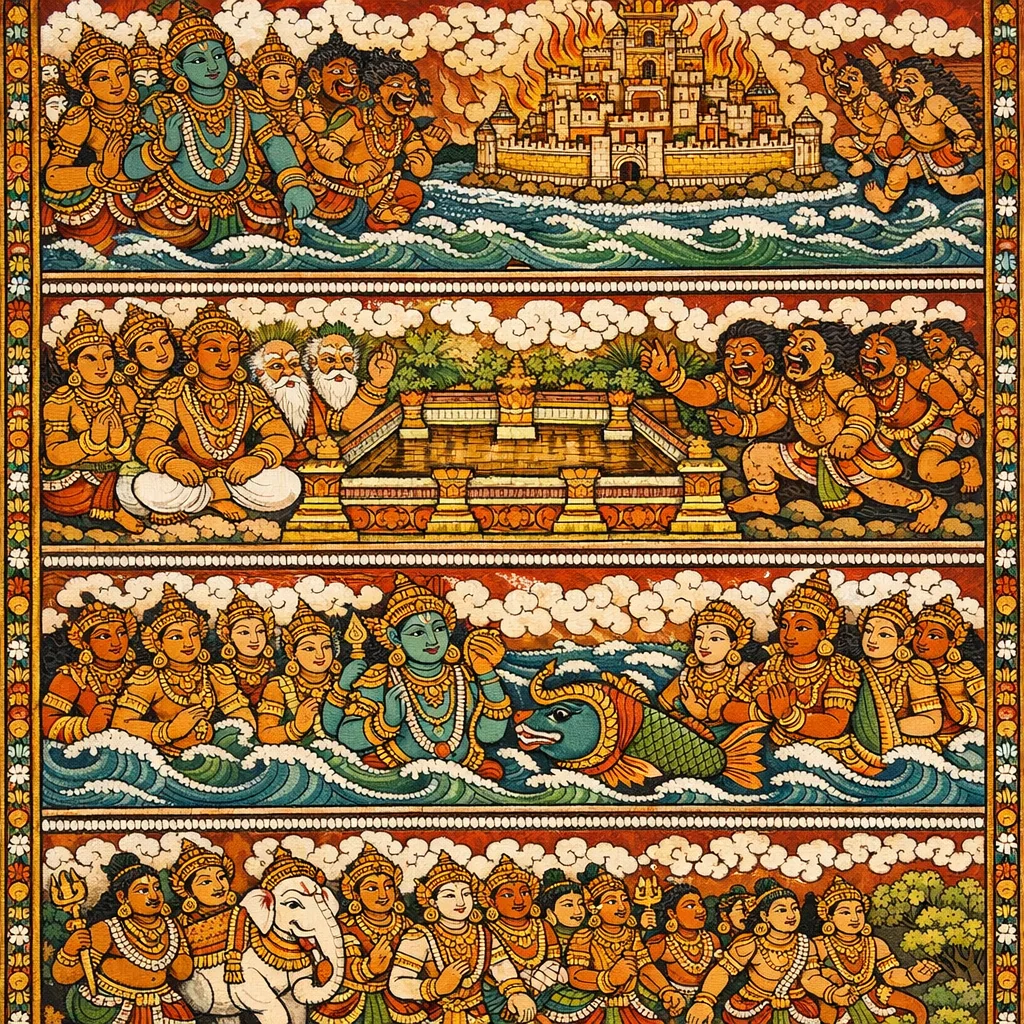
Adhyaya 137: Tripura Takes Refuge in the Ocean; Maya’s Hidden Nectar-Reservoir and the Gods’ Pursuit
त्रिपुरसंश्रयः सागरे मयवापी-रहस्यं च
Speaker: Sūta, Maya (Daitya/Dānava lord), Vāpī-pālas (guardians of the stepwell), Śiva (Trilocana/Bhava/Tripurāri), Brahmā (Pitāmaha), Indra (Śakra), Hari (Viṣṇu)
Sūta recounts how the Daityas were routed by the Pramathas and, in fear, withdrew into Tripura. Maya heartens the demoralized Daityas, explains the setback as the power of Kāla, and receives word from the vāpī-guardians that his secret, amṛta-like lotus reservoir has been drained by an intruder in bull form. Maya concludes that only Viṣṇu (Ajita, Gadādhara) could pierce his māyā, linking this to the gods’ power to restore the slain to life. He proposes taking refuge in the ocean and obstructing supply lines, then leads Tripura to the sea, where a splendid city rises amid deep waters. After Tripura’s withdrawal, Śiva informs Brahmā and orders the divine chariot redirected; the gods assemble, roar, and march to the western ocean. Seeing the foe sheltered in Tripura, Śiva assigns coordinated strikes with the great deities, and Hari advances with firm resolve to destroy Tripura.
Key Concepts
Shlokas in Adhyaya 137
Verse 1
*सूत उवाच प्रमथैः समरे भिन्नास् त्रैपुरास्ते सुरारयः पुरं प्रविविशुर्भीताः प्रमथैर्भग्नगोपुरम् //
Sūta said: In the battle, those Tripura-demons—enemies of the gods—were shattered by the Pramathas. Terrified, they fled back into their city, whose gateways had been broken by the Pramathas.
Verse 2
शीर्णदंष्ट्रा यथा नागा भग्नशृङ्गा यथा वृषाः यथा विपक्षाः शकुना नद्यः क्षीणोदका यथा //
Like serpents whose fangs have worn away, like bulls whose horns are broken, like birds whose wings are impaired, and like rivers whose waters have dwindled—so too one becomes weakened and powerless when strength and supports are lost.
Verse 3
मृतप्रायास्तथा दैत्या दैवतैर्विकृताननाः बभूवुस्ते विमनसः कथं कार्यमिति ब्रुवन् //
Thus the Daityas, nearly dead and with their faces disfigured by the gods, became utterly dejected, saying, “What is to be done now—how shall we proceed?”
Verse 4
अथ तान्म्लानमनसस् तदा तामरसाननः उवाच दैत्यो दैत्यानां परमाधिपतिर्मयः //
Then, seeing them downcast at heart, the lotus-faced one—Maya, the Daitya who was the supreme overlord of the Daityas—spoke to them.
Verse 5
कृत्वा युद्धानि घोराणि प्रमथैः सह सामरैः तोषयित्वा तथा युद्धे प्रमथानमरैः सह //
Having waged dreadful battles together with the Pramathas and the warlike hosts, he likewise gratified the Pramathas in the midst of battle, along with the immortals.
Verse 6
यूयं यत्प्रथमं दैत्याः पश्चाच्च बलपीडिताः प्रविष्टा नगरं त्रासात् प्रमथैर्भृशमर्दिताः //
You Daityas—who at first came forward—later, when your strength was crushed, entered the city out of fear, being fiercely harried by the Pramathas.
Verse 7
अप्रियं क्रियते व्यक्तं देवैर्नास्त्यत्र संशयः यत्र नाम महाभागाः प्रविशन्ति गिरेर्वनम् //
Surely the gods are plainly being offended—of this there is no doubt—when those illustrious ones enter the forest of the mountain.
Verse 8
अहो हि कालस्य बलम् अहो कालो हि दुर्जयः यत्रेदृशस्य दुर्गस्य उपरोधो ऽवमागतः //
Alas—how great is the power of Time (Kāla)! Indeed Time is hard to overcome, for even such a formidable fortress has come under siege and constraint.
Verse 9
मये विवदमाने तु नर्दमान इवाम्बुदे बभूवुर्निष्प्रभा दैत्या ग्रहा इन्दूदये यथा //
But when I entered into dispute, like a cloud that thunders, the Daityas became lustreless—just as the planets grow dim at the rising of the Moon.
Verse 10
वापीपालास्ततो ऽभ्येत्य नभः काल इवाम्बुदाः मयमाहुर्यमप्रख्यं साञ्जलिप्रग्रहाः स्थिताः //
Then the guardians of the stepwell approached—like clouds gathering in the sky at the appointed season—and they stood with hands joined in reverence, declaring, “I am Maya,” famed like Yama.
Verse 11
या सामृतरसा गूढा वापी वै निर्मिता त्वया समाकुलोत्पलवना समीनाकुलपङ्कजा //
That concealed well or pool you have built is filled with nectar-like essence; it is dense with lotus-groves, and its lotuses are thronged with fish.
Verse 12
पीता सा वृषरूपेण केनचिद्दैत्यनायक वापी सा साम्प्रतं दृष्टा मृतसंज्ञा इवाङ्गना //
She was carried off by some Daitya leader who had assumed the form of a bull; and now that woman has been seen again—like one who has lost all consciousness, as if dead.
Verse 13
वापीपालवचः श्रुत्वा मयो ऽसौ दानवप्रभुः कष्टमित्यसकृत्प्रोच्य दितिजानिदमब्रवीत् //
Hearing the words of the guardian of the stepwell (vāpī), Maya—the lord of the Dānavas—repeatedly cried, “Alas, what hardship!” and then addressed the sons of Diti as follows.
Verse 14
मया मायाबलकृता वापी पीता त्वियं यदि विनष्टाः स्म न संदेहस् त्रिपुरं दानवा गतम् //
If this reservoir (vāpī), fashioned by me through the power of māyā, has truly been drunk up by you, then we are ruined—there is no doubt: the Dānavas have reached Tripura.
Verse 15
निहतान्निहतान्दैत्यान् आजीवयति दैवतैः पीता वा यदि वा वापी पीता वै पीतवाससा //
Even Daityas who have been slain—again and again—are restored to life by the gods. Whether they are ‘drunk up’ or cast into a well, they are indeed made to drink by the Yellow-robed One.
Verse 16
को ऽन्यो मन्मायया गुप्तां वापीम् अमृततोयिनीम् पास्यते विष्णुमजितं वर्जयित्वा गदाधरम् //
Who else—apart from Vishnu the Unconquered, the mace-bearer—could ever drink from that well, hidden by my own māyā, whose waters are like nectar (amṛta)?
Verse 17
सुगुह्यम् अपि दैत्यानां नास्त्यस्याविदितं भुवि यत्र मद्वरकौशल्यं विज्ञातं न वृतं बुधैः //
Even what is most secret among the Daityas is not unknown to him on earth; for there, my superior skill in granting boons (vara) is understood—yet it is not chosen as a course by the wise.
Verse 18
समो ऽयं रुचिरो देशो निर्द्रुमो निर्द्रुमाचलः नवाम्भःपूरितं कृत्वा बाधन्ते ऽस्मान्मरुद्गणाः //
This land is level and pleasing, yet it is bereft of trees, and its hills are treeless. Having filled all things with ever-fresh waters, the hosts of winds (the Maruts) now assail us.
Verse 19
ते यूयं यदि मन्यध्वं सागरोपरिधिष्ठिताः प्रमथानां महावेगं सहामः श्वसनोपमम् //
If you indeed think yourselves stationed upon the bounds of the ocean, then know: we can withstand the mighty rush of the Pramathas, like a blast of wind.
Verse 20
एतेषां च समारम्भास् तस्मिन्सागरसम्प्लवे निरुत्साहा भविष्यन्ति एतद्रथपथावृताः //
And in that oceanic inundation, the undertakings of these people will lose all momentum; their spirits will grow dispirited, for their chariot-roads and paths will be blocked.
Verse 21
युध्यतां निघ्नतां शत्रून् भीतानां च द्रविष्यताम् सागरो ऽम्बरसंकाशः शरणं नो भविष्यति //
Whether we stand and fight, striking down our enemies, or flee in fear, the ocean—vast and sky-like in appearance—will become our refuge.
Verse 22
इत्युक्त्वा स मयो दैत्यो दैत्यानामधिपस्तदा त्रिपुरेण ययौ तूर्णं सागरं सिन्धुबान्धवम् //
Having spoken thus, Maya—the Daitya and then lord of the Daityas—swiftly set out by way of Tripura toward the ocean, the kinsman of the river Sindhu.
Verse 23
सागरे जलगम्भीर उत्पपात पुरं वरम् अवतस्थुः पुराण्येव गोपुराभरणानि च //
In the sea, deep with waters, a splendid city suddenly rose up; and there appeared, as though from ancient times, its gateway-towers and other adornments as well.
Verse 24
अपक्रान्ते तु त्रिपुरे त्रिपुरारिस्त्रिलोचनः पितामहमुवाचेदं वेदवादविशारदम् //
When Tripura had withdrawn, the three-eyed Lord—the destroyer of Tripura—addressed Pitāmaha (Brahmā), well-versed in the doctrines of the Vedas, and spoke these words.
Verse 25
पितामह दृढं भीता भगवन्दानवा हि नः विपुलं सागरं ते तु दानवाः समुपाश्रिताः //
O Pitāmaha (Brahmā), O Blessed Lord—truly we Dānavas are seized with great fear. Those Dānavas have taken refuge in the vast ocean.
Verse 26
यत एव हि ते यातास् त्रिपुरेण तु दानवाः तत एव रथं तूर्णं प्रापयस्व पितामह //
“From the very direction where those Dānavas have gone along with Tripura, from that same direction quickly bring the chariot here, O Pitāmaha.”
Verse 27
सिंहनादं ततः कृत्वा देवा देवरथं च तम् परिवार्य ययुर्हृष्टाः सायुधाः पश्चिमोदधिम् //
Then, having raised a lion-like battle-cry, the gods—glad at heart and armed—surrounded that divine chariot and marched toward the western ocean.
Verse 28
ततो ऽमरामरगुरुं परिवार्य भवं हरम् नर्दयन्तो ययुस्तूर्णं सागरं दानवालयम् //
Then, surrounding Bhava—Hara (Śiva), the revered preceptor of both gods and antigods, they roared aloud and swiftly set out for the ocean, the stronghold and dwelling-place of the Dānavas.
Verse 29
अथ चारुपताकभूषितं पटहाडम्बरशङ्खनादितम् / त्रिपुरमभिसमीक्ष्य देवता विविधबला ननदुर्यथा घनाः //
Then, beholding Tripura—adorned with lovely banners and resounding with the din of kettledrums and the blare of conches—the gods, possessed of diverse powers, roared aloud like thundering clouds.
Verse 30
अमरवरपुरे ऽपि दारुणो जलधररावमृदङ्गगह्वरः दनुतनयनिनादमिश्रितः प्रतिनिधिसंक्षुभिताणवोपमः //
Even in the excellent city of the immortals there arose a dreadful, cavernous booming—like a kettle-drum—mixed with the roar of rain-clouds and the cries of the sons of Danu; it was as though the very hosts of the Daityas were being violently stirred into upheaval.
Verse 31
अथ भुवनपतिर्गतिः सुराणाम् अरिमृगयाम् अददात्सुलब्धबुद्धिः त्रिदशगणपतिर्ह्युवाच शक्रं त्रिपुरगतं सहसा निरीक्ष्य शत्रुम् //
Then the Lord of the worlds—who is the refuge and course of the gods—granting them the pursuit of the enemy with clear, readily won resolve, spoke at once to Śakra (Indra) after suddenly beholding the foe who had taken shelter in Tripura.
Verse 32
त्रिदशगणपते निशामयैतत् त्रिपुरनिकेतनं दानवाः प्रविष्टाः यमवरुणकुबेरषण्मुखैस्तत् सह गणपैरपि हन्मि तावदेव //
O Lord of the hosts of the gods, behold this: the Dānava demons have entered the stronghold of Tripura. Together with Yama, Varuṇa, Kubera, and Ṣaṇmukha—and with their attendant troops as well—I shall strike them down this very moment.
Verse 33
विहितपरबलाभिघातभूतं व्रज जलधेस्तु यतः पुराणि तस्थुः स रथवरगतो भवः समर्थो ह्य् उदधिमगात्त्रिपुरं पुनर्निहन्तुम् //
Appointed as the instrument to strike down the enemy host, Bhava (Śiva), mounted upon the excellent chariot, went to the ocean—where the ancient cities had stood—in order once again to destroy Tripura.
Verse 34
इति परिगणयन्तो दितेः सुता ह्य् अवतस्थुर्लवणार्णवोपरिष्टात् अभिभवत्रिपुरं सदानवेन्द्रं शरवर्षैर्मुसलैश्च वज्रमिश्रैः //
Thus, while reckoning and conferring among themselves, the sons of Diti took their stand above the Salt Ocean, overpowering Tripura and the lord of the Dānavas, assailing them with showers of arrows, with clubs, and with weapons mixed with thunderbolt-like force.
Verse 35
अहमपि रथवर्यमास्थितः सुरवरवर्य भवेय पृष्ठतः असुरवरवधार्थमुद्यतानां प्रतिविदधामि सुखाय ते ऽनघ //
I too, mounted upon an excellent chariot, O best of the best among the gods, will remain behind you; and, for the destruction of the foremost Asuras who are rising up for battle, I shall render counter-action—so that it may be for your ease, O blameless one.
Verse 36
इति भववचनप्रचोदिते दशशतनयनवपुः समुद्यतः त्रिपुरपुरजिघांसया हरिः प्रविकसिताम्बुजलोचनो ययौ //
Thus, urged on by Bhava’s words, Hari—whose form bore a hundred eyes and who had risen to action—set forth with the intent to destroy the city of Tripura, his lotus-like eyes fully opened.
Frequently Asked Questions
The chapter teaches that power and fortifications are ultimately vulnerable to Kāla (Time), and that strategy must adapt when supports are lost. Maya’s counsel shows a shift from pride in strength to reliance on terrain and logistics (the ocean as refuge), while the narrative also asserts Viṣṇu’s unconquerable capacity to penetrate māyā and hidden protections—implying that even the most secret defenses fail before higher divine order.
This adhyaya is primarily narrative and theological rather than Vāstu-technical or genealogical. It touches indirectly on ‘fortress logic’ and engineered concealment through Maya’s hidden vāpī (a constructed reservoir) and Tripura’s ocean-based stronghold, but it does not provide measurements or formal Vāstu prescriptions. The dominant themes are cosmic warfare, divine polity (command and coalition), and metaphysics of Time and māyā.
The vāpī is a concealed reservoir created by Maya through māyā, described as amṛta-like, lotus-filled, and teeming with fish. Its being ‘drunk up’ signals a breach of Daitya security and becomes proof to Maya that only Viṣṇu (Ajita, Gadādhara) could overcome the illusionary concealment—marking a decisive turn in the Daityas’ confidence and strategy.
Maya argues the ocean provides a vast, sky-like refuge that can protect both in battle and in retreat. He anticipates that in an oceanic inundation or sea-encircled theater, the enemy’s chariot-roads and pathways will be obstructed, causing their initiatives to lose momentum—an early statement of terrain-based defensive strategy.