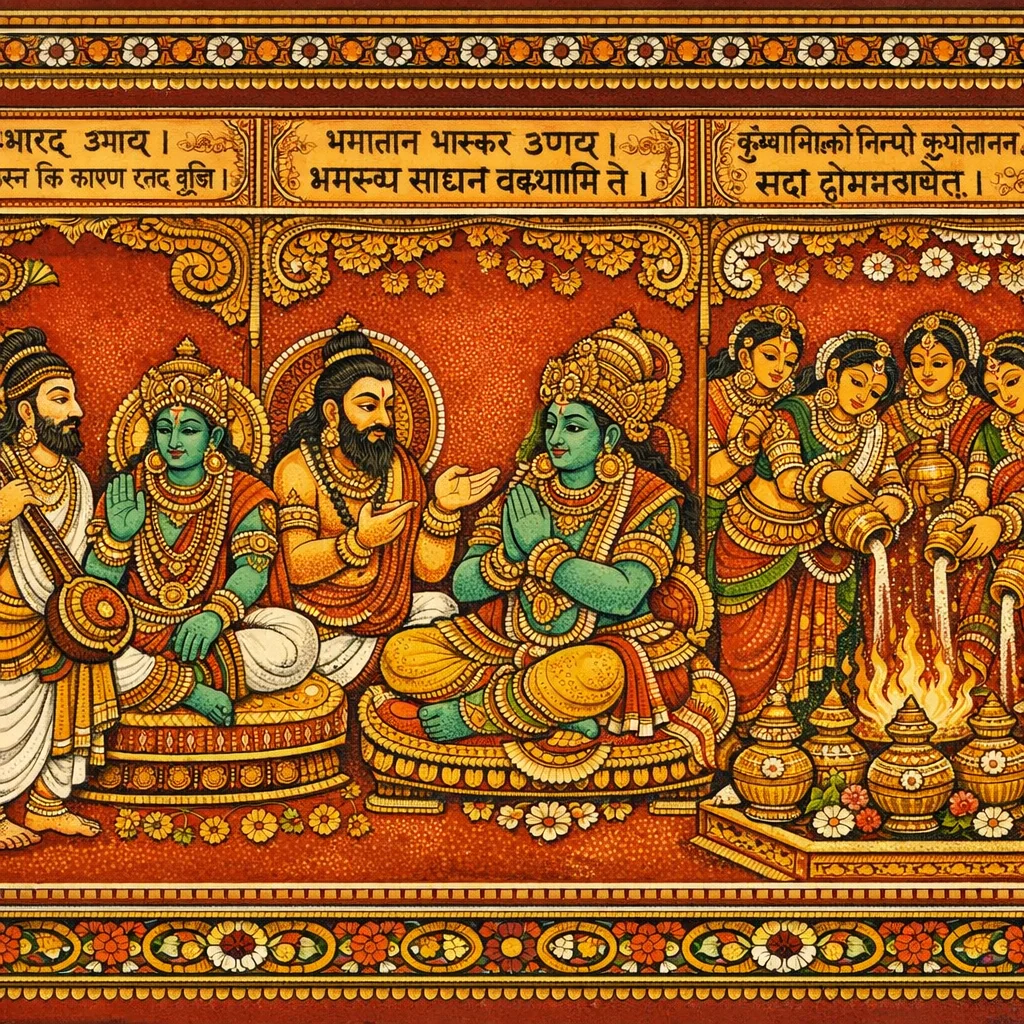
Adhyaya 68: Saptamī Sacred Bath and the Mṛtavatsābhiṣeka Rite for Pacifying Misfortune and Protecting Children
सप्तमीस्नपनं तथा मृतवत्साभिषेकविधानम्
Speaker: नारद (Narada), श्रीभगवान् (The Blessed Lord), सूर्य/भास्कर (Surya/Bhaskara)
Nārada asks which rites can remedy sudden fear, mental agitation, ominous portents, and how Alakṣmī is destroyed, especially through ceremonies such as the mṛtavatsābhiṣeka. The Lord replies that present misfortunes arise from prior sins and teaches the Saptamī-snapana as a universal shānti rite for welfare. To validate the practice, the chapter presents a future exemplar: King Kṛtavīrya of the Haihayas, though fated to fall by Cyavana’s curse, seeks Sūrya’s aid to safeguard his son’s life. Sūrya reassures him and imparts the full procedure—rules of timing (in some cases avoiding the child’s birth nakṣatra/tithi), sequences of homa and mantras, arrangement and consecration of kumbhas, abhiṣeka performed by seven women, protective blessings, guru-dakṣiṇā and honoring brāhmaṇas, and concluding worship of Sūrya and Śaṅkara. The chapter ends by praising Śukla-saptamī worship as an enduring shānti practice that averts distress and grants longevity and purification.
Key Concepts
Shlokas in Adhyaya 68
Verse 1
*नारद उवाच किमुद्वेगाद्भुते कृत्यम् अलक्ष्मीः केन हन्यते मृतवत्साभिषेकादिकार्येषु च किमिष्यते //
Narada said: “When one is shaken by anxiety and fear, what rite should be performed? By what means is Alakṣmī—misfortune—destroyed? And what is prescribed in rituals such as the mṛtavatsābhiṣeka and related ceremonial acts?”
Verse 2
*श्रीभगवानुवाच पुरा कृतानि पापानि फलन्त्यस्मिंस्तपोधन रोगदौर्गत्यरूपेण तथैवेष्टवधेन च //
The Blessed Lord said: “O treasure of austerity, sins committed in the past bear fruit in this very life—appearing as disease, as misfortune and wretchedness, and also as the death of one’s beloved.”
Verse 3
तद्विघाताय वक्ष्यामि सदा कल्पाणकारकम् सप्तमीस्नपनं नाम जनपीडाविनाशनम् //
To counter that affliction, I shall describe the rite called the Saptamī Ablution (Saptamī-snāna), ever a maker of welfare and a destroyer of the people’s suffering.
Verse 4
बालानां मरणं यत्र क्षीरपाणां प्रदृश्यते तद्वद्वृद्धातुराणां च यौवने चापि वर्तताम् //
Where the death of children—still drinking milk—is seen, in the same way the death of the aged and the sick is also seen; and even those who are in youth may meet with it.
Verse 5
शान्तये तत्र वक्ष्यामि मृतवत्साभिषेचनम् एतद् एवाद्भुतोद्वेगचित्तभ्रमविनाशनम् //
For pacification, I shall now describe the rite called the ‘Mṛtavatsābhiṣecana’—the ablution for a (seemingly) dead calf; this very procedure destroys the distress caused by portents, agitation, and confusion of the mind.
Verse 6
भविष्यति च वाराहो यत्र कल्पस्तपोधन वैवस्वतश्च तत्रापि यदा तु मनुरुत्तमः //
O ascetic rich in austerities, there will be in the future a Varāha-kalpa; and in that same cycle there will also be the Vaivasvata Manvantara, when the excellent Manu arises to preside.
Verse 7
भविष्यति च तत्रैव पञ्चविंशतिमं यदा कृतं नाम युगं तत्र हैहयान्वयवर्धनः भविता नृपतिर्वीरः कृतवीर्यः प्रतापवान् //
And there itself, when the twenty-fifth age called the Kṛta Yuga arrives, there will be born a heroic king—Kṛtavīrya, mighty in splendour—who will expand the lineage of the Haihayas.
Verse 8
स सप्तद्वीपमखिलं पालयिष्यति भूतलम् यावद्वर्षसहस्राणि सप्तसप्तति नारद //
O Nārada, he will protect and rule the whole earth with its seven continents for seventy-seven thousand years.
Verse 9
जातमात्रं च तस्यापि यावत्पुत्रशतं तथा च्यवनस्य तु शापेन विनाशमपयास्यति //
Even from the moment of his birth, and even if a hundred sons are born to him, he will nonetheless meet destruction—brought about by the curse of Cyavana.
Verse 10
सहस्रबाहुश्च यदा भविता तस्य वै सुतः कुरङ्गनयनः श्रीमान् सम्भूतो नृपलक्षणैः //
And when Sahasrabāhu comes to be his son, Sahasrabāhu’s son will indeed be Kuranganayana—illustrious, endowed with the distinguishing marks of a king.
Verse 11
कृतवीर्यस्तदाराध्य सहस्रांशुं दिवाकरम् उपवासैर्व्रतैर्दिव्यैर् वेदसूक्तैश्च नारद पुत्रस्य जीवनायालम् एतत्स्नानमवाप्स्यति //
O Nārada, Kṛtavīrya, having duly worshipped the thousand-rayed Sun (Divākara) through fasts, exalted vows, and Vedic hymns, will obtain this sacred bath—fully sufficient for securing the life of his son.
Verse 12
कृतवीर्येण वै पृष्ट इदं वक्ष्यति भास्करः अशेषदुष्टशमनं सदा कल्मषनाशनम् //
Questioned by Kṛtavīrya, Bhāskara will now expound this teaching—one that pacifies every form of wickedness and ever destroys impurity (sin).
Verse 13
*सूर्य उवाच अलं क्लेशेन महता पुत्रस्तव नराधिप भविष्यति चिरंजीवी किंतु कल्मषनाशनम् //
Sūrya said: “Enough of this great distress. Your son will become a lord of men (a king); he will be long-lived, and a remover of sin.”
Verse 14
सप्तमीस्नपनं वक्ष्ये सर्वलोकहिताय वै जातस्य मृतवत्सायाः सप्तमे मासि नारद अथवा शुक्लसप्तम्याम् एतत्सर्वं प्रशस्यते //
I shall explain the Saptamī bathing rite (Saptamī-snapana), intended for the welfare of all people. O Nārada, it is especially commended for a woman who has given birth to a dead child—either in the seventh month, or on the bright fortnight’s seventh lunar day; all of this is considered highly praiseworthy.
Verse 15
ग्रहताराबलं लब्ध्वा कृत्वा ब्राह्मणवाचनम् बालस्य जन्मनक्षत्रं वर्जयेत्तां तिथिं बुधः तद्वद्वृद्धातुराणां च कृत्यं स्यादितरेषु च //
After ascertaining the strength of the planets and the lunar asterisms (nakṣatra), and after having Brahmins recite the appropriate formulas, a wise man should avoid performing the rite on the child’s birth-asterism and on the corresponding tithi (lunar day). The same rule applies for the elderly and the sick; for others, the rite may be performed (without that restriction).
Verse 16
गोमयेनानुलिप्तायां भूमावेकाग्निवत्तदा तण्डुलै रक्तशालीयैश् चरुं गोक्षीरसंयुतम् निर्वपेत्सूर्यरुद्राभ्यां तन्मन्त्राभ्यां विधानतः //
Then, on ground plastered with cow-dung, one should establish the sacred fire as for the one-fire rite. Using grains of red śāli-rice, he should prepare a caru (cooked oblation) mixed with cow’s milk, and offer it duly with the mantras of Sūrya and Rudra, according to the prescribed rule.
Verse 17
कीर्तयेत्सूर्यदेवत्यं सप्तर्चं च घृताहुतीः जुहुयाद्रुद्रसूक्तेन तद्वद्रुद्राय नारद //
One should recite the seven-verse hymn addressed to the Sun-deity, and offer oblations of ghee. Then, using the Rudra-sūkta, one should perform the fire-offering; and in the same manner, offer to Rudra as well—O Nārada.
Verse 18
होतव्याः समिधश्चात्र तथैवार्कपलाशयोः यवकृष्णतिलैर्होमः कर्तव्यो ऽष्टशतं पुनः //
Here, fuel-sticks (samidh) are to be offered into the fire—likewise those of the arka and palāśa trees; and a homa with barley and black sesame should again be performed eight hundred times.
Verse 19
व्याहृतीभिस्तथाज्येन तथैवाष्टशतं पुनः हुत्वा स्नानं च कर्तव्यं मङ्गलं येन धीमता //
Having again offered eight hundred oblations with the sacred utterances (vyāhṛtis) together with ghee, the wise person should then perform a bath—by which auspiciousness is secured.
Verse 20
विप्रेण वेदविदुषा विधिवद्दर्भपाणिना स्थापयित्वा तु चतुरः कुम्भान्कोणेषु शोभनान् //
Then, a Brahmin learned in the Vedas—holding sacred darbha grass in his hand and acting according to proper rite—should duly set up four auspicious ritual pots (kumbhas) at the corners.
Verse 21
पञ्चमं च पुनर्मध्ये दध्यक्षतविभूषितम् स्थापयेदव्रणं कुम्भं सप्तर्चेनाभिमन्त्रितम् //
And then, in the middle, one should place the fifth vessel, adorned with curd and unbroken grains of rice; one should set there a flawless (undamaged) water-pot (kumbha), consecrated by the seven-verse hymn (Saptarcā).
Verse 22
सौरेण तीर्थतोयेन पूर्णं रत्नसमन्वितम् सर्वान्सर्वौषधैर्युक्तान् पञ्चगव्यसमन्वितान् पञ्चरत्नफलैः पुष्पैर् वासोभिः परिवेष्टयेत् //
One should fill it with sacred pilgrimage-water (tīrtha) consecrated for Sūrya, furnish it with gems, mix in all auspicious medicinal herbs, and add the pañcagavya. Then it should be wrapped and arranged together with the five kinds of precious fruits, flowers, and cloths.
Verse 23
गजाश्वरथ्यावल्मीकात् संगमाद्ध्रदगोकुलात् संशुद्धां मृदमानीय सर्वेष्वेव विनिक्षिपेत् //
Having brought well-purified earth from places such as an elephant-stable, a horse-stable, a chariot-road, an anthill, a river-confluence, a pond, or a cattle-settlement, one should deposit (apply) it in all the required spots (of the site/works).
Verse 24
चतुर्ष्वपि च कुम्भेषु रत्नगर्भेषु मध्यमम् गृहीत्वा ब्राह्मणस्तत्र सौरान्मन्त्रानुदीरयेत् //
Then, from the four jewel-filled ritual pots, the brāhmaṇa should take the middle portion (as prescribed) and, at that spot, recite the solar (Sūrya-related) mantras.
Verse 25
नारीभिः सप्तसंख्याभिर् अव्यङ्गाङ्गीभिरत्र च पूजिताभिर्यथाशक्त्या माल्यवस्त्रविभूषणैः सविप्राभिश्च कर्तव्यं मृतवत्साभिषेचनम् //
Here, the rite called the Mṛtavatsābhiṣecana should be performed with seven women of unimpaired limbs, who are to be honoured according to one’s means with garlands, garments, and ornaments, and along with brāhmaṇas as well.
Verse 26
एते ऽभिषेकमन्त्राः दीर्घायुरस्तु बालो ऽयं जीवत्पुत्रा च भामिनी आदित्यश्चन्द्रमाः सार्धं ग्रहनक्षत्रमण्डलैः //
These are the consecration (abhiṣeka) mantras: “May this child be long-lived; and may the radiant lady be blessed with living sons. May the Sun and the Moon, together with the circles of planets and constellations, bestow auspiciousness.”
Verse 27
सशक्रा लोकपाला वै ब्रह्मविष्णुमहेश्वराः ते ते चान्ये च देवौघाः सदा पान्तु कुमारकम् //
May the guardians of the worlds, together with Śakra (Indra), and Brahmā, Viṣṇu, and Maheśvara (Śiva)—and all those other hosts of gods—ever protect the divine youth Kumāra (Skanda).
Verse 28
मित्रः शनिर्वा हुतभुग् ये च बालग्रहाः क्वचित् पीडां कुर्वन्तु बालस्य मा मातुर्जनकस्य वै //
May Mitra, or Śani, or Agni, and whatever child-seizing spirits (bālagrahas) there may be anywhere—let them cause affliction only to the child, and not to the mother or to the father.
Verse 29
ततः शुक्लाम्बरधरा कुमारपतिसंयुता सप्तकं पूजयेद्भक्त्या स्त्रीणामथ गुरुं पुनः //
Then, wearing white garments and accompanied by her husband, a woman should devoutly worship the sevenfold group (saptaka); thereafter, she should again worship the preceptor (guru) of women.
Verse 30
काञ्चनीं च ततः कुर्यात् ताम्रपात्रोपरिस्थिताम् प्रतिमां धर्मराजस्य गुरवे विनिवेदयेत् //
Then one should have a golden image made—placed upon a copper vessel—and formally present that image of Dharmarāja (Yama) to one’s teacher (guru).
Verse 31
वस्त्रकाञ्चनरत्नौघैर् भक्ष्यैः सघृतपायसैः पूजयेद्ब्राह्मणांस्तद्वद् वित्तशाठ्यविवर्जितः //
With heaps of garments, gold, and jewels—and with foods such as ghee and sweet rice (pāyasa)—one should honour the Brahmins, likewise remaining free from deceit or stinginess in one’s wealth.
Verse 32
भुक्त्वा च गुरुणा चेयम् उच्चार्या मन्त्रसंततिः दीर्घायुरस्तु बालो ऽयं यावद्वर्षशतं सुखी //
After (the rite/meal) has been completed, the teacher should recite this continuous series of mantras: “May this child be long-lived; may he remain happy for as long as a hundred years.”
Verse 33
यत्किंचिदस्य दुरितं तत्क्षिप्तं वडवानले ब्रह्मा रुद्रो वसुः स्कन्दो विष्णुः शक्रो हुताशनः //
Whatever sin or misfortune may cling to him—let it be cast into the mare-faced submarine fire (Vaḍavānala). May Brahmā, Rudra, the Vasu, Skanda, Viṣṇu, Śakra (Indra), and Hutāśana (Agni) protect him.
Verse 34
रक्षन्तु सर्वे दुष्टेभ्यो वरदाः सन्तु सर्वदा एवमादीनि वाक्यानि वदन्तं पूजयेद्गुरुम् //
“May all the deities protect (you) from the wicked; may they ever remain bestowers of boons.” One should honor and worship the guru who utters such words and similar auspicious blessings.
Verse 35
शक्तितः कपिलां दद्यात् प्रणम्य च विसर्जयेत् चरुं च पुत्रसहिता प्रणम्य रविशंकरौ //
According to one’s capacity, one should donate a tawny cow (kapilā); having bowed, one should then respectfully dismiss (the rite/recipient). With one’s sons accompanying, one should also offer the caru (cooked oblation) and, bowing down, pay reverence to Ravi (Sūrya) and Śaṅkara (Śiva).
Verse 36
हुतशेषं तदाश्नीयाद् आदित्याय नमो ऽस्त्विति इदमेवाद्भुतोद्वेगदुःस्वप्नेषु प्रशस्यते //
One should then eat what remains after the homa offering, reciting, “Salutations to Āditya (the Sun).” This very practice is commended in cases of ominous portents, sudden anxiety, and evil dreams.
Verse 37
कर्तुर्जन्मदिनर्क्षं च त्यक्त्वा सम्पूजयेत्सदा शान्त्यर्थं शुक्लसप्तम्याम् एतत्कुर्वन्न सीदति //
Setting aside (ordinary) attention to the patron’s birthday and birth-star (nakṣatra), one should always perform full worship for the sake of pacification on the bright fortnight’s seventh lunar day (Śukla-saptamī). One who performs this does not fall into distress.
Verse 38
सदानेन विधानेन दीर्घायुरभवन्नरः संवत्सराणामयुतं शशास पृथिवीमिमाम् //
By constantly following this prescribed method, the man became long-lived, and he ruled this very earth for ten thousand years.
Verse 39
पुण्यं पवित्रमायुष्यं सप्तमीस्नपनं रविः कथयित्वा द्विजश्रेष्ठ तत्रैवान्तरधीयत //
Having declared that the Saptamī bath is meritorious, purifying, and life-promoting, Ravi (the Sun) spoke thus, O best of the twice-born, and then vanished on the very spot.
Verse 40
एतत्सर्वं समाख्यातं सप्तमीस्नानमुत्तमम् सर्वदुष्टोपशमनं बालानां परमं हितम् //
Thus, all of this has been explained—the excellent rite of bathing on the Saptamī (seventh lunar day). It pacifies every harmful influence and is supremely beneficial for children.
Verse 41
आरोग्यं भास्करादिच्छेद् धनमिच्छेद्धुताशनात् ईश्वराज्ज्ञानम् अन्विच्छेन् मोक्षम् इच्छेज्जनार्दनात् //
Let one seek health from Bhāskara (the Sun), wealth from Hutāśana (Agni, the Fire), knowledge from Īśvara (the Lord), and liberation (mokṣa) from Janārdana (Viṣṇu).
Verse 42
एतन्महापातकनाशनं स्यात् परं हितं बालविवर्धनं च शृणोति यश्चैनमनन्यचेतास् तस्यापि सिद्धिं मुनयो वदन्ति //
This becomes a destroyer of the great sins; it is supremely beneficial and promotes the well-being and growth of children. Whoever listens to it with an undivided mind—the sages declare of him too the attainment of success (spiritual accomplishment).
Frequently Asked Questions
The chapter prescribes the Saptamī-snapana (Saptamī bathing rite) and the associated Mṛtavatsābhiṣeka as śānti practices to counter fear, anxiety, ominous signs, evil dreams, and Alakṣmī. It teaches that such suffering can be the fruition of earlier sins and gives a structured ritual program—Sūrya and Rudra mantra-recitation, caru and homa, kumbha abhiṣeka, protective blessings for the child, and concluding gifts and honor to the guru and brāhmaṇas.
This adhyaya is primarily Dharma/Ritual (prayoga-vidhi and śānti-karma). It includes a brief puranic future-setting and royal-genealogical anchoring through Kṛtavīrya (Haihaya line) and references to kalpa/manvantara framing, but it does not teach Vāstu-śāstra or rājadharma procedures here.
It is especially praised for a woman who has given birth to a dead child, linked to the seventh month and/or the bright fortnight’s seventh lunar day (Śukla-saptamī). The chapter also recommends it for pacifying sudden anxiety, portents, and bad dreams.
After assessing graha and nakṣatra strength, the wise performer should avoid doing the rite on the child’s birth nakṣatra and the corresponding tithi (and similarly for the elderly and the sick). For others, the restriction is relaxed; additionally, Śukla-saptamī is upheld as a standing day for śānti worship even if ordinary birthday/birth-star considerations are set aside.
Sūrya (Bhāskara/Ravi) is central, supported by Rudra/Śiva. The procedure includes the Saptarcā hymn to the Sun, ghee oblations, Rudra-sūkta homa, vyāhṛti oblations, and protective abhiṣeka mantras invoking Āditya, Candra, graha-nakṣatra मंडल, lokapālas, and deities like Brahmā, Viṣṇu, Maheśvara, Skanda, Indra, and Agni.
Mṛtavatsābhiṣeka is performed as an abhiṣeka involving seven women of unimpaired limbs (avyanga), who are honored with garlands, garments, and ornaments according to means, along with brāhmaṇas. The abhiṣeka mantras ask for the child’s longevity and the mother’s blessing of living sons, and for protection from harmful forces (including bālagrahas).