Adhyaya 38
Kapālamocana-tīrtha (Auśanasa) and Balarāma’s Sarasvatī Pilgrimage
Upa-parva: Tīrtha-yātrā and Sarasvatī Tīrtha Cycle (Balarāma in Śalya-parva)
Vaiśaṃpāyana narrates that Balarāma, after residing at an āśrama and honoring its residents, rises at dawn, performs gifting to dvijas, and departs swiftly with the intent of visiting tīrthas. He reaches the Auśanasa tīrtha known as Kapālamocana, a site associated with a great sage’s liberation from an affliction involving a severed head. Janamejaya requests clarification on how the liberation occurred and why the head became attached. Vaiśaṃpāyana provides an etiological account: in the Daṇḍakāraṇya context, a rākṣasa’s head is severed and, by chance, becomes lodged in Mahodara’s leg, causing pain and impurity that obstruct his access to sacred places. After visiting many rivers and seas without relief, he learns of the renowned Auśanasa tīrtha on the Sarasvatī, where, upon ritual contact with the water, the afflicting head detaches and falls into the water; he returns purified and reports the event, leading sages to name the site Kapālamocana. Balarāma performs further dāna and proceeds to Ruṣaṅgu’s āśrama and the Pṛthūdaka tīrtha, where traditions concerning auspicious death and ascetic attainment are referenced, including figures such as Viśvāmitra and Ārṣṭiṣeṇa.
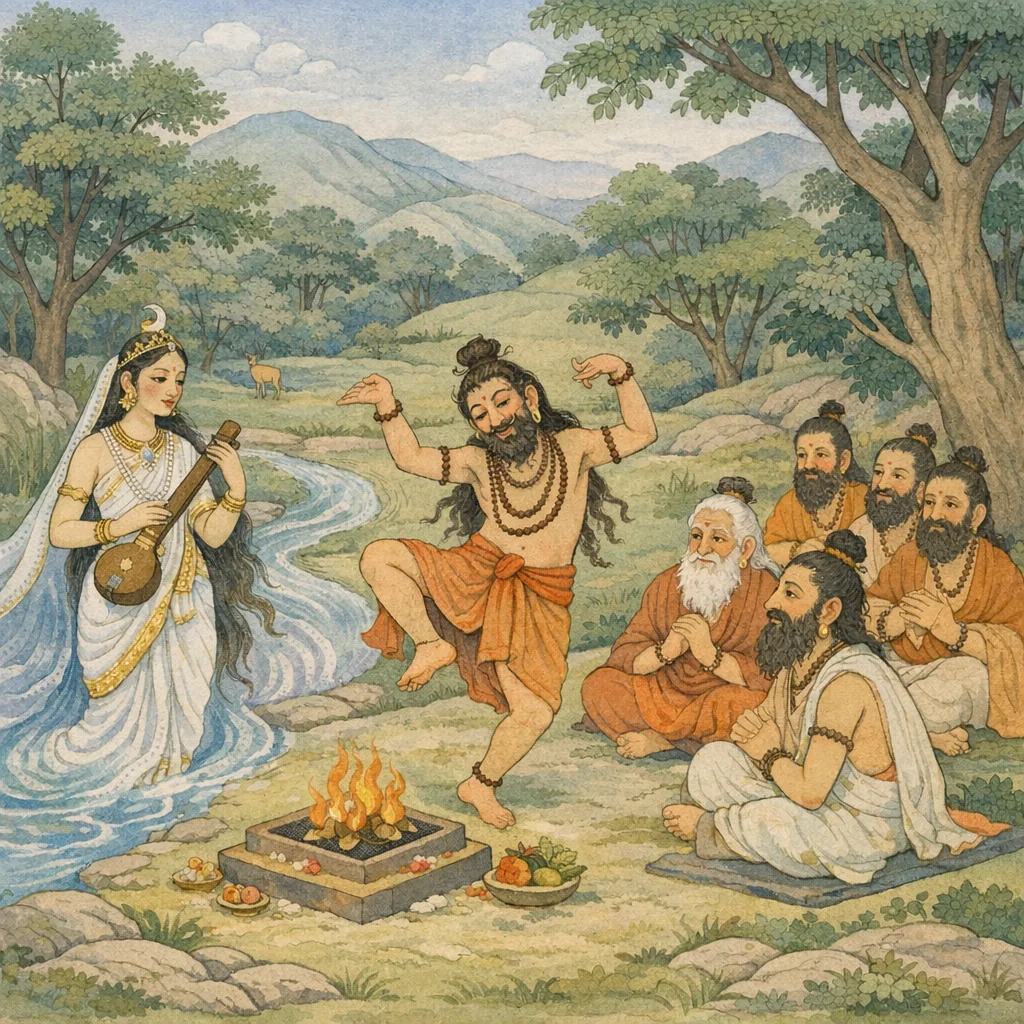
Chapter Arc: Janamejaya’s curiosity is stirred: he asks the learned Vaishampayana to tell, in proper order, the lineage and learning of the extraordinary sages connected with the sacred Sarasvati—those who live on austere fare and severe vows. → Vaishampayana unfolds a wondrous account: the seven Sarasvatis that pervade the world are invoked again and again; the river-goddess Sarasvati, swift and potent, appears among the sattrayajins of Naimisharanya, honoring Pitamaha (Brahma). The assembly’s reverence grows, yet a strange sight unsettles them—an ascetic brahmana begins to dance in sudden joy. → The sages challenge the dancing ascetic—“Why do you dance? What excess of happiness has arisen?” He answers with startling simplicity: he dances because he sees leafy-vegetable juice dripping from his hand—proof that even his meager sustenance has arrived by dharma’s grace. The small sign becomes a thunderclap of meaning: contentment itself is a sacrament. → The narrative widens into praise: Sarasvati is worshiped as the best of rivers, and the Supreme is extolled—Brahma and the gods worship that Varada Lord, who is all, the maker and the cause behind all causes. By that grace, the gods rejoice without fear; the sages’ doubt dissolves into devotion and understanding. → The sanctity of Sarasvati and the power of tapas are established, inviting the listener onward to further marvels of the tīrtha and the continuing chain of sacred episodes that stand beside the war’s grim march.
Shlokas
Verse 1
अकाल ३. पत्थरसे फोड़े हुए फलका भोजन करनेवाले। २. दाँतसे ही ओखलीका काम लेनेवाले अर्थात् ओखलीमें कूटकर नहीं
Janamejaya said: “For what reason did the sacred ford called Saptasārasvata arise? And who was the venerable sage Maṅkaṇaka? How did that holy one attain spiritual accomplishment, and what discipline or vow did he observe?”
Verse 2
कस्य वंशे समुत्पन्न: कि चाधीतं द्विजोत्तम । एतदिच्छाम्यहं श्रोतुं विधिवद् द्विजसत्तम
Janamejaya said: “O best of Brahmins, from which lineage was he born, and what sacred learning did he study? O foremost among the twice-born, I wish to hear all this in due and proper order.”
Verse 3
वैशम्पायन उवाच राजन् सप्त सरस्वत्यो याभिव्यप्तमिदं जगत् । आहूता बलवद्धिह्िं तत्र तत्र सरस्वती
Vaiśampāyana said: O King, there are seven rivers called Sarasvatī by which this world is pervaded. Wherever the mighty, austerity-endowed sages have invoked Sarasvatī, there and there she has manifested—answering their call.
Verse 4
सुप्रभा काउ्चनाक्षी च विशाला च मनोरमा । सरस्वती चौघवती सुरेणुर्विमलोदका,उन सबके नाम इस प्रकार हैं--सुप्रभा, कांचनाक्षी, विशाला, मनोरमा, सरस्वती, ओघवती, सुरेणु और विमलोदका
Vaiśampāyana said: “Their names are as follows—Suprabhā, Kāñcanākṣī, Viśālā, Manoramā, Sarasvatī, Oghavatī, Sureṇu, and Vimalodakā.”
Verse 5
पितामहस्य महतो वर्तमाने महामखे । वितते यज्ञवाटे च संसिद्धिषु द्विजातिषु
Vaiśampāyana said: When the great Grandfather (Brahmā) was conducting a mighty sacrificial rite, and the sacrificial enclosure had been spread out and fully prepared, with accomplished twice-born priests in attendance, the entire arena resounded with faultless auspicious recitations and the reverberation of Vedic mantras, while all the gods busied themselves in carrying out the ritual acts.
Verse 6
पुण्याहघोषैर्विमलैवेंदानां निनदैस्तथा । देवेषु चैव व्यग्रेषु तस्मिन् यज्ञविधौ तदा
Vaiśaṃpāyana said: “At that time, as that sacrificial rite was being carried out, the sacrificial enclosure resounded with the pure, faultless proclamations of ‘puṇyāha’ and with the reverberation of Vedic recitations. The gods themselves, intent and fully engaged, were busily occupied in the proceedings of that sacrifice.”
Verse 7
तत्र चैव महाराज दीक्षिते प्रपितामहे | यजतस्तस्य सत्रेण सर्वकामसमृद्धिना,महाराज! साक्षात् ब्रह्माजीने उस यज्ञकी दीक्षा ली थी। उनके यज्ञ करते समय सबकी समस्त इच्छाएँ उस यज्ञद्वारा परिपूर्ण होती थीं
Vaiśampāyana said: “There, O King, when the Grandsire had undertaken the consecration, he performed a great sacrificial session (satra) endowed with the fulfillment of every desire. As he carried out that rite, the wishes of all were satisfied through the abundance generated by that sacrifice.”
Verse 8
मनसा चिन्तिता हार्था धर्मार्थकुशलैस्तदा । उपतिष्ठ न्ति राजेन्द्र द्विजातींस्तत्र तत्र ह
Vaiśampāyana said: O king, at that time, whatever objects were merely conceived in the mind by those skilled in dharma and artha would at once present themselves—appearing here and there, as if summoned—before the twice-born.
Verse 9
जगुश्न तत्र गन्धर्वा ननृतुश्चाप्सरोगणा: । वादित्राणि च दिव्यानि वादयामासुरञण्जसा,उस यज्ञमें गन्धर्व गीत गाते और अप्सराएँ नृत्य करती थीं। वहाँ दिव्य बाजे बजाये जा रहे थे
Vaiśampāyana said: In that sacrificial rite, the Gandharvas sang, and the companies of Apsarases danced. Divine musical instruments were played there with effortless ease, heightening the sanctity and auspicious atmosphere of the ceremony.
Verse 10
तस्य यज्ञस्य सम्पत्त्या तुतुषुर्देवता अपि | विस्मयं परमं जग्मु: किमु मानुषयोनय:,उस यज्ञके वैभवसे देवता भी संतुष्ट थे और अत्यन्त आश्वर्यमें निमग्न हो रहे थे; फिर मनुष्योंकी तो बात ही क्या है?
Vaiśampāyana said: By the splendid success of that sacrifice, even the gods were fully gratified and were struck with the highest wonder; how much more, then, would those of human birth be amazed.
Verse 11
वर्तमाने तथा यज्ञे पुष्करस्थे पितामहे | अब्र॒ुवन्नषयो राजन्नायं यज्ञों महागुण:
Vaiśaṃpāyana said: While that sacrifice was thus in progress, and the Grandsire was at Puṣkara, the sages said to him, “O king, this sacrifice is endowed with great excellence.”
Verse 12
तच्छुत्वा भगवान् प्रीतः सस्माराथ सरस्वतीम्
Hearing those words, the revered one became pleased and, in his gladness, called Sarasvatī to mind—invoking the power of inspired speech and right counsel.
Verse 13
सुप्रभा नाम राजेन्द्र नाम्ना तत्र सरस्वती
Vaiśampāyana said: “O king, there was there a river named Sarasvatī, known by the name Suprabhā.”
Verse 14
तां दृष्टवा मुनयस्तुष्टास्त्वरायुक्तां सरस्वतीम् । पितामहं मानयन्तीं क्रतुं ते बहु मेनिरे
Seeing Sarasvatī arrive in haste, the sages were pleased. Observing her honoring the Grandsire (Pitāmaha), they regarded that sacrificial rite as greatly enhanced and auspicious—made weighty by due reverence and right order.
Verse 15
राजेन्द्र! तब वहाँ सरस्वती सुप्रभा नामसे प्रकट हुईं। बड़ी उतावलीके साथ आकर ब्रह्माजीका सम्मान करती हुई सरस्वतीका दर्शन करके ऋषिगण बड़े प्रसन्न हुए और उन्होंने उस यज्ञको बहुत सम्मान दिया ।।
O king, then and there the goddess Sarasvatī manifested, bearing the name Suprabhā. Hastening swiftly, she approached and paid honor to Brahmā. At the sight of Sarasvatī the sages were filled with joy, and they greatly revered that sacrifice. Thus, Sarasvatī—best among rivers—appeared at the Puṣkara sacred ford for the sake of Brahmā and to bring satisfaction to the wise seers.
Verse 16
नैमिषे मुनयो राजन् समागम्य समासते । तत्र चित्रा: कथा हासन वेदं प्रति जनेश्वर,राजन! जनेश्वर! नैमिषारण्यमें बहुत-से मुनि आकर रहते थे। वहाँ वेदके विषयमें विचित्र कथा-वार्ता होती रहती थी
Vaiśampāyana said: “O King, in Naimiṣa the sages gather and reside together. There, O lord of men, they continually engage in varied and striking discussions—often light and pleasant in tone—centered on the Veda.”
Verse 17
यत्र ते मुनयो ह्यासन् नानास्वाध्यायवेदिन: । ते समागम्य मुनयः सस्मरुर्वे सरस्वतीम्
There, where those sages—versed in many branches of Vedic study and recitation—were dwelling, the sages gathered together and reverently called to mind Sarasvatī. In the midst of grave events, the narrative highlights that true guidance is sought through learning joined with devotion, invoking the goddess of speech and wisdom before proceeding further.
Verse 18
सा तु ध्याता महाराज ऋषिभ: सत्रयाजिभि: । समागतानां राजेन्द्र साहाय्यार्थ महात्मनाम्
Vaiśampāyana said: “But she, O great king, was contemplated by the seers who were performing sacrificial sessions; and she came together with them, O lord of kings, to aid those high-souled ones who had assembled.”
Verse 19
नैमिषे काउ्चनाक्षी तु मुनीनां सत्रयाजिनाम्
Vaiśampāyana said: In Naimiṣa, Kāñcanākṣī—present among the sages engaged in a sacrificial session (satra)—was there, setting the tale within the sanctified sphere of a long Vedic rite, where disciplined inquiry and remembrance of dharma are upheld.
Verse 20
गयस्य यजमानस्य गयेष्वेव महाक्रतुम्
Vaiśampāyana said: King Gaya, the sacrificer (yajamāna), was performing a great rite in Gaya itself, in the land of Gaya. In that sacrifice too, Sarasvatī—foremost among rivers—was invoked. The Sarasvatī who came to the sacrifice of the austere sage Gaya is spoken of as “Viśālā” (the Broad, the Expansive One).
Verse 21
आहूता सरितां श्रेष्ठा गययज्ञे सरस्वती । विशालां तु गयस्याहु#षय: संशितव्रता:
Vaiśampāyana said: In King Gaya’s sacrifice, Sarasvatī—the foremost among rivers—was duly invoked. The sages of firm and disciplined vows declare that, in connection with Gaya, that very Sarasvatī is known by the name Viśālā.
Verse 22
सरित् सा हिमवत्पारश्चात् प्रख्रुता शीघ्रगामिनी । ओऔद्वालकेस्तथा यज्ञे यजतस्तस्य भारत
Vaiśampāyana said: That river, swift-flowing and rushing down from the far side of the Himālaya, was present there—O Bhārata—at the sacrifice of Audvālaki while he was performing the rite.
Verse 23
भरतनन्दन! यज्ञपरायण उद्दालक ऋषिके यज्ञमें भी सरस्वतीका आवाहन किया गया। वे शीघ्रगामिनी सरस्वती हिमालयसे निकलकर उस यज्ञमें आयी थीं ।।
Vaiśampāyana said: “O descendant of Bharata, the sage Uddālaka—steadfast in sacrifice—invoked Sarasvatī even within the rite. Swift-moving Sarasvatī, issuing forth from the Himālaya, came to that sacrifice. At that time, in the holy and prosperous region of Northern Kosala, the circle of sages had assembled from all directions. There, while performing the sacrifice, the great-souled Uddālaka contemplated the goddess Sarasvatī; and to bring the sage’s purpose to fulfillment, Sarasvatī—foremost among rivers—arrived in that land.”
Verse 24
उद्दालकेन यजता पूर्व ध्याता सरस्वती । आजगाम सरिच्छेष्ठा तं देशं मुनिकारणात्
Vaiśampāyana said: While the sage Uddālaka was performing a sacrifice, he had earlier meditated upon the goddess Sarasvatī. In order to accomplish the purpose of the sages, O King, Sarasvatī—the foremost among rivers—came to that region.
Verse 25
पूज्यमाना मुनिगणैर्वल्कलाजिनसंवृतै: । मनोरमेति विख्याता सा हि तैर्मनसा कृता
Honoured by companies of sages clad in bark-garments and deer-skins, that river-goddess Sarasvatī became renowned by the name “Manoramā,” for those seers had fashioned that appellation through their mental contemplation of her.
Verse 26
सुरेणुरषभे द्वीपे पुण्ये राजर्षिसेविते । कुरोश्व यजमानस्य कुरुक्षेत्र महात्मन:
Vaiśampāyana said: In the sacred island called Sureṇu-Ṛṣabha, frequented by royal sages, lies Kurukṣetra—the holy field of the great-souled Kuru, who performed sacrifices there.
Verse 27
ओघवत्यपि राजेन्द्र वसिष्ठेन महात्मना
Vaiśampāyana said: O king, even there the swift-flowing river was renowned by the name Sureṇu. When Dakṣa Prajāpati, while performing a sacrifice at Gaṅgādvāra, invoked Sarasvatī, she was then seen flowing there and became celebrated as Sureṇu. In the same way, the great sage Vasiṣṭha invoked the divine-streamed Sarasvatī in Kurukṣetra, where she became famous under the name Oghavatī.
Verse 28
समाहूता कुरुक्षेत्रे दिव्यतोया सरस्वती । दक्षेण यजता चापि गड्जाद्वारे सरस्वती
Vaiśampāyana said: The river Sarasvatī—whose waters are wondrous and sacred—was invoked and gathered at Kurukṣetra; and there too she was invoked by Dakṣa as he performed sacrifice, at the place called Gaḍjādvāra.
Verse 29
विमलोदा भगवती ब्रह्मणा यजता पुन:
Vaiśampāyana said: Again, the revered goddess Vimalodā was worshipped by Brahmā, the sacrificer.
Verse 30
एकी भूतास्ततस्तास्तु तस्मिंस्तीर्थे समागता:
Vaiśampāyana said: Then, having become united as one body, those women gathered together at that sacred ford—the tīrtha.
Verse 31
इति सप्तसरस्वत्यो नामतः परिकीर्तिता:
Vaiśampāyana said: “Thus, the seven Sarasvatī rivers have been recounted by name.”
Verse 32
शृणु मड़कणकस्यापि कौमारब्रह्मचारिण:
Vaiśampāyana said: “Listen also to the account of Maḍakaṇaka, who observed brahmacarya from boyhood.”
Verse 33
दृष्टवा यदृच्छया तत्र स्त्रियमंभसि भारत
Vaiśaṃpāyana said: “O Bhārata, O delight of the Bharatas, O great king—once it happened that a blameless, exquisitely beautiful woman with lovely eyes was bathing in the waters of the Sarasvatī. By the turn of fate, the sage Maṅkaṇaka’s gaze fell upon her, and his semen involuntarily slipped and fell into the water.”
Verse 34
जायन्तीं रुचिरापाड़ीं दिग्वाससमनिन्दिताम् | सरस्वत्यां महाराज चस्कन्दे वीर्यमम्भसि
Vaiśampāyana said: “O great king, there was once a blameless, beautiful young woman—Jayantī—lovely in her glances, bathing in the waters of the Sarasvatī. By the force of fate, the sage Maṅkaṇaka’s gaze fell upon her, and his semen was involuntarily discharged and fell into the water.”
Verse 35
तद् रेत: स तु जग्राह कलशे वै महातपा: । सप्तधा प्रविभागं तु कलशस्थं जगाम ह,महातपस्वी मुनिने उस वीर्यको एक कलशमें ले लिया। कलशमें स्थित होनेपर वह वीर्य सात भागोंमें विभक्त हो गया
Vaiśaṃpāyana said: “The great ascetic collected that semen in a jar. Once contained in the jar, it separated into seven distinct portions.”
Verse 36
तत्रर्षय: सप्त जाता जज्ञिरे मरुतां गणा: । वायुवेगो वायुबलो वायुहा वायुमण्डल:
Vaiśampāyana said: “There, seven sages were born—beings who became the primal companies of the Maruts. Their names were Vāyuvega, Vāyubala, Vāyuhā, and Vāyumaṇḍala (and, as the tradition continues, Vāyujvāla, Vāyuretā, and the mighty Vāyucakra). Thus arose the progenitors of the Marut hosts, embodying the elemental force of wind and its disciplined, ordered power.”
Verse 37
वायुज्वालो वायुरेता वायुचक्रश्न वीर्यवान् । एवमेते समुत्पन्ना मरुतां जनयिष्णव:
Vaiśampāyana said: “Thus were born these progenitors of the Maruts—Vāyujvāla, Vāyuretā, and the mighty Vāyucakra.”
Verse 38
इदमत्यद्भुतं राजन् शृण्वाशच्चर्यतरं भुवि । महर्षेश्वरितं यादृक् त्रिषु लोकेषु विश्रुतम्
Vaiśampāyana said: “O King, listen to this most wondrous account—more astonishing than anything on earth. Hear the extraordinary conduct of the great seer, famed throughout the three worlds.”
Verse 39
पुरा मड़कणक: सिद्धः कुशाग्रेणेति न: श्रुतम् क्षत: किल करे राज॑स्तस्य शाकरसो5स्रवत्
Vaiśampāyana said: “We have heard, O king, that long ago the perfected sage Maṅkaṇaka was once pricked on the hand by the tip of a blade of kuśa grass; and from that wound, it is said, not blood but the sap of a leafy vegetable flowed.”
Verse 40
स वै शाकरसं दृष्टवा हर्षाविष्ट: प्रनृत्तवान् । ततस्तस्मिन् प्रनृत्ते वै स्थावरं जड़मं च यत्
Seeing that sweet, sugar-like essence, he was seized with delight and began to dance. And when he thus danced, even whatever was motionless and inert there seemed to be stirred—such was the contagious force of that joy.
Verse 41
ब्रह्मादिभि: सुरै राजन्नषिभिश्व॒ तपोधनै:,राजन! नरेश्वर! तब ब्रह्मा आदि देवताओं तथा तपोधन महर्षियोंने ऋषिके विषयमें महादेवजीसे निवेदन किया--'देव! आप ऐसा कोई उपाय करें, जिससे ये मुनि नृत्य न करें
Vaiśampāyana said: “O King, O lord of men—Brahmā and the other gods, together with the austere seers rich in tapas, approached Mahādeva regarding that sage and submitted a request: ‘O Lord, devise some means by which these ascetics will cease their dancing.’”
Verse 42
विज्ञप्तो वै महादेव ऋषेरथें नराधिप । नायं नृत्येद् यथा देव तथा त्वं कर्तुमहसि
Vaiśampāyana said: “O king, Mahādeva was formally petitioned on behalf of the sage. The gods—headed by Brahmā—and the ascetic great seers submitted a request to Śiva: ‘O Lord, please devise some means by which this muni may not dance.’”
Verse 43
ततो देवो मुनि दृष्टवा हर्षाविष्टमतीव ह । सुराणां हितकामार्थ महादेवो5भ्यभाषत,मुनिको हर्षके आवेशसे अत्यन्त मतवाला हुआ देख महादेवजीने (ब्राह्मणका रूप धारण करके) देवताओंके हितके लिये उनसे इस प्रकार कहा--
Then Mahādeva, seeing the divine sage utterly overcome with joy, addressed him for the welfare of the gods—speaking with the intention of securing what was beneficial to the devas.
Verse 44
भो भो ब्राह्मण धर्मज्ञ किमर्थ नृत्यते भवान् | हर्षस्थानं किमर्थ च तवेदमधिकं मुने
Vaiśampāyana said: “O Brahmin, knower of dharma, for what reason are you dancing? And what is the cause of this joy of yours, O sage—why is your delight so excessive?”
Verse 45
ऋषिरुवाच कि न पश्यसि मे ब्रह्मन् कराच्छाकरसं स्रुतम्
The sage said: “O Brahmin, do you not see the stream of sugarcane-juice flowing from my hand?”
Verse 46
त॑ं प्रहस्याब्रवीद् देवो मुनिं रागेण मोहितम्
Smiling, the divine one addressed the sage, who had been deluded by passion.
Verse 47
अहं न विस्मयं विप्र गच्छामीति प्रपश्य माम् । यह सुनकर महादेवजी ठठाकर हँस पड़े और उन आसक्तिसे मोहित हुए मुनिसे बोले --'विप्रवर! मुझे तो यह देखकर विस्मय नहीं हो रहा है। मेरी ओर देखो” ।।
Vaiśampāyana said: “O brāhmaṇa, seeing this, I do not fall into astonishment. Look at me.” Having spoken thus to the foremost of sages, the wise Mahādeva addressed the sage Maṅkaṇaka; and then, O king, Mahādeva made a wound at the tip of his thumb with the tip of his finger. From that wound there began to fall ash, white like snow.
Verse 48
अड्गुल्यग्रेण राजेन्द्र स्वड्गुष्ठस्ताडितो5भवत् । ततो भस्म क्षताद् राजन् निर्गतं हिमसंनिभम्
O lord of kings! Having spoken thus, the wise Mahādeva struck his own thumb with the tip of his finger, wounding it. Then, O King, from that cut there issued ash, white as snow.
Verse 49
तद् दृष्टवा व्रीडितो राजन् स मुनि: पादयोर्गत: । मेने देवं महादेवमिदं चोवाच विस्मित:,राजन! यह देखकर मुनि लजा गये और महादेवजीके चरणोंमें गिर पड़े। उन्होंने महादेवजीको पहचान लिया और विस्मित होकर कहा--
Seeing that, the sage—ashamed, O King—fell at the Lord’s feet. Recognizing him as the divine Mahādeva, he spoke in astonishment—
Verse 50
नान्यं देवादहं मन्ये रुद्रात्ू परतरं महत् । सुरासुरस्य जगतो गतिस्त्वमसि शूलधृत्
“O Lord! I know no deity greater than Rudra. O Mahādeva who bears the trident, you are the supreme refuge and final course of the whole world—of gods and asuras alike.”
Verse 51
त्वया सृष्टमिदं विश्व वदन्तीह मनीषिण: । त्वामेव सर्व व्रजति पुनरेव युगक्षये,“मनीषी पुरुष कहते हैं कि आपने ही इस सम्पूर्ण विश्वकी सृष्टि की है। प्रलयके समय यह सारा जगत् आपमें ही विलीन हो जाता है
“The wise declare that this entire universe has been created by you; and at the end of the age, when dissolution comes, all that exists returns again into you alone.”
Verse 52
देवैरपि न शक््यस्त्वं परिज्ञातुं कुतो मया । त्वयि सर्वे सम दृश्यन्ते भावा ये जगति स्थिता:
“Even the gods cannot know you as you truly are—how then could I? In you are seen all the states and entities that exist in the world.”
Verse 53
त्वामुपासन्त वरदं देवा ब्रह्मादयोडनघ । सर्वस्त्वमसि देवानां कर्ता कारयिता च ह
Vaiśaṃpāyana said: “O blameless one, even the gods—beginning with Brahmā—worship you as the bestower of boons. You are everything to the gods: both the doer and the one who causes deeds to be done.”
Verse 54
(त्वं प्रभु: परमैश्वर्यादधिक॑ं भासि शड्कर । त्वयि ब्रह्मा च शक्रश्न लोकान् संधार्य तिष्ठत: ।।
Vaiśampāyana said: “O Śaṅkara, you are the Lord; by your supreme sovereignty you shine all the more. In you Brahmā and Indra stand, sustaining the worlds. O Maheśvara, the entire universe has you as its root, and in you it finds its end. O source of all, these seven worlds have arisen from you and spread through the cosmos. O Lord of all beings, the gods worship you in every way; for the whole universe—moving and unmoving—is pervaded by you and has you as its material ground. You grant the highest station, heaven, to humans who seek prosperity and rise, weighing their deeds through the discipline of meditative yoga. O Mahādeva, O Maheśvara, your grace is never in vain. Since it is by the means you provide that I am able to act, I take refuge in you, O Śambhu—ever-present, abiding everywhere.”
Verse 55
यदिदं चापलं देव कृतमेतत् स्मयादिकम् | ततः प्रसादयामि त्वां तपो मे न क्षरेदिति
Vaishampayana said: “O Lord, whatever rashness I have shown—this display of pride and the like—was done in heedlessness. Therefore I seek to propitiate you and pray that you be gracious to me, so that my austerity may not be diminished.”
Verse 56
ततो देव: प्रीतमनास्तमृषिं पुनरब्रवीत् । तपस्ते वर्धतां विप्र मत्प्रसादात्ू सहस्नर्धा
Then the god, his mind filled with delight, addressed that sage again: “O brahmin, by my grace may your austerity increase a thousandfold.”
Verse 57
आश्रमे चेह वत्स्यामि त्वया सार्थमहं सदा । सप्तसारस्वते चास्मिन् यो मामर्चिष्यते नर:
Vaiśampāyana said: “Here in this hermitage I shall dwell always together with you. And in this sacred region of the Seven Sarasvatīs, the man who worships me will find nothing unattainable—whether in this world or the next.”
Verse 58
न तस्य दुर्लभ किज्चिद् भवितेह परत्र वा । सारस्वतं च ते लोक॑ गमिष्यन्ति न संशय:
Vaiśaṃpāyana said: “For one who worships there, nothing will be unattainable—whether in this world or in the next. And they will indeed go to the Sārasvata realm; of this there is no doubt.”
Verse 59
एतन्मड्कणकस्यापि चरितं भूरितेजस: । स हि पुत्र: सुकन्यायामुत्पन्नो मातरिश्वना,यह महातेजस्वी मंकणक मुनिका चरित्र बताया गया है। वे वायुके औरस पुत्र थे। वायुदेवताने सुकन्याके गर्भसे उन्हें उत्पन्न किया था
Vaiśampāyana said: “This, too, is the account of the mighty and radiant sage Maṅkaṇaka. He was born as a son in Sukanyā’s womb, begotten by Mātariśvan (Vāyu).”
Verse 113
न दृश्यते सरिच्छेष्ठा यस्मादिह सरस्वती । राजन्! इस प्रकार जब पितामह ब्रह्मा पुष्करमें रहकर यज्ञ कर रहे थे
Vaiśampāyana said: “O King, thus it happened: when the Grandsire Brahmā was residing at Puṣkara and performing a sacrifice, the sages addressed him, saying, ‘Blessed Lord, this sacrifice of yours is not yet endowed with its full greatness, for here Sarasvatī—the foremost among rivers—is not to be seen.’”
Verse 126
पितामहेन यजता आहूता पुष्करेषु वै । यह सुनकर भगवान ब्रह्माने प्रसन्नतापूर्वक सरस्वती देवीकी आराधना करके पुष्करमें यज्ञ करते समय उनका आवाहन किया
Vaiśampāyana said: “When the Grandsire (Brahmā) was performing a sacrifice at Puṣkara, he invoked (called upon) Sarasvatī there.”
Verse 183
आजगाम महाभागा तत्र पुण्या सरस्वती । महाराज! राजाधिराज! उन सत्रयाजी (ज्ञानयज्ञ करनेवाले) ऋषियोंके ध्यान लगानेपर महाभागा पुण्यसलिला सरस्वतीदेवी उन समागत महात्माओंकी सहायताके लिये वहाँ आयीं
Vaiśampāyana said: “Then the blessed and sacred river Sarasvatī came there. O great king, O king of kings! When those sages—performers of the sacrificial rite of knowledge—fixed their minds in meditation, the illustrious goddess Sarasvatī, whose waters are holy, arrived at that very place to aid the assembled great souls.”
Verse 193
आगता सरितां श्रेष्ठा तत्र भारत पूजिता । भारत! नैमिषारण्यतीर्थमें उन सत्रयाजी मुनियोंके समक्ष आयी हुई सरिताओंमें श्रेष्ठ सरस्वती कांचनाक्षी नामसे सम्मानित हुईं
Vaiśampāyana said: There, O Bhārata, the foremost of rivers was duly honored. At the sacred ford of Naimiṣāraṇya, before those sages engaged in sacrificial sessions, the best among rivers—Sarasvatī—was revered under the epithet “Kāñcanākṣī.”
Verse 263
आजगाम महाभागा सरिच्छेष्ठा सरस्वती । राजर्षियोंसे सेवित पुण्यमय ऋषभद्वीप तथा कुरुक्षेत्रमें जब महात्मा राजा कुरु यज्ञ कर रहे थे
Vaiśampāyana said: The blessed Sarasvatī, best among rivers, came to that holy region—Ṛṣabhadvīpa and Kurukṣetra—frequented by royal seers. When the great-souled King Kuru was performing a sacrifice there, Sarasvatī arrived at that place; and there she came to be known by the name Sureṇu.
Verse 283
सुरेणुरिति विख्याता प्रस्नुता शीघ्रगामिनी । गंगाद्वारमें यज्ञ करते समय दक्षप्रजापतिने जब सरस्वतीका स्मरण किया था
Vaiśaṃpāyana said: The swiftly flowing Sarasvatī, welling forth in a strong current, was renowned there by the name Sureṇu. In the same way, when Dakṣa Prajāpati performed sacrifice at Gaṅgādvāra and remembered Sarasvatī, she flowed there too and was famed as Sureṇu. O best of kings, likewise when the great sage Vasiṣṭha invoked the divine-waters Sarasvatī in Kurukṣetra, she became celebrated under the name Oghavatī.
Verse 296
समाहूता ययौ तत्र पुण्ये हैमवते गिरौ । ब्रह्माजीने एक बार फिर पुण्यमय हिमालयपर्वतपर यज्ञ किया था। उस समय उनके आवाहन करनेपर भगवती सरस्वतीने विमलोदका नामसे प्रसिद्ध होकर वहाँ पदार्पण किया था
Vaiśampāyana said: When she was invoked, she went there—to the sacred Himalayan mountain. Once, Brahmā performed a holy sacrifice upon Himavat; and at his summons the goddess Sarasvatī arrived there, becoming renowned by the name Vimalodakā.
Verse 303
सप्तसारस्वतं तीर्थ ततस्तु प्रथितं भुवि । फिर ये सातों सरस्वतियाँ एकत्र होकर उस तीर्थमें आयी थीं, इसीलिये इस भूतलपर 'सप्तसारस्वततीर्थके नामसे उसकी प्रसिद्धि हुई!
Vaiśaṃpāyana said: “Thereafter, that sacred ford became renowned on earth as the ‘Saptasārasvata Tīrtha’—so called because the seven streams of the Sarasvatī were believed to have gathered together at that very holy place.”
Verse 313
सप्तसारस्वतं चैव तीर्थ पुण्यं तथा स्मृतम् । इस प्रकार सात सरस्वती नदियोंका नामोल्लेखपूर्वक वर्णन किया गया है। इन्हींसे सप्तसारस्वत नामक परम पुण्यमय तीर्थका प्रादुर्भाव बताया गया है
Vaiśaṃpāyana said: “The sacred ford known as Saptasārasvata is likewise remembered as highly meritorious.” In context, this means that after the seven Sarasvatī streams are named, their sanctity is gathered into the famed pilgrimage-site called Saptasārasvata—affirming the Mahābhārata’s teaching that remembrance, reverence, and a right approach to tīrthas sustain inner purification even amid the harshness of war-time narration.
Verse 326
आपगामवगाढस्य राजन प्रक्रीडितं महत् । राजन! कुमारावस्थासे ही ब्रह्मचर्यव्रतका पालन तथा प्रतिदिन सरस्वती नदीमें स्नान करनेवाले मंकणक मुनिका महान् लीलामय चरित्र सुनो
Vaiśampāyana said: “O King, listen to the great, playful episode of the sage Maṅkaṇaka—how, while immersed in a river-stream, he sported mightily; and how, from his boyhood onward, he maintained the vow of brahmacarya and bathed every day in the river Sarasvatī.” The narrative highlights the power of disciplined vows and the subtle moral need to govern even one’s spiritual pride and exuberance.
Verse 403
प्रनृत्तमुभयं वीर तेजसा तस्य मोहितम् । वह शाकका रस देखकर मुनि हर्षके आवेशसे मतवाले हो नृत्य करने लगे। वीर! उनके नृत्यमें प्रवृत्त होते ही स्थावर और जंगम दोनों प्रकारके प्राणी उनके तेजसे मोहित होकर नाचने लगे
Vaiśaṃpāyana said: “O hero, when he began to dance, both kinds of beings—stationary and moving—were bewildered by his radiance (tejas) and were drawn into dancing as well.” The passage underscores how overwhelming power can captivate the world, suspending ordinary restraint and making even the natural order respond.
Verse 443
तपस्विनो धर्मपथे स्थितस्य द्विजसत्तम । “धर्मज्ञ ब्राह्मण! आप किसलिये नृत्य कर रहे हैं? मुने! आपके लिये अधिक हर्षका कौन-सा कारण उपस्थित हो गया है? द्विजश्रेष्ठू आप तो तपस्वी हैं
Vaiśaṃpāyana said: “O best of the twice-born, you are an ascetic established on the path of dharma. O dharma-knowing brāhmaṇa—why are you dancing? Sage, what extraordinary cause for joy has arisen for you? O foremost among brāhmaṇas, you are devoted to austerity and ever steady in righteousness; why then are you becoming intoxicated with delight?”
Verse 452
य॑ं दृष्टवा सम्प्रनृत्तो वै हर्षण महता विभो । ऋषिने कहा--ब्रह्मन! क्या आप नहीं देखते कि मेरे हाथसे शाकका रस चू रहा है। प्रभो! उसीको देखकर मैं महान् हर्षसे नाचने लगा हूँ
Vaiśaṃpāyana said: “O mighty one, seeing that, he indeed began to dance, overwhelmed by great joy.” The line conveys a sudden surge of elation upon witnessing a sign taken as auspicious or meaningful, highlighting how perception can trigger powerful emotional and ethical responses amid the epic’s tense circumstances.
Verse 533
त्वत्प्रसादात् सुरा: सर्वे मोदन््तीहाकुतो भया: । “अनघ! ब्रह्मा आदि देवता आप वरदायक प्रभुकी ही उपासना करते हैं। आप सर्वस्वरूप हैं। देवताओंके कर्ता और कारयिता भी आप ही हैं। आपके प्रसादसे ही सम्पूर्ण देवता यहाँ निर्भय हो आनन्दका अनुभव करते हैं
Vaiśampāyana said: “By your grace, all the gods rejoice here—how could there be any fear? O sinless one, even Brahmā and the primeval deities worship you alone as the boon-giving Lord. You are the form of all that exists; you are both the maker and the mover of the gods. It is through your favor that the entire host of deities, freed from fear, experiences joy.”
Frequently Asked Questions
The chapter frames a tension between physical/ritual impurity and the aspirational pursuit of sacred space: the afflicted figure is unable to access tīrthas until a proper locus of purification is identified, underscoring the epic’s concern with eligibility, obstruction, and restoration within religious practice.
A key takeaway is the Mahābhārata’s linkage of place, memory, and moral order: tīrthas are presented as culturally authorized sites where suffering and moral-ritual disorder can be resolved through disciplined approach (travel, counsel from sages, and correct rites), integrating personal transformation with communal naming and remembrance.
Rather than a formal phalaśruti formula, the chapter embeds benefit-claims through description: Auśanasa/Kapālamocana is characterized as a renowned Sarasvatī tīrtha that pacifies wrongdoing and functions as a siddha-kṣetra; similarly, Pṛthūdaka is associated with auspicious outcomes regarding the manner of death, presented as normative tradition within the narrative.
Read Mahabharata in the Vedapath app
Scan the QR code to open this directly in the app, with audio, word-by-word meanings, and more.