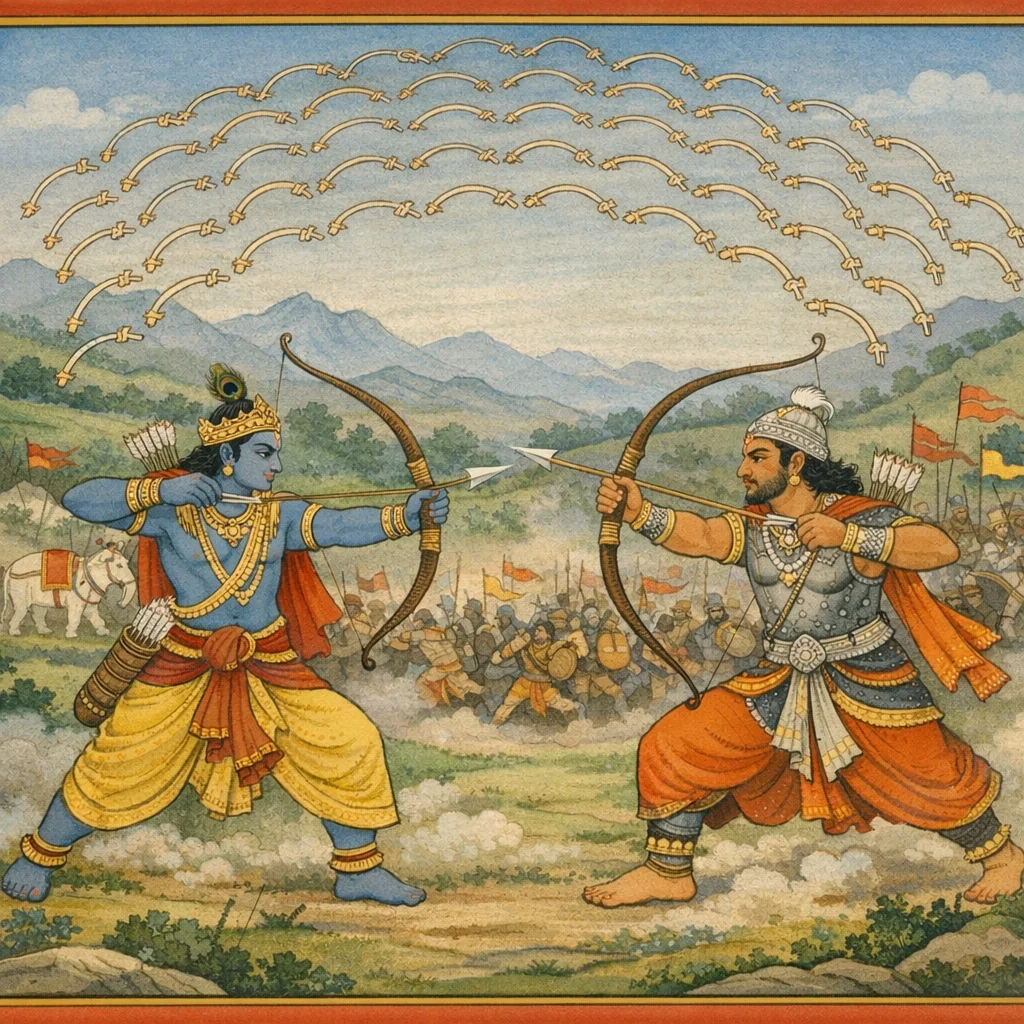
Adhyaya 14
Adhyāya 14: Śalya’s Missile-Pressure and the Pāṇḍava Convergence (शल्यस्य शरवर्षम्)
Upa-parva: Śalya–Pāṇḍava Saṃgharṣa (Strategic Engagements with the Madra King)
Saṃjaya reports a dense sequence of engagements. Duryodhana and Dhṛṣṭadyumna exchange heavy volleys, with imagery of arrow-showers likened to seasonal raincloud downpours. Dhṛṣṭadyumna’s counter-pressure prompts Kaurava allies to encircle him, while he maneuvers amid elite chariot-fighters displaying technical dexterity. Parallel combats unfold: Śikhaṇḍin, supported by Prabhadrakas, engages Kṛtavarman and Gautama. The narrative then centers on Śalya, who releases sustained arrow-rains, pressing the Pāṇḍavas including Sātyaki and Vṛkodara (Bhīma). Nakula charges Śalya, strikes him with a focused set of arrows, and Śalya responds by wounding Nakula and severing his bow; Nakula re-arms and continues. Yudhiṣṭhira, Bhīma, Sātyaki, and Sahadeva collectively advance; Śalya receives them with calibrated strikes, notably disabling Sātyaki’s chariot team and rendering him chariotless before Sātyaki returns on another chariot to renew the duel. The scene culminates in a tumultuous convergence likened to mythic combat, with the battlefield saturated by arrows, darkness-like missile density, and the depiction of Śalya’s singular capacity to hold off many attackers.
Chapter Arc: रणभूमि में द्रोणपुत्र अश्वत्थामा और सव्यसाची अर्जुन आमने-सामने आते हैं; आरम्भ होते ही दोनों ओर से शिलीमुखों की वर्षा होती है और महाधनुर्धर एक-दूसरे की परीक्षा लेने लगते हैं। → अर्जुन तीन-तीन और दो-दो बाणों से अश्वत्थामा तथा अन्य महारथियों को बेधते हुए शरवर्षा से सेना को ढक देता है; प्रत्युत्तर में द्रोणि भी घोर अस्त्र-संघर्ष छेड़ देता है, जिससे रथ, सारथि, घोड़े और कवच तक लक्ष्य बन जाते हैं। → सव्यसाची अश्वत्थामा के घोड़े, सारथि और रथ को चौपट कर देता है; उधर महारथी सुरथ के क्रोधपूर्ण आक्रमण से द्रोणि दण्डाहत सर्प-सा उग्र हो उठता है और युद्ध अत्यन्त घोर रूप ले लेता है। → लम्बे समय तक युद्ध सम बना रहता है; फिर अर्जुन क्षणभर ‘गुरुपुत्र’ का मान रखकर भी हर्ष-उत्साह से गाण्डीव खींचता है—संकेत देता है कि वह मर्यादा और रणनीति दोनों को साथ लेकर निर्णायक प्रहार की ओर बढ़ रहा है। → अस्त्र-शस्त्रों का संघर्ष फिर से घोर हो उठता है—क्या अर्जुन की मर्यादित दृढ़ता द्रोणपुत्र के उग्र प्रतिशोध को तोड़ेगी, या युद्ध और अधिक विनाशकारी मोड़ लेगा?
Shlokas
Verse 1
(दाक्षिणात्य अधिक पाठके २ श्लोक मिलाकर कुल ५० श्लोक हैं।) अपन क्ाा छा 2 चतुर्दशो 5 ध्याय: अर्जुन और अभ्वत्थामाका युद्ध तथा पांचाल वीर सुरथका वध संजय उवाच अर्जुनो द्रौणिना विद्धो युद्धे बहुभिरायसै: । तस्य चानुचरै: शूरैस्त्रिगर्तानां महारथै:,संजय कहते हैं--महाराज! दूसरी ओर द्रोणपुत्र अश्वत्थामा तथा उसके पीछे चलनेवाले त्रिगर्तदेशीय शूरवीर महारथियोंने अर्जुनको लोहेके बने हुए बहुत-से बाणोंद्वारा घायल कर दिया
Sanjaya said: O King, in the thick of battle Arjuna was struck by the son of Droṇa, Aśvatthāmā, with many iron-tipped arrows; and he was also assailed by Aśvatthāmā’s attendant heroes—the great chariot-warriors of the Trigartas. The verse casts the moment as a concentrated onslaught against a principal defender of the Pāṇḍava cause, highlighting the relentless, collective pressure typical of late-war engagements.
Verse 2
द्रौर्णि विव्याध समरे त्रिभिरेव शिलीमुखै: । तथेतरान् महेष्वासान द्वाभ्यां द्वाभ्यां धनंजय:
Sañjaya said: In the thick of battle, Dhanañjaya (Arjuna) struck Droṇa’s son (Aśvatthāmā) with three sharp arrows. In the same manner, he pierced the other great bowmen as well, two arrows apiece—an image of disciplined force used with measured precision amid the chaos of war.
Verse 3
तब अर्जुनने समरभूमिमें तीन बाणोंसे अश्वत्थामाको और दो-दो बाणोंसे अन्य महाधनुर्धरोंको बींध डाला ।। भूयश्वचैव महाराज शरवर्षैरवाकिरत् | शरकण्टकितास्ते तु तावका भरतर्षभ
Sañjaya said: “And again, O great king, he showered them with torrents of arrows. Your warriors, O bull among the Bharatas, were bristling with shafts—pierced and shaken—showing how, in the frenzy of battle, prowess and resolve drive men to relentless violence, even as the moral weight of such destruction continues to gather.”
Verse 4
अर्जुन रथवंशेन द्रोणपुत्रपुरोगमा:
Sañjaya said: Arjuna’s chariot-line advanced, with Droṇa’s son at its head—signaling how the battle’s momentum was being driven by leading champions and their retinues, where prowess and command shaped the day’s unfolding violence and its moral stakes.
Verse 5
अयोधयन्त समरे परिवार्य महारथा: । समरांगणमें द्रोणपुत्रको आगे करके कौरव महारथी अर्जुनको रथसमूहसे घेरकर उनके साथ युद्ध करने लगे ।। तैस्तु क्षिप्ता: शरा राजन् कार्तस्वरविभूषिता:
Sanjaya said: The great chariot-warriors fought in the battle, surrounding him on every side. On the field of war, the Kaurava champions, placing Droṇa’s son at the forefront, closed in upon Arjuna with a mass of chariots and engaged him in combat. Then, O King, the arrows they hurled—adorned with gold—flew forth, heightening the crush of war and the peril borne by the lone target within their encirclement.
Verse 6
तथा कृष्णौ महेष्वासौ वृषभौ सर्वधन्विनाम्
Sanjaya said: In the same manner, the two Krishnas—those mighty archers—stood forth as the foremost among all bowmen, like leading bulls among their kind, embodying unsurpassed martial excellence amid the swelling war.
Verse 7
कूबरं रथचक्राणि ईषा योक््त्राणि वा विभो
Sanjaya said: “O mighty one, (there lay) the chariot’s pole-box (kūbara), the chariot-wheels, the axle-pole, and the harness-straps as well.” The line evokes the battlefield’s harsh aftermath, where the very instruments of war—meant to uphold a warrior’s duty in combat—are seen broken and scattered, underscoring the cost and fragility of martial power when dharma is tested amid destruction.
Verse 8
नैतादृशं दृष्टपूर्व राजन् नैव च न श्रुतम्
Sanjaya said: O King, never before has anything like this been seen, nor has it even been heard of. The moment is presented as unprecedented—an ethical shock within the war narrative, where familiar norms of battle and human conduct seem to be exceeded or overturned.
Verse 9
स रथ: सर्वतो भाति चित्रपुड्खै: शितै: शरै:
Sanjaya reports that the chariot shone on every side, made brilliant by the sharp arrows with variegated fletchings embedded all around—an image that underscores how, in the fury of battle, even instruments of war can appear dazzling while bearing the marks of violence.
Verse 10
ततोडर्जुनो महाराज शरै: संनतपर्वभि:
Then Arjuna, O king, struck him with arrows whose joints were well-tempered and firm—an act of disciplined martial skill amid the relentless ethics of battlefield duty.
Verse 11
ते वध्यमाना: समरे पार्थनामाड्कितै: शरै:
Sañjaya said: In the thick of battle, they were being struck down by arrows marked with the name of Pārtha—missiles that proclaimed their source and made the slaughter unmistakable. The line underscores the grim clarity of responsibility in war: deeds are not anonymous, and the warrior’s agency is openly borne on his weapons.
Verse 12
कोपोद्धूतशरज्वालो धनु:शब्दानिलो महान्
Sañjaya said: “A mighty wind—made of the roar of the bow—rose up, and its flame was the shower of arrows driven forth by wrath.”
Verse 13
इस प्रकार श्रीमह्याभारत शल्यपर्वमें शल्यका युद्धविषयक तेरहवाँ अध्याय पूरा हुआ,चक्राणां पततां चापि युगानां च धरातले समदृश्यन्त पार्थस्य रथमार्गेषु भारत । भारत! महाभाग! अर्जुनके रथके मार्गोमें धरतीपर गिरते हुए रथके पहियों, जूओं तरकसों, पताकाओं, ध्वजों, रथों, हरसों, अनुकर्षों, त्रिवेणु नामक काष्ठों, धुरों, रस्सियों, चाबुकों, कुण्डल और पगड़ी धारण करनेवाले मस्तकों, भुजाओं, कंधों, छत्रों, व्यजनों और मुकुटोंके ढेर-के-ढेर दिखायी देने लगे
Sanjaya said: O Bharata, along the tracks of Partha’s chariot there could be seen upon the ground the fallen wheels and yokes. The battlefield, churned by Arjuna’s advance, displayed heaps of shattered chariot-gear and the severed remnants of warriors—an image that underscores how swiftly martial prowess can turn pride and possession into ruin, and how war’s momentum leaves a visible trail of loss.
Verse 14
तूणीराणां पताकानां ध्वजानां च रथै: सह । ईषाणामनुकर्षाणां त्रिवेणूनां च भारत,इति श्रीमहाभारते शल्यपर्वणि संकुलयुद्धे चतुर्दशोध्याय:
Sanjaya said: “O Bhārata, there were (scattered) quivers, banners, and standards, along with chariots; and also the chariot-poles, the yokes and traces for drawing, and the triple-braided reins.” The verse paints the battlefield’s aftermath through broken equipment—an ethical reminder that war reduces even royal power and martial pride to debris.
Verse 15
अक्षाणामथ योकत्राणां प्रतोदानां च सर्वश: । शिरसां पततां चापि कुण्डलोष्णीषधारिणाम्
Sañjaya said: “Everywhere lay scattered the dice-like axle-pins, the yoke-straps, and the goads; and also the heads of fallen warriors—still bearing their earrings and turbans.”
Verse 16
भुजानां च महाभाग स्कन्धानां च समन्तत: । छत्राणां व्यजनै: सार्थ मुकुटानां च राशय:
Sañjaya said: “O noble one, there were heaps all around—of severed arms and shoulders, and also piles of royal umbrellas, together with fly-whisks, and of fallen crowns.”
Verse 17
ततः क्रुद्धस्य पार्थस्य रथमार्गे विशाम्पते
Then, O lord of the people, along the track of Pārtha’s chariot—now inflamed with wrath—the action moved forward.
Verse 18
भीरूणां त्रासजननी शूराणां हर्षवर्धिनी
Sañjaya said: “She becomes the very source of terror for the fearful, yet the increaser of joy for the brave.”
Verse 19
हत्वा तु समरे पार्थ: सहस्रे द्वे परंतप:
Sañjaya said: “In the thick of battle, Pārtha (Arjuna), the scorcher of foes, slew two thousand warriors.”
Verse 20
यथा हि भगवान ग्निर्जगद् दग्ध्वा चराचरम्
Sañjaya said: “Just as the blessed Fire, having burned the whole world—both the moving and the unmoving—…,”
Verse 21
द्रौणिस्तु समरे दृष्टवा पाण्डवस्थ पराक्रमम्
Sañjaya said: Seeing, in the thick of battle, the valor displayed by the Pāṇḍavas, Drauni (Aśvatthāmā) took note of their formidable prowess.
Verse 22
तावुभौ पुरुषव्याप्रौ तावुभौ धन्विनां वरौ
Sañjaya said: Those two were both tiger-like among men—both foremost among archers—standing out in prowess and martial excellence.
Verse 23
समीयतुस्तदान्योन्यं परस्परवधैषिणौ । वे दोनों ही मनुष्योंमें व्याप्रके समान पराक्रमी थे और दोनों ही धनुर्धरोंमें श्रेष्ठ समझे जाते थे। उस समय परस्पर वधकी इच्छासे दोनों ही एक-दूसरेके साथ भिड़ गये || २२३ || तयोरासीन्महाराज बाणवर्ष सुदारुणम्
Sañjaya said: Then the two closed in upon each other, each intent on the other’s death. O King, between them there arose a most dreadful shower of arrows.
Verse 24
अन्योन्यस्पर्धिनौ तौ तु शरै: संनतपर्वभि:
Sañjaya said: Those two, locked in mutual rivalry, assailed one another with arrows whose joints were well-bent and firm.
Verse 25
तयोरयुद्धं महाराज चिरं सममिवाभवत्
Sañjaya said: O great king, the battle between those two went on for a long time, appearing evenly matched—neither gaining a clear advantage, as if fate held both in balance.
Verse 26
ततोड्र्जुनं द्वादशभी रुक्मपुड्खै: सुतेजनै:
Then he struck Arjuna with twelve exceedingly sharp arrows, each fitted with golden shafts—an image of relentless martial skill and the harsh inevitability of battle’s violence.
Verse 27
ततः प्रहर्षाद् बीभत्सुर्व्याक्षिपद् गाण्डिवं धनु:
Then, overcome with exhilaration, Arjuna (Bībhatsu) swiftly brandished the Gāṇḍīva bow—an outward sign of renewed resolve as the battle’s duty pressed on.
Verse 28
व्यश्वसूतरथं चक्रे सव्यसाची परंतप:
Sañjaya said: Arjuna, the ambidextrous master of the bow and a scorcher of foes, reduced the enemy’s horse, charioteer, and chariot to ruin—an image of decisive martial skill employed in the grim, duty-bound violence of war.
Verse 29
हताश्वे तु रथे तिष्ठन् द्रोणपुत्रस्त्वयस्मयम्
Sañjaya said: Standing upon his chariot whose horses had been slain, Droṇa’s son remained firm—unyielding in spirit—continuing the grim work of battle even when his means of movement and protection had been shattered. The moment underscores how, in war, resolve can persist beyond material support, raising ethical tension between steadfast courage and the destructive momentum of vengeance.
Verse 30
तमापतन्तं सहसा हेमपट्टविभूषितम्
Sañjaya said: “All at once he rushed down upon him, adorned with a golden headband.”
Verse 31
स च्छिन्न॑ं मुसलं दृष्टवा द्रौणि: परमकोपन:
Sañjaya said: “Seeing that the mace had been shattered, Drauṇi—overcome by extreme wrath—flared up in fierce anger.”
Verse 32
चिक्षेप चैव पार्थाय द्रौणिर्युद्धविशारद:,युद्धविशारद द्रोणपुत्रने वह परिघ अर्जुनपर दे मारा। क्रोधमें भरे हुए यमराजके समान उस परिघको देखकर पाण्डुपुत्र अर्जुनने तुरंत ही पाँच उत्तम बाणोंद्वारा उसे काट गिराया
Sañjaya said: “Drauṇi, the son of Droṇa, skilled in the ways of battle, hurled a weapon at Pārtha (Arjuna).”
Verse 33
तमन्तकमिव क्रुद्ध॑ परिघं प्रेक्ष्य पाण्डव: । अर्जुनस्त्वरितो जघ्ने पजचभि: सायकोत्तमै:,युद्धविशारद द्रोणपुत्रने वह परिघ अर्जुनपर दे मारा। क्रोधमें भरे हुए यमराजके समान उस परिघको देखकर पाण्डुपुत्र अर्जुनने तुरंत ही पाँच उत्तम बाणोंद्वारा उसे काट गिराया
Beholding that parigha, wrathful like Death itself, Arjuna the Pāṇḍava swiftly struck, cutting it down with five finest arrows.
Verse 34
स च्छिन्न: पतितो भूमौ पार्थबाणैर्महाहवे । दारयन् पृथिवीन्द्राणां मनांसीव च भारत,भारत! उस महासमरमें पार्थके बाणोंसे कटकर वह परिघ राजाओंके हृदयोंको विदीर्ण करता हुआ-सा पृथ्वीपर गिर पड़ा
Sañjaya said: “In that great battle, the parigha, cut apart by Pārtha’s arrows, fell to the earth as though it were rending the hearts of kings, O Bhārata.”
Verse 35
ततो<परैस्त्रिभिर्भल्लैद्रौणिं विव्याध पाण्डव: । सो5तिविद्धो बलवता पार्थेन सुमहात्मना
Sañjaya said: Then the Pāṇḍava warrior struck Droṇa’s son (Aśvatthāman) with three more keen arrows. Deeply pierced by the mighty Pārtha, that great-souled archer still pressed the fight onward amid the harsh demands of war—where prowess and resolve decide the moment, even as dharma remains the larger measure of a warrior’s conduct.
Verse 36
न जहुः: पार्थमासाद्य ताड्यमाना: शितै: शरै: । महाराज! भरतश्रेष्ठ! तत्पश्चात् अर्जुनने पुन उन सबको अपने बाणोंकी वर्षसि आच्छादित कर दिया। अर्जुनके पैने बाणोंकी मार खाकर उन बाणोंसे कण्टकयुक्त होकर भी आपके सैनिक अर्जुनको छोड़ न सके,नाकम्पत तदा द्रौणि: पौरुषे स्वे व्यवस्थित: । तत्पश्चात् पाण्डुकुमार अर्जुनने दूसरे तीन भल््लोंसे द्रोणपुत्रको घायल कर दिया। महामनस्वी बलवान् वीर अर्जुनके द्वारा अत्यन्त घायल होकर भी अश्व॒त्थामा अपने पुरुषार्थका आश्रय ले तनिक भी कम्पित नहीं हुआ ।। सुरथं च ततो राजन् भारद्वाजो महारथम्
Sañjaya said: “O great king, best of the Bharatas—though struck by Arjuna’s sharp arrows after closing in on Pārtha, your warriors did not abandon him. Then Drauṇi (Aśvatthāmā), firmly grounded in his own manly resolve, did not tremble. Thereafter, O king, Bhāradvāja’s son (Droṇa’s son), the great chariot-warrior, was (again) pressed in the fight….”
Verse 37
ततस्तु सुरथो5प्याजी पञ्चालानां महारथ:
Sañjaya said: Then, in that very battle, Suratha too—one of the great chariot-warriors of the Pāñcālas—entered the fray, adding his strength to their cause amid the relentless clash of arms.
Verse 38
विकर्षन् वै धनु: श्रेष्ठ सर्वभारसहं दृढम्
Sañjaya said: Drawing back that excellent bow—firm and able to bear every strain—he prepared himself with unwavering resolve, embodying the grim discipline of the battlefield where strength and steadiness decide life and death.
Verse 39
सुरथं तं ततः क्रुद्धमापतन्तं महारथम्
Sañjaya said: Then that great chariot-warrior, enraged, came charging forward in his well-equipped chariot—pressing the battle on with wrath and momentum, as the conflict tightened into a direct clash.
Verse 40
त्रिशिखां भ्रुकुटीं कृत्वा सक्किणी परिसंलिहन्,वह भौंहोंको तीन जगहसे टेढ़ी करके अपने गलफरोंको चाटने लगा और सुरथकी ओर रोषपूर्वक देखकर धनुषकी प्रत्यंचाकों साफ करके उसने यमदण्डके समान तेजस्वी तीखे नाराचका प्रहार किया
Sanjaya said: Twisting his brows into a triple-furrowed frown and licking his lips, he glared in wrath toward Suratha. Then, after setting his bowstring straight and ready, he launched a sharp, radiant nārāca arrow—terrible like Yama’s staff—signaling the ruthless resolve that drives warriors to lethal action when anger eclipses restraint.
Verse 41
द्वीक्ष्य सुरथथं रोषाद् धनुज्यामवमृज्य च | मुमोच तीक3्ष्णं नाराचं यमदण्डोपमद्युतिम्,वह भौंहोंको तीन जगहसे टेढ़ी करके अपने गलफरोंको चाटने लगा और सुरथकी ओर रोषपूर्वक देखकर धनुषकी प्रत्यंचाकों साफ करके उसने यमदण्डके समान तेजस्वी तीखे नाराचका प्रहार किया
Sañjaya said: Seeing Suratha in anger, and wiping clean the bowstring, he released a sharp nārāca-arrow, blazing like Yama’s staff—an act that intensifies the ruthless momentum of battle, where wrath drives warriors to lethal resolve.
Verse 42
स तस्य ह्ृदयं भित्त्वा प्रविवेशातिवेगित: । शक्राशनिरिवोत्सृष्टो विदार्य धरणीतलम्,जैसे इन्द्रका छोड़ा हुआ अत्यन्त वेगशाली वज्र पृथ्वी फाड़कर उसके भीतर घुस जाता है, उसी प्रकार वह नाराच वेगपूर्वक सुरथकी छाती छेदकर उसके भीतर समा गया
Sañjaya said: That arrow, splitting his heart, plunged into him with tremendous speed—like Indra’s thunderbolt when hurled, tearing open the earth and entering it. The simile underscores the irresistible, fated force of the missile in the brutal momentum of battle.
Verse 43
ततः स पतितो भूमौ नाराचेन समाहतः । वज्नेण च यथा शज्र पर्वतस्येव दीर्यत:,नाराचसे घायल हुआ सुरथ वज्से विदीर्ण हुए पर्वतके शिखरकी भाँति पृथ्वीपर गिर पड़ा
Sañjaya said: Then he, struck hard by a nārāca arrow, fell to the ground—like a mountain peak split apart by a thunderbolt. The image underscores the brutal finality of battle: even the mighty are brought down in an instant when violence is unleashed.
Verse 44
तस्मिन् विनिहते वीरे द्रोणपुत्र: प्रतापवान् । आरुरोह रथं तूर्ण तमेव रथिनां वर:,उस वीरके मारे जानेपर रथियोंमें श्रेष्ठ प्रतापी द्रोणपुत्र अश्वत्थामा तुरंत ही उसी रथपर आरूढ़ हो गया
Sanjaya said: When that heroic warrior had been slain, the valiant son of Drona—foremost among chariot-fighters—swiftly mounted that very chariot. The moment underscores how, in the churn of war, the fall of a single champion immediately triggers a transfer of command and momentum, as warriors rush to seize strategic advantage despite the moral weight of death on the battlefield.
Verse 45
ततः सज्जो महाराज द्रौणिराहवदुर्मद: । अर्जुनं योधयामास संशप्तकवृतो रणे,महाराज! फिर युद्धसज्जासे सुसज्जित हो रणभूमिमें संशप्तकोंसे घिरा हुआ रणदुर्मद द्रोणकुमार अर्जुनके साथ युद्ध करने लगा
Sañjaya said: Then, O King, Drauṇi—proud and maddened by the fury of battle—took his stand for combat. Ringed about on the field by the Saṃśaptakas, he engaged Arjuna in a fierce duel, sharpening the war’s moral and strategic strain, where vows, loyalty, and wrath drive warriors into relentless confrontation.
Verse 46
तत्र युद्ध महच्चासीदर्जुनस्य परै: सह । मध्यंदिनगते सूर्ये यमराष्ट्रविवर्धनम्,वहाँ दोपहर होते-होते अर्जुनका शत्रुओंके साथ महाघोर युद्ध होने लगा, जो यमराजके राष्ट्रकी वृद्धि करनेवाला था
Sañjaya said: There, as the sun reached midday, a great and dreadful battle arose between Arjuna and his foes—one that swelled the realm of Yama, for it sent many warriors to death. The verse bears the grim moral weight of war: even heroic prowess, unleashed in mass combat, becomes an instrument that enlarges the dominion of Death.
Verse 47
तत्राश्चर्यमपश्याम दृष्टवा तेषां पराक्रमम् । यदेको युगपद् वीरान् समयोधयदर्जुन:
Sañjaya said: There we witnessed something astonishing. Having seen the prowess of those warriors, it was a marvel that Arjuna alone engaged and fought many heroes at the same time—an image of singular mastery amid the moral turbulence of war.
Verse 48
उस समय उन कौरवपक्षीय वीरोंका पराक्रम देखकर हमने एक और आश्चर्यकी बात यह देखी कि अर्जुन अकेले ही एक ही समय उन सभी वीरोंके साथ युद्ध कर रहे हैं ।। विमर्द: सुमहानासीदेकस्य बहुभि: सह । शतक्रतुर्य था पूर्व महत्या दैत्यसेनया,जैसे पूर्वकालमें विशाल दैत्यसेनाके साथ इन्द्रका युद्ध हुआ था, उसी प्रकार एकमात्र अर्जुनका बहुसंख्यक विपक्षियोंके साथ महान् संग्राम होने लगा
Sañjaya said: At that time, seeing the prowess of the Kaurava champions, we beheld yet another marvel—that Arjuna alone was fighting all those heroes at once. A tremendous melee arose, one warrior contending against many. As in former times Śatakratu (Indra) battled a vast host of Daityas, so now Arjuna alone waged a great fight against a multitude of foes. The scene lays bare the war’s moral tension: individual valor is praised, yet the very grandeur of such combat proclaims the tragic scale of ruin that Kurukṣetra has brought upon both sides.
Verse 56
अर्जुनस्य रथोपस्थं पूरयामासुरञ्जसा । राजन! उनके चलाये हुए सुवर्णभूषित बाणोंने अर्जुनके रथकी बैठकको अनायास ही भर दिया
Sañjaya said: O King, the warriors’ arrows—shot with swift precision—quickly filled the standing-space of Arjuna’s chariot. The scene underscores the relentless pressure of battle and the moral weight of steadfastness under overwhelming assault.
Verse 66
शरैवीक्ष्य विनुन्नाड़ौ प्रह्ृ् युद्धदुर्मदा: । सम्पूर्ण धनुर्धरोंमें श्रेष्ठ तथा महाधनुर्धर श्रीकृष्ण और अर्जुनके सम्पूर्ण अंगोंको बाणोंसे व्यथित हुआ देख रणदुर्मद कौरवयोद्धा बड़े प्रसन्न हुए
Sañjaya said: Seeing Śrī Kṛṣṇa and Arjuna—foremost of all archers, mighty wielders of the bow—their bodies struck and pained in every limb by arrows, the Kaurava warriors, intoxicated with the frenzy of battle, were greatly delighted.
Verse 76
युगं चैवानुकर्ष च शरभूतम भूत्तदा । प्रभो! अर्जुनके रथके पहिये, कूबर, ईषादण्ड, लगाम या जोते, जूआ और अनुकर्ष-- ये सब-के-सब उस समय बाणमय हो रहे थे
Sañjaya said: “O lord, at that time even the yoke and the drag-rope became as though made of arrows. Indeed, the wheels of Arjuna’s chariot, its pole and yoke-parts, the reins and harness, the yoke and the traces—everything was being turned into a mass of arrows.”
Verse 83
यादृशं तत्र पार्थस्य तावका: सम्प्रचक्रिरे राजन! वहाँ आपके योद्धाओंने अर्जुनकी जैसी अवस्था कर दी थी, वैसी पहले कभी न तो देखी गयी और न सुनी ही गयी थी
Sañjaya said: O King, the condition into which your warriors reduced Pārtha (Arjuna) on that battlefield was of such a kind that nothing like it had ever been seen before, nor even heard of.
Verse 96
उल्काशतै: सम्प्रदीप्त॑ विमानमिव भूतले । विचित्र पंखवाले पैने बाणोंद्वारा सब ओरसे व्याप्त हुआ अर्जुनका रथ भूतलपर सैकड़ों मसालोंसे प्रकाशित होनेवाले विमानके समान शोभा पाता था
Sanjaya said: On the battlefield, Arjuna’s chariot—covered on every side by sharp arrows with variegated feathers—shone like a celestial car blazing with hundreds of meteors or torches.
Verse 103
अवाकिरत्तां पृतनां मेघो वृष्ट्येव पर्वतम् महाराज! तदनन्तर अर्जुनने झुकी हुई गाँठवाले बाणोंद्वारा आपकी उस सेनाको उसी प्रकार ढक दिया, जैसे मेघ पानीकी वर्षासे पर्वतको आच्छादित कर देता है
Sanjaya said: “O King, just as a rain-cloud drenches and covers a mountain with its downpour, so too did Arjuna, immediately thereafter, blanket your army with his bent, knotted arrows—overwhelming it in a storm of missiles.”
Verse 113
पार्थभूतममन्यन्त प्रेक्षमाणास्तथाविधम् | समरभूमिमें अर्जुनके नामसे अंकित बाणोंकी चोट खाते हुए कौरव-सैनिक उन्हें उसी रूपमें देखते हुए सब कुछ अर्जुनमय ही मानने लगे
Sanjaya said: Beholding him in that extraordinary state upon the battlefield, the Kaurava soldiers—struck by arrows bearing Arjuna’s name—began to regard him as Arjuna himself. Seeing him thus, they felt that all before them was pervaded by Arjuna alone, as fear and awe overwhelmed their judgment amid the violence of war.
Verse 126
सैन्येन्धनं ददाहाशु तावकं पार्थपावक: । अर्जुनरूपी महान् अग्निने क्रोधसे प्रजवलित हुई बाणमयी ज्वालाएँ फैलाकर धनुषकी टंकाररूपी वायुसे प्रेरित हो आपके सैन्यरूपी ईंधनको शीघ्रतापूर्वक जलाना आरम्भ किया
Sanjaya said: The fire that was Pārtha began swiftly to consume your army as its fuel. Like a great blaze kindled by wrath, Arjuna spread flame-like volleys of arrows, and, driven by the wind of his bow’s thunderous twang, he set about burning up your forces without delay.
Verse 163
समदृश्यन्त पार्थस्य रथमार्गेषु भारत । भारत! महाभाग! अर्जुनके रथके मार्गोमें धरतीपर गिरते हुए रथके पहियों, जूओं तरकसों, पताकाओं, ध्वजों, रथों, हरसों, अनुकर्षों, त्रिवेणु नामक काष्ठों, धुरों, रस्सियों, चाबुकों, कुण्डल और पगड़ी धारण करनेवाले मस्तकों, भुजाओं, कंधों, छत्रों, व्यजनों और मुकुटोंके ढेर-के-ढेर दिखायी देने लगे
Sanjaya said: O Bhārata, O noble one—along the tracks of Pārtha’s chariot there appeared, strewn upon the earth, heap after heap of what had fallen in the rout: chariot-wheels, yokes, quivers, banners and standards, broken chariots, weapons and drag-ropes, wooden fittings called triveṇu, axles, cords and whips, and even severed heads adorned with earrings and turbans, arms and shoulders, together with parasols, fans, and crowns.
Verse 176
अगम्यरूपा पृथिवी मांसशोणितकर्दमा | प्रजानाथ! कुपित हुए अर्जुनके रथके मार्गकी भूमिपर मांस और रक्तकी कीच जम जानेके कारण वहाँ चलना-फिरना असम्भव हो गया
Sanjaya said: O lord of men, the earth became impassable—turned into mire of flesh and blood. When Arjuna’s chariot raged onward, the ground along its path was so clogged with the sludge of flesh and gore that movement there became impossible.
Verse 183
बभूव भरतश्रेष्ठ रुद्रस्याक्रीडनं यथा । भरतश्रेष्ठ! वह रणभूमि रुद्रदेवके क्रीडास्थल (श्मशान)-की भाँति कायरोंके मनमें भय उत्पन्न करनेवाली और शूरवीरोंका हर्ष बढ़ानेवाली थी
Sanjaya said: O best of the Bharatas, that battlefield became like Rudra’s playground—like a cremation-ground—striking fear into the hearts of the cowardly, yet increasing the exhilaration and resolve of the brave.
Verse 196
रथानां सवरूथानां विधूमो5ग्निरिव ज्वलन् । शत्रुओंको संताप देनेवाले पार्थ समरांगणमें आवरणसहित दो सहस्र रथोंका संहार करके धूमरहित प्रज्वलित अग्निके समान प्रकाशित हो रहे थे
Sañjaya said: Blazing like a smokeless fire amid the chariots and their protective formations, Pārtha—who scorched his enemies with anguish—shone on the battlefield after destroying two thousand chariots together with their defenses. His radiance was like a bright, flame-filled fire without smoke, a fearful emblem of irresistible martial power.
Verse 206
विधूमो दृश्यते राजंस्तथा पार्थो धनंजय: । राजन्! जैसे चराचर जगत्को दग्ध करके भगवान् अग्निदेव धूमरहित देखे जाते हैं, उसी प्रकार कुन्तीकुमार अर्जुन भी देदीप्यमान हो रहे थे
Sañjaya said: “O King, Dhananjaya—Arjuna, the son of Pṛthā—was seen blazing forth, smoke-free. Just as the divine Fire-god, after burning the whole moving and unmoving world, is beheld without smoke, so too was Arjuna shining with a pure, consuming radiance.”
Verse 216
रथेनातिपताकेन पाण्डवं प्रत्यवारयत् । संग्रामभूमिमें पाण्डुपुत्र अर्जुनका वह पराक्रम देखकर द्रोणकुमार अश्व॒त्थामाने अत्यन्त ऊँची पताकावाले रथके द्वारा आकर उन्हें रोका
Sañjaya said: Seeing on the battlefield the prowess of Arjuna, the son of Pāṇḍu, Droṇa’s son Aśvatthāmā came forward in a chariot bearing an exceedingly lofty banner and checked the Pāṇḍava’s advance.
Verse 233
जीमूतयोर्यथा वृष्टिस्तपान्ते भरतर्षभ । महाराज! भरतश्रेष्ठ! जैसे वर्षा-ऋतुमें दो मेघखण्ड पानी बरसा रहे हों, उसी प्रकार उन दोनोंके बाणोंकी वहाँ अत्यन्त भयंकर वर्षा होने लगी
Sañjaya said: “O bull among the Bharatas, O great king, best of the Bharata line—just as, at the end of the summer heat, two masses of cloud pour down rain in the rainy season, so too there arose there a most dreadful downpour of arrows from those two warriors.”
Verse 246
ततक्षतुस्तदान्योन्यं शृज्भाभ्यां वृषभाविव । जैसे दो साँड़ परस्पर सींगोंसे प्रहार करते हैं, उसी प्रकार आपसमें लाग-डाँट रखनेवाले वे दोनों वीर झुकी हुई गाँठवाले बाणोंद्वारा एक-दूसरेको क्षत-विक्षत करने लगे
Sañjaya said: Then the two warriors struck at one another, like two bulls butting with their horns. Driven by mutual hostility, they began to wound and tear each other with their bent, knotty arrows—an image of how enmity in war turns valor into relentless mutual injury.
Verse 266
वासुदेवं च दशभिद्रौणिरविव्याध भारत । भरतनन्दन! तब अअश्वत्थामाने अत्यन्त तेज किये हुए सुवर्णमय पंखवाले बारह बाणोंसे अर्जुनको और दस सायकोंसे श्रीकृष्णको भी घायल कर दिया
Sañjaya said: O Bharata, Droṇa’s son (Aśvatthāmā) pierced Vāsudeva (Kṛṣṇa) with ten arrows. Then, O joy of the Bharatas, Aśvatthāmā—having made his missiles exceedingly powerful and fitted with golden wings—wounded Arjuna with twelve arrows and also struck Śrī Kṛṣṇa with ten shafts. The scene reveals the grim impartiality of war: even the charioteer who guides dharma by counsel is not spared the fury of weapons, and prowess is displayed without regard for any person’s sanctity.
Verse 283
मृदुपूर्व ततश्वैनं पुन: पुनरताडयत् । शत्रुओंको संताप देनेवाले सव्यसाचीने अश्वत्थामाके घोड़े, सारथि एवं रथको चौपट कर दिया। फिर वे हलके हाथों बाण चलाकर बारंबार उसे घायल करने लगे
Sañjaya said: First, striking him lightly, he then kept smiting him again and again. In this phase of the battle, the archer deliberately moderated his force—wounding repeatedly rather than delivering an immediate killing blow—thus deepening the foe’s distress and displaying controlled mastery amid the violence of war.
Verse 296
मुसलं पाण्डुपुत्राय चिक्षेप परिघोपमम् | जिसके घोड़े मार डाले गये थे, उसी रथपर खड़े हुए द्रोणपुत्रने पाण्डुकुमार अर्जुनपर लोहेका एक मुसल चलाया, जो परिघके समान प्रतीत होता था
Sañjaya said: Standing upon that very chariot whose horses had been slain, Droṇa’s son hurled at Arjuna, the son of Pāṇḍu, an iron mace-like weapon, appearing like a heavy bludgeon. The scene underscores the relentless escalation of violence in war—where even after grievous loss, a warrior’s resolve turns immediately back to attack, binding both sides ever tighter to the harsh momentum of battle.
Verse 303
चिच्छेद सप्तधा वीर: पार्थ: शत्रुनिबर्हण: । शत्रुओंका संहार करनेवाले वीर अर्जुनने सहसा अपनी ओर आते हुए उस सुवर्णपत्रविभूषित मुसलके सात टुकड़े कर डाले
Sañjaya said: The heroic Pārtha (Arjuna), famed as a destroyer of foes, swiftly cut that onrushing weapon into seven pieces. The scene underscores disciplined martial skill used in the grim duty of war—meeting violence with controlled, decisive action rather than reckless fury.
Verse 316
आददे परिधघं घोर नगेन्द्रशिखरोपमम् । अपने मुसलको कटा हुआ देख अभ्व॒त्थामाको बड़ा क्रोध हुआ और उसने पर्वतशिखरके समान एक भयंकर परिघ हाथमें ले लिया
Sañjaya said: Seeing his club cut down, Aśvatthāmā was seized by fierce anger and took up in his hand a dreadful iron bludgeon, likened to the peak of a mighty mountain—an image of wrath escalating into renewed violence on the battlefield.
Verse 366
अवाकिरच्छरव्रातै: सर्वक्षत्रस्थ पश्यत: । राजन्! तब भारद्वाजनन्दन अभश्वत्थामाने सम्पूर्ण क्षत्रियोंके देखते-देखते महारथी सुरथको अपने बाणसमूहोंसे आच्छादित कर दिया
Sañjaya said: “O King, before the eyes of the entire assembled host of kṣatriya warriors, Bhāradvāja’s son Aśvatthāmā then showered Suratha with volleys of arrows, covering that great chariot-warrior completely. The scene shows how, in the fury of battle, prowess is displayed publicly as a test of martial duty, even as it deepens the tragic cost borne by the kṣatriyas who witness and partake in the slaughter.”
Verse 373
रथेन मेघघोषेण द्रौणिमेवाभ्यधावत । तब युद्धस्थलमें पांचाल महारथी सुरथने भी मेघके समान गम्भीर घोष करनेवाले रथके द्वारा अश्वत्थामापर ही धावा किया
Sañjaya said: Then Suratha, the great chariot-warrior of the Pañcālas, charged straight at Aśvatthāmā (Drauṇi) in his chariot whose roar was deep like thunderclouds—an image of relentless martial resolve as the battle’s fury intensified.
Verse 383
ज्वलनाशीविषनिभै: शरैश्नैनमवाकिरत् । सब प्रकारके भारोंको सहन करनेमें समर्थ, सुदृढ़ एवं उत्तम धनुषको खींचकर सुरथने अग्नि और विषैले सर्पोके समान भयंकर बाणोंकी वर्षा करके अश्वत्थामाको ढक दिया
Sañjaya said: With arrows resembling blazing fire and venomous serpents, he showered him on all sides. Drawing his firm and excellent bow—capable of bearing every strain—Suratha rained down dreadful shafts like fire and poison-snakes, enveloping Aśvatthāmā in a storm of missiles. The scene underscores the relentless momentum of battle, where prowess and endurance are turned toward destruction, and ethical restraint is eclipsed by the demands of war.
Verse 393
चुकोप समरे द्रौणिर्दण्डाहत इवोरग: । महारथी सुरथको क्रोधपूर्वक आक्रमण करते देख अश्वत्थामा समरमें डंडेकी चोट खाये हुए सर्पके समान अत्यन्त कुपित हो उठा
Sañjaya said: In the thick of battle, Droṇa’s son Aśvatthāmā flared up in wrath—like a serpent struck with a staff. Seeing the great chariot-warrior Suratha launch a furious assault, Aśvatthāmā rose in the field, intensely enraged, his anger now driving his response in the ethics-shattering momentum of war.
Verse 2536
शस्त्राणां सड़मश्वनैव घोरस्तत्राभवत् पुन: । महाराज! बहुत देरतक तो उन दोनोंका युद्ध एक-सा चलता रहा। फिर उनमें वहाँ अस्त्र-शस्त्रोंका घोर संघर्ष आरम्भ हो गया
Sañjaya said: “There again, O King, a dreadful tumult arose there—like the roaring of horses—born of the clash of weapons. For a long while the combat between the two had continued evenly; then the fierce collision of missiles and arms began in earnest.”
Verse 2736
मानयित्वा मुहूर्त तु गुरुपुत्रं महाहवे । तदनन्तर उस महासमरमें दो घड़ीतक गुरुपुत्रका आदर करके अर्जुनने बड़े हर्ष और उत्साहके साथ गाण्डीव धनुषको खींचना आरम्भ किया
Sañjaya said: Having shown due honor for a brief while to the son of his teacher amid the great battle, Arjuna then, in that vast and terrible combat, began to draw his bow Gāṇḍīva with joy and renewed ardor—signaling that even in war he would uphold respect for worthy opponents while resolutely returning to his duty as a warrior.
Frequently Asked Questions
The implicit dilemma is the clash between kinship ethics and wartime role-duty: Nakula confronts his maternal uncle Śalya under the compulsion to protect Yudhiṣṭhira and the coalition, illustrating how familial bonds are subordinated to sovereign and martial obligations.
The chapter suggests that late-stage conflict compresses agency: tactical necessity (coordination, rapid re-arming, and resilience after setbacks) becomes decisive, while ethical ideals remain present but strained by the urgency of protecting leaders and maintaining cohesion.
No explicit phalaśruti is presented in this passage; the meta-commentary is indirect, conveyed through Saṃjaya’s evaluative framing of extraordinary prowess and the epic’s recurrent emphasis on the cost and density of massed violence.