Adhyaya 19
Mokṣa-dharma Yoga-Upadeśa: Equanimity, Sense-Restraint, and Vision of the Ātman (आत्मदर्शन-योगोपदेशः)
Upa-parva: Mokṣa-dharma (Yoga-Upadeśa episode within Āśvamedhika Parva)
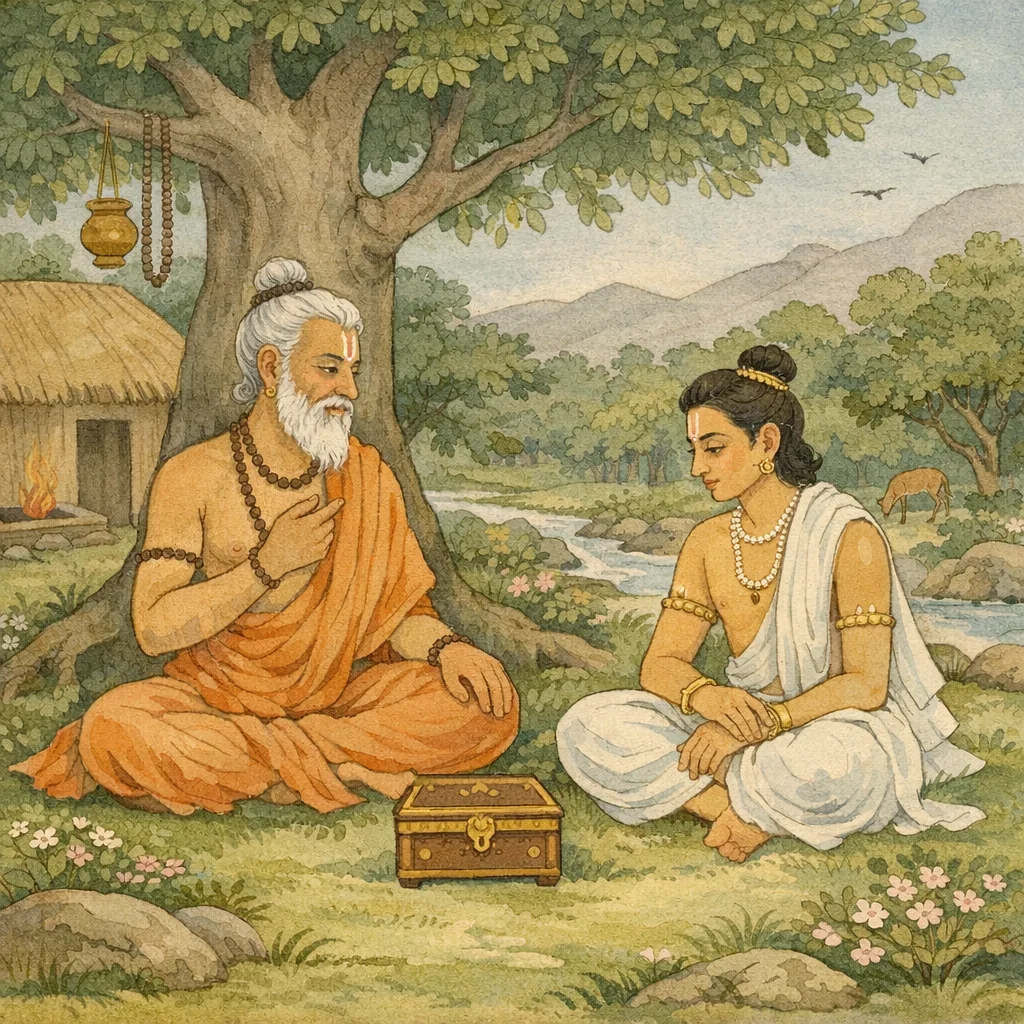
A Brahmin speaker outlines a liberation-oriented profile: the practitioner becomes non-initiating (nirārambha), friendly to all, forbearing, self-controlled, pure in conduct, free from pride and fear, and equal toward life/death, pleasure/pain, gain/loss, and the dear/hostile. Detachment (vairāgya) and the relinquishing of mental constructions lead gradually to nirvāṇa-like quiescence, likened to a fire extinguished without fuel. The discourse then turns technical: yoga is taught as sense-withdrawal and mind-fixation in the self, practiced in solitude and silence, with stepwise interior attention to the ‘city’ (pura) of embodiment—moving from external orientation to dwelling within the body’s ‘abode.’ Metaphors clarify self-extraction: like drawing a reed from muñja grass, the yogin discerns the self distinct from the body. The realized practitioner is described as unshaken by distress, unafraid amid worldly dissolution, and oriented to Brahman beyond sensory grasp, apprehended by the ‘lamp’ of mind. A student then asks physiological questions (digestion, breath, growth, wastes, locus of self), prompting the teacher’s response: the mind is placed within the body through controlled ‘gates’ (dvāras), seeking the self without negligence. Vāsudeva reports the teaching to Arjuna, stresses its esoteric status, and concludes with a practical claim: for one constantly disciplined, yoga becomes effective within six months.
Chapter Arc: एक ब्राह्मण-गुरु शिष्य को ‘एकायन’ (एक-निष्ठ) साधना का रहस्य खोलते हैं—कैसे तुष्णीम्, अल्पचिन्तन, और आत्म-स्थापन से मोक्ष का द्वार खुलता है। → उपदेश सूक्ष्म होता जाता है: ‘सर्वमित्र, सर्वसह, शम-रत, जितेन्द्रिय’ बनने की कठिन शर्तें; सब प्राणियों में आत्मवत् व्यवहार; और निर्जन वन में इन्द्रिय-ग्राम को संनियम्य कर भीतर-ही-भीतर काय-चिन्तन। साधक के सामने सबसे बड़ा शत्रु बाह्य विषय नहीं, भीतर का चंचल मन है—जो ‘कोष’ में वस्तुएँ रख देने पर भी उन्हीं का ध्यान करता रहता है। → गुरु ‘सर्वरहस्य’ का सार बाँध देते हैं: इन्द्रियों का निर्घोष-निग्रह, एकाग्रता, और मन को ‘पुर के भीतर’ स्थिर करना—बाह्य में नहीं। यही वह निर्णायक बिन्दु है जहाँ साधना का मार्ग कर्म-आचरण से आगे बढ़कर अन्तःकरण-शासन में परिणत होता है। → गुरु शिष्य को रहस्य कहकर विदा करते हैं—‘यथासुखं गच्छ’; और साथ ही संकेत देते हैं कि स्वधर्म-रत (यहाँ तक कि क्षत्रिय भी) यदि नित्य ब्रह्मलोक-परायण हों तो वही परमगति के अधिकारी हैं। → शिष्य (या जिज्ञासु) आगे जीवात्मा के शरीर-भार-वहन और नये शरीर-धारण (कैसे, किस प्रकार/‘किस रंग’ के) जैसे गूढ़ प्रश्न उठाता है—और कथावाचक कहता है कि उसने ‘यथाश्रुत’ उत्तर दिया, जिससे आगे के अध्यायों में सूक्ष्म देह-तत्त्व का विस्तार होने का संकेत मिलता है।
Shlokas
Verse 1
प्याज बछ। जज: एकोनविशो< ध्याय: गुरु-शिष्यके संवादमें मोक्षप्राप्तिके उपायका वर्णन ब्राह्मण उवाच यः स्यादेकायने लीनस्तूष्णीं किंचिदचिन्तयन् । पूर्व पूर्व परित्यज्य स तीर्णो बन्धनाद् भवेत्,सिद्ध ब्राह्मणने कहा--काश्यप! जो मनुष्य (स्थूल, सूक्ष्म और कारण शरीरोंमेंसे क्रमश:) पूर्व-पूर्वका अभिमान त्यागकर कुछ भी चिन्तन नहीं करता और मौनभावसे रहकर सबके एकमात्र अधिष्ठान--परत्रह्म परमात्मामें लीन रहता है, वही संसार-वन्धनसे मुक्त होता है
The Brahmin said: “O Kāśyapa, one who becomes absorbed in the One Refuge (the Supreme Self), remaining silent and not entertaining any thought, and who relinquishes, step by step, the identification with the earlier states (the successive layers of embodied selfhood), crosses beyond bondage and becomes free from worldly fetters.”
Verse 2
सर्वमित्र: सर्वसह: शमे रक्तो जितेन्द्रिय: । व्यपेतभयमन्युश्च॒ आत्मवान् मुच्यते नर:,जो सबका मित्र, सब कुछ सहनेवाला, मनोनिग्रहमें तत्पर, जितेन्द्रिय, भय और क्रोधसे रहित तथा आत्मवान् है, वह मनुष्य बन्धनसे मुक्त हो जाता है
The Brahmin said: A man who is a friend to all, who endures everything with patience, who is devoted to inner calm, who has conquered his senses, and who is free from fear and anger—such a self-possessed person is released from bondage.
Verse 3
आत्मवत् सर्वभूतेषु यश्नरेन्नियत: शुचि: । अमानी निरभीमान: सर्वतो मुक्त एव सः,जो नियमपरायण और पवित्र रहकर सब प्राणियोंके प्रति अपने-जैसा बर्ताव करता है, जिसके भीतर सम्मान पानेकी इच्छा नहीं है तथा जो अभिमानसे दूर रहता है, वह सर्वथा मुक्त ही है
The brāhmaṇa said: One who, disciplined and pure, treats all beings as one would treat oneself—who does not seek honor and remains free from pride—such a person is wholly liberated in every respect.
Verse 4
जीवितं मरणं चोभे सुखदु:खे तथैव च । लाभालाभे प्रियद्वेष्पे य: सम: स च मुच्यते,जो जीवन-मरण, सुख-दुःख, लाभ-हानि तथा प्रिय-अप्रिय आदि द्वन्धोंको समभावसे देखता है, वह मुक्त हो जाता है
The brāhmaṇa said: He who regards life and death alike, and likewise pleasure and pain, gain and loss, and the pairs of opposites such as what is dear and what is hateful, with an even mind—he is released.
Verse 5
न कस्यचित् स्पृहयते नावजानाति किंचन । निर्दचन्दो वीतरागात्मा सर्वथा मुक्त एव सः,जो किसीके द्रव्यका लोभ नहीं रखता, किसीकी अवहेलना नहीं करता, जिसके मनपर द्न्द्दोंका प्रभाव नहीं पड़ता और जिसके चित्तकी आसक्ति दूर हो गयी है, वह सर्वथा मुक्त ही है
The brāhmaṇa said: He who covets no one’s possessions, who despises no being, whose mind is untouched by the pull of opposites, and whose inner self is free from attachment—such a person is, in every way, truly liberated.
Verse 6
अनमित्रश्न निर्बन्धुरनपत्यश्न यः क्वचित् । त्यक्तधर्मार्थकामश्न निराकाड्क्षी च मुच्यते,जो किसीको अपना मित्र, बन्धु या संतान नहीं मानता, जिसने सकाम धर्म, अर्थ और कामका त्याग कर दिया है तथा जो सब प्रकारकी आकांक्षाओंसे रहित है, वह मुक्त हो जाता है
The Brahmin said: Whoever, in any circumstance, does not regard anyone as ‘my friend’, ‘my kinsman’, or ‘my child’; whoever has renounced desire-driven pursuits of dharma, wealth, and pleasure; and whoever is free from all craving—such a person attains liberation.
Verse 7
नैव धर्मी न चाधर्मी पूर्वोपचितहायक: । धातुक्षयप्रशान्तात्मा निर्दन्दः स विमुच्यते,जिसकी न धर्ममें आसक्ति है न अधर्ममें, जो पूर्वसंचित कर्मोको त्याग चुका है, वासनाओंका क्षय हो जानेसे जिसका चित्त शान्त हो गया है तथा जो सब प्रकारके द्वन्धोंसे रहित है, वह मुक्त हो जाता है
The Brahmin says: One who clings neither to dharma nor to adharma, who has cast off the burden of previously accumulated actions, whose inner self has become tranquil through the wearing away of the constituents (and the cravings bound up with them), and who is free from all pairs of opposites—such a person is released.
Verse 8
अकर्मवान् विकाडृक्षश्न पश्येज्जगदशाश्वतम् । अश्वत्थसदृशं नित्यं जन्ममृत्युजरायुतम्,जो किसी भी कर्मका कर्ता नहीं बनता, जिसके मनमें कोई कामना नहीं है, जो इस जगत्को अभश्वत्थके समान अनित्य--कलतक न टिक सकनेवाला समझता है तथा जो सदा इसे जन्म, मृत्यु और जरासे युक्त जानता है, जिसकी बुद्धि वैराग्यमें लगी रहती है और जो निरन्तर अपने दोषोंपर दृष्टि रखता है, वह शीघ्र ही अपने बन्धनका नाश कर देता है
The Brahmin said: One who does not take himself to be the doer of any action, in whose mind no craving arises; who sees this world as impermanent like the aśvattha tree, unable to endure; and who knows it is ever bound up with birth, death, and old age—such a person destroys his bondage.
Verse 9
वैराग्यबुद्धि: सततमात्मदोषव्यपेक्षक: । आत्मबन्धविनिर्मोक्षं स करोत्यचिरादिव,जो किसी भी कर्मका कर्ता नहीं बनता, जिसके मनमें कोई कामना नहीं है, जो इस जगत्को अभश्वत्थके समान अनित्य--कलतक न टिक सकनेवाला समझता है तथा जो सदा इसे जन्म, मृत्यु और जरासे युक्त जानता है, जिसकी बुद्धि वैराग्यमें लगी रहती है और जो निरन्तर अपने दोषोंपर दृष्टि रखता है, वह शीघ्र ही अपने बन्धनका नाश कर देता है
The Brahmin said: One whose understanding is steadily grounded in dispassion, and who continually keeps watch on his own faults, quickly brings about release from the bonds that bind the self. He does not cling to doership, harbors no craving, and recognizes the world as unstable and perishable—ever marked by birth, death, and old age—thus cutting the roots of bondage without delay.
Verse 10
अगन्धमरसस्पर्शमशब्दमपरिग्रहम् । अरूपमनभिश्ञेयं दृष्टवा$5त्मानं विमुच्यते,जो आत्माको गन्ध, रस, स्पर्श, शब्द, परिग्रह, रूपसे रहित तथा अज्ञेय मानता है, वह मुक्त हो जाता है
The brāhmaṇa said: One becomes free when one truly beholds the Self as beyond smell, taste, touch, and sound—without grasping or possession, without form, and not an object of ordinary knowing.
Verse 11
पजञ्चभूतगुणैहीनममूर्तिमदहेतुकम् । अगुणं गुणभोक्तारं यः पश्यति स मुच्यते,जिसकी दृष्टिमें आत्मा पाउ्चभौतिक गुणोंसे हीन, निराकार, कारणरहित तथा निर्मुण होते हुए भी (मायाके सम्बन्धसे) गुणोंका भोक्ता है, वह मुक्त हो जाता है
The brāhmaṇa said: Whoever truly perceives the Self as devoid of the qualities born of the five elements—formless and without any material cause—yet understands that, through association with māyā, it appears as the experiencer of the guṇas, that person is released.
Verse 12
विहाय सर्वसंकल्पान् बुद्ध्या शारीरमानसान् | शनैर्निर्वाणमाप्रोति निरिन्धन इवानल:,जो बुद्धिसे विचार करके शारीरिक और मानसिक सब संकल्पोंका त्याग कर देता है, वह बिना ईंधनकी आगके समान धीरे-धीरे शान्तिको प्राप्त हो जाता है
The brāhmaṇa said: When a person, through discerning intelligence, abandons every resolve and construction of thought—those rooted in the body and those arising in the mind—he gradually attains quiescence and release, like a fire that, lacking fuel, slowly dies down into peace.
Verse 13
सर्वसंस्कारनिर्मुक्तो निर्द्धन्द्रो निष्परिग्रह: । तपसा इन्द्रियग्रामं यश्नरेन्मुक्त एव सः,जो सब प्रकारके संस्कारोंसे रहित, द्वद्ध और परिग्रहसे रहित हो गया है तथा जो तपस्याके द्वारा इन्द्रिय-समूहको अपने वशमें करके (अनासक्त) भावसे विचरता है, वह मुक्त ही है
The brāhmaṇa said: One who has cast off all conditioning impressions, who is free from the pairs of opposites and from possessiveness, and who—through austerity—has brought the whole community of the senses under control, moving about without attachment, is to be regarded as already liberated.
Verse 14
विमुक्त: सर्वसंस्कारैस्ततो ब्रह्म सनातनम् । परमाप्रोति संशान्तमचलं नित्यमक्षरम्,जो सब प्रकारके संस्कारोंसे मुक्त होता है, वह मनुष्य शान्त, अचल, नित्य, अविनाशी एवं सनातन परब्रह्म परमात्माको प्राप्त कर लेता है
The Brahmin said: One who becomes free from all conditioning impressions and ritual-mental formations attains the eternal Brahman—the Supreme Reality—peaceful, unmoving, ever-abiding, and imperishable.
Verse 15
अतः पर प्रवक्ष्यामि योगशास्त्रमनुत्तमम् । युञ्जन्तः सिद्धमात्मानं यथा पश्यन्ति योगिन:,अब मैं उस परम उत्तम योगशास्त्रका वर्णन करूँगा, जिसके अनुसार योग-साधन करनेवाले योगी पुरुष अपने आत्माका साक्षात्कार कर लेते हैं
Therefore, I shall now expound the unsurpassed science of Yoga—by following which disciplined practitioners, applying themselves to yogic practice, come to behold the Self (ātman) in its perfected reality. In this teaching, the emphasis is on inner realization: through right method and steady effort, the yogin gains direct insight into the true nature of the ātman.
Verse 16
तस्योपदेशं वक्ष्यामि यथावत् तन्निबोध मे । यैद्वरिश्षारयन्नित्यं पश्यत्यात्मानमात्मनि,मैं उसका यथावत् उपदेश करता हूँ। मनोनिग्रहके जिन उपायोंद्वारा चित्तको इस शरीरके भीतर ही वशीभूत एवं अन्तर्मुख करके योगी अपने नित्य आत्माका दर्शन करता है, उन्हें मुझसे श्रवण करो
The brāhmaṇa said: “I shall now teach you this instruction exactly as it should be understood—listen carefully to me. By those disciplines of steady inner holding and restraint, through which a yogin, ever engaged in practice, turns the mind inward, brings it under control within this very body, and beholds the eternal Self as present in the Self.”
Verse 17
इन्द्रियाणि तु संहृत्य मन आत्मनि धारयेत् | तीव्र तप्त्वा तप: पूर्व मोक्षयोगं समाचरेत्,इन्द्रियोंको विषयोंकी ओरसे हटाकर मनमें और मनको आत्मामें स्थापित करे। इस प्रकार पहले तीव्र तपस्या करके फिर मोक्षोपयोगी उपायका अवलम्बन करना चाहिये
The Brāhmaṇa said: Having withdrawn the senses from their outward objects, one should steady the mind within, and establish that mind in the Self. After first undertaking intense austerity (tapas) to purify and discipline oneself, one should then practice the discipline that leads toward liberation—choosing the path of release over the pull of sense-pleasures.
Verse 18
इस प्रकार श्रीमह्याभारत आश्वमेधिकपववके अन्तर्गत अनुगीतापर्वमें अद्ठारहवाँ अध्याय पूरा हुआ,तपस्वी सतत युक्तो योगशास्त्रमथाचरेत् । मनीषी मनसा विद्र: पश्यन्नात्मानमात्मनि मनीषी ब्राह्मणको चाहिये कि वह सदा तपसयामें प्रवृत्त एवं यत्नशील होकर योगशास्त्रोक्त उपायका अनुष्ठान करे। इससे वह मनके द्वारा अन्त:ःकरणमें आत्माका साक्षात्कार करता है
The Brahmin said: A wise man, ever disciplined and steadfast in austerity, should practice the methods taught in the science of yoga. By inward contemplation he comes to a direct vision of the Self within the inner self—an ethical call to sustained self-restraint and focused practice as the path to true knowledge.
Verse 19
स चेच्छक्नोत्ययं साधुर्योक्तुमात्मानमात्मनि । तत एकान्तशील: स पश्यत्यात्मानमात्मनि,एकान्तमें रहनेवाला साधक पुरुष यदि अपने मनको आत्मामें लगाये रखनेमें सफल हो जाता है तो वह अवश्य ही अपनेमें आत्माका दर्शन करता है इति श्रीमहाभारते आश्वमेधिके पर्वणि अनुगीतापर्वणि एकोनविंशोडध्याय:
If a virtuous practitioner is able to yoke his own self (mind and inner faculties) into the Self, then—living in solitude and inwardly collected—he surely beholds the Self within the Self. The verse frames liberation as an ethical and contemplative achievement: disciplined inwardness culminates in direct self-knowledge rather than external display.
Verse 20
संयतः सतत युक्त आत्मवान् विजितेन्द्रिय: । तथा य आत्मना55त्मानं सम्प्रयुक्त: प्रपश्यति
The brāhmaṇa said: “One who is self-restrained, ever disciplined, inwardly steadfast, and who has conquered the senses—such a one, by the Self alone, clearly beholds the self fully yoked to inner practice.”
Verse 21
जो साधक सदा संयमपरायण, योगयुक्त, मनको वशमें करनेवाला और जितेन्द्रिय है, वही आत्मासे प्रेरित होकर बुद्धिके द्वारा उसका साक्षात्कार कर सकता है ।। यथा हि पुरुष: स्वप्ने दृष्टवा पश्यत्यसाविति । तथा रूपमिवात्मानं साधुयुक्त: प्रपश्यति
The Brahmin said: “Only that practitioner who is ever devoted to self-restraint, established in yoga, able to bring the mind under control, and master of the senses can—impelled from within by the Self—realize That through the power of discernment. Just as a man, having seen something in a dream, seems to behold it as ‘there it is,’ so too the well-disciplined yogin perceives the Self as though it had a form—an appearance that points beyond itself to direct realization.”
Verse 22
जैसे मनुष्य सपनेमें किसी अपरिचित पुरुषको देखकर जब पुनः उसे जाग्रत् अवस्थामें देखता है, तब तुरंत पहचान लेता है कि “यह वही है।” उसी प्रकार साधन-परायण योगी समाधि-अवस्थामें आत्माको जिस रूपमें देखता है, उसी रूपमें उसके बाद भी देखता रहता है ।। इषीकां च यथा मुञ्जात् वक्षिन्रिष्कृष्य दर्शयेत् | योगी निष्कृष्य चात्मानं तथा पश्यति देहत:,जैसे कोई मनुष्य मूँजसे सींकको अलग करके दिखा दे, वैसे ही योगी पुरुष आत्माको इस देहसे पृथक् करके देखता है
The brāhmaṇa said: “Just as a person, having seen an unfamiliar man in a dream, later recognizes him at once upon seeing him in the waking state—thinking, ‘This is the very same one’—so too a yogin devoted to spiritual discipline beholds the Self in samādhi in a particular manner, and thereafter continues to perceive it in that very manner. And just as one may draw out and show a reed-fiber from a muñja-grass stalk, so the yogin, drawing out the Self as it were, sees it as distinct from the body.”
Verse 23
मुछ्जं शरीरमित्याहुरिषीकामात्मनि श्रिताम् । एतन्निदर्शनं प्रोक्तं योगविद्धिरनुत्तमम्,यहाँ शरीरको मूँज कहा गया है और आत्माको सींक। योगवेत्ताओंने देह और आत्माके पार्थक्यको समझनेके लिये यह बहुत उत्तम दृष्टान्त दिया है
The Brāhmaṇa said: “They declare the body to be like muñja-grass, and the Self to be like the inner reed (the pith) that rests within it. This illustration has been taught by the knowers of Yoga as a supreme means for discerning the distinction between body and Self.”
Verse 24
यदा हि युक्तमात्मानं सम्यक् पश्यति देहभूृत् । न तस्येहेश्वरः कश्चित् त्रैलोक्यस्यापि यः प्रभु:,देहधारी जीव जब योगके द्वारा आत्माका यथार्थ-रूपसे दर्शन कर लेता है, उस समय उसके ऊपर त्रिभुवनके अधीश्वरका भी आधिपत्य नहीं रहता
When an embodied being, through disciplined Yoga, truly beholds the Self in its correct reality, then here in this world no lord holds sway over him—not even the sovereign who rules the three worlds.
Verse 25
अन्यान्याश्षैव तनवो यशथेष्टं प्रतिपद्यते । विनिवृत्य जरां मृत्युंन शोचति न हृष्पति,वह योगी अपनी इच्छाके अनुसार विभिन्न प्रकारके शरीर धारण कर सकता है, बुढ़ापा और मृत्युको भी भगा देता है, वह न कभी शोक करता है न हर्ष
The Brāhmaṇa said: “Such a yogin can assume other bodies as he wishes. Having turned back old age and death, he neither grieves nor exults.”
Verse 26
देवानामपि देवत्व॑ युक्त: कारयते वशी । ब्रह्म चाव्ययमाप्रोति हित्वा देहमशाश्व॒तम्,अपनी इन्द्रियोंको वशमें रखनेवाला योगी पुरुष देवताओंका भी देवता हो सकता है। वह इस अनित्य शरीरका त्याग करके अविनाशी ब्रह्मको प्राप्त होता है
The Brahmin said: “The disciplined yogin, master of his senses, can even bring about godhood among the gods. Casting off this impermanent body, he attains the imperishable Brahman.”
Verse 27
विनश्यत्सु च भूतेषु न भयं तस्य जायते । क्लिश्यमानेषु भूतेषु न स क्लिश्यति केनचित्,सम्पूर्ण प्राणियोंका विनाश होनेपर भी उसे भय नहीं होता। सबके क्लेश उठानेपर भी उसको किसीसे क्लेश नहीं पहुँचता
The Brahmin said: Even when all living beings are perishing, fear does not arise in him. Even when beings are afflicted and suffering, no one can cause him distress.
Verse 28
दुःखशोकमयैघोरै: सड़स्नेहसमुद्धवै: । न विचाल्यति युक्तात्मा निःस्पृह: शान्तमानस:,शान्ताचित्त एवं निःस्पृह योगी आसक्ति और स्नेहसे प्राप्त होनेवाले भयंकर दुःख-शोक तथा भयसे विचलित नहीं होता
The disciplined yogin—tranquil in mind and free from craving—is not shaken by dreadful waves of sorrow and grief born of attachment and affection.
Verse 29
नैनं शस्त्राणि विध्यन्ते न मृत्युश्नास्य विद्यते । नात: सुखतरं किंचिल्लोके क्वचन दृश्यते,उसे शस्त्र नहीं बींध सकते, मृत्यु उसके पास नहीं पहुँच पाती, संसारमें उससे बढ़कर सुखी कहीं कोई नहीं दिखायी देता
The Brāhmaṇa said: “Weapons cannot pierce him, and death does not come near him. Nowhere in this world is anyone seen who is happier than he.”
Verse 30
सम्यग्युक्त्वा स आत्मानमात्मन्येव प्रतिष्ठते । विनिवृत्तजरादु:ख: सुखं स्वपिति चापि स:,वह मनको आत्मामें लीन करके उसीमें स्थित हो जाता है तथा बुढ़ापाके दु:खोंसे छुटकारा पाकर सुखसे सोता--अक्षय आनन्दका अनुभव करता है
Having properly disciplined and integrated his own self, he becomes firmly established in the Self alone. Freed from the sorrows that accompany old age, he rests in ease—sleeping peacefully, as one who abides in an undiminishing inner bliss.
Verse 31
देहान्यथेष्टमभ्येति हित्वेमां मानुषीं तनुम् निर्वेदस्तु न कर्तव्यों भुज्जानेन कथंचन,वह इस मानव-शरीरका त्याग करके इच्छानुसार दूसरे बहुत-से शरीर धारण करता है। योगजनित ऐश्वर्यका उपभोग करनेवाले योगीको योगसे किसी तरह विरक्त नहीं होना चाहिये
Having cast off this human body, he attains—according to his own will—many other bodies. Therefore, one who is enjoying the yogic powers born of Yoga should never, in any way, fall into disillusionment or aversion toward Yoga.
Verse 32
सम्यग्युक्तो यदा55त्मानमात्मन्येव प्रपश्यति । तदैव न स्पृहयते साक्षादपि शतक्रतो:,अच्छी तरह योगका अभ्यास करके जब योगी अपनेमें ही आत्माका साक्षात्कार करने लगता है, उस समय वह साक्षात् इन्द्रके पदको भी पानेकी इच्छा नहीं करता है
When a yogin, properly disciplined, beholds the Self within the Self, then at that very moment he no longer longs—even for the manifest station of Śatakratu (Indra). The verse underscores that direct inner realization eclipses the lure of celestial rank and reward.
Verse 33
योगमेकान्तशीलस्तु यथा विन्दति तच्छूणु । दृष्टपूर्वां दिश॑ चिन्त्य यस्मिन् संनिवसेत् पुरे
The Brāhmaṇa said: “Listen to how one who is devoted to solitude attains Yoga. Having reflected on a direction already known and tested, let him take up residence in a city where he can live steadily (for practice).”
Verse 34
पुरस्याभ्यन्तरे तिष्ठन् यस्मिन्नावसथे वसेत् । तस्मिन्नावसथे धार्य सबाहा[॒ भ्यन्तरं मन:,शरीरके भीतर रहते हुए वह आत्मा जिस आश्रयमें स्थित होता है, उसीमें बाह्य और आभ्यन्तर विषयोंसहित मनको धारण करे
Dwelling within the city—within the body—one should hold the mind steady in that very abode in which the Self resides, keeping it gathered there together with its outward and inward objects. The teaching urges inward discipline: instead of letting attention scatter among sense-objects and inner fantasies, one anchors the mind in the Self’s seat within the embodied life.
Verse 35
प्रचिन्त्यावसथे कृत्स्नं यस्मिन् काले स पश्यति । तस्मिन् काले मनश्लास्य न च किंचन बाह्त:,मूलाधार आदि किसी आश्रयमें चिन्तन करके जब वह सर्वस्वरूप परमात्माका साक्षात्कार करता है, उस समय उसका मन प्रत्यक्स्वरूप आत्मासे भिन्न कोई “बाहा[” वस्तु नहीं रह जाता
Having reflected and taken refuge in an inner support (such as the mūlādhāra and the like), when the time comes that he directly beholds the Paramātman—the Supreme Self that is the form of all—then, at that very time, his mind no longer retains anything as an “outer” object, distinct from the Self that stands revealed.
Verse 36
संनियम्येन्द्रियग्रामं निर्घोषं निर्जने वने । कायमभ्यन्तरं कृत्स्नमेकाग्र: परिचिन्तयेत्,निर्जन वनमें इन्द्रिय-समुदायको वशमें करके एकाग्रचित्त हो शब्दशून्य अपने शरीरके बाहर और भीतर प्रत्येक अंगमें परिपूर्ण परब्रह्म परमात्माका चिन्तन करे
In a lonely, soundless forest, having restrained the host of senses and brought them to silence, with a one-pointed mind one should contemplate the Parabrahman, the Paramātman, who wholly pervades the body—without and within—in every limb.
Verse 37
दन्तांस्तालु च जिद्ठां च गलं॑ ग्रीवां तथैव च । हृदयं चिन्तयेच्चापि तथा हृदयबन्धनम्,दन्त, तालु, जिह्ला, गला, ग्रीवा, हृदय तथा हृदय-बन्धन (नाड़ीमार्ग)-को भी परमात्मरूपसे चिन्तन करे
One should contemplate, as forms of the Supreme Self, the teeth, the palate, the tongue, the throat, and the neck; and one should also contemplate the heart, as well as the “bond of the heart”—the inner channel (nāḍī) by which the vital currents are held and directed.
Verse 38
इत्युक्त: स मया शिष्यो मेधावी मधुसूदन । पप्रच्छ पुनरेवेम॑ मोक्षधर्म सुदुर्वचम्,मधुसूदन! मेरे ऐसा कहनेपर उस मेधावी शिष्यने पुनः जिसका निरूपण करना अत्यन्त कठिन है, उस मोक्षधर्मके विषयमें पूछा--
O Madhusūdana, when I had spoken thus, my intelligent disciple questioned me once again about mokṣa-dharma, the doctrine of liberation—an exceedingly difficult matter to expound—seeking a clearer account.
Verse 39
भुक्तं भुक्तमिदं कोछे कथमन्न॑ विपच्यते । कथं रसत्वं बत्रजति शोणितत्वं कथं पुन:,“यह बारंबार खाया हुआ अन्न उदरमें पहुँचकर कैसे पचता है? किस तरह उसका रस बनता है और किस प्रकार वह रक्तके रूपमें परिणत हो जाता है?
“This food, eaten again and again, when it reaches the belly, how is it digested? How does it become rasa, the nutritive essence, and how, again, does it transform into blood?”
Verse 40
तथा मांसं च मेदश्न स्नाय्वस्थीनि च योषिति । कथमेतानि सर्वाणि शरीराणि शरीरिणाम्,'स्त्री-शरीरमें मांस, मेदा, स्नायु और हडियाँ कैसे होती हैं? देहधारियोंके ये समस्त शरीर कैसे बढ़ते हैं? बढ़ते हुए शरीरका बल कैसे बढ़ता है? जिनका सब ओरसे अवरोध है, उन मलोंका पृथक्-पृथक् नि:सारण कैसे होता है?
The Brahmin said: “So too, in a woman’s body there are flesh and fat, sinews and bones. How do all these bodies of embodied beings come to be formed and grow?”
Verse 41
वर्धते वर्धमानस्य वर्धते च कथं बलम् । निरोधानां निर्गमनं मलानां च पृथक् पृथक्,'स्त्री-शरीरमें मांस, मेदा, स्नायु और हडियाँ कैसे होती हैं? देहधारियोंके ये समस्त शरीर कैसे बढ़ते हैं? बढ़ते हुए शरीरका बल कैसे बढ़ता है? जिनका सब ओरसे अवरोध है, उन मलोंका पृथक्-पृथक् नि:सारण कैसे होता है?
The Brahmin asks: “As a body grows, how does its strength increase along with it? And when the bodily wastes are hemmed in on all sides within the body, by what means do they each find their separate outlets?”
Verse 42
कुतो वायं प्रश्नसिति उच्छवसित्यपि वा पुनः । कं च देशमधिष्ठाय तिष्ठत्यात्मायमात्मनि,“यह जीव कैसे साँस लेता, कैसे उच्छवास खींचता और किस स्थानमें रहकर इस शरीरमें सदा विद्यमान रहता है?
The Brahmin asked: “From where does this being’s in-breath arise, and how does it again draw the out-breath? And occupying what ‘place’ does this self remain—ever present within this embodied self?”
Verse 43
जीव: कथं वहति च चेष्टमान: कलेवरम् । कि वर्ण कीदृशं चैव निवेशयति वै पुन:
The brāhmaṇa asks: “How does the living self, while actively striving and moving about, carry this bodily frame? And into what kind of form and condition does it enter again?”
Verse 44
इति सम्परिपृष्टो5हं तेन विप्रेण माधव
“Thus, O Mādhava, I was closely questioned by that brāhmaṇa.”
Verse 45
यथा स्वकोषे प्रक्षिप्प भाण्डं भाण्डमना भवेत्,जैसे घरका सामान अपने कोटेमें डालकर भी मनुष्य उन्हींके चिन्तनमें मन लगाये रहता है, उसी प्रकार इन्द्रियरूपी चंचल द्वारोंसे विचरनेवाले मनको अपनी कायामें ही स्थापित करके वहीं आत्माका अनुसंधान करे और प्रमादको त्याग दे
Just as a man, even after placing each household article safely into his own store, still keeps his mind occupied with those very possessions, so too should one gather the mind—wandering out through the restless “doors” of the senses—back into one’s own body, and there undertake the search for the Self, abandoning heedlessness.
Verse 46
तथा स्वकाये प्रक्षिप्य मनो द्वारैरनिश्चलै: । आत्मानं तत्र मार्गेत प्रमादं परिवर्जयेत्,जैसे घरका सामान अपने कोटेमें डालकर भी मनुष्य उन्हींके चिन्तनमें मन लगाये रहता है, उसी प्रकार इन्द्रियरूपी चंचल द्वारोंसे विचरनेवाले मनको अपनी कायामें ही स्थापित करके वहीं आत्माका अनुसंधान करे और प्रमादको त्याग दे
So too should one draw the mind—wandering out through the restless gateways of the senses—back into one’s own body, and there seek the Self. Let him abandon heedlessness and remain vigilant in inner inquiry.
Verse 47
एवं सततमुदूुक्त: प्रीतात्मा नचिरादिव । आसादयति तदू् ब्रह्म यद् दृष्टवा स्यात् प्रधानवित्,इस प्रकार सदा ध्यानके लिये प्रयत्न करनेवाले पुरुषका चित्त शीघ्र ही प्रसन्न हो जाता है और वह उस परब्रह्म परमात्माको प्राप्त कर लेता है, जिसका साक्षात्कार करके मनुष्य प्रकृति एवं उसके विकारोंको स्वतः जान लेता है
The brāhmaṇa said: Thus, one who is continually urged on toward meditation soon becomes inwardly serene. In a short time he attains that supreme Brahman; and by directly realizing It, a person comes to know Prakṛti and its transformations in their true nature.
Verse 48
न त्वसौ चक्षुषा ग्राह्मो न च सर्वैरपीन्द्रियै: । मनसैव प्रदीपेन महानात्मा प्रदृश्यते,उस परमात्माका इन चर्म-चक्षुओंसे दर्शन नहीं हो सकता, सम्पूर्ण इन्द्रियोंसे भी उसको ग्रहण नहीं किया जा सकता; केवल बुद्धिरूपी दीपककी सहायतासे ही उस महान् आत्माका दर्शन होता है
But that Supreme Self cannot be apprehended by the eye, nor indeed by all the senses together. Only with the mind—illumined like a lamp—does one behold that Great Self.
Verse 49
सर्वतःपाणिपादान्त: सर्वतो$क्षिशिरोमुख: । सर्वतः श्रुतिमाल्लोके सर्वमावृत्य तिष्ठति,वह सब ओर हाथ-पैरवाला, सब ओर नेत्र, सिर और मुखवाला तथा सब ओर कानवाला है; क्योंकि वह संसारमें सबको व्याप्त करके स्थित है
The Brahmin said: He has hands and feet on every side; eyes, heads, and faces on every side; and ears everywhere. For, pervading the entire world, He stands encompassing all.
Verse 50
जीवो निष्क्रान्तमात्मानं शरीरात् सम्प्रपश्यति । स तमुत्सृज्य देहे स्वं धारयन् ब्रह्म केवलम्,तत्त्वज्ञ जीव अपने-आपको शरीरसे पृथक् देखता है। वह शरीरके भीतर रहकर भी उसका त्याग करे--उसकी पृथकृताका अनुभव करके अपने स्वरूपभूत केवल परब्रह्म परमात्माका चिन्तन करता हुआ बुद्धिके सहयोगसे आत्माका साक्षात्कार करता है। उस समय वह यह सोचकर हँसता-सा रहता है कि अहो! मृगतृष्णामें प्रतीत होनेवाले जलकी भाँति मुझमें ही प्रतीत होनेवाले इस संसारने मुझे अबतक व्यर्थ ही भ्रममें डाल रखा था। जो इस प्रकार परमात्माका दर्शन करता है, वह उसीका आश्रय लेकर अन्तमें मुझमें ही मुक्त हो जाता है (अर्थात् अपने-आपमें ही परमात्माका अनुभव करने लगता है)
The brāhmaṇa said: “The individual self perceives itself as having come forth—distinct from the body. Though still dwelling within the body, it abandons identification with it, realizing its separateness, and holds fast to the pure Brahman alone. The knower of reality contemplates the Supreme as his own true nature and, with the aid of discerning intellect, directly realizes the Self. In that state he almost laughs, thinking: ‘Alas! Like water seen in a mirage, this world—appearing only within me—has until now cast me into pointless delusion.’ One who thus beholds the Supreme takes refuge in That and, in the end, is liberated into Me—resting in the direct experience of the Supreme within one’s own Self.”
Verse 51
आत्मानमालोकयति मनसा प्रहसन्निव । तदेवमाश्रयं कृत्वा मोक्ष याति ततो मयेि,तत्त्वज्ञ जीव अपने-आपको शरीरसे पृथक् देखता है। वह शरीरके भीतर रहकर भी उसका त्याग करे--उसकी पृथकृताका अनुभव करके अपने स्वरूपभूत केवल परब्रह्म परमात्माका चिन्तन करता हुआ बुद्धिके सहयोगसे आत्माका साक्षात्कार करता है। उस समय वह यह सोचकर हँसता-सा रहता है कि अहो! मृगतृष्णामें प्रतीत होनेवाले जलकी भाँति मुझमें ही प्रतीत होनेवाले इस संसारने मुझे अबतक व्यर्थ ही भ्रममें डाल रखा था। जो इस प्रकार परमात्माका दर्शन करता है, वह उसीका आश्रय लेकर अन्तमें मुझमें ही मुक्त हो जाता है (अर्थात् अपने-आपमें ही परमात्माका अनुभव करने लगता है)
The brāhmaṇa said: With his mind he beholds the Self, as though smiling. Taking refuge in That alone in this manner, he attains liberation—thereafter abiding in Me. The knower of truth sees himself as distinct from the body; even while dwelling within it, he inwardly relinquishes it by realizing its separateness. Fixing his contemplation on the one Supreme Brahman, he comes to direct realization of the Self with the aid of discerning intelligence. Then he remains almost laughing at the thought: “Alas! like water imagined in a mirage, this world—appearing only within me—has kept me deluded in vain until now.” One who thus beholds the Supreme takes refuge in Him and finally becomes free in Me—meaning, he comes to experience the Supreme as his own very Self.
Verse 52
इदं सर्वरहस्यं ते मया प्रोक्त द्विजोत्तम । आपूृच्छे साधयिष्यामि गच्छ विप्र यथासुखम्,द्विजश्रेष्ठ) यह सारा रहस्य मैंने तुम्हें बता दिया। अब मैं जानेकी अनुमति चाहता हूँ। विप्रवर! तुम भी सुखपूर्वक अपने स्थानको लौट जाओ
O best of the twice-born, I have disclosed to you this entire secret teaching. Now I ask leave to depart and to carry out what must be accomplished. O Brahmin, go back as you please, in comfort and peace.
Verse 53
इत्युक्त:स तदा कृष्ण मया शिष्यो महातपा: । अगच्छत यथाकामं ब्राह्मण: संशितव्रत:,श्रीकृष्ण! मेरे इस प्रकार कहनेपर वह कठोर व्रतका पालन करनेवाला मेरा महातपस्वी शिष्य ब्राह्मण काश्यप इच्छानुसार अपने अभीष्ट स्थानको चला गया
The Brāhmaṇa said: “O Kṛṣṇa, when I had spoken thus, my disciple—an ascetic of great austerity, a Brāhmaṇa of firm and disciplined vows—departed then, going as he wished to his chosen destination.”
Verse 54
वायुदेव उवाच इत्युक्त्वा स तदा वाक्यं मां पार्थ द्विजसत्तम: । मोक्षधर्माश्रित: सम्यक् तत्रैवान्तरधीयत,भगवान् श्रीकृष्ण कहते हैं--अर्जुन! मोक्षधर्मका आश्रय लेनेवाले वे सिद्धमहात्मा श्रेष्ठ ब्राह्मण मुझसे यह प्रसंग सुनाकर वहीं अन्तर्धान हो गये
Vāyudeva said: “Having spoken these words to me then, O Pārtha, that foremost of twice-born sages—firmly established in the discipline of liberation (mokṣa-dharma)—vanished from that very spot.”
Verse 55
कच्चिदेतत् त्वया पार्थ श्रुतमेकाग्रचेतसा । तदापि हि रथस्थस्त्वं श्रुववानेतदेव हि,पार्थ! क्या तुमने मेरे बताये हुए इस उपदेशको एकाग्रचित्त होकर सुना है? उस युद्धके समय भी तुमने रथपर बैठे-बैठे इसी तत्त्वको सुना था
Vāyu said: “O Pārtha, have you listened to this teaching with a mind fixed in single-pointed attention? For even then—at the time of the war—you heard this very truth while seated upon the chariot.”
Verse 56
नैतत् पार्थ सुविज्ञेयं व्यामिश्रेणेति मे मतिः । नरेणाकृतसंज्ञेन विशुद्धेनान्तरात्मना,कुन्तीनन्दन! मेरा तो ऐसा विश्वास है कि जिसका चित्त व्यग्र है, जिसे ज्ञानका उपदेश नहीं प्राप्त है, वह मनुष्य इस विषयको सुगमतापूर्वक नहीं समझ सकता। जिसका अन्त:करण शुद्ध है, वही इसे जान सकता है
Vāyu said: “O Pārtha, in my view this matter is not easily understood when one’s understanding is mixed and confused. A man whose awareness has not been properly formed—whose mind is unsettled and untrained—cannot grasp it with ease. Only one whose inner self is purified can truly know it, O son of Kuntī.”
Verse 57
सुरहस्यमिदं प्रोक्तं देवानां भरतर्षभ । कच्चिन्नेदं श्रुतं पार्थ मनुष्येणेह कर्हिचित्,भरतश्रेष्ठ! यह मैंने देवताओंका परम गोपनीय रहस्य बताया है। पार्थ! इस जगतमें कभी किसी भी मनुष्यने इस रहस्यका श्रवण नहीं किया है
Vāyu said: “O bull among the Bharatas, I have declared to you this supremely secret mystery belonging to the gods. Tell me, O Pārtha—has this ever been heard in this world by any human being at any time?”
Verse 58
न होतच्छोतुमहों5न्यो मनुष्यस्त्वामृतेडनघ । नैतदद्य सुविज्ञेयं व्यामिश्रेणान्तरात्मना,अनघ! तुम्हारे सिवा दूसरा कोई मनुष्य इसे सुननेका अधिकारी भी नहीं है। जिसका चित्त दुविधेमें पड़ा हुआ है, वह इस समय इसे अच्छी तरह नहीं समझ सकता
Vāyu said: “Ah, no other human being but you, O blameless one, is entitled even to hear this. And one whose inner self is mixed with doubt and inner conflict cannot, at this time, understand it clearly.”
Verse 59
क्रियावद्धि्हिं कौन्तेय देवलोक: समावृत: । न चैतदिष्टं देवानां मर्त्यरूपनिवर्तनम्,कुन्तीकुमार! क्रियावान् पुरुषोंसे देवलोक भरा पड़ा है। देवताओंको यह अभीष्ट नहीं है कि मनुष्यके मर्त्यरूपकी निवृत्ति हो
Vāyu said: “O son of Kuntī, the heavenly world is filled with those who are rich in sacred action and disciplined performance of duty. The gods do not desire that a mortal’s human condition be cast off (prematurely); for the divine order is upheld when humans remain within their appointed sphere and pursue merit through rightful deeds.”
Verse 60
परा हि सा गति: पार्थ यत् तद् ब्रह्म सनातनम् | यत्रामृतत्व॑ प्राप्रोति त्यक्त्वा देह सदा सुखी,पार्थ! जो सनातन ब्रह्म है, वही जीवकी परम-गति है। ज्ञानी मनुष्य देहको त्यागकर उस ब्रह्ममें ही अमृतत्त्वको प्राप्त होता है और सदाके लिये सुखी हो जाता है
O Pārtha, that is indeed the highest goal—namely the eternal Brahman. Having cast off the body, the knower attains immortality in that Brahman and becomes happy forever.
Verse 61
इमं धर्म समास्थाय येडपि स्यु: पापयोनय: । स्त्रियो वैश्यास्तथा शूद्रास्तेडपि यान्ति परां गतिम्,इस आत्मदर्शनरूप धर्मका आश्रय लेकर स्त्री, वैश्य और शूद्र तथा जो पापयोनिके मनुष्य हैं, वे भी परमगतिको प्राप्त हो जाते हैं
Vāyu said: “Even those who are born in sinful conditions—women, Vaiśyas, and Śūdras as well—by taking refuge in and firmly practicing this dharma of inner realization, attain the highest state.”
Verse 62
किं पुनर्त्रह्मिणा: पार्थ क्षत्रिया वा बहुश्ुता: । स्वधर्मरतयो नित्य॑ ब्रह्मलोकपरायणा:,पार्थ! फिर जो अपने धर्ममें प्रेम रखते और सदा ब्रह्मलोककी प्राप्तिके साधनमें लगे रहते हैं, उन बहुश्रुत ब्राह्मण और क्षत्रियोंकी तो बात ही क्या है
Vāyu said: “Then what need be said, O Pārtha, of learned Brāhmaṇas and Kṣatriyas—those who delight in their own ordained duty and who are ever intent on the means that lead to Brahmaloka? For such people, the higher goal is all the more assured.”
Verse 63
हेतुमच्चैतदुद्दिष्टमुपाया श्वास्य साधने । सिद्धि फलं च मोक्षश्न दुःखस्य च विनिर्णय:,इस प्रकार मैंने तुम्हें मोक्षधर्मका युक्तियुक्त उपदेश किया है। उसके साधनके उपाय भी बतलाये हैं और सिद्धि, फल, मोक्ष तथा दुःखके स्वरूपका भी निर्णय किया है
Vāyu said: “I have set forth this teaching on the dharma of liberation with clear reasoning. I have also explained the practical means for its attainment, and I have determined for you the nature of accomplishment and its fruit—liberation itself—as well as the true character of suffering.”
Verse 64
नात: परं सुखं त्वन्यत् किंचित् स्याद् भरतर्षभ । बुद्धिमान श्रद्दधानश्व पराक्रान्तश्व॒ पाण्डव,भरतश्रेष्ठ! इससे बढ़कर दूसरा कोई सुखदायक धर्म नहीं है। पाण्डुनन्दन! जो कोई बुद्धिमान, श्रद्धालु और पराक्रमी मनुष्य लौकिक सुखको सारहीन समझकर उसे त्याग देता है, वह उपर्युक्त इन उपायोंके द्वारा बहुत शीघ्र परम गतिको प्राप्त कर लेता है
Vāyu said: “O bull among the Bharatas, there is no happiness higher than this—nothing else at all. O Pāṇḍava: the person who is intelligent, full of faith, and steadfast in effort, who recognizes worldly pleasures as insubstantial and renounces them, quickly attains the supreme goal through the means described above.”
Verse 65
यः परित्यज्यते मर्त्यो लोकसारमसारवत् | एतैरुपायै: स क्षिप्रं परां गतिमवाप्रुते,भरतश्रेष्ठ! इससे बढ़कर दूसरा कोई सुखदायक धर्म नहीं है। पाण्डुनन्दन! जो कोई बुद्धिमान, श्रद्धालु और पराक्रमी मनुष्य लौकिक सुखको सारहीन समझकर उसे त्याग देता है, वह उपर्युक्त इन उपायोंके द्वारा बहुत शीघ्र परम गतिको प्राप्त कर लेता है
Vāyu said: “O best of the Bharatas, the mortal who renounces what people take to be the ‘essence’ of worldly life, seeing it as truly without substance, swiftly attains the highest state by these very means.”
Verse 66
एतावदेव वक्तव्यं नातो भूयो5स्ति किंचन । षण्मासान् नित्ययुक्तस्य योग: पार्थ प्रवर्तते,पार्थ! इतना ही कहनेयोग्य विषय है। इससे बढ़कर कुछ भी नहीं है। जो छः: महीनेतक निरन्तर योगका अभ्यास करता है, उसका योग अवश्य सिद्ध हो जाता है
Vāyu said: “This much alone is worth declaring; beyond this there is nothing further to add. O Pārtha, for one who remains steadily disciplined, yoga truly comes into operation and attains effectiveness within six months.”
Verse 336
पुरस्याभ्यन्तरे तस्य मन: स्थाप्यं न बाह्मत:। एकान्तमें ध्यान करनेवाले पुरुषको जिस प्रकार योगकी प्राप्ति होती है, वह सुनो--जो उपदेश पहले श्रुतिमें देखा गया है, उसका चिन्तन करके जिस भागमें जीवका निवास माना गया है, उसीमें मनको भी स्थापित करे। उसके बाहर कदापि न जाने दे
The Brahmin said: “Fix the mind within that inner ‘city’ (the body), not outside. Hear how a man who practices solitary, one-pointed meditation attains Yoga: reflecting on the instruction already known from the Śruti, he should place his mind precisely where the dwelling of the living self is understood to be, and never allow it to wander beyond that.”
Verse 433
याथातथ्येन भगवन् वक्तुमहसि मेडनघ । 'चेष्टाशील जीवात्मा इस शरीरका भार कैसे वहन करता है? फिर कैसे और किस रंगके शरीरको धारण करता है। निष्पाप भगवन्! यह सब मुझे यथार्थरूपसे बताइये”
The Brahmin said: “O Blessed Lord, O sinless one endowed with wisdom—please explain this to me exactly as it truly is. How does the individual self, ever engaged in activity, bear the burden of this body? And then, how does it take up another body, and of what complexion or type? O faultless Lord, tell me all this in its real form.”
Verse 443
प्रत्यब्रुवं महाबाहो यथाश्रुतमरिंदम । शत्रुदमन महाबाहु माधव! उस ब्राह्मणके इस प्रकार पूछनेपर मैंने जैसा सुना था वैसा ही उसे बताया
I replied, O mighty-armed one, exactly as I had heard it, O subduer of foes. O Mādhava, when that brāhmaṇa questioned me in this manner, I told him the account just as it had been received—without distortion—upholding truthfulness in speech and fidelity to tradition.
Frequently Asked Questions
Non-attachment and non-reactivity: friendliness to all, self-control, purity, absence of pride, and equality toward opposites (life/death, pleasure/pain, gain/loss), culminating in a ‘non-initiating’ stance toward compulsive projects.
A staged inward relocation of attention: from an outer direction to the city, from the city to the dwelling, and from the dwelling to the body—keeping the mind from outward roaming and stabilizing it within embodied awareness to seek the self.
Yes. It concludes that for one who is ‘nitya-yukta’ (constantly disciplined), yoga becomes operative within six months, presented as an instructional benchmark rather than a narrative reward formula.