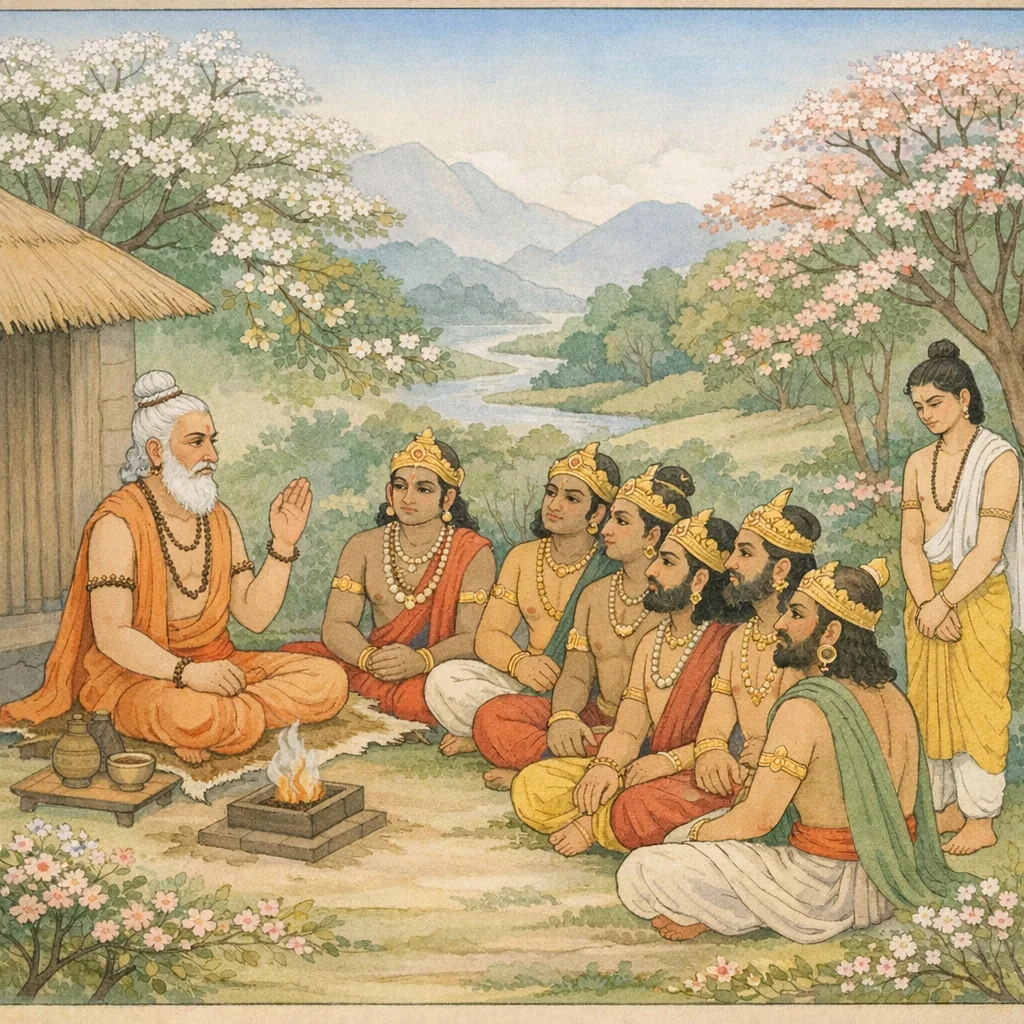
Adhyaya 76
ययाति–देवयानी संवादः (Yayāti–Devayānī Dialogue and Śukra’s Consent)
Upa-parva: Yayāti–Devayānī Upākhyāna (Episode within Ādi Parva)
Vaiśaṃpāyana narrates that Devayānī returns to a forest locale for recreation with a large retinue, accompanied by Śarmiṣṭhā. King Yayāti, arriving incidentally while seeking water and game, observes the women and addresses the two central figures, requesting their names and lineages. Devayānī identifies herself as Śukra’s daughter and introduces Śarmiṣṭhā as the daughter of the Dānava king Vṛṣaparvan, while also describing her as a companion in a subordinate role. Yayāti questions the apparent contradiction of a royal-born woman being designated a servant; Devayānī answers by invoking established social order (vidhāna) and then inquires into Yayāti’s identity. Yayāti presents himself as a learned king (Nāhuṣa line), and the dialogue shifts to the propriety of marriage across social categories. Devayānī asserts her choice and frames Yayāti as the appropriate recipient of her hand, while Yayāti expresses concern about the dangers of offending a powerful brahmin (Śukra) and about legitimacy absent paternal gifting. Devayānī sends for Śukra; upon arrival, Śukra authorizes the marriage, reassures Yayāti regarding fault, and instructs him to honor Śarmiṣṭhā while prohibiting her from being taken as a sexual partner. Yayāti circumambulates Śukra and departs joyfully with authorization, establishing a formally sanctioned alliance and a conditional household arrangement.
Chapter Arc: जनमेजय तपोधन वैशम्पायन से ययाति-वंश की आनुपूर्वी और विस्तार से कथा सुनने की उत्कंठा प्रकट करता है—वंश-परंपरा के भीतर छिपे उपाख्यानों का द्वार खुलता है। → वैशम्पायन ययाति का परिचय देते हुए कथा-धारा को उस प्रसंग से जोड़ते हैं जहाँ देव-दानव संघर्ष में ‘संजीवनी विद्या’ का महत्व उभरता है; शुक्राचार्य की अद्वितीय विद्या से देवता विषाद में पड़ते हैं और ब्रह्मा से सहायता की याचना करते हैं। कच का दीर्घ ब्रह्मचर्य-व्रत (पाँच सौ वर्ष) और दानवों की शंका-भरी दृष्टि तनाव को बढ़ाती है। → शुक्राचार्य दानवों को स्पष्ट चेतावनी देते हैं कि कच सिद्ध होकर उनके ही समीप रहेगा और संजीवनी प्राप्त कर ब्रह्म-तुल्य प्रभाव वाला ब्राह्मण बनेगा—दानवों की योजनाओं पर गुरु-वाणी का निर्णायक प्रहार। → कच गुरु के समीप दीर्घकाल (दश वर्ष-शतानि) व्रत पूर्ण कर, अनुमति पाकर त्रिदशालय (देवलोक) जाने को उद्यत होता है; उपाख्यान का यह चरण पूर्णता और प्रस्थान के भाव में ठहरता है। → ययाति-वंश की आगे की कड़ी और इस उपाख्यान का वंश-इतिहास से वास्तविक संधान अगले अध्याय में खुलने की प्रतीक्षा छोड़ता है।
Shlokas
Verse 1
इस प्रकार श्रीमहाभारत आदिपर्वके अन्तर्गत सम्भवपर्वमें ययात्युपाख्यानविषयक पचहत्तरवाँ अध्याय पूरा हुआ ॥/ ७५ ॥। ऑपन-- माल बछ। डे - वास्तवमें इला माता ही थी। जन्मदाता पिता चन्द्रमाके पुत्र बुध थे, परंतु इला जब पुरुषरूपमें परिणत हुई तो उसका नाम सुद्युम्न हुआ। सुद्युम्नने ही पुरूरवाको राज्य दिया था, इसलिये वे पिता भी कहे जाते हैं। षट्सप्ततितमो< ध्याय: कचका शिष्य भावसे शुक्राचार्य और देवयानीकी सेवामें संलग्न होना और अनेक कष्ट सहनेके पश्चात् मृतसंजीवनी विद्या प्राप्त करना जनमेजय उवाच ययाति: पूर्वजो5स्माकं दशमो य: प्रजापते: । कथं स शुक्रतनयां लेभे परमदुर्लभाम्,जनमेजयने पूछा--तपोधन! हमारे पूर्वज महाराज ययातिने, जो प्रजापतिसे दसवीं पीढ़ीमें उत्पन्न हुए थे, शुक्राचार्यकी अत्यन्त दुर्लभ पुत्री देवयानीको पत्नीरूपमें कैसे प्राप्त किया? मैं इस वृत्तान्तको विस्तारके साथ सुनना चाहता हूँ। आप मुझसे सभी वंश-प्रवर्तक राजाओंका क्रमश: पृथक्-पृथक् वर्णन कीजिये
Janamejaya said: “O ascetic sage, our forefather King Yayāti—born in the tenth generation from Prajāpati—how did he obtain as his wife Devayānī, the exceedingly hard-to-attain daughter of Śukra? Tell me this account in detail, and also relate, in due order, the line of those kings who became founders of dynasties.”
Verse 2
एतदिच्छाम्यहं श्रोतुं विस्तरेण तपोधन । आनुपूर्व्या च मे शंस राज्ञो वंशकरान् पृथक्,जनमेजयने पूछा--तपोधन! हमारे पूर्वज महाराज ययातिने, जो प्रजापतिसे दसवीं पीढ़ीमें उत्पन्न हुए थे, शुक्राचार्यकी अत्यन्त दुर्लभ पुत्री देवयानीको पत्नीरूपमें कैसे प्राप्त किया? मैं इस वृत्तान्तको विस्तारके साथ सुनना चाहता हूँ। आप मुझसे सभी वंश-प्रवर्तक राजाओंका क्रमश: पृथक्-पृथक् वर्णन कीजिये
Janamejaya said: “I wish to hear this in detail, O treasure of austerity. Please recount to me, in proper sequence, the lineage-founding kings—each one separately.”
Verse 3
वैशम्पायन उवाच ययातिरासीन्नूपतिर्देवराजसमग्युति: । त॑ शुक्रवृषपर्वाणौ वत्राते वै यथा पुरा,वैशम्पायनजीने कहा--जनमेजय! राजा ययाति देवराज इन्द्रके समान तेजस्वी थे। पूर्वकालमें शुक्राचार्य और वृषपर्वाने ययातिका अपनी-अपनी कन्याके पतिके रूपमें जिस प्रकार वरण किया, वह सब प्रसंग तुम्हारे पूछनेपर मैं तुमसे कहूँगा। साथ ही यह भी बताऊँगा कि नहुषनन्दन ययाति तथा देवयानीका संयोग किस प्रकार हुआ
Vaiśampāyana said: “There was a king named Yayāti, radiant like the lord of the gods. How, in former times, Śukra and Vṛṣaparvan each chose him as the husband for their respective daughters—this whole episode, since you have asked, I shall recount to you; and I shall also explain how Yayāti, the son of Nahuṣa, came to be united with Devayānī.”
Verse 4
तत् ते5हं सम्प्रवक्ष्यामि पृच्छते जनमेजय । देवयान्याश्व संयोगं ययाते्नाहुषस्यथ च,वैशम्पायनजीने कहा--जनमेजय! राजा ययाति देवराज इन्द्रके समान तेजस्वी थे। पूर्वकालमें शुक्राचार्य और वृषपर्वाने ययातिका अपनी-अपनी कन्याके पतिके रूपमें जिस प्रकार वरण किया, वह सब प्रसंग तुम्हारे पूछनेपर मैं तुमसे कहूँगा। साथ ही यह भी बताऊँगा कि नहुषनन्दन ययाति तथा देवयानीका संयोग किस प्रकार हुआ
Vaiśampāyana said: “O Janamejaya, since you ask, I shall now relate to you the account—how Devayānī came to be united with Yayāti, the son of Nahusha. I will narrate the earlier circumstances as well, by which Śukrācārya and Vṛṣaparvan each chose Yayāti as the husband of his own daughter, and how these events unfolded.”
Verse 5
सुराणामसुराणां च समजायत वै मिथ: । ऐश्वर्य प्रति संघर्षस्त्रलोक्ये सचराचरे,एक समय चराचर प्राणियोंसहित समस्त त्रिलोकीके ऐश्वर्यके लिये देवताओं और असुरोंमें परस्पर बड़ा भारी संघर्ष हुआ
Vaiśampāyana said: “A great mutual conflict arose between the gods and the asuras, contending for sovereignty over the entire threefold world together with all moving and unmoving beings.”
Verse 6
जिगीषया ततो देवा वव्रिरे55ड्विरसं मुनिम् पौरोहित्येन याज्यार्थे काव्यं तूशनसं परे,उसमें विजय पानेकी इच्छासे देवताओंने अंगिरा मुनिके पुत्र बृहस्पतिका पुरोहितके पदपर वरण किया और दैत्योंने शुक्राचार्यको पुरोहित बनाया। वे दोनों ब्राह्मण सदा आपसमें बहुत लाग-डाट रखते थे। देवताओंने उस युद्धमें आये हुए जिन दानवोंको मारा था, उन्हें शुक्राचार्यने अपनी संजीवनी विद्याके बलसे पुनः जीवित कर दिया। अतः वे पुनः उठकर देवताओंसे युद्ध करने लगे
Vaiśampāyana said: Then, desiring victory, the gods chose the sage of the Aṅgirasa line, Bṛhaspati, as their priest for sacrificial rites, while the Daityas appointed Kāvya Uśanas (Śukra) as their priest. Those two Brahmin preceptors were constantly in sharp rivalry. And the Daityas whom the gods slew in that war were restored to life by Śukra through the power of his Sañjīvanī knowledge; rising again, they returned to fight the gods once more.
Verse 7
ब्राह्मणी तावुभौ नित्यमन्योन्यस्पर्थिनौ भृशम् । तत्र देवा निजघ्नुर्यान् दानवान् युधि संगतान्,उसमें विजय पानेकी इच्छासे देवताओंने अंगिरा मुनिके पुत्र बृहस्पतिका पुरोहितके पदपर वरण किया और दैत्योंने शुक्राचार्यको पुरोहित बनाया। वे दोनों ब्राह्मण सदा आपसमें बहुत लाग-डाट रखते थे। देवताओंने उस युद्धमें आये हुए जिन दानवोंको मारा था, उन्हें शुक्राचार्यने अपनी संजीवनी विद्याके बलसे पुनः जीवित कर दिया। अतः वे पुनः उठकर देवताओंसे युद्ध करने लगे
Vaiśampāyana said: Those two Brahmin priests were constantly in fierce rivalry with one another. In that conflict, the gods struck down the Dānavas who had come together on the battlefield.
Verse 8
तान् पु]नर्जीवयामास काव्यो विद्याबलाश्रयात् | ततस्ते पुनरुत्थाय योधयांचक्रिरे सुरान्,उसमें विजय पानेकी इच्छासे देवताओंने अंगिरा मुनिके पुत्र बृहस्पतिका पुरोहितके पदपर वरण किया और दैत्योंने शुक्राचार्यको पुरोहित बनाया। वे दोनों ब्राह्मण सदा आपसमें बहुत लाग-डाट रखते थे। देवताओंने उस युद्धमें आये हुए जिन दानवोंको मारा था, उन्हें शुक्राचार्यने अपनी संजीवनी विद्याके बलसे पुनः जीवित कर दिया। अतः वे पुनः उठकर देवताओंसे युद्ध करने लगे
Vaiśampāyana said: Kāvya (Śukrācārya), relying on the power of his sacred knowledge, restored those slain to life again. Then they rose once more and resumed battle against the gods.
Verse 9
असुरास्तु निजघ्नुर्यान् सुरान् समरमूर्थनि । न तान् संजीवयामास बृहस्पतिरुदारधी:,परंतु असुरोंने युद्धके मुहानेपर जिन देवताओंको मारा था, उन्हें उदारबुद्धि बृहस्पति जीवित न कर सके
Vaiśaṃpāyana said: The Asuras slew those Devas at the very forefront of battle; and even Bṛhaspati, though of lofty and generous intellect, was unable to restore them to life.
Verse 10
नहि वेद सतां विद्यां यां काव्यो वेत्ति वीर्यवान् । संजीविनीं ततो देवा विषादमगमन् परम्,क्योंकि शक्तिशाली शुक्राचार्य जिस संजीवनी विद्याको जानते थे, उसका ज्ञान बृहस्पतिको नहीं था। इससे देवताओंको बड़ा विषाद हुआ
Vaiśampāyana said: “Bṛhaspati did not know that sacred science known among the noble—the mighty Kāvya (Śukrācārya) alone knew it: the Sañjīvinī, the art of restoring life. Therefore the gods were overcome with profound despair.”
Verse 11
ते तु देवा भयोद्विग्ना: काव्यादुशनसस्तदा । ऊचु: कचमुपागम्य ज्येष्ठं पुत्रं बृहस्पते:,इससे देवता शुक्राचार्यके भयसे उद्विग्ग हो उस समय बृहस्पतिके ज्येष्ठ पुत्र कचके पास जाकर बोले--
Then the gods, shaken with fear of Kāvya Uśanas (Śukrācārya), approached Kaca—the eldest son of Bṛhaspati—and addressed him.
Verse 12
भजमानान् भज स्वास्मान् कुरु नः साहामुत्तमम् । या सा विद्या निवसति ब्राह्म॒णेडमिततेजसि,“ब्रह्म! हम आपके सेवक हैं। आप हमें अपनाइये और हमारी उत्तम सहायता कीजिये। अमिततेजस्वी ब्राह्मण शुक्राचार्यके पास जो मृतसंजीवनी विद्या है, उसे शीघ्र सीखकर यहाँ ले आइये। इससे आप हम देवताओंके साथ यज्ञमें भाग प्राप्त कर सकेंगे। राजा वृषपर्वाके समीप आपको विप्रवर शुक्राचार्यका दर्शन हो सकता है”
“Accept us who seek your protection; take us as your own and render us the highest aid. That knowledge which abides in the immeasurably radiant Brāhmaṇa—go and obtain it quickly and bring it here.”
Verse 13
शुक्रे तामाहर क्षिप्रं भागभाड़ नो भविष्यसि । वृषपर्वसमीपे हि शकयो द्रष्टूं त्वया द्विज:,“ब्रह्म! हम आपके सेवक हैं। आप हमें अपनाइये और हमारी उत्तम सहायता कीजिये। अमिततेजस्वी ब्राह्मण शुक्राचार्यके पास जो मृतसंजीवनी विद्या है, उसे शीघ्र सीखकर यहाँ ले आइये। इससे आप हम देवताओंके साथ यज्ञमें भाग प्राप्त कर सकेंगे। राजा वृषपर्वाके समीप आपको विप्रवर शुक्राचार्यका दर्शन हो सकता है”
“Bring that knowledge quickly from Śukra; then you will become a rightful sharer of our sacrificial portion. For near King Vṛṣaparvan, O brāhmaṇa, you will indeed be able to meet and see Śukra.”
Verse 14
रक्षते दानवांस्तत्र न स रक्षत्यदानवान् | तमाराधयितुं शक्तो भवान् पूर्ववया: कविम्,“वहाँ रहकर वे दानवोंकी रक्षा करते हैं। जो दानव नहीं हैं, उनकी रक्षा नहीं करते। आपकी अभी नयी अवस्था है, अतः आप शुक्राचार्युकी आराधना (करके उन्हें प्रसन्न) करनेमें समर्थ हैं"
There he protects the Dānavas, but he does not protect those who are not Dānavas. Yet you, being young, are able to honor and win the favor of that Kavi, who is older in years.
Verse 15
देवयानीं च दयितां सुतां तस्य महात्मन: । त्वमाराधयितुं शक्तो नान्य: कश्नन विद्यते,“उन महात्माकी प्यारी पुत्रीका नाम देवयानी है, उसे अपनी सेवाओंद्वारा आप ही प्रसन्न कर सकते हैं। दूसरा कोई इसमें समर्थ नहीं है!
And that beloved daughter of the noble-souled man—Devayānī—can be won over and satisfied by your devoted service alone; no one else is capable of pleasing her in this matter.
Verse 16
शीलदाक्षिण्यमाधुर्यराचारेण दमेन च । देवयान्यां हि तुष्टायां विद्यां तां प्राप्स्यसि ध्रुवम्,“अपने शील-स्वभाव, उदारता, मधुर व्यवहार, सदाचार तथा इन्द्रियसंयमद्वारा देवयानीको संतुष्ट कर लेनेपर आप निश्चय ही उस विद्याको प्राप्त कर लेंगे”
Vaiśampāyana said: “By your good character, generosity, gentle sweetness of conduct, proper discipline of life, and self-restraint—if Devayānī is truly pleased—you will certainly obtain that knowledge.”
Verse 17
तथेत्युक्त्वा तत: प्रायाद् बृहस्पतिसुत: कच: । तदाभिपूजितो देवै: समीपे वृषपर्वण:,तब “बहुत अच्छा” कहकर बृहस्पतिपुत्र कच देवताओंसे सम्मानित हो वहाँसे वृषपर्वाके समीप गये
Having said, “So be it,” Kaca, the son of Bṛhaspati, then set out. Honoured and duly revered by the gods, he went from there to the presence of Vṛṣaparvan.
Verse 18
स गत्वा त्वरितो राजन देवै: सम्प्रेषित: कच: । असुरेन्द्रपुरे शुक्र दृष्टवा वाक्यमुवाच ह,राजन! देवताओंके भेजे हुए कच तुरंत दानवराज वृषपर्वाके नगरमें जाकर शुक्राचार्यसे मिले और इस प्रकार बोले--
Vaiśampāyana said: “O King, Kaca—dispatched by the gods—went swiftly. Reaching the city of the lord of the Asuras, he met Śukra (Śukrācārya) and then addressed him with fitting words.”
Verse 19
ऋषेरज्ञलिरस: पौत्रं पुत्र साक्षाद् बृहस्पते: । नाम्ना कचमिति ख्यातं शिष्यं गृह्नातु मां भवान्,“भगवन्! मैं अंगिरा ऋषिका पौत्र तथा साक्षात् बृहस्पतिका पुत्र हूँ। मेरा नाम कच है। आप मुझे अपने शिष्यके रूपमें ग्रहण करें
Vaiśampāyana said: “I am the grandson of the Ṛṣi Aṅgiras and the direct son of Bṛhaspati. I am known by the name Kaca. O venerable one, please accept me as your disciple.”
Verse 20
ब्रह्मचर्य चरिष्यामि त्वय्यहं परमं गुरौ । अनुमन्यस्व मां ब्रह्मनू सहस्नं परिवत्सरान्,'ब्रह्मन! आप मेरे गुरु हैं। मैं आपके समीप रहकर एक हजार वर्षोतक उत्तम ब्रह्मचर्यका पालन करूँगा। इसके लिये आप मुझे अनुमति दें”
Vaiśampāyana said: “O Brahman, you are my supreme teacher. Remaining near you, I shall undertake the highest discipline of brahmacarya for a full thousand years. Grant me your consent for this vow.”
Verse 21
शुक्र उवाच कच सुस्वागतं तेअस्तु प्रतिगृह्लामि ते वच: । अर्चयिष्ये5हमर्च्य त्वामर्चितो<स्तु बृहस्पति:,शुक्राचार्यने कहा--कच! तुम्हारा भलीभाँति स्वागत है; मैं तुम्हारी प्रार्थना स्वीकार करता हूँ। तुम मेरे लिये आदरके पात्र हो, अतः मैं तुम्हारा सम्मान एवं सत्कार करूँगा। तुम्हारे आदर-सत्कारसे मेरे द्वारा बृहस्पतिका आदर-सत्कार होगा
Śukra said: “Kaca, welcome. I accept your request. You are worthy of honor to me; therefore I shall show you reverence and hospitality. By honoring you, I will in effect be honoring Bṛhaspati as well.”
Verse 22
वैशम्पायन उवाच कचस्तु त॑ तथेत्युक्त्वा प्रतिजग्राह तद् व्रतम् आदिटष्ट॑ कविपुत्रेण शुक्रेणोशनसा स्वयम्,वैशम्पायनजी कहते हैं--तब कचने “बहुत अच्छा” कहकर महाकान्तिमान् कविपुत्र शुक्राचार्यके आदेशके अनुसार स्वयं ब्रह्मचर्य व्रत ग्रहण किया
Vaiśampāyana said: Then Kaca, saying “So be it,” accepted the vow of brahmacarya, as enjoined by Śukra—Uśanas himself, the sage-poet’s son.
Verse 23
व्रतस्य प्राप्तकालं स यथोत्तं प्रत्यगृह्नत । आराधयचन्नुपाध्यायं देवयानीं च भारत,जनमेजय! नियत समयतकके लिये व्रतकी दीक्षा लेनेवाले कचको शुक्राचार्यने भलीभाँति अपना लिया। कच आचार्य शुक्र तथा उनकी पुत्री देवयानी दोनोंकी नित्य आराधना करने लगे। वे नवयुवक थे और जवानीमें प्रिय लगनेवाले कार्य--गायन और नृत्य करके तथा भाँति-भाँतिके बाजे बजाकर देवयानीको संतुष्ट रखते थे
Vaiśampāyana said: When the proper time for the observance arrived, Kaca accepted the vow exactly as it had been prescribed. O Janamejaya of Bhārata’s line, he continued to honor and serve his preceptor (Śukrācārya) and also Devayānī, living with restraint and regularity.
Verse 24
नित्यमाराधयिष्यंस्तौ युवा यौवनगोचरे । गायन नृत्यन् वादयंश्व देवयानीमतोषयत्,जनमेजय! नियत समयतकके लिये व्रतकी दीक्षा लेनेवाले कचको शुक्राचार्यने भलीभाँति अपना लिया। कच आचार्य शुक्र तथा उनकी पुत्री देवयानी दोनोंकी नित्य आराधना करने लगे। वे नवयुवक थे और जवानीमें प्रिय लगनेवाले कार्य--गायन और नृत्य करके तथा भाँति-भाँतिके बाजे बजाकर देवयानीको संतुष्ट रखते थे
Vaiśampāyana said: “O Janamejaya, intent on serving them constantly, the young Kaca pleased Devayānī by singing, dancing, and playing musical instruments. Having undertaken a disciplined observance for a fixed period, he was duly accepted by Śukrācārya; and Kaca continued daily to honor both the teacher Śukra and his daughter Devayānī.”
Verse 25
स शीलयन् देवयानीं कन्यां सम्प्राप्तयौवनाम् । पुष्प: फलै: प्रेषणैश्न तोषयामास भारत,भारत! आचार्यकन्या देवयानी भी युवावस्थामें पदार्पण कर चुकी थी। कच उसके लिये फूल और फल ले आते तथा उसकी आज्ञाके अनुसार कार्य करते थे। इस प्रकार उसकी सेवामें संलग्न रहकर वे सदा उसे प्रसन्न रखते थे
Vaiśampāyana said: Kaca, attending upon Devayānī—the maiden who had now come into youth—kept her pleased, O Bhārata, by bringing her flowers and fruits and by carrying out the errands she directed. In this way, through steady service and compliance, he maintained her satisfaction.
Verse 26
देवयान्यपि तं विप्रं नियमव्रतधारणम् । गायन्ती च ललन्ती च रह: पर्यचरत् तथा,देवयानी भी नियमपूर्वक ब्रह्मचर्य धारण करनेवाले कचके ही समीप रहकर गाती और आमोद-प्रमोद करती हुई एकान्तमें उनकी सेवा करती थी
Vaiśampāyana said: Devayānī too attended upon that brāhmaṇa youth, Kaca, who was steadfast in disciplined vows. Singing and playfully delighting him, she served him in seclusion—staying close to him while he maintained his rule-bound celibacy.
Verse 27
पज्चवर्षशतान्येवं कचस्य चरतो व्रतम् । तत्रातीयुरथो बुद्ध्वा दानवास्तं ततः कचम्,इस प्रकार वहाँ रहकर ब्रह्मचर्य त्रतका पालन करते हुए कचके पाँच सौ वर्ष व्यतीत हो गये। तब दानवोंको यह बात मालूम हुई। तदनन्तर कचको वनके एकान्त प्रदेशमें अकेले गौएँ चराते देख बृहस्पतिके द्वेषसे और संजीवनी विद्याकी रक्षाके लिये क्रोधमें भरे हुए दानवोंने कचको मार डाला
Vaiśampāyana said: Thus, while Kaca continued to observe his vow of disciplined celibacy and service, five hundred years passed there. Then the Dānavas came to know of it; and thereafter, seeing Kaca alone in a secluded part of the forest tending the cows, they—out of hatred for Bṛhaspati and in order to safeguard the secret of the Sañjīvanī lore—were inflamed with anger and killed Kaca.
Verse 28
गा रक्षन्तं वने दृष्टवा रहस्येकममर्षिता: । जघ्नुर्बृहस्पतेद्?ैषाद् विद्यारक्षार्थमेव च,इस प्रकार वहाँ रहकर ब्रह्मचर्य त्रतका पालन करते हुए कचके पाँच सौ वर्ष व्यतीत हो गये। तब दानवोंको यह बात मालूम हुई। तदनन्तर कचको वनके एकान्त प्रदेशमें अकेले गौएँ चराते देख बृहस्पतिके द्वेषसे और संजीवनी विद्याकी रक्षाके लिये क्रोधमें भरे हुए दानवोंने कचको मार डाला
Vaiśampāyana said: Seeing Kaca alone in the forest, guarding the cows in a secluded spot, the asuras—seized by resentment—killed him, driven both by hostility toward Bṛhaspati’s line and by the determination to protect the secret of the reviving knowledge (sañjīvanī) from being obtained.
Verse 29
हत्वा शालावृकेभ्यश्व प्रायच्छेललवश: कृतम् । ततो गावो निवृत्तास्ता अगोपा: स्वं निवेशनम्,उन्होंने मारनेके बाद उनके शरीरको टुकड़े-टुकड़े कर कुत्तों और सियारोंको बाँट दिया। उस दिन गौएँ बिना रक्षकके ही अपने स्थानपर लौटीं
Vaiśampāyana said: Having slain them, he distributed the bodies in pieces to the dogs and jackals. Thereafter, those cows—left without any herdsman—returned on their own to their dwelling-place. The episode underscores a harsh, punitive response to predation, while also highlighting the instinctive order by which the cattle find their way home even in the absence of human protection.
Verse 30
सा दृष्टवा रहिता गाश्न॒ कचेनाभ्यागता वनात् । उवाच वचन काले देवयान्यथ भारत,जनमेजय! जब देवयानीने देखा, गौएँ तो वनसे लौट आयीं पर उनके साथ कच नहीं हैं, तब उसने उस समय अपने पितासे इस प्रकार कहा
Seeing that the cows had returned from the forest without Kaca, Devayānī spoke at once, at that very moment, to her father—O Bhārata, O Janamejaya. The scene underscores her anxious concern and the moral tension around responsibility and protection: the safe return of the herd is not enough when a trusted companion is missing.
Verse 31
देवयान्युवाच आहुतं चाम्निहोत्रं ते सूर्यश्चास्तं गत: प्रभो । अगोपाश्चागता गाव: कचस्तात न दृश्यते,शुक्राचार्य और कच देवयानी बोली--प्रभो! आपने अग्निहोत्र कर लिया और सूर्यदेव भी अस्ताचलको चले गये। गौएँ भी आज बिना रक्षकके ही लौट आयी हैं। तात! तो भी कच नहीं दिखायी देते हैं
Devayānī said: “Lord, your evening Agnihotra has been duly offered, and the sun has set. The cows, too, have returned today without any herdsman. Yet Kaca, dear sir, is nowhere to be seen.”
Verse 32
व्यक्त हतो मृतो वापि कचस्तात भविष्यति । तं विना न च जीवेयमिति सत्यं ब्रवीमि ते,पिताजी! अवश्य ही कच या तो मारे गये हैं या मर गये हैं। मैं आपसे सच कहती हूँ, उनके बिना जीवित नहीं रह सकूँगी
She said: “Father, Kaca must surely have been slain, or else he has died. I tell you the truth, O father: without him I cannot go on living.”
Verse 33
शुक्र उवाच अयमेहीति संशब्द्य मृतं संजीवयाम्यहम् । ततः संजीविनीं विद्यां प्रयुज्य कचमाह्नयत्,शुक्राचार्यने कहा--(बेटी! चिन्ता न करो।) मैं अभी “आओ” इस प्रकार बुलाकर मरे हुए कचको जीवित किये देता हूँ। ऐसा कहकर उन्होंने संजीवनी विद्याका प्रयोग किया और कचको पुकारा
Śukra said: “I shall summon him with the words ‘Come!’ and I will revive the dead.” So saying, he employed the Sañjīvanī lore and called Kaca forth.
Verse 34
भित्त्वा भित्त्वा शरीराणि वृकाणां स विनिर्गत: । आहूत: प्रादुरभवत् कचो हृष्टोडथ विद्यया,फिर तो गुरुके पुकारनेपर कच विद्याके प्रभावसे हृष्ट-पुष्ट हो कुत्तोंक शरीर फाड़- फाड़कर निकल आये और वहाँ प्रकट हो गये
Rending open, again and again, the bodies of the wolves, he came out. When summoned by his teacher, Kaca manifested there—joyful and strengthened by the power of the knowledge he had gained.
Verse 35
कस्माच्चिरायितो$सीति पृष्टस्तामाह भार्गवीम् । समिथधश्च कुशादीनि काष्ठ भारं च भामिनि,उन्हें देखते ही देवयानीने पूछा--/आज आपने लौटनेमें विलम्ब क्यों किया?” इस प्रकार पूछनेपर कचने शुक्राचार्यकी कनन््यासे कहा--“भामिनि! मैं समिधा, कुश आदि और काष्ठका भार लेकर आ रहा था। रास्तेमें थकावट और भारसे पीड़ित हो एक वटवृक्षके नीचे ठहर गया। साथ ही सारी गौएँ भी उसी वृक्षकी छायामें आकर विश्राम करने लगीं
When she asked, “Why have you been delayed so long?”, he replied to the Bhārgava maiden: “O fair lady, I was bringing sacrificial fuel-sticks (samidh), kuśa grass and the like, and a load of firewood.”
Verse 36
गृहीत्वा श्रमभारार्तों वटवृक्ष॑ं समाश्रित: । गावश्व सहिता: सर्वा वृक्षच्छायामुपाश्रिता:,उन्हें देखते ही देवयानीने पूछा--/आज आपने लौटनेमें विलम्ब क्यों किया?” इस प्रकार पूछनेपर कचने शुक्राचार्यकी कनन््यासे कहा--“भामिनि! मैं समिधा, कुश आदि और काष्ठका भार लेकर आ रहा था। रास्तेमें थकावट और भारसे पीड़ित हो एक वटवृक्षके नीचे ठहर गया। साथ ही सारी गौएँ भी उसी वृक्षकी छायामें आकर विश्राम करने लगीं
Śukra said: “Carrying a load and worn down by fatigue, I took shelter beneath a banyan tree. All the cows, together with the horses, also came and rested in the shade of that tree.”
Verse 37
असुरास्तत्र मां दृष्टवा कस्त्वमित्यभ्यचोदयन् | बृहस्पतिसुतश्चाहं कच इत्यभिविश्रुत:,“वहाँ मुझे देखकर असुरोंने पूछा--“तुम कौन हो?” मैंने कहा--मेरा नाम कच है, मैं बृहस्पतिका पुत्र हूँ
Seeing me there, the Asuras challenged me, asking, “Who are you?” I replied, “I am Kaca, widely known as the son of Bṛhaspati.”
Verse 38
इत्युक्तमात्रे मां हत्वा पेषीकृत्वा तु दानवा: | दत्त्वा शालावृकेभ्यस्तु सुखं जग्मु:ः स््वमालयम्,“मेरे इतना कहते ही दानवोंने मुझे मार डाला और मेरे शरीरको चूर्ण करके कुत्ते- सियारोंको बाँट दिया। फिर वे सुखपूर्वक अपने घर चले गये
Śukra said: “No sooner had I spoken these words than the Dānavas killed me. They crushed my body into pulp and distributed it to dogs and jackals. Having done so, they went back to their own dwelling, content and at ease.”
Verse 39
आहूतो विद्यया भद्ठे भार्गवेण महात्मना । त्वत्सममीपमिहायात: कथंचित् समजीवित:,“भद्रे! फिर महात्मा भार्गवने जब विद्याका प्रयोग करके मुझे बुलाया है, तब किसी प्रकारसे पूर्ण जीवन लाभ करके यहाँ तुम्हारे पास आ सका हूँ
Śukra said: “O noble lady, the great-souled Bhārgava has summoned me by the power of his knowledge. Somehow, having regained full life, I have managed to come here close to you.”
Verse 40
हतो5हमिति चाचख्यौ पृष्टो ब्राह्मणकन्यया । स पुनर्देवयान्योक्त: पुष्पाहारो यदृच्छया,इस प्रकार ब्राह्मणकन्याके पूछनेपर कचने उससे अपने मारे जानेकी बात बतायी। तदनन्तर पुन: देवयानीने एक दिन अकस्मात् कचको फूल लानेके लिये कहा
When questioned by the Brahmin maiden, Kaca disclosed, “I have been slain.” Thereafter, on another occasion, Devayānī, as if by chance, asked Kaca to go and bring flowers.
Verse 41
वन॑ ययौ कचो वित्रो ददृशुर्दानवाश्न तम् पुनस्तं पेषयित्वा तु समुद्राम्भस्यमिश्रयन्,विप्रवर कच इसके लिये वनमें गये। वहाँ दानवोंने उन्हें देख लिया और फिर उन्हें पीसकर समुद्रके जलमें घोल दिया
Śukra said: Kaca went into the forest. There the Dānavas spotted him; and once again, after crushing him to a pulp, they mixed him into the waters of the sea. The episode underscores the extremes of hostility and deceit used to obstruct sacred knowledge, and it frames Kaca’s ordeal as a test of steadfastness and the protection of learning against adharma.
Verse 42
चिरं गतं पुनः कन्या पित्रे त॑ं संन्यवेदयत् । विप्रेण पुनराहूतो विद्यया गुरुदेहज: । पुनरावृत्य तद् वृत्तं न््यवेदयत तद् यथा,जब उसके लौटनेमें विलम्ब हुआ, तब आचार्यकन्याने पितासे पुनः यह बात बतायी। विप्रवर शुक्राचार्यने कचका पुनः संजीवनी विद्याद्वारा आवाहन किया। इससे बृहस्पतिपूुत्र कच पुनः वहाँ आ पहुँचे और उनके साथ असुरोंने जो बर्ताव किया था, वह बताया
When the maiden’s return was long delayed, she again reported the matter to her father. Then the eminent Brahmin Śukrācārya, by means of the reviving science (Saṁjīvanī-vidyā), summoned back Kaca, the son of Bṛhaspati. Having returned once more, Kaca related exactly what had happened to him and how the Asuras had treated him—highlighting both the peril of envy and the teacher’s duty to protect and restore the worthy disciple.
Verse 43
ततस्तृतीयं हत्वा त॑ दग्ध्वा कृत्वा च चूर्णश: । प्रायच्छन् ब्राह्मणायैव सुरायामसुरास्तदा,तत्पश्चात् असुरोंने तीसरी बार कचको मारकर आगमें जलाया और उनकी जली हुई लाशका चूर्ण बनाकर मदिरामें मिला दिया तथा उसे ब्राह्मण शुक्राचार्यको ही पिला दिया
Then, for the third time, the Asuras killed Kaca; they burned his body, ground it into powder, mixed it into liquor, and made the Brāhmaṇa Śukrācārya himself drink it. The episode underscores a grim ethical inversion: violence and deceit are used not merely to destroy a person, but to defile a teacher’s body and conscience by turning him into an unwitting instrument of the crime.
Verse 44
देवयान्यथ भूयो5पि पितरं वाक्यमब्रवीत् पुष्पाहार: प्रेषणकृत् कचस्तात न दृश्यते,अब देवयानी पुनः अपने पितासे यह बात बोली--'पिताजी! कच मेरे कहनेपर प्रत्येक कार्य पूर्ण कर दिया करते हैं। आज मैंने उन्हें फ़ूल लानेके लिये भेजा था, परंतु अभीतक वे दिखायी नहीं दिये
Devayānī again addressed her father: “Father, Kaca always carries out whatever task I ask of him. Today I sent him to bring flowers, yet he has not been seen even now.” The passage highlights her dependence on Kaca’s service and hints at an ethical tension: when a trusted helper goes missing, concern and suspicion naturally arise, setting the stage for questions of duty, protection, and responsibility within the teacher’s household.
Verse 45
व्यक्त हतो मृतो वापि कचस्तात भविष्यति । तं विना न च जीवेयं कचं सत्यं ब्रवीमि ते,“तात! जान पड़ता है वे मार दिये गये या मर गये। मैं आपसे सच कहती हूँ, मैं उनके बिना जीवित नहीं रह सकती हूँ!
Śukra said: “Dear child, it seems certain that Kaca has been slain—or has died. Without him I cannot go on living. About Kaca I speak to you the truth.”
Verse 46
शुक्र उवाच बृहस्पते: सुतः पुत्रि कचः प्रेतगतिं गतः । विद्यया जीवितो<प्येवं हन्यते करवाणि किम्,शुक्राचार्यने कहा--बेटी! बृहस्पतिके पुत्र कच मर गये। मैंने विद्यासे उन्हें कई बार जिलाया, तो भी वे इस प्रकार मार दिये जाते हैं, अब मैं क्या करूँ। देवयानी! तुम इस प्रकार शोक न करो, रोओ मत। तुम-जैसी शक्तिशालिनी स्त्री किसी मरनेवालेके लिये शोक नहीं करती। तुम्हें तो वेद, ब्राह्मण, इन्द्रसहित सब देवता, वसुगण, अश्विनीकुमार, दैत्य तथा सम्पूर्ण जगतके प्राणी मेरे प्रभावसे तीनों संध्याओंके समय मस्तक झुकाकर प्रणाम करते हैं। अब उस ब्राह्मणको जिलाना असम्भव है। यदि जीवित हो जाय, तो फिर दैत्योंद्वारा मार डाला जायगा (अत: उसे जिलानेसे कोई लाभ नहीं है)
Śukra said: “Daughter, Kaca, the son of Bṛhaspati, has gone to the state of the dead. Even when I restore him to life by my knowledge, he is killed again in the same manner. What, then, am I to do?”
Verse 47
मैवं शुचो मा रुद देवयानि न त्वादृशी मर्त्यमनुप्रशोचते । यस्यास्तव ब्रह्म च ब्राह्मणाश्न सेन्द्रा देवा वसवो5थाश्विनौ च,शुक्राचार्यने कहा--बेटी! बृहस्पतिके पुत्र कच मर गये। मैंने विद्यासे उन्हें कई बार जिलाया, तो भी वे इस प्रकार मार दिये जाते हैं, अब मैं क्या करूँ। देवयानी! तुम इस प्रकार शोक न करो, रोओ मत। तुम-जैसी शक्तिशालिनी स्त्री किसी मरनेवालेके लिये शोक नहीं करती। तुम्हें तो वेद, ब्राह्मण, इन्द्रसहित सब देवता, वसुगण, अश्विनीकुमार, दैत्य तथा सम्पूर्ण जगतके प्राणी मेरे प्रभावसे तीनों संध्याओंके समय मस्तक झुकाकर प्रणाम करते हैं। अब उस ब्राह्मणको जिलाना असम्भव है। यदि जीवित हो जाय, तो फिर दैत्योंद्वारा मार डाला जायगा (अत: उसे जिलानेसे कोई लाभ नहीं है)
Śukra said: “Devayānī, do not grieve like this; do not weep. A woman of your power and stature does not lament after one who is mortal. For you possess sacred knowledge and the support of the Brahmins; and even the gods—Indra with them—the Vasus and the two Aśvins, all stand in reverence. Therefore restrain your sorrow.”
Verse 48
सुरद्विषश्चैव जगच्च सर्व- मुपस्थाने संनमन्ति प्रभावात् | अशक्योडसौ जीवयितु द्विजाति: संजीवितो बध्यते चैव भूय:,शुक्राचार्यने कहा--बेटी! बृहस्पतिके पुत्र कच मर गये। मैंने विद्यासे उन्हें कई बार जिलाया, तो भी वे इस प्रकार मार दिये जाते हैं, अब मैं क्या करूँ। देवयानी! तुम इस प्रकार शोक न करो, रोओ मत। तुम-जैसी शक्तिशालिनी स्त्री किसी मरनेवालेके लिये शोक नहीं करती। तुम्हें तो वेद, ब्राह्मण, इन्द्रसहित सब देवता, वसुगण, अश्विनीकुमार, दैत्य तथा सम्पूर्ण जगतके प्राणी मेरे प्रभावसे तीनों संध्याओंके समय मस्तक झुकाकर प्रणाम करते हैं। अब उस ब्राह्मणको जिलाना असम्भव है। यदि जीवित हो जाय, तो फिर दैत्योंद्वारा मार डाला जायगा (अत: उसे जिलानेसे कोई लाभ नहीं है)
Śukra said: “Both the foes of the gods and the whole world bow down at my presence, out of the power I possess. That twice-born man cannot be restored to life now; even if revived, he will only be slain again.”
Verse 49
देवयान्युवाच यस्याड्रिरा वृद्धतम: पितामहो बृहस्पतिश्चापि पिता तपोनिधि: । ऋषे: पुत्र तमथो वापि पौत्र कथं न शोचेयमहं न रुद्याम्,देवयानी बोली--पिताजी! अत्यन्त वृद्ध महर्षि अंगिरा जिनके पितामह हैं, तपस्याके भण्डार बृहस्पति जिनके पिता हैं, जो ऋषिके पुत्र और ऋषिके ही पौत्र हैं; उन ब्रह्मचारी कचके लिये मैं कैसे शोक न करूँ और कैसे न रोऊँ
Devayānī said: “How could I not grieve, how could I not weep for that brahmacārin Kaca—whose grandsire is the most aged Aṅgiras, whose father is Bṛhaspati, a very treasury of austerity, and who is himself the son of a ṛṣi and even the grandson of a ṛṣi?”
Verse 50
स ब्रह्मचारी च तपोधनश्न सदोत्थित: कर्मसु चैव दक्ष: । कचस्य मार्ग प्रतिपत्स्ये न भोक्ष्ये प्रियो हि मे तात कचो5डभिरूप:,तात! वे ब्रह्मचर्यपालनमें रत थे, तपस्या ही उनका धन था। वे सदा ही सजग रहनेवाले और कार्य करनेमें कुशल थे। इसलिये कच मुझे बहुत प्रिय थे। वे सदा मेरे मनके अनुरूप चलते थे। अब मैं भोजनका त्याग कर दूँगी और कच जिस मार्गपर गये हैं, वहीं मैं भी चली जाऊँगी
Devayānī said: “Kaca was a true brahmacārin; austerity was his wealth. Ever vigilant, he was also skillful in action. Therefore, dear father, Kaca was exceedingly beloved to me and always acted in harmony with my wishes. Now I shall renounce food, and I too will follow the very path that Kaca has taken.”
Verse 51
वैशम्पायन उवाच स पीडितो देवयान्या महर्षि: समाह्दयत् संरम्भाच्चैव काव्य: । असंशयं मामसुरा द्विषन्ति ये मे शिष्यानागतान् सूदयन्ति,वैशम्पायनजी कहते हैं--जनमेजय! देवयानीके कहनेसे उसके दुःखसे दुःखी हुए महर्षि शुक्राचार्यने कचको पुकारा और दैत्योंके प्रति कुृपित होकर बोले--“इसमें तनिक भी संशय नहीं है कि असुरलोग मुझसे द्वेष करते हैं। तभी तो यहाँ आये हुए मेरे शिष्योंको ये लोग मार डालते हैं
Vaiśampāyana said: Urged by Devayānī and pained by her distress, the great sage Kāvya (Śukrācārya) angrily called out for Kaca. He declared, “There is no doubt that the Asuras bear hatred toward me—otherwise they would not kill my disciples who have come here.”
Verse 52
अब्राद्मणं कर्तुमिच्छन्ति रौद्रा- स््ते मां यथा व्यभिचरन्ति नित्यम् | अप्यस्य पापस्य भवेदिहान्तः कं ब्रह्महत्या न दहेदपीन्द्रमू,“ये भयंकर स्वभाववाले दैत्य मुझे ब्राह्मणत्वसे गिराना चाहते हैं। इसीलिये प्रतिदिन मेरे विरुद्ध आचरण कर रहे हैं। इस पापका परिणाम यहाँ अवश्य प्रकट होगा। ब्रह्महत्या किसे नहीं जला देगी, चाहे वह इन्द्र ही क्यों न हो?
Vaiśampāyana said: “Those fierce-natured beings wish to strip me of my brahmin status; therefore they continually act against me. The end-result of this sin will surely manifest here itself. Whom would the sin of brahmin-slaying not burn— even if it were Indra?”
Verse 53
गुरोहि भीतो विद्यया चोपहूत: शनैर्वाक्यं जठरे व्याजहार । जब गुरुने विद्याका प्रयोग करके बुलाया, तब उनके पेटमें बैठे हुए कच भयभीत हो धीरेसे बोले। (कच उवाच प्रसीद भगवन् महां कचो5हमभिवादये । यथा बहुमत: पुत्रस्तथा मन्यतु मां भवान् ।।) कचने कहा--भगवन्! आप मुझपर प्रसन्न हों, मैं कच हूँ और आपके चरणोंमें प्रणाम करता हूँ। जैसे पुत्रपर पिताका बहुत प्यार होता है, उसी प्रकार आप मुझे भी अपना स्नेहभाजन समझें। वैशम्पायन उवाच तमब्रवीत् केन पथोपनीत- स्त्वं चोदरे तिष्ठसि ब्रूहि विप्र,वैशम्पायनजी कहते हैं--उनकी आवाज सुनकर शुक्राचार्यने पूछा--“विप्र! किस मार्गसे जाकर तुम मेरे उदरमें स्थित हो गये? ठीक-ठीक बताओ”
Vaiśampāyana said: Summoned by his teacher through the power of knowledge, and frightened, Kaca—who was lodged within the belly—spoke slowly. Kaca said: “Be gracious, O Blessed one. I am Kaca; I bow to you. As a father holds a beloved son in high regard, so may you also regard me with the same affection.” Vaiśampāyana said: Hearing that voice, Śukrācārya asked him: “O brahmin, by what path were you brought here, that you stand within my belly? Tell me truly.”
Verse 54
कच उवाच तव प्रसादान्न जहाति मां स्मृति: स्मरामि सर्व यच्च यथा च वृत्तम् । न त्वेवं स्यात् तपस: संक्षयो मे ततः क्लेशं घोरमिमं सहामि,कचने कहा--गुरुदेव! आपके प्रसादसे मेरी स्मरणशक्तिने साथ नहीं छोड़ा है। जो बात जैसे हुई है, वह सब मुझे याद है। इस प्रकार पेट फाड़कर निकल आनेसे मेरी तपस्याका नाश होगा। वह न हो, इसीलिये मैं यहाँ घोर क्लेश सहन करता हूँ
Kaca said: “By your grace my memory has not abandoned me; I remember everything—what happened and how it happened. But if I were to come out by tearing open the belly, my austerity would be diminished. Therefore, to prevent that loss, I endure this dreadful suffering here.”
Verse 55
असुरै: सुरायां भवतो5स्मि दत्तो हत्वा गग्ध्वा चूर्णयित्वा च काव्य । ब्राह्मीं मायां चासुरीं विप्र मायां त्वयि स्थिते कथमेवातिवर्तेत्,आचार्यपाद! असुरोंने मुझे मारकर मेरे शरीरको जलाया और चूर्ण बना दिया। फिर उसे मदिरामें मिलाकर आपको पिला दिया! विप्रवर! आप ब्राह्मी, आसुरी और दैवी तीनों प्रकारकी मायाओंको जानते हैं। आपके होते हुए कोई इन मायाओंका उल्लंघन कैसे कर सकता है?
Kaca said: “O Kāvya (Śukra), the Asuras killed me, burned my body, ground it to powder, mixed it into liquor, and made you drink it. O best of Brahmins, you know the Brahmic and the Asuric arts of illusion; with you present, how could anyone possibly transgress or overpower these powers, revered teacher?”
Verse 56
शुक्र उवाच किं ते प्रियं करवाण्यद्य वत्से वधेन मे जीवितं स्थात् कचस्य । नान्यत्र कुक्षेमम भेदनेन दृश्येत् कचो मद्गतो देवयानि,शुक्राचार्य बोले--बेटी देवयानी! अब तुम्हारे लिये कौन-सा प्रिय कार्य करूँ? मेरे वधसे ही कचका जीवित होना सम्भव है। मेरे उदरको विदीर्ण करनेके सिवा और कोई ऐसा उपाय नहीं है, जिससे मेरे शरीरमें बैठा हुआ कच बाहर दिखायी दे
Śukra said: “My child, Devayānī, what dear thing shall I do for you today? Only by my own death can Kaca’s life be restored. There is no other means—except by splitting open my belly—by which Kaca, who has entered into me, could be seen and brought out.”
Verse 57
देवयान्युवाच द्ौ मां शोकावग्निकल्पौ दहेतां कचस्य नाशस्तव चैवोपघात: । कचस्य नाशे मम नास्ति शर्म तवोपघाते जीवितुं नास्मि शक्ता,देवयानीने कहा--पिताजी! कचका नाश और आपका वध--ये दोनों ही शोक अग्निके समान मुझे जला देंगे। कचके नष्ट होनेपर मुझे शान्ति नहीं मिलेगी और आपका वध हो जानेपर मैं जीवित नहीं रह सकूँगी
Devayānī said: “Two calamities, like fires of grief, will burn me—Kaca’s destruction and your own death. If Kaca is lost, I will find no peace; and if you are slain, I will not be able to go on living.”
Verse 58
शुक्र उवाच संसिद्धरूपो5सि बृहस्पते: सुत यत् त्वां भक्त भजते देवयानी । विद्यामिमां प्राप्तुहि जीविनीं त्वं न चेदिन्द्र: कचरूपी त्वमद्य,शुक्राचार्य बोले--बृहस्पतिके पुत्र कच! अब तुम सिद्ध हो गये, क्योंकि तुम देवयानीके भक्त हो और वह तुम्हें चाहती है। यदि कचके रूपमें तुम इन्द्र नहीं हो, तो मुझसे मृतसंजीवनी विद्या ग्रहण करो
Śukra said: “O son of Bṛhaspati, you have now become fully accomplished, since Devayānī—devoted to you—seeks you and cherishes you. Therefore, receive here from me this life-restoring knowledge. Only if you are not Indra disguised today in the form of Kaca, may you learn the Mṛtasañjīvanī.”
Verse 59
न निवर्तेत् पुनर्जीवन् कश्चिदन्यो ममोदरात् । ब्राह्मणं वर्जयित्वैंकं तस्माद् विद्यामवाप्रुहि,केवल एक ब्राह्णको छोड़कर दूसरा कोई ऐसा नहीं है, जो मेरे पेटसे पुनः जीवित निकल सके। इसलिये तुम विद्या ग्रहण करो
Śukra said: “No one else can come out of my belly alive again—except a single brāhmaṇa. Therefore, seek and obtain true knowledge.”
Verse 60
पुत्रो भूत्वा भावय भावितो मा- मस्मद्देहादुपनिष्क्रम्य तात । समीक्षेथा धर्मवतीमवेक्षां गुरो: सकाशातृ् प्राप्य विद्यां सविद्य:,तात! मेरे इस शरीरसे जीवित निकलकर मेरे लिये पुत्रके तुल्य हो मुझे पुन: जिला देना। मुझ गुरुसे विद्या प्राप्त करके विद्वान् हो जानेपर भी मेरे प्रति धर्मयुक्त दृष्टिसे ही देखना
Śukra said: “Dear child, when the life departs from this body of mine, come out of me alive; then be as a son to me and restore me to life in return for what I have nurtured in you. And even after you have obtained learning from your teacher and become truly learned, look upon me only with a righteous, dutiful regard.”
Verse 61
वैशम्पायन उवाच गुरो: सकाशात् समवाप्य विद्यां भित्त्वा कुक्षिं निर्विचक्राम विप्र: । कचो<$भिरूपस्ततक्षणाद् ब्राह्मणस्य शुक्लात्यये पौर्णमास्यामिवेन्दु:,वैशम्पायनजी कहते हैं--जनमेजय! गुरुसे संजीवनी विद्या प्राप्त करके सुन्दर रूपवाले विप्रवर कच तत्काल ही महर्षि शुक्राचार्यका पेट फाड़कर ठीक उसी तरह बाहर निकल आये, जैसे दिन बीतनेपर पूर्णिमाकी संध्याको चन्द्रमा प्रकट हो जाते हैं
Vaiśampāyana said: Having obtained the sacred knowledge in his teacher’s presence, the brahmin youth Kaca—handsome in form—at once burst open the belly of the brāhmaṇa (Śukrācārya) and came forth. He appeared like the moon emerging on the full-moon evening when the bright fortnight has run its course.
Verse 62
दृष्टवा च त॑ पतितं ब्रह्मराशि- मुत्थापयामास मृतं कचो<डपि । विद्यां सिद्धां तामवाप्याभिवाद्य ततः कचस्तं गुरुमित्युवाच,मूर्तिमान् वेदराशिके तुल्य शुक्राचार्यको भूमिपर पड़ा देख कचने भी अपने मरे हुए गुरुको विद्याके बलसे जिलाकर उठा दिया और उस सिद्ध विद्याको प्राप्त कर लेनेपर गुरुको प्रणाम करके वे इस प्रकार बोले--
Vaiśampāyana said: Seeing his teacher—like a fallen embodiment of the Vedic treasury—lying dead upon the ground, Kaca raised him up again by the power of knowledge. Having attained that perfected lore, he bowed in reverence and then addressed him, saying, “O Guru.”
Verse 63
यः श्रोत्रयोरमृतं संनिषिड्चेद् विद्यामविद्यस्थ यथा ममायम् | त॑ मन्ये5हं पितरं मातरं च तस्मै न द्रहोत् कृतमस्य जानन्,“मैं विद्यासे शून्य था, उस दशामें मेरे इन पूजनीय आचार्य जैसे मेरे दोनों कानोंमें मृतसंजीवनी विद्यारूप अमृतकी धारा डाली है, इसी प्रकार जो कोई दूसरे ज्ञानी महात्मा मेरे कानोंमें ज्ञानरूप अमृतका अभिषेक करेंगे, उन्हें भी मैं अपना माता-पिता मानूँगा (जैसे गुरुदेव शुक्राचार्यको मानता हूँ)। गुरुदेवके द्वारा किये हुए उपकारको स्मरण रखते हुए शिष्यको उचित है कि वह उनसे कभी द्रोह न करे
“Whoever pours the nectar of knowledge into the two ears of one who stands in ignorance, as this revered teacher has done for me—him I regard as both father and mother. Remembering the benefaction done by the guru, a disciple, knowing it well, should never commit treachery against him.”
Verse 64
ऋतस्य दातारमनुत्तमस्य निर्धि निधीनामपि लब्धविद्या: | ये नाद्रियन्ते गुरुमर्चनीयं पापॉल्लोकांस्ते व्रजन्त्यप्रतिष्ठा:,“जो लोग सम्पूर्ण वेदके सर्वोत्तम ज्ञानको देने-वाले तथा समस्त विद्याओंके आश्रयभूत पूजनीय गुरुदेवका उनसे विद्या प्राप्त करके भी आदर नहीं करते, वे प्रतिष्ठारहित होकर पापपूर्ण लोकों--नरकोंमें जाते हैं!
Vaiśampāyana said: Those who, even after receiving learning, fail to honor the venerable teacher—who is the unsurpassed giver of sacred knowledge and the very treasury among treasuries—go without standing or dignity to sinful realms (hells).
Verse 65
वैशम्पायन उवाच सुरापानाद् वज्चनां प्राप्य विद्वान् संज्ञानाशं चैव महातिघोरम् | दृष्टवा कचं चापि तथाभिरूपं पीत॑ तदा सुरया मोहितेन,वैशम्पायनजी कहते हैं--जनमेजय! विद्वान् शुक्राचार्य मदिरापानसे ठगे गये थे और उस अत्यन्त भयानक परिस्थितिको पहुँच गये थे, जिसमें तनिक भी चेत नहीं रह जाता। मदिरासे मोहित होनेके कारण ही वे उस समय अपने मनके अनुकूल चलनेवाले प्रिय शिष्य ब्राह्मगकुमार कचको भी पी गये थे। यह सब देख और सोचकर वे महानुभाव कविपुत्र शुक्र कुपित हो उठे। मदिरापानके प्रति उनके मनमें क्रोध और घृणाका भाव जाग उठा और उन्होंने ब्राह्मणोंका हित करनेकी इच्छासे स्वयं इस प्रकार घोषणा की--
Vaiśampāyana said: Having fallen into the vice of drinking liquor, the learned one reached a most dreadful state—the loss of all awareness. Deluded by wine, he even consumed Kaca, that handsome and beloved disciple who moved in accordance with his wishes. Seeing and reflecting on this, the illustrious son of the seer (Śukra) became enraged; disgust and anger toward intoxication arose in his mind, and, wishing the welfare of the brāhmaṇas, he proceeded to make a public declaration.
Verse 66
समन्युरुत्थाय महानुभाव- स्तदोशना विप्रहितं चिकीर्ष: । सुरापानं प्रति संजातमन्यु: काव्य: स्वयं वाक्यमिदं जगाद,वैशम्पायनजी कहते हैं--जनमेजय! विद्वान् शुक्राचार्य मदिरापानसे ठगे गये थे और उस अत्यन्त भयानक परिस्थितिको पहुँच गये थे, जिसमें तनिक भी चेत नहीं रह जाता। मदिरासे मोहित होनेके कारण ही वे उस समय अपने मनके अनुकूल चलनेवाले प्रिय शिष्य ब्राह्मगकुमार कचको भी पी गये थे। यह सब देख और सोचकर वे महानुभाव कविपुत्र शुक्र कुपित हो उठे। मदिरापानके प्रति उनके मनमें क्रोध और घृणाका भाव जाग उठा और उन्होंने ब्राह्मणोंका हित करनेकी इच्छासे स्वयं इस प्रकार घोषणा की--
Vaiśampāyana said: Then the illustrious son of Kavi (Śukra), rising up in anger, resolved to undo what that drink had brought about. His wrath blazed against the drinking of liquor; and, wishing to act for the welfare of the brāhmaṇas, he himself proclaimed these words.
Verse 67
यो ब्राह्मणोअ्द्यप्रभूतीह कश्रनि- न्मोहात् सुरां पास्यति मन्दबुद्धि: । अपेतधर्मा ब्रह्म॒हा चैव स स्या- दस्मिंल्लोके गर्लहितः स्यात् परे च,“आजसे इस जगत्का जो कोई भी मन्दबुद्धि ब्राह्मण अज्ञानसे भी मदिरापान करेगा, वह धर्मसे भ्रष्ट हो ब्रह्महत्याके पापका भागी होगा तथा इस लोक और परलोक दोनोंमें वह निन्दित होगा"
Vaiśampāyana said: “From this day onward, if any brahmin here, being dull-witted, drinks intoxicating liquor even out of delusion, he falls away from dharma; he is to be regarded as bearing the sin of brahma-slaughter (brahma-hatyā), and he will be condemned both in this world and in the next.”
Verse 68
मया चैतां विप्रधर्मोक्तिसीमां मर्यादां वै स्थापितां सर्वलोके । सन््तो विप्रा: शुश्रुवांसो गुरूणां देवा लोकाश्लोपशृण्वन्तु सर्वे,“धर्मशास्त्रोंमें ब्राह्मण-धर्मकी जो सीमा निर्धारित की गयी है, उसीमें मेरे द्वारा स्थापित की हुई यह मर्यादा भी रहे और यह सम्पूर्ण लोकमें मान्य हो। साधु पुरुष, ब्राह्मण, गुरुओंके समीप अध्ययन करनेवाले शिष्य, देवता और समस्त जगतके मनुष्य, मेरी बाँधी हुई इस मर्यादाको अच्छी तरह सुन लें”
Vaiśampāyana said: “I have established this boundary and rule of conduct—set within the limits declared in the dharma-texts for brahmins—so that it may be accepted throughout the whole world. Let the virtuous, the brahmins, the disciples who have studied at the feet of their teachers, the gods, and all people everywhere listen well to this ordinance I have laid down.”
Verse 69
इतीदमुक्त्वा स महानुभाव- स्तपोनिधीनां निधिरप्रमेय: । तान् दानवान् दैवविमूढबुद्धी - निदं समाहूय वचो<भ्युवाच,ऐसा कहकर तपस्याकी निधियोंकी निधि, अप्रमेय शक्तिशाली महानुभाव शुक्राचार्यने दैवने जिनकी बुद्धिको मोहित कर दिया था उन दानवोंको बुलाया और इस प्रकार कहा --
Vaiśampāyana said: Having spoken thus, the illustrious Śukrācārya—an immeasurable power, a veritable treasury among the treasuries of ascetic merit—summoned those Dānavas whose understanding had been deluded by fate, and addressed them with these words.
Verse 70
आचक्षे वो दानवा बालिशा: स्थ सिद्ध: कचो वत्स्यति मत्सकाशे । संजीविनीं प्राप्य विद्यां महात्मा तुल्यप्रभावो ब्राह्मणो ब्रह्मभूत:
Vaiśaṃpāyana said: “I tell you, O foolish Dānavas—stand firm and listen: the accomplished Kaca will dwell in my presence. Having obtained the life-restoring knowledge called Saṃjīvinī, that great-souled brāhmaṇa will become equal in power (to the foremost), established in brahman—one who has attained the state of brahman.”
Verse 71
(यो5कार्षीद् दुष्करं कर्म देवानां कारणात् कच: । न तत्कीर्तिर्जरां गच्छेद् यज्ञियश्न भविष्यति ।।) एतावदुकक््त्वा वचनं विरराम स भार्गव: । दानवा विस्मयाविष्टा: प्रययु: स्वं निवेशनम्,“जिन महात्मा कचने देवताओंके लिये वह दुष्कर कार्य किया है, उनकी कीर्ति कभी नष्ट नहीं हो सकती और वे यज्ञभागके अधिकारी होंगे।” ऐसा कहकर शुक्राचार्यजी चुप हो गये और दानव आश्चवर्यचकित होकर अपने-अपने घर चले गये
Vaiśampāyana said: “Kaca, for the sake of the gods, accomplished a deed exceedingly difficult. Therefore his fame will not fade with time, and he will be entitled to a share in the sacrificial offerings.” Having spoken thus, the Bhārgava (Śukra) fell silent. The Dānavas, struck with astonishment, departed to their respective dwellings.
Verse 72
गुरोरुष्प सकाशे तु दशवर्षशतानि स: । अनुज्ञात: कचो गन्तुमियेष त्रिदशालयम्,कचने एक हजार वर्षोतक गुरुके समीप रहकर अपना व्रत पूरा कर लिया। तब घर जानेकी अनुमति मिल जानेपर कचने देवलोकमें जानेका विचार किया
Vaiśampāyana said: Having stayed in the presence of his teacher Uśanas for a full hundred decades of years, Kaca completed his vowed discipline. When he was granted permission to depart, he resolved to go to the abode of the gods—thus bringing to a righteous close a student’s long service and taking respectful leave of the guru after fulfilling his commitment.
Verse 76
इति श्रीमहाभारते आदिपर्वणि सम्भवपर्वणि ययात्युपाख्याने षट्सप्ततितमो<ध्याय:
Thus, in the Śrī Mahābhārata, within the Ādi Parva—specifically the Sambhava Parva—ends the narrative episode concerning King Yayāti: this is the seventy-sixth chapter.
Frequently Asked Questions
The dilemma concerns whether Yayāti may accept Devayānī’s self-choice without prior paternal gifting, given the perceived risks of violating social-ritual legitimacy and the potential repercussions of displeasing Śukra.
Personal desire and political advantage are subordinated to regulated legitimacy: consent, authorization, and respectful conduct toward spiritual authority are presented as stabilizing constraints within royal decision-making.
No explicit phalaśruti appears in this unit; the meta-significance is conveyed structurally through the narrator’s framing and the causal setup for later dynastic outcomes arising from formally conditioned marital arrangements.