Adhyaya 96
Saṅkara-jāti-nirṇaya and Gṛhastha-ācāra: Daily Rites, Purity, Anadhyāya, and Food Discipline
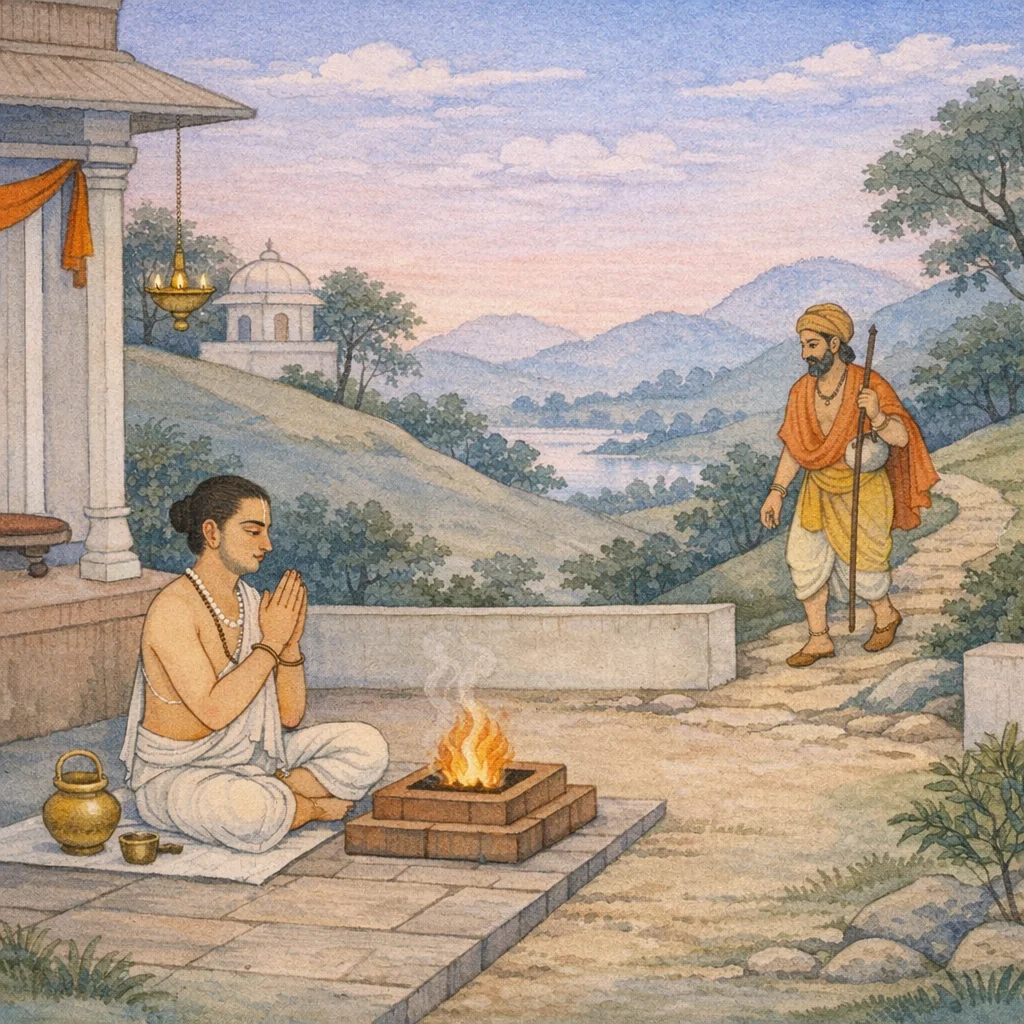
Yājñavalkya begins by declaring that he will teach the rules on saṅkara-jātis and the disciplines that start with the householder stage. He lists mixed lineages born from anuloma and pratiloma unions, noting that such births lie outside the ideal community, though recognition as “twice-born” may be attained after many generations through gradual elevation. He then sets forth gṛhastha duties: daily smārta worship in the marriage fire, bodily purity (śauca), dawn sandhyā, homa to the Sun, study of Veda and śāstra, offerings to pitṛs and devas, pañca-mahāyajña-style balis, and strict atithi-sevā—never turning away guests and honoring teachers, snātakas, and the king. The chapter also codifies varṇa duties, general virtues (ahiṃsā, satya, śauca, etc.), and standards for performing sacrifices without defect or impure patronage. It concludes with extensive prohibitions on conduct (etiquette, bodily behavior, avoidance of pollution), anadhyāya rules for suspending study, and a large dietary code with forbidden foods and expiations, ending with a karmic warning: unlawful animal-killing leads to hell, while renunciation and prayer lead toward Hari. Thus higher spiritual aims are grounded in household discipline and purity.
Shlokas
Verse 1
नाम पञ्चनवतितमो ऽध्यायः श्रागरुडमहापुराणम्- ९६ याज्ञवल्क्य उवाच / वक्ष्ये सङ्करजात्यादिगृहस्थादि विधिं परम् / विप्रान्मूर्धावषिक्तो हि क्षात्त्रियायां विशः स्त्रियाम्
Yājñavalkya said: “I shall proclaim the supreme ordinances concerning mixed births (saṅkara-jātis) and the disciplines of the āśramas, beginning with the householder’s way. Truly, from a brāhmaṇa father and a kṣatriya mother is born the ‘mūrdhāvaṣikta’; and from a brāhmaṇa father and a vaiśya mother is born another mixed class.”
Verse 2
जातो ऽम्बष्ठस्तु शूद्रायां निषादः पर्वतो ऽपि वा / माहिष्यः क्षत्त्रियाज्जातो वैश्यायां म्लेच्छसंज्ञितः
From a śūdra woman is born the Ambāṣṭha; and from that line arises the Niṣāda, also called Parvata. From a kṣatriya man and a vaiśya woman is born the Māhiṣya, who is designated a mleccha.
Verse 3
शूद्रायां करणो वैश्याद्विन्नास्वेष विधिः स्मृतः / ब्राह्मण्यां क्षत्त्रियात्सूतो वैश्याद्वैदेहकस्तथा
This is remembered as the prescribed rule for mixed unions: from a vaiśya man and a śūdra woman is born the Karaṇa. Likewise, from a kṣatriya man and a brāhmaṇa woman is born the Sūta; and from a vaiśya man and a brāhmaṇa woman is born the Vaidehaka.
Verse 4
शूद्राज्जातस्तु चाण्डालः सर्ववर्णविगर्हितः / क्षत्त्रिया मागधं वैश्याच्छूद्रा क्षत्तारमेव च
From a śūdra is born the Cāṇḍāla, censured by all the varṇas; from a kṣatriyā woman is born the Māgadha; and from a vaiśyā woman by a śūdra is born the Kṣattāra.
Verse 5
शूद्रादयोगवं वैश्या जनयामास वै सुतम् / माहिष्येण करण्यां तु रथकारः प्रजायते
From a Śūdra man and a Vaiśyā woman is born a son called Ayogava; and from a Māhiṣya man with a Karaṇī woman is born a Rathakāra, the maker of chariots.
Verse 6
असत्सन्तस्तु वै ज्ञेयाः प्रतिलोमानुलोमजाः / जात्युत्कर्षाद्द्विजो ज्ञेयः सप्तमे पञ्चमे ऽपि वा
Those born of mixed unions—whether pratiloma (contrary order) or anuloma (in due order)—are to be known as outside the true community of the virtuous. Yet, by gradual elevation of lineage, one may be recognized as a dvija (twice-born) in the seventh generation, or even in the fifth.
Verse 7
व्यत्यये कर्मणां साम्यं पूर्ववच्चोत्तरावरम् / कर्म स्मार्तं विवाहाग्नौ कुर्वीत प्रत्यहं गृही
When rites are substituted or adjusted, the equivalence of the acts should be preserved—following the earlier procedure while applying the later steps in proper order. The householder should perform the daily Smārta duties in the sacred fire established at marriage.
Verse 8
दायकालादृते वापि श्रौतं वैतानिकाग्निषु / शरीरचिन्तां निर्वर्त्य कृतशौचविधिर्द्विजः
Except at the appointed time (for giving or for the rite), the dvija should not undertake śrauta rites in the vaitānika fires. Having attended to the body’s necessary concerns and completed the prescribed purification (śauca), he should then proceed.
Verse 9
प्रातः सन्ध्यामुपासीत दन्तधावनपूर्वकम् / हुत्वाग्नौ सर्यदेवत्याञ्जपेन्मन्त्रान्समाहितः
At dawn, after first cleaning the teeth, one should perform the morning Sandhyā worship. Having offered oblations into the fire to the Sun-deity, one should then recite the mantras with a collected mind.
Verse 10
वेदार्थानधिगच्छेच्च शास्त्राणि विविधानि च / योगक्षोमादिसिद्ध्यर्थमुपेयादीश्वरं गृही
Let the householder strive to grasp the meaning of the Vedas and the many śāstras; and for well-being, protection, and other attainments, let him take refuge in the Lord.
Verse 11
स्नात्वा देवान्पितॄंश्चैव तर्पयेदर्चयेत्तथा / वेदानथ पुराणानि सेतिहासानि शक्तितः
After bathing, one should offer libations (tarpana) and worship the Devas and the Pitṛs (ancestors). Thereafter, according to one’s capacity, one should study the Vedas, the Purāṇas, and the Itihāsas (epics).
Verse 12
जपयज्ञानुसिद्ध्यर्थं विद्यां चाध्यात्मिकीं जपेत् / बलिकर्मस्वधाहोमस्वाध्यायातिथिसक्रियाः
For the successful fulfillment of japa and sacrificial rites, one should also recite and study spiritual knowledge (adhyātmika). One should duly perform bali-offerings, svadhā rites for the departed, homa (fire-offerings), svādhyāya (self-study), and proper service to guests (atithi).
Verse 13
भूतपित्रमरब्रह्ममनुष्याणां महामखाः / देवेभ्यस्तु हुतं चाग्नौ क्षिपेद्भूतबलिं हरेत्
The great sacrifices (mahā-yajñas) are ordained for beings, the Pitṛs, the Devas, Brahmā, and human beings. What is offered to the Devas should be cast into the fire, and the bhūta-bali should be taken out and presented.
Verse 14
अन्नं भूमौश्वचाण्डालवायसेभ्यश्च निः क्षिपेत् / अन्नं पितृमनुष्येभ्यो देयमप्यन्वहं जलम्
One should place food upon the ground for dogs, caṇḍālas (the outcast), and crows. One should also offer food to the Pitṛs and to human beings, and give water every day as well.
Verse 15
स्वाध्यायमन्वहं कुर्यान्न पचेच्चान्नमात्मने / बालस्ववासिनीवृद्धगर्भिण्यातुरकन्यकाः
One should perform svādhyāya (sacred self-study) each day, and one should not cook food only for oneself. Food should be shared with children, dependents of the household, the elderly, pregnant women, the sick, and unmarried girls.
Verse 16
संभोज्यातिथिभृत्यांश्च दम्पत्योः शेषभोजनम् / प्राणाग्निहोत्रविधिनाश्रीयादन्नमकुत्सयन्
After feeding guests and servants, husband and wife should partake of the remaining food. One should accept food according to the rite of prāṇāgnihotra (offering into the life-breaths), never despising or disparaging the food.
Verse 17
मितं विपाकं च हितं भक्ष्यं बालादिपूर्वकम् / आपोशानेनोपरिष्टादधस्ताच्चैव भुज्यते
One should eat in measured quantity—food properly cooked and wholesome—beginning with what is suitable for children and the like. One should partake only after performing āpośana (ritual sipping of water), keeping water present above and below as prescribed.
Verse 18
अनग्नममृतं चैव कार्यमन्नं द्विजन्मना / अतिथिभ्यस्तु वर्णेभ्यो देयं शक्त्यानुपूर्वशः
A dvija (twice-born) should prepare food that is not cooked on a fire and is pure, fit for sacred use. To guests of the various varṇas, it should be given in due order according to one’s capacity.
Verse 19
अप्रणोद्यो ऽतिथिः सायमपि नात्र विचारणा / सत्कृत्य भिक्षवे भिक्षा दातव्या सुव्रताय च
A guest must not be turned away—even in the evening; there is no deliberation in this. After honoring him, one should give alms-food to a bhikṣu (mendicant), and also to one steadfast in suvrata, righteous vows.
Verse 20
आगतान् भोजयेत्सर्वान्महोक्षं श्रोत्रियाय च / प्रतिसंवत्सरं त्वर्च्याः स्नातकाचार्यपार्थिवाः
One should feed all guests who arrive, and also present a great bull to a śrotriya, a Veda-knowing Brahmin. Moreover, each year one should honor with worship and due respect the snātaka, one’s teacher, and the king.
Verse 21
प्रियो विवाह्यश्च तथा यज्ञं प्रत्यृर्त्विजः पुनः / अध्वनीनो ऽतिथिः प्रोक्तः श्रोत्रियो वेदपारगः
A dear friend, a bridegroom fit for marriage, and the officiating priest (ṛtvij) invited for a yajña—also a traveler—are all declared to be atithi, “guests.” And a śrotriya is the learned one who has mastered the Vedas.
Verse 22
मान्यावेतौ गृहस्थस्य ब्रह्मलोकमभीप्सतः / परपाकरुचिर्न स्यादनिन्द्यामन्त्रणादृते
For a householder who longs to attain Brahmaloka, these two are to be honored. One should not take delight in food cooked by others—except when invited in a blameless, righteous manner.
Verse 23
वाक्पाणिपादचापल्यं वर्जयच्चातिभोजनम् / श्रोत्रियं वातिथिं तृप्तमासीमान्तादनुव्रजेत्
One should avoid fickleness of speech, hands, and feet, and also avoid overeating. Having satisfied a śrotriya and a guest, one should respectfully accompany them up to the boundary of one’s dwelling.
Verse 24
अहः शेषं सहासीत शिष्टैरिष्टैश्च बन्धुभिः / उपास्य पश्चिमां सन्ध्यां हुत्वाग्नौ भोजनं ततः
Let him spend the remainder of the day seated with respectable elders, dear friends, and relatives. Having performed the evening sandhyā and offered oblations into the sacred fire, he should then take his meal.
Verse 25
कुर्याद्भत्यैः समायुक्तैश्चिन्तयेदात्मनो हितम् / ब्राह्मे मुहूर्ते चोत्थाय मान्यो विप्रो धनादिभिः
In the company of capable attendants, one should reflect upon and pursue what is beneficial for oneself. Rising in the Brahma-muhūrta, the learned brāhmaṇa becomes worthy of honor and attains prosperity such as wealth.
Verse 26
वृद्धार्तानां समादेयः पन्था वै भारवाहिनाम् / इज्याध्ययनदानानि वैश्यस्य क्षत्त्रियस्य च
One should yield the way to the aged and the afflicted, and also to those who carry burdens. Worship through yajña, study, and charitable giving are prescribed for the Vaiśya and the Kṣatriya as well.
Verse 27
प्रतिग्रहो ऽधिको विप्रे याजनाध्यापने तथा / प्रधानं क्षत्त्रिये कर्म प्रजानां परिपालनम्
For a Brāhmaṇa, receiving gifts is regarded as a principal duty, as are officiating at sacrifices and teaching. For a Kṣatriya, the foremost duty is the protection and governance of the people.
Verse 28
कुसीदकृषिवाणिज्यं पाशुपाल्यं विशः स्मृतम् / शूद्रस्य द्विजशुश्रूषा द्विजो यज्ञान्न हापयेत्
Moneylending, agriculture, trade, and the tending of cattle are declared to be the duties of the Vaiśya. For the Śūdra, service to the twice-born (dvija) is prescribed; and a twice-born should not neglect the performance of yajña.
Verse 29
अहिंसा सत्यमस्तेयं शौचमिन्द्रियसंयमः / दमः क्षमार्जवं दानं सर्वेषां धर्मसाधनम्
Non-violence (ahiṃsā), truthfulness, non-stealing, purity, restraint of the senses, self-control, forgiveness, straightforwardness, and generosity—these are the means by which all beings accomplish dharma.
Verse 30
आचरेत्सदृशीं वृत्तिमजिह्मामशठान्तथा / त्रैवार्षिका धिकान्नो यः स सोमं पातुमर्हति
One should practice a fitting and proper conduct—straightforward, without crookedness or deceit. He who keeps provisions of food sufficient for at least three years is worthy to drink Soma.
Verse 31
स्यादन्नं वार्षिकं यस्य कुर्यात्प्रकसौमिकीं क्रियाम् / प्रतिसंवत्सरं सोमः पशुः प्रत्ययनं तथा
For one who has the means to make the annual offering of food, he should perform the Saumika rite as prescribed; and each year there should likewise be the Soma-offering, the animal-offering, and the pratyayana rite of confirmation and renewal.
Verse 32
कर्तव्याऽग्रहणेष्टिश्च चातुर्मास्यानि यत्नतः / एषामसम्भवे कुर्यादिष्टिं वैश्वानरीं द्विजः
A twice-born man should diligently perform the Āgrahaṇeṣṭi and the Cāturmāsya rites. If these cannot be performed, he should instead perform the Vaiśvānara iṣṭi, the fire-offering.
Verse 33
हीनकल्पं न कुर्वीत सति द्रव्ये फलप्रदम् / चण्डालो जायते यज्ञकरणाच्छूद्रभिक्षितात
When one has the means, one should not perform a rite in a deficient or inferior manner, for only a properly done sacrifice yields its fruit. If a yajña is performed using food obtained from a Śūdra’s alms, the performer is said to be born as a caṇḍāla (outcaste).
Verse 34
यज्ञार्थलब्धं नादद्याद्भासः काको ऽपि वा भवेत् / कुसूतकुम्भीधान्यो वा त्र्याहिकः श्वस्तनो ऽपि वा
One should not accept as a gift what has been obtained for the sake of a sacrifice; if one does, one becomes like a kite, or even a crow. Likewise, one should not accept gifts from a weaver, a potter, a grain-dealer, from one observing a three-day rite, or even from one who only intends to give “tomorrow”.
Verse 35
जीवेद्वापि शिलोञ्छेन श्रेयानेषां परः परः / न स्वाध्यायविरोध्यर्थमीहेत न यतस्ततः
Even if one must live by gleaning scattered grains (śiloñcha), that is the better way—each successive form of simple livelihood being superior to the former. One should not seek wealth or aims that obstruct svādhyāya, the Vedic study and recitation, nor chase gains from every possible source.
Verse 36
राजान्तेवासियाज्येभ्यः सीदन्निच्छेद्धनं क्षुधा / दम्भहैतुकपाषण्डिबकवृत्तींश्च वर्जयेत्
When afflicted by hunger, one should not seek wealth from the king, from the teacher’s household, or from those for whom one performs sacrifices (yajña). One should also shun hypocrites, self-serving heretics (pāṣaṇḍin), and those who live by the “crane-like” way—piety that is merely a show.
Verse 37
शुक्लाम्बरधरो नीचकेशश्मश्रुनखः शुचिः / न भार्यादर्शने ऽश्रीयान्नैकवासा न संस्थितः
He should wear clean white garments, remain pure, and keep his hair, beard, and nails properly trimmed. He should not appear before his wife in an inauspicious state; he should not wear only a single garment, nor remain in an improper posture or in an unsettled condition.
Verse 38
अप्रियं न वदेज्जातु ब्रह्मसूत्री विनीतवान् / देवप्रदक्षिणाङ्कुर्याद्यष्टिमान्सकमण्डलुः
A disciplined bearer of the sacred thread (brahmasūtra) should never speak what is unpleasant. Humble in conduct, carrying a staff and a kamaṇḍalu (water-pot), he should perform pradakṣiṇā—reverent circumambulation—in honor of the Devas.
Verse 39
न तु मेहेन्नदीच्छायाभस्मगोष्टाम्बुवर्त्मसु / न प्रत्यग्न्यर्कगोसोमसन्ध्याम्बुस्त्रीद्विजन्मनाम्
One should not urinate in a river, in the shade, on ashes, in a cowshed, in water, or on pathways; nor should a dvija (twice-born) do so facing fire, the sun, a cow, the moon, sandhyā (the twilight rites-time), water, a woman, or a brāhmaṇa.
Verse 40
नेक्षेताग्न्यर्कनग्नां स्त्रीं न च संसृष्टमैथुनाम् / न च मूत्रं पुरीषं वा स्वपेत्प्रत्यकूशिरा न च
One should not gaze upon a naked woman, nor stare at fire or the sun; nor should one look upon a woman engaged in sexual union. One should not look at urine or feces; and one should not sleep with the head placed toward the north.
Verse 41
ष्टीवनासृक्शकृन्मूत्रविषाण्यप्सु न संक्षिपेत् / पादौ प्रतापयेन्नाग्नौ न चैनमभिलङ्घयेत्
One should not cast saliva, blood, feces, urine, or poison into water. One should not warm one’s feet at the fire, nor should one step over it.
Verse 42
पिबेन्नाञ्जलिना तोयं न शयानं प्रबोधयेत् / नाक्षैः क्रीजेच्च कितवैर्व्याधितैश्च न संविशेत्
One should not drink water by scooping it with joined palms; one should not wake a person who is lying down. One should not play dice, and one should not lie down in the company of gamblers or the sick.
Verse 43
विरुद्धं वर्जयेत्कम प्रेतधूमं नदीतरम् / केशभस्मतुषाङ्गारकपालेषु च संस्थितिम्
One should avoid incompatible, improper conduct; likewise one should shun the smoke of the funeral pyre and the crossing of a river at improper times. One should also avoid staying amid hair, ashes, husks, embers, and skulls.
Verse 44
नाचक्षीत धयन्तीं गां नाद्वारेणाविशेत्क्रचित् / न राज्ञः प्रतिगृह्णायाल्लुब्धस्योच्छास्त्रवर्तिनः
One should not look at a cow while she is suckling her calf, and one should never enter a house through the doorway in an improper manner. Nor should one accept gifts from a greedy king who acts contrary to the teachings of the śāstra.
Verse 45
अध्यायानामुपाकर्म श्रावण्यां श्रवणेन वा / हस्तेनौषधिभावे वा पञ्चम्यां श्रावणस्य च
The rite commencing Vedic study (Upākarman) should be performed on the Śrāvaṇī day, or at the time of the Śravaṇa nakṣatra; alternatively, when Hasta prevails, or on the fifth lunar day (pañcamī) of the month of Śrāvaṇa.
Verse 46
पौषमासस्य रोहिण्यामष्टकायामथापि वा / जलान्ते छन्दसां कुर्यादुत्सर्गं विधिवद्वहिः
In the month of Pauṣa, on the day of the Rohiṇī nakṣatra—or else on the Aṣṭakā day—one should, outside the house at the water’s edge, duly perform Utsarga, the prescribed offering of consigning the Vedic hymns.
Verse 47
अनध्यायस्त्र्यहं प्रेते शिष्यर्त्विग्गुरुबन्धुषु / उपाकर्मणि चोत्सर्गे स्वशाखश्रोत्रिये मृते
When a death occurs, Vedic study should be suspended for three days—if the departed is one’s student, ṛtvij (officiating priest), guru, or relative. Likewise, (study is suspended) at the time of Upākarman and Utsarga, and also when a learned śrotriya of one’s own Vedic branch passes away.
Verse 48
सन्ध्यागर्जितनिर्घातभूकम्पोल्कानिपातने / समाप्य वेदं द्युनिशमारण्यकमधीत्य च
At twilight (sandhyā), amid thunderous roaring, violent claps, earthquakes, and the fall of meteors—having completed the Veda, one should also study the Āraṇyaka by day and by night.
Verse 49
पञ्चदश्यां चतुर्दश्यामष्टम्यां राहुसूतके / ऋतुसन्धिषु भुक्त्वा वा श्राद्धिकं प्रतिगृह्य च
On the fifteenth (full-moon) day, the fourteenth day, the eighth day, during Rāhu’s sūtaka (the impurity period of an eclipse), and at the junctions of the seasons—having eaten, or having accepted offerings meant for śrāddha—one incurs ritual fault/impurity according to the stated rule.
Verse 50
पशुमण्डूकनकुलश्वाहिमार्जारसूकरैः / कृते ऽन्तरे त्वहोरात्रं शक्रपाते तथोच्छ्रये
When the sinner is set upon by beasts—frogs, mongooses, dogs, serpents, cats, and boars—each interval of torment endures a full day and night; so too beneath Indra’s downpour of rain, and in the ordeal of being lifted aloft and cast down.
Verse 51
श्वक्रोष्टुगर्दभोलूकसामबाणार्तनिः स्वने / अमेध्यशवशूद्रान्त्यश्मशानपतितान्तिके
Amid the howling of dogs, jackals, donkeys, and owls, and the wailing of those struck by arrows; near impure corpses, among Śūdras and outcastes, and close to the cremation ground (śmaśāna) and the fallen in sin—one should not perform sacred rites there.
Verse 52
देशे ऽशुचावात्मनि च विद्युत्स्तनितसंप्लवे / भुक्त्वार्द्रपाणिरम्भो ऽन्तरर्धरात्रे ऽतिमारुते
In an impure place, and when one’s own body is impure; amid storms of lightning and thunder; after eating while the hands are still wet; in water; at midnight; and in violent winds—these are improper times and conditions for prescribed observances.
Verse 53
दिग्दाहे पांसुवर्षेषु सन्ध्यानी हारभीतिषु / धावतः पूतिगन्धे च शिष्टे च गृहमागते
When the quarters seem to blaze, when dust rains down, when fear arises at sandhyā—the junction of day and night—when one runs about and foul odors arise, and when a stranger or an ominous visitor comes to the house—
Verse 54
खरोष्ट्रयानहस्त्यश्वनौवृक्षगिरिरोहणे / सप्तत्रिंशदनध्यायानेतांस्तात्कालिकान्विदुः
Riding a donkey or camel, mounting an elephant or horse, traveling by boat, climbing trees, and ascending mountains—these are known as thirty-seven temporary occasions of anadhyāya, when Vedic study is to be suspended at that time.
Verse 55
वेददिष्टं तथाचार्यं राजच्छायां परस्त्रियम् / नाक्रामेद्रक्तविण्मूत्रष्ठीवनोद्वर्तनानि च
One should not tread upon what the Veda enjoins, nor upon the teacher; nor upon the king’s shadow, nor another man’s wife; and one should not step upon blood, feces, urine, spittle, or the scrapings left from rubbing and cleansing the body.
Verse 56
विप्राहिक्षत्त्रियात्मानो नावज्ञेयाः कदाचन / दूरादुच्छिष्टविण्मूत्रपादाम्भांसि समुत्सृजेत्
One should never, at any time, show contempt toward a brāhmaṇa, a cow, or a kṣatriya. One should discard far away the remnants of food, feces, urine, and the water used for washing the feet.
Verse 57
श्रुतिस्मृत्युक्तमाचारं कुर्यान्मर्मणि न स्पृशेत् / न निन्दाताडने कुर्यात्सुतं शिष्यं च ताडयेत्
One should practice the conduct taught in the Vedas and Smṛtis. One should not strike a vulnerable spot; one should not punish out of blame or abusive scolding—yet one may discipline one’s son and one’s student.
Verse 58
आचरेत्सर्वदा धर्मं तद्विरुद्धं तु नाचरेत् / मातापित्रतिथीभ्याढ्यैर्विवादं नाचरेद्गृही
A householder should always practice dharma and should not act contrary to it. He should not engage in disputes with his mother, father, guests, or with wealthy and influential people.
Verse 59
पञ्च पिण्डाननुद्धृत्य न स्नायात्परवारिषु / स्नायान्नदीप्रस्त्रवणदेवखातह्रदेषु च
Without first lifting and collecting the five piṇḍa offerings, one should not bathe in another person’s water (water set aside for others). One may, however, bathe in rivers, in natural streams and springs, and in ponds or lakes excavated and maintained for the gods.
Verse 60
वर्जयेत्परशय्यादि न चाश्रीयादनापदि / कदर्यबद्धचो (वै) राणां तथा चानम्निकस्य च
One should shun another’s bed and the like; and, when there is no emergency, one should not seek shelter in or depend upon others. Likewise, one should avoid the company and support of the miser, of one deceitfully bound by gifts like bribes, and of a person without integrity, unworthy of trust.
Verse 61
वैणाभिशस्तवार्धुष्यगणिकागणदीक्षिणाम् / चिकित्सकातुरक्रुद्धक्लीबरङ्गोपजीविनाम्
—and likewise those who live as musicians and minstrels; those publicly accused; usurers; courtesans; those who take fees for giving diksha (initiation) to groups; physicians; the sick; the wrathful; the impotent; and those who earn their living through stage-entertainment.
Verse 62
क्रूरोग्रपतितव्रात्यदाम्भिकोच्छिष्टभोजिनाम् / शास्त्रविक्रयिणश्चैव स्त्रीजितग्रामयाजिनाम्
Avoid those who are cruel and violently harsh; the fallen and the Vrātyas (who have strayed from Vedic discipline); the hypocritical; those who eat others’ leftovers; and those who sell sacred learning. Also avoid those ruled by women, and village priests who perform rites for an entire settlement merely for livelihood rather than for dharma.
Verse 63
नृशंसराजरजककृतघ्नवधजीविनाम् / पिशुनानृतिनोश्चैव सोमविक्रयिणस्तथा
Likewise, avoid the cruel; kings and washermen when they act sinfully; the ungrateful and those who live by killing; slanderers and liars; and also those who sell Soma.
Verse 64
बन्दिनां स्वर्णकाराणामन्नमेषां कदाचन / न भोक्तव्यं वृथा मांसं केशकीटसमन्वितम्
One should never eat the food of bards and panegyrists, nor that of goldsmiths. Likewise, one should not eat meat obtained without proper cause or without a fitting rite—meat defiled, as though mixed with hair and insects.
Verse 65
भक्तं पर्युषितोच्छिष्टं श्वस्पृष्टं पतितो (ते) क्षितम् / उदक्यास्पृष्टसंघुष्टमपर्याप्तं च वर्जयेत्
One should renounce food that is stale or left over, that has been touched by a dog, that has fallen upon the ground (or been touched by an impure/fallen person), that has been contaminated by a menstruating woman, that has been defiled by contact or disturbance, and that is insufficient or improperly measured.
Verse 66
घोघ्रातं शकुनोच्छिष्टं पादस्पृष्ट च कामतः / शूद्रेषु दासगोपालकुलमित्रार्धसीरिणः
Food that has been smelled and thus defiled, food left over by birds, and food deliberately touched by the foot—those who eat such things are reckoned among the lowest, like servants, cowherds, clan-dependents, friends who live on others, and half-labourers.
Verse 67
भोज्यान्नो नापितश्चैव यश्चात्मानं निवेदयेत् / अन्नं पर्युषितं भोज्यं स्नेहाक्तं चिरसंभृ (स्थि) तम्
Food offered by a barber, or by one who ‘offers himself’ in servile surrender for livelihood, and food that is stale, kept overnight, smeared with grease, or stored for a long time—such food is deemed unfit to be eaten.
Verse 68
अस्नेहा अपि घोधूमयवगोरसविक्रियाः / औष्ट्रमैकशफं स्त्रीणां पयश्च परिवर्जयेत्
Even if prepared without ghee or oil, foods made from wheat, barley, and milk-products should be avoided; likewise, camel’s milk, the milk of single-hoofed animals, and a woman’s milk should be wholly shunned.
Verse 69
क्रव्यादपक्षिदात्यूहशुकमांसानि वर्जयेत् / सारसैकशफान्हंसान्बलाकबकटिट्टिभान्
One should avoid the meat of carrion-eating birds, as well as the meat of the dātyūha and the parrot; likewise one should avoid the sārasa (crane), single-hoofed animals, the haṃsa (swan/goose), the balākā (heron), the baka (crane), and the ṭiṭṭibha (lapwing).
Verse 70
वृथा कृसरसंयाव पायसापूपशष्कुलीः / कुररं जालपादं च खञ्जरीटमृगद्विजान्
In vain are offerings such as kṛsara, saṃyāva, pāyasa, apūpa, and śaṣkulī; likewise, in vain are offerings of birds and beasts such as the kurara, the jālapāda, the khañjarīṭa, and deer and other twice-born birds.
Verse 71
चाषान्मत्स्यात्रक्तपादञ्चग्द्ध्वा वै कामतो नरः / बल्लूरं कामतो जग्द्ध्वा सोप वासस्त्र्यहं भवेत्
If a man, out of desire, eats crow, fish, or the red-footed bird, and likewise, out of desire, eats ballūra (a kind of dried meat), he should observe a three-day expiation, taking only broth/vegetable-soup and fasting.
Verse 72
पलाण्डुलशुनादीनि जग्द्ध्वा चान्द्रायणं चरेत् / श्राद्धे देवान्पितॄन्प्रार्च्य खादन्मांसं न दोषभाक्
Having eaten onions, garlic, and the like, one should undertake the Cāndrāyaṇa expiation. But if, during a śrāddha, after duly worshipping the Devas and the Pitṛs, one eats meat, one does not incur fault.
Verse 73
वसेत्स नरके घोर दिनानि पशुरोमतः / संमितानि दुराचारो यो हन्त्यविधिना पशून् / मांसं सन्त्यज्य संप्रार्थ्य कामान्याति ततो हरिम्
That wicked person who kills animals in an unlawful manner dwells in a dreadful hell for a number of days measured by the hairs on the animal’s body. Thereafter, renouncing meat and earnestly praying, he attains his desired aims and then reaches Hari (Lord Viṣṇu).
Frequently Asked Questions
Daily śauca and sandhyā, homa in the household fire, study (svādhyāya) of Veda/śāstra, offerings to Devas and Pitṛs (including bali for beings), and atithi-sevā (feeding and honoring guests), along with measured eating and disciplined conduct.
Atithi-sevā is treated as a core dharmic obligation of the householder: feeding the unexpected guest sustains the human/social yajña and purifies household wealth and food, converting daily consumption into sacrificial merit.
It warns against unlawful killing and desire-driven meat consumption, prescribing expiations for certain violations, while stating that eating meat in the context of a properly conducted śrāddha—after worshipping Devas and Pitṛs—does not incur fault in that ritual frame.
It states that the killer dwells in a dreadful hell for a duration measured by the hairs on the animal’s body; afterward, by renouncing meat and praying earnestly, one may regain desired aims and ultimately reach Hari.