Adhyaya 18
Mahārāja Parīkṣit Cursed by a Brāhmaṇa Boy (Śṛṅgi) and the Moral Crisis of Kali-yuga
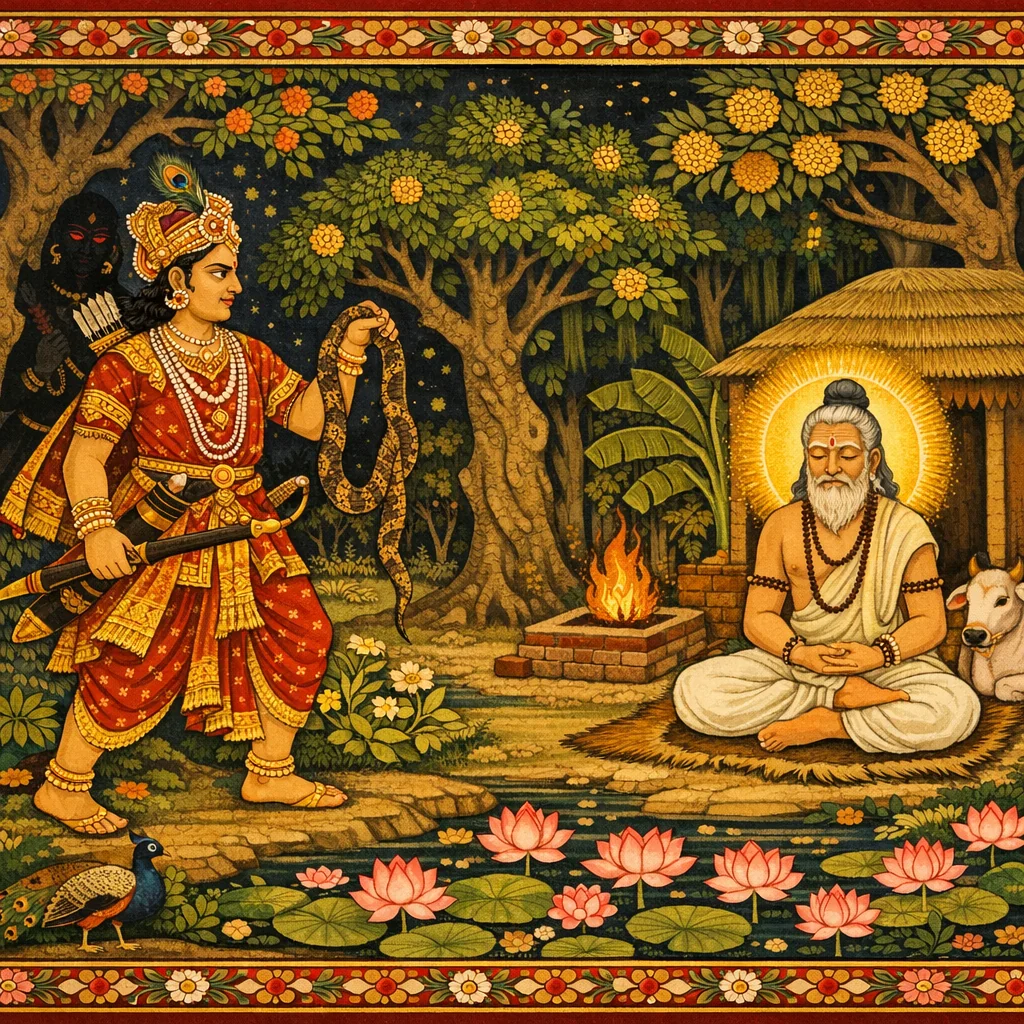
Sūta Gosvāmī concludes the previous thread on Mahārāja Parīkṣit’s greatness—protected by Kṛṣṇa in the womb and fearless even before the foretold serpent-bird Takṣaka—while the sages of Naimiṣāraṇya press to hear the bhakti-filled narrations spoken by Śukadeva. Sūta affirms the purifying power of saintly association and the Lord’s limitless nature (Ananta), then begins the chain of causes leading to the seven-day Bhāgavatam recital. While hunting, Parīkṣit grows exhausted, hungry, and thirsty, enters Ṛṣi Śamīka’s āśrama, and—mistaking the sage’s silent samādhi for neglect—offends him by placing a dead snake on his shoulder. Back at the palace, he doubts the sage’s sincerity. Śamīka’s powerful son Śṛṅgi, driven by pride and anger, condemns kings and curses Parīkṣit: within seven days Takṣaka will bite him. When Śamīka awakens, he laments the disproportionate punishment, praises dharmic kingship as society’s protection, foresees Kali-yuga’s chaos without righteous rule, prays to the Lord to forgive his son, and exemplifies a devotee’s forbearance. The chapter sets up Parīkṣit’s response to the curse and his full turning toward hearing Śrīmad Bhāgavatam.
Shlokas
Verse 1
सूत उवाच यो वै द्रौण्यस्त्रविप्लुष्टो न मातुरुदरे मृत: । अनुग्रहाद् भगवत: कृष्णस्याद्भुतकर्मण: ॥ १ ॥
Sūta Gosvāmī said: By the mercy of Bhagavān Śrī Kṛṣṇa, whose deeds are wondrous, Mahārāja Parīkṣit—though struck in his mother’s womb by the weapon of Droṇa’s son—was not burned to death.
Verse 2
ब्रह्मकोपोत्थिताद् यस्तु तक्षकात्प्राणविप्लवात् । न सम्मुमोहोरुभयाद् भगवत्यर्पिताशय: ॥ २ ॥
Moreover, because Mahārāja Parīkṣit had always offered his heart to Bhagavān, he was neither afraid nor shaken, even by the deadly threat of Takṣaka, brought about by the wrath of a young brāhmaṇa.
Verse 3
उत्सृज्य सर्वत: सङ्गं विज्ञाताजितसंस्थिति: । वैयासकेर्जहौ शिष्यो गङ्गायां स्वं कलेवरम् ॥ ३ ॥
Leaving all association, the King—having understood the true position of the unconquerable Bhagavān—surrendered as a disciple to Vyāsa’s son, Śukadeva Gosvāmī, and at last gave up his material body on the bank of the Gaṅgā.
Verse 4
नोत्तमश्लोकवार्तानां जुषतां तत्कथामृतम् । स्यात्सम्भ्रमोऽन्तकालेऽपि स्मरतां तत्पदाम्बुजम् ॥ ४ ॥
For those who relish the messages of Uttamaśloka and drink the nectar of His narrations, ever remembering the Lord’s lotus feet, do not fall into confusion even at the final hour.
Verse 5
तावत्कलिर्न प्रभवेत् प्रविष्टोऽपीह सर्वत: । यावदीशो महानुर्व्यामाभिमन्यव एकराट् ॥ ५ ॥
So long as the great and powerful son of Abhimanyu remains the sole emperor of the earth, Kali—though having entered everywhere—cannot flourish here.
Verse 6
यस्मिन्नहनि यर्ह्येव भगवानुत्ससर्ज गाम् । तदैवेहानुवृत्तोऽसावधर्मप्रभव: कलि: ॥ ६ ॥
On the very day and at the very moment when Bhagavān, Lord Śrī Kṛṣṇa, left this earth, Kali—who gives rise to adharma—at once entered this world.
Verse 7
नानुद्वेष्टि कलिं सम्राट् सारङ्ग इव सारभुक् । कुशलान्याशु सिद्ध्यन्ति नेतराणि कृतानि यत् ॥ ७ ॥
Mahārāja Parīkṣit did not hate Kali; like a bee that takes only the essence, he was a realist. He knew that in Kali-yuga auspicious deeds bear fruit swiftly, whereas inauspicious results arise only when such acts are truly performed; therefore he was never envious of Kali.
Verse 8
किं नु बालेषु शूरेण कलिना धीरभीरुणा । अप्रमत्त: प्रमत्तेषु यो वृको नृषु वर्तते ॥ ८ ॥
Mahārāja Parīkṣit reflected: to the less intelligent, Kali may seem very powerful, but for the self-controlled and vigilant there is nothing to fear. The King, mighty like a tiger, protected the foolish and careless.
Verse 9
उपवर्णितमेतद्व: पुण्यं पारीक्षितं मया । वासुदेवकथोपेतमाख्यानं यदपृच्छत ॥ ९ ॥
O sages, as you inquired, I have described for you the pious history of Mahārāja Parīkṣit, joined with narrations of Vāsudeva, Śrī Kṛṣṇa.
Verse 10
या या: कथा भगवत: कथनीयोरुकर्मण: । गुणकर्माश्रया: पुम्भि: संसेव्यास्ता बुभूषुभि: ॥ १० ॥
Those who long for complete perfection should humbly hear and cherish all narrations connected with the wondrous deeds and divine qualities of Bhagavān.
Verse 11
ऋषय ऊचु: सूत जीव समा: सौम्य शाश्वतीर्विशदं यश: । यस्त्वं शंससि कृष्णस्य मर्त्यानाममृतं हि न: ॥ ११ ॥
The sages said: O grave Sūta Gosvāmī, may you live many years and may your fame endure, for you speak purely of Śrī Kṛṣṇa’s līlā; to us mortals it is verily nectar.
Verse 12
कर्मण्यस्मिन्ननाश्वासे धूमधूम्रात्मनां भवान् । आपाययति गोविन्दपादपद्मासवं मधु ॥ १२ ॥
In this ritual work, whose result is uncertain, our bodies have been darkened by smoke; yet you make us drink the honey-like nectar of Govinda’s lotus feet, which you are distributing. By that alone we are truly satisfied.
Verse 13
तुलयाम लवेनापि न स्वर्गं नापुनर्भवम् । भगवत्सङ्गिसङ्गस्य मर्त्यानां किमुताशिष: ॥ १३ ॥
Even a single moment in the company of the Lord’s devotee cannot be weighed against heaven or liberation; what then to speak of worldly boons like material prosperity meant for the mortal.
Verse 14
को नाम तृप्येद् रसवित्कथायां महत्तमैकान्तपरायणस्य । नान्तं गुणानामगुणस्य जग्मु- र्योगेश्वरा ये भवपाद्ममुख्या: ॥ १४ ॥
Govinda, the sole refuge of the greatest souls—who, tasting the nectar of rasa, could ever be satiated by hearing His divine narrations? Even Śiva and Brahmā, masters of mystic power, have not reached the end of His transcendental qualities.
Verse 15
तन्नो भवान् वै भगवत्प्रधानो महत्तमैकान्तपरायणस्य । हरेरुदारं चरितं विशुद्धं शुश्रूषतां नो वितनोतु विद्वन् ॥ १५ ॥
O Sūta Gosvāmī, you are learned and pure, for service to Bhagavān is your foremost aim; therefore, for us who long to hear, unfold the Lord Hari’s noble and spotless pastimes, beyond all material conception.
Verse 16
स वै महाभागवत: परीक्षिद् येनापवर्गाख्यमदभ्रबुद्धि: । ज्ञानेन वैयासकिशब्दितेन भेजे खगेन्द्रध्वजपादमूलम् ॥ १६ ॥
Please speak those topics of the Lord by which Mahārāja Parīkṣit—the great bhāgavata, his intelligence fixed on liberation—attained the lotus feet of the Lord who bears Garuḍa on His banner, through the wisdom voiced by Vyāsa’s son, Śrī Śukadeva.
Verse 17
तन्न: परं पुण्यमसंवृतार्थ- माख्यानमत्यद्भुतयोगनिष्ठम् । आख्याह्यनन्ताचरितोपपन्नं पारीक्षितं भागवताभिरामम् ॥ १७ ॥
Therefore narrate to us the supreme, purifying account of the Unlimited Lord—firmly grounded in wondrous bhakti-yoga and filled with His endless deeds—spoken to Mahārāja Parīkṣit and dearly loved by the pure bhāgavatas.
Verse 18
सूत उवाच अहो वयं जन्मभृतोऽद्य हास्म वृद्धानुवृत्त्यापि विलोमजाता: । दौष्कुल्यमाधिं विधुनोति शीघ्रं महत्तमानामभिधानयोग: ॥ १८ ॥
Śrī Sūta Gosvāmī said: Alas, though we are born of mixed lineage, by serving and following the venerable great souls advanced in knowledge we are uplifted. Even discourse with such exalted ones about the holy name swiftly washes away the disqualifications of lower birth.
Verse 19
कुत: पुनर्गृणतो नाम तस्य महत्तमैकान्तपरायणस्य । योऽनन्तशक्तिर्भगवाननन्तो महद्गुणत्वाद् यमनन्तमाहु: ॥ १९ ॥
What, then, can be said of those who, under the guidance of the great devotees, chant the holy name of Bhagavān Ananta, whose potencies are without limit? By the majesty of His transcendental qualities, He is known as Ananta—the Unlimited.
Verse 20
एतावतालं ननु सूचितेन गुणैरसाम्यानतिशायनस्य । हित्वेतरान् प्रार्थयतो विभूति- र्यस्याङ्घ्रिरेणुं जुषतेऽनभीप्सो: ॥ २० ॥
This much is enough to indicate that He is unequaled and surpasses all; therefore no one can speak of Him adequately. The great demigods pray for the favor of Lakṣmī yet do not attain it, whereas that very Lakṣmī serves the dust of His lotus feet, though He has no desire for such service.
Verse 21
अथापि यत्पादनखावसृष्टं जगद्विरिञ्चोपहृतार्हणाम्भ: । सेशं पुनात्यन्यतमो मुकुन्दात् को नाम लोके भगवत्पदार्थ: ॥ २१ ॥
Who is worthy of the name “Supreme Lord” but Mukunda, Śrī Kṛṣṇa? Brahmā gathered the water that issued from the nails of His feet to offer it to Śiva as a worshipful welcome; that very water (the Gaṅgā) purifies the entire universe, Śiva included.
Verse 22
यत्रानुरक्ता: सहसैव धीरा व्यपोह्य देहादिषु सङ्गमूढम् । व्रजन्ति तत्पारमहंस्यमन्त्यं यस्मिन्नहिंसोपशम: स्वधर्म: ॥ २२ ॥
Self-controlled and steady souls, attached to the Supreme Lord Śrī Kṛṣṇa, can suddenly cast off the delusion born of attachment to body and mind and depart to attain the highest perfection of the paramahaṁsa path, wherein nonviolence and renunciation become their natural dharma.
Verse 23
अहं हि पृष्टोऽर्यमणो भवद्भि- राचक्ष आत्मावगमोऽत्र यावान् । नभ: पतन्त्यात्मसमं पतत्त्रिण- स्तथा समं विष्णुगतिं विपश्चित: ॥ २३ ॥
O ṛṣis, pure and radiant like the sun, since you have inquired I shall describe, as far as my understanding reaches, the transcendental pastimes of Śrī Viṣṇu. As birds fly through the sky only to the limit of their strength, so learned devotees speak of the Lord’s path and abode only to the limit of their realization.
Verse 24
एकदा धनुरुद्यम्य विचरन् मृगयां वने । मृगाननुगत: श्रान्त: क्षुधितस्तृषितो भृशम् ॥ २४ ॥ जलाशयमचक्षाण: प्रविवेश तमाश्रमम् । ददर्श मुनिमासीनं शान्तं मीलितलोचनम् ॥ २५ ॥
Once, Mahārāja Parīkṣit, bow in hand, roamed the forest on a hunt, pursuing the stags. He became greatly fatigued and was tormented by intense hunger and thirst. Searching for water, he entered the hermitage of the renowned Śamīka Ṛṣi and saw the sage seated in silence, peaceful, with eyes closed.
Verse 25
एकदा धनुरुद्यम्य विचरन् मृगयां वने । मृगाननुगत: श्रान्त: क्षुधितस्तृषितो भृशम् ॥ २४ ॥ जलाशयमचक्षाण: प्रविवेश तमाश्रमम् । ददर्श मुनिमासीनं शान्तं मीलितलोचनम् ॥ २५ ॥
Once, Mahārāja Parīkṣit, carrying bow and arrows, hunted in the forest and pursued the stags. He became extremely weary and suffered greatly from hunger and thirst. Finding no water, he entered the hermitage of the renowned Śamīka Ṛṣi and saw the sage seated silently, peaceful, with eyes closed.
Verse 26
प्रतिरुद्धेन्द्रियप्राणमनोबुद्धिमुपारतम् । स्थानत्रयात्परं प्राप्तं ब्रह्मभूतमविक्रियम् ॥ २६ ॥
The muni’s senses, breath, mind, and intelligence were all restrained from material activity. He was absorbed in samādhi beyond the three states—waking, dreaming, and deep sleep—having attained the brahma-bhūta condition, unchanging and serene.
Verse 27
विप्रकीर्णजटाच्छन्नं रौरवेणाजिनेन च । विशुष्यत्तालुरुदकं तथाभूतमयाचत ॥ २७ ॥
The sage was covered with a raurava deer-skin, and his long matted locks lay scattered over him. The king’s palate was parched with thirst, and so he asked that muni—thus absorbed—for water.
Verse 28
अलब्धतृणभूम्यादिरसम्प्राप्तार्घ्यसूनृत: । अवज्ञातमिवात्मानं मन्यमानश्चुकोप ह ॥ २८ ॥
Not being welcomed with a seat, a place, water, arghya, and gentle words, the King thought himself neglected and, thus thinking, became angry.
Verse 29
अभूतपूर्व: सहसा क्षुत्तृड्भ्यामर्दितात्मन: । ब्राह्मणं प्रत्यभूद् ब्रह्मन् मत्सरो मन्युरेव च ॥ २९ ॥
Stricken by intense hunger and thirst, the King turned toward the brāhmaṇa-sage an envy and anger he had never before directed toward a brāhmaṇa.
Verse 30
स तु ब्रह्मऋषेरंसे गतासुमुरगं रुषा । विनिर्गच्छन्धनुष्कोट्या निधाय पुरमागत: ॥ ३० ॥
As he departed, the King, enraged by the insult, lifted a lifeless snake with the tip of his bow, placed it on the sage’s shoulder, and then returned to his palace.
Verse 31
एष किं निभृताशेषकरणो मीलितेक्षण: । मृषासमाधिराहोस्वित्किं नु स्यात्क्षत्रबन्धुभि: ॥ ३१ ॥
After returning, he argued within himself: was the sage truly in meditation, senses withdrawn and eyes closed, or was he merely feigning trance to avoid receiving a lesser kṣatriya?
Verse 32
तस्य पुत्रोऽतितेजस्वी विहरन् बालकोऽर्भकै: । राज्ञाघं प्रापितं तातं श्रुत्वा तत्रेदमब्रवीत् ॥ ३२ ॥
The sage had a very powerful son. While playing with other boys, he heard of his father’s distress caused by the King, and right there he spoke as follows.
Verse 33
अहो अधर्म: पालानां पीव्नां बलिभुजामिव । स्वामिन्यघं यद् दासानां द्वारपानां शुनामिव ॥ ३३ ॥
Alas, behold the unrighteousness of these rulers: like well-fed crows and door-guard dogs, though servants they commit sin against their own master.
Verse 34
ब्राह्मणै: क्षत्रबन्धुर्हि गृहपालो निरूपित: । स कथं तद्गृहे द्वा:स्थ: सभाण्डं भोक्तुमर्हति ॥ ३४ ॥
The brāhmaṇas have indeed appointed the kṣatriya-born as watchdogs of the house, meant to remain at the door. On what grounds may a dog enter the home and claim to dine with the master from the same plate?
Verse 35
कृष्णे गते भगवति शास्तर्युत्पथगामिनाम् । तद्भिन्नसेतूनद्याहं शास्मि पश्यत मे बलम् ॥ ३५ ॥
After Lord Śrī Kṛṣṇa—the Bhagavān, the supreme ruler—departed, these wayward upstarts have flourished. Therefore today I myself shall punish the breakers of sacred bounds—witness my power!
Verse 36
इत्युक्त्वा रोषताम्राक्षो वयस्यानृषिबालक: । कौशिक्याप उपस्पृश्य वाग्वज्रं विससर्ज ह ॥ ३६ ॥
Having spoken thus, the ṛṣi’s son—his eyes red-hot with wrath—before his companions touched the waters of the Kauśikī River and unleashed a thunderbolt of words.
Verse 37
इति लङ्घितमर्यादं तक्षक: सप्तमेऽहनि । दङ्क्ष्यति स्म कुलाङ्गारं चोदितो मे ततद्रुहम् ॥ ३७ ॥
Thus, for having transgressed the bounds of proper conduct, that disgrace of the dynasty shall be bitten by Takṣaka on the seventh day from today—impelled by my command.
Verse 38
ततोऽभ्येत्याश्रमं बालो गले सर्पकलेवरम् । पितरं वीक्ष्य दु:खार्तो मुक्तकण्ठो रुरोद ह ॥ ३८ ॥
Thereafter the boy returned to the hermitage; seeing the dead snake upon his father’s shoulder, he was stricken with grief and cried out loudly.
Verse 39
स वा आङ्गिरसो ब्रह्मन् श्रुत्वा सुतविलापनम् । उन्मील्य शनकैर्नेत्रे दृष्ट्वा चांसे मृतोरगम् ॥ ३९ ॥
O brāhmaṇas, the ṛṣi born in the line of Aṅgirā, hearing his son’s lament, slowly opened his eyes and saw the dead snake around his neck.
Verse 40
विसृज्य तं च पप्रच्छ वत्स कस्माद्धि रोदिषि । केन वा तेऽपकृतमित्युक्त: स न्यवेदयत् ॥ ४० ॥
Casting the dead snake aside, he asked, “My son, why do you weep? Has anyone wronged you?” Thus questioned, the boy explained all that had occurred.
Verse 41
निशम्य शप्तमतदर्हं नरेन्द्रं स ब्राह्मणो नात्मजमभ्यनन्दत् । अहो बतांहो महदद्य ते कृत- मल्पीयसि द्रोह उरुर्दमो धृत: ॥ ४१ ॥
Hearing from his son that the king—most excellent among men—had been cursed though undeserving, the brāhmaṇa ṛṣi did not praise his child; rather he repented: “Alas! Today my son has committed a grave sin, imposing a heavy punishment for a trifling offense.”
Verse 42
न वै नृभिर्नरदेवं पराख्यं सम्मातुमर्हस्यविपक्वबुद्धे । यत्तेजसा दुर्विषहेण गुप्ता विन्दन्ति भद्राण्यकुतोभया: प्रजा: ॥ ४२ ॥
My child, your understanding is still unripe; thus you do not know that the king, best among men, is like a naradeva. He should never be equated with ordinary persons, for by his irresistible prowess the citizens are protected and attain prosperity without fear.
Verse 43
अलक्ष्यमाणे नरदेवनाम्नि रथाङ्गपाणावयमङ्ग लोक: । तदा हि चौरप्रचुरो विनङ्क्ष्य- त्यरक्ष्यमाणोऽविवरूथवत् क्षणात् ॥ ४३ ॥
My dear boy, the Lord who bears the chariot wheel is represented through the monarchical rule; when that rule is abolished, the world becomes crowded with thieves, who at once overpower the unprotected subjects like scattered lambs.
Verse 44
तदद्य न: पापमुपैत्यनन्वयं यन्नष्टनाथस्य वसोर्विलुम्पकात् । परस्परं घ्नन्ति शपन्ति वृञ्जते पशून् स्त्रियोऽर्थान् पुरुदस्यवो जना: ॥ ४४ ॥
Today unbroken sin will come upon us, for when the people lose their protector, rogues plunder their wealth. Then men will kill and curse one another, and many bandits will steal animals, women, and property; for these sins we shall be held responsible.
Verse 45
तदार्यधर्म: प्रविलीयते नृणां वर्णाश्रमाचारयुतस्त्रयीमय: । ततोऽर्थकामाभिनिवेशितात्मनां शुनां कपीनामिव वर्णसङ्कर: ॥ ४५ ॥
At that time, noble dharma—rooted in varṇāśrama conduct and the Vedic injunctions—will gradually dissolve among men. Then, minds absorbed in wealth and sense pleasure will produce varṇa-saṅkara, an unwanted population on the level of dogs and monkeys.
Verse 46
धर्मपालो नरपति: स तु सम्राड् बृहच्छ्रवा: । साक्षान्महाभागवतो राजर्षिर्हयमेधयाट् । क्षुत्तृट्श्रमयुतो दीनो नैवास्मच्छापमर्हति ॥ ४६ ॥
Emperor Parīkṣit is a king who protects dharma, renowned far and wide. He is truly a mahā-bhāgavata, a saint among rulers, and the performer of many aśvamedha sacrifices. Such a king, worn by hunger, thirst, and fatigue, does not deserve our curse at all.
Verse 47
अपापेषु स्वभृत्येषु बालेनापक्वबुद्धिना । पापं कृतं तद्भगवान् सर्वात्मा क्षन्तुमर्हति ॥ ४७ ॥
Then the ṛṣi prayed to Bhagavān, the all-pervading Soul of all, to forgive his immature boy, for he had committed a grave sin by cursing one who was wholly sinless, under our care, and worthy of protection.
Verse 48
तिरस्कृता विप्रलब्धा: शप्ता: क्षिप्ता हता अपि । नास्य तत् प्रतिकुर्वन्ति तद्भक्ता: प्रभवोऽपि हि ॥ ४८ ॥
The Lord’s devotees are supremely forbearing: though defamed, deceived, cursed, disturbed, neglected, or even slain, they never turn to vengeance, even when they have the power to do so.
Verse 49
इति पुत्रकृताघेन सोऽनुतप्तो महामुनि: । स्वयं विप्रकृतो राज्ञा नैवाघं तदचिन्तयत् ॥ ४९ ॥
Thus the great sage lamented the sin committed by his own son, and he did not regard the King’s insult as something of great consequence.
Verse 50
प्रायश: साधवो लोके परैर्द्वन्द्वेषु योजिता: । न व्यथन्ति न हृष्यन्ति यत आत्माऽगुणाश्रय: ॥ ५० ॥
Generally, the saintly, though drawn by others into the world’s dualities, are neither distressed nor elated, for their self is sheltered in that which is beyond the guṇas.
Frequently Asked Questions
Overcome by hunger and thirst, Parīkṣit misinterpreted the sage’s deep samādhi as deliberate neglect of royal etiquette. His action illustrates how bodily distress can cloud discrimination (viveka) and how even a saintly ruler can momentarily fall into aparādha—an event providentially used to usher in the Bhāgavata’s seven-day discourse.
In Vedic culture, brāhmaṇas possess potency through mantra, tapas, and inherited spiritual force; speech can function as a “thunderbolt” when backed by such śakti. The chapter simultaneously critiques misuse: Śamīka condemns his son’s immaturity and disproportionate punishment, distinguishing raw power from dharmic wisdom.
The text refers to Takṣaka, a powerful nāga (serpent) whose bite becomes the instrument of Parīkṣit’s foretold death. The Bhāgavata emphasizes that Parīkṣit’s real victory is not avoiding death, but attaining perfection through surrender and hearing Kṛṣṇa-kathā.
Śamīka frames righteous kingship as a functional representation of the Lord’s governing order: when dharmic rule collapses, predatory forces dominate, leading to theft, violence, and social disintegration. His warning connects political stability to dharma and anticipates Kali-yuga’s symptoms.
The curse creates the narrative necessity for Parīkṣit to renounce immediately and seek the highest instruction. It becomes the hinge between history (vaṁśānucarita) and the Bhāgavata’s central praxis: continuous hearing (śravaṇam) of the Lord’s names, forms, qualities, and pastimes as the direct path to liberation and pure bhakti.