Adhyaya 80
Sudāmā Brāhmaṇa: Divine Friendship, Guru-bhakti, and the Lord’s Grace
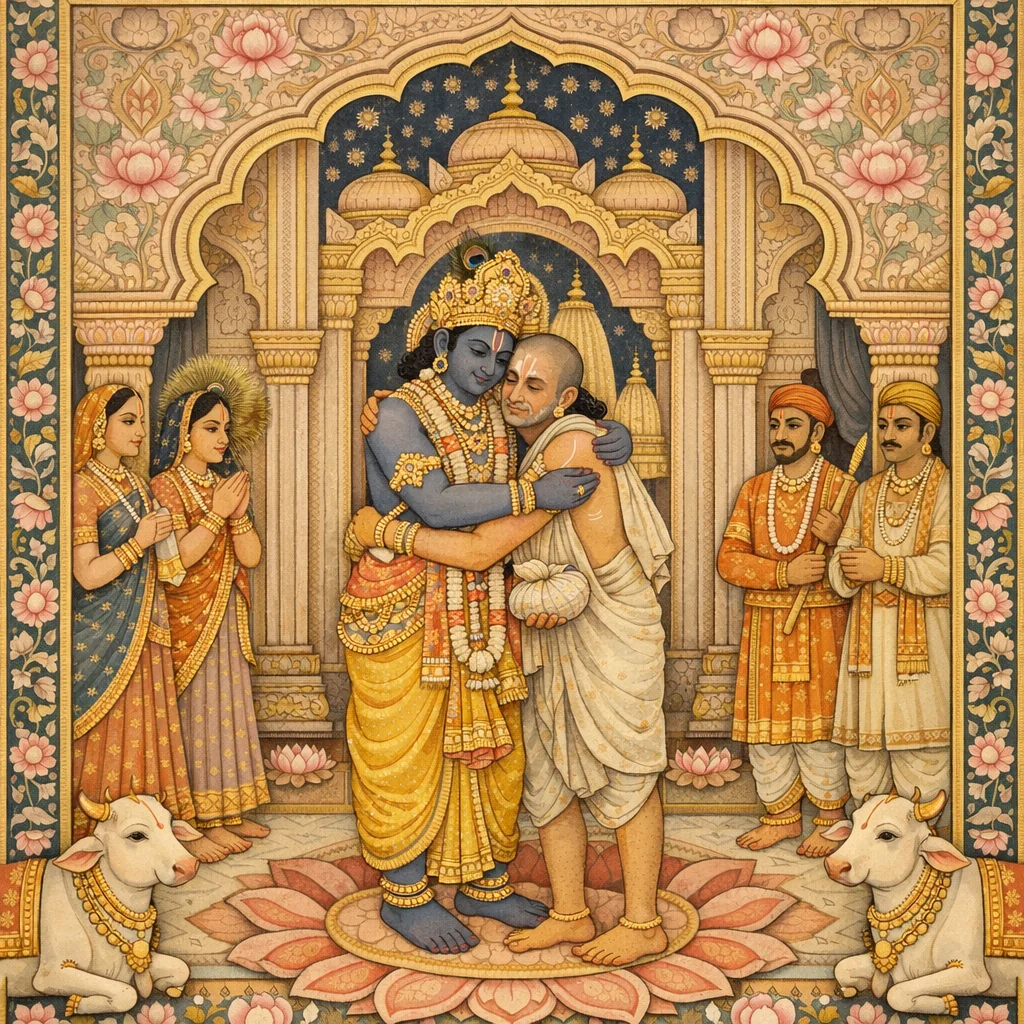
Prompted by Parīkṣit’s eagerness to hear more of Mukunda’s limitless deeds, the narration turns to a paradigmatic bhakti episode: Kṛṣṇa’s meeting with His poor brāhmaṇa friend Sudāmā. Parīkṣit praises as “true” the speech, hands, mind, ears, eyes, and limbs engaged in glorifying, serving, remembering, hearing, seeing, and honoring the Lord and His devotees, setting the devotional lens. Sudāmā, learned and detached, lives as a householder in extreme poverty; his chaste wife urges him to seek Kṛṣṇa’s shelter, trusting the Lord’s special compassion for brāhmaṇas. Bearing a humble gift of flat rice, Sudāmā reaches Dvārakā, enters the royal palace, and tastes liberation-like bliss. Kṛṣṇa rises, embraces him with tears, seats him on the bed, washes his feet, and honors him lavishly, while Lakṣmī herself serves—astonishing all. In affectionate dialogue, Kṛṣṇa recalls their gurukula days under Sāndīpani and teaches that service to the spiritual master pleases Him more than ritual, austerity, or formal initiation. The chapter bridges earlier Dvārakā narratives toward reflections on Kṛṣṇa’s household kingship as instruction for society, and toward the outcome of Sudāmā’s visit—the Lord’s subtle bestowal of grace.
Shlokas
Verse 1
श्रीराजोवाच भगवन् यानि चान्यानि मुकुन्दस्य महात्मन: । वीर्याण्यनन्तवीर्यस्य श्रोतुमिच्छामि हे प्रभो ॥ १ ॥
King Parīkṣit said: My lord, O master, I wish to hear of other heroic deeds of Mukunda, the great soul whose valor is unlimited.
Verse 2
को नु श्रुत्वासकृद् ब्रह्मन्नुत्तम:श्लोकसत्कथा: । विरमेत विशेषज्ञो विषण्ण: काममार्गणै: ॥ २ ॥
O brāhmaṇa, how could one who knows life’s true essence and is weary of pursuing sense pleasure give up the sacred, transcendental narrations of Lord Uttamaḥśloka after hearing them again and again?
Verse 3
सा वाग् यया तस्य गुणान् गृणीते करौ च तत्कर्मकरौ मनश्च । स्मरेद् वसन्तं स्थिरजङ्गमेषु शृणोति तत्पुण्यकथा: स कर्ण: ॥ ३ ॥
True speech is that which glorifies the Lord’s qualities; true hands are those that labor in His service; true mind is that which remembers Him dwelling in all moving and unmoving beings; and true ears are those that hear His purifying sacred narrations.
Verse 4
शिरस्तु तस्योभयलिङ्गमान- मेत्तदेव यत् पश्यति तद्धि चक्षु: । अङ्गानि विष्णोरथ तज्जनानां पादोदकं यानि भजन्ति नित्यम् ॥ ४ ॥
A true head is one that bows to the Lord as He appears in both moving and unmoving beings; true eyes are those that see only the Lord; and true limbs are those that daily honor the water that has washed Viṣṇu’s feet, or the feet of His devotees.
Verse 5
सूत उवाच विष्णुरातेन सम्पृष्टो भगवान् बादरायणि: । वासुदेवे भगवति निमग्नहृदयोऽब्रवीत् ॥ ५ ॥
Sūta Gosvāmī said: Thus questioned by King Viṣṇurāta, the mighty sage Bādarāyaṇi replied, his heart fully absorbed in meditation upon Vāsudeva, the Supreme Personality of Godhead.
Verse 6
श्रीशुक उवाच कृष्णस्यासीत् सखा कश्चिद् ब्राह्मणो ब्रह्मवित्तम: । विरक्त इन्द्रियार्थेषु प्रशान्तात्मा जितेन्द्रिय: ॥ ६ ॥
Śukadeva Gosvāmī said: Lord Kṛṣṇa had a brāhmaṇa friend, foremost in Vedic wisdom—detached from sense pleasures, serene in mind, and master of his senses.
Verse 7
यदृच्छयोपपन्नेन वर्तमानो गृहाश्रमी । तस्य भार्या कुचैलस्य क्षुत्क्षामा च तथाविधा ॥ ७ ॥
Though living as a householder, he sustained himself by whatever came of its own accord. The wife of that poorly clad brāhmaṇa shared his hardship and had grown emaciated from hunger.
Verse 8
पतिव्रता पतिं प्राह म्लायता वदनेन सा । दरिद्रं सीदमाना वै वेपमानाभिगम्य च ॥ ८ ॥
The chaste wife of the impoverished brāhmaṇa approached him, her face withered by distress; trembling in fear, she spoke as follows.
Verse 9
ननु ब्रह्मन् भगवत: सखा साक्षाच्छ्रिय: पति: । ब्रह्मण्यश्च शरण्यश्च भगवान् सात्वतर्षभ: ॥ ९ ॥
O brāhmaṇa, is it not so that Bhagavān, the husband of Śrī (Lakṣmī), is your personal friend? That foremost of the Yādavas, Lord Śrī Kṛṣṇa, is compassionate to brāhmaṇas and eager to grant them shelter.
Verse 10
तमुपैहि महाभाग साधूनां च परायणम् । दास्यति द्रविणं भूरि सीदते ते कुटुम्बिने ॥ १० ॥
O fortunate one, please go to Him, the true refuge of the saints. He will surely grant abundant wealth to you, a suffering householder.
Verse 11
आस्तेऽधुना द्वारवत्यां भोजवृष्ण्यन्धकेश्वर: । स्मरत: पादकमलमात्मानमपि यच्छति । किं न्वर्थकामान् भजतो नात्यभीष्टान् जगद्गुरु: ॥ ११ ॥
Lord Śrī Kṛṣṇa now resides in Dvārakā as the ruler of the Bhojas, Vṛṣṇis and Andhakas. Since He gives even His own Self to one who merely remembers His lotus feet, what doubt is there that the Jagad-guru will bestow prosperity and worldly enjoyment upon His sincere worshiper—things not even greatly worth desiring?
Verse 12
स एवं भार्यया विप्रो बहुश: प्रार्थितो मुहु: । अयं हि परमो लाभ उत्तम:श्लोकदर्शनम् ॥ १२ ॥ इति सञ्चिन्त्य मनसा गमनाय मतिं दधे । अप्यस्त्युपायनं किञ्चिद् गृहे कल्याणि दीयताम् ॥ १३ ॥
As his wife repeatedly entreated him, the brāhmaṇa reflected, “To behold Uttamaśloka, the Lord praised by the finest hymns, is the greatest gain.” He resolved to go and said, “My good wife, if there is any offering in the house that I may take as a gift, please give it to me.”
Verse 13
स एवं भार्यया विप्रो बहुश: प्रार्थितो मुहु: । अयं हि परमो लाभ उत्तम:श्लोकदर्शनम् ॥ १२ ॥ इति सञ्चिन्त्य मनसा गमनाय मतिं दधे । अप्यस्त्युपायनं किञ्चिद् गृहे कल्याणि दीयताम् ॥ १३ ॥
Urged again and again by his wife, the brāhmaṇa reflected, “To behold Lord Kṛṣṇa, the Uttamaśloka, is the greatest gain of life.” Thus he resolved to go, and he said to her, “My auspicious wife, if there is anything at home fit to be offered as a gift, please give it to me.”
Verse 14
याचित्वा चतुरो मुष्टीन् विप्रान् पृथुकतण्डुलान् । चैलखण्डेन तान् बद्ध्वा भर्त्रे प्रादादुपायनम् ॥ १४ ॥
Sudāmā’s wife begged four handfuls of flat rice from neighboring brāhmaṇas, tied it up in a torn piece of cloth, and gave it to her husband as an offering to Lord Kṛṣṇa.
Verse 15
स तानादाय विप्राग्र्य: प्रययौ द्वारकां किल । कृष्णसन्दर्शनं मह्यं कथं स्यादिति चिन्तयन् ॥ १५ ॥
Taking the flat rice, the saintly brāhmaṇa set off for Dvārakā, all the while wondering, “How will I be able to obtain Lord Kṛṣṇa’s audience?”
Verse 16
त्रीणि गुल्मान्यतीयाय तिस्र: कक्षाश्च सद्विज: । विप्रोऽगम्यान्धकवृष्णीनां गृहेष्वच्युतधर्मिणाम् ॥ १६ ॥ गृहं द्वयष्टसहस्राणां महिषीणां हरेर्द्विज: । विवेशैकतमं श्रीमद् ब्रह्मानन्दं गतो यथा ॥ १७ ॥
The learned brāhmaṇa (with some local brāhmaṇas) passed three guard stations and three gateways, walked among the homes of the Andhakas and Vṛṣṇis—devotees steadfast in Acyuta’s dharma, where none could ordinarily go—and then entered one of the splendid palaces of Lord Hari’s sixteen thousand queens, feeling as if he had attained the brahmānanda of liberation.
Verse 17
त्रीणि गुल्मान्यतीयाय तिस्र: कक्षाश्च सद्विज: । विप्रोऽगम्यान्धकवृष्णीनां गृहेष्वच्युतधर्मिणाम् ॥ १६ ॥ गृहं द्वयष्टसहस्राणां महिषीणां हरेर्द्विज: । विवेशैकतमं श्रीमद् ब्रह्मानन्दं गतो यथा ॥ १७ ॥
The learned brāhmaṇa (with some local brāhmaṇas) passed three guard stations and three gateways, walked among the homes of the Andhakas and Vṛṣṇis—devotees steadfast in Acyuta’s dharma, where none could ordinarily go—and then entered one of the splendid palaces of Lord Hari’s sixteen thousand queens, feeling as if he had attained the brahmānanda of liberation.
Verse 18
तं विलोक्याच्युतो दूरात् प्रियापर्यङ्कमास्थित: । सहसोत्थाय चाभ्येत्य दोर्भ्यां पर्यग्रहीन्मुदा ॥ १८ ॥
At that time Lord Acyuta was seated upon His consort’s bed. Seeing the brāhmaṇa from afar, He at once rose, went forward to meet him, and joyfully embraced him with both arms.
Verse 19
सख्यु: प्रियस्य विप्रर्षेरङ्गसङ्गातिनिर्वृत: । प्रीतो व्यमुञ्चदब्बिन्दून् नेत्राभ्यां पुष्करेक्षण: ॥ १९ ॥
Upon touching the body of His dear friend, the wise brāhmaṇa, the lotus-eyed Supreme Lord was filled with ecstatic joy and, out of love, shed tears from His eyes.
Verse 20
अथोपवेश्य पर्यङ्के स्वयं सख्यु: समर्हणम् । उपहृत्यावनिज्यास्य पादौ पादावनेजनी: ॥ २० ॥ अग्रहीच्छिरसा राजन् भगवाँल्लोकपावन: । व्यलिम्पद् दिव्यगन्धेन चन्दनागुरुकुङ्कुमै: ॥ २१ ॥ धूपै: सुरभिभिर्मित्रं प्रदीपावलिभिर्मुदा । अर्चित्वावेद्य ताम्बूलं गां च स्वागतमब्रवीत् ॥ २२ ॥
Lord Kṛṣṇa then seated His friend Sudāmā upon the bed. O King, the Lord who purifies the worlds personally honored him: He washed his feet and sprinkled that water upon His own head. He anointed him with divinely fragrant sandalwood, aguru, and kuṅkuma, and joyfully worshiped him with sweet incense and rows of lamps. Finally, offering betel and the gift of a cow, He welcomed him with pleasing words.
Verse 21
अथोपवेश्य पर्यङ्के स्वयं सख्यु: समर्हणम् । उपहृत्यावनिज्यास्य पादौ पादावनेजनी: ॥ २० ॥ अग्रहीच्छिरसा राजन् भगवाँल्लोकपावन: । व्यलिम्पद् दिव्यगन्धेन चन्दनागुरुकुङ्कुमै: ॥ २१ ॥ धूपै: सुरभिभिर्मित्रं प्रदीपावलिभिर्मुदा । अर्चित्वावेद्य ताम्बूलं गां च स्वागतमब्रवीत् ॥ २२ ॥
Lord Kṛṣṇa then seated His friend Sudāmā upon the bed. O King, the Lord who purifies the worlds personally honored him: He washed his feet and sprinkled that water upon His own head. He anointed him with divinely fragrant sandalwood, aguru, and kuṅkuma, and joyfully worshiped him with sweet incense and rows of lamps. Finally, offering betel and the gift of a cow, He welcomed him with pleasing words.
Verse 22
अथोपवेश्य पर्यङ्के स्वयं सख्यु: समर्हणम् । उपहृत्यावनिज्यास्य पादौ पादावनेजनी: ॥ २० ॥ अग्रहीच्छिरसा राजन् भगवाँल्लोकपावन: । व्यलिम्पद् दिव्यगन्धेन चन्दनागुरुकुङ्कुमै: ॥ २१ ॥ धूपै: सुरभिभिर्मित्रं प्रदीपावलिभिर्मुदा । अर्चित्वावेद्य ताम्बूलं गां च स्वागतमब्रवीत् ॥ २२ ॥
Lord Kṛṣṇa then seated His friend Sudāmā upon the bed. O King, the Lord who purifies the worlds personally honored him: He washed his feet and sprinkled that water upon His own head. He anointed him with divinely fragrant sandalwood, aguru, and kuṅkuma, and joyfully worshiped him with sweet incense and rows of lamps. Finally, offering betel and the gift of a cow, He welcomed him with pleasing words.
Verse 23
कुचैलं मलिनं क्षामं द्विजं धमनिसन्ततम् । देवी पर्यचरत् साक्षाच्चामरव्यजनेन वै ॥ २३ ॥
The goddess Śrī (Lakṣmī) personally served that poor brāhmaṇa, fanning him with a cāmara; his clothes were torn and dirty, and he was so emaciated that his veins stood out all over his body.
Verse 24
अन्त:पुरजनो दृष्ट्वा कृष्णेनामलकीर्तिना । विस्मितोऽभूदतिप्रीत्या अवधूतं सभाजितम् ॥ २४ ॥
The palace residents were astonished to see Kṛṣṇa, whose glory is spotless, so lovingly honor that shabbily dressed brāhmaṇa.
Verse 25
किमनेन कृतं पुण्यमवधूतेन भिक्षुणा । श्रिया हीनेन लोकेऽस्मिन् गर्हितेनाधमेन च ॥ २५ ॥ योऽसौ त्रिलोकगुरुणा श्रीनिवासेन सम्भृत: । पर्यङ्कस्थां श्रियं हित्वा परिष्वक्तोऽग्रजो यथा ॥ २६ ॥
[The palace residents said:] What piety has this unkempt, begging brāhmaṇa performed? Though the world deems him fortune-less, despised, and low, the guru of the three worlds—Śrīnivāsa, abode of Goddess Śrī—serves him with reverence; leaving Lakṣmī seated upon the bed, the Lord embraced him as if an elder brother.
Verse 26
किमनेन कृतं पुण्यमवधूतेन भिक्षुणा । श्रिया हीनेन लोकेऽस्मिन् गर्हितेनाधमेन च ॥ २५ ॥ योऽसौ त्रिलोकगुरुणा श्रीनिवासेन सम्भृत: । पर्यङ्कस्थां श्रियं हित्वा परिष्वक्तोऽग्रजो यथा ॥ २६ ॥
[The palace residents said:] What piety has this unkempt, begging brāhmaṇa performed? Though the world deems him fortune-less, despised, and low, the guru of the three worlds—Śrīnivāsa, abode of Goddess Śrī—serves him with reverence; leaving Lakṣmī seated upon the bed, the Lord embraced him as if an elder brother.
Verse 27
कथयां चक्रतुर्गाथा: पूर्वा गुरुकुले सतो: । आत्मनोर्ललिता राजन् करौ गृह्य परस्परम् ॥ २७ ॥
O King, Kṛṣṇa and Sudāmā took each other’s hands and happily spoke of the sweet memories from earlier days, when they had lived together in their guru’s school.
Verse 28
श्रीभगवानुवाच अपि ब्रह्मन् गुरुकुलाद् भवता लब्धदक्षिणात् । समावृत्तेन धर्मज्ञ भार्योढा सदृशी न वा ॥ २८ ॥
The Supreme Lord said: My dear brāhmaṇa, you know the path of dharma. After offering the proper gift (dakṣiṇā) to our guru and returning from the gurukula, did you marry a suitable wife, or not?
Verse 29
प्रायो गृहेषु ते चित्तमकामविहितं तथा । नैवातिप्रीयसे विद्वन् धनेषु विदितं हि मे ॥ २९ ॥
Though you are mostly engaged in household affairs, your mind is not touched by material desire. Nor, O learned one, do you take much delight in pursuing wealth—this I know well.
Verse 30
केचित् कुर्वन्ति कर्माणि कामैरहतचेतस: । त्यजन्त: प्रकृतीर्दैवीर्यथाहं लोकसङ्ग्रहम् ॥ ३० ॥
Some, having renounced the material propensities born of the Lord’s divine māyā, perform worldly duties with minds undisturbed by mundane desire. They act as I do, for loka-saṅgraha—guiding the people.
Verse 31
कच्चिद् गुरुकुले वासं ब्रह्मन् स्मरसि नौ यत: । द्विजो विज्ञाय विज्ञेयं तमस: पारमश्नुते ॥ ३१ ॥
My dear brāhmaṇa, do you remember how we lived together in the gurukula? When a twice-born student has learned from his guru all that is to be learned, he can relish spiritual life beyond the darkness of ignorance.
Verse 32
स वै सत्कर्मणां साक्षाद् द्विजातेरिह सम्भव: । आद्योऽङ्ग यत्राश्रमिणां यथाहं ज्ञानदो गुरु: ॥ ३२ ॥
My friend, the one who gives physical birth is the first teacher; and the one who initiates one as twice-born and engages one in dharmic duties is a more direct teacher. But the guru who bestows transcendental knowledge upon all āśramas is the ultimate spiritual master—indeed, he is as good as My own self.
Verse 33
नन्वर्थकोविदा ब्रह्मन् वर्णाश्रमवतामिह । ये मया गुरुणा वाचा तरन्त्यञ्जो भवार्णवम् ॥ ३३ ॥
O brāhmaṇa, among all who follow varṇāśrama, those who take shelter of the words I speak in the role of the spiritual master and thus easily cross the ocean of material existence best understand their true welfare.
Verse 34
नाहमिज्याप्रजातिभ्यां तपसोपशमेन वा । तुष्येयं सर्वभूतात्मा गुरुशुश्रूषया यथा ॥ ३४ ॥
I, the Soul of all beings, am not as satisfied by ritual worship, brahminical initiation, austerity or self-control as I am by faithful service rendered to one’s spiritual master.
Verse 35
अपि न: स्मर्यते ब्रह्मन् वृत्तं निवसतां गुरौ । गुरुदारैश्चोदितानामिन्धनानयने क्वचित् ॥ ३५ ॥ प्रविष्टानां महारण्यमपर्तौ सुमहद् द्विज । वातवर्षमभूत्तीव्रं निष्ठुरा: स्तनयित्नव: ॥ ३६ ॥
O brāhmaṇa, do you remember what happened when we were living at our guru’s āśrama? Once the guru’s wife sent us to bring firewood.
Verse 36
अपि न: स्मर्यते ब्रह्मन् वृत्तं निवसतां गुरौ । गुरुदारैश्चोदितानामिन्धनानयने क्वचित् ॥ ३५ ॥ प्रविष्टानां महारण्यमपर्तौ सुमहद् द्विज । वातवर्षमभूत्तीव्रं निष्ठुरा: स्तनयित्नव: ॥ ३६ ॥
O twice-born one, after we entered that vast forest, an unseasonal storm arose—fierce wind and rain, with harsh peals of thunder.
Verse 37
सूर्यश्चास्तं गतस्तावत् तमसा चावृता दिश: । निम्नं कूलं जलमयं न प्राज्ञायत किञ्चन ॥ ३७ ॥
Then the sun set and darkness covered every direction. With the flooding waters, we could not distinguish anything—high ground from low, bank from hollow.
Verse 38
वयं भृशं तत्र महानिलाम्बुभि- र्निहन्यमाना महुरम्बुसम्प्लवे । दिशोऽविदन्तोऽथ परस्परं वने गृहीतहस्ता: परिबभ्रिमातुरा: ॥ ३८ ॥
Battered again and again by fierce wind and rain, we lost our way amid the floodwaters. So, in the forest, we held one another’s hands and, in great distress, wandered without direction.
Verse 39
एतद् विदित्वा उदिते रवौ सान्दीपनिर्गुरु: । अन्वेषमाणो न: शिष्यानाचार्योऽपश्यदातुरान् ॥ ३९ ॥
Understanding our plight, after sunrise our guru Sāndīpani, the ācārya, went out searching for us, his disciples, and found us in distress.
Verse 40
अहो हे पुत्रका यूयमस्मदर्थेऽतिदु:खिता: । आत्मा वै प्राणिनां प्रेष्ठस्तमनादृत्य मत्परा: ॥ ४० ॥
[Sāndīpani said:] O my children, you have suffered so much for my sake! To every living being, one’s own body is most dear, yet, devoted to me, you neglected your own comfort entirely.
Verse 41
एतदेव हि सच्छिष्यै: कर्तव्यं गुरुनिष्कृतम् । यद् वै विशुद्धभावेन सर्वार्थात्मार्पणं गुरौ ॥ ४१ ॥
This is indeed the duty of true disciples: to repay their debt to the spiritual master by offering him, with a pure heart, their wealth—and even their very lives.
Verse 42
तुष्टोऽहं भो द्विजश्रेष्ठा: सत्या: सन्तु मनोरथा: । छन्दांस्ययातयामानि भवन्त्विह परत्र च ॥ ४२ ॥
You boys are first-class brāhmaṇas, and I am satisfied with you. May all your desires be fulfilled, and may the Vedic mantras you have learned never lose their meaning, in this world or the next.
Verse 43
इत्थंविधान्यनेकानि वसतां गुरुवेश्मनि । गुरोरनुग्रहेणैव पुमान् पूर्ण: प्रशान्तये ॥ ४३ ॥
While living in our spiritual master’s home, we had many such experiences. By the guru’s grace alone, a person fulfills life’s true purpose and attains eternal peace.
Verse 44
श्रीब्राह्मण उवाच किमस्माभिरनिर्वृत्तं देवदेव जगद्गुरो । भवता सत्यकामेन येषां वासो गुरोरभूत् ॥ ४४ ॥
The brāhmaṇa said: O Lord of lords, O teacher of the universe, since I was able to live with You—whose every desire is fulfilled—at our guru’s home, what could I possibly have failed to attain?
Verse 45
यस्यच्छन्दोमयं ब्रह्म देह आवपनं विभो । श्रेयसां तस्य गुरुषु वासोऽत्यन्तविडम्बनम् ॥ ४५ ॥
O almighty Lord, Your body is the Absolute Truth in the form of the Vedas, the very source of all auspicious goals. That You lived in a guru’s school is simply Your lila, in which You play the role of a human being.
Frequently Asked Questions
The Lord’s act teaches that bhakti, humility, and brāhmaṇa devotion are honored above external status. By washing Sudāmā’s feet and placing that water on His own head, Kṛṣṇa establishes the sanctity of the devotee (bhakta-mahattva) and demonstrates that serving His devotee is non-different from serving Him. Traditional Vaiṣṇava readings highlight that this reverses worldly hierarchies: the Supreme becomes the servant to glorify pure devotion.
The chapter frames Sudāmā’s condition as a setting for showcasing detachment and exclusive shelter rather than karmic condemnation. Sudāmā is described as learned, peaceful, and sense-controlled, maintaining himself by what comes of its own accord. His poverty highlights niṣkāma living and becomes the backdrop for Kṛṣṇa’s grace, which is bestowed without being demanded and without making wealth the devotee’s goal.
The flat rice functions as a bhakti-symbol: a small, simple offering given with sincerity outweighs opulence without devotion. In Bhāgavata theology, the Lord accepts bhāva (devotional intent) rather than material magnitude. Sudāmā’s gift also preserves maryādā (etiquette) in friendship—he comes not as a claimant but as a giver, however poor.
Kṛṣṇa recalls gurukula life and states that He is not as satisfied by ritual worship, initiation, penance, or self-discipline as by faithful service to one’s spiritual master. He delineates gradations of ‘guru’—birth-giver, initiator into dharma, and the giver of transcendental knowledge—culminating in the ultimate spiritual master who imparts tattva-jñāna and is ‘as good as My own self.’ The point is that guru-sevā is a primary axis of bhakti and a direct means to cross material existence.
Sāndīpani is presented as Kṛṣṇa and Sudāmā’s guru. The storm-and-firewood episode illustrates śiṣya-dharma (the duty of disciples): service even at personal hardship, done with pure intent. The guru’s blessing—retention of mantra efficacy and fulfillment of desires—shows the Bhāgavata principle that spiritual success comes by guru-kṛpā, and that the Lord Himself models ideal discipleship to instruct society.