Adhyaya 99
भीष्मस्य मध्याह्नयुद्धवर्णनम् / Mid-day Battle Description: Bhīṣma Engaged by the Pāñcālas
Upa-parva: Kurukṣetra-raṇa-vṛttānta (Battlefield Chronicle under Bhīṣma’s Command)
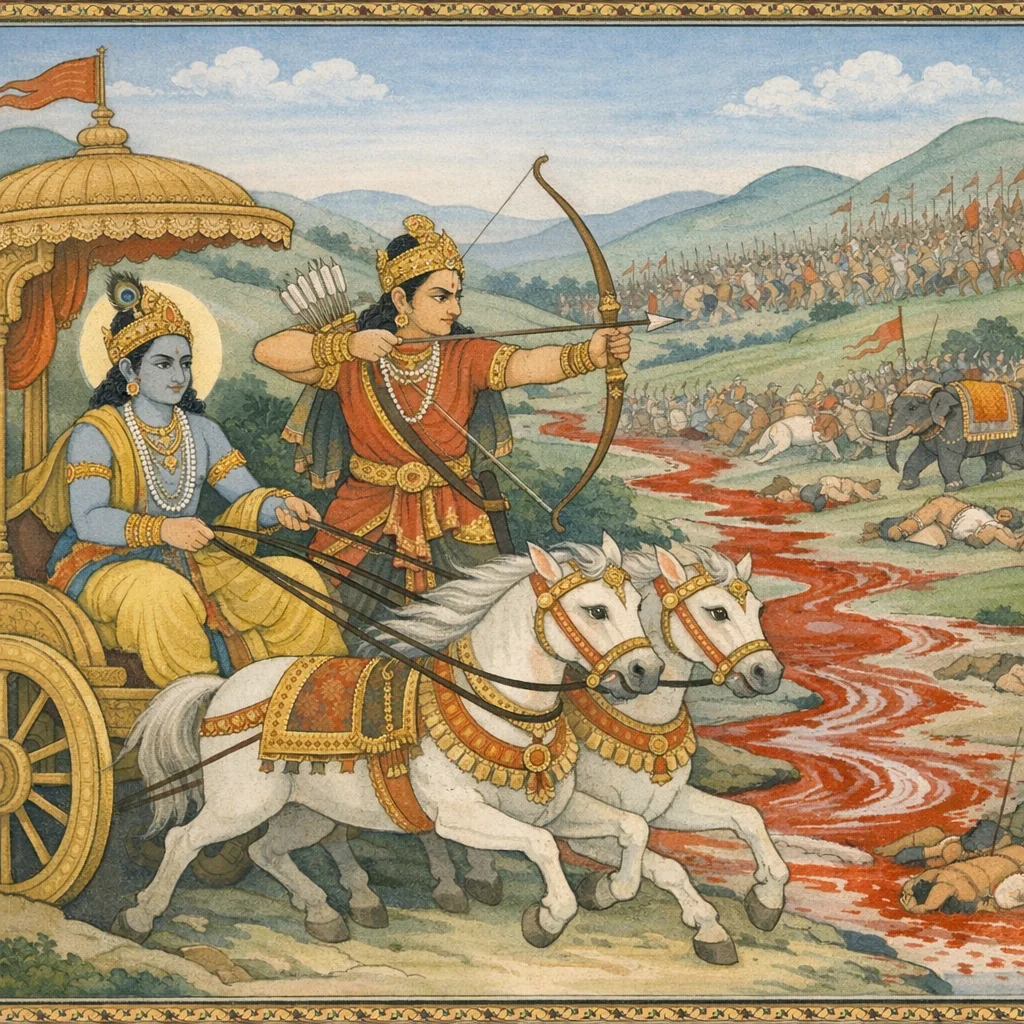
Sañjaya reports that by mid-day a severe, population-depleting engagement unfolds under Bhīṣma’s leadership. Bhīṣma (Gāṅgeya) strikes the Pāṇḍava formations with dense volleys, compressing their ranks like harvested grain under stampeding cattle. Dhṛṣṭadyumna, Śikhaṇḍin, Virāṭa, and Drupada converge to strike Bhīṣma with repeated arrows; Bhīṣma counters by piercing them and severing Drupada’s bow, prompting renewed exchanges with replacement weapons and targeted strikes on charioteers. Reinforcements—Bhīma, Draupadī’s five sons, five Kekaya brothers, and Sātyaki—advance to protect the Pāñcālas, while the Kaurava host moves to safeguard Bhīṣma, producing a congested, multi-arm clash of chariots, elephants, cavalry, and infantry. The narration emphasizes battlefield disarray: riderless chariots, scattered horses, and armored warriors moving on foot. A culminating metaphor depicts a dreadful ‘river’ of blood and debris (bones, hair, armor, weapons), carrying away the fearful like the Vaitaraṇī, while soldiers voice that the catastrophe stems from Duryodhana’s wrongdoing and the unresolved consequences of the dice-game. The chapter closes by attributing the ongoing mass destruction to causality beyond any single side’s immediate control—fate, leadership error, and accumulated grievance.
Chapter Arc: संजय धृतराष्ट्र को सुनाते हैं कि इरावान के वध का समाचार अर्जुन के भीतर विष की तरह उतर गया—वह सर्प-सी लंबी साँसें लेकर शोक और क्रोध के बीच काँप उठता है। → अर्जुन युद्धभूमि में वासुदेव से कहता है कि यह वही घोर क्षय है जिसे विदुर ने पहले ही देख लिया था और धृतराष्ट्र को रोकने का प्रयत्न किया था। शोक शीघ्र ही प्रतिज्ञा-सा कठोर संकल्प बनता है—‘क्षत्रिय मुझे अशक्त समझेंगे’—और वह समय न गँवाने का आग्रह करता है। केशव उसके आवेग को रथ-गति में बदलते हैं और पाण्डवों की ओर से तीव्र धावा आरम्भ होता है। → दोनों विशाल सेनाएँ परस्पर भिड़ती हैं; रणभूमि रक्त-प्रवाहों से भर उठती है, कटे हुए भुज-दण्ड, ऊरु और आयुधों से धरती ढँक जाती है। अर्जुन का ‘समरोदधि’ को भुजाओं से पार करने जैसा उद्घोष (अर्थात् असंभव को भी कर गुजरने का निश्चय) युद्ध को चरम उन्माद तक ले जाता है। → केशव पाण्डुर अश्वों को दुर्योधन की सेना की ओर हाँकते हैं; अर्जुन का शोक अब कर्म में रूपान्तरित हो चुका है। अध्याय का अंत व्यापक संग्राम-वर्णन में ठहरता है—रणस्थल मृतकों और टूटे आयुधों से पर्वत-सा प्रतीत होता है, और युद्ध की ध्वनि-तरंगें दोनों पक्षों को रौंदती हुई आगे बढ़ती हैं। → अर्जुन का संकल्प दुर्योधन की सेना के हृदय में प्रवेश करने को है—अगले प्रसंग में उसका प्रतिशोध किस पर टूटेगा, यह अनकहा रह जाता है।
Shlokas
Verse 1
संजय कहते हैं--राजन्! अपने पुत्र इरावानके वधका वृत्तान्त सुनकर अर्जुनको बड़ा दुःख हुआ। वे सर्पके समान लंबी साँस खींचने लगे
Sanjaya said: O King, when Arjuna heard the account of the slaying of his own son Iravan, he was overwhelmed with grief. Like a serpent, he began to draw long, heavy breaths—his sorrow breaking through the warrior’s composure amid the moral weight of war.
Verse 2
अब्रवीत् समरे राजन् वासुदेवमिदं वच: । इदं नूनं महाप्राज्ञो विदुरो दृष्टवान् पुरा,नरेश्वर! तब उन्होंने समरभूमिमें भगवान् वासुदेवसे इस प्रकार कहा--“भगवन्! निश्चय ही महाज्ञानी विदुरने पहले ही यह सब देख लिया था
Sañjaya said: “O King, in the midst of the battle he spoke these words to Vāsudeva: ‘O Lord, surely the great sage Vidura had foreseen all this long ago, O ruler of men.’” The line underscores the moral irony of war: wise counsel and foresight existed, yet was not heeded in time, and the present calamity now appears as the fruition of ignored dharmic warning.
Verse 3
कुरूणां पाण्डवानां च क्षयं घोरं॑ महामति: । स ततो निवारितवान् धृतराष्ट्रं जनेश्वरम्,“कौरवों और पाण्डवोंका यह भयंकर विनाश परम बुद्धिमान् विदुरकी दृष्टिमें पहले ही आ गया था। इसलिये उन्होंने राजा धृतराष्ट्रको मना किया था
Sañjaya said: The dread destruction of both the Kurus and the Pāṇḍavas had already been foreseen by the great-minded (Vidura). Therefore, he had tried to restrain King Dhṛtarāṣṭra, the lord of men, from the course that would lead to such ruin.
Verse 4
अन्ये च बहवो वीरा: संग्रामे मधुसूदन । निहता: कौरवै: संख्ये तथास्माभिश्न॒ कौरवा:
Sañjaya said: “And many other heroes too, O Madhusūdana, were slain in the battle—some by the Kauravas in the thick of combat, and likewise many Kauravas by us. Thus the war’s ‘victory’ is stained on both sides by mutual destruction, revealing the grim moral cost of fratricidal conflict.”
Verse 5
“मधुसूदन! और भी बहुत-से वीरोंको संग्राममें कौरवोंने मारा और हमने कौरव सैनिकोंका संहार किया ।। अर्थहेतोर्नरश्रेष्ठ क्रियते कर्म कुत्सितम् । धिगर्थान् यत्कृते होवं क्रियते ज्ञातिसंक्षय:,“नरश्रेष्ठल धनके लिये यह कुत्सित कर्म किया जा रहा है। धिक््कार है उस धनको, जिसके लिये इस प्रकार जाति-भाइयोंका विनाश किया जाता है
Sanjaya said: “O Madhusudana! Many other heroes too have been slain in battle by the Kauravas, and we in turn have destroyed Kaurava soldiers. O best of men, for the sake of wealth this disgraceful deed is being done. Shame on that wealth for whose sake such a ruin of one’s own kinsmen is brought about.”
Verse 6
अधनस्य मृतं श्रेयो न च ज्ञातिवधाद् धनम् । कि नु प्राप्स्यामहे कृष्ण हत्वा ज्ञातीनू समागतान्,“मनुष्यका निर्धन रहकर मर जाना अच्छा है, परंतु जाति-भाइयोंके वधसे धन प्राप्त करना कदापि अच्छा नहीं है। कृष्ण! हम यहाँ आये हुए इन जाति-भाइयोंको मारकर क्या प्राप्त कर लेंगे
Verse 7
दुर्योधनापराधेन शकुने: सौबलस्य च । क्षत्रिया निधन यान्ति कर्णदुर्मन्त्रितेन च,“दुर्योधनके अपराधसे और सुबलपुत्र शकुनि तथा कर्णकी कुमन्त्रणासे ये क्षत्रिय मारे जा रहे हैं
Sañjaya said: “Because of Duryodhana’s wrongdoing—and also through the agency of Śakuni, son of Subala, and through Karṇa’s ruinous counsel—these kṣatriya warriors are being driven to death. The slaughter unfolding is not mere fate; it is the moral consequence of pride, deceit, and reckless advice that has pushed the noble order into self-destruction.”
Verse 8
इदानीं च विजानामि सुकृतं मधुसूदन । कृतं राज्ञा महाबाहो याचता च सुयोधनम्,महाबाहु मधुसूदन! राजा युधिष्ठिरने दुर्योधनसे पहले जो याचना की थी, वही उत्तम कार्य था; यह बात अब मेरी समझमें आ रही है
Sanjaya said: “Now I understand, O Madhusūdana, that the righteous course was the one the king (Yudhiṣṭhira) undertook—when, with great-armed resolve, he sought terms from Suyodhana (Duryodhana). That act of requesting peace was truly the best deed.”
Verse 9
राज्यार्ध पञज्च वा ग्रामान् नाकार्षीत् स च दुर्मति: । दृष्टवा हि क्षत्रियान् शूरान् शयानान् धरणीतले
Sañjaya said: That evil-minded man did not even accept half the kingdom, nor even five villages—especially after seeing the heroic kṣatriyas lying slain upon the earth. The sight of such fallen warriors underscores how stubborn ambition, when it rejects fair compromise, drives a conflict to ruinous and morally weighty consequences.
Verse 10
अशक्तमिति मामेते ज्ञास्यन्ते क्षत्रिया रणे
Sañjaya said: “These kṣatriya warriors will come to regard me as ‘incapable’ on the battlefield.”
Verse 11
संचोदय हयान् शीघ्र धार्तराष्ट्रचमूं प्रति
Sañjaya said: “Urge the horses on quickly—drive straight toward the army of the Dhārtarāṣṭras.” In the charged ethics of battle, the command signals decisive engagement: once the moment of confrontation arrives, hesitation gives way to disciplined action aligned with one’s chosen side and duty.
Verse 12
नायं यापयितुं कालो विद्यते माधव क्वचित्,“माधव! यह समयको व्यर्थ बितानेका अवसर नहीं है।” अर्जुनके ऐसा कहनेपर शत्रुवीरोंका विनाश करनेवाले केशवने वायुके समान वेगशाली उन श्वेत घोड़ोंको आगे बढ़ाया
Sañjaya said: “O Mādhava, this is no time to be squandered—there is no occasion here for delay.” When Arjuna spoke thus, Keśava, the destroyer of hostile heroes, urged forward those white horses, swift as the wind, setting the chariot in motion toward the work of battle.
Verse 13
एवमुक्तस्तु पार्थेन केशव: परवीरहा । चोदयामास तानश्वान् पाण्डुरान् वातरंहस:,“माधव! यह समयको व्यर्थ बितानेका अवसर नहीं है।” अर्जुनके ऐसा कहनेपर शत्रुवीरोंका विनाश करनेवाले केशवने वायुके समान वेगशाली उन श्वेत घोड़ोंको आगे बढ़ाया
Sañjaya said: Thus addressed by Pārtha, Keśava—slayer of hostile heroes—urged on those pale-white horses, swift as the wind. In the press of righteous duty on the battlefield, Kṛṣṇa responds not with delay but with decisive action, aligning movement and resolve with the urgent demands of the moment.
Verse 14
अथ शब्दो महानासीत् तव सैन्यस्य भारत । मारुतोद्धतवेगस्य सागरस्येव पर्वणि,भारत! तदनन्तर जैसे पूर्णिमाको वायुकी प्रेरणासे समुद्रका वेग बढ़ जानेसे उसकी भीषण गर्जना सुनायी पड़ती है, उसी प्रकार आपकी सेनाका महान् कोलाहल प्रकट हुआ
Sañjaya said: Then, O Bhārata, a mighty roar arose from your army—like the ocean’s thunder on a festival day when its surge is whipped up by the wind. The simile underscores how collective passion and momentum can swell into overwhelming force at the outset of war, foreshadowing the moral gravity of the conflict.
Verse 15
अपराह्ने महाराज संग्राम: समपद्यत | पर्जन्यसमनिर्घोषो भीष्मस्य सह पाण्डवै:,महाराज! अपराह्नकालमें पाण्डवोंके साथ भीष्मका भीषण संग्राम आरम्भ हुआ, जिसमें मेघकी गर्जनाके समान गम्भीर घोष हो रहा था
Sañjaya said: “O King, in the latter part of the day the battle truly came to be joined. Between Bhīṣma and the Pāṇḍavas there arose a deep, thundercloud-like roar—an ominous sign of the war’s swelling fury and the heavy moral weight borne by all who fought.”
Verse 16
ततो राजंस्तव सुता भीमसेनमुपाद्रवन् । परिवार्य रणे द्रोणं वसवो वासवं यथा,राजन्! तब आपके पुत्र, जैसे वसुगण इन्द्रके सब ओर खड़े होते हैं, उसी प्रकार द्रोणाचार्यको चारों ओरसे घेरकर रणभूमिमें भीमसेनपर टूट पड़े
Sañjaya said: “Then, O King, your sons rushed upon Bhīmasena. Having surrounded Droṇa in the battle—just as the Vasus stand encircling Vāsava (Indra)—they fell upon Bhīma on the field.” The verse highlights the tactical and moral tension of war: the Kauravas attempt to protect their commander while concentrating force against a foremost opponent, showing how loyalty to one’s side and the drive for victory can intensify violence even under the shadow of dharma.
Verse 17
ततः शान्तनवो भीष्म: कृपश्च रथिनां वर: । भगदत्त: सुशर्मा च धनंजयमुपाद्रवन्,तत्पश्चात् शान्तनुनन्दन भीष्म, रथियोंमें श्रेष्ठ कृपाचार्य, भगदत्त और सुशर्माने अर्जुनपर धावा किया
Sañjaya said: Then Bhīṣma, son of Śāntanu, and Kṛpa—the foremost among chariot-warriors—together with Bhagadatta and Suśarmā, charged at Dhanañjaya (Arjuna). The scene underscores the relentless pressure of war: renowned elders and kings, bound by allegiance and kṣatriya-duty, converge upon Arjuna in a coordinated assault, intensifying the moral weight of combat where personal virtue and political obligation collide.
Verse 18
हार्दिक्यो बाह्लिकश्चैव सात्यकिं समभिद्रुतौ । अम्बष्ठकस्तु नृपतिरभिमन्युमवस्थित:,कृतवर्मा और बाह्नलीक सात्यकिपर टूट पड़े। राजा अम्बष्ठने अभिमन्युका सामना किया
Sanjaya said: Kṛtavarmā (the son of Hṛdīka) and King Bāhlika together rushed straight at Sātyaki. Meanwhile, the king of the Ambaṣṭhas took his stand against Abhimanyu. The scene underscores the relentless press of battle, where renowned warriors deliberately seek out worthy opponents, driven by loyalty to their side and the harsh code of kṣatriya warfare.
Verse 19
शेषास्त्वन्ये महाराज शेषानेव महारथान् । ततः प्रववृते युद्ध घोररूपं भयावहम्,महाराज! शेष अन्य महारथियोंने शत्रुपक्षके शेष महारथियोंपर आक्रमण किया। फिर तो उनमें घोर एवं भयंकर युद्ध आरम्भ हुआ
Sañjaya said: “O great king, the remaining warriors then fell upon the remaining great chariot-fighters of the opposing side. Thereupon a battle began in full force—terrible in form and fraught with fear.”
Verse 20
भीमसेनस्तु सम्प्रेक्ष्य पुत्रांस्तव जनेश्वर । प्रजज्वाल रणे क्रुद्धो हविषा हव्यवाडिव,जनेश्वर! जैसे घीकी आहुति देनेसे अग्निदेव प्रज्वलित हो उठते हैं, उसी प्रकार रणक्षेत्रमें आपके पुत्रोंको देखकर भीमसेन क्रोधसे जल उठे
Sañjaya said: O lord of men, when Bhīmasena beheld your sons, he blazed with wrath on the battlefield—like the sacrificial fire flares up when fed with clarified butter. The sight of the Kauravas becomes the very fuel that intensifies his resolve and fury in the righteous yet terrible work of war.
Verse 21
पुत्रास्तु तव कौन्तेयं छादयाज्चक्रिरे शरै: । प्रावषीव महाराज जलदा इव पर्वतम्,परंतु महाराज! आपके पुत्रोंने कुन्तीनन्द्र भीमको अपने बाणोंसे उसी प्रकार आच्छादित कर दिया, जैसे वर्षा-ऋतुमें बादल पर्वतको जलकी धाराओंसे ढक लेते हैं
Sañjaya said: “O great king, your sons covered Bhīma, the son of Kuntī, with a shower of arrows—just as, in the rainy season, clouds veil a mountain with streaming sheets of water.” The image underscores the intensity of the assault and the collective resolve of the Kauravas to overwhelm a single formidable opponent on the battlefield.
Verse 22
स च्छाद्यमानो बहुधा पुत्रैस्तव विशाम्पते । सृक्किणी संलिहन् वीर: शार्दूल इव दर्पित:,प्रजानाथ! भरतनन्दन! आपके पुत्रोंद्वारा बारंबार बाणोंकी वर्षासे आच्छादित किये जानेपर क्रोधपूर्वक अपने मुहके कोनोंको चाटते हुए सिंहके समान शौर्यका अभिमान रखनेवाले वीर भीमसेनने एक अत्यन्त तीखे क्षुरप्रके द्वारा आपके पुत्र व्यूढोरस्कको मार गिराया। उसकी जीवन-लीला समाप्त हो गयी
Sanjaya said: O lord of the people, though repeatedly covered on all sides by volleys of arrows shot by your sons, that heroic warrior—licking the corners of his mouth in wrath, like a proud tiger—stood his ground, his valor undiminished. (In the surrounding narrative of this passage, Bhīmasena, inflamed with anger amid the press of battle, strikes down your son Vyūḍhoraska with a razor-edged arrow, bringing his life to an end.)
Verse 23
व्यूढोरस्क॑ ततो भीम: पातयामास भारत | क्षुरप्रेण सुतीक्ष्णेन सो5भवद् गतजीवित:,प्रजानाथ! भरतनन्दन! आपके पुत्रोंद्वारा बारंबार बाणोंकी वर्षासे आच्छादित किये जानेपर क्रोधपूर्वक अपने मुहके कोनोंको चाटते हुए सिंहके समान शौर्यका अभिमान रखनेवाले वीर भीमसेनने एक अत्यन्त तीखे क्षुरप्रके द्वारा आपके पुत्र व्यूढोरस्कको मार गिराया। उसकी जीवन-लीला समाप्त हो गयी
Sañjaya said: Then Bhīma struck down Vyūḍhoraska, O descendant of Bharata. With a razor-edged, exceedingly sharp arrow, he brought him to the ground; thus Vyūḍhoraska’s life came to an end. The scene underscores the relentless logic of battlefield duty: amid repeated volleys and rising wrath, valor is expressed through decisive action, yet it culminates in irreversible loss.
Verse 24
अपरेण तु भल्लेन पीतेन निशितेन तु । अपातयत् कुण्डलिन सिंह: क्षुद्रमूगं यथा,तत्पश्चात् जैसे सिंह छोटे-से मृगको दबोच लेता है, उसी प्रकार भीमने दूसरे पानीदार एवं तीखे भल्लसे आपके पुत्र कुण्डलीको धराशायी कर दिया
Sañjaya said: Then, with another barbed dart—gleaming and razor-sharp—Bhīma struck down Kuṇḍalin, your son, just as a lion brings a small deer to the ground. The image underscores the brutal asymmetry of strength on the battlefield, where prowess and fate can swiftly overturn a warrior’s standing, regardless of lineage.
Verse 25
ततः सुनिशितान् पीतान् समादत्त शिलीमुखान् । ससर्ज त्वरया युक्तः पुत्रांस्ते प्राप्प मारिष,आर्य! इसके बाद भीमने बड़ी उतावलीके साथ बहुत-से तीखे और पानीदार बाण हाथमें लिये और आपके पुत्रोंको लक्ष्य करके छोड़ दिये
Sañjaya said: Then, taking up keenly whetted, yellow-hued arrows, he—driven by urgency—swiftly discharged them, having reached your sons as his targets, O venerable one. The scene underscores the relentless momentum of battle, where resolve and speed become decisive, even as the moral weight of striking one’s kin remains implicit in the Kurukṣetra conflict.
Verse 26
प्रेषिता भीमसेनेन शरास्ते दृढ्धन्वना । अपातयन्त पुत्रांस्ते रथेभ्य: सुमहारथान्,सुदृढ़ धनुर्धर भीमसेनके द्वारा चलाये हुए उन बाणोंने आपके बहुत-से महारथी पुत्रोंको मारकर रथोंसे नीचे गिरा दिया
Sanjaya said: The arrows discharged by Bhimasena, that steadfast wielder of the bow, struck down many of your sons—great chariot-warriors—and hurled them from their chariots. The scene underscores the grim impartiality of battle, where prowess and resolve bring swift consequences even upon the mighty, and where attachment to one’s own kin is tested against the harsh outcomes of adharma-driven conflict.
Verse 27
अनाधूुष्टिं कुण्डभेदिं वैराट्ट दीर्घलोचनम् । दीर्घबाहुं सुबाहुंच तथैव कनकध्वजम्,उनके नाम इस प्रकार हैं--अनाधृष्टि, कुण्डभेदि, वैराट, दीर्घलोचन, दीर्घबाहु, सुबाहु तथा कनकध्वज
Sañjaya said: “(Among them were) Anādhṛṣṭi, Kuṇḍabhedin, Vairāṭa, Dīrghalocana, Dīrghabāhu, Subāhu, and likewise Kanakadhvaja.” In this war-report, Sañjaya continues to enumerate named warriors, underscoring how many individuals—each with distinct identity and valor—are drawn into the moral gravity of the Kurukṣetra conflict.
Verse 28
प्रपतन्त सम वीरास्ते विरेजुर्भरतर्षभ । वसन्ते पुष्पशबलाश्षूता: प्रपतिता इव,भरतश्रेष्ठ) वे सभी वीर वहाँ गिरकर वसन्त-ऋतुमें धराशायी हुए पुष्पयुक्त आम्रवृक्षोंकी भाँति सुशोभित हो रहे थे
Sañjaya said: O bull among the Bharatas, those warriors, falling down together on the battlefield, still appeared splendid—like mango trees in spring, variegated with blossoms, that have been felled and lie upon the earth. The verse underscores the tragic dignity of valor in war: even in collapse, the signs of life’s former beauty remain, inviting reflection on the cost of conflict and the impermanence of embodied glory.
Verse 29
ततः प्रदुद्रुवु: शेषास्तव पुत्रा महाहवे । त॑ कालमिव मन्यन्तो भीमसेनं महाबलम्,तब उस महायुद्धमें आपके शेष पुत्र महाबली भीमसेनको कालके समान समझकर वहाँसे भाग चले
Sañjaya said: Then, in that great battle, your remaining sons fled. Taking the mighty Bhīmasena to be like Death itself, they ran from that place—fear overwhelming their resolve and exposing the moral collapse that follows when pride and aggression meet righteous force.
Verse 30
द्रोणस्तु समरे वीर निर्दहन्तं सुतांस्तव | यथाद्रिं वारिधाराभि: समन्ताद् व्यकिरच्छरै:,तदनन्तर युद्धस्थलमें आपके पुत्रोंको दग्ध करते हुए वीर भीमसेनपर द्रोणाचार्यने सब ओरसे उसी प्रकार बाणोंकी वर्षा आरम्भ की, जैसे बादल पर्वतपर जलकी धाराएँ गिराते हैं
Sanjaya said: In the thick of battle, O hero, as Bhima was scorching your sons, Drona showered him from every side with volleys of arrows—just as rain-clouds pour streams of water all around upon a mountain. The image underscores the war’s relentless reciprocity: fierce prowess answered by an even more encompassing counterstroke, where skill and duty to one’s side drive the combatants onward despite the mounting ruin.
Verse 31
तत्राद्भुतमपश्याम कुन्तीपुत्रस्य पौरुषम् । द्रोणेन वार्यमाणो5पि निजघ्ने यत् सुतांस्तव
There we witnessed something astonishing—the heroic prowess of Kuntī’s son. Even though Droṇa tried to restrain him, he struck down your sons.
Verse 32
महाराज! उस समय हमने कुन्तीपुत्र भीमका अद्भुत पराक्रम देखा। यद्यपि द्रोणाचार्य बाणोंकी वर्षा करके उन्हें रोक रहे थे, तो भी उन्होंने आपके पुत्रोंको मार डाला ।। यथा गोवृषभो वर्ष संधारयति खात् पतत् | भीमस्तथा द्रोणमुक्तं शरवर्षमदीधरत्,जैसे साँड़ आकाशसे गिरती हुई जल-वर्षाको अपने शरीरपर शान्त भावसे धारण और सहन करता है, उसी प्रकार भीमसेन द्रोणाचार्यकी छोड़ी हुई बाण-वर्षाको धारण कर रहे थे
Sanjaya said: O King, at that time I witnessed the wondrous valor of Bhima, the son of Kunti. Though Drona, by pouring forth a rain of arrows, tried to check him, Bhima still struck down your sons. As a mighty bull calmly bears the rain that falls from the sky, so Bhima endured the arrow-storm released by Drona.
Verse 33
अद्भुतं च महाराज तत्र चक्रे वृकोदर: । यत् पुत्रांस्तेडवधीत् संख्ये द्रोणं चैव न््यवारयत्,महाराज! भीमसेनने उस युद्धस्थलमें आपके पुत्रोंका वध तो किया ही, द्रोणाचार्यको भी आगे बढ़नेसे रोक रखा था। यह उन्होंने अद्भुत पराक्रम किया
Sañjaya said: “O great king, Vṛkodara (Bhīma) performed a truly astonishing feat there: in the thick of battle he slew your sons, and he also held Droṇa back, preventing him from advancing. It was an extraordinary display of might on that battlefield.”
Verse 34
पुत्रेषु तव वीरेषु चिक्रीडार्जुनपूर्वज: । मृगेष्विव महाराज चरन् व्यात्रो महाबल:ः,राजन! जैसे महाबली व्याप्र मृगोंके झुंडमें विचरता हो, उसी प्रकार भीमसेन आपके वीर पुत्रोंके समुदायमें खेल रहे थे
Sañjaya said: O great king, mighty Bhīmasena—elder brother of Arjuna—moved among your valiant sons as a powerful tiger ranges amid a herd of deer, sporting with them in battle. The image underscores the stark imbalance of strength and the grim moral weight of war, where pride and aggression meet their consequence on the field.
Verse 35
यथा हि पशुमध्यस्थो दारयेत पशून् वृक: । वृकोदरस्तव सुतांस्तथा व्यद्रावयद् रणे,जैसे भेड़िया पशुओंके बीचमें रहकर भी उन्हें विदीर्ण कर डालता है, उसी प्रकार भीमसेन रणभूमिमें आपके पुत्रोंको भगा रहे थे
Sañjaya said: “Just as a wolf, even while moving amid a herd, rends the animals, so did Vṛkodara (Bhīma) on the battlefield scatter your sons, driving them into flight.” The simile underscores the ruthless asymmetry of strength in war and the moral shock of seeing a royal host broken by a single, fearsome warrior.
Verse 36
गाड़्ेयो भगदत्तश्न गौतमश्न महारथा: । पाण्डवं रभसं युद्धे वारयामासुरर्जुनम्,दूसरी ओर गंगानन्दन भीष्म, भगदत्त और कृपाचार्य--ये तीनों महारथी युद्धमें वेगसे आगे बढ़नेवाले पाण्डुकुमार अर्जुनका निवारण कर रहे थे
Sañjaya said: On the other side, the great chariot-warriors—Bhīṣma, son of the Gaṅgā, Bhagadatta, and Gautama (Kṛpa)—checked Arjuna, the Pāṇḍava who was surging forward with fierce momentum in the battle. The scene underscores how even a righteous advance in war is met by equally formidable resistance, as duty-bound champions on both sides strive to halt the other’s purpose.
Verse 37
अस्त्रैरस्त्राणि संवार्य तेषां सो&तिरथो रणे । प्रवीरांस्तव सैन्येषु प्रेषयामास मृत्यवे,परंतु अतिरथी वीर अर्जुनने रणभूमिमें उनके अस्त्रोंका अस्त्रोंद्वारा निवारण करके आपकी सेनाके प्रमुख वीरोंको यमराजके पास भेज दिया
Sañjaya said: In the battle, that great chariot-warrior (Arjuna) countered their weapons with his own, and he dispatched the foremost heroes of your army to Death—sending them, as it were, to Yama’s realm. The verse underscores the grim moral weight of war: prowess here is measured by mastery and restraint in arms, yet its immediate fruit is the taking of lives.
Verse 38
अभिमन्युस्तु राजानमम्बष्ठ॑ं लोकविश्रुतम् । विरथं रथिनां श्रेष्ठ वारयामास सायकै:,अभिमन्युने रथियोंमें श्रेष्ठ लोकविख्यात राजा अम्बष्ठको सायकोंद्वारा रथहीन करके आगे बढ़नेसे रोक दिया
Sañjaya said: Abhimanyu checked the advance of the widely renowned king Ambaṣṭha—one of the foremost among chariot-warriors—by striking him with arrows and rendering him without his chariot. In the ethic of battle, this depicts Abhimanyu’s decisive skill in neutralizing a dangerous opponent by disabling his means of combat rather than merely pursuing slaughter.
Verse 39
विरथो वध्यमानस्तु सौभद्रेण यशस्विना । अवल्लुत्य रथात् तूर्णमम्बष्ठो वसुधाधिप:,यशस्वी सुभद्राकुमार अभिमन्युसे पीड़ित एवं रथहीन होकर राजा अम्बष्ठ अपने रथसे कूद पड़े और महामना सुभद्राकुमारपर उन्होंने रणक्षेत्रमें तलवार चलायी। फिर वे महाबली नरेश कृतवर्माके रथपर जा बैठे
Sañjaya said: Struck down and left without a chariot by the illustrious son of Subhadrā (Abhimanyu), King Ambaṣṭha quickly leapt from his chariot. Though hard-pressed and now chariotless, he—high-minded in battle—swung his sword at Abhimanyu on the field. Thereafter, that mighty king went to Kṛtavarmā’s chariot and took his seat upon it.
Verse 40
असिं चिक्षेप समरे सौभद्रस्य महात्मन: । आरुरोह रथं चैव हार्दिक्यस्य महाबल:,यशस्वी सुभद्राकुमार अभिमन्युसे पीड़ित एवं रथहीन होकर राजा अम्बष्ठ अपने रथसे कूद पड़े और महामना सुभद्राकुमारपर उन्होंने रणक्षेत्रमें तलवार चलायी। फिर वे महाबली नरेश कृतवर्माके रथपर जा बैठे
Verse 41
आपततन्तं तु निस्त्रिंशं युद्धमार्गविशारद: । लाघवाद् व्यंसयामास सौभद्र: परवीरहा,युद्धके पैतरोंको जाननेमें कुशल तथा शत्रुवीरोंका संहार करनेवाले सुभद्राकुमारने अपनी ओर आती हुई अम्बष्ठकी तलवारको अपनी फुर्तीके कारण निष्फल कर दिया
Sañjaya said: Skilled in the ways and tactics of battle, and a slayer of enemy champions, Saubhadra (Abhimanyu) with swift agility rendered futile the sword that was rushing toward him—turning aside the oncoming strike through disciplined martial skill rather than reckless fury.
Verse 42
व्यंसितं वीक्ष्य निस्त्रिंशं सौ भद्रेण रणे तदा । साधु साध्विति सैन्यानां प्रणादो5भूद् विशाम्पते,प्रजानाथ! उस समय रफक्षेत्रमें अम्बष्ठकी चलायी हुई तलवारको सुभद्राकुमारद्वारा निष्फल की गयी देख समस्त सैनिकोंके मुखसे निकली हुई 'साधु-साधु' (वाह-वाह)-की ध्वनि गूँज उठी
Verse 43
धृष्टद्युम्नमुखास्त्वन्ये तव सैन्यमयोधयन् । तथैव तावका: सर्वे पाण्ड्सैन्यमयो धयन्,धृष्टद्यम्म आदि अन्य महारथी आपकी सेनाके साथ तथा आपके प्रमुख सैनिक पाण्डव-सेनाके साथ युद्ध करने लगे
Sañjaya said: Led by Dhṛṣṭadyumna, other warriors engaged your army in battle; and in the same way, all your own men fought against the Pāṇḍava host. The scene is one of total mobilization, where leadership and allegiance drive each side into reciprocal violence, underscoring the moral weight of collective participation in war.
Verse 44
तत्राक्रन्दो महानासीत् तव तेषां च भारत । (पाण्डवानां च राजेन्द्र सैनिकानां सुदारुण: ।) निध्नतां दृढमन्योन्यं कुर्वतां कर्म दुष्करम्,भारत! राजेन्द्र! एक-दूसरेपर सुदृढ़ प्रहार और दुष्कर पराक्रम करनेवाले आपके और पाण्डवोंके सैनिकोंमें अत्यन्त भयंकर महान् संग्राम होने लगा
Sañjaya said: There arose there a great and dreadful outcry among your warriors and those of the Pāṇḍavas, O Bhārata, O lord of kings. As they struck one another with unyielding force and attempted deeds hard to accomplish, the battle swelled into a most terrible clash—an image of war’s moral cost, where valor and destruction advance together.
Verse 45
अन्योन्यं हि रणे शूरा: केशेष्वाक्षिप्प मानिन: । नखदन्तैरयुध्यन्त मुष्टिभिजनुभिस्तथा,कितने ही मानी शूरवीर उस रफणक्षेत्रमें एक-दूसरेके केश पकड़कर नखों, दाँतों, मुक्कों और घुटनोंसे प्रहार करते हुए लड़ रहे थे
Sañjaya said: In that battle, proud heroes grappled with one another, seizing each other by the hair, and fought without weapons—striking with nails and teeth, with fists, and with their knees. The scene underscores how, when fury and pride overtake restraint, even kṣatriya combat can descend from regulated warfare into raw, bodily violence.
Verse 46
तलैश्नैवाथ निस्त्रिंशैर्बाहुभिश्न सुसंस्थितै: । विवरं प्राप्प चान्योन्यमनयन् यमसादनम्,अवसर पाकर वे थप्पड़ों, तलवारों तथा सुदृढ़ भुजाओंद्वारा भी एक-दूसरेको यमलोक पहुँचा देते थे
Sañjaya said: Then, with open palms and with swords, and with their well-planted, powerful arms, finding an opening in one another’s guard, they drove each other to the abode of Yama. The verse underscores the grim momentum of battle: skill and strength, when yoked to violence, swiftly become instruments of death.
Verse 47
न्यहनच्च पिता पुत्र पुत्रश्न पितरं तथा । व्याकुलीकृतसर्वाड् युयुधुस्तत्र मानवा:,उस युद्धमें पिताने पुत्रको और पुत्रने पिताको मार डाला। सबके सभी अंग व्याकुल हो गये थे, तो भी सब लोग युद्ध कर रहे थे
Sañjaya said: In that battle, a father struck down his own son, and a son likewise struck down his father. Though every limb of the warriors trembled in agitation and distress, the men there still fought on—showing how war can drive even natural bonds of kinship into tragic collapse.
Verse 48
रणे चारूणि चापानि हेमपृष्ठानि मारिष । हतानामपविद्धानि कलापाश्न महाधना:,आर्य! उस रणक्षेत्रमें मारे गये नरेशोंके सुवर्णमय पृष्ठसे विभूषित सुन्दर धनुष तथा बहुमूल्य तरकस जहाँ-तहाँ पड़े हुए थे
Sañjaya said: “O venerable one, on that battlefield there lay scattered the beautiful bows with backs plated in gold, cast away from the hands of the slain, and also their richly furnished quivers. The scene silently proclaims the cost of war—splendor and wealth rendered useless when life and duty are cut down.”
Verse 49
जातरूपमयै: पुड्खै राजतैर्निशिता: शरा: । तैलधौता व्यराजन्त निर्मुक्तभुजगोपमा:,सोने अथवा चाँदीके पंखोंसे युक्त तथा तेलके धोये हुए तीखे बाण केचुल छोड़कर निकले हुए सर्पोंके समान सुशोभित होते थे
Sañjaya said: The sharp arrows, fitted with fletchings of gold and silver and cleansed with oil, shone brilliantly—like snakes released from bondage. In the ethical atmosphere of the war, the verse underscores how human skill and royal wealth are harnessed to instruments of destruction, making the battlefield both dazzling and ominous.
Verse 50
हस्तिदन्तत्सरून् खड्गाज्जातरूपपरिष्कृतान् | चर्माणि चापविद्धानि रुक्मचित्राणि धन्विनाम्,हमने देखा कि रणभूमिमें धनुर्धर वीरोंकी तलवारें और ढालें फेंकी पड़ी हैं। तलवारोंमें हाथीके दाँतकी मूँठें लगी थीं और उनमें यथास्थान सुवर्ण जड़ा हुआ था। इसी प्रकार ढालोंमें सुवर्णमय विचित्र तारक चिह्न दिखायी देते थे
Sañjaya said: “We saw on the battlefield the swords of bowmen lying cast aside—swords fitted with handles of elephant-ivory and adorned with inlaid gold. Likewise, their shields too were seen thrown away, decorated with gold and patterned with ornate designs.”
Verse 51
सुवर्णविकृतप्रासान् पट्टिशान् हेमभूषितान् । जातरूपमयारश्षष्टी: शक्तीक्ष कनकोज्ज्वला:,सुवर्णभूषित प्रास, स्वर्णजटित पट्टिश, सोनेकी बनी हुई ऋष्टियाँ तथा स्वर्णभूषित चमकीली शक्तियाँ यत्र-तत्र पड़ी हुई थीं
Sañjaya said: “There lay scattered here and there spears fashioned with gold, axes adorned with gold, lances made of refined gold, and bright, gold-gleaming javelins.” The scene underscores the terrible splendor of war: wealth and craftsmanship, meant for honor and display, are turned into instruments of killing and left strewn across the battlefield.
Verse 52
सुसंनाहाश्च पतिता मुसलानि गुरूणि च | परिघान पट्टिशांश्वैव भिन्दिपालांश्व मारिष,आर्य! वहाँ सुन्दर कवच पड़े थे। भारी मूसल, परिघ, पट्टिश और भिन्दिपाल भी इधर- उधर बिखरे दिखायी देते थे
Sañjaya said: “O revered one, fine pieces of armor lay scattered about. Heavy clubs had fallen there as well, and iron bars, battle-axes, and bhindipāla javelins were seen strewn in different places.”
Verse 53
पतितान् विविधांश्षापांश्रित्रान् हेमपरिष्कृतान् । कुथा बहुविधाकाराश्चामरान् व्यजनानि च,नाना प्रकारके विचित्र एवं स्वर्णभूषित धनुष गिरे हुए थे। हाथीकी पीठपर बिछाये जानेवाले भाँति-भाँतिके कम्बल तथा चँँवर और व्यजन भी यत्र-तत्र गिरे दिखायी देते थे
Sañjaya said: “Scattered about were many fallen weapons and implements—variously fashioned, richly adorned with gold—along with diverse coverings (as used on elephants’ backs), and also yak-tail whisks and fans. The battlefield appeared strewn with the trappings of royal power, now cast down amid the ruin of war.”
Verse 54
नानाविधानि शस्त्राणि प्रगृह् पतिता नरा: । जीवन्त इव दृश्यन्ते गतसत्त्वा महारथा:,भाँति-भाँतिके अस्त्र-शस्त्रोंको हाथोंमें लेकर पृथ्वीपर पड़े हुए प्राणहीन महारथी सैनिक जीवित-से दिखायी देते थे
Sañjaya said: Men had fallen to the ground still clutching weapons of many kinds; those great chariot-warriors, though their life-breath had departed, appeared as if they were still alive. The scene underscores the grim irony of war: outward martial readiness remains, even when inner vitality is extinguished.
Verse 55
गदाविमशथितैगत्रिर्मुसलैर्भिन्नमस्तका: । गजवाजिरथक्षुण्णा: शेरते सम नरा: क्षितौ,किन्हींके शरीर गदाकी चोटसे चूर-चूर हो गये थे, किन्हींके मस्तक मूसलोंकी मारसे फट गये थे तथा कितने ही मनुष्य घोड़े, हाथी एवं रथोंसे कुचल गये थे। ये सभी वहाँ पृथ्वीपर प्राणहीन होकर सो गये थे
Sañjaya said: Men lay there on the earth, lifeless—some with limbs shattered by the crushing blows of maces, some with heads split open by clubs, and many trampled and ground down beneath elephants, horses, and chariots. The scene reveals the stark moral cost of battle: bodies reduced to silence, and victory purchased through widespread destruction.
Verse 56
तथैवाश्वनूनागानां शरीरैविंबभौ तदा । संछन्ना वसुधा राजन् पर्वतैरिव सर्वश:,राजन! इसी प्रकार घोड़े, हाथी और मनुष्योंके मृत शरीरोंसे सारी वसुधा आच्छादित हो उस समय पर्वतोंसे ढकी हुई-सी जान पड़ती थी
Sañjaya said: “So too, O King, at that time the earth appeared covered everywhere with the bodies of fallen horses, elephants, and men—looking as though it were blanketed by mountains.”
Verse 57
समरे पतितैश्वैव शक््त्यृष्टिशरतोमरै: । निस्त्रिंशै: पट्टिशै: प्रासैरयस्कुन्तै: परश्वथै:,आर्य! समरभूमिमें गिरे हुए बाण, तोमर, शक्ति, ऋष्टि, खड्ग, पट्टिश, प्रास, लोहेके भाले, फरसे, परिघ, भिन्दिपाल तथा शतघ्नी (तोप)--इन अस्त्र-शस्त्रों तथा इनके द्वारा विदीर्ण हुए मृत शरीरोंसे सारी पृथ्वी पट गयी थी
Sañjaya said: O noble one, the battlefield was strewn with weapons that had fallen in the fighting—spears and lances, arrows and javelins, swords, battle-axes, pikes, iron-tipped lances, and other arms. Along with these, the earth was covered with lifeless bodies torn and pierced by those missiles and blades, revealing the grim moral cost of war even amid the warriors’ adherence to their chosen duty.
Verse 58
परिघैर्भिन्दिपालैश्व शतघ्नीभिक्ष मारिष । शरीरै: शस्त्रनिर्भिन्नै: समास्तीर्यत मेदिनी,आर्य! समरभूमिमें गिरे हुए बाण, तोमर, शक्ति, ऋष्टि, खड्ग, पट्टिश, प्रास, लोहेके भाले, फरसे, परिघ, भिन्दिपाल तथा शतघ्नी (तोप)--इन अस्त्र-शस्त्रों तथा इनके द्वारा विदीर्ण हुए मृत शरीरोंसे सारी पृथ्वी पट गयी थी
Sañjaya said: “O revered one, the earth was completely carpeted—strewn with clubs and bhindipālas and with śataghnīs, and with bodies torn open by weapons.” The verse underscores the grim moral cost of war: the battlefield’s abundance is not glory but devastation, where instruments of violence and the slain together cover the ground.
Verse 59
विशब्दैरल्पशब्दैश्व शोणितौघपरिप्लुतै: । गतासुभिरमित्रघ्न विबभौ निचिता मही,शत्रुओंका नाश करनेवाले महाराज! वहाँ पृथ्वीपर कुछ ऐसे लोग गिरे थे, जिनके मुखसे शब्द नहीं निकल पाता था। कुछ ऐसे थे, जो बहुत थोड़ा बोल पाते थे। प्रायः सभी लोग खूनसे लथपथ हो रहे थे और बहुत-से ऐसे शरीर पड़े थे, जो सर्वथा प्राणहीन हो चुके थे। इन सबके द्वारा वहाँकी भूमि मानो चुन दी गयी थी
Sañjaya said: O slayer of foes, the earth there appeared heaped and strewn with bodies—some fallen silent, some able to utter only faint sounds—most drenched in torrents of blood, and many utterly bereft of life. The battlefield, packed with the slain and the dying, stood as a stark witness to the moral cost of war.
Verse 60
सतलन्रै: सकेयूरैर्बाहिभि श्रन्दनो क्षितै: । हस्तिहस्तोपमैश्छिन्नैरूरुभिश्न॒ तरस्विनाम्,भारत! रणभूमिमें गिरे हुए बैलके समान विशाल नेत्रोंवाले वेगशाली वीरोंकी दस्तानों और केयूरोंसे युक्त चन्दनचर्चित भुजाओंसे, हाथीकी सूँड़के समान प्रतीत होनेवाली छिन्न- भिन्न हुई जाँघोंसे तथा उत्तम चूड़ामणि (मुकुट)-से आबद्ध कुण्डलमण्डित मस्तकोंसे वहाँकी भूमि अद्भुत शोभा पा रही थी
Sañjaya said: O Bhārata, the battlefield ground appeared wondrously adorned—strewn with the sandal-smeared arms of mighty warriors, still bearing their protective gloves and armlets, and with severed thighs that looked like the trunks of elephants. The scene, though terrible, is narrated as a grim ‘splendour’ of war, underscoring how martial glory can mask the ethical horror of bodies broken in battle.
Verse 61
बद्धचूडामणिवरै: शिरोभिश्व सकुण्डलै: । पातितैर््नषभाक्षाणां बभौ भारत मेदिनी,भारत! रणभूमिमें गिरे हुए बैलके समान विशाल नेत्रोंवाले वेगशाली वीरोंकी दस्तानों और केयूरोंसे युक्त चन्दनचर्चित भुजाओंसे, हाथीकी सूँड़के समान प्रतीत होनेवाली छिन्न- भिन्न हुई जाँघोंसे तथा उत्तम चूड़ामणि (मुकुट)-से आबद्ध कुण्डलमण्डित मस्तकोंसे वहाँकी भूमि अद्भुत शोभा पा रही थी
Sañjaya said: O Bhārata, the earth on that battlefield shone with a strange, dreadful splendor—strewn with the fallen heads of mighty warriors, bound with excellent crest-jewels and adorned with earrings, and with the bodies of bull-eyed heroes cast down. The verse underscores the moral cost of war: even the most splendid marks of rank and valor become mere ornaments of ruin when dharma is eclipsed by slaughter.
Verse 62
कवचै: शोणितादिग्धैरविप्रकीर्णैक्ष काउ्चनै: । रराज सुभृशं भूमि: शान्तार्चिभिरिवानलै:,रक्तमें सनकर इधर-उधर बिखरे हुए सुवर्णमय कवचोंसे वह युद्धभूमि ऐसे सुशोभित हो रही थी, मानो वहाँ जिसकी लपटें शान्त हो गयी हैं, ऐसी आग जगह-जगह पड़ी हो
Sañjaya said: The battlefield shone exceedingly, strewn with golden cuirasses smeared with blood and lying scattered about—like patches of fire whose flames have died down, leaving only a subdued glow. The image underscores the grim aftermath of combat: splendor of arms turned into mute witnesses of violence, where outward brilliance cannot conceal the ethical cost of war.
Verse 63
विप्रविद्धे:ः कलापैश्न पतितैश्व शरासनै: । विप्रकीर्ण: शरैश्वैव रुक्मपुड्खै: समन्तत:,चारों ओर तरकस फेंके पड़े थे, धनुष गिरे थे और सोनेके पंखवाले बाण बिखरे हुए थे
Sañjaya said: “All around, quivers lay scattered, bows had fallen to the ground, and arrows with golden fletching were strewn everywhere.” The scene conveys the stark aftermath of battle—implements of war abandoned amid disorder—quietly underscoring the human cost and the moral weight that accompanies violence, even when undertaken under the banner of duty.
Verse 64
रथैश्व सर्वतो भग्नै: किड़किणीजालभूषितै: । वाजिभिश्ष हतैर्बाणै: स्रस्तजिद्लैः सशोणितै:,सब ओर क्षुद्रधघण्टिकाओंके जालसे विभूषित टूटे-फूटे रथ पड़े थे। बाणोंसे मारे गये घोड़े खूनसे लथपथ हो जीभ निकाले ढेर हो रहे थे
Sañjaya said: All around, shattered chariots lay strewn, adorned with nets of small tinkling bells. Horses, struck down by arrows, collapsed in heaps—tongues lolling, bodies smeared with blood. The scene underscores the grim moral cost of war: even the noble instruments of battle become wreckage, and living beings—human and animal alike—pay the price of contested duty and ambition.
Verse 65
अनुकर्ष: पताकाभिरुपासज्लैर्ध्वजैरपि | प्रवीराणां महाशड्खेैरविंप्रकीर्णैश्व॒ पाण्डुरै:,अनुकर्ष, पताका, उपासंग, ध्वज तथा बड़े-बड़े वीरोंके श्वेत महाशंख बिखरे पड़े थे
Sañjaya said: The field was strewn with the harness and trappings, with banners and standards as well; and with the great white conches of mighty warriors, scattered all about. The scene conveys the aftermath of fierce combat—emblems of identity and instruments of proclamation lying abandoned—hinting at the impermanence of martial pride and the heavy cost that war exacts from even the foremost heroes.
Verse 66
स्रस्तहस्तैश्व मातज्रैः शयानैर्विबभौ मही । नानारूपैरलंकारै: प्रमदेवाभ्यलंकृता,जिनकी सूँड़ें कट गयी थीं, ऐसे मतवाले हाथी धराशायी हो रहे थे। उन सबके द्वारा वह रणभूमि भाँति-भाँतिके अलंकारोंसे अलंकृत युवतीके समान सुशोभित हो रही थी
Sañjaya said: The earth shone, strewn with fallen elephants whose trunks had been severed, lying senseless on the ground. That battlefield appeared as though it were a young woman adorned with ornaments of many kinds—an image that starkly heightens the moral horror of war by describing slaughter as ‘decoration.’
Verse 67
दन्तिभिशक्षापरैस्तत्र सप्रासैर्गाढवेदनै: | करै: शब्द विमुञ्चद्धिः शीकरं मुहुर्मुहु:,कुछ दन्तार हाथी प्रास धँस जानेके कारण गहरी व्यथासे युक्त सूँड़ोंद्वारा बारंबार शब्द करते और पानीके कण फेंकते थे
Sañjaya said: There, the elephants—wounded and pierced by spears, suffering intense pain—kept trumpeting again and again with their trunks, repeatedly spraying fine droplets of water. The scene underscores the brutal cost of war: even mighty creatures are driven into distress, and the battlefield’s glory is inseparable from widespread suffering.
Verse 68
विबभौ तद् रणस्थानं स्यन्दमानैरिवाचलै: । नानारागै: कम्बलैश्व परिस्तोमैश्नव दन्तिनाम्
Sañjaya said: That battlefield shone brilliantly, as if with mountains streaming down—made splendid by the many-colored blankets and the fine coverings spread upon the elephants. The scene conveys the vast scale and opulence of war, where royal display and martial preparation stand in stark contrast to the impending destruction.
Verse 69
घण्टाभिश्न गजेन्द्राणां पतिताभि: समन्तत:,चारों ओर गजराजोंके घंटे पड़े हुए थे। हाथियोंकी पीठपर बिछाये जानेवाले फटे हुए विचित्र कम्बल और अंकुश सब ओर गिरे हुए थे। गलेके विचित्र आभूषण और सुनहरे रस्से भी जहाँ-तहाँ बिखरे पड़े थे
Sañjaya said: All around lay the fallen bells of the lordly elephants. Torn, variegated saddle-blankets that had been spread upon their backs and the goads used to drive them were scattered everywhere. Neck-ornaments of many kinds and golden ropes too were strewn here and there—mute signs of the battlefield’s ruin, where instruments of control and display have been reduced to debris by the violence of war.
Verse 70
विपाटितविचित्राभि: कुथाभिरड्कुशैस्तथा । ग्रैवेयैश्षित्ररूपैश्व॒ रुक्मकक्ष्याभिरेव च,चारों ओर गजराजोंके घंटे पड़े हुए थे। हाथियोंकी पीठपर बिछाये जानेवाले फटे हुए विचित्र कम्बल और अंकुश सब ओर गिरे हुए थे। गलेके विचित्र आभूषण और सुनहरे रस्से भी जहाँ-तहाँ बिखरे पड़े थे
Sañjaya said: “All around lay the fallen bells of the lordly elephants. Torn, many-coloured saddle-cloths and the goads were scattered everywhere; and likewise their variegated neck-ornaments and golden girths lay strewn about.”
Verse 71
यन्त्रैश्व बहुधाच्छिन्नैस्तोमरैश्वापि काउचनै: । अश्वानां रेणुकपिलै रुक्मच्छन्नैरुरश्छदै:,अनेक टुकड़ोंमें कटे हुए यन्त्र, सुवर्णमय तोमर, धूलसे कपिल वर्णके दिखायी देनेवाले अश्वोंकी छातीको ढकनेवाले सुनहरे कवच, बाजूबंदसहित घुड़सवारोंके हाथोंमें धारण किये हुए तीखे और चमकीले प्रास तथा चमचमाती हुई ऋष्टियाँ छिन्न-भिन्न होकर यत्र-तत्र पड़ी थीं
Sañjaya said: The field was strewn with war-engines shattered into many pieces, with golden tomara-spears, and with the horses’ breast-guards—gold-covered and, through the dust, making the horses appear tawny—lying broken and scattered here and there. The scene underscores the impersonal devastation of battle: splendid weapons and armor, meant for protection and prowess, are reduced to fragments amid the churned dust of slaughter.
Verse 72
सादिनां भुजगैश्छिन्नै: पतितै: साड्रदैस्तथा । प्रासैश्न विमलैस्तीक्ष्णै्विमलाभिस्तथर्डिभि:,अनेक टुकड़ोंमें कटे हुए यन्त्र, सुवर्णमय तोमर, धूलसे कपिल वर्णके दिखायी देनेवाले अश्वोंकी छातीको ढकनेवाले सुनहरे कवच, बाजूबंदसहित घुड़सवारोंके हाथोंमें धारण किये हुए तीखे और चमकीले प्रास तथा चमचमाती हुई ऋष्टियाँ छिन्न-भिन्न होकर यत्र-तत्र पड़ी थीं
Sañjaya said: “There lay scattered everywhere the severed and fallen arms of the horsemen, cut as though by serpents—along with sharp, spotless lances and gleaming spears. Weapons and harness, broken into many pieces, were strewn across the field, bearing witness to the relentless violence of battle and the swift undoing of martial pride.”
Verse 73
उष्णीषैश्व तथा चित्रैविंप्रविद्धेस्ततस्तत: । विचिन्रैर्बाणवषैश्व॒ जातरूपपरिष्कृतै:,जहाँ-तहाँ गिरे हुए विचित्र उष्णीष (पगड़ी आदि), पानीकी तरह बरसाये गये सुवर्णभूषित नाना प्रकारके बाण, घोड़ोंकी जीन, झूल और उनकी पीठपर बिछाने योग्य रंकु नामक मृगोंके कोमल चर्ममय आसन, जो पैरोंसे कुचलकर धूलमें सन गये थे तथा नरेशोंके मुकुटमें आबद्ध बहुमूल्य एवं विचित्र मणिरत्न सब ओर बिखरे पड़े थे
Sañjaya said: “Here and there lay scattered many ornate headgear—turbans and the like—flung away in the turmoil. And like water poured down in sheets, showers of diverse arrows, embellished with gold, had been rained forth. The battlefield thus appeared strewn with the costly remnants of royal pride and martial display, now reduced to debris by the impartial violence of war.”
Verse 74
अश्वास्तरपरिस्तोमै राड्कवैर्मुदितैस्तथा । नरेन्द्रचूडामणिभिर्विचित्रैश्व महाधनै:,जहाँ-तहाँ गिरे हुए विचित्र उष्णीष (पगड़ी आदि), पानीकी तरह बरसाये गये सुवर्णभूषित नाना प्रकारके बाण, घोड़ोंकी जीन, झूल और उनकी पीठपर बिछाने योग्य रंकु नामक मृगोंके कोमल चर्ममय आसन, जो पैरोंसे कुचलकर धूलमें सन गये थे तथा नरेशोंके मुकुटमें आबद्ध बहुमूल्य एवं विचित्र मणिरत्न सब ओर बिखरे पड़े थे
Sañjaya said: Everywhere lay scattered the trappings of war—horse-gear and coverings, and soft seats made of the delicate hides of the r̥ṅku-deer meant to be spread upon the horses’ backs—now trampled underfoot and smeared with dust. Alongside them were strewn richly adorned arrows, as if poured down like water, and the precious, variegated gems once set in the crowns of kings, now fallen and dispersed on all sides—an image of royal splendor reduced to ruin by battle.
Verse 75
छत्रैस्तथापविद्धैश्न चामरैव्यजनैरपि । पद्येन्दुद्युतिभिश्वैव वदनैश्वारुकुण्डलै:
Sañjaya said: “There were also umbrellas cast aside, along with yak-tail fans and hand-fans; and faces radiant like lotus and moon, adorned with beautiful earrings.”
Verse 76
क्लृप्तश्मश्रुभिरत्यर्थ वीराणां समलंकृतै: । अपविद्धैर्महाराज सुवर्णोज्ज्वलकुण्डलै:
Sanjaya said: O King, the warriors—now exceedingly adorned with neatly trimmed moustaches—had their bright golden earrings cast off and scattered about. The scene underscores how the outward marks of valor and ornament, once signs of pride and status, are rendered meaningless amid the harsh reality of battle.
Verse 77
ग्रहनक्षत्रशबला द्यौरिवासीद् वसुन्धरा । इधर-उधर गिरे हुए राजाओंके छत्र, चँवर, व्यजन, वीर योद्धाओंके मनोहर कुण्डलोंसे विभूषित, कमल एवं चन्द्रमाके समान कान्तिमान् तथा मूँछोंसे युक्त और अत्यन्त अलंकृत कटे हुए मस्तक, जिनमें सोनेके सुन्दर कुण्डल जगमगा रहे थे, फेंके हुए-से पड़े थे। महाराज! इन सब वस्तुओंसे आच्छादित हुई वहाँकी भूमि ग्रहों और नक्षत्रोंसे भरे हुए आकाशके समान विचित्र शोभा धारण कर रही थी || ७५-७६ ह ।। एवमेते महासेने मृदिते तत्र भारत
Sanjaya said: The earth looked like the sky mottled with planets and stars. Scattered here and there lay the fallen kings’ parasols, yak-tail fans, and other fans; and severed heads of heroic warriors—radiant like lotus and moon, moustached, richly adorned—cast down as if discarded, with beautiful golden earrings still glittering in them. O King, covered with these objects, the ground there assumed a strange splendor, like the heavens filled with planets and constellations. Thus, O Bharata, when that great host had been crushed there…
Verse 78
तेषु श्रान्तेषु भग्नेषु मृदितेषु च भारत,भरतनन्दन! उस समय जब अधिकांश सैनिक परिश्रमसे चूर-चूर हो रहे थे, कितने ही भाग गये थे और बहुतेरे योद्धा रौंद डाले गये थे, रात हो गयी थी एवं हमें अपने सेवक नहीं दिखायी दे रहे थे, तब कौरवों और पाण्डवोंने अपनी-अपनी सेनाको युद्धभूमिसे लौटनेका आदेश दे दिया
Sanjaya said: When those troops were exhausted, broken, and trampled down, O Bharata, night fell; and our attendants could no longer be seen. Then both the Kauravas and the Pandavas gave orders for their respective armies to withdraw from the battlefield. The moment underscores a grim ethical boundary in war: when darkness and disarray overtake the field, command turns from conquest to restraint and recovery, acknowledging the limits of human endurance and the need to regroup rather than pursue slaughter blindly.
Verse 79
रात्रि: समभवत् तत्र नापश्याम ततो<नुगान् | ततो<वहारं सैन्यानां प्रचक्रु: कुरुपाण्डवा:,भरतनन्दन! उस समय जब अधिकांश सैनिक परिश्रमसे चूर-चूर हो रहे थे, कितने ही भाग गये थे और बहुतेरे योद्धा रौंद डाले गये थे, रात हो गयी थी एवं हमें अपने सेवक नहीं दिखायी दे रहे थे, तब कौरवों और पाण्डवोंने अपनी-अपनी सेनाको युद्धभूमिसे लौटनेका आदेश दे दिया
Sañjaya said: Night fell there, and we could no longer see our attendants. Then, O delight of the Bharatas, both the Kurus and the Pāṇḍavas gave the order for their respective armies to withdraw from the battlefield—an enforced pause amid exhaustion, flight, and trampling, as the day’s violence yielded to darkness.
Verse 80
रजनीमुखे सुरौद्रे तु वर्तमाने महाभये । अवहारं ततः कृत्वा सहिता: कुरुपाण्डवा: । न्यविशन्त यथाकाल गत्वा स्वशिबिरं तदा,फिर उस महाभयानक तथा अत्यन्त रौद्र रूपवाले प्रदोषकालमें कौरव तथा पाण्डव एक साथ अपनी सेनाओंको लौटाकर यथासमय शिविरमें जा पहुँचे और विश्राम करने लगे
Verse 96
निन्दामि भृशमात्मानं धिगस्तु क्षत्रजीविकाम् । 'युधिष्ठिरने आधा राज्य अथवा पाँच गाँव माँगे थे, परंतु दुर्बुद्धि दुर्योधनने उनकी माँग पूरी नहीं की। आज क्षत्रिय वीरोंको रणभूमिमें सोते देख मैं सबसे अधिक अपनी निन्दा करता हूँ। क्षत्रियोंकी इस जीविकाको धिक्कार है,इति श्रीमहाभारते भीष्मपर्वणि भीष्मवधपर्वणि अष्टमदिवसयुद्धावहारे षण्णवतितमो<ध्याय:
Sanjaya said: “I bitterly condemn myself; shame upon this warrior’s livelihood. Yudhishthira asked only for half the kingdom—or even merely five villages—yet the ill‑minded Duryodhana did not grant that request. Today, seeing heroic kshatriyas lying on the battlefield, I reproach myself more than anyone. Shame upon this way of life that feeds on war.”
Verse 106
युद्ध तु मेन रुचितं ज्ञातिभिर्मधुसूदन । “मधुसूदन! रणक्षेत्रमें मेरे मुखसे ऐसी बात सुनकर ये क्षत्रिय मुझे असमर्थ समझेंगे, परंतु इन जाति-भाइयोंके साथ युद्ध करना मुझे अच्छा नहीं लगता है
Sañjaya said: “O Madhusūdana, fighting with my own kinsmen does not appeal to me. If such words are heard from my mouth on the battlefield, these warriors will judge me incapable; yet even so, I find no joy in waging war against those who are bound to me by blood.”
Verse 113
प्रतरिष्ये महापारं भुजाभ्यां समरोदधिम् । (तथापि मैं आपके आदेशानुसार युद्ध करूँगा; अतः) “आप शीघ्र ही अपने घोड़ोंको दुर्योधनकी सेनाकी ओर हाँकिये, जिससे इन दोनों भुजाओंद्वारा अपार सैन्यसागरको पार करूँ
Sañjaya said: “With these two arms I shall cross the battle-ocean whose far shore is vast and hard to reach. Even so, in obedience to your command, drive the horses swiftly toward Duryodhana’s host, so that I may force my way through this immeasurable sea of armies.”
Verse 686
वैदूर्यमणिदण्डैश्व॒ पतितैरड्कुशै: शुभै: । उनके कारण वह युद्धस्थल जलके स्रोत बहानेवाले पर्वतोंसे युक्त-सा प्रतीत होता था। वहाँ नाना प्रकारके रंगवाले कम्बल, हाथियोंके झूल तथा वैदूर्यमणिके दण्डवाले सुन्दर अंकुश गिरे हुए थे
Sañjaya said: “There lay scattered fine elephant-goads, their handles set with vaidūrya (cat’s-eye) gems—fallen amid the wreckage of battle. Such costly implements, cast down in the dust, made the field appear like a mountain-land from which streams flow—rich with ‘sources’ and channels, as if the very wealth and order of royal life had been broken and poured out by war.”
Verse 776
परस्परं समासाद्य तव तेषां च संयुगे । भारत! इस प्रकार आपकी और पाण्डवोंकी वे दोनों विशाल सेनाएँ एक-दूसरीसे भिड़कर युद्धस्थलमें रौंदी जा रही थी
Sañjaya said: “O Bhārata (Dhṛtarāṣṭra), having closed with one another in battle—your forces and theirs—the two vast armies were locked in mutual assault, trampling and being trampled on the field.”
Frequently Asked Questions
The narration frames a dilemma of responsibility: combatants execute role-duty in battle, yet the chapter repeatedly signals that the larger catastrophe is rooted in earlier political wrongdoing and failed restraint, raising the question of how far duty can be separated from the moral origins of a conflict.
The implied instruction is causal literacy in ethics and governance: collective suffering is shown as the compounded outcome of choices (especially leadership choices), and the text models how eyewitness reporting can remain descriptive while still preserving accountability and moral interpretation.
No explicit phalaśruti is stated; the meta-commentary functions indirectly through Sañjaya’s archival depiction and the soldiers’ voiced attribution of causality, positioning the chapter as evidence within the epic’s broader inquiry into consequence, agency, and legitimacy.