Adhyaya 15
ऋभु–निदाघ-संवादः—अद्वैत-उपदेशः, समता, वासुदेव-स्वरूप-एकत्वम्
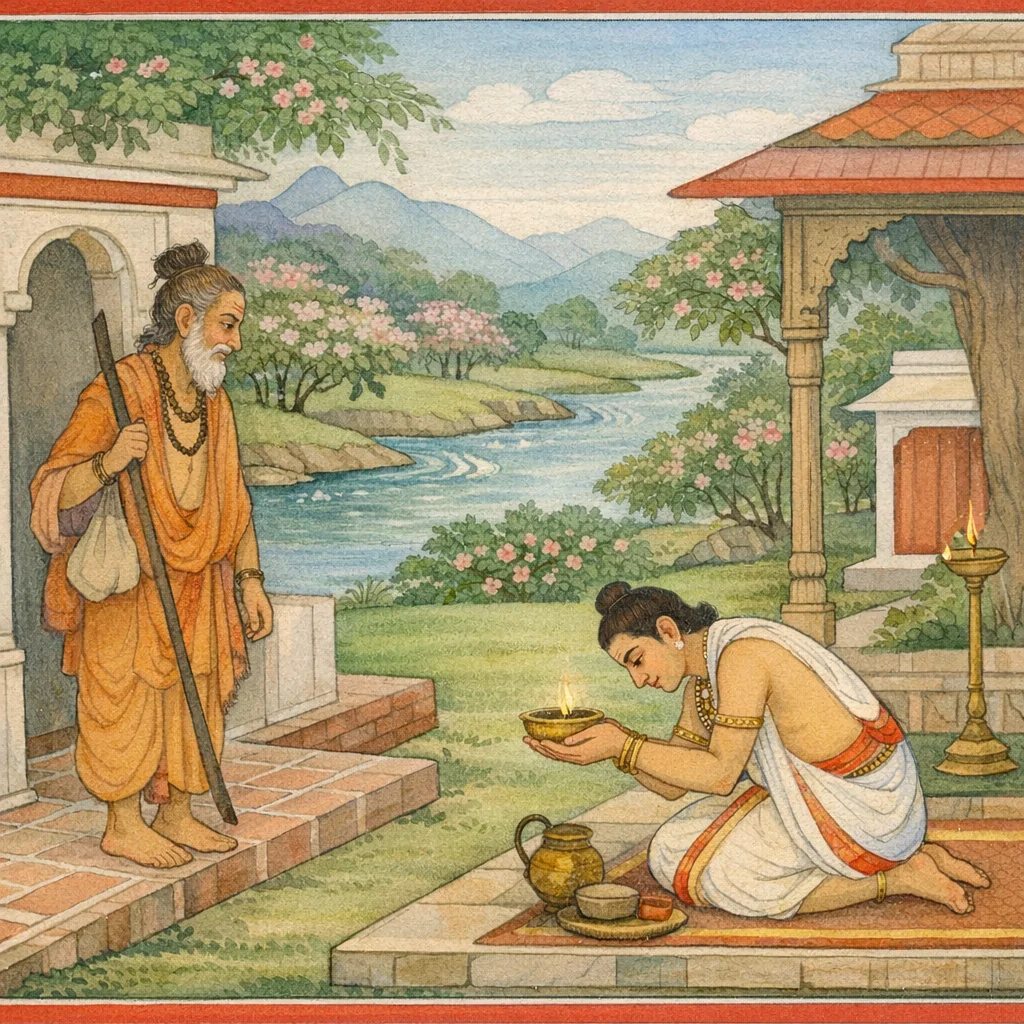
With the king absorbed in contemplation, Parāśara continues the teaching through the Ṛbhu–Nidāgha episode, framed as an advaita-leaning discourse to awaken direct understanding. Ṛbhu, son of Brahmā, visits his disciple Nidāgha after a long interval, using hospitality and food to question hunger, satisfaction, taste (mṛṣṭa/amṛṣṭa), and mental steadiness, thereby separating bodily dharmas from the Self. By explaining earth, water, fire, and other elements, he shows that bodily states arise from material conditions while the realized standpoint remains untouched. The instruction transcends notions of “coming and going,” affirming the all-pervading Person like space. Samatā—equanimity—is taught as the practical support for liberation. The chapter ends with Ṛbhu revealing his identity and sealing the non-dual vision: the entire undivided universe is the very svarūpa of Vāsudeva, the Paramātman.
Shlokas
Verse 1
इत्य् उक्ते मौनिनं भूयश् चिन्तयानं महीपतिम् प्रत्युवाचाथ विप्रो ऽसाव् अद्वैतान्तर्गतां कथाम्
When this had been spoken, and the king—silent like a sage—again sank into contemplation, that Brahmin then addressed him, unfolding a discourse that moved within the scope of non-duality.
Verse 2
श्रूयतां नृपशार्दूल यद् गीतम् ऋभुणा पुरा अवबोधं जनयता निदाघस्य द्विजन्मनः
O tiger among kings, listen: this was sung long ago by Ṛbhu—words that awakened true understanding in Nidāgha, the twice-born, and led him to clear realization.
Verse 3
ऋभुर् नामाभवत् पुत्रो ब्रह्मणः परमेष्ठिनः विज्ञाततत्त्वसद्भावो निसर्गाद् एव भूपते
O king, there was a son of Brahmā, the Supreme Ordainer (Parameṣṭhin), named Ṛbhu; by his very nature from birth he knew the true principle of reality and the genuine state of being.
Verse 4
तस्य शिष्यो निदाघो ऽभूत् पुलस्त्यतनयः पुरा प्रादाद् अशेषविज्ञानं स तस्मै परया मुदा
He had a disciple named Nidāgha, born long ago in the lineage of Pulastya; and with supreme joy Ṛbhu imparted to him the entirety of sacred knowledge, without remainder.
Verse 5
अवाप्तज्ञानतत्त्वस्य न तस्याद्वैतवासनाम् स ऋभुस् तर्कयाम् आस निदाघस्य नरेश्वर
O king, although Nidāgha had grasped the principle of true knowledge, the inward inclination toward non-duality had not yet arisen in him; therefore Ṛbhu began to guide Nidāgha through discerning reasoning.
Verse 6
देविकायास् तटे वीरनगरं नाम वै पुरम् समृद्धम् अतिरम्यं च पुलस्त्येन निवेशितम्
Upon the bank of the Devikā river stood a city called Vīranagara—prosperous and exceedingly delightful—established there by the sage Pulastya.
Verse 7
रम्योपवनपर्यन्ते स तस्मिन् पार्थिवोत्तम निदाघो नाम योगज्ञ ऋभुशिष्यो ऽवसत् पुरा
O best of kings, in that very place—at the edge of a delightful grove—there once dwelt Nidāgha, a knower of Yoga, the disciple of Ṛbhu, in former times.
Verse 8
दिव्ये वर्षसहस्रे तु समतीते ऽस्य तत् पुरम् जगाम स ऋभुः शिष्यं निदाघम् अवलोकितुम्
When a thousand divine years had passed, Ṛbhu went to that very city of his disciple, wishing to see Nidāgha.
Verse 9
स तस्य वैश्वदेवान्ते द्वारालोकनगोचरे स्थितस् तेन गृहीतार्घो निजवेश्मप्रवेशितः
He stood there at the close of the Vaiśvadeva rite, within sight of the doorway; then, received with the offering of arghya, he was respectfully led into the host’s own residence.
Verse 10
प्रक्षालिताङ्घ्रिपाणिं च कृतासनपरिग्रहम् उवाच स द्विजश्रेष्ठो भुज्यताम् इति सादरम्
After his feet and hands had been washed and a proper seat had been arranged, that foremost of twice-born sages said with respectful warmth, “Please partake of the meal.”
Verse 11
भो विप्रवर्य भोक्तव्यं यद् अन्नं भवतो गृहे तत् कथ्यतां कदन्नेषु न प्रीतिः सततं मम
O best of Brahmins, I shall partake of whatever food is in your house; yet tell me—why is my heart never at ease when it comes to unwholesome fare?
Verse 12
सक्तुयावकवाट्यानाम् अपूपानां च मे गृहे यद् रोचते द्विजश्रेष्ठ तत् त्वं भुङ्क्ष्व यथेच्छया
In my home there are barley-gruel, barley-cakes, and sweet apūpa cakes. Whatever pleases you, O best of the twice-born, eat that freely, as you desire.
Verse 13
कदन्नानि द्विजैतानि मिष्टम् अन्नं प्रयच्छ मे संयावपायसादीनि द्रप्सफाणितवन्ति च
O twice-born one, give me those cooked dishes; offer me sweet food as well—preparations such as saṃyāva and pāyasa, and foods enriched with drops of syrup and molasses.
Verse 14
हे हे शालिनि मद्गेहे यत् किंचिद् अतिशोभनम् भक्ष्योपसाधनं मिष्टं तेनास्यान्नं प्रसाधय
O Śālinī, whatever there is in my house that is especially fine—sweet foods and choice preparations—use that to arrange and serve her meal.
Verse 15
इत्य् उक्ता तेन सा पत्नी मिष्टम् अन्नं द्विजस्य यत् प्रसाधितवती तद् वै भर्तुर् वचनगौरवात्
Thus addressed by him, the wife—out of reverence for her husband’s word—prepared the sweet food that was to be offered to the twice-born (brāhmaṇa).
Verse 16
तं भुक्तवन्तम् इच्छातो मिष्टम् अन्नं महामुनिम् निदाघः प्राह भूपाल प्रश्रयावनतः स्थितः
When the great sage had eaten the sweet food according to his wish, Nidāgha—standing before the king with reverent humility and a bowed demeanor—addressed him: “O ruler of the earth …”
Verse 17
अपि ते परमा तृप्तिर् उत्पन्ना तुष्टिर् एव च अपि ते मानसं स्वस्थम् आहारेण कृतं द्विज
Has supreme satiety arisen in you, and true contentment as well? O twice-born, has your mind been made calm and steady by the food?
Verse 18
क्वनिवासो भवान् विप्र क्व च गन्तुं समुद्यतः आगम्यते च भवता यतस् तच् च द्विजोच्यताम्
O Brahmin, where is your dwelling, and to what place are you now setting out? And from where have you come to us? Tell me this also, O twice-born.
Verse 19
क्षुद् यस्य तस्य भुक्ते ऽन्ने तृप्तिर् ब्राह्मण जायते न मे क्षुद् अभवत् तृप्तिं कस्मान् मां परिपृच्छसि
O Brāhmaṇa, satisfaction arises for one who is hungry when food is eaten. But hunger never arose in me—so from where could “contentment” come to me? Why, then, do you question me about being satisfied?
Verse 20
वह्निना पार्थिवे धातौ क्षपिते क्षुत्समुद्भवः भवत्य् अम्भसि च क्षीणे नृणां तृड् अपि जायते
When the earthly element is consumed by fire, hunger is born; and when the waters diminish, thirst too arises among human beings.
Verse 21
क्षुत्तृष्णे देहधर्माख्ये न ममैते यतो द्विज ततः क्षुत्संभवाभावात् तृप्तिर् अस्त्य् एव मे सदा
Hunger and thirst, O twice-born, are called properties of the body; they are not mine. Therefore, since hunger never arises in me, contentment abides in me always.
Verse 22
मनसः स्वस्थता तुष्टिश् चित्तधर्माव् इमौ द्विज चेतसो यस्य तत् पृच्छ पुमान् एभिर् न युज्यते
O twice-born, steadiness of mind and contentment—these two are the true qualities of the citta. Inquire after the person whose consciousness holds them; one not joined to these is not firmly established in inner discipline.
Verse 23
क्व निवासस् तवेत्य् उक्तं क्व गन्तासि च यत् त्वया कुतश् चागम्यते तत्र त्रितये ऽपि निबोध मे
You have spoken of “where Your dwelling is,” and also of “where You go.” Tell me too—from where do You come to that place? In these three—abode, departure, and arrival—make me understand the truth.
Verse 24
पुमान् सर्वगतो व्यापी आकाशवद् अयं यतः कुतः कुत्र क्व गन्तासीत्य् एतद् अप्य् अर्थवत् कथम्
If this Supreme Person is everywhere—pervading all like space itself—then how could questions such as “From where?”, “From what cause?”, “Where?”, or “To what destination does He go?” ever be truly meaningful?
Verse 25
सो ऽहं गन्ता न चागन्ता नैकदेशनिकेतनः त्वं चान्ये च न च त्वं च नान्ये नैवाहम् अप्य् अहम्
That am I: the one who is said to “go,” and yet in truth neither comes nor goes, for I do not dwell confined to any single place. You too, and all others, are in essence that same Reality—yet not merely “you,” nor “others”; indeed, even “I” am not bound by the notion of “I”.
Verse 26
मृष्टं न मृष्टम् इत्य् एषा जिज्ञासा मे कृता तव किं वक्ष्यतीति तत्रापि श्रूयतां द्विजसत्तम
I have asked you this very question—what is to be regarded as “cleansed” and what as “not cleansed”. Now hear also, O best among the twice-born, what is to be said in that matter.
Verse 27
किम् अस्वाद्व् अथ वा मृष्टं भुञ्जतो ऽन्नं द्विजोत्तम मृष्टम् एव यदामृष्टं तद् एवोद्वेगकारणम्
O best of the twice-born, whether the food is tasteless or delicious—when what is truly sweet is found to be unsweet, that very reversal becomes the cause of inner disturbance.
Verse 28
अमृष्टं जायते मृष्टं मृष्टाद् उद्विजते जनः आदिमध्यावसानेषु किम् अन्नं रुचिकारकम्
From what is unseasoned arises what is seasoned; yet even from what is seasoned people grow weary and recoil. Tell me—what food is truly delightful at the beginning, in the middle, and at the end?
Verse 29
मृण्मयं हि गृहं यद्वन् मृदा लिप्तं स्थिरं भवेत् पार्थिवो ऽयं तथा देहः पार्थिवैः परमाणुभिः
Just as a house made of clay becomes firm when it is plastered with earth, so too this body—of the earth element—appears solid, compacted by countless minute earthly particles.
Verse 30
यवगोधूममुद्गादि घृतं तैलं पयो दधि गुडं फलादीनि तथा पार्थिवाः परमाणवः
Barley, wheat, and pulses such as green gram; ghee and oil; milk and curd; jaggery; fruits and the rest—these, and likewise the minute earthly atoms, are counted among the products and constituents of the terrestrial principle.
Verse 31
तद् एतद् भवता ज्ञात्वा मृष्टामृष्टविचारि यत् तन् मनः समतालम्बि कार्यं साम्यं हि मुक्तये
Knowing this—after discerning what is pleasing and what is unpleasing—let your mind take refuge in evenness. For steadfast inner equality is the means to liberation.
Verse 32
इत्य् आकर्ण्य वचस् तस्य परमार्थाश्रितं नृप प्रणिपत्य महाभागो निदाघो वाक्यम् अब्रवीत्
O King, having heard his words grounded in the highest truth, the noble Nidāgha bowed in reverence and then spoke.
Verse 33
प्रसीद मद्धितार्थाय कथ्यतां यस् त्वम् आगतः नष्टो मोहस् तवाकर्ण्य वचांस्य् एतानि मे द्विज
Be gracious to me for my welfare; tell me for what purpose you have come. O twice-born one, hearing these words of yours, my delusion has been dispelled.
Verse 34
ऋभुर् अस्मि तवाचार्यः प्रज्ञादानाय ते द्विज इहागतो ऽहं यास्यामि परमार्थस् तवोदितः
“I am Ṛbhu, your preceptor. O twice-born one, I have come here to bestow discerning wisdom upon you. I shall depart—your highest purpose has been declared.”
Verse 35
एवम् एकम् इदं विद्धि न भेदि सकलं जगत् वासुदेवाभिधेयस्य स्वरूपं परमात्मनः
Know thus that this entire universe is one—undivided and without true separation—for it is the very form of the Supreme Self, denoted by the name Vāsudeva.
Verse 36
तथेत्य् उक्त्वा निदाघेन प्रणिपातपुरःसरम् पूजितः परया भक्त्या इच्छातः प्रययाव् ऋभुः
Having said, “So be it,” Ṛbhu—first received with Nidāgha’s prostration and then honored with supreme devotion—departed of his own accord, as he willed.
Frequently Asked Questions
It uses ordinary experience to reveal a key discrimination: hunger/thirst and satisfaction are body–mind conditions arising from elemental imbalance, while the Self is not modified by them; this supports detachment and samatā leading toward mokṣa.
That the whole universe is one, undivided, and is the very form of the Paramātman denoted as Vāsudeva—so multiplicity is an appearance over the single all-pervading reality.