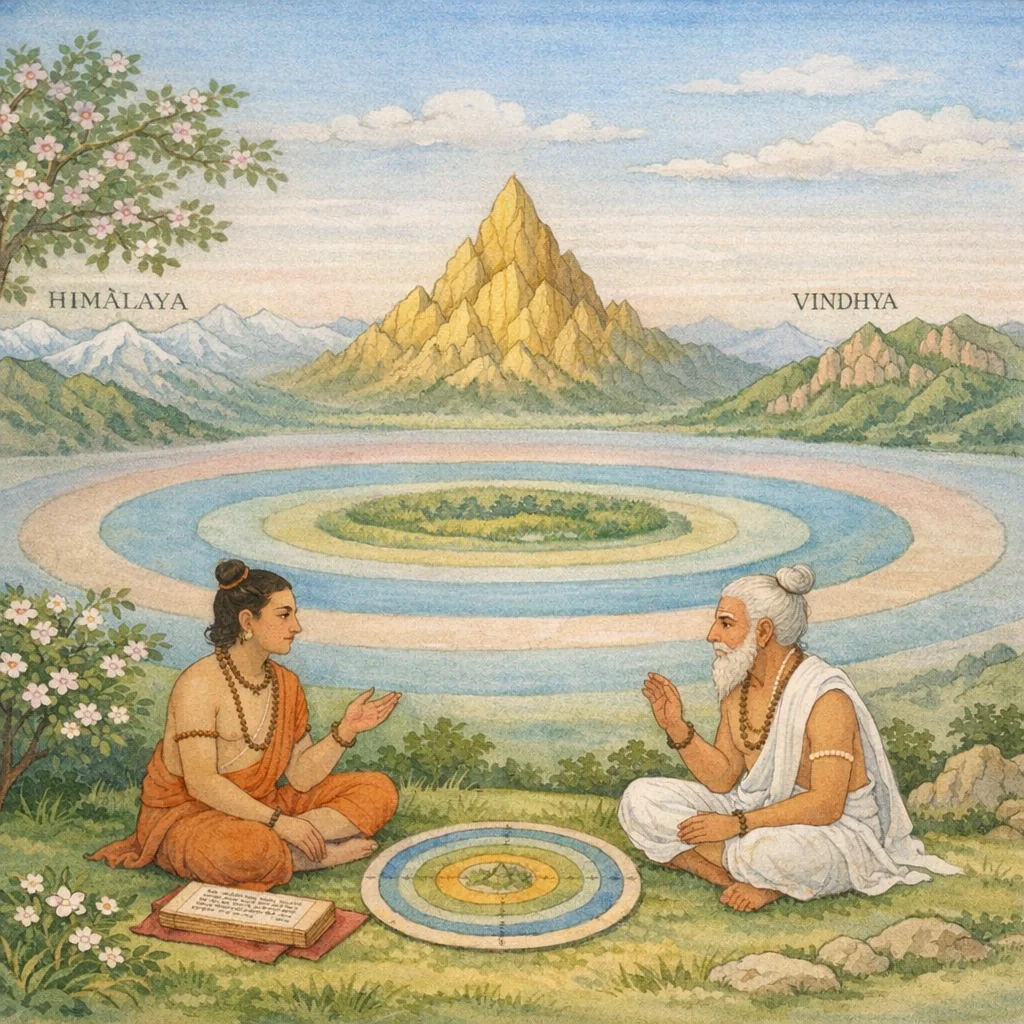
Bhu-maṇḍala-varṇanam (Description of the Earth-Maṇḍala, the Seven Continents, and Meru)
This adhyāya is a didactic instruction in which Sanatkumāra teaches Parāśarya a concise yet technical cosmography. It describes the bhū-maṇḍala as a world-disk of seven dvīpas encircled by seven oceans of differing substances, with Jambūdvīpa at the center. Meru is then set forth as the golden axial mountain within Jambūdvīpa, its height and breadth given in yojanas, along with the surrounding ranges—Himavān, Hemakūṭa, and Niṣadha to the south; Nīla, Śveta, and Śṛṅgī to the north. The chapter proceeds to name and order the varṣas (regions) such as Bhārata, Kimpuruṣa, Harivarṣa, Ramyaka, Hiraṇmaya, and Uttara-Kuru, presenting a Purāṇic geography that serves both as encyclopedic cosmology and as a ritual-theological map, wherein dharma, pilgrimage imagination, and devotion to Śiva become intelligible in an ordered space.
Shlokas
Verse 1
सनत्कुमार उवाच । पाराशर्य्य सुसंक्षेपाच्छृणु त्वं वदतो मम । मण्डलं च भुवस्सम्यक् सप्तद्वीपादिसंयुतम्
Sanatkumāra said: O Pārāśarya, listen attentively as I speak in brief. I shall correctly describe the earthly mandala of Bhū—this world-system furnished with the seven dvīpas and the rest.
Verse 2
जंबू प्लक्षश्शाल्मलिश्च कुशः क्रौञ्चश्च शाककः । पुष्पकस्सप्तमस्सर्वे समुद्रैस्सप्तभिर्वृताः
Jambū, Plakṣa, Śālmali, Kuśa, Krauñca, and Śākadvīpa—together with Puṣpaka as the seventh—these seven continents are all encircled by seven oceans.
Verse 3
लवणेक्षुरसौ सर्पिर्दविदुग्धजलाशयाः । जम्बुद्वीपस्समस्तानामेतेषां मध्यतः स्थितः
The encircling seas are of salt water, sugarcane juice, ghee, curd, and milk. In the very midst of them all lies Jambūdvīpa.
Verse 4
तस्यापि मेरुः कालेयमध्ये कनकपर्वतः । प्रविष्टः षोडशाधस्ताद्योजनैस्तस्य चोच्छ्रयः
Within that region, Mount Meru—also called the Golden Mountain—extends downward for sixteen yojanas; that is the measure of its embedded depth.
Verse 5
चतुरशीतिमानैस्तैर्द्वात्रिंशन्मूर्ध्नि विस्तृतः । भूमिपृष्ठस्थशैलोऽयं विस्तरस्तस्य सर्वतः
Measured as eighty-four (units) in extent and spread as thirty-two (units) at its summit, this mountain stands upon the earth’s surface, expanding on all sides.
Verse 6
मूले षोडशसाहस्रः कर्णिकाकार संस्थितः । हिमवान् हेमकूटश्च निषधश्चास्य दक्षिणे
At the base stands the mountain Ṣoḍaśasāhasra, set like the lotus’ pericarp. To its south are the mountains Himavān, Hemakūṭa, and Niṣadha.
Verse 7
नीलः श्वेतश्च शृङ्गी च उत्तरे वर्षपर्वताः । दशसाहस्रिकं ह्येते रत्नवंतोऽरुणप्रभाः
In the northern quarter stand the varṣa-mountains named Nīla, Śveta, and Śṛṅgī. These ranges stretch for ten thousand yojanas, rich in gems and glowing with a ruddy, dawn-like radiance.
Verse 8
सहस्रयोजनोत्सेधास्तावद्विस्तारिणश्च ते । भारतं प्रथमं वर्षं ततः किंपुरुषं स्मृतम्
Each of these regions is a thousand yojanas in height, and likewise a thousand yojanas in breadth. The first is known as Bhārata-varṣa; after it is spoken of the land called Kiṁpuruṣa.
Verse 9
हरिवर्षं ततो ऽन्यद्वै मेरोर्दक्षिणतो मुने । रम्यकं चोत्तरे पार्श्वे तस्यांशे तु हिरण्मयम्
O sage, to the south of Mount Meru lies another region called Harivarṣa. On the northern side is Ramyaka; and within that very division is the land known as Hiraṇmaya.
Verse 10
उत्तरे कुरवश्चैव यथा वै भारतं तथा । नवसाहस्रमेकैकमेतेषां मुनिसत्तम
O best of sages, in the northern region there are also the Kurus; and just as there is Bhārata, so each of these realms too is said to extend to nine thousand yojanas.
Verse 11
इलावृतं तु तन्मध्ये तन्मध्ये मेरुरुच्छ्रितः । मेरोश्चतुर्द्दिशं तत्र नवसाहस्रमुच्छ्रितम्
In the very midst of Ilāvṛta rises the lofty Mount Meru. Around Meru on all four sides, a surrounding region rises to the height of nine thousand yojanas.
Verse 12
इलावृतमृषिश्रेष्ठ चत्वारश्चात्र पर्वताः । विष्कंभा रचिता मेरोर्योजिताः पुनरुच्छ्रिताः
O best of sages, in Ilāvṛta there are four mountains. They have been set in place as supporting buttresses of Mount Meru, joined to it and rising up again in lofty height.
Verse 13
पूर्वे हि मन्दरो नाम दक्षिणे गन्धमादनः । विपुलः पश्चिमे भागे सुपार्श्वश्चोत्तरे स्थितः
To the east stands the mountain named Mandara; to the south is Gandhamādana. In the western quarter is Vipula, and to the north is situated Supārśva.
Verse 14
कदंबो जंबुवृक्षश्च पिप्पलो वट एव च । एकादशशतायामाः पादपा गिरिकेतवः
Kadamba, the Jambu tree, the Pippala (aśvattha), and the Vaṭa (banyan) as well—these trees, like banners upon the mountains, rose to a height of eleven hundred yojanas.
Verse 15
जम्बूद्वीपस्य नाम्नो वै हेतुं शृणु महामुने । विराजंते महावृक्षास्तत्स्वभावं वदामि ते
O great sage, hear the true reason for the name “Jambūdvīpa.” There the mighty trees shine forth in splendor; I shall tell you their very nature.
Verse 16
महागज प्रमाणानि जम्ब्वास्तस्याः फलानि च । पतंति भूभृतः पृष्ठे शीर्य्यमाणानि सर्वतः
The fruits of that jambu tree are as vast as great elephants; when they ripen and split, they fall in every direction upon the face of the earth.
Verse 17
इति श्रीशिवमहापुराणे पञ्चम्यामुमासंहितायां ब्रह्माण्डकथने जम्बूद्वीपवर्षवर्णनं नाम सप्तदशोध्यायः
Thus, in the Śrī Śiva Mahāpurāṇa—within the Fifth Book, the Umāsaṃhitā, in the section narrating the Brahmāṇḍa (the cosmic egg)—ends the seventeenth chapter entitled “Description of the regions (varṣas) of Jambūdvīpa.”
Verse 18
न स्वेदो न च दौर्गंध्यं न जरा चेन्द्रियग्रहः । तस्यास्तटे स्थितानान्तु जनानां तन्न जायते
For those who remain on the bank of that sacred place, there arises neither perspiration nor foul odour, neither old age nor any affliction of the senses.
Verse 19
तीरमृत्स्नां च सम्प्राप्य मुखवायुविशोषिताम् । जाम्बूनदाख्यं भवति सुवर्णं सिद्धभूषणम्
When the riverbank clay is obtained and dried by the breath of the mouth, it becomes the gold called Jāmbūnada—fit to be the perfected adornment of accomplished beings.
Verse 20
भद्राश्वं पूर्वतो मेरोः केतुमालं च पश्चिमे । वर्षे द्वे तु मुनिश्रेष्ठ तयोर्मध्य इलावृतम्
O best of sages, to the east of Mount Meru lies Bhadrāśva, and to the west lies Ketumāla. These are two great varṣas; between them, in the middle, is Ilāvṛta.
Verse 21
वनं चैत्ररथं पूर्वे दक्षिणे गन्धमादनः । विभ्राजं पश्चिमे तद्वदुत्तरे नन्दनं स्मृतम्
To the east lies the Caitraratha forest; to the south is Gandhamādana. To the west is Vibhrāja; and likewise, to the north, Nandana is spoken of as situated.
Verse 22
अरुणोदं महाभद्रं शीतोदं मानसं स्मृतम् । सरांस्येतानि चत्वारि देवभोग्यानि सर्वशः
Arunoda, Mahābhadra, Śītoda, and the lake Mānasa—these are remembered as the four lakes. In every way, they are places of divine enjoyment, fit for the gods.
Verse 23
शीतांजनः कुरुंगश्च कुररो माल्यवांस्तथा । चैकैकप्रमुखा मेरोः पूर्वतः केसराचलाः
To the east of Mount Meru lie the Kesarācalas, mane-like subsidiary ranges, each with its own chief peak—Śītāṃjana, Kuruṅga, Kurara, and Mālyavān.
Verse 24
त्रिकूटश्शिशिरश्चैव पतंगो रुचकस्तथा । निषधः कपिलायाश्च दक्षिणे केसराचलाः
To the south are these famed mountains: Trikūṭa and Śiśira, Pataṅga and Rucaka; likewise Niṣadha; and, in the southern region, the Kesarācalas of Kapilā.
Verse 25
सिनी वासः कुसुंभश्च कपिलो नारदस्तथा । नागादयश्च गिरयः पश्चिमे केसराचलाः
To the west are the sacred mountains Sinīvāsa, Kusumbha, Kapila, and also Nārada; likewise the Nāga and other mountains—among them the Kesarācala range—are situated there.
Verse 26
शंखचूडोऽथ ऋषभो हंसो नाम महीधरः । कालंजराद्याश्च तथा उत्तरे केसराचलाः
There is a mountain named Śaṅkhacūḍa; then (the mountains) Ṛṣabha and Haṃsa. Likewise, (there are) Kālañjara and others; and in the northern region are the Kesara mountains.
Verse 27
मेरोरुपरि मध्ये हि शातकौंभं विधेः पुरम् । चतुर्द्दशसहस्राणि योजनानि च संख्यया
In the middle region atop Mount Meru stands Śātakauṃbha, the city of the Creator, Brahmā; its extent is declared to be fourteen thousand yojanas.
Verse 28
अष्टानां लोकपालानां परितस्तदनुक्रमात् । यथादिशं यथारूपं पुरोऽष्टावुपकल्पिताः
In proper sequence, eight arrangements were set forth in front and all around, corresponding to the eight Lokapālas—each in its own direction and in a form befitting that quarter.
Verse 29
तस्यां च ब्रह्मणः पुर्य्यां पातयित्वेन्दुमण्डलम् । विष्णुपादविनिष्क्रांता गंगा पतति वै नदी
And there, in Brahmā’s celestial city, after striking the orb of the Moon, the Gaṅgā—issued from the feet of Viṣṇu—indeed descended downward as a flowing river.
Verse 30
सीता चालकनंदा च चक्षुर्भद्रा च वै क्रमात् । सा तत्र पतिता दिक्षु चतुर्द्धा प्रत्यपद्यत
In due order—(as) Sītā, Cālakānandā, and Cakṣurbhadrā—she, having fallen there, became established in the quarters in a fourfold form.
Verse 31
सीता पूर्वेण शैलं हि नन्दा चैव तु दक्षिणे । सा चक्षुः पश्चिमे चैव भद्रा चोत्तरतो व्रजेत्
“Let Sītā go to the eastern side of the mountain; and Nandā indeed to the southern side. Let Sā-Cakṣuḥ go to the western side; and Bhadrā should proceed to the northern side.”
Verse 32
गिरीनतीत्य सकलांश्चतुर्द्दिक्षु महांबुधिम् । सा ययौ प्रयता सूता गंगा त्रिपथगामिनी
Crossing beyond all the mountains and moving in the four directions toward the great ocean, the sacred Gaṅgā—pure and intent—flowed on, she who travels the three paths (heaven, earth, and the netherworld).
Verse 33
सुनीलनिषधौ यौ तौ माल्यवद्गन्धमादनौ । तेषां मध्यगतो मेरुः कर्णिकाकारसंस्थितः
Between the two mountains Sunīla and Niṣadha, and (between) Mālyavat and Gandhamādana, stands Mount Meru at the very center, situated like the pericarp of a lotus—the central support around which all is ordered.
Verse 34
भारतः केतुमालश्च भद्राश्वः कुरवस्तथा । पत्राणि लोकपद्मस्य मर्यादालोकपर्वताः
Bhārata, Ketumāla, Bhadrāśva, and likewise the Kurus—these are the petals of the world-lotus; and the boundary mountains are the mountains that mark the limits of the worlds.
Verse 35
जठरं देवकूटश्च आयामे दक्षिणोत्तरे । गन्धमादनकैलासौ पूर्वपश्चिमतो गतौ
In the north–south expanse lie the mountains Jaṭhara and Devakūṭa; and in the east–west direction extend Gandhamādana and Kailāsa.
Verse 36
पूर्वपश्चिमतो मेरोर्निषधो नीलपर्वतः । दक्षिणोत्तरमायातौ कर्णिकांतर्व्यवस्थितौ
To the east and west of Mount Meru are the Niṣadha and Nīla mountains. Extending in the south–north direction, they are situated within the inner region of the (cosmic) pericarp.
Verse 37
जठराद्याः स्थिता मेरोर्येषां द्वौ द्वौ व्यवस्थितौ । केसराः पर्वता एते श्वेताद्याः सुमनोरमाः
Beginning with Jaṭhara, mountains stand around Mount Meru, arranged in pairs. These charming ranges are called the “Kesaras,” including Śveta and the others, delightful to behold.
Verse 38
शैलानामुत्तरे द्रोण्यस्सिद्धचारणसेविताः । सुरम्याणि तथा तासु काननानि पुराणि च
To the north of the mountains lie valleys frequented by Siddhas and Cāraṇas; within them are exceedingly beautiful ancient groves and primeval forests as well.
Verse 39
सर्वेषां चैव देवानां यक्षगंधर्वरक्षसाम् । क्रीडंति देवदैतेयाश्शैलप्रायेष्वहर्निशम्
Indeed, the Devas—as well as the Yakṣas, Gandharvas, and Rākṣasas—together with the Devas and Daityas, sport there day and night, mostly upon the mountain-peaks.
Verse 40
धर्मिणामालया ह्येते भौमास्स्वर्गाः प्रकीर्तिताः । न तेषु पापकर्तारो यांति पश्यंति कुत्रचित्
These are proclaimed to be “earthly heavens”—abodes meant for the righteous. Into them, doers of sin do not enter; nor are they seen there at any time.
Verse 41
यानि किंपुरुषादीनि वर्षाण्यष्टौ महामुने । न तेषु शोको नापत्त्यो नोद्वेगः क्षुद्भयादिकम्
O great sage, in those eight regions beginning with Kimpuruṣa, there is no sorrow, no calamity, no agitation, nor the fears of hunger and the like.
Verse 42
स्वस्थाः प्रजा निरातंकास्सर्वदुःखविवर्जिताः । दशद्वादशवर्षाणां सहस्राणि स्थिरायुषः
The people remain well and whole, free from fear and anxiety, untouched by every kind of sorrow. Their lifespan is steady and long—enduring for thousands of years, reckoned in tens and in twelves of years.
Verse 43
कृतत्रेतादिकाश्चैव भौमान्यंभांसि सर्वतः । न तेषु वर्षते देवस्तेषु स्थानेषु कल्पना
In the Kṛta, Tretā, and other ages, earthly waters are said to be found on every side; yet in those regions the deity sends no rain. Thus it is understood that such places are only kalpanā—imagined conceptions, not truly describable abodes.
Verse 44
सप्तस्वेतेषु नद्यश्च सुजातास्स्वर्णवा लुकाः । शतशस्संति क्षुद्राश्च तासु क्रीडारता जनाः
Among these seven are well-born rivers whose sands gleam like gold. There are also hundreds of smaller streams, and people delight in play and recreation along their banks.
Frequently Asked Questions
A compact cosmographic unit: the bhū-maṇḍala schema with seven dvīpas and seven encircling oceans, followed by the centrality of Jambūdvīpa, the axial Meru mountain, and the ordered varṣa divisions (including Bhārata and Uttara-Kuru).
Meru operates as an axis-mundi symbol of cosmic centrality and vertical hierarchy, while the concentric dvīpa–ocean pattern encodes an ordered universe where space is not neutral but value-laden—supporting Purāṇic ideas of sacred orientation, gradation of realms, and the intelligibility of dharma within a mapped cosmos.
No specific Śiva/Umā form is foregrounded in the sampled portion; the chapter’s emphasis is cosmology and sacred geography. Its Shaiva relevance is indirect: the ordered world-map serves as a doctrinal substrate for later tīrtha logic, ritual orientation, and the Purāṇic framing of Śiva as the ultimate ground of cosmic order.