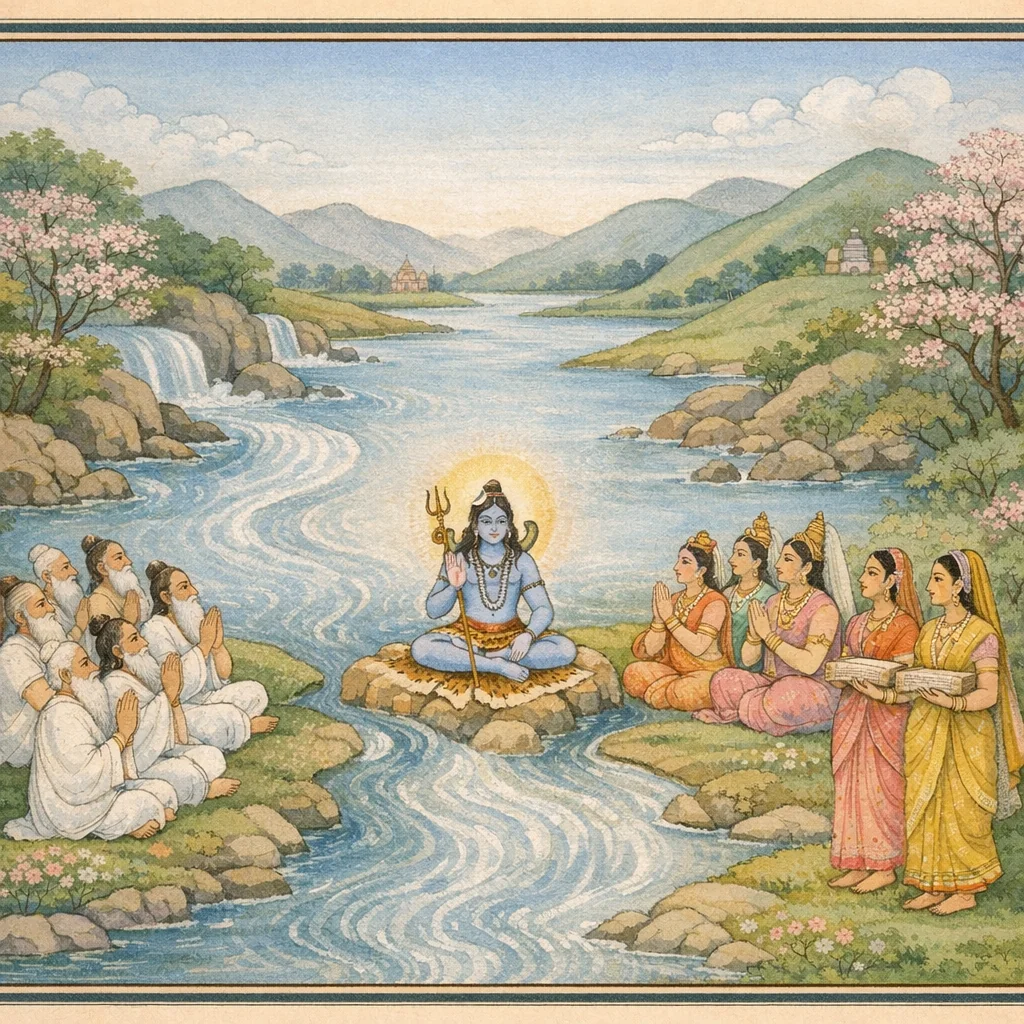
प्रयागे महत्समाजः — शिवदर्शनं दक्षागमनं च (The Great Assembly at Prayāga: Śiva’s Appearance and Dakṣa’s Arrival)
Adhyāya 26 begins with Brahmā recounting a former grand sacrifice (adhvara) duly performed at Prayāga, where great sages and exalted beings assembled. Siddhas and primordial rishis such as Sanaka, along with devas and prajāpatis—knowers and “brahma-seers”—formed a vast, learned congregation. Brahmā arrived with his retinue, and the nigamas (Vedic corpus) and āgamas (Shaiva revelatory traditions) are portrayed as luminous, personified authorities, indicating a deliberate harmonizing of scriptural streams. The variegated assembly became festival-like, and a jñānavāda—formal discourse on knowledge—arose from many śāstras. At that moment Śiva appeared, accompanied by Bhavānī’s gaṇas, as benefactor of the three worlds; before his presence the assembly’s hierarchy reordered. Devas, siddhas, and sages—including Brahmā—offered salutations and hymns; at Śiva’s command they took their seats, satisfied by his darśana and speaking of their ritual duties. Then Dakṣa arrived, radiant and powerful as lord among the prajāpatis, paid homage to Brahmā, and was seated by Brahmā’s instruction. The gathered sura-ṛṣis honored Dakṣa with praises and prostrations, setting the stage for coming tensions of ritual pride, status, and the necessity of honoring Śiva within sacrificial order.
Shlokas
Verse 1
ब्रह्मोवाच । पुराभवच्च सर्वेषामध्वरो विधिना महान् । प्रयागे समवेतानां मुनीनां च महा त्मनाम्
Brahmā said: In former times, at Prayāga, there took place—duly performed according to sacred rule—a great sacrificial rite for the benefit of all, when great-souled sages had assembled there together.
Verse 2
तत्र सिद्धास्समायातास्सनकाद्यास्सुरर्षयः । सप्रजापतयो देवा ज्ञानिनो ब्रह्मदर्शिनः
There, the Siddhas arrived, along with the celestial sages beginning with Sanaka. The gods too came—together with the Prajāpatis—wise ones who had direct vision of Brahman.
Verse 3
अहं समागतस्तत्र परिवारसमन्वितः । निगमैरागमैर्युक्तो मूर्तिमद्भिर्महाप्रभैः
“I arrived there, accompanied by my attendants, and attended by the Nigamas and Āgamas—those mighty, resplendent scriptures—present in embodied form.”
Verse 4
समाजोभूद्विचित्रो हि तेषामुत्सवसंयुः । ज्ञानवादोऽभवत्तत्र नानाशास्त्रस मुद्भवः
Indeed, their gathering became a wondrous festival-assembly. There, a discourse on spiritual knowledge arose—born of many śāstras—unfolding in that very congregation.
Verse 5
तस्मिन्नवसरे रुद्रस्सभवानीगणः प्रभुः । त्रिलोकहितकृत्स्वामी तत्रागात्सूक्तिकृन्मुने
At that very moment, Lord Rudra—the sovereign Lord—arrived there, accompanied by Bhavānī and her retinue, O sage. The Master, ever intent on the welfare of the three worlds, came there, uttering auspicious and fitting words.
Verse 6
दृष्ट्वा शिवं सुरास्सर्वे सिद्धाश्च मुनयस्तथा । अनमंस्तं प्रभुं भक्त्या तुष्टुवुश्च तथा ह्यहम्
Beholding Śiva, all the Devas, the Siddhas, and the sages likewise bowed to that Lord with devotion and praised Him; and so did I as well.
Verse 7
तस्थुश्शिवाज्ञया सर्वे यथास्थानं मुदान्विताः । प्रभुदर्शनसंतुष्टाः वर्णयन्तो निजं विधिम्
By Śiva’s command, they all stood in their proper places, filled with joy. Content from the vision of the Lord, they spoke among themselves of their own duties and the ordained ways of service.
Verse 8
तस्मिन्नवसरे दक्षः प्रजापतिपतिः प्रभुः । आगमत्तत्र सुप्रीतस्सुवर्चस्वी यदृच्छया
At that very time, Dakṣa—the mighty lord among the Prajāpatis—arrived there by chance, radiant with splendid lustre and in a pleased mood.
Verse 9
मां प्रणम्य स दक्षो हि न्युष्टस्तत्र मदाज्ञया । ब्रह्माण्डाधिपतिर्मान्यो मानी तत्त्वबहिर्मुखः
Having bowed to Me, Dakṣa indeed remained there by My command. Though he was the revered lord of the cosmic sphere, he was proud and turned outward—away from the inner truth (tattva).
Verse 10
स्तुतिभिः प्रणिपातैश्च दक्षस्सर्वैस्सुरर्षिभिः । पूजितो वरतेजस्वी करौ बध्वा विनम्रकैः
Praised with hymns and honoured with prostrations by all the gods and sages, Dakṣa—radiant with the splendour of boons—was reverently worshipped by the humble, who bowed with hands joined in submission.
Verse 11
नानाविहारकृन्नाथस्स्वतंत्र परमोतिकृत् । नानामत्तं तदा दक्षं स्वासनस्थो महेश्वरः
Then Maheshvara—the Lord who sports in many ways, utterly independent and supremely exalted—remained seated upon His own seat and regarded Daksha, who at that time was puffed up with manifold pride.
Verse 12
दृष्टाऽनतं हरं तत्र स मे पुत्रोऽप्रसन्नधीः । अकुपत्सहसा रुद्रे तदा दक्षः प्रजापतिः
There, seeing Hara (Śiva) not bowing, that son of mine—Dakṣa Prajāpati, whose mind was displeased—suddenly became angry with Rudra.
Verse 13
क्रूरदृष्ट्या महागर्वो दृष्ट्वा रुद्रं महाप्रभुम् । सर्वान्संश्रावयन्नुच्चैरवोचज्ज्ञानवर्जितः
Seeing Rudra, the mighty and supremely radiant Lord, that great egotist—casting a cruel glance—spoke aloud so that all could hear, for he was devoid of true spiritual discernment.
Verse 14
एते हि सर्वे च सुरासुरा भृशं नमंति मां विप्रवरास्तथर्षयः । कथं ह्यसौ दुर्जनवन्महामनास्त्वभूत्तु यः प्रेतपिशाचसंवृतः
“All these—both devas and asuras—bow to me with great reverence; so too do the foremost Brahmins and the sages. How then did that high-minded one come to behave like a wicked man—he who has become surrounded by pretas and piśācas?”
Verse 15
श्मशानवासी निरपत्रपो ह्ययं कथं प्रणामं न करोति मेऽधुना । लुप्तक्रियो भूतपिशाचसेवितो मत्तोऽविधो नीतिविदूषकस्सदा
“This one dwells in the cremation-ground and is utterly shameless—how is it that he does not bow to me even now? His rites are lost, he is attended by bhūtas and piśācas; like a drunkard he is unruly, ever a mocker of propriety.”
Verse 16
पाखंडिनो दुर्जनपाप शीला दृष्ट्वा द्विजं प्रोद्धतनिंदकाश्च । वध्वां सदासक्तरतिप्रवीणस्तस्मादमुं शप्तुमहं प्रवृत्तः
Seeing that brāhmaṇa—those heretical men, wicked and habituated to sin, swollen with arrogance and given to slander—being ever skilled in lust and attached to another’s wife, therefore I have set myself to curse him.
Verse 17
ब्रह्मोवाच । इत्येवमुक्त्वा स महाखलस्तदा रुषान्वितो रुद्रमिदं ह्यवोचत् । शृण्वंत्वमी विप्रवरास्तथा सुरा वध्यं हि मे चार्हथ कर्तुमेतम्
Brahmā said: “Having spoken thus, that exceedingly wicked one, overcome with anger, addressed Rudra in these words: ‘Let these foremost brāhmaṇas and the devas hear. This man deserves to be slain—so you must make him slain for my sake.’”
Verse 18
दक्ष उवाच । रुद्रो ह्ययं यज्ञबहिष्कृतो मे वर्णेष्वतीतोथ विवर्णरूपः । देवैर्न भागं लभतां सहैव श्मशानवासी कुलजन्म हीनः
Dakṣa said: “Truly, this Rudra has been excluded by me from the yajña. He stands beyond the varṇas and appears without the customary marks of rank. Let him receive no share with the devas—he dwells in the cremation ground, bereft of noble lineage and birth.”
Verse 19
ब्रह्मोवाच । इति दक्षोक्तमाकर्ण्य भृग्वाद्या बहवो जनाः । अगर्हयन् दुष्टसत्त्वं रुद्रं मत्त्वामरैस्समम्
Brahmā said: Hearing Dakṣa’s words thus, many people—beginning with Bhṛgu—reviled Rudra, deeming Him wicked in nature and regarding Him as merely equal to the other devas.
Verse 20
नन्दी निशम्य तद्वाक्यं लालाक्षोतिरुषान्वितः । अब्रवीत्त्वरितं दक्षं शापं दातुमना गणः
Hearing those words, Nandī—his eyes reddened with wrath—at once addressed Dakṣa; the gaṇa, intent on uttering a curse, spoke without delay.
Verse 21
नन्दीश्वर उवाच । रेरे शठ महा मूढ दक्ष दुष्टमते त्वया । यज्ञबाह्यो हि मे स्वामी महेशो हि कृतः कथम्
Nandīśvara said: “Alas, you deceitful one—O Dakṣa, great fool of wicked intent! How could you make my Lord Maheśa, truly the Supreme, into one excluded from the sacrifice?”
Verse 22
यस्य स्मरणमात्रेण भवंति सफला मखाः । तीर्थानि च पवित्राणि सोयं शप्तो हरः कथम्
By the mere remembrance of Hara (Śiva), sacrifices become fruitful and holy pilgrimage-places are sanctified—how could that very Hara ever be cursed?
Verse 23
वृथा ते ब्रह्मचापल्याच्छप्तोयं दक्ष दुर्मते । वृथोपहसितश्चैवादुष्टो रुद्रो महा प्रभुः
O Dakṣa, of perverse understanding—because of your brahminical arrogance and fickle pride, this curse of yours is in vain. Your mockery too is in vain; for Rudra, the great Lord, is not wicked at all.
Verse 24
येनेदं पाल्यते विश्वं सृष्टमंते विनाशितम् । शप्तोयं स कथं रुद्रो महेशो ब्राह्मणाधम
“He by whom this entire universe is sustained, and who, at the end, dissolves what has been created—how can that Rudra, that Mahādeva, truly be ‘cursed’? O vilest of Brahmins!”
Verse 25
एवं निर्भत्सितस्तेन नन्दिना हि प्रजापतिः । नन्दिनं च शशापाथ दक्षो रोषसमन्वितः
Thus rebuked by Nandin, the Prajāpati Dakṣa—overcome with anger—then proceeded to curse Nandin as well.
Verse 26
इति श्रीशिवमहापुराणे द्वितीयायां रुद्रसंहितायां द्वितीयखण्डे सत्युपाख्याने शिवेन दक्षविरोधो नाम षड्विंशोऽध्यायः
Thus, in the Śrī Śiva Mahāpurāṇa—within the second Saṃhitā, the Rudra-saṃhitā; in its second section, the Satī narrative—ends the twenty-sixth chapter entitled “Dakṣa’s Opposition to Śiva,” as spoken by Lord Śiva.
Verse 27
पाखंडवादनिरताः शिष्टाचारबहिष्कृताः । मदिरापाननिरता जटा भस्मास्थिधारिणः
They are engrossed in heretical talk, cast out from the conduct of the cultured; addicted to drinking liquor, they wear matted locks and carry ash and bones.
Verse 28
ब्रह्मोवाच । इति शप्तास्तथा तेन दक्षेण शिवकिंकराः । तच्छ्रुत्वातिरुषाविष्टोभवन्नंदी शिवप्रियः
Brahmā said: “Thus were Śiva’s attendants cursed by Dakṣa. Hearing those words, Nandī—dear to Lord Śiva—became overwhelmed with intense wrath.”
Verse 29
प्रत्युवाच द्रुतं पक्षं गर्वितं तं महाखलम् । शिलादतनयो नंदी तेजस्वी शिववल्लभः
Then Nandī—Śilāda’s son, radiant in splendor and dearly beloved of Lord Śiva—swiftly replied to that arrogant and utterly wicked partisan.
Verse 30
नन्दीश्वर उवाच । रे दक्ष शठ दुर्बुद्धे वृथैव शिवकिंकराः । शप्तास्ते ब्रह्मचापल्याच्छिवतत्त्वमजानता
Nandīśvara said: “O Dakṣa, deceitful one of perverse understanding! In vain have you cursed the servants of Śiva. Those curses were uttered only out of Brahmā-like impetuosity, for you do not know the true tattva—the principle—of Śiva.”
Verse 31
भृग्वाद्यैर्दुष्टचित्तैश्च मूढैस्स उपहासितः । महा प्रभुर्महेशानो ब्राह्मणत्वादहंमते
Mocked by the dull-witted and evil-minded, beginning with Bhṛgu, the Great Lord Maheśāna was treated with contempt—because, in their arrogant opinion, He had assumed the condition of a brāhmaṇa.
Verse 32
ये रुद्रविमुखाश्चात्र ब्राह्मणास्त्वादृशाः खलाः । रुद्रतेजःप्रभावत्वात्तेषां शापं ददाम्यहम्
“Those wicked brāhmaṇas here, who are like you—turned away from Rudra—by the power of Rudra’s blazing spiritual splendor, I now pronounce a curse upon them.”
Verse 33
वेदवादरता यूयं वेदतत्त्वबहिर्मुखाः । भवंतु सततं विप्रा नान्यदस्तीति वादिनः
You are devoted only to disputing about the Vedas, yet you have turned away from the Vedas’ true purport. O brāhmaṇas, may you remain ever as those who argue, “There is nothing beyond this.”
Verse 34
कामात्मानर्स्स्वर्गपराः क्रोधलोभमदान्विताः । भवंतु सततं विप्रा भिक्षुका निरपत्रपाः
“May those brāhmaṇas become forever driven by desire, intent only on heaven; possessed of anger, greed, and pride—may they become shameless beggars continually.”
Verse 35
वेदमार्गं पुरस्कृत्य ब्राह्मणाश्शूद्रयाजिनः । दरिद्रा वै भविष्यंति प्रतिग्रहरता स्सदा
Brāhmaṇas who put forward the Vedic path yet perform sacrifices for Śūdras will indeed become poor, for they remain ever attached to accepting gifts in return for such rites.
Verse 36
असत्प्रतिग्रहाश्चैव सर्वे निरयगामिनः । भविष्यंति सदा दक्ष केचिद्वै ब्रह्मराक्षसाः
“Those who accept improper gifts—offerings not grounded in dharma—are all destined for hell. And some, O Dakṣa, will indeed ever become Brahma-rākṣasas.”
Verse 37
यश्शिवं सुरसामान्यमुद्दिश्य परमेश्वरम् । द्रुह्यत्यजो दुष्टमतिस्तत्त्वतो विमुखो भवेत्
Whoever, though speaking of the Supreme Lord Parameśvara Śiva, deems Him merely an ordinary deity among the gods and then bears malice toward Him—such a one, though unborn in essence as the Ātman, becomes of wicked understanding and turns away from the truth of reality.
Verse 38
कूटधर्मेषु गेहेषु सदा ग्राम्यसुखेच्छया । कर्मतंत्रं वितनुता वेदवादं च शाश्वतम्
In households ruled by crooked and hypocritical duties, ever driven by the craving for coarse, worldly pleasures, they spread a whole machinery of ritual action (karma) and keep proclaiming Veda-vāda as though it were itself the eternal end.
Verse 39
विनष्टानंदकमुखो विस्मृतात्मगतिः पशुः । भ्रष्टकर्मानयसदा दक्षो बस्तमुखोऽचिरात्
Deprived of all joy, that beast Dakṣa—forgetting the soul’s true course—became ever fallen in conduct and misled in action; and before long he came to bear the face of a goat.
Verse 40
शप्तास्ते कोपिना तत्र नंदिना ब्राह्मणा यदा । हाहाकारो महानासीच्छप्तो दक्षेण चेश्वरः
When, in that assembly, those brāhmaṇas were cursed by the enraged Nandin, a great uproar arose; and Dakṣa, in turn, also pronounced a curse upon the Lord Īśvara (Śiva).
Verse 41
तदाकर्ण्यामहत्यंतमनिंदंतं मुहुर्मुहुः । भृग्वादीनपि विप्रांश्च वेदसृट् शिव तत्त्ववित्
Hearing that grievous slander again and again, Brahmā—the lord born of the Veda, knower of Śiva’s truth—repeatedly condemned it, and reproved even the brāhmaṇa sages beginning with Bhṛgu.
Verse 42
ईश्वरोपि वचः श्रुत्वा नंदिनः प्रहसन्निव । उवाच मधुरं वाक्यं बोधयंस्तं सदाशिवः
Even the Lord, having heard Nandin’s words, as though smiling, spoke sweetly—Sadāśiva instructing and enlightening him.
Verse 43
सदाशिव उवाच । शृणु नंदिन् महाप्राज्ञ न कर्तुं क्रोधमर्हसि । वृथा शप्तो ब्रह्मकुलो मत्वा शप्तं च मां भ्रमात्
Sadāśiva said: “Listen, O Nandin, great wise one—you should not give way to anger. The lineage of Brahmā has been cursed in vain, imagining in delusion that they had cursed even Me.”
Verse 44
वेदो मंत्राक्षरमयस्साक्षात्सूक्तमयो भृशम् । सूक्ते प्रतिष्ठितो ह्यात्मा सर्वेषामपि देहिनाम्
The Veda is, in truth, made of mantra-syllables and richly composed of sacred hymns (sūktas). In those hymns the very Self (Ātman) is established, for the Self of all embodied beings abides there as its foundation and revelation.
Verse 45
तस्मादात्मविदो नित्यं त्वं मा शप रुषान्वितः । शप्या न वेदाः केनापि दुर्द्धियापि कदाचन
Therefore, you who are ever a knower of the Self (Ātman)—do not, overcome by anger, utter a curse. The Vedas are never fit to be cursed by anyone at any time, not even by a person of perverse understanding.
Verse 46
अहं शप्तो न चेदानीं तत्त्वतो बोद्धुमर्हसि । शान्तो भव महाधीमन्सनकादिविबोधकः
If I were not under a curse, you would now be fit to realize the Truth in its very essence. O great-minded one, be at peace—you who are the awakener of Sanaka and the other sages.
Verse 47
यज्ञोहं यज्ञकर्माहं यज्ञांगानि च सर्वशः । यतात्मा यज्ञनिरतो यज्ञबाह्योहमेव वै
I am the sacrifice (yajña) itself; I am the act of sacrifice; and I am all the limbs and constituents of the sacrifice in every way. I am the self-controlled one, ever devoted to yajña—and I alone also stand beyond the sacrifice (as its transcendent Lord).
Verse 48
कोयं कस्त्वमिमे के हि सर्वोहमपि तत्त्वतः । इति बुद्ध्या हि विमृश वृथा शप्तास्त्वया द्विजाः
Reflect with discernment: “Who is this? Who are you? Who indeed are these? In truth, all is one Self.” Having understood thus, know that the twice-born have been cursed by you in vain.
Verse 49
तत्त्वज्ञानेन निर्हृत्य प्रपंचरचनो भव । बुधस्स्वस्थो महाबुद्धे नन्दिन् क्रोधादिवर्जितः
Having removed the bondage of worldly proliferation through knowledge of Reality, become one who no longer weaves saṃsāric entanglement. O great-intellect, Nandin—be a steady sage, established in inner poise, free from anger and the like.
Verse 50
ब्रह्मोवाच । एवं प्रबोधितस्तेन शम्भुना नन्दिकेश्वरः । विवेकपरमो भूत्वा शांतोऽभूत्क्रोधवर्जितः
Brahmā said: Thus instructed by Śambhu (Lord Śiva), Nandikeśvara became established in right discernment; he grew calm and peaceful, free from anger.
Verse 51
शिवोपि तं प्रबोध्याशु स्वगणं प्राणवल्लभम् । सगणस्स ययौ तस्मात्स्वस्थानं प्रमुदान्वितः
Śiva too quickly roused that dear attendant of His—beloved as life itself. Then that gaṇa, accompanied by his retinue, departed from there and returned to his own abode, filled with joy.
Verse 52
दक्षोपि स रुषाविष्टस्तैर्द्धिजैः परिवारितः । स्वस्थानं च ययौ चित्ते शिवद्रो हपरायणः
Even Daksha, seized by anger and surrounded by the twice-born (brahmins), returned to his own abode—his mind fixed on hostility toward Shiva.
Verse 53
रुद्रं तदानीं परिशप्यमानं संस्मृत्य दक्षः परया रुषान्वितः । श्रद्धां विहायैव स मूढबुद्धिर्निंदापरोभूच्छिवपूजकानाम्
Remembering how Rudra had been reviled and cursed at that time, Dakṣa was seized by fierce anger. Casting aside all reverence and śraddhā, that deluded man turned wholly to condemning the worshippers of Śiva.
Verse 54
इत्युक्तो दक्षदुर्बुद्धिश्शंभुना परमात्मना । परां दुर्धिषणां तस्य शृणु तात वदाम्यहम्
Thus addressed by Śambhu—the Supreme Self (Paramātman)—Dakṣa, whose understanding was perverted, was spoken to: “Listen, dear one; I shall now tell you of his most obstinate and misguided resolve.”
Frequently Asked Questions
A grand sacrificial assembly at Prayāga is described, culminating in Śiva’s arrival and the formal reception of Dakṣa—an opening movement that anticipates the Dakṣa-yajña conflict cycle.
By portraying Veda (nigama) and Shaiva revelation (āgama) as authoritative and even personified presences, the chapter frames Shaiva theology as continuous with—yet interpretively guiding—Vedic ritual culture.
Śiva is highlighted as prabhu (sovereign lord) and trilokahita-kṛt (benefactor of the three worlds), whose darśana and command stabilize the assembly; Dakṣa is highlighted as prajāpati-pati (chief among progenitors) whose status becomes ritually visible through public honors.