गोत्र-प्रवर-प्रश्नः तथा तिथ्यादि-कीर्तनं (Gotra–Pravara Inquiry and Proclamation of Auspicious Time)
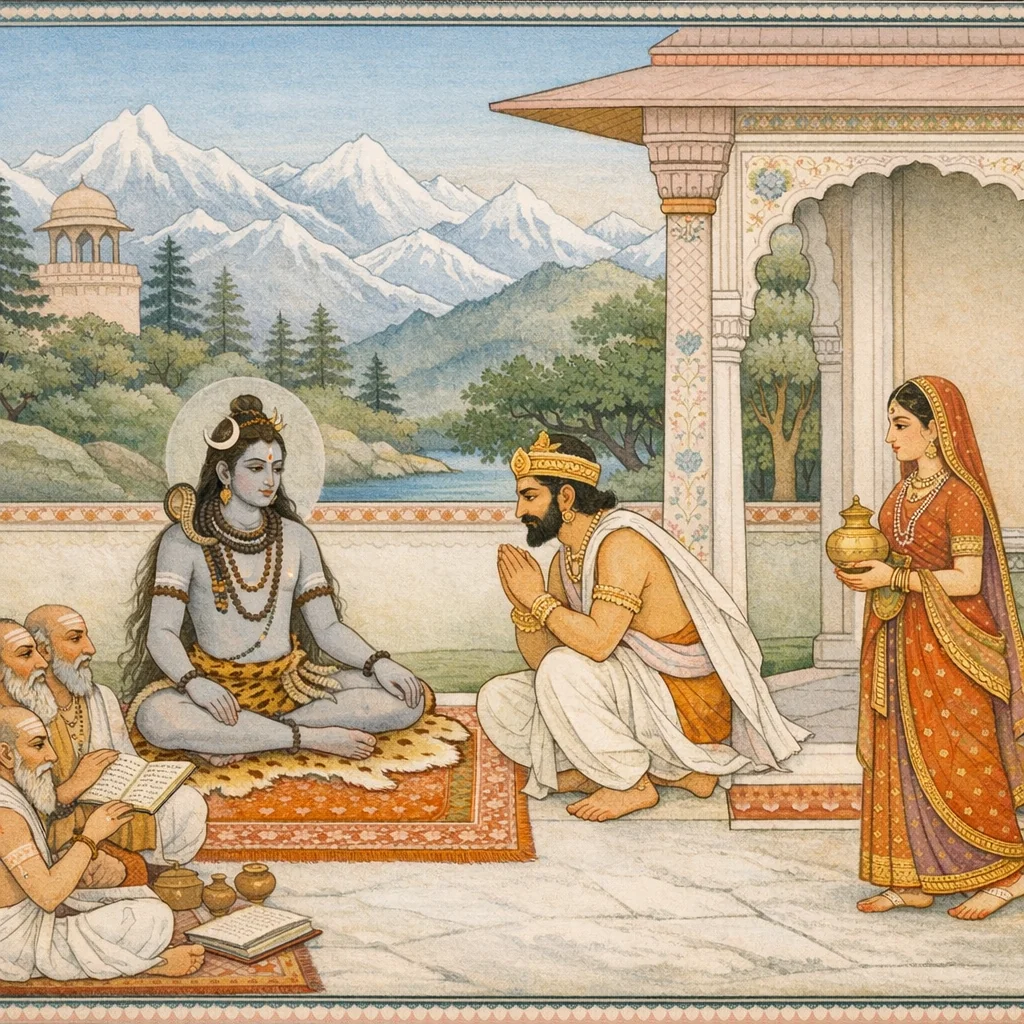
Adhyāya 48 presents a formal, ritualized juncture in the marriage rites. At Garga’s prompting as ācārya, Himavān and Menā prepare to give the maiden in marriage, beginning hospitality and ceremonial preliminaries: Menā arrives adorned with a golden vessel, while Himavān and the household priests perform reception rites (pādya and related offerings) and honor the groom with garments, sandal, and ornaments. Himavān then asks learned brāhmaṇas skilled in calendrical science to proclaim the tithi and other auspicious indicators, which they do with joy. The narrative turns to a theological tension when, inwardly urged by Śambhu, Himācala asks Śiva to state his gotra, pravara, lineage, name, Veda, and śākhā—customary identifiers for marriage eligibility. Śiva, whose nature transcends such classifications, falls silent, astonishing gods, sages, and attendants. This silence cues Nārada, the brahmavid and vīṇā-player, to intervene, transforming the social-ritual difficulty into a revelation of Śiva’s supra-genealogical status while keeping the marriage proceedings within orthodox forms.
Shlokas
Verse 1
ब्रह्मोवाच । एतस्मिन्नंतरे तत्र गर्गाचार्य्यप्रणोदितः । हिमवान्मेनया सार्द्धं कन्या दातुं प्रचक्रमे
Brahmā said: Meanwhile, at that very time, Himavān—urged on by the revered teacher Garga—together with Menā, began the arrangements to give his daughter in marriage.
Verse 2
हैमं कलशमादाय मेना चार्द्धांगमाश्रिता । हिमाद्रेश्च महाभागा वस्त्राभरणभूषिता
Taking up a golden water-pot, the noble Menā—clinging to the side of Himālaya—stood there, adorned with garments and ornaments, in all her auspicious dignity.
Verse 3
पाद्यादिभिस्ततः शैलः प्रहृष्टः स्वपुरोहितः । तं वंरं वरयामास वस्त्रचंदनभूषणैः
Then Śaila (the Mountain King), delighted, together with his own family priest, honored that excellent one with the offerings beginning with water for the feet, and with garments, sandal-paste, and ornaments.
Verse 4
ततो हिमाद्रिणा प्रोक्ता द्विजास्तिथ्यादिकीर्तने । प्रयोगो भण्यतां तावदस्मिन्समय आगते
Then Himālaya spoke, extolling the honoring of a brāhmaṇa guest and the duties connected with it: “Now that this occasion has arrived, let the proper procedure for it be set forth.”
Verse 5
तथेति चोक्त्वा ते सर्वे कालज्ञा द्विजसत्तमाः । तिथ्यादिकीर्तनं चक्रुः प्रीत्या परमनिर्वृताः
Saying, “So be it,” all those excellent brāhmaṇas—knowers of sacred time—joyfully proclaimed the tithi and other calendrical particulars, filled with love and supreme contentment.
Verse 6
ततो हिमाचलः प्रीत्या शम्भुना प्रेरितो हृदा । सूती कृतः परेशेन विहसञ्शम्भुमब्रवीत्
Then Himācala, lord of the mountains, filled with joy and inwardly impelled by Śambhu, was appointed by the Supreme Lord to speak; smiling, he addressed Śambhu.
Verse 7
स्वगोत्रं कथ्यतां शम्भो प्रवरश्च कुलं तथा । नाम वेदं तथा शाखां मा कार्षीत्समयात्ययम्
“O Śambhu, please declare Your own gotra, Your pravara, and likewise Your lineage; also tell Your name, Veda, and Vedic branch. Do not cause any delay beyond the proper time.”
Verse 8
ब्रह्मोवाच । इत्याकर्ण्य वचस्तस्य हिमाद्रेश्शङ्करस्तदा । सुमुखाविमुखः सद्योऽप्यशोच्यः शोच्यतां गतः
Brahmā said: Hearing those words, Śaṅkara on Himālaya at once turned away from Sumukhā; though by nature beyond sorrow, he immediately assumed a state that invited compassion, as if grieved.
Verse 9
एवंविधस्सुरवरैर्मुनिभिस्तदानीं गन्धर्वयक्षगणसिद्धगणैस्तथैव । दृष्टो निरुत्तरमुखो भगवान्महेशोऽकार्षीस्तु हास्यमथ तत्र स नारदत्वम्
At that time, when the foremost of the gods, the sages, and likewise the hosts of Gandharvas, Yakṣas, and Siddhas saw Bhagavān Maheśa standing with a silent, unanswering face, he smiled. Thereupon, in that very moment, Nārada became firmly established in the state of being Nārada.
Verse 10
वीणामवादयस्त्वं हि ब्रह्मविज्ञोऽथ नारद । शिवेन प्रेरितस्तत्र मनसा शम्भुमानसः
O Nārada, knower of Brahman, you indeed began to play the vīṇā there—impelled by Śiva Himself, and with your mind absorbed in Śambhu.
Verse 11
तदा निवारितो धीमान्पर्वतेन्द्रेण वै हठात् । विष्णुना च मया देवैर्मुनिभिश्चाखिलैस्तथा
Then that wise one was forcibly restrained by Parvatendra; and likewise by Viṣṇu, by me, by the gods, and by all the sages as well.
Verse 12
न निवृत्तोऽभवस्त्वं हि स यदा शङ्करेच्छया । इति प्रोक्तोऽद्रिणा तर्हि वीणां मा वादयाधुना
Truly, you did not withdraw from that act at that time, for it was by Śaṅkara’s own will. Thus spoken to by the Mountain (Himālaya), he then said, “Do not play the vīṇā now.”
Verse 13
सुनिषिद्धो हठात्तेन देवर्षे त्वं यदा बुध । प्रत्यवोचो गिरीशं तं सुसंस्मृत्य महेश्वरम्
O divine sage, O wise one—when you were forcefully and strictly restrained by him, you replied after inwardly recollecting the Lord of the Mountain, Mahādeva, Maheśvara.
Verse 14
नारद उवाच । त्वं हि मूढत्वमापन्नो न जानासि च किञ्चन । वाच्ये महेशविषयेऽतीवासि त्वं बहिर्मुखः
Nārada said: “Truly, you have fallen into delusion and understand nothing at all. In matters that are to be spoken of regarding Maheśa (Śiva), you are exceedingly outward-turned, estranged from the inner truth.”
Verse 15
त्वया पृष्ठो हरस्साक्षात्स्वगोत्रकथनं प्रति । समयेऽस्मिंस्तदत्यन्तमुपहासकरं वचः
You have directly questioned Hara Himself about the narration of His own lineage; at this moment, such words are utterly laughable—fit only for amusement.
Verse 16
अस्य गोत्रं कुलं नाम नैव जानन्ति पर्वत । विष्णुब्रह्मादयोऽपीह परेषां का कथा स्मृता
O Mountain (Himālaya), no one truly knows His lineage, family, or even His name. Even Viṣṇu, Brahmā, and the other gods do not know this here—what then can be said of anyone else?
Verse 17
यस्यैकदिवसे शैल ब्रह्मकोटिर्लयं गता । स एव शङ्करस्तेद्य दृष्टः कालीतपोबलात
O Mountain, in a single day, in whom crores of Brahmās dissolve into laya—He alone is that Śaṅkara, whom you have seen today by the power of Kālī’s tapas.
Verse 18
अरूपोऽयं परब्रह्म निर्गुणः प्रकृतेः परः । निराकारो निर्विकारो मायाधीशः परात्परः
He is the formless Supreme Brahman, nirguṇa—beyond the guṇas and beyond Prakṛti. Without shape and without change, He is the Lord of Māyā, the Transcendent beyond even the highest.
Verse 19
अगोत्रकुलनामा हि स्वतन्त्रो भक्तवत्सलः । तदिच्छया हि सगुणस्सुतनुर्बहुनामभृत्
He has no fixed gotra, clan, or limiting name; He is wholly independent and tenderly loving toward His devotees. Yet by His own will He becomes the Saguṇa Lord, assuming a beautiful form and bearing many names.
Verse 20
सुगोत्री गोत्रहीनश्च कुलहीनः कुलीनकः । पार्वतीतपसा सोऽद्य जामाता ते न संशयः
He is of noble lineage—and yet beyond all lineage; without any clan—and yet the very perfection of a clan. By the power of Pārvatī’s tapas, today He has become your son-in-law—of this there is no doubt.
Verse 21
लीलाविहारिणा तेन मोहितं च चराचरम् । नो जानाति शिवं कोऽपि प्राज्ञोऽपि गिरिसत्तम
O best of mountains, by Him who sports in divine līlā, all that is moving and unmoving is indeed deluded; therefore no one—even one deemed wise—truly knows Lord Śiva in the fullness of His reality.
Verse 22
लिंगाकृतेर्महेशस्य केन दृष्टं न मस्तकम् । विष्णुर्गत्वा हि पातालं तदेनं नापविस्मितः
Who indeed has ever beheld the head—the upper limit—of Mahādeva when He appeared as the Liṅga? Even Viṣṇu, descending to Pātāla in search, could not fathom that Reality nor discover its end.
Verse 23
किंबहूक्त्या नगश्रेष्ठ शिवमाया दुरत्यया । तदधीनास्त्रयो लोका हरिब्रह्मादयोपि च
What more need be said, O best of mountains? Śiva’s Māyā is truly hard to cross. The three worlds are subject to it—Viṣṇu, Brahmā, and the others as well.
Verse 24
तस्मात्त्वया शिवा तात सुविचार्य प्रयत्नतः । न कर्तव्यो विमर्शोऽत्र त्वेवंविधवरे मनाक्
Therefore, dear child, reflect carefully and with full effort upon Śivā (Pārvatī). In this matter, entertain not even the slightest doubt or second-guessing, for you are truly worthy and fit for such a union.
Verse 25
ब्रह्मोवाच । इत्युक्त्वा त्वं मुने ज्ञानी शिवेच्छाकार्यकारकः । प्रत्यवोचः पुनस्तं वै शैलेद्रं हर्षयन्गिरा
Brahmā said: “Having spoken thus, O sage—wise and one who acts to accomplish the work willed by Śiva—you again replied to that lord of mountains, gladdening him with your words.”
Verse 26
नारद उवाच । शृणु तात महाशैल शिवाजनक मद्वचः । तच्छ्रुत्वा तनयां देवीं देहि त्वं शंकराय हि
Narada said: “Listen, dear Mahāśaila—O father of the Devī Śivā—to my words. Having heard this, give your divine daughter to Śaṅkara in marriage indeed.”
Verse 27
सगुणस्य महेशस्य लीलया रूप धारिणः । गोत्रं कुलं विजानीहि नादमेव हि केवलम्
Know well that for Maheśa—who, though possessed of attributes (saguṇa), assumes forms only by divine play (līlā)—His true ‘lineage’ and ‘family’ are none at all: He is, in essence, nothing but Nāda alone.
Verse 28
शिवो नादमयः सत्त्यं नादश्शिवमयस्तथा । उभयोरन्तरं नास्ति नादस्य च शिवस्य च
Truly, Śiva is of the nature of Nāda, the primal sacred sound, and Nāda is likewise of the nature of Śiva. Between Nāda and Śiva there is no difference at all—no separation exists between the sound-principle and Śiva Himself.
Verse 29
सृष्टौ प्रथमजत्वाद्धि लीलासगुणरूपिणः । शिवान्नादस्य शैलेन्द्र सर्वोत्कृष्टस्ततस्स हि
O Lord of mountains, because it was the first to arise in creation, this sacred sound—Śiva’s nāda, the playful manifestation of His saguṇa form—is therefore declared the most excellent of all.
Verse 30
अतो हि वादिता वीणा प्रेरितेन मयाद्य वै । सर्वेश्वरेण मनसा शङ्करेण हिमालय
Therefore, O Himālaya, today this vīṇā has indeed been played by me, impelled inwardly by Śaṅkara—the Lord of all—through His divine will.
Verse 31
ब्रह्मोवाच । एतच्छ्रुत्वा तव मुने वचस्तत्तु गिरिश्वरः । हिमाद्रिस्तोषमापन्नो गतविस्मयमानसः
Brahmā said: “O sage, having heard these words of yours, Girīśvara (Śiva), the Lord of the Mountain, and Himādri too became pleased; their minds were freed from astonishment.”
Verse 32
अथ विष्णुप्रभृतयस्सुराश्च मुनयस्तथा । साधुसाध्विति ते सर्वे प्रोचुर्विगतविस्मयाः
Then Viṣṇu and the other gods, together with the sages, all free from astonishment, cried out in one voice, “Well done! Well done!”
Verse 33
महेश्वरस्य गांभीर्यं ज्ञात्वा सर्वे विचक्षणाः । सविस्मया महामोदान्विताः प्रोचुः परस्परम्
Recognizing the profound depth and solemn gravity of Mahādeva, all the discerning ones—filled with wonder and great joy—began speaking among themselves.
Verse 34
यस्याज्ञया जगदिदं च विशालमेव जातं परात्परतरो निजबोधरूपः । शर्वः स्वतन्त्रगतिकृत्परभावगम्यस्सोऽसौ त्रिलोकपतिरद्य च नस्सुदृष्टः
By whose command this vast universe has arisen—He who is beyond even the highest, whose very nature is pure self-luminous Consciousness—Śarva, who moves in absolute freedom, knowable only through the supreme inner realization: that Lord of the three worlds has today been graciously seen by us.
Verse 35
अथ ते पर्वतश्रेष्ठा मेर्वाद्या जातसंभ्रमाः । ऊचुस्ते चैकपद्येन हिमवन्तं नगेश्वरम्
Then those foremost of mountains—beginning with Meru—were stirred with awe and urgency. In one voice they addressed Himavān, the lord of mountains.
Verse 36
पर्वता ऊचुः । कन्यादाने स्थीयतां चाद्य शैलनाथोक्त्या किं कार्यनाशस्तवेव । सत्यं ब्रूमो नात्र कार्यो विमर्शस्तस्मात्कन्या दीयतामीश्वराय
The mountains said: “Let the rite of giving the maiden be carried out today. What ‘loss of purpose’ is there for you merely because the Lord of the mountain has spoken thus? We speak the truth—there is no need for further deliberation; therefore let the maiden be given to Īśvara (Lord Śiva).”
Verse 37
ब्रह्मो वाच । तच्छुत्वा वचनं तेषां सुहृदां स हिमालयः । स्वकन्यादानमकरोच्छिवाय विधिनोदितः
Brahmā said: Hearing the words of those well-wishing friends, Himālaya—urged on in accordance with the sacred rite—performed the giving of his own daughter in marriage to Śiva.
Verse 38
इमां कन्यां तुभ्यमहं ददामि परमेश्वर । भार्यार्थे परिगृह्णीष्व प्रसीद सकलेश्वर
“O Parameśvara, I give this maiden to You. Accept her as Your wife, and be gracious, O Lord of all.”
Verse 39
तस्मै रुद्राय महते मंत्रेणानेन दत्तवान् । हिमाचलो निजां कन्यां पार्वतीं त्रिजगत्प्रसूम्
Then Himācala, by this very sacred mantra, bestowed his own daughter Pārvatī—she who is the divine mother of the three worlds—upon the great Rudra.
Verse 40
इत्थं शिवाकरं शैलं शिवहस्तेनिधाय च । मुमोदातीव मनसि तीर्णकाममहार्णवः
Thus, placing that mountain—made auspicious by Śiva’s own touch—into Śiva’s hand, he rejoiced deeply in his heart, as one who has crossed the vast ocean of desire.
Verse 41
वेदमंत्रेण गिरिशो गिरिजाकरपङ्कजम् । जग्राह स्वकरेणाशु प्रसन्नः परमेश्वरः
Pleased, the Supreme Lord—Giriśa—at once took into His own hand the lotus-like hand of Girijā, sanctifying the act with a Vedic mantra.
Verse 42
क्षितिं संस्पृश्य कामस्य कोदादिति मनुं मुने । पपाठ शङ्करः प्रीत्या दर्शयंल्लौकिकीं गतिम्
O sage, touching the earth, Śaṅkara—out of gracious delight—recited the mantra beginning with “kodā…”, connected with Kāma, thereby also demonstrating the worldly course of action (laukikī gati).
Verse 43
महोत्सवो महानासीत्सर्वत्र प्रमुदावहः । बभूव जयसंरावो दिवि भूम्यन्तरिक्षके
A grand festival took place, bringing delight everywhere. Cries of victory arose throughout heaven, on earth, and in the space between, filling all the worlds with auspicious joy.
Verse 44
साधुशब्दं नमः शब्दं चक्रुस्सर्वेऽति हर्षिताः । गंधर्वास्सुजगुः प्रीत्या ननृतुश्चाप्सरोगणाः
Overjoyed, all of them cried out “Sādhu! (Well done!)” and “Namaḥ! (Salutations!).” The Gandharvas sang sweetly with delight, and the hosts of Apsarases danced.
Verse 45
हिमाचलस्य पौरा हि मुमुदु श्चाति चेतसि । मंगलं महदासीद्वै महोत्सवपुरस्सरम्
Indeed, the townspeople of Himācala rejoiced deeply in their hearts. A great auspiciousness arose there, preceded by a grand festival celebration.
Verse 46
अहं विष्णुश्च शक्रश्च निर्जरा मुनयोऽखिलाः । हर्षिता ह्यभवंश्चाति प्रफुल्लवदनाम्बुजाः
“I, Viṣṇu, and Śakra (Indra), along with the deathless gods and all the sages, became filled with joy; indeed, our lotus-like faces blossomed fully in delight.”
Verse 47
अथ शैलवरस्सोदात्सुप्रसन्नो हिमाचलः । शिवाय कन्यादानस्य साङ्गतां सुयथोचिताम्
Then Himācala, foremost of mountains, became exceedingly pleased and, in a manner fully proper, made all complete arrangements for giving his daughter in marriage to Lord Śiva.
Verse 48
ततो वन्धुजनास्तस्य शिवां सम्पूज्य भक्तितः । ददुश्शिवाय सद्द्रव्यं नानाविधिविधानतः
Then her kinsmen, having devoutly honored Śivā (Pārvatī), offered to Lord Śiva excellent gifts and auspicious materials, in many ways and according to proper rites.
Verse 49
हिमालयस्तुष्टमनाः पार्वतीशि वप्रीतये । नानाविधानि द्रव्याणि ददौ तत्र मुनीश्वर
O lord among sages, the Himalaya—his heart filled with joy—thereupon bestowed many kinds of valuable offerings, desiring to please both Pārvatī and Śiva.
Verse 50
कौतुकानि ददौ तस्मै रत्नानि विविधानि च । चारुरत्नविकाराणि पात्राणि विविधानि च
He presented him with auspicious gifts and many kinds of jewels; and also various vessels of beautiful workmanship, fashioned from precious gems.
Verse 51
गवां लक्षं हयानां च सज्जितानां शतं तथा । दासीनामनुरक्तानां लक्षं सद्द्रव्यभूषितम्
A lakh of cows, and likewise a hundred well-equipped horses; and a lakh of devoted maidservants, adorned with fine and fitting wealth—these were given as sacred gifts.
Verse 52
नागानां शतलक्षं हि रथानां च तथा मुने । सुवर्णजटितानां च रत्नसारविनिर्मितम्
O sage, there were indeed a hundred thousand elephants, and chariots as well in like measure—adorned with gold and fashioned from the finest essence of gems.
Verse 53
इत्थं हिमालयो दत्त्वा स्वसुतां गिरिजां शिवाम् । शिवाय परमेशाय विधिनाऽऽप कृतार्थताम्
Thus Himālaya, having duly given his own daughter Girijā (Pārvatī) to Śiva, the Supreme Lord Parameśvara, attained fulfillment, for his duty was perfectly accomplished according to sacred rite.
Verse 54
अथ शैलवरो माध्यंदिनोक्तस्तोत्रतो मुदा । तुष्टाव परमेशानं सद्गिरा सुकृताञ्जलिः
Then the noble Lord of the Mountain, rejoicing, praised Parameśāna (Lord Śiva) with the hymn prescribed for midday; with truthful, gracious words and hands properly joined in añjali, he offered his adoration.
Verse 55
ततो वेदविदा तेनाज्ञप्ता मुनिगणास्तदा । शिरोऽभिषेकं चक्रुस्ते शिवायाः परमोत्सवाः
Then, at that time, the hosts of sages—commanded by that knower of the Vedas—performed the śiro’bhiṣeka, the ceremonial head-anointing, for Śivā (Pārvatī), celebrating it as a supremely auspicious festival.
Verse 56
देवाभिधानमुच्चार्य्य पर्य्यक्षणविधिं व्यधुः । महोत्सवस्तदा चासीन्महानन्दकरो मुने
Having uttered the divine names, they performed the prescribed rite of pradakṣiṇā, sacred circumambulation. Then, O sage, a great festival arose, bringing immense joy.
Frequently Asked Questions
The formal wedding-preparatory sequence where Himavān initiates ritual hospitality and requests auspicious calendrical declarations, followed by the pivotal gotra–pravara inquiry directed at Śiva, leading to Śiva’s silence and the narrative setup for Nārada’s intervention.
It signals Śiva’s supra-social, supra-genealogical nature: the Absolute cannot be reduced to lineage markers, yet enters ritual society by līlā. The tension teaches that dharmic forms are honored, but the divine reality exceeds them.
Śiva as Mahēśa beyond classification; Himavān as dharmic householder-father enforcing ritual norms; brāhmaṇas as custodians of time-ritual knowledge; and Nārada as divinely prompted mediator who converts social protocol into theological disclosure.