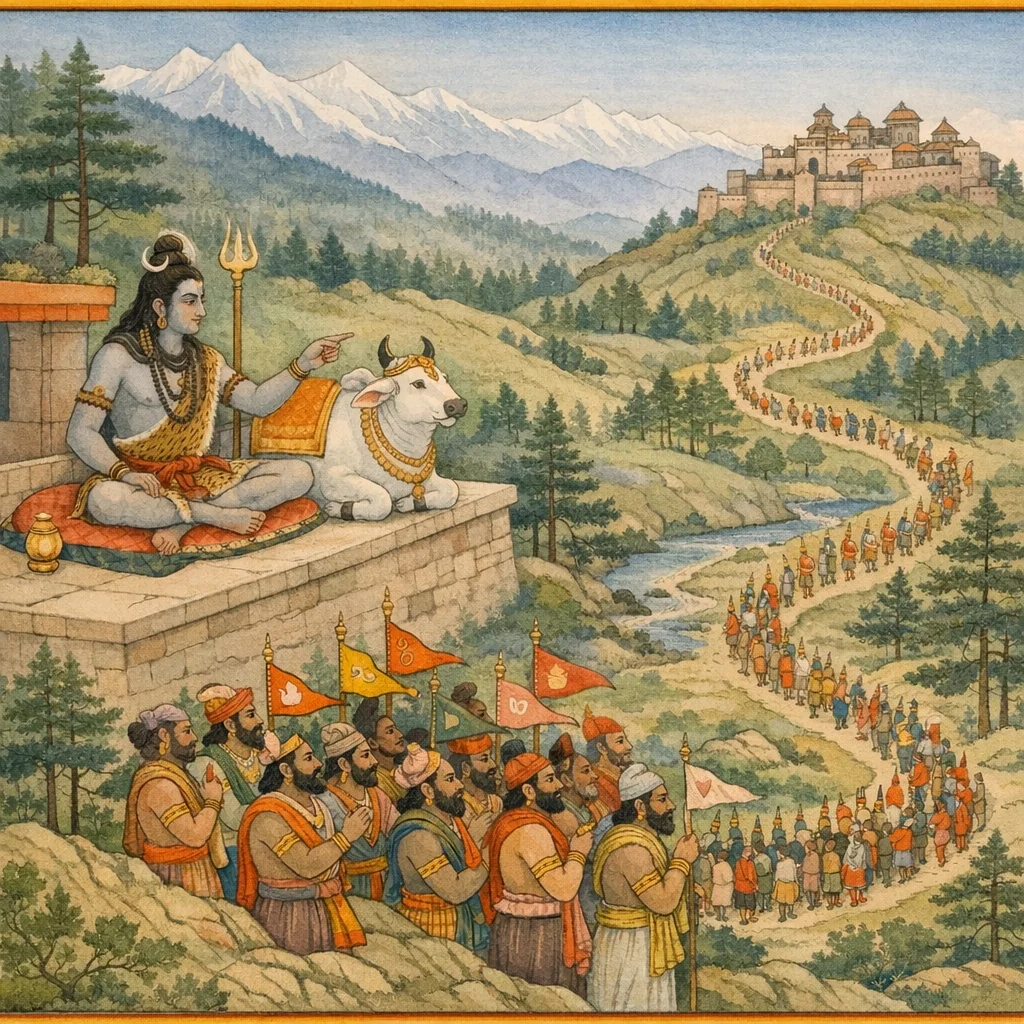
गणसमागमः (Śiva Summons the Gaṇas for the Great Festival)
In this chapter, Brahmā describes a grand mobilization: Śiva summons Nandin and the assembled gaṇas and, with festive purpose, commands them to proceed toward the Himalayan mountain-city. Śiva invites his attendants to accompany him, yet leaves a contingent behind for administrative order, portraying the gaṇas as a disciplined cosmic retinue. The text then lists eminent gaṇa-leaders (gaṇeśvaras/gaṇanāyakas) and the vast numbers of their troops (koṭi, daśakoṭi, sahasrakoṭi, koṭikoṭi), stressing scale, hierarchy, and the resonant ritual mood of a mahotsava. Figures such as Śaṅkhakarṇa, Kekarākṣa, Vikṛta, Viśākha, Pārijāta, Sarvāntaka, Vikṛtānana, Kapālākhya, Sandāraka, Kanduka, Kuṇḍaka, Viṣṭambha, Pippala, and Saṃnādaka appear as commanders of immense units. The chapter’s purpose is to magnify Śiva’s sovereignty and the cosmic participation in the impending auspicious event (in context, aligned with Pārvatī-related festivities), making procession, enumeration, and command a devotional spectacle and a theological affirmation.
Shlokas
Verse 1
ब्रह्मोवाच । अथ शम्भुः समाहूय नन्द्यादीन् सकलान्गणान् । आज्ञापयामास मुदा गन्तुं स्वेन च तत्र वै
Brahmā said: Then Śambhu, having summoned all his gaṇas beginning with Nandin, joyfully commanded them to proceed there, and he himself would go along as well.
Verse 2
शिव उवाच । अपि यूयं सह मया संगच्छध्वं गिरेः पुरम् । कियद्गणानिहास्थाप्य महोत्सवपुरस्सरम्
Śiva said: “Will you also go with me to the city of the Mountain (Himālaya)? Leave some attendants here, and go ahead to arrange the great festive celebration.”
Verse 3
ब्रह्मोवाच । अथ ते समनुज्ञप्ता गणेशा निर्ययुर्मुदा । स्वंस्वं बलमुपादाय तान् कथंचिद्वदाम्यहम्
Brahmā said: Then those Gaṇeśas, having received permission, set forth joyfully. Each took up his own strength, and of them I shall speak as best I am able.
Verse 4
अभ्यगाच्छंखकर्णश्च गणकोट्या गणेश्वरः । शिवेन सार्द्धं संगन्तुं हिमाचलपुरम्प्रति
Then the Gaṇeśvara named Śaṅkhakarṇa arrived, accompanied by a koṭi (a crore) of Śiva’s gaṇas, to proceed together with Lord Śiva toward the city of Himācala.
Verse 5
दशकोट्या केकराक्षो गणानां समहोत्सवः । अष्टकोट्या च विकृतो गणानां गणनायकः
Among Śiva’s gaṇas, Kekarākṣa—at the head of ten crores—served as the organizer of the grand assembly-festival; and Vikṛta—at the head of eight crores—was the commander and leader of the gaṇas.
Verse 6
चतुष्कोट्या विशाखश्च गणानां गणनायकः । पारिजातश्च नवभिः कोटिभिर्गणपुंगवः
Viśākha, together with four crores of attendants, is the commander of the gaṇas; and Pārijāta, together with nine crores, is a foremost leader among those gaṇas.
Verse 7
षष्टिस्सर्वान्तकः श्रीमान्तथैव विकृताननः । गणानान्दुन्दुभोष्टाभिः कोटिकोटिभिर्गणनायकः
“He is Ṣaṣṭi—Sarvāntaka, the all-destroying—auspicious and resplendent as Śrīmān, and likewise Vikṛtānana, of wondrous visage. Amid the thunder of the gaṇas’ dundubhi drums, he stands as leader of the gaṇas, attended by crores upon crores.”
Verse 8
पञ्चभिश्च कपालाख्यो गणेशः कोटिभिस्तथा । षड्भिस्सन्दारको वीरो गणानां कोटिभिर्मुने
O sage, Gaṇeśa called Kapālākhyā, a lord among Śiva’s gaṇas, came forth with five crores of attendants; and the heroic Sandāraka also arrived with six crores of gaṇas.
Verse 9
कोटिकोटिभिरेवेह कन्दुकः कुण्डकस्तथा । विष्टम्भो गणपोऽष्टाभिर्गणानां कोटिभिस्तथा
Here indeed, Kanduka and Kuṇḍaka served Śiva with crores upon crores of attendants; likewise Viṣṭambha and Gaṇapa too—together with eight chief groups—and with crores of Śiva’s gaṇas as well.
Verse 10
सहस्रकोट्या गणपः पिप्पलो मुदितो ययौ । तथा संनादको वीरो गणेशो मुनिसत्तम
O best of sages, the Gaṇapa named Pippala departed joyfully with a host numbering a thousand crores; likewise the valiant Gaṇeśa named Saṃnādaka also went forth.
Verse 11
आवेशनस्तथाष्टाभिः कोटिभिर्गणनायकः । महाकेशस्सहस्रेण कोटीनां गणपो ययौ
Then Āveśana, the leader of the Gaṇas, set forth accompanied by eight crores. And Mahākeśa went forth as the lord of the Gaṇas, with a thousand crores following him.
Verse 12
कुण्डो द्वादशकोट्या हि तथा पर्वतको मुने । अष्टाभिः कोटिभिर्वीरस्समगाच्चन्द्रतापनः
O sage, the sacred fire-pit (kuṇḍa) was made with twelve crores (of measures), and likewise the mountain (of offerings/fuel) was of the same extent. The heroic Candratāpana arrived there accompanied by eight crores (of followers).
Verse 13
कालश्च कालकश्चैव महाकालश्शतेन वै । कोटीनां गणनाथो हि तथैवाग्निकनामकः
Among the gaṇas are those named Kāla and Kālaka, and likewise a hundred Mahākālas. Over hosts numbering in crores, Gaṇanātha indeed presides; and there is also one named Agnika.
Verse 14
कोट्यग्निमुख एवागाद् गणानां गणनायकः । आदित्यमूर्द्धा कोट्या च तथा चैव घनावहः
Then Koṭyagnimukha arrived— a commander among Śiva’s gaṇas. With him came Ādityamūrdhā, Koṭyā, and likewise Ghanāvaha as well.
Verse 15
सन्नाहश्शतकोट्या हि कुमुदो गणपस्तथा । अमोघः कोकिलश्चैव शतकोट्या गणाधिपः
Sannāha, with a force of a hundred crores, and likewise Kumuda as a Gaṇapa; and also Amogha and Kokila—each a lord of the gaṇas with a hundred crores of attendants.
Verse 16
सुमन्त्रः कोटिकोट्या च गणानां गणानायकः । काकपादोदरः कोटिषष्ट्या सन्तानकस्तथा
Sumantra is the leader of the gaṇas, commanding ten million crores. Likewise, Kākapādodara, the progenitor named Santānaka, has sixty million crores under him.
Verse 17
महाबलश्च नवभिर्मधुपिंगश्च कोकिलः । नीलो नवत्या कोटीनां पूर्णभद्रस्तथैव च
Mahābala is with nine crores; Madhupiṅga and Kokila are also named. Nīla is with ninety crores; and Pūrṇabhadra likewise is present.
Verse 18
सप्तकोट्या चतुर्वक्त्रः करणो विंशकोटिभिः । ययौ नवतिकोट्या तु गणेशानो हि रोमकः
With seven crores went Brahmā of the four faces; with twenty crores went Karaṇa; and with ninety crores indeed went Gaṇeśa—known as Romaka.
Verse 19
यज्वाशश्शतमन्युश्च मेघमन्युश्च नारद । तावत्कोट्या ययुस्सर्वे गणेशा हि पृथक्पृथक्
O Nārada, the Gaṇeśas named Yajvāśa, Śatamanyu, and Meghamanyu—together with all the other Gaṇeśas—departed in that very multitude of crores, each going separately to his own place and appointed task.
Verse 20
काष्ठाङ्गुष्ठश्चतुष्षष्ट्या कोटीनां गणनायकः । विरूपाक्षस्सुकेशश्च वृषाभश्च सनातनः
Kāṣṭhāṅguṣṭha, the leader who presides over the reckoning of sixty-four crores; Virūpākṣa and Sukeśa; and Vṛṣābha, the eternal one—these are (among) the divine Gaṇas in Śiva’s retinue.
Verse 21
तालकेतुः षडास्यश्च चञ्च्वास्यश्च सनातनः । सम्वर्तकस्तथा चैत्रो लकुलीशस्स्वयम्प्रभुः
Tālaketu, Ṣaḍāsya, Caṅcvāsya, the Eternal (Sanātana), Samvartaka, Caitra, and Lakulīśa—the Self-luminous Lord—(are the revered manifestations/names spoken of here).
Verse 22
लोकान्तकश्च दीप्तात्मा तथा दैत्यान्तको मुने । देवो भृंगिरिटिश्श्रीमान्देवदेवप्रियस्तथा
O sage, (he is known as) Lokāntaka, of radiant spirit; also Daityāntaka, the destroyer of the daityas. He is the god Bhṛṅgiriṭi—splendid and illustrious—ever beloved of the God of gods (Śiva).
Verse 23
अशनिर्भानुकश्चैव चतुष्षष्ट्या सहस्रशः । ययुश्शिवविवाहार्थं शिवेन सहसोत्सवाः
Aśani and Bhānuka as well, together with sixty-four thousand others, set out with Śiva for the sake of Śiva’s marriage, all proceeding in a spirit of great festivity.
Verse 24
भूतकोटिसहस्रेण प्रमथाः कोटिभिस्त्रिभिः । वीरभद्रश्चतुष्षष्ट्या रोमजानान्त्रिकोटिभिः
There were Pramathas in three crores, accompanied by thousands of crores of bhūtas; and Vīrabhadra too was surrounded by sixty-four crores of fierce hosts—born from the Lord’s hairs—and by innumerable other multitudes.
Verse 25
कोटिकोटिसहस्राणां शतैर्विंशतिभिर्वृताः । तत्र जग्मुश्च नन्द्याद्या गणपाश्शंकरोत्सवे
Surrounded by hundreds and by twenties of crores upon crores of thousands, the hosts of Śiva’s Gaṇas—led by Nandin—also went there, to the great festival of Lord Śaṅkara.
Verse 26
क्षेत्रपालो भैरवश्च कोटिकोटिगणैर्युतः । उद्वाहश्शंकरस्येत्याययौ प्रीत्या महोत्सवे
Kṣetrapāla Bhairava, accompanied by crores upon crores of Śiva’s gaṇas, came joyfully to that great festival, proclaiming, “This is the wedding of Śaṅkara.”
Verse 27
एते चान्ये च गणपा असङ्ख्याता महाबलाः । तत्र जग्मुर्महाप्रीत्या सोत्साहाश्शंकरोत्सवे
These and many other Gaṇas—countless and mighty—went there with great joy and overflowing enthusiasm to celebrate the festival of Śaṅkara (Lord Śiva).
Verse 28
सर्वे सहस्रहस्ताश्च जटामुकुटधारिणः । चन्द्ररेखावतंसाश्च नीलकण्ठास्त्रिलोचनाः
All of them were thousand-armed, wearing matted locks as a crown. They were adorned with the crescent-moon mark; all were blue-throated and three-eyed—bearing the auspicious signs of Śiva’s manifest (saguṇa) form.
Verse 29
रुद्राक्षाभरणास्सर्वे तथा सद्भस्मधारिणः । हारकुण्डलकेयूरमुकुटाद्यैरलंकृताः
All of them wore rudrākṣa ornaments and bore the sacred ash (bhasma). They were adorned with necklaces, earrings, armlets, crowns, and other ornaments.
Verse 30
ब्रह्मविष्ण्विन्द्रसंकाशा अणिमादिगुणैर्युताः । सूर्य्यकोटिप्रतीकाशास्तत्र रेजुर्गणेश्वराः
There, the chiefs of Śiva’s gaṇas shone forth—radiant like Brahmā, Viṣṇu, and Indra, endowed with powers such as aṇimā and the rest, and blazing with a splendor comparable to ten million suns.
Verse 31
पृथिवीचारिणः केचित् केचित्पातालचारिणः । केचिद्व्योमचराः केचित्सप्तस्वर्गचरा मुने
O sage, some move upon the earth; some move in the nether regions (Pātāla); some roam in the sky; and some traverse the seven heavens.
Verse 32
किम्बहूक्तेन देवर्षे सर्वलोकनिवासिनः । आययुस्स्वगणाश्शम्भोः प्रीत्या वै शङ्करोत्सवे
O divine sage, what need is there to say much? All the residents of the worlds—indeed, even Śambhu’s own gaṇas—came with joy and loving devotion to celebrate the festival of Śaṅkara.
Verse 33
इत्थं देवैर्गणैश्चान्यैस्सहितश्शङ्करः प्रभुः । ययौ हिमगिरिपुरं विवाहार्थं निजस्य वै
Thus, the Lord Śaṅkara—accompanied by the gods and by other hosts of Gaṇas—set out for Himagiri’s city, for the sake of His own wedding.
Verse 34
यदाजगाम सर्वेशो विवाहार्थे सुरादिभिः । तदा तत्र ह्यभूद्वृत्तं तच्छृणु त्वं मुनीश्वर
When the Lord of all, Śiva, arrived there for the sake of the marriage—accompanied by the gods and others—then the events that occurred in that place indeed came to pass. O best of sages, listen to that account.
Verse 35
रुद्रस्य भगिनी भूत्वा चण्डी सूत्सवसंयुता । तत्राजगाम सुप्रीत्या परेषां सुंभयावहा
Having become the sister of Rudra, Caṇḍī—attended by auspicious festivities—arrived there in great delight, casting dread upon the hostile hosts.
Verse 36
प्रेतासनसमारूढा सर्पाभरणभूषिता । पूर्णं कलशमादाय हैमं मूर्ध्नि महाप्रभम्
Mounted upon a seat of spirits and adorned with serpent-ornaments, she lifted a brimming pot and set that splendid golden vessel upon her head.
Verse 37
स्वपरीवारसंयुक्ता दीप्तास्या दीप्तलोचना । कुतूहलम्प्रकुर्वन्ती जातहर्षा महाबला
Accompanied by her own attendants, her face radiant and her eyes shining, the mighty Goddess—stirred by eager curiosity—became filled with joy.
Verse 38
तत्र भूतगणा दिव्या विरूपः कोटिशो मुने । विराजन्ते स्म बहुशस्तथा नानाविधास्तदा
There, O sage, divine hosts of Bhūtas—numbering in crores and of many strange and varied forms—were seen shining forth in great multitudes at that time.
Verse 39
तैस्समेताग्रतश्चण्डी जगाम विकृतानना । कुतूहलान्विता प्रीता प्रीत्युपद्रव कारिणी
Then Caṇḍī, her face fierce and transformed, went forth at their head along with them—filled with eager curiosity, delighted, and, in her playful joy, causing a commotion.
Verse 40
इति श्रीशिवमहापुराणे द्वितीयायां रुद्रसंहितायां तृतीये पार्वतीखण्डे यात्रावर्णनं नाम चत्वारिशोऽध्यायः
Thus ends the fortieth chapter, called “The Description of Pilgrimage,” in the Pārvatī-khaṇḍa (third section) of the Rudra-saṃhitā (second part) of the glorious Śiva Mahāpurāṇa.
Verse 41
तदा डमरुनिर्घोषैर्व्याप्तमासीज्जगत्त्रयम् । भेरीझंकारशब्देन शंखानां निनदेन च
Then the three worlds were filled with the resounding beats of the ḍamaru, with the reverberant clang of kettledrums, and with the booming sound of conches.
Verse 42
तथा दुन्दुभिनिर्घोषैश्शब्दः कोलाहलोऽभवत् । कुर्वञ्जगन्मंगलं च नाशयेन्मंगलेतरत्
Likewise, with the resounding blasts of kettledrums, a great tumult of sound arose—creating auspiciousness for the whole world and dispelling whatever is inauspicious.
Verse 43
गणानां पृष्ठतो भूत्वा सर्वे देवास्समुत्सुकाः । अन्वयुस्सर्वसिद्धाश्च लोकपालादिका मुने
O sage, all the gods—eager and full of anticipation—took their place behind Śiva’s gaṇas. The perfected Siddhas too, and the world-guardians (Lokapālas) and others, followed along.
Verse 44
मध्ये व्रजन् रमेशोऽथ गरुडासनमाश्रितः । शुशुभे ध्रियमाणेन क्षत्रेण महता मुने
O sage, then Rameśa proceeded in the midst of the assembly, mounted upon Garuḍa’s seat; he shone resplendently, borne along with great royal majesty and protective power.
Verse 45
चामरैर्वीज्यमानोऽसौ स्वगणैः परिवारितः । पार्षदैर्विलसद्भिश्च स्वभूषाविधिभूषितः
He was fanned with chāmara yak-tail whisks and surrounded by his own gaṇas; attended by radiant pāriṣadas, he shone forth, adorned with his prescribed ornaments and divine regalia.
Verse 46
तथाऽहमप्यशोभम्वै व्रजन्मार्गे विराजितः । वेदैर्मूर्तिधरैश्शास्त्रैः पुराणैरागमैस्तथा
So too, even I was indeed adorned—radiant on the path as I went—attended and glorified by the embodied Vedas, by authoritative śāstras, by the Purāṇas, and likewise by the Āgamas.
Verse 47
सनकादिमहासिद्धैस्सप्रजापतिभिस्सुतैः । परिवारैस्संयुतो हि शिवसेवनतत्परः
Accompanied by the great perfected sages beginning with Sanaka, together with the Prajāpatis and their sons, and surrounded by their retinues, he was indeed wholly devoted to the service and worship of Lord Śiva.
Verse 48
स्वसैन्यमध्यगश्शक्र ऐरावतगज स्थितः । नामाविभूषितोऽत्यन्तं व्रजन् रेजे सुरेश्वरः
Indra, lord of the gods, seated upon the elephant Airāvata and moving amid his own army, shone brilliantly as he advanced—fully adorned with his insignia and renowned titles.
Verse 49
तदा तु व्रजमानास्ते ऋषयो बहवश्च ते । विरेजुरतिसोत्कण्ठश्शिवस्योद्वाहनम्प्रति
Then, as those many sages set forth, they shone with intense eager longing, their hearts fixed upon witnessing the auspicious marriage of Lord Śiva.
Verse 50
शाकिन्यो यातुधानाश्च वेताला ब्रह्मराक्षसाः । भूतप्रेतपिशाचाश्च तथान्ये प्रमथादयः
Śākinīs, yātudhānas, vetālas, brahmarākṣasas, and also bhūtas, pretas, and piśācas—along with other hosts such as the Pramathas—are the various spirit-beings and fierce attendants that move in Śiva’s sphere.
Verse 51
तुम्बुरुर्नारदो हाहा हूहूश्चेत्यादयो वराः । गन्धर्वाः किन्नरा जग्मुर्वाद्यानाध्माय हर्षिताः
Tumburu, Nārada, Hāhā, Hūhū, and other eminent ones—Gandharvas and Kinnaras—went forth joyfully, blowing and playing their musical instruments in celebration.
Verse 52
जगतो मातरस्सर्वा देवकन्याश्च सर्वशः । गायत्री चैव सावित्री लक्ष्मीरन्यास्सुरस्त्रियः
All the Mothers of the worlds, and all the celestial maidens in every way—Gāyatrī, Sāvitrī, Lakṣmī, and the other divine women—were assembled there.
Verse 53
एताश्चान्याश्च देवानां पत्नयो भवमातरः । उद्वाहश्शंकरस्येति जग्मुस्सर्वा मुदान्विताः
These and other wives of the gods—revered as mothers in the world—went forth, all filled with joy, saying, “This is the wedding of Śaṅkara.”
Verse 54
शुद्धस्फटिकसंकाशो वृषभस्सर्वसुन्दरः । यो धर्म उच्यते वेदैश्शास्त्रैस्सिद्धमहर्षिभिः
He shines like pure crystal; the Bull Nandin is supremely beautiful in every way. He is that very Dharma spoken of by the Vedas and the Śāstras, and established by the perfected great Ṛṣis—thus he stands as the embodied standard of righteous order in Śiva’s domain.
Verse 55
तमारूढो महादेवो वृषभं धर्मवत्सलः । शुशुभेतीव देवर्षिसेवितस्सकलैर्व्रजन्
Mahādeva, the lover of Dharma, mounted that bull and proceeded. Attended by all and served by the divine seers, he appeared as though resplendent with glory.
Verse 56
एभिस्समेतैस्सफलैमहर्षिभिर्बभौ महेशो बहुशोत्यलंकृतः । हिमालयाह्वस्य धरस्य संव्रजन् पाणिग्रहार्थं सदनं शिवायाः
Accompanied by those great sages bearing auspicious offerings, Mahādeva shone forth, adorned in many ways. Proceeding toward the abode of the mountain-lord named Himālaya, he went for the sacred rite of taking Śivā’s hand in marriage.
Verse 57
इत्युक्तं शम्भुचरितं गमनम्परमोत्सवम् । हिमालयपुरोद्भूतं सद्वृत्तं शृणु नारद
Thus has been spoken the sacred account of Śambhu—His departure, a most exalted festival. Now hear, O Nārada, the noble and auspicious narrative that arose in the city of Himālaya.
Frequently Asked Questions
Śiva convenes and commands his gaṇas (led by Nandin and other gaṇeśvaras) to accompany him toward Himālaya for a major auspicious festival (mahotsava), with an organized division of forces.
The gaṇa-muster symbolizes Śiva’s all-pervading governance: innumerable hosts reflect the infinite modalities of divine power operating under a single consciousness-principle (Śiva), while the festival setting sacralizes movement, sound, and order as forms of devotion.
The chapter highlights Śiva’s manifestation as Lord of hosts (Gaṇeśvara/gaṇādhipati in functional sense) through named commanders and their troop-units, underscoring hierarchy, protection, and cosmic participation in the impending auspicious rite.