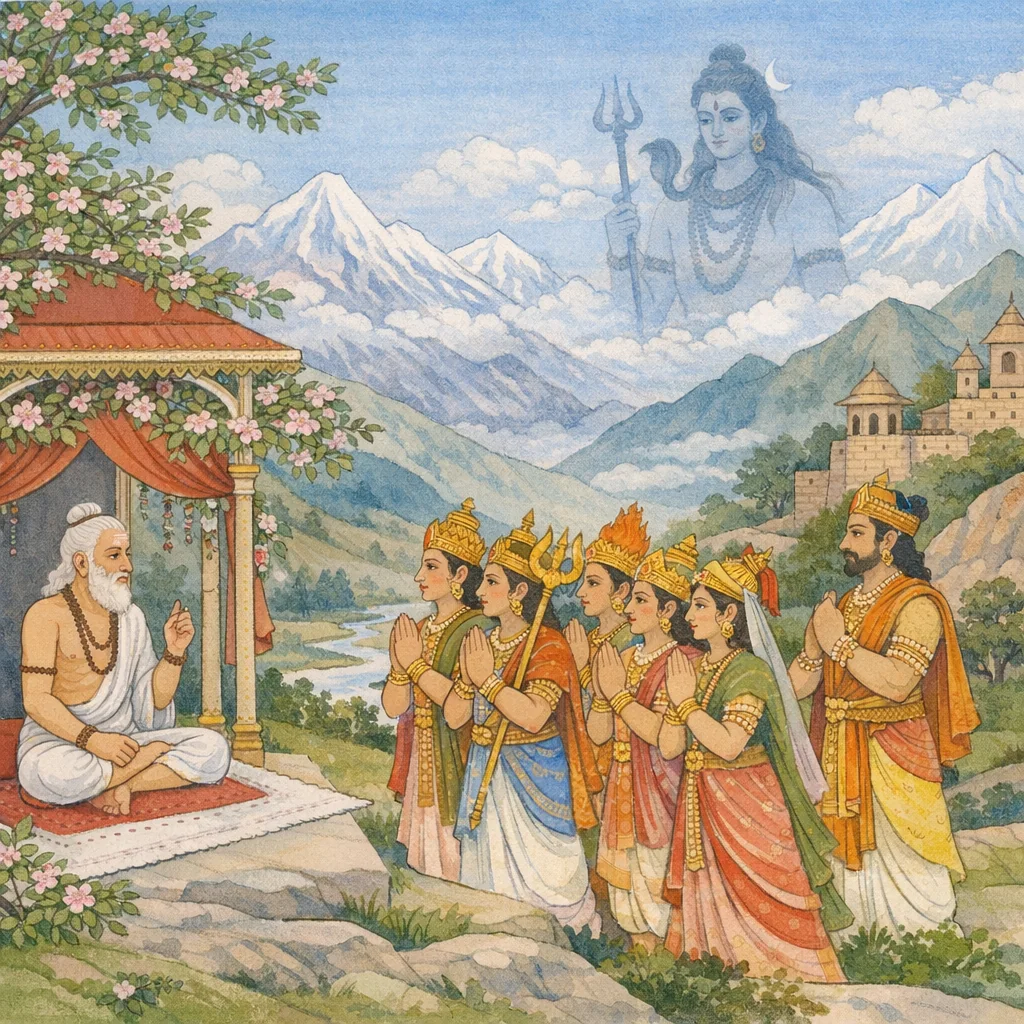
देवगुरुप्रेषणम् (Himālaya Mission of the Gods’ Preceptor / The Gods Send Their Guru)
Adhyāya 31 begins with Brahmā telling Nārada that the gods, led by Śakra/Indra, have recognized the unwavering, non-deviating supreme devotion (avyabhicāriṇī parā bhakti) of Himālaya and his daughter Pārvatī toward Śiva. The devas deliberate pragmatically: if Himālaya, with single-pointed bhakti, gives his daughter to Śiva, he at once gains an auspicious destiny—divinization, entry into Śiva’s realm, and ultimately mokṣa. They even argue rhetorically that the earth’s fame as “Ratnagarbhā” would be imperiled if the “support of infinite jewels” (Himālaya) were to depart, highlighting his cosmic significance. They conclude that Himālaya will abandon his immobile state (sthāvaratva), assume a divine form, offer the maiden to the trident-bearer, attain sārūpya with Mahādeva, enjoy boons, and finally be liberated. Having resolved this, the gods approach their preceptor with reverence and self-interest, asking him to go to Himālaya’s abode to secure their aim. The plan is explicitly speech-based and adversarial: the guru is requested to criticize or denigrate Śiva (śūlin/pinākin) so that, by contrariness, Himālaya will quickly consent to the marriage—even if unwilling—since Durgā will accept no bridegroom other than Śiva. Thus the chapter presents a political-theological maneuver to shape the marriage through counsel, persuasion, and controlled rhetoric, while affirming Śiva as the sole telos of Pārvatī’s choice.
Shlokas
Verse 1
ब्रह्मोवाच । तयोर्भक्तिं शिवे ज्ञात्वा परामव्यभिचारिणीम् । सर्वे शक्रादयो देवाश्चिचिन्तुरिति नारद
Brahmā said: O Nārada, having understood the supreme, unwavering devotion of those two toward Śiva, all the gods—beginning with Śakra (Indra)—fell into deep reflection.
Verse 2
देवा ऊचुः । एकान्तभक्त्या शैलश्चेत्कन्यां तस्मै प्रदास्यति । ध्रुवं निर्वाणता सद्यस्स प्राप्स्यति च भारते
The Devas said: “O Bhārata, if the Mountain (Himālaya), with one-pointed devotion, gives his daughter to Him, then surely and immediately he will attain the state of nirvāṇa (liberation).”
Verse 3
अनन्तरत्नाधारश्चेत्पृथ्वी त्यक्त्वा प्रयास्यति । रत्नगर्भाभिधा भूमिर्मिथ्यैव भविता ध्रुवम्
If the Earth, which is the support of countless jewels, were to abandon her nature and depart, then the land called “Ratnagarbhā” (“the jewel-wombed Earth”) would surely become a mere false name.
Verse 4
स्थावरत्वं परित्यज्य दिव्यरूपं विधाय सः । कन्यां शूलभृते दत्त्वा शिवलोकं गमिष्यति
Casting off the state of immobility, he will assume a divine form; and, having offered the maiden to the Trident-bearer (Lord Śiva), he shall go to Śivaloka.
Verse 5
महादेवस्य सारूप्यं लप्स्यते नात्र संशयः । तत्र भुक्त्वा वरान्भोगांस्ततो मोक्षमवाप्स्यति
He will assuredly attain sārūpya, likeness to Mahādeva—of this there is no doubt. There, having enjoyed the excellent divine pleasures bestowed by that state, he ultimately attains mokṣa, final liberation, through Śiva’s grace.
Verse 6
ब्रह्मोवाच । इत्यालोच्य सुरास्सर्वे कृत्वा चामन्त्रणं मिथः । प्रस्थापयितुमैच्छंस्ते गुरुं तत्र सुविस्मिताः
Brahmā said: Having thus deliberated, all the gods, after mutually taking leave of one another, stood there in great amazement, wishing to send their Guru forth on the intended mission.
Verse 7
ततः शक्रादयो देवास्सर्वे गुरुनिकेतनम् । जग्मुः प्रीत्या सविनया नारद स्वार्थसाधकाः
Then Indra and the other gods—all of them—went to the preceptor’s abode, O Nārada, with joy and humility, intent on securing their own desired purpose.
Verse 8
गत्वा तत्र गुरुं नत्वा सर्वे देवास्सवासवाः । चक्रुर्निवेदनं तस्मै गुरवे वृत्तमादरात्
Going there, all the gods—along with Indra—bowed to the Guru; and with reverence they reported to that preceptor the entire matter that had occurred.
Verse 9
देवा ऊचुः । गुरो हिमालयगृहं गच्छास्मत्कार्य्यसिद्धये । तत्र गत्वा प्रयत्नेन कुरु निन्दाञ्च शूलिनः
The gods said: “O Guru, go to the house of Himālaya so that our purpose may be fulfilled. Having gone there, strive deliberately and speak words of censure against Śūlin (Lord Śiva).”
Verse 10
पिनाकिना विना दुर्गा वरं नान्यं वरिष्यति । अनिच्छया सुतां दत्त्वा फलं तूर्णं लभिष्यति
Without Pinākin (Lord Śiva, bearer of the Pināka bow), Durgā will not choose any other bridegroom. Even if one gives away his daughter unwillingly, he will swiftly reap the inevitable result of that act.
Verse 11
कालेनैवाधुना शैल इदानीं भुवि तिष्ठतु । अनेकरत्नाधारं तं स्थापय त्वं क्षितौ गुरौ
By the power of time itself, let this mountain now remain established upon the earth. You, O venerable one, set it firmly on the ground—this mountain that is a repository and support of many gems.
Verse 12
ब्रह्मोवाच । इति देववचः श्रुत्वा प्रददौ कर्णयोः करम् । न स्वीचकार स गुरुस्स्मरन्नाम शिवेति च
Brahmā said: Having heard those words of the gods, the Guru placed his hand upon his ears; yet he did not accept, for inwardly he was remembering the Name—“Śiva”—again and again.
Verse 13
अथ स्मृत्वा महादेवं बृहस्पतिरुदारधीः । उवाच देववर्यांश्च धिक्कृत्वा च पुनः पुनः
Then Bṛhaspati, noble in understanding, remembered Mahādeva; and again and again he spoke, repeatedly reproaching the foremost among the gods.
Verse 14
बृहस्पतिरुवाच । सर्वे देवास्स्वार्थपराः परार्थध्वंसकारकाः । कृत्वा शंकरनिंदा हि यास्यामि नरकं ध्रुवम्
Bṛhaspati said: “All the gods have turned to self-interest, destroying the good of others. Having slandered Śaṅkara, I shall surely go to hell.”
Verse 15
कश्चिन्मध्ये च युष्माकं गच्छेच्छैलान्तिकं सुराः । संपादयेत्स्वाभिमतं शैलेन्द्रं प्रतिबोध्य च
“O gods, let someone from among you go near the mountain; having awakened and informed the lord of the mountain, let him accomplish what is desired by you.”
Verse 16
अनिच्छया सुतां दत्त्वा सुखं तिष्ठतु भारते । तस्मै भक्त्या सुतां दत्त्वा मोक्षं प्राप्स्यति निश्चितम्
O Bhārata, even if he gives his daughter unwillingly, let him thereafter dwell in comfort. But he who gives his daughter to that worthy one with devotion will surely attain moksha.
Verse 17
पश्चात्सप्तर्षयस्सर्वे बोधयिष्यन्ति पर्वतम् । पिनाकिना विना दुर्गा वरं नान्यं वरिष्यति
Afterwards, all the Seven Sages will instruct Parvata (Himālaya). Without Pinākin—Lord Śiva, bearer of the bow Pināka—Durgā will choose no other boon; she will accept none besides him.
Verse 18
अथवा गच्छत सुरा ब्रह्मलोकं सवासवाः । वृत्तं कथयत स्वं तत्स वः कार्यं करिष्यति
“Or else, O gods—together with Indra—go to Brahmā’s world. Tell him fully what has occurred; he will accomplish for you the task that must be done.”
Verse 19
ब्रह्मोवाच । तच्छ्रुत्वा ते समालोच्याजग्मुर्मम सभां सुराः । सर्वे निवेदयांचक्रुर्नत्वा तद्गतमादरात्
Brahmā said: Hearing that, the gods deliberated together and came to my assembly. Having bowed with reverence, they all reported the matter exactly as it had occurred.
Verse 20
देवानां तद्वचः श्रुत्वा शिवनिन्दाकरं तदा । वेदवक्ता विलप्याहं तानवोचं सुरान्मुने
O sage, when I heard those words of the gods—words that amounted to a censure of Śiva—then I, the reciter of the Veda, lamenting, addressed those devas and spoke to them.
Verse 21
ब्रह्मोवाच । नाहं कर्तुं क्षमो वत्साः शिवनिन्दां सुदुस्सहाम् । संपद्विनाश रूपाञ्च विपदां बीजरूपिणीम्
Brahmā said: “O dear children, I am not capable of uttering the unbearable blasphemy of Śiva—blasphemy that destroys prosperity and becomes the seed of calamities.”
Verse 22
सुरा गच्छत कैलासं सन्तोषयत शंकरम् । प्रस्थापयत तं शीघ्रं हिमालयगृहं प्रति
O Devas, go to Kailāsa and gladden Śaṅkara. Urge Him swiftly to set forth toward the abode of Himālaya.
Verse 23
स गच्छेदुपशैलेशमात्मनिन्दां करोतु वै । परनिन्दाविनाशाय स्वनिन्दा यशसे मता
Let him go near the Lord of the Mountain and truly speak in self-deprecation. For the destruction of slander of others, self-blame is held to be a source of genuine honor.
Verse 24
ब्रह्मोवाच । श्रुत्वेति मद्वचो देवा मां प्रणम्य मुदा च ते । कैलासं प्रययुः शीघ्रं शैलानामधिपं गिरिम्
Brahmā said: Having thus heard my words, the gods bowed to me with joy and quickly set out for Kailāsa—the sovereign mountain, lord among peaks.
Verse 25
तत्र गत्वा शिवं दृष्ट्वा प्रणम्य नतमस्तकाः । सुकृतांजलयस्सर्वे तुष्टुवुस्तं सुरा हरम्
Going there and beholding Lord Śiva, the devas bowed with lowered heads. With hands reverently joined in añjali, they all praised Hara—Śiva, the remover of bondage and sorrow.
Verse 26
देवा ऊचुः । देवदेव महादेव करुणाकर शंकर । वयं त्वां शरणापन्नाः कृपां कुरु नमोऽस्तु ते
The Devas said: “O God of gods, O Mahādeva, O compassionate Śaṅkara—we have come to You for refuge. Show us Your grace. Salutations to You.”
Verse 27
त्वं भक्तवत्सलः स्वामिन्भक्तकार्यकरस्सदा । दीनोद्धरः कृपासिन्धुर्भक्तापद्विनिमोचकः
O Lord, You are ever affectionate to Your devotees; You always accomplish the aims of the bhaktas. You uplift the lowly and the distressed; You are an ocean of compassion, and You free devotees from calamities.
Verse 28
ब्रह्मोवाच । इति स्तुत्वा महेशानं सर्वे देवास्सवासवाः । सर्वं निवेदयांचक्रुस्तद्वृत्तं तत आदरात्
Brahmā said: Having thus praised Maheśāna (Lord Śiva), all the gods—along with Indra—then respectfully reported to Him the entire account of what had occurred.
Verse 29
तच्छ्रुत्वा देववचनं स्वीचकार महेश्वरः । देवान् सुयापयामास तानाश्वास्य विहस्य सः
Hearing the gods’ words, Mahādeva accepted their request. Smiling, he comforted the devas and brought them peace, dispelling their anxiety.
Verse 30
देवा मुमुदिरे सर्वे शीघ्रं गत्वा स्वमंदिरम् । सिद्धं मत्वा स्वकार्य्यं हि प्रशंसन्तस्सदाशिवम्
All the gods rejoiced. Quickly returning to their own abodes, they considered their purpose accomplished and praised Sadāśiva, the ever-auspicious Lord.
Verse 31
इति श्रीशिवमहापुराणे द्वितीयायां रुद्रसंहितायां तृतीये पार्वतीखण्डे शिवमायावर्णनं नामैकत्रिंशोऽध्यायः
Thus ends the thirty-first chapter, entitled “The Description of Śiva’s Māyā,” in the Pārvatī-khaṇḍa (third section) of the Rudra-saṃhitā (second division) of the Śrī Śiva Mahāpurāṇa.
Verse 32
यदा शैलस्सभामध्ये समुवास मुदान्वितः । बन्धुवर्गैः परिवृतः पार्वतीसहितस्स्वयम्
When the Mountain Lord, Himālaya, sat joyfully in the midst of the assembly hall, he himself was surrounded by his kinsmen, with Pārvatī seated beside him.
Verse 33
एतस्मिन्नन्तरे तत्र ह्याजगाम सदाशिवः । दण्डी छत्री दिव्यवासा बिभ्रत्तिलकमुज्ज्वलम्
Just then, at that very place, Sadāśiva arrived—bearing a staff and a parasol, clothed in divine garments, and wearing a radiant tilaka upon His forehead.
Verse 34
करे स्फटिकमालाञ्च शालग्रामं गले दधत् । जपन्नाम हरेर्भक्त्या साधुवेषधरौ द्विजः
With a crystal rosary in his hand and a Śālagrāma upon his neck, the twice-born—outwardly clad in the guise of a holy mendicant—kept chanting the name of Hari with devotion.
Verse 35
तं च दृष्ट्वा समुत्तस्थौ सगणोऽपि हिमालयः । ननाम दण्डवद्भूमौ भक्त्यातिथिमपूर्वकम्
Seeing Him, Himālaya—together with all his attendants—rose at once, and in devotion bowed upon the ground like a staff, offering unprecedented reverence to that divine guest.
Verse 36
ननाम पार्वती भक्त्या प्राणेशं विप्ररूपिणम् । ज्ञात्वा तं मनसा देवी तुष्टाव परया मुदा
With devotion, Pārvatī bowed to the Lord of her life, who had assumed the form of a brāhmaṇa. Recognizing Him inwardly, the Goddess praised Him with supreme joy.
Verse 37
आशिषं युयुजे विप्रस्सर्वेषां प्रीतितश्शिवः । शिवाया अधिकं तात मनोभिलषितं हृदा
Pleased with them all, Śiva bestowed His blessings upon the sages; but, dear one, He granted Śivā (Pārvatī) even more—exactly what her heart had long desired.
Verse 38
मधुपर्कादिकं सर्वं जग्राह ब्राह्मणो मुदा । दत्तं शैलाधिराजेन हिमांगेन महादरात्
Joyfully, the brāhmaṇa accepted all the offerings—beginning with the madhuparka—given with great reverence by Himālaya, the lord of mountains.
Verse 39
पप्रच्छ कुशलं चास्य हिमाद्रिः पर्वतोत्तमः । तं द्विजेन्द्रं महाप्रीत्या सम्पूज्य विधिवन्मुने
Then Himādri, the best of mountains, after duly honoring that foremost brāhmaṇa with great joy, inquired about his welfare, O sage.
Verse 40
पुनः पप्रच्छ शैलेशस्तं ततः को भवानिति । उवाच शीघ्रं विप्रेन्द्रो गिरीद्रं सादरं वचः
Then the Lord of the mountain again asked him, “Who are you?” Thereupon the foremost of brāhmaṇas promptly addressed the king of mountains with respectful words.
Verse 41
विप्रेन्द्र उवाच । ब्राह्मणोऽहं गिरिश्रेष्ठ वैष्णवो बुधसत्तमः । घटिकीं वृतिमाश्रित्य भ्रमामि धरणीतले
Viprendra said: “O best of mountains (Giriśa), I am a brāhmaṇa, a devotee of Viṣṇu, and foremost among the wise. Living by a mere ghaṭikā’s worth of subsistence, I wander upon the earth.”
Verse 42
मनोयायी सर्व गामी सर्वज्ञोहं गुरोर्बलात् । परोपकारी शुद्धात्मा दयासिन्धुर्विकारहा
By the power of my Guru, I move as swiftly as the mind, I can go everywhere, and I am all-knowing. I am devoted to the welfare of others, pure in soul, an ocean of compassion, and a destroyer of inner distortions and impurities.
Verse 43
मया ज्ञातं हराय त्वं स्वसुतां दातुमिच्छसि । इमां पद्मसमां दिव्यां वररूपां सुलक्षणाम्
I have understood that you wish to give your own daughter to Hara (Śiva). This maiden—divine, lotus-like, of excellent beauty, and endowed with auspicious marks—is indeed fit for Him.
Verse 44
निराश्रयायासंगाय कुरूपायागुणाय च । श्मशानवासिने व्यालग्राहिरूपाय योगिने
Salutations to the Lord who is without dependence and without attachment; who appears in a fearsome form and is beyond the guṇas; who dwells in cremation grounds; who bears the form that seizes and subdues serpents; and who is the supreme Yogi.
Verse 45
दिग्वाससे कुगात्राय व्यालभूषणधारिणे । अज्ञातकुलनाम्ने च कुशीलायाविहारिणे
Salutations to Him who is clad in the quarters (sky-clad), whose body appears rough and unadorned, who wears serpents as ornaments; who is beyond known lineage and name, and who roams as a free, unconventional ascetic.
Verse 46
विभूतिदिग्धदेहाय संक्रुद्धायाविवेकिने । अज्ञातवयसेऽतीव कुजटाधारिणे सदा
Ever bearing matted jaṭā locks, his body smeared with vibhūti (sacred ash), he appeared in fierce, raging wrath, as though beyond discrimination; even his age could not be known—such was he in that extraordinary guise.
Verse 47
सर्वाश्रयाय भ्रमिणे नागहाराय भिक्षवे । कुमार्गनिरतायाथ वेदाऽध्वत्यागिने हठात्
Salutations to Him who is the refuge of all, who roams in freedom, who wears serpents as His garland, and who lives as a holy mendicant. Salutations also to Him who, to confound the proud, appears intent on forbidden paths, and who by His sovereign will casts aside the mere track of Vedic formalism.
Verse 48
इयं ते बुद्धिरचल न हि मंगलदा खलु । विबोध ज्ञानिनां श्रेष्ठ नारायणकुलोद्भव
O steadfast one, this understanding of yours is truly not auspicious. Awaken to right discernment, O best among the wise, born in the lineage of Nārāyaṇa.
Verse 49
न ते पात्रानुरूपश्च पार्वतीदानकर्मणि । महाजनः स्मेरमुखः श्रुतमात्राद्भविष्यति
In the act of giving on behalf of Pārvatī, you are not acting in a manner suited to a worthy recipient. The people at large, merely on hearing of it, will smile—mocking and amused.
Verse 50
पश्य शैलाधिप त्वं च न तस्यैकोस्ति बान्धवः । महारत्नाकरस्त्वञ्च तस्य किञ्चिद्धनं न हि
Behold, O lord of mountains: he has not even a single kinsman. And though you are a great mine of jewels, he has no wealth whatsoever. (Yet such outward lack does not diminish Śiva’s sovereignty; He is complete in Himself and bestows the true riches—devotion and liberation.)
Verse 51
बान्धवान्मेनकां कुध्रपते शीघ्रं सुतांस्तथा । सर्वान्पृच्छ प्रयत्नेन पण्डितान्पार्वती विना
“Quickly ask your kinsmen, and Menakā as well, and also your sons. With due effort, consult all the learned ones—yet do so without involving Pārvatī.”
Verse 52
रोगिणो नौषधं शश्वद्रोचते गिरिसत्तम । कुपथ्यं रोचतेऽभीक्ष्णं महादोषकरं सदा
O best of mountains, to a sick person the true medicine never seems agreeable; but unwholesome fare repeatedly appears pleasing—though it always produces great harm.
Verse 53
ब्रह्मोवाच । इत्युक्त्वा ब्राह्मणः शीघ्रं स वै भुक्त्वा मुदान्वितः । जगाम स्वालयं शान्तो नानालीलाकर श्शिवः
Brahmā said: Having spoken thus, the brāhmaṇa quickly ate and, filled with joy, departed to his own dwelling. That tranquil Śiva—who performs many divine play-acts (līlās)—went on his way.
Frequently Asked Questions
The devas, realizing Himālaya and Pārvatī’s steadfast devotion to Śiva, decide to send their guru to Himālaya’s home to expedite the offering of Pārvatī to Śiva, even employing strategic criticism of Śiva as a persuasive tactic.
The chapter frames ekānta-bhakti as immediately transformative: devotion leads to divine proximity (Śiva-loka), sārūpya with Mahādeva, and culminates in mokṣa—showing a graded soteriology grounded in Śaiva theism.
Śiva is invoked as Śūlin and Pinākin, emphasizing his iconic martial-ascetic sovereignty; these names function as theological identifiers while the narrative insists that Durgā/Pārvatī will accept no other vara, reinforcing Śiva’s singular status.