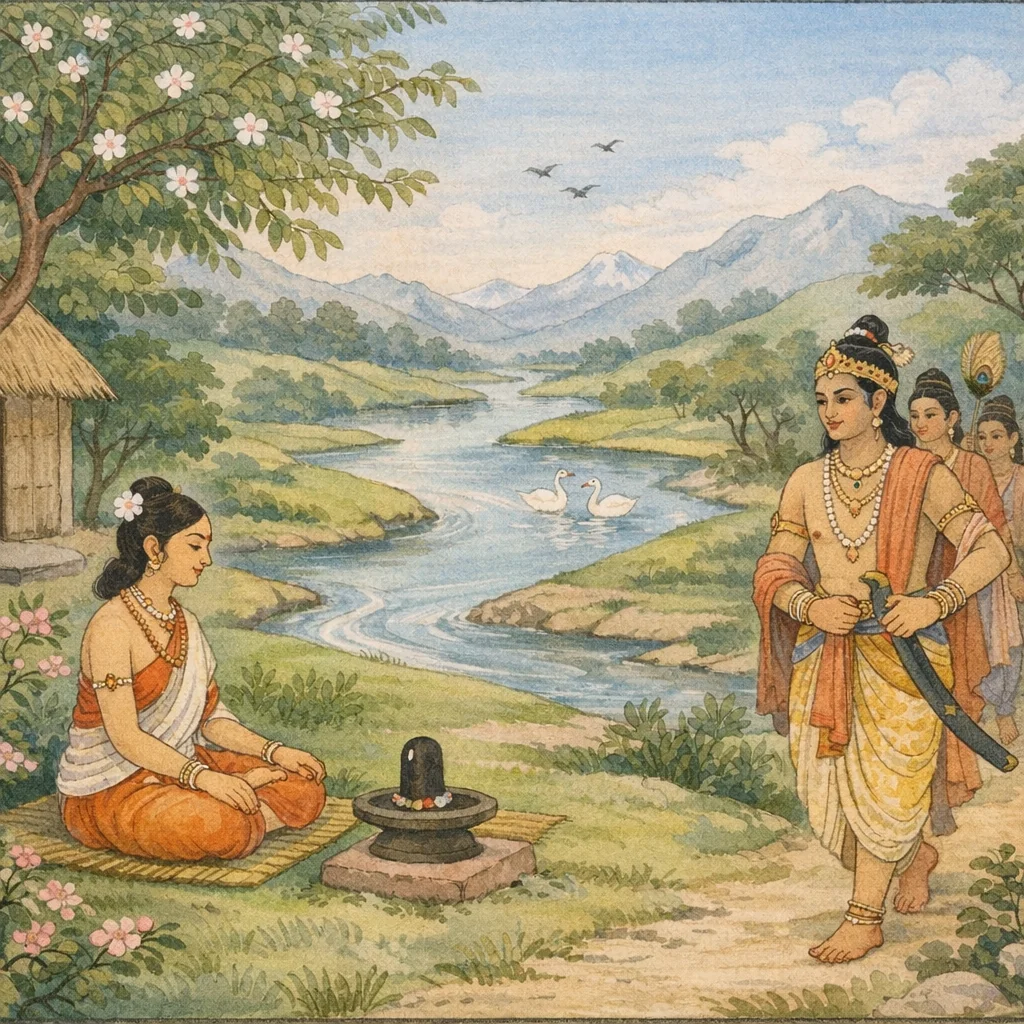
नन्दिकेश्वरशिवलिङ्गमाहात्म्यवर्णनम् (The Māhātmya of the Nandikeśvara Śiva-liṅga)
Adhyāya 7 unfolds in the Purāṇic question–answer style: the ṛṣis ask Sūta to explain (i) how Gaṅgā is said to have “arrived” on the seventh day of Vaiśākha in connection with Narmadā, and (ii) the origin story of Nandikeśa (Nandikeśvara). Sūta agrees, declaring the hearing of this account merit-bestowing, and introduces an exemplum about a brāhmaṇī named Ṛṣikā. Made a young widow by the force of prior karma, she nevertheless vows brahmacarya and undertakes severe tapas, beginning with worship of a Pārthiva form—an earthen Pārthiva-liṅga. An asuric disturber, Mūḍhanāmā, driven by desire, approaches to seduce her with inducements, but she remains unwavering in Śiva-dhyāna, refusing him and granting not even a lustful glance. The chapter’s colophon identifies the core theme as the māhātmya of the Nandikeśvara Śiva-liṅga, so that the ascetic trial and its outcome serve to affirm that liṅga’s sanctity, its associated observances and vratas, and the moral-ritual teaching that steadfast Śaiva contemplation and vows protect from adharma and yield spiritual efficacy.
Shlokas
Verse 1
ऋषय ऊचुः । कथं गंगा समायाता वैशाखे सप्तमीदिने । नर्मदायां विशेषेण सूतैतद्वर्णय प्रभो
The sages said: “How did the river Gaṅgā come to be present on the seventh lunar day of the month of Vaiśākha—especially at the Narmadā? O Sūta, venerable one, describe this to us.”
Verse 2
ईश्वरश्च कथं जातो नन्दिकेशो हि नामतः । वृत्तं तदपि सुप्रीत्या कथय त्वं महामते
“And how was Īśvara—known by the name Nandikeśa—born? O great-minded one, please also narrate that account with gracious goodwill.”
Verse 3
सूत उवाच । साधु पृष्टमृषिश्रेष्ठा नन्दिकेशाश्रितं वचः । तदहं कथयाम्यद्य श्रवणात्पुण्यवर्द्धनम्
Sūta said: “O best of sages, you have asked well—words grounded in Nandikeśa. Therefore today I shall recount it; by merely hearing it, one’s merit (puṇya) is increased.”
Verse 4
ब्राह्मणी ऋषिका नाम्ना कस्यचिच्च द्विजन्मनः । सुता विवाहिता कस्मैचिद्द्विजाय विधानतः
There was a Brahmin woman named Ṛṣikā, the daughter of a certain twice-born man. In accordance with the prescribed rites, she was married to a Brahmin.
Verse 5
पूर्वकर्मप्रभावेन पत्नी सा हि द्विजन्मनः । सुव्रतापि च विप्रेन्द्रा बालवैधव्यमागता
By the force of her former karma, she—the wife of that twice-born—though virtuous and steadfast in noble vows, O best of brahmins, fell into widowhood while still young.
Verse 6
अथ सा द्विजपत्नी हि ब्रह्मचर्य्यव्रतान्विता । पार्थिवार्चनपूर्वं हि तपस्तेपे सुदारुणम्
Then that wife of the twice-born, steadfast in the vow of brahmacarya, performed exceedingly austere tapas—first worshipping a Pārthiva-liṅga, Śiva’s emblem fashioned of earth.
Verse 7
इति श्रीशिवमहापुराणे चतुर्थ्यां कोटिरुद्रसंहितायां नन्दिकेश्वरशिवलिंगमाहात्म्यवर्णनंनाम सप्तमोऽध्यायः
Thus, in the Śrī Śiva-Mahāpurāṇa, in the Fourth Book—the Koṭirudra Saṃhitā—concludes the seventh chapter entitled “The Description of the Glory of the Nandikeśvara Śiva-Liṅga.”
Verse 8
तपन्तीं तां समालोक्य सुन्दरीमतिकामिनीम् । तया भोगं ययाचे स नानालोभं प्रदर्शयन्
Seeing her engaged in austerity—yet exceedingly beautiful and a strong object of desire—he begged to enjoy sensual pleasures with her, displaying many kinds of temptations and greedy enticements.
Verse 9
अथ सा सुव्रता नारी शिवध्यानपरायणा । तस्मिन्दृष्टिं दधौ नैव कामदृष्ट्या मुनीश्वराः
Then that virtuous woman, wholly devoted to meditation on Śiva, did not cast her gaze upon him with a lustful look—O best of sages.
Verse 10
न मानितवती तं च ब्राह्मणी सा तपोरता । अतीव हि तपोनिष्ठासीच्छिवध्यानमाश्रिता
That Brahmin woman, devoted to austerity, did not pay him any special honor; for she was exceedingly steadfast in tapas, wholly absorbed in meditation on Lord Śiva.
Verse 11
अथ मूढः स दैत्येन्द्रः तया तन्व्या तिरस्कृतः । चुक्रोध विकटं तस्यै पश्चाद्रूपमदर्शयत्
Then that deluded lord of the Daityas, scorned by the slender maiden, blazed with dreadful wrath and thereafter revealed to her a terrifying form.
Verse 12
अथ प्रोवाच दुष्टात्मा दुर्वचो भयकारकम् । त्रासयामास बहुशस्तां च पत्नीं द्विजन्मनः
Then that wicked-souled man spoke harsh, fear-inspiring words, and again and again he tormented the wife of that twice-born brāhmaṇa.
Verse 13
तदा सा भयसंत्रस्ता बहुवारं शिवेति च । बभाषे स्नेहतस्तन्वी द्विजपत्नी शिवाश्रया
Then, terrified with fear, that slender brāhmaṇa’s wife—having taken refuge in Śiva—again and again uttered the name “Śiva,” speaking with heartfelt devotion.
Verse 14
विह्वलातीव सा नारी शिवनामप्रभाषिणी । जगाम शरणं शम्भोः स्वधर्मावनहेतवे
That woman, overwhelmed and distressed, kept uttering Lord Śiva’s Name; and for the sake of preserving her own dharma, she went to take refuge in Śambhu (Śiva).
Verse 15
शरणागतरक्षार्थं कर्तुं सद्वृत्तमाहितम् । आनन्दार्थं हि तस्यास्तु शिव आविर्बभूव ह
To protect the one who had taken refuge, and to establish righteous conduct, Śiva indeed manifested—so that she might attain joy and reassurance.
Verse 16
अथ तं मूढनामानं दैत्येन्द्रं काम विह्वलम् । चकार भस्मसात्सद्यः शंकरो भक्तवत्सलः
Then Śaṅkara—ever tender to His devotees—at once reduced to ashes that lord of the Daityas, the one called Mūḍha, who was deluded and agitated by desire.
Verse 17
ततश्च परमेशानो कृपादृष्ट्या विलोक्य ताम् । वरं ब्रूहीति चोवाच भक्तरक्षणदक्षधीः
Then the Supreme Lord (Śiva), gazing upon her with a compassionate look, spoke: “Speak—choose a boon.” Thus said He, whose discerning mind is ever skilled in protecting His devotees.
Verse 18
श्रुत्वा महेशवचनं सा साध्वी द्विजकामिनी । ददर्श शांकरं रूपमानन्दजनकं शुभम्
Having heard Mahesha’s words, that virtuous Brahmin lady beheld Śaṅkara’s auspicious form—one that gives rise to spiritual bliss.
Verse 19
ततः प्रणम्य तं शंभुं परमेशसुखावहम् । तुष्टाव साञ्जलिः साध्वी नतस्कन्धा शुभाशया
Then, bowing down to that Śambhu—who bestows the bliss of the Supreme Lord—the virtuous lady, with hands folded in reverence, praised Him, her shoulders bent in humility and her heart filled with auspicious intent.
Verse 20
ऋषिकोवाच । देवदेव महादेव शरणागतवत्सल । दीनबन्धुस्त्वमीशानो भक्तरक्षाकरः सदा
The sage said: “O God of gods, O Mahādeva—You are ever affectionate to those who seek refuge. You are the friend of the helpless, the sovereign Lord, and always the protector of Your devotees.”
Verse 21
त्वया मे रक्षितो धर्मो मूढनाम्नोऽसुरादिह । यदयं निहतो दुष्टो जगद्रक्षा कृता त्वया
By You my dharma has been protected here from the asura named Mūḍha. Since this wicked one has been slain, the safeguarding of the world has been accomplished by You.
Verse 22
स्वपादयोः परां भक्तिं देहि मे ह्यनपायिनीम् । अयमेव वरो नाथ किमन्यदधिकं ह्यतः
Grant me supreme devotion to Your lotus-feet—devotion that never departs. This alone is the boon, O Lord; what could be greater than this?
Verse 23
अन्यदाकर्णय विभो प्रार्थनां मे महेश्वर । लोकानामुपकारार्थमिह त्वं संस्थितो भव
O all-pervading Lord, Maheshvara, please hear yet another prayer of mine: for the welfare of the worlds, remain established here, as a gracious and manifest presence.
Verse 24
सूत उवाच । इति स्तुत्वा महादेवमृषिका सा शुभव्रता । तूष्णीमासाथ गिरिशः प्रोवाच करुणाकरः
Sūta said: Having thus praised Mahādeva, that woman-sage of auspicious vows then fell silent. Thereupon Girīśa—the compassionate Lord—spoke.
Verse 25
गिरिश उवाच । ऋषिके सुचरित्रा त्वं मम भक्ता विशेषतः । दत्ता वराश्च ते सर्वे तुभ्यं येये हि याचिताः
Girish (Lord Śiva) said: “O holy woman, you are of noble conduct and are especially devoted to Me. All the boons you have asked for—each and every one—have been granted to you.”
Verse 26
एतस्मिन्नंतरे तत्र हरिब्रह्मादयः सुराः । शिवाविर्भावमाज्ञाय ययुर्हर्षसमन्विताः
Meanwhile, at that very time and place, the gods—Vishnu, Brahmā, and the others—having come to know of Lord Śiva’s manifestation, proceeded there filled with joy.
Verse 27
शिवं प्रणम्य सुप्रीत्या समानर्चुश्च तेऽखिलाः । तुष्टुवुर्नतका विप्राः करौ बद्ध्वा सुचेतसः
Bowing to Śiva with deep gladness, all those brāhmaṇas worshipped Him together. With minds purified and intent, they stood reverently, hands joined in añjali, and praised Him.
Verse 28
एतस्मिन्समये गंगा साध्वी तां स्वर्धुनी जगौ । ऋषिकां सुप्रसन्नात्मा प्रशंसन्तो च तीद्विधिम्
At that time, the virtuous Gaṅgā—celebrated as Svardhunī, the celestial river—spoke with a deeply pleased heart, praising the sages and that sacred ordinance of worship and right conduct.
Verse 29
गंगोवाच । ममार्थे चैव वैशाखे मासि देयं त्वया वचः । स्थित्यर्थं दिनमेकं मे सामीप्यं कार्य्यमेव हि
Gaṅgā said: “For my sake, in the month of Vaiśākha you must give your word. For the sake of my continuance, you must indeed remain near me for a single day.”
Verse 30
सूत उवाच । गंगावचनमाकर्ण्य सा साध्वी प्राह सुव्रता । तथास्त्विति वचः प्रीत्या लोकानां हितहेतवे
Sūta said: Hearing Gaṅgā’s words, that virtuous and steadfast lady replied with joy, “So be it,” for the welfare and benefit of all the worlds.
Verse 31
आनन्दार्थं शिवस्तस्याः सुप्रसन्नश्च पार्थिवे । तस्मिंल्लिंगे लयं यातः पूर्णांशेन तया हरः
For her joy, Śiva became exceedingly gracious in that earthen Liṅga. There, within that Liṅga, Hara—by His complete and undivided presence—entered into absorptive samādhi, revealing Himself fully through the Liṅga for the devotee’s bliss.
Verse 32
देवः सर्वे सुप्रसन्नाः प्रशंसंति शिवं च ताम् । स्वंस्वं धाम ययुर्विष्णुब्रह्माद्या अपि स्वर्णदी
All the gods, fully delighted, praised Lord Śiva and that divine Lady. Then Viṣṇu, Brahmā, and the other deities departed to their respective abodes (from that golden river-bank region).
Verse 33
तद्दिनात्पावनं तीर्थमासीदीदृशमुत्तमम् । नन्दिकेशः शिवः ख्यातः सर्वपापविनाशनः
From that very day, that sacred tīrtha became supremely purifying. There, Śiva became renowned as Nandikeśa—the Lord who destroys all sins.
Verse 34
गंगापि प्रतिवर्षं तद्दिने याति शुभेच्छया । क्षालनार्थं स्वपापस्य यद्ग्रहीतं नृणां द्विजाः
O twice-born sages, even the Goddess Gaṅgā, year after year on that very day, comes with auspicious intent—to wash away the sins that human beings have taken upon themselves.
Verse 35
तत्र स्नातो नरः सम्यङ् नंदिकेशं समर्च्य च । ब्रह्महत्यादिभिः पापैर्मुच्यते ह्यखिलैरपि
There, one who bathes properly and worships Nandikeśa with devotion is truly freed from all sins—beginning with brahmahatyā (the grave sin of slaying a brāhmaṇa) and every other stain besides.
Frequently Asked Questions
It presents a two-part inquiry (Gaṅgā’s Vaiśākha Saptamī arrival in relation to Narmadā, and Nandikeśa’s origin) and develops a narrative exemplum: the widow-ascetic Ṛṣikā’s tapas and Śiva-dhyāna tested by the asura Mūḍhanāmā, in service of establishing the Nandikeśvara Śiva-liṅga’s māhātmya.
The chapter encodes a ritual logic: Pārthiva worship signifies accessible, materially grounded liṅga-praxis; brahmacarya and tapas function as internal ‘protective technologies’; and the seduction attempt dramatizes kāma as a destabilizing force overcome through single-pointed Śiva-dhyāna, thereby legitimizing the liṅga’s sanctity and the efficacy of the associated observance.
Nandikeśvara/Nandikeśa is foregrounded as the key Śaiva figure anchoring the chapter’s liṅga-māhātmya; Śiva appears primarily as the meditative object (dhyeya) whose contemplation grants steadiness and protection, while the chapter’s framing implies a localized manifestation via the Nandikeśvara Śiva-liṅga.