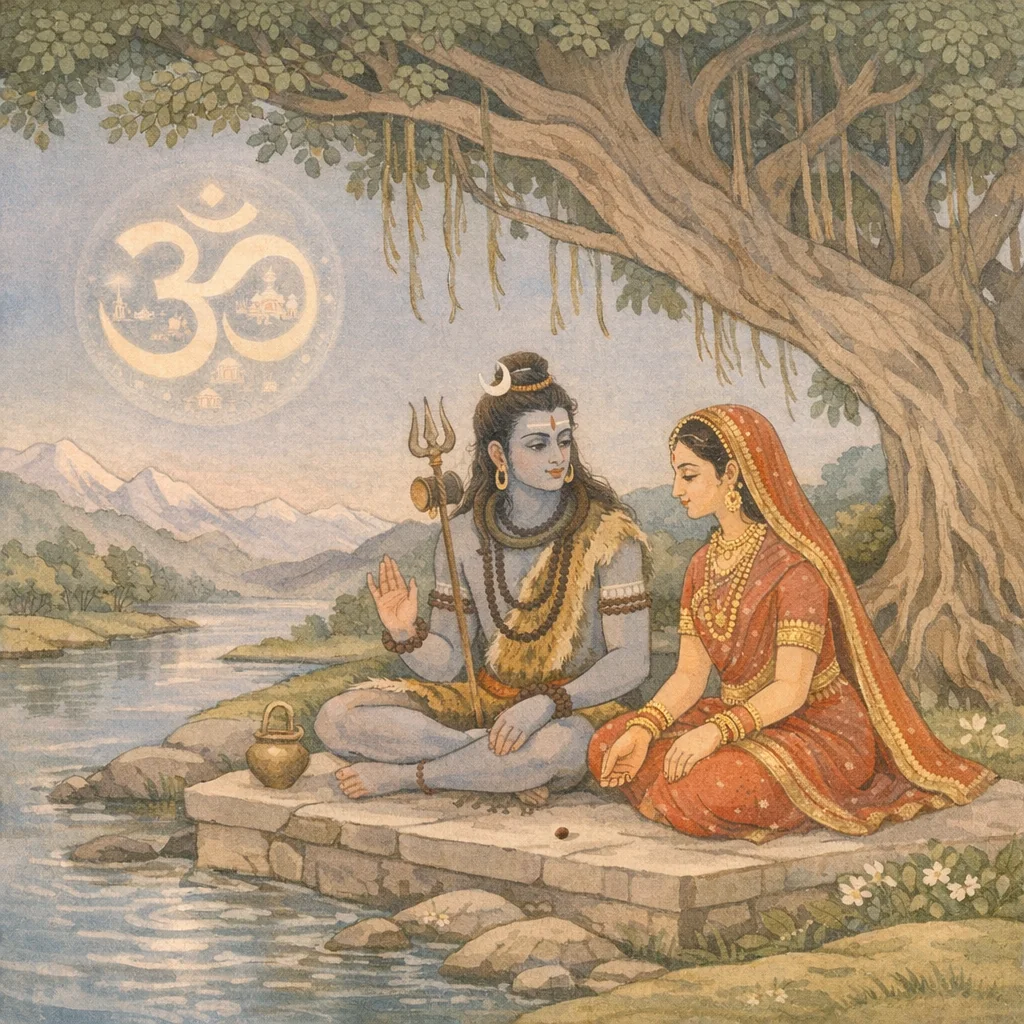
प्रणवमहिमा — The Greatness of the Praṇava (Om) as Śiva
Adhyāya 3 presents a direct theological instruction from Īśvara (Śiva) to Devī in answer to her question. It argues that the praṇava, “Om,” the single-syllable mantra (ekākṣara-mantra), is Śiva himself—beyond the three guṇas, omniscient, and the causal ground of the cosmos. Knowing Om’s meaning (praṇava-jñāna) is praised as the essence of knowledge and the seed of all vidyās, illustrated by the banyan-seed analogy showing vast power contained in an extremely subtle sound. A key doctrine is the near non-difference of signifier and signified (vācaka-vācya): Om is not merely a symbol of Śiva but participates in Śiva’s reality. The chapter also links Om to liberation (mukti), calling it the crest-jewel of all mantras, and mentions Kāśī (Vārāṇasī) as a place where Śiva bestows this saving means upon beings.
Shlokas
Verse 1
ईश्वर उवाच । शृणु देवि प्रवक्ष्यामि यन्मां त्वम्परि पृच्छसि । तस्य श्रवणमात्रेण जीवस्साक्षाच्छिवो भवेत्
Īśvara said: “Listen, O Devī. I shall explain what you are asking Me about. By merely hearing that teaching, the bound jīva becomes directly (sākṣāt) Shiva.”
Verse 2
प्रणवार्थपरिज्ञानमेव ज्ञानं मदात्मकम् । बीजन्तत्सर्वविद्यानां मंत्र म्प्रणवनामकम्
True knowledge is indeed the direct realization of the meaning of Praṇava (Oṃ), for that knowledge is of My very nature. That Praṇava—called the mantra—stands as the seed of all branches of sacred knowledge.
Verse 3
अतिसूक्ष्मं महार्थं च ज्ञेयं तद्वटबीजवत् । वेदादि वेदसारं च मद्रूपं च विशेषतः
Know That (Supreme Reality) to be exceedingly subtle yet of vast import—like the seed of the banyan tree. It is the beginning of the Vedas and also their very essence; and, most especially, it is of My own nature and form.
Verse 4
देवो गुणत्रयातीतः सर्वज्ञः सर्वकृत्प्रभुः । ओमित्येकाक्षरे मंत्रे स्थितोहं सर्वगश्शिवः
I am the Divine Lord who transcends the three guṇas, all-knowing and the sovereign doer of all. Abiding in the one-syllable mantra “Om”, I am Śiva—present everywhere and pervading all.
Verse 5
यदस्ति वस्तु तत्सर्वं गुणप्राधान्ययोगतः । समस्तं व्यस्त मपि च प्रणवार्थं प्रचक्षते
Whatever reality exists—through the predominance of the guṇas—whether regarded as an undivided whole or as differentiated parts, the wise proclaim it all to be the very meaning of the Praṇava (Oṃ).
Verse 6
सर्वार्थसाधकं तस्मादेकं ब्रह्मैतदक्षरम् । तेनोमिति जगत्कृस्नं कुरुते प्रथमं शिवः
Therefore this one imperishable syllable—Brahman itself—is the accomplisher of all aims. By that very “Oṃ,” Śiva, in the beginning, brings forth and orders the entire universe.
Verse 7
शिवो वा प्रणवो ह्येष प्रणवो वा शिवः स्मृतः । वाच्यवाचकयोर्भेदो नात्यंतं विद्यते यतः
This Praṇava (Oṁ) is indeed Śiva; and Praṇava too is remembered as Śiva. For the difference between the expressed meaning and the expressing sound is not absolute.
Verse 8
तस्मादेकाक्षरं देवं मां च ब्रह्मर्षयो विदुः । वाच्यवाचकयोरैक्यं मन्यमाना विपश्चितः
Therefore the Brahmarṣis know Me as the one-syllabled Lord. The wise, understanding the oneness of the signified reality and the signifying sound, recognize that unity—of Name and Named.
Verse 9
अतस्तदेव जानीयात्प्रणवं सर्वकारणम् । निर्विकारी मुमुक्षुर्मां निर्गुणं परमेश्वरम्
Therefore, one should know the Praṇava (Oṁ) alone as the cause of all. Let the seeker of liberation, free from all modifications, realize Me—the attributeless (nirguṇa) Supreme Lord, Paramēśvara.
Verse 10
एनमेव हि देवेशि सर्वमंत्रशिरोमणिम् । काश्यामहं प्रदास्यामि जीवानां मुक्तिहेतवे
O Goddess, this indeed is the crest-jewel of all mantras. In Kāśī I shall bestow it for the sake of the liberation of living beings.
Verse 11
तत्रादौ सम्प्रवक्ष्यामि प्रणवोद्धारम म्बिके । यस्य विज्ञानमात्रेण सिद्धिश्च परमा भवेत्
There, first of all, O Ambikā, I shall duly expound the derivation and inner import of the Praṇava (Oṁ); by the mere true understanding of it, the highest spiritual attainment indeed arises.
Verse 12
निवृत्तिमुद्धरेत्पूर्वमिन्धनं च ततः परम् । कालं समुद्धरेत्पश्चाद्दंडमी श्वरमेव च
First one should transcend Nivṛtti; thereafter, Indhana. Next one should rise beyond Kāla (Time), and then beyond Daṇḍa (the principle of chastisement/discipline), and finally attain Īśvara Himself.
Verse 13
वर्णपंचकरूपोयमेवं प्रणव उद्धृतः । त्रिमात्रबिन्दुनादात्मा मुक्तिदो जपतां सदा
Thus is the Praṇava (Oṁ) proclaimed: it is of the form of the five letters, and its essence is the three mātrās together with bindu and nāda. To those who ever repeat it in japa, it bestows liberation (mokṣa).
Verse 14
ब्रह्मादिस्थावरान्तानां सर्वेषां प्राणिनां खलु । प्राणः प्रणव एवायं तस्मात्प्रणव ईरितः
Truly, for all beings—from Brahmā down to the immobile creatures—this very Praṇava (Oṁ) is the life-breath (prāṇa). Therefore it is proclaimed as “Praṇava.”
Verse 15
आद्यम्वर्णमकारं च उकारमुत्तरे ततः । मकारं मध्यतश्चैव नादांतं तस्य चोमिति
Its first sound is the letter “A”; thereafter comes “U”; in the middle is “M”; and its culmination is the subtle resonance (nāda). Thus it is called “Om”.
Verse 16
जलवद्वर्णमाद्यन्तु दक्षिणे चोत्तरे तथा । मध्ये मकारं शुचिवदोंकारे मुनिसत्तम
O best of sages, place the first letter—shining like water—on the right and likewise on the left; place the letter “ma” in the middle, and thus contemplate the pure Oṅkāra.
Verse 17
अकारश्चाप्युकारोयं मकाराश्च त्रयं क्रमात् । तिस्रो मात्रास्समाख्याता अर्द्धमात्रा ततः परम्
In due order, ‘a’, ‘u’, and ‘m’—these three are declared the three mātrās (measures of sound) of Oṃ; beyond them is the half‑mātrā, the subtle transcendence that follows.
Verse 18
अर्द्धमात्रा महेशानि बिन्दुनादस्वरूपिणी । वर्णनीया न वै चाद्धा ज्ञेया ज्ञानिभिरेव सा
O Maheshānī, the half‑measure (ardhamātrā) is of the very nature of nāda and bindu. She cannot truly be described in full by words; she is to be known only by the wise through direct realization.
Verse 19
ईशानस्सर्वविद्यानामित्यद्याश्श्रुतयः प्रिये । मत्त एव भवन्तीति वेदास्सत्यम्वदन्ति हि
Beloved, the Śrutis begin with the proclamation, “Īśāna is the Lord of all knowledges.” Indeed, the Vedas truthfully declare that all forms of knowledge arise from Me alone.
Verse 20
तस्माद्वेदादिरेवाहं प्रणवो मम वाचकः । वाचकत्वान्ममैषोऽपि वेदादिरिति कथ्यते
Therefore, I alone am the very beginning of the Vedas; the Praṇava (Oṃ) is the sign that denotes Me. Because it serves as My denoter, this Praṇava too is spoken of as “the beginning of the Vedas.”
Verse 21
अकारस्तु महद्बीजं रजस्स्रष्टा चतुर्मुखः । उकारः प्रकृतिर्योनिस्सत्त्वं पालयिता हरिः
“A” is the great seed, the primordial source; from rajas arises the four‑faced creator, Brahmā. “U” is Prakṛti, the womb of manifestation; from sattva arises Hari (Viṣṇu), the preserver.
Verse 22
मकारः पुरुषो बीजी तमस्संहारको हरः । बिन्दुर्महेश्वरो देवस्तिरो भाव उदाहृतः
The syllable “Ma” is declared to be the Puruṣa, the seed (bīja), and Hara who dissolves tamas (darkness and inertia). The Bindu is taught as Maheśvara, the Lord, and is described as the power of concealment (tirobhāva).
Verse 23
नादस्सदाशिवः प्रोक्तस्सर्वानुग्रहकारकः । नादमूर्द्धनि संचिन्त्य परात्परतरः शिवः
Nāda is declared to be Sadāśiva, the bestower of grace upon all. Meditating upon that Nāda at the crown of the head, one realizes Śiva who is higher than the highest—beyond even the beyond.
Verse 24
स सर्वज्ञः सर्वकर्त्ता सर्वेशो निर्मलोऽव्ययः । अनिर्देश्यः परब्रह्म साक्षात्सदसतः परः
He is omniscient, the doer of all, and the Lord of all—spotless and imperishable. He is beyond description, the Supreme Brahman Himself, directly transcending both the manifest (sat) and the unmanifest (asat).
Verse 26
सद्यादीशानपर्य्यंतान्यकारादिषु पंचसु । स्थितानि पंच ब्रह्माणि तानि मन्मूर्त्तयः क्रमात्
From Sadyojāta up to Īśāna, the five Brahmas abide in the five vowels beginning with “a”. In due order, those five Brahmas are My very forms.
Verse 27
अष्टौ कलास्समाख्याता अकारे सद्यजाश्शिवे । उकारे वामरूपिण्यस्त्रयोदश समीरिताः
In the syllable “A”, eight kalās (divine potencies) are declared—belonging to Śiva in His Sadyajāta aspect. In the syllable “U”, thirteen kalās are taught—belonging to the Vāma form (the gracious, sustaining aspect).
Verse 28
अष्टावघोररूपिण्यो मकारे संस्थिताः कलाः । बिन्दौ चतस्रस्संभूताः कलाः पुरुषगोचराः
Eight kalās, taking the form of Aghora, abide in the syllable ‘ma’. And in the bindu arise four kalās, apprehended within the range of the individual soul (puruṣa).
Verse 29
नादे पंच समाख्याताः कला ईशानसंभवाः । षड्विधैक्यानुसंधानात्प्रपंचात्मकतोच्यते
Within Nāda are proclaimed the five Kalās, born of Īśāna (Śiva). And because, by contemplating sixfold unity, it becomes the ground of manifested diversity, it is therefore said to possess the nature of prapañca—the universe itself.
Verse 30
मन्त्रो यन्त्रं देवता च प्रपंचो गुरुरेव च । शिष्यश्च षट्पदार्था नामेषामर्थं शृणु प्रिये
“Mantra, yantra, the presiding deity, the ritual manifold of practice, the Guru, and the disciple—these are said to be the six fundamental principles. Now, O beloved, listen to their meaning.”
Verse 31
पंचवर्णसमष्टिः स्यान्मन्त्रः पूर्वमुदाहतः । स एव यंत्रतां प्राप्तो वक्ष्ये तन्मण्डलक्रमम्
The mantra proclaimed earlier is a composite of five sacred syllables. That very mantra, when arranged into the form of a yantra, becomes the yantra itself; now I shall describe the proper sequence of its maṇḍala.
Verse 32
यन्त्रं तु देवतारूपं देवता विश्वरूपिणी । विश्वरूपो गुरुः प्रोक्तश्शिष्यो गुरुवपुस्त्वतः
The yantra is indeed the very form of the deity, and the deity is of universal form. The Guru is declared to be universal in form; therefore the disciple is to be regarded as the very body of the Guru.
Verse 33
ओमितीदं सर्वमिति सर्वं ब्रह्मेति च श्रुतेः । वाच्यवाचकसम्बन्धोप्ययमेवार्थ ईरितः
Because the Śruti declares, “Om—this is all,” and also, “All this is Brahman,” it is taught that even the relation between the expressed meaning and the expressing word points to this very truth: that the entirety is of the nature of Brahman (the Supreme Lord, Śiva).
Verse 34
आधारो मणिपूरश्च हृदयं तु ततः परम् । विशुद्धिराज्ञा च ततः शक्तिः शान्तिरिति क्रमात्
In due order come the Ādhāra (root center) and Maṇipūra; above them is the Heart; then in sequence Viśuddhi and Ājñā; and beyond these are Śakti and Śānti.
Verse 35
स्थानान्येतानि देवेशि शान्त्यतीतं परात्परम् । अधिकारी भवेद्यस्य वैराग्यं जायते दृढम्
O Goddess, these are the lofty states—beyond peace and supremely transcendent. One becomes truly qualified for this realization when firm dispassion (vairāgya) arises within.
Verse 36
विषयः स्यामहं देवि जीवब्रह्मैक्यभावनात् । सम्बन्धं शृणु देवेशि विषयः सम्यगीरितः
O Goddess, the subject intended here is the contemplative realization of the oneness of the individual self (jīva) and Brahman. O Queen of the gods, now listen to the proper connection and context—this topic has been rightly stated.
Verse 37
जीवात्मनोर्मया सार्द्धमैक्यस्य प्रणवस्य च । वाच्यवाचकभावोत्र सम्वन्धस्समुदीरितः
Here, along with Me, the relationship of unity between the individual self and the Praṇava (Oṁ) is explained as that of the ‘expressed meaning’ and the ‘expressing sound’—the connection between what is denoted and the denoter.
Verse 38
व्रतादिनिरतः शान्तस्तपस्वी विजितेन्द्रियः । शौचाचारसमायुक्तो भूदेवो वेदनिष्ठितः
He was devoted to vows and sacred observances, tranquil in nature, an ascetic who had conquered the senses. Endowed with purity and right conduct, that ‘god among men’ (the Brahmin) was firmly established in the Vedas.
Verse 39
विषयेषु विरक्तः सन्नैहिकामुष्मिकेषु च । देवानां ब्राह्मणोऽपीह लोकजेषु शिवव्रती
Detached from sense-objects—both in regard to worldly enjoyments and otherworldly rewards—he becomes, even while living among people, a Brahmin fit to be honored by the gods, steadfast in the vow and discipline of Shiva.
Verse 40
सर्वशास्त्रार्थ तत्त्वज्ञं वेदान्तज्ञानपारगम् । आचार्य्यमुपसंगम्य यतिं मतिमतां वरम्
They approached the venerable Teacher—an ascetic yati, foremost among the wise—who knew the true purport of all the śāstras and had crossed to the far shore of Vedāntic knowledge, seeking his guidance.
Verse 41
दीर्घदण्डप्रणामाद्यैस्तोषयेद्यत्नतस्सुधीः । शान्त्यादिगुणसंयुक्तः शिष्यस्सौशील्यवान्वरः
A wise disciple should, with diligent effort, please the Guru through acts such as the long, staff-like prostration. The best disciple is endowed with peace and other virtues, and is marked by noble conduct and humility.
Verse 42
यो गुरुः स शिवः प्रोक्तो यश्शिवस्स गुरुः स्मृतः । इति निश्चित्य मनसा स्वविचारं निवेदयेत्
It is declared: “The Guru is Śiva,” and likewise, “Śiva is remembered as the Guru.” Having firmly ascertained this within the mind, one should submit one’s inner inquiry and reflections to that Guru-Śiva.
Verse 43
लब्धानुज्ञस्तु गुरुणा द्वादशाहं पयोवती । समुद्रतीरे नद्यां च पर्वते वा शिवालये
Having obtained the guru’s permission, she should observe a twelve-day vow sustained on milk, staying at the seashore, by a river, on a mountain, or in a temple of Lord Śiva.
Verse 44
शुक्लपक्षे तु पंचम्यामेकादश्यां तथापि वा । प्रातः स्नात्वा तु शुद्धात्मा कृतनित्य क्रियस्सुधीः
In the bright fortnight—on the fifth lunar day, or else on the eleventh—having bathed in the morning, the wise devotee, purified in mind and having completed the daily obligatory rites, should proceed to the prescribed worship.
Verse 45
गुरुमाहूय विधिना नान्दीश्राद्धं विधाय च । क्षौरं च कारयित्वाथ कक्षोपस्थविवर्जितम्
Having duly invited the preceptor and performed the Nāndī-śrāddha according to rule, he then had the shaving done—leaving the armpits and the private region untouched.
Verse 46
केशश्मश्रुनखानां वै स्नात्वा नियतमानसः । सक्तुं प्राश्याथ सायाह्ने स्नात्वा सन्ध्यामुपास्य च
Having bathed after tending to the hair, beard, and nails, with a disciplined mind one should partake of saktu (parched-barley meal). Then, in the evening, having bathed again, one should also perform the Sandhyā worship with reverence.
Verse 47
सायमौपासनं कृत्वा गुरुणा सहितो द्विजः । शास्त्रोक्तदक्षिणान्दत्त्वा शिवाय गुरुरूपिणे
Having performed the evening upāsanā, the twice-born disciple, accompanied by his guru, offered the scripturally prescribed dakṣiṇā to Śiva—who was present in the very form of the guru.
Verse 48
होमद्रव्याणि संपाद्य स्वसूत्रोक्तविधानतः । अग्निमाधाय विधिवल्लौकिकादिविभेदतः
Having procured the oblation-materials for the homa in accordance with the procedures taught in one’s own ritual-sūtra, one should duly establish the sacred fire, properly distinguishing the laukika (worldly) fire and the other kinds, as prescribed.
Verse 49
आहिताग्निस्तु यः कुर्यात्प्राजापत्ये ष्टिनाहिते । श्रौते वैश्वानरे सम्यक् सर्ववेदसदक्षिणम्
But a householder who has established the sacred fires—if he duly performs the Prājāpatya iṣṭi and, in the Śrauta rite of Vaiśvānara, completes it properly with the prescribed dakṣiṇā as enjoined by all the Vedas—such an observance is praised here as meritorious.
Verse 50
अथाग्निमात्मन्यारोप्य ब्राह्मणः प्रव्रजेद्गृहात् । श्रपयित्वा चरुं तस्मिन्समिदन्नाज्यभेदतः
Then, having inwardly installed the sacred fire within himself, the brāhmaṇa should depart from the house as a renunciate. Having cooked the ritual oblation, the caru, in that fire—using fuel-sticks (samid), grains, and ghee in their proper distinctions—he should proceed in the discipline of inner worship, seeking Lord Śiva, the Pati, as the liberating refuge.
Verse 51
पौरुषेणैव सूक्तेन हुत्वा प्रत्यृचमात्मवान् । हुत्वा च सौविष्टकृतीं स्वसूत्रोक्तविधानतः
The disciplined practitioner should offer oblations with the Puruṣa-sūkta—one offering for each ṛc (verse)—and then perform the Sauviṣṭakṛt offering as well, exactly in accordance with the procedure taught in his own ritual sūtra (tradition).
Verse 52
हुत्वोपरिष्टात्तन्त्रं च तेनाग्नेरुत्तरे बुधः । स्थित्वासने जपेन्मौनी चैलाजिनकुशोत्तरे । यावद्ब्राह्ममुहूर्त्तं तु गायत्रीं दृढमानसः
Having performed the oblation and then completed the prescribed rite, the wise devotee should stand to the north of the sacred fire. Seated there in silence upon a seat prepared with cloth, deer-skin, and kuśa-grass, he should, with steady mind, repeat the Gāyatrī mantra until the end of the brāhma-muhūrta.
Verse 53
ततः स्नात्वा यथा पूर्वं श्रपयित्वा चरुं ततः । पौरुषं सूक्तमारभ्य विरजान्तं हुनेद्बुधः
Then, having bathed as prescribed earlier and having cooked the caru, the sacrificial rice-porridge, the wise devotee should offer oblations into the fire, beginning with the Pauruṣa Sūkta and continuing in order up to the hymn that ends with Virajā—thus completing the rite in disciplined Shaiva spirit.
Verse 54
वामदेवमतेनापि शौनकादिमतेन वा । तत्र मुख्यं वामदेव्यं गर्भयुक्तो यतो मुनिः
Whether according to the doctrine of Vāmadeva or according to the view of Śaunaka and the other sages, in this matter the Vāmadevya is held to be primary—because the sage is connected with the garbha, the inner womb, the subtle source where realization is conceived and brought to maturity.
Verse 55
होमशेषं समाप्याथ हुनेत् । ततोग्निमात्मन्यारोप्य प्रातस्सन्ध्यमुपास्य च
After completing the remaining portion of the homa, he should offer the final oblation. Then, having inwardly established the sacred fire within his own self, he should also perform the morning Sandhyā worship.
Verse 56
सवितर्युदिते पश्चात्सावित्रीं प्राविशेत्क्रमात् । एषणानां त्रयं त्यक्त्वा प्रेषमुच्चार्य च क्रमात्
After the Sun has risen, one should then, in due sequence, enter upon the recitation of the Sāvitrī (Gāyatrī). Abandoning the three worldly cravings, one should also utter the proper ritual injunction (preṣa) in the prescribed order.
Verse 57
शिखोपवीते संत्यज्य कटिसूत्रादिकं ततः । विसृज्य प्राङ्मुखो गच्छेदुत्तराशामुखोपि वा
After casting aside the hair-tuft (śikhā) and the sacred thread (yajñopavīta), and then discarding the waist-cord and related marks as well, one should proceed—facing east, or else facing north—for the prescribed Śaiva observance.
Verse 58
गृह्णीयाद्दण्डकौपीनाद्युचितं लोकवर्तने । विरक्तश्चेन गृह्णीयाल्लोकवृत्तिविचारणे
For moving about among people, one may accept what is suitable—such as a staff (daṇḍa) and a loincloth (kaupīna). But if one is truly detached, one should accept not even these, after carefully reflecting on worldly conventions.
Verse 59
गुरोः समीपं गत्वाथ दण्डवत्प्रणमेत्त्रयम् । समुत्थाय ततस्तिष्ठेद्गुरुपादसमीपतः
Having approached the Guru, one should prostrate fully like a staff (daṇḍavat) three times. Then, rising, one should stand near the Guru’s feet.
Verse 60
ततो गुरुः समादाय विरजानलजं शितम् । भस्म तेनैव तं शिष्यं समुद्धृत्य यथाविधि
Then the Guru took the cool sacred ash (bhasma) born of the pure (virajā) fire, and with that very ash he duly consecrated and uplifted the disciple according to the prescribed rite.
Verse 61
अग्निरित्यादिभिर्मन्त्रैस्त्रिपुण्ड्रं धारयेत्ततः । हृत्पंकजे समासीनं मां त्वया सह चिन्तयेत्
Then, reciting the mantras beginning with “Agni…”, one should apply the Tripuṇḍra of sacred ash. Thereafter, one should meditate upon Me, seated within the lotus of the heart, together with you—the Divine Consort.
Verse 62
हस्तं निधाय शिरसि शिष्यस्य प्रीतमानसः । ऋष्यादिसहितं तस्य दक्षकर्णे समुच्चरेत्
With a pleased heart, placing his hand upon the disciple’s head, the teacher should softly recite into the disciple’s right ear the mantra together with its ṛṣi and other preliminaries (such as the metre and the presiding deity).
Verse 63
प्रणवं त्रिःप्रकारं तु ततस्तस्यार्थमादिशेत् । षड्विधार्थं परिज्ञानसहितं गुरुसत्तमः
Then the foremost Guru should teach the Praṇava (Om) in its threefold form, and thereafter explain its meaning—together with clear realization of its sixfold import—so that the disciple truly understands.
Verse 64
द्विषट्प्रकारं स गुरुं प्रणम्य भुवि दण्डवत् । तदधीनो भवेन्नित्यं वेदान्तं सम्यगभ्यसेत्
Having bowed to the Guru in the twelvefold manner—prostrating on the earth like a staff—one should always remain under his guidance and diligently study the Vedānta in the proper way.
Verse 65
मामेव चिंतयेन्नित्यं परमात्मानमात्मनि । विशुद्धे निर्विकारे वै ब्रह्मसाक्षिणमव्ययम्
One should ever meditate on Me alone—the Supreme Self—within one’s own Self: the perfectly pure, truly changeless, imperishable Reality, the Witness of Brahman.
Verse 66
शमादिधर्मनिरतो वेदान्तज्ञानपारगः । अत्राधिकारी स प्रोक्तो यतिर्विगतमत्सरः
He who is devoted to the virtues beginning with inner calm, who has reached the far shore of Vedānta-knowledge, and who is a yati free from envy—such a one is declared here to be the qualified aspirant (adhikārī).
Verse 67
हृत्पुण्डरीकं विरजं विशोकं विशदम्परम् । अष्टपत्रं केशराढ्यं कर्णिकोपरि शो भितम्
He should contemplate the lotus within the heart—stainless, sorrowless, supremely pure—an eight-petalled lotus rich with filaments, made splendid by its central pericarp.
Verse 68
आधारशक्तिमारभ्य त्रितत्वांतमयं पदम् । विचिन्त्य मध्यतस्तस्य दहरं व्योम भावयेत्
Beginning with the Ādhāra-Śakti and contemplating the station that culminates in the three tattvas, one should then reflect upon its center and meditate on the subtle inner space—the ‘dahara’ sky—within.
Verse 69
ओमित्येकाक्षरं ब्रह्म व्याहरन्मां त्वया सह । चिंतयेन्मध्यतस्तस्य नित्यमुद्युक्तमानसः
Uttering the one-syllabled Brahman, “Om,” together with devotion to Me, one should constantly meditate—with an ever-attentive mind—upon Me as abiding in the very centre of that sacred sound.
Verse 70
एवंविधोपासकस्य मल्लोकगतिमेव च । मत्तो विज्ञानमासाद्य मत्सायुज्यफलं प्रिये
O beloved, such a devotee attains entry into My own world; and, receiving from Me true liberating knowledge, he gains the fruit of sāyujya—union with Me.
Frequently Asked Questions
The chapter argues that praṇava (Om) is not merely a devotional utterance but the ekākṣara form in which Śiva abides: “śivo vā praṇavo… praṇavo vā śivaḥ.” It further claims that knowing praṇava’s meaning constitutes true Śiva-centered knowledge and that this mantra is the causal principle through which the cosmos is effected.
The banyan seed (vaṭa-bīja) models how the subtlest unit (sound/syllable) can contain an immense totality (mahārtha), implying that Om compresses Vedic essence and metaphysical reality. The vācya–vācaka doctrine minimizes the gap between word and referent: the mantra is treated as a mode of presence, so contemplation/japa is framed as participation in Śiva rather than mere representation.
Śiva is highlighted as the guṇātīta, nirguṇa Parameśvara who nevertheless ‘abides’ in the ekākṣara mantra Om. Access is primarily through praṇava-jñāna (understanding its meaning) and mantra practice oriented to liberation, with Kāśī noted as a privileged site of Śiva’s liberating bestowal.