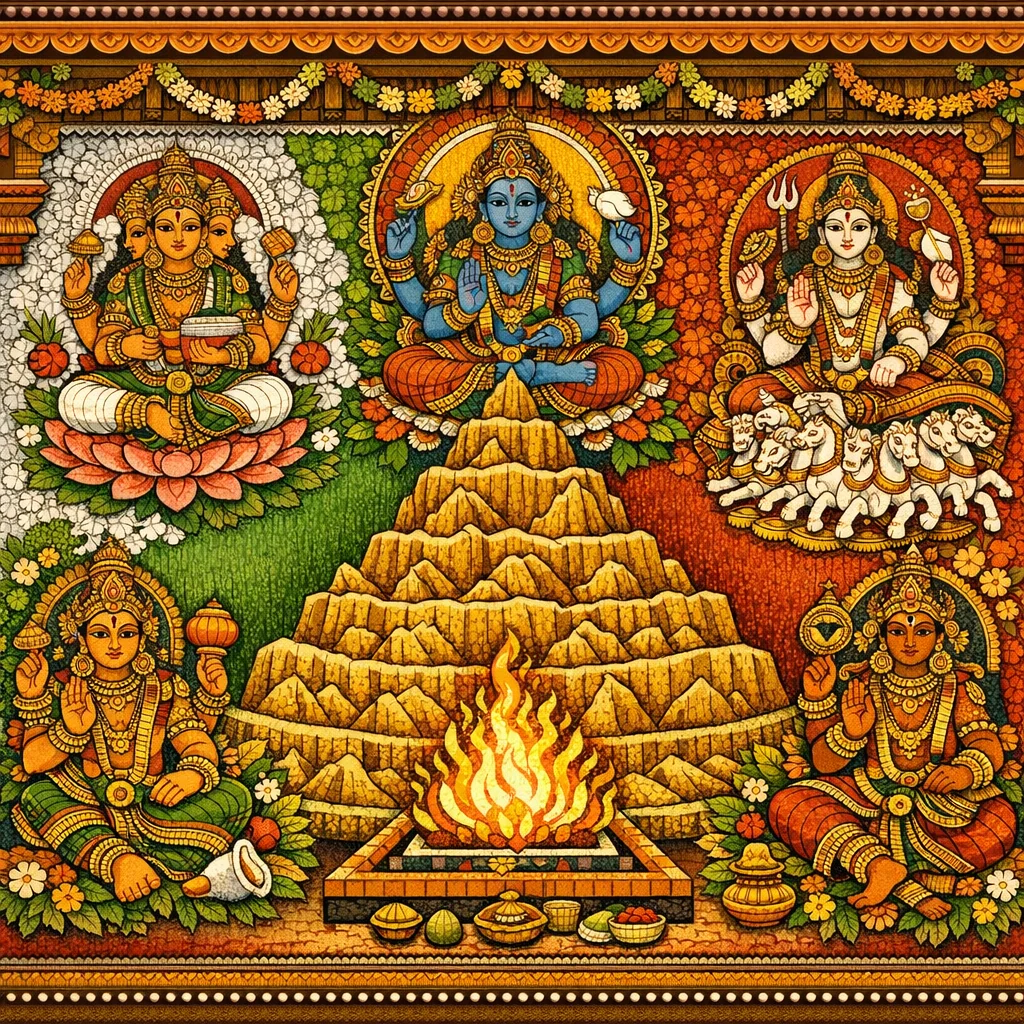
Adhyaya 83: The Rite and Glory of Meru-Dāna: The Tenfold ‘Gift of Meru’ and Mountain-Offerings
मेरुदानविधानम् (मेरुदान-माहात्म्यं च)
Speaker: Nārada, Umāpati (Śiva)
Nārada asks for the supreme glory of charity that yields imperishable merit in the next world. Umāpati teaches Meru-dāna as a tenfold rite of mountain-shaped gifts: he names the ten “mountains,” assigns auspicious tithis and cosmic junctions, and details the procedure—maṇḍapa orientation, ground purification, spreading kuśa, measured heaps (droṇas), Meru’s gem-and-metal symbolism, installation of major deities and the eight Lokapālas, canopy and garlands, and attendant mountains such as Mandara, Gandhamādana, Tilācala, and others. He adds homa, night vigil, and āvāhana prayers that proclaim the mountain a divine sanctuary of the gods. The chapter ends with gifting rules for guru and priests, cow-dāna counts according to means, fasting disciplines, the teaching “food is Brahman,” and the fruits of heaven and later kingship.
Key Concepts
Shlokas in Adhyaya 83
Verse 1
*नारद उवाच भगवञ्छ्रोतुमिच्छामि दानमाहात्म्यमुत्तमम् यदक्षयं परे लोके देवर्षिगणपूजितम् //
Nārada said: O Blessed Lord, I wish to hear the highest glory of charity (dāna)—that which yields imperishable merit in the world beyond and is revered by the hosts of divine sages.
Verse 2
*उमापतिरुवाच मेरोः प्रदानं वक्ष्यामि दशधा मुनिपुंगव यत्प्रदानान्नरो लोकान् आप्नोति सुरपूजितान् //
Umāpati said: O best of sages, I shall describe the tenfold offering known as the “gift of Meru”; by making that gift, a man attains worlds that are honored and worshipped by the gods.
Verse 3
पुराणेषु च वेदेषु यज्ञेष्वायतनेषु च न तत्फलमधीतेषु कृतेष्विह यदश्नुते //
In the Purāṇas and the Vedas, in sacrifices and in sacred abodes (temples), the fruit is not equal to what one truly attains here through genuine study and due performance.
Verse 4
तस्माद्विधानं वक्ष्यामि पर्वतानामनुक्रमात् प्रथमो धान्यशैलः स्याद् द्वितीयो लवणाचलः //
Therefore, I shall explain—in due sequence—the arrangement and classification of the mountains: the first is called Dhānya-śaila (the Grain Mountain), and the second is Lavaṇācala (the Salt Mountain).
Verse 5
गुडाचलस्तृतीयस्तु चतुर्थो हेमपर्वतः पञ्चमस्तिलशैलः स्यात् षष्ठः कार्पासपर्वतः //
The third is Guḍācala; the fourth is Hemaparvata (the Golden Mountain). The fifth is called Tilaśaila (the Sesame Mountain), and the sixth is Kārpāsaparvata (the Cotton Mountain).
Verse 6
सप्तमो घृतशैलश्च रत्नशैलस्तथाष्टमः राजतो नवमस्तद्वद् दशमः शर्कराचलः //
The seventh is the Ghee Mountain; the eighth is the Jewel Mountain. The ninth is the Silver Mountain; and likewise, the tenth is the Sugar Mountain.
Verse 7
वक्ष्ये विधानमेतेषां यथावदनुपूर्वशः अयने विषुवे पुण्ये व्यतीपाते दिनक्षये //
I shall now explain, in due order and exactly as prescribed, the proper procedure for these rites—(to be observed) at the solstices, at the equinoxes, on the meritorious Vyatīpāta, and at the close of the day.
Verse 8
शुक्लपक्षे तृतीयायाम् उपरागे शशिक्षये विवाहोत्सवयज्ञेषु द्वादश्यामथ वा पुनः //
In the bright fortnight, on the third lunar day, and again at the time of an eclipse—when the Moon is waning—these times are prescribed for marriage-rites, festive celebrations, and sacrificial ceremonies; likewise, the twelfth lunar day too is again recommended.
Verse 9
शुक्लायां पञ्चदश्यां वा पुण्यर्क्षे वा विधानतः धान्यशैलादयो देया यथाशास्त्रं विजानता //
On the fifteenth day of the bright fortnight (the full moon), or under an auspicious lunar mansion, one who knows the śāstric injunctions should, in the proper prescribed manner, bestow gifts such as the “mountain of grain” and other ordained donations.
Verse 10
तीर्थेष्वायतने वापि गोष्ठे वा भवनाङ्गणे मण्डपं कारयेद्भक्त्या चतुरस्रमुदङ्मुखम् प्रागुदक्प्रवणं तद्वत् प्राङ्मुखं च विधानतः //
At a tīrtha, in a sanctuary, within the precinct of a cattle-shed, or in a house courtyard, one should devoutly have a maṇḍapa constructed—square in plan and facing north. It should slope toward the east and toward water; likewise, according to rule, it may also be made to face east.
Verse 11
गोमयेनानुलिप्तायां भूमावास्तीर्य वै कुशान् तन्मध्ये पर्वतं कुर्याद् विष्कम्भपर्वतान्वितम् //
On ground smeared with cow-dung, one should spread kuśa grass; in its midst one should construct a raised mound, furnished with the prescribed breadth and dimensions.
Verse 12
धान्यद्रोणसहस्रेण भवेद्गिरिरिहोत्तमः मध्यमः पञ्चशतिकः कनिष्ठः स्यात् त्रिभिः शतैः //
Here, a mountain-like heap of grain is deemed best when it amounts to a thousand droṇas; a middling one is five hundred; and the least is three hundred (droṇas).
Verse 13
मेरुर्महाव्रीहिमयस्तु मध्ये सुवर्णवृक्षत्रयसंयुतः स्यात् पूर्वेण मुक्ताफलवज्रयुक्तो याग्येन गोमेदकपुष्परागैः //
In the center, Mount Meru is said to be fashioned from great heaps of rice and furnished with three golden trees. On its eastern side it is adorned with pearls and diamonds; on its southern side with gomeda gems and puṣparāga (topaz).
Verse 14
पश्चाच्च गारुत्मतनीलरत्नैः सौम्येन वैदूर्यसरोजरागैः श्रीखण्डखण्डैरभितः प्रवालैर् लतान्वितः शुक्तिशिलातलः स्यात् //
Further, on the western side, let the surface be a floor of pearl-oyster stone, adorned with garuḍa-like blue gems, gentle-hued cat’s-eye and ruby, set with pieces of sandalwood, and bordered on all sides with coral, embellished with creeper-like motifs.
Verse 15
ब्रह्माथ विष्णुर्भगवान्पुरारिर् दिवाकरो ऽप्यत्र हिरण्मयः स्यात् मूर्धन्यवस्थानममत्सरेण कार्यं त्वनेकैश्च पुनर्द्विजौघैः //
Here, Brahmā, Lord Viṣṇu, Purāri (Śiva), and even the Sun are to be fashioned in gold. Their installation in the foremost honoured position should be done without jealousy, and it is again to be carried out by many groups of twice-born priests.
Verse 16
चत्वारि शृङ्गाणि च राजतानि नितम्बभागेष्वपि राजतः स्यात् तथेक्षुवंशावृतकन्दरस्तु घृतोदकप्रस्रवणैश्च दिक्षु //
It has four peaks made of silver; even its lower slopes gleam with silver. Its ravines are encircled by thickets of sugarcane, and in every direction streams of ghee and water flow forth.
Verse 17
शुक्लाम्बराण्यम्बुधरावली स्यात् पूर्वेण पीतानि च दक्षिणेन वासांसि पश्चादथ कर्बुराणि रक्तानि चैवोत्तरतो घनाली //
In the east there should be a massing like a line of rain-clouds, with white garments; in the south, yellow garments; in the west, variegated garments; and in the north, red garments—thus is the prescribed arrangement.
Verse 18
रौप्यान्महेन्द्रप्रमुखांस् तथाष्टौ संस्थाप्य लोकाधिपतीन्क्रमेण नानाफलाली च समन्ततः स्यान् मनोरमं माल्यविलेपनं च //
Then, fashioning them in silver, one should install in due order the eight world-guardians beginning with Mahendra (Indra). All around there should be rows of diverse fruits, along with delightful garlands and fragrant unguents for anointing.
Verse 19
वितानकं चोपरि पञ्चवर्णम् अम्लानपुष्पाभरणं सितं च इत्थं निवेश्यामरशैलमग्र्यं मेरोस्तु विष्कम्भगिरीन् क्रमेण //
Above it one should place a five-coloured canopy, and adorn it with white garlands of unfading flowers. Thus, having duly set up the foremost divine mountain, Amaraśaila, one should then arrange in proper sequence the supporting mountains of Meru.
Verse 20
तुरीयभागेण चतुर्दिशं च संस्थापयेत्पुष्पविलेपनाढ्यान् पूर्वेण मन्दरमनेकफलावलीभिर् युक्तं यवैः कनकभद्रकदम्बचिह्नैः //
Dividing the ground into four parts, one should arrange in the four directions the auspicious offerings, richly provided with flowers and unguents. On the eastern side one should set the ‘Mandara’ arrangement, adorned with clusters of many fruits, together with barley grains (yava), and marked with the auspicious emblems of kanaka, bhadraka, and kadamba.
Verse 21
कामेन काञ्चनमयेन विराजमानम् आकारयेत्कुसुमवस्त्रविलेपनाढ्यम् क्षीरारुणोदसरसाथ वनेन चैवं रौप्येण शक्तिघटितेन विराजमानम् //
One should have it fashioned so that it shines in gold, richly adorned with flowers, garments, and unguents. Likewise, it may be made to appear with a milky-white or reddish hue, and also in silver—resplendent and firmly constructed with proper strength.
Verse 22
याम्येन गन्धमदनश्च निवेशनीयो गोधूमसंचयमयः कलधौतयुक्तः हैमेन यज्ञपतिना घृतमानसेन वस्त्रैश्च राजतवनेन च संयुतः स्यात् //
On the southern side one should place Gandhamadana, fashioned as a heap of wheat (godhūma) and adorned with kaladhauta (fine gold). It should be accompanied by a golden yajñapati, the lord of the sacrifice, with ghee (ghṛta) represented as his disposition/offering, and furnished with garments and a silver grove as ornamentation.
Verse 23
पश्चात् तिलाचलम् अनेकसुगन्धिपुष्पसौवर्णपिप्पलहिरण्मयहंसयुक्तम् आकारयेद्रजतपुष्पवनेन तद्वद् वस्त्रान्वितं दधिसितोदसरस् तथाग्रे //
Thereafter, to the rear one should fashion Tilācala (the Sesame Mountain), adorned with many fragrant flowers, with a golden pippala (aśvattha) tree, and furnished with golden swans. Likewise, one should arrange a grove of silver flowers; and in front of it, a lake whose water is white as curd (dadhi), adorned with cloth ornaments (hangings/coverings).
Verse 24
संस्थाप्य तं विपुलशैलमथोत्तरेण शैलं सुपार्श्वमपि माषमयं सुवस्त्रम् पुष्पैश्च हेमवटपादपशेखरं तम् आकारयेत् कनकधेनुविराजमानम् //
Having installed that great stone as a seat, one should then place to its north another stone as a well-proportioned side-support, together with fine cloth and an offering of black gram. Adorn it with flowers and a golden ornament at the feet, and fashion it so that it shines like a golden cow.
Verse 25
माक्षीकभद्रसरसाथ वनेन तद्वद् रौप्येण भास्वरवता च युतं विधाय होमश्चतुर्भिरथ वेदपुराणविद्भिर् दान्तैर् अनिन्द्यचरिताकृतिभिर्द्विजेन्द्रैः //
Then, having duly prepared it with mākṣīka, bhadra, and sarasa—fragrant substances—together with forest-offerings, and likewise combining it with bright, shining silver, one should have the homa performed by four eminent Brahmins: self-controlled men, versed in the Vedas and Purāṇas, whose conduct and character are beyond reproach.
Verse 26
पूर्वेण हस्तमितमत्र विधाय कुण्डं कार्यस्तिलैर्यवघृतेन समित्कुशैश्च रात्रौ च जागरमनुद्धतगीततूर्यैर् आवाहनं च कथयामि शिलोच्चयानाम् //
Here, on the eastern side, one should construct a kuṇḍa (fire-pit) measuring one cubit. It is to be prepared with sesame, barley, and ghee, along with fuel-sticks and kuśa grass. One should keep a night-long vigil with restrained singing and instrumental music; and now I shall explain the rite of invocation (āvāhana) for the śiloccaya, the stone-heaps/stone-structures.
Verse 27
त्वं सर्वदेवगणधामनिधे विरुद्धम् अस्मद्गृहेष्वमरपर्वत नाशयाशु क्षेमं विधत्स्व कुरु शान्तिमनुत्तमां नः सम्पूजितः परमभक्तिमता मया हि //
O abode and treasure-house of the hosts of all gods, O divine mountain, swiftly destroy whatever is hostile within our homes. Establish welfare and safety; grant us unsurpassed peace, for I have worshipped you with the highest devotion.
Verse 28
त्वमेव भगवानीशो ब्रह्मा विष्णुर्दिवाकरः मूर्तामूर्तात्परं बीजम् अतः पाहि सनातन //
You alone are the Blessed Lord, the Supreme Ruler—Brahmā, Viṣṇu, and the Sun. You are the transcendent seed beyond both the manifest and the unmanifest; therefore protect us, O Eternal One.
Verse 29
यस्मात्त्वं लोकपालानां विश्वमूर्तेश्च मन्दिरम् रुद्रादित्यवसूनां च तस्माच्छान्तिं प्रयच्छ मे //
Because you are the temple—the abiding sanctuary—of the Lokapālas, of the Cosmic-Formed Lord (Viśvamūrti), and also of the Rudras, Ādityas, and Vasus, therefore grant me peace.
Verse 30
यस्मादशून्यममरैर् नारीभिश्च शिवेन च तस्मान्माम् उद्धराशेषदुःखसंसारसागरात् //
Since that realm is never empty—being filled with the immortals, with divine women, and with Śiva—therefore lift me up and deliver me from the ocean of worldly existence, an ocean made of unending sorrow.
Verse 31
एवमभ्यर्च्य तं मेरुं मन्दरं चाभिपूजयेत् यस्माच्चैत्ररथेन त्वं भद्राश्वेन च वर्षतः //
Thus, having duly worshipped Mount Meru, one should also offer reverent worship to Mount Mandara—because you are associated with the Varṣa regions called Caitraratha and Bhadrāśva.
Verse 32
शोभसे मन्दर क्षिप्रम् अतस्तुष्टिकरो भव यस्माच्चूडामणिर्जम्बूद्वीपे त्वं गन्धमादन //
O Mandara, you shine forth swiftly; therefore become the bestower of satisfaction. For you, O Gandhamādana, are the crest-jewel (cūḍāmaṇi) of Jambūdvīpa.
Verse 33
गन्धर्ववनशोभावान् अतः कीर्तिर्दृढास्तु मे यस्मात्त्वं केतुमालेन वैभ्राजेन वनेन च //
Because you are adorned by the splendor of the Gandharva-forest—by Ketumāla and by the radiant Vaibhrāja grove—therefore may my fame become firm and enduring.
Verse 34
हिरण्मयाश्वत्थशिरास् तस्मात्पुष्टिर्ध्रुवास्तु मे उत्तरैः कुरुभिर्यस्मात् सावित्रेण वनेन च //
Having the golden aśvattha (the sacred fig) as its crest or chief emblem, therefore may prosperity be steadfast for me—since this is sanctified by the Northern Kurus and also by the Savitrī-forest.
Verse 35
सुपार्श्व राजसे नित्यम् अतः श्रीरक्षयास्तु मे एवमामन्त्र्य तान्सर्वान् प्रभाते विमले पुनः //
O King Supārśva, may prosperity ever abide with you; therefore may good fortune protect me as well. Having thus taken leave of them all, he again set forth at the pure, clear morning.
Verse 36
स्नात्वाथ गुरवे दद्यान् मध्यमं पर्वतोत्तमम् विष्कम्भपर्वतान्दद्याद् ऋत्विग्भ्यः क्रमशो मुने //
After bathing, one should present to the guru the “middle” portion of the excellent Parvata-offering; and then, O sage, one should give the Viṣkambha-parvatas to the officiating priests (ṛtvij) in due order.
Verse 37
गाश्च दद्याच्चतुर्विंशत् यथवा दश नारद नव सप्त तथाष्टौ वा पञ्च दद्याद् अशक्तिमान् //
One should donate cows—twenty-four; or else ten, O Nārada; or nine, seven, or eight; and if one lacks the means, one may give five.
Verse 38
एकापि गुरवे देया कपिला च पयस्विनी पर्वतानामशेषाणाम् एष एव विधिः स्मृतः //
Even a single kapilā (tawny) cow, rich in milk, should be given to one’s teacher; and for all the “mountain” offerings without exception, this alone is remembered as the proper rule of gifting.
Verse 39
त एव पूजने मन्त्रास् त एवोपस्करा मताः ग्रहाणां लोकपालानां ब्रह्मादीनां च सर्वदा //
Those very (items) are regarded as the mantras for worship, and those very (items) are also considered the ritual implements—always—for the Grahas (planets), the Lokapālas (Guardians of the Directions), and for Brahmā and the other deities.
Verse 40
स्वमन्त्रेणैव सर्वेषु होमः शैलेषु पठ्यते उपवासी भवेन्नित्यम् अशक्ते नक्तमिष्यते //
In all such cases, the fire-offering (homa) is to be performed using only one’s own prescribed mantra; this rule is taught for the sacred hill-shrines. One should regularly keep a fast; but if one is unable, eating only at night is permitted.
Verse 41
विधानं सर्वशैलानां क्रमशः शृणु नारद दानकाले च ये मन्त्राः पर्वतेषु च यत्फलम् //
Listen in due order, O Nārada, to the complete procedure for (donating) all sacred mountains—together with the mantras to be recited at the time of gifting, and the spiritual results obtained from each mountain-gift.
Verse 42
अन्नं ब्रह्म यतः प्रोक्तम् अन्ने प्राणाः प्रतिष्ठिताः अन्नाद्भवन्ति भूतानि जगदन्नेन वर्तते //
Food is declared to be Brahman, for the vital breaths (prāṇas) are established in food. From food beings come into existence, and by food the whole world is sustained.
Verse 43
अन्नमेव ततो लक्ष्मीर् अन्नमेव जनार्दनः धान्यपर्वतरूपेण पाहि तस्मान्नगोत्तम //
Therefore, food itself is Lakṣmī, and food itself is Janārdana (Viṣṇu). Hence, O best of mountains, protect (the world) in the form of a mountain of grain.
Verse 44
अनेन विधिना यस्तु दद्याद्धान्यमयं गिरिम् मन्वन्तरशतं साग्रं देवलोके महीयते //
Whoever, in accordance with this prescribed rite, donates a “mountain” made of grain is honored in the world of the gods for a full hundred Manvantaras and even beyond.
Verse 45
अप्सरोगणगन्धर्वैर् आकीर्णेन विराजता विमानेन दिवः पृष्ठम् आयाति स्म निषेवित धर्मक्षये राजराज्यम् आप्नोतीह न संशयः //
Adorned with a radiant celestial chariot, crowded with hosts of Apsarases and Gandharvas, he reaches the heights of heaven. And when that merit of dharma is exhausted, he attains sovereign kingship on earth—of this there is no doubt.
Frequently Asked Questions
The chapter teaches Meru-dāna as a supreme form of charity: constructing symbolic ‘mountains’ (especially a grain-Meru) in a ritually prepared maṇḍapa, installing deities and Lokapālas, performing homa and invocation, and then gifting the entire consecrated setup—along with cows and dakṣiṇā—to guru and priests to gain akṣaya-puṇya, peace (śānti), and exalted posthumous and worldly results.
Primarily Dharma (dāna-dharma and ritual duty). It also contains Vāstu-like ritual architecture: maṇḍapa plan (square), orientation (north/east), slope rules, quadrant-based placement, and measured construction of heaps and kuṇḍa. Genealogy/creation narratives are not the focus in this adhyāya.
Dhānya-śaila (grain), Lavaṇācala (salt), Guḍācala (jaggery), Hema-parvata (gold), Tila-śaila (sesame), Kārpāsa-parvata (cotton), Ghṛta-śaila (ghee), Ratna-śaila (jewels), Rājata-parvata (silver), and Śarkarā-acala (sugar).
A ‘mountain-like heap’ of grain is best at 1000 droṇas, middling at 500 droṇas, and least at 300 droṇas.
Solstices (ayana), equinoxes (viṣuva), the meritorious Vyatīpāta, day’s end, bright fortnight tṛtīyā, eclipse time during lunar waning, and also dvādaśī; alternatively on full moon (śukla-pañcadaśī) or under an auspicious nakṣatra.