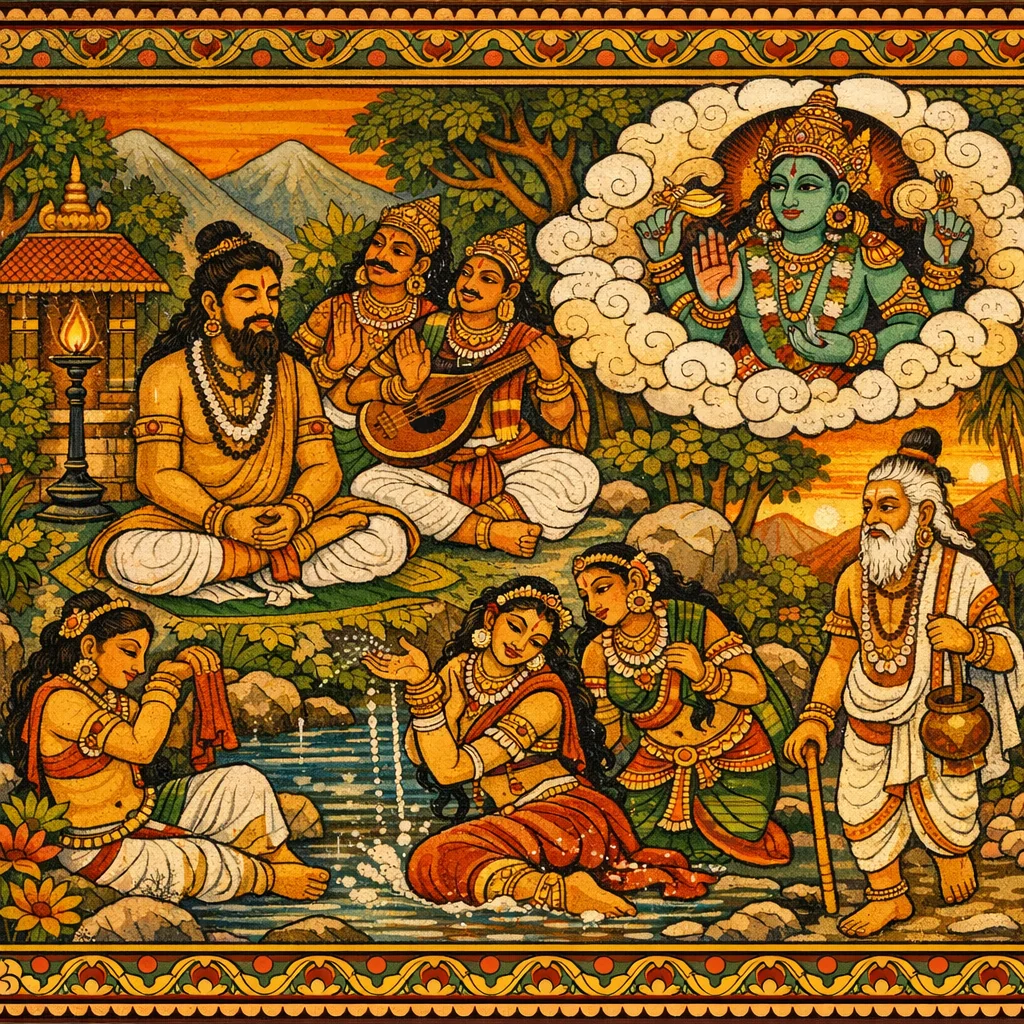
Adhyaya 120: Purūravas Witnesses the Sports of Apsarases and Gandharvas; Attains the Grace of Janārdana
पुरूरवसोऽप्सरोगन्धर्वक्रीडादर्शनं जनार्दनप्रसादप्राप्तिश्च
Speaker: Suta (narrator), Pururavas (king), Gandharvas and Apsarases (celestial hosts), Janardana/Keshava (via dream-oracle), Sage Atri
Continuing the Purūravas episode, Sūta tells how the king, practicing renunciation and austerity, beholds the Apsarases’ and Gandharvas’ flower and water sports, their music, and their twilight dance of worship to Janārdana. The celestial hosts offer boons, but the king asks only for Madhusūdana’s prasāda. He worships Janārdana for a month, then enters a gem-adorned hermitage and sustains himself on water until the bright fortnight of Phālguna ends. In a dream the God of gods declares that when the night has passed Purūravas will meet Sage Atri and become kṛtakṛtya, one whose purpose is fulfilled. At dawn the king bathes and worships, beholds Atri, recounts the dream, hears the deities’ confirming words, performs deva-arcana and homa, and attains his desired aims through Keśava’s grace.
Key Concepts
Shlokas in Adhyaya 120
Verse 1
स त्वाश्रमपदे रम्ये त्यक्ताहारपरिच्छदः क्रीडाविहारं गन्धर्वैः पश्यन्नप्सरसां सह //
There, in that delightful hermitage setting, he—having renounced food and all belongings—watched the revelry and sportive amusements of the Apsarases together with the Gandharvas.
Verse 2
कृत्वा पुष्पोच्चयं भूरि ग्रन्थयित्वा तथा स्रजः अग्रं निवेद्य देवाय गन्धर्वेभ्यस्तदा ददौ //
Having gathered a great heap of flowers and strung them into garlands, he first offered the finest portion to the deity; thereafter he gave the remainder to the Gandharvas.
Verse 3
पुष्पोच्चयप्रसक्तानां क्रीडन्तीनां यथासुखम् चेष्टा नानाविधाकाराः पश्यन्नपि न पश्यति //
Even while looking, one does not truly see—just as those absorbed in gathering flowers, playing at ease, move about in many different ways, yet remain inattentive to what is before them.
Verse 4
काचित्पुष्पोच्चये सक्ता लताजालेन वेष्टिता सखीजनेन संत्यक्ता कान्तेनाभिसमुज्झिता //
A certain woman, absorbed in gathering flowers, became entangled in a net of creepers—abandoned by her circle of friends and cast off even by her beloved.
Verse 5
काचित्कमलगन्धाभा निःश्वासपवनाहृतैः मधुपैराकुलमुखी कान्तेन परिमोचिता //
One woman, fragrant like a lotus, had her face disturbed by bees drawn in by the breeze of her breath; she was then gently freed from them by her beloved.
Verse 6
मकरन्दसभाक्रान्तनयना काचिदङ्गना कान्तनिःश्वासवातेन नीरजस्ककृतेक्षणा //
A certain lovely woman’s eyes were overcome as though by a whole assembly of flower-honey; and by the breeze of her beloved’s sighs, her lotus-like gaze was made free of dust—clearer and more lustrous.
Verse 7
काचिद् उच्चीय पुष्पाणि ददौ कान्तस्य भामिनी कान्तसंग्रथितैः पुष्पै रराज कृतशेखरा //
One passionate young woman gathered flowers and offered them to her beloved; and with those flowers, strung together by her lover, she shone—her hair adorned with a newly made floral crest.
Verse 8
उच्चीय स्वयम् उद्ग्रथ्य कान्तेन कृतशेखरा कृतकृत्यमिवात्मानं मेने मन्मथवर्धिनी //
Raising her hair and braiding it with her own hands, and with her beloved arranging the crest-ornament upon her head, the woman—who heightened the power of Kāmadeva—deemed herself as though her purpose had been fulfilled.
Verse 9
अस्त्वस्मिन्गहने कुञ्जे विशिष्टकुसुमा लता काचिदेवं रहो नीता रमणेन रिरंसुना //
In this dense woodland bower there was a certain creeper adorned with exquisite blossoms; thus, in secret, she was led away by her lover, who longed to delight in the pleasures of love.
Verse 10
कान्तसंनामितलता कुसुमानि विचिन्वती सर्वाभ्यः काचिदात्मानं मेने सर्वगुणाधिकम् //
While gathering flowers from a creeper bent down by her beloved, a certain woman considered herself superior to all others, endowed with virtues surpassing everyone.
Verse 11
काश्चित्पश्यति भूपालं नलिनीषु पृथक्पृथक् क्रीडमानास्तु गन्धर्वैर् देवरामा मनोरमाः //
Some celestial maidens behold the king, while others—separately, here and there among the lotus-pools—charmingly sport with the Gandharvas, those delightful women of heaven.
Verse 12
काचिद् आताडयत् कान्तम् उदकेन शुचिस्मिता ताड्यमानाथ कान्तेन प्रीतिं काचिदुपाययौ //
A certain woman, smiling with bright purity, splashed her beloved with water; and though her lover struck back in return, she only grew more delighted.
Verse 13
कान्तं च ताडयामास जातखेदा वराङ्गना अदृश्यत वरारोहा श्वासनृत्यत्पयोधरा //
The beautiful woman, overcome with distress, even struck her beloved; then the lovely lady vanished from sight, her bosom heaving as her breath rose and fell like a dance.
Verse 14
कान्ताम्बुताडनाकृष्टकेशपाशनिबन्धना केशाकुलमुखी भाति मधुपैरिव पद्मिनी //
With her hair-tresses bound up after being pulled by the splashing of her beloved’s water-play, her face slightly dishevelled with loosened locks, she shines—like a lotus-pond surrounded by bees.
Verse 15
स्वचक्षुःसदृशैः पुष्पैः संछन्ने नलिनीवने छन्ना काचिच् चिरात्प्राप्ता कान्तेनान्विष्य यत्नतः //
In a lotus-grove thickly covered with blossoms like her own eyes, a certain woman lay hidden; after a long while, her beloved—searching with great effort—found her at last.
Verse 16
स्नाता शीतापदेशेन काचित्प्राहाङ्गना भृशम् रमणालिङ्गनं चक्रे मनो ऽभिलषितं चिरम् //
Having bathed on the pretext of feeling cold, a certain woman then spoke insistently and embraced her lover—fulfilling a longing her mind had cherished for a long time.
Verse 17
जलार्द्रवसनं सूक्ष्मम् अङ्गलीनं शुचिस्मिता धारयन्ती जनं चक्रे काचित् तत्र समन्मथम् //
There, a certain woman—smiling with a pure, bright smile—wore a fine, water-damp garment clinging to her limbs; by displaying it she stirred the people into amorous excitement.
Verse 18
कण्ठमाल्यगुणैः काचित् कान्तेन कृष्यताम्भसि त्रुट्यत्स्रग्दामपतितं रमणं प्राहसच्चिरम् //
A certain woman, playfully drawn into the water by her beloved by the cords of the garland-necklace at her throat, laughed for a long while when the lover slipped and fell as the garland-cord snapped.
Verse 19
काचिद्भुग्ना सखीदत्तजानुदेशे नखक्षता संभ्रान्ता कान्तशरणं मग्ना काचिद्गता चिरम् //
One maiden, bending down, bore nail-marks upon the place of her knee where her companion had set it; startled, she sank into her lover’s protection. Another had gone away for a long while.
Verse 20
काचित्पृष्ठकृतादित्या केशनिस्तोयकारिणी शिलातलगता भर्त्रा दृष्टा कामार्तचक्षुषा //
A certain woman, with the sun at her back, stood upon a stone slab letting water drip from her loosened hair; her husband beheld her then with eyes troubled by desire.
Verse 21
कृत्तमाल्यं विलुलितं संक्रान्तकुचकुङ्कुमम् रतिक्रीडितकान्तेव रराज तत्सरोदकम् //
That lake-water shone, strewn with severed garlands, tousled and disarrayed, and tinged with the saffron kunkuma from women’s breasts—like a beloved woman after amorous play.
Verse 22
सुस्नातदेवगन्धर्वदेवरामागणेन च पूज्यमानं च ददृशे देवदेवं जनार्दनम् //
He beheld Janārdana—the God of gods—being worshipped by hosts of devas and gandharvas, all purified by sacred bathing and adorned with divine fragrances.
Verse 23
क्वचिच् च ददृशे राजा लतागृहगताः स्त्रियः मण्डयन्तीः स्वगात्राणि कान्तसंन्यस्तमानसाः //
And in one place the king beheld women within vine-covered bowers, adorning their own bodies, their minds wholly fixed upon their beloved.
Verse 24
काचिद् आदर्शनकरा व्यग्रा दूतीमुखोद्गतम् शृण्वती कान्तवचनम् अधिका तु तथा बभौ //
One lady, holding a mirror in her hand, listened intently to her beloved’s words as they issued from the messenger’s mouth; in that very moment her agitation only grew stronger.
Verse 25
काचित् सत्वरिता दूत्या भूषणानां विपर्ययम् कुर्वाणा नैव बुबुधे मन्मथाविष्टचेतना //
One woman, hurried along by her role as a go-between, absentmindedly put her ornaments on the wrong way round; her mind, seized by Manmatha, the god of love, did not notice it at all.
Verse 26
वायुनुन्नातिसुरभिकुसुमोत्करमण्डिते काचित्पिबन्ती ददृशे मैरेयं नीलशाद्वले //
In that blue-green grassy meadow, adorned with heaps of exquisitely fragrant blossoms stirred by the breeze, a certain woman was seen drinking maireya, a sweet intoxicating liquor.
Verse 27
पाययामास रमणं स्वयं काचिद्वराङ्गना काचित्पपौ वरारोहा कान्तपाणिसमर्पितम् //
One noble lady herself made her beloved drink; another fair-thighed woman drank what was offered by her lover’s own hand.
Verse 28
काचित्स्वनेत्रचपलनीलोत्पलयुतं पयः पीत्वा पप्रच्छ रमणं क्व गते ते ममोत्पले //
A certain woman, whose restless eyes were like blue lotuses, having drunk milk, asked her beloved: “Where have you gone, my lotus-eyed one?”
Verse 29
त्वयैव पीतौ तौ नूनम् इत्युक्ता रमणेन सा तथा विदित्वा मुग्धत्वाद् बभूव व्रीडिता भृशम् //
Thus addressed by her beloved—“Surely, it was you who drank those two”—she, realizing her own naïve folly, became intensely ashamed.
Verse 30
काचित्कान्तार्पितं सुभ्रूः कान्तपीतावशेषितम् सविशेषरसं पानं पपौ मन्मथवर्धनम् //
A certain fair-browed woman drank a beverage offered by her beloved—what remained after he had sipped it—rich with a distinctive flavor, a draught that heightened the power of Kāma (desire).
Verse 31
आपानगोष्ठीषु तथा तासां स नरपुंगवः शुश्राव विविधं गीतं तन्त्रीस्वरविमिश्रितम् //
And in those drinking-assemblies, that bull among men listened to their many kinds of songs, blended with the tones of stringed instruments.
Verse 32
प्रदोषसमये ताश्च देवदेवं जनार्दनम् राजन्सदोपनृत्यन्ति नानावाद्यपुरःसराः //
O King, at the time of pradoṣa (evening twilight), those celestial women continually dance in worship before Janārdana, the God of gods, accompanied by many kinds of musical instruments.
Verse 33
याममात्रे गते रात्रौ विनिर्गत्य गुहामुखात् आवसन्संयुताः कान्तैः परर्द्धिरचितां गुहाम् //
When a single watch of the night had passed, they came out from the mouth of the cave and then dwelt—together with their beloved companions—in a grotto fashioned with surpassing splendor.
Verse 34
नानागन्धान्वितलतां नानागन्धसुगन्धिनीम् नानाविचित्रशयनां कुसुमोत्करमण्डिताम् //
Adorned with creepers rich in many fragrances, sweet-smelling with a variety of perfumes, furnished with many kinds of ornate resting-places, and embellished with heaps of flowers.
Verse 35
एवम् अप्सरसां पश्यन् क्रीडितानि स पर्वते तपस्तेपे महाराजन् केशवार्पितमानसः //
Thus, even while watching the playful sports of the Apsarases, he performed austerities upon the mountain, O great king, with his mind wholly offered to Keśava (Viṣṇu).
Verse 36
तमूचुर्नृपतिं गत्वा गन्धर्वाप्सरसां गणाः राजन्स्वर्गोपमं देशम् इमं प्राप्तो ऽस्यरिंदम //
Approaching the king, the hosts of Gandharvas and Apsarases said: “O King, tamer of foes, you have reached this land that is like heaven.”
Verse 37
वयं हि ते प्रदास्यामो मनसः काङ्क्षितान्वरान् तानादाय गृहं गच्छ तिष्ठेह यदि वा पुनः //
“Indeed, we shall grant you the boons your mind desires. Having received them, go to your home—or remain here, if you wish.”
Verse 38
*राजोवाच अमोघदर्शनाः सर्वे भवन्तस्त्वमितौजसः वरं वितरताद्यैव प्रसादं मधुसूदनात् //
The King said: “All of you possess unfailing vision and immeasurable might. Therefore grant me, this very day, a boon—namely, the gracious favor of Madhusūdana (Viṣṇu).”
Verse 39
एवमस्त्वित्यथोक्तस्तैः स तु राजा पुरूरवाः तत्रोवास सुखी मासं पूजयानो जनार्दनम् //
They replied, “So be it.” Thereupon King Purūravas stayed there happily for a month, worshipping Janārdana (Viṣṇu).
Verse 40
प्रिय एव सदैवासीद् गन्धर्वाप्सरसां नृपः तुतोष स जनो राज्ञस् तस्यालौल्येन कर्मणा //
O king, he was ever dear to the Gandharvas and Apsarases; and the people too were pleased with that ruler, for his deeds were steady and free from fickleness.
Verse 41
मासस्य मध्ये स नृपः प्रविष्टस्तदाश्रमं रत्नसहस्रचित्रम् / तोयाशनस्तत्र ह्युवास मासं यावत्सितान्तो नृप फाल्गुनस्य //
Midway through the month, the king entered that hermitage, wondrously adorned with thousands of gems. There, taking only water as his sustenance, he stayed a full month—until the end of the bright fortnight of Phālguna, O king.
Verse 42
फाल्गुनामलपक्षान्ते राजा स्वप्ने पुरूरवाः तस्यैव देवदेवस्य श्रुतवान्गदितं शुभम् //
At the close of the bright fortnight of Phālguna, King Purūravas, in a dream, heard the auspicious words spoken by that very God of gods.
Verse 43
रात्र्यामस्यां व्यतीतायाम् अत्रिणा त्वं समेष्यसि तेन राजन्समागम्य कृतकृत्यो भविष्यसि //
When this night has passed, you will meet the sage Atri; and, O King, upon meeting him, you will become one whose purpose is fulfilled.
Verse 44
स्वप्नमेवं स राजर्षिर् दृष्ट्वा देवेन्द्रविक्रमः प्रत्यूषकाले विधिवत् स्नातः स प्रयतेन्द्रियः //
Having thus seen the dream, that royal sage—mighty like Indra—bathed at the pre-dawn hour according to proper rule, with his senses restrained and disciplined.
Verse 45
कृतकृत्यो यथाकामं पूजयित्वा जनार्दनम् ददर्शात्रिं मुनिं राजा प्रत्यक्षं तपसां निधिम् //
Having fulfilled his duties and, as he wished, worshipped Janārdana, the king then beheld the sage Atri—manifest before his eyes—an actual treasury of ascetic power.
Verse 46
स्वप्नं तु देवदेवस्य न्यवेदयत धार्मिकः ततः शुश्राव वचनं देवतानां समीरितम् //
The righteous one reported the dream to the Lord of gods; then he heard the uttered words of the deities.
Verse 47
एवमेतन्महीपाल नात्र कार्या विचारणा एवं प्रसादं सम्प्राप्य देवदेवाज्जनार्दनात् //
So it is, O king; there is no need for deliberation here. Thus, having obtained such grace from Janārdana, the God of gods, one attains the intended good.
Verse 48
कृतदेवार्चनो राजा तथा हुतहुताशनः सर्वान्कामानवाप्तो ऽसौ वरदानेन केशवात् //
That king—having duly worshiped the gods and offered oblations into the sacred fire—attained all desired aims through the boon-giving grace of Keśava (Viṣṇu).
Frequently Asked Questions
The chapter teaches that true attainment comes from steadiness of mind and devotion, not from being swept away by sensory delights. Purūravas witnesses captivating Apsara–Gandharva pleasures, yet he keeps tapas and worship of Janārdana central. When offered any boon, he asks specifically for Madhusūdana’s prasāda, showing a bhakti-first hierarchy of goals. The narrative reinforces that disciplined practice (snāna, arcana, homa, vow-like residence) leads to divine guidance (dream-oracle) and fulfillment (meeting Atri and receiving Keśava’s boon-granting grace).
This adhyāya is primarily Dharma and Bhakti-oriented narrative (Rajadharma in the sense of royal self-control and right aim), not Vāstu-śāstra or genealogical cataloging. The text emphasizes kingly discipline (alāulya, sense-restraint), devotional worship of Viṣṇu (Janārdana/Keśava), and ritual actions (pradoṣa worship, snāna, homa). Genealogy is not the focus, though the episode belongs to the broader purāṇic-Itihāsa narrative stream involving Purūravas and rishis such as Atri.